Volume 2006, Article ID 19514, Pages1–7 DOI 10.1155/ASP/2006/19514
Computationally Efficient Direction-of-Arrival Estimation
Based on Partial A Priori Knowledge of Signal Sources
Lei Huang,1, 2Shunjun Wu,1Dazheng Feng,1and Linrang Zhang1
1National Key Laboratory for Radar Signal Processing, Xidian University, 710071 Xi’an, China 2Department of Electrical and Computer Engineering, Duke University, Durham, NC 27708-0291, USA
Received 19 January 2005; Revised 20 September 2005; Accepted 25 October 2005
Recommended for Publication by Peter Handel
A computationally efficient method is proposed for estimating the directions-of-arrival (DOAs) of signals impinging on a uniform linear array (ULA), based on partial a priori knowledge of signal sources. Unlike the classical MUSIC algorithm, the proposed method merely needs the forward recursion of the multistage Wiener filter (MSWF) to find the noise subspace and does not involve an estimate of the array covariance matrix as well as its eigendecomposition. Thereby, the proposed method is computationally efficient. Numerical results are given to illustrate the performance of the proposed method.
Copyright © 2006 Hindawi Publishing Corporation. All rights reserved.
1. INTRODUCTION
It is desired to estimate the directions-of-arrival (DOAs) of incident signals from noisy data in many areas such as communication, radar, sonar, and geophysical seismology [1]. The classical subspace-based methods, for example, the MUSIC-type [2] algorithms that rely on the decomposition of the observation space into signal subspace and noise sub-space, can provide high-resolution DOA estimates with good estimation accuracy. Normally, the classical subspace-based methods are developed without considering any knowledge of the incident signals, except for some general statistical properties like the second-order ergodicity. Nevertheless, the subspace-based methods typically involve the eigendecom-position of the array covariance matrix. As a result, these methods are rather computationally intensive, especially for large arrays.
To attain better DOA estimation accuracy and, perhaps, reduce the computational complexity, a number of algo-rithms that assume some a priori knowledge, such as the waveforms, of the incident signals have been developed in [3–9]. The assumption is reasonable in friendly communi-cations, such as wireless communications and GPS, where certain a priori knowledge of the incident signals is avail-able to the receiver. The a priori information may or may not be explicit. For example, in a packet radio communica-tion system or a mobile communicacommunica-tion system, a known preamble may be added to the message for training pur-poses. In a digital communication system, the modulation
estimation. Exploiting the received signal of the first array el-ement to initialize the multistage Wiener filter (MSWF) [12], the ROCKET algorithm only needs the forward recursion of the MSWF to find a subspace of interest and use that sub-space to calculate a rank data matrix and a reduced-rank weight vector for a reduced-reduced-rank autoregressive (AR) spectrum estimator. Given the direction or spatial frequency of one signal, the ROCK MUSIC method can find a nonuni-tary basis for the signal subspace by using the forward and backward recursions of the MSWF. The ROCKET and ROCK MUSIC algorithms do not resort to the eigendecomposition of the array covariance matrix, giving them a computational advantage. Nevertheless, the ROCK MUSIC algorithm still needs the forward and backward recursions of the MSWF, which increases the complexity of the algorithm since the backward recursion coefficients completely change with each new stage that is added. To find the reduced-rank data ma-trix and the reduced-rank AR weight vector, the ROCKET method still involves complex matrix-matrix products, im-plying that additional computational cost is incurred.
In this paper, we propose a computationally efficient method for DOA estimation, based on partial a priori knowl-edge of signal sources. Using the orthogonal property of the matched filters of the MSWF, we show that the sig-nal subspace and the noise subspace can be spanned by the matched filters. The estimated noise subspace is then ex-ploited to super-resolve the incident signals instead of using the eigendecomposition-based MUSIC method, thus reduc-ing the computational complexity of calculatreduc-ing the noise subspace. To cure coherent signals, we apply the spatial smoothing technique merely to the array data matrix and the training data vector, and therefore avoid the estimate of the array covariance matrix. Unlike the ROCKET and ROCK MUSIC techniques, the proposed method merely needs the forward recursion of the MSWF to obtain the noise subspace and does not require any complex matrix-matrix products, thereby further reducing the computational complexity of the algorithm. Compared to the classical MUSIC estimator and the fast subspace decomposition (FSD) method [13], the proposed method does not involve the estimate of the ar-ray covariance matrix or any eigendecomposition. Thus, the novel method is computationally attractive and can be used in the case of small samples where the array covariance ma-trix cannot be estimated efficiently. While operationally sim-ilar to the classical MUSIC estimator, the proposed method finds the noise subspace in a more computationally efficient way, which is the distinguishing feature of the new method.
This paper is organized as follows. Section 2gives the data model and reviews the MSWF. Section 3presents the new method for DOA estimation. InSection 4, numerical re-sults are given. Finally, conclusions are drawn inSection 5.
2. PROBLEM FORMULATION 2.1. Data model
Consider a uniform linear array (ULA) composed of M isotropic sensors. Impinging upon the ULA areP narrow-band signals from distinct directionsθ1,θ2,. . .,θP. TheM×1
vector received by the array at thekth snapshot can be ex-pressed as
x(k)= P
i=1
aθi
si(k) +n(k), k=0, 1,. . .,N−1, (1)
wheresi(k) is the scalar complex waveform referred to as the
ith signal,n(k)∈CM×1is the additive noise vector,NandP denote the number of snapshots and the number of signals, respectively,a(θi) is the steering vector of the array toward
directionθiand takes the following form:
aθi
=1,ejϕi,. . .,ej(M−1)ϕiT, (2)
whereϕi =(2πd/λ) sinθiin whichθi ∈(−π/2,π/2),dand
λ are the interelement spacing and the wavelength, respec-tively, and the superscript (·)T denotes the transpose
oper-ator. Assume that the first signal is the desired signal whose waveform or training data is known.
In matrix form, (1) becomes
x(k)=Aθ)s(k) +n(k), k=0, 1,. . .,N−1, (3)
where
A(θ)=aθ1
,aθ2
,. . .,aθP
,
s(k)=s1(k),s2(k),. . .,sP(k)
T (4)
are the M×P steering matrix and the P×1 complex sig-nal vector, respectively. Throughout this paper, we assume thatM > P. Furthermore, the background noise uncorre-lated with the signals is modeled as a stationary, spatially-temporally white, zero-mean, complex Gaussian random process.
2.2. Multistage Wiener filter
It is well known that the Wiener filter (WF)ww f ∈ CM×1
can be used to estimate the desired signald(k)∈Cfrom the array datax(k) in the minimum mean square error (MMSE) sense. Thereby, we have the following design criterion:
ww f =arg minw E
d(k)−wHx(k)2 , (5)
whered(k)=wHx(k) represents the estimate of the desired
signald(k), and w ∈ CM×1 is the linear filter. Solving (5) leads to the Wiener-Hopf equation
Rxww f =rxd, (6)
whereRx=E[x(k)xH(k)],rxd =E[x(k)d∗(k)]. The classical
Wiener filter, that is,ww f =R−x1rxd, is computationally
in-tensive for largeM since the inverse of the array covariance matrix Rx is involved. The MSWF developed by Goldstein
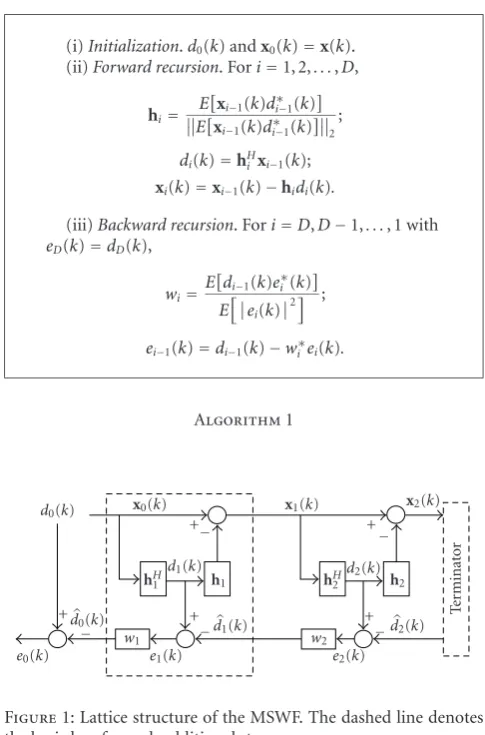
Figure 1illustrates the lattice structure of the MSWF. The reference signald0(k) is the training data of the desired sig-nal, which is available in friendly communications. In this paper, letd0(k)=s1(k). The observation dataxi−1(k) at the ith stage are partitioned into an interesting signaldi(k) and
its orthogonal componentxi(k). The desired signaldi(k) is
obtained by prefilteringxi−1(k) with the matched filtershi,
but is annihilated by the blocking matrixBi=I−hihHi . The
array data matrix is partitioned stage-by-stage in the same manner. As a result, we can readily achieve the prefiltering matrixTM=[h1,h2,. . .,hM].
3. COMPUTATIONALLY EFFICIENT ALGORITHM FOR DOA ESTIMATION
It is shown in [15] that all the matched filters hi, i =
1, 2,. . .,D (D ≤ P) are contained in the column space of
A(θ) by assumingd0(k)=s1(k). It follows that the orthog-onal matched filtersh1,h2,. . .,hPspan the signal subspace,
namely,
spanh1,h2,. . .,hP
=colA(θ). (7)
Since all the matched filtersh1,h2,. . .,hM are mutually
or-thogonal for the special choice of the blocking matrixBi = I−hihHi , the matched filters after thePth stage of the MSWF
are orthogonal to the signal subspace, that is,hi⊥col{A(θ)}
fori=P+ 1,P+ 2,. . .,M. Therefore, the lastM−Pmatched filters span the orthogonal complement of the signal sub-space, namely the noise subspace:
spanhP+1,hP+2,. . .,hM
=nullA(θ). (8)
Equation (8) indicates that the noise subspace can be readily obtained by performing the forward recursion of the MSWF, and thus the MUSIC estimator based on the noise subspace can be exploited to produce peaks at the DOA lo-cations. For coherent signals, however, the noise subspace es-timated by this method is no longer correct. That is to say, the lastM−Pmatched filters do not span a noise subspace for the case where the signals are coherent. As a result, we must resort to the smoothing techniques to decorrelate the coherent signals. Since the array covariance matrix is not in-volved in computing the basis vectors for the noise subspace, we perform the spatial smoothing method [16] merely to the array data matrix.
For the spatial smoothing technique, an array consisting of M sensors is subdivided into Lsubarrays. Thereby, the number of elements per subarray isML = M−L+ 1. For
l=1, 2,. . .,L, let theML×MmatrixJlbe a selection matrix
that takes the following form:
Jl=
0ML×(l−1)
.. . IML×ML
..
. 0ML×(M−l−ML+1)
. (10)
The selection matrixJlis used to select part of theM×N
ar-ray data matrixX0=[x0(0),x0(1),. . .,x0(N−1)], which cor-responds to thelth subarray. Hence, the spatially smoothed
(i)Initialization.d0(k) andx0(k)=x(k).
(ii)Forward recursion. Fori=1, 2,. . .,D,
hi= E
xi−1(k)d∗i−1(k)
E
xi−1(k)di∗−1(k)2
;
di(k)=hHi xi−1(k); xi(k)=xi−1(k)−hidi(k).
(iii)Backward recursion. Fori=D,D−1,. . ., 1 with eD(k)=dD(k),
wi=E
di−1(k)e∗i (k)
Eei(k)2 ;
ei−1(k)=di−1(k)−w∗i ei(k).
Algorithm1
d0(k)
e0(k)
+
−
d0(k) x0(k)
hH 1 h1
d1(k)
w1
+
−
+
−
e1(k)
d1(k)
x1(k)
hH 2 h2
w2
e2(k)
d2(k)
+
−d2(k)
+
−
x2(k)
T
er
minat
o
r
Figure1: Lattice structure of the MSWF. The dashed line denotes the basic box for each additional stage.
ML×LNdata matrix ¯X0is constructed as
¯
X0=
J1X0 J2X0 · · · JLX0
∈CML×LN. (11)
Similarly to the spatially smoothed data matrix ¯X0, the “spa-tially smoothed” training data vector should have the form
¯
d0=
d0;d0;· · ·;d0
L
∈CLN×1, (12)
whered0 = [d0(0),d0(1),. . .,d0(N−1)]T ∈ CN×1and “;” denotes vertical concatenation. Accordingly, theith spatially smoothed matched filter of the MSWF is computed as
hi=
r¯xi−1d¯i−1 r¯xi−1d¯i−12
= X¯i−1d¯∗i−1 X¯i−1d¯∗
i−12
. (13)
Thus, the computationally efficient algorithm for DOA esti-mation can be summarized as shown inAlgorithm 2.
Step 1. Apply the spatial smoothing technique to the M×Ndata matrixX0and obtain the spatially smoothed ML×LNdata matrix ¯X0.
Step 2. Construct the spatially smoothed training data vector ¯d0as (12).
Step 3. Perform the followingMLrecursions.
Fori=1, 2,. . .,ML,
hi= ¯
Xi−1d¯∗i−1
X¯i−1d¯∗ i−12
,
¯
di=hHi X¯i−1,
¯
Xi=X¯i−1−hid¯i.
(9)
Obtain the estimated noise subspace
NML−P=[hP+1,hP+2,. . .,hML].
Step 4. Exploit the MUSIC estimator
PMUSIC(θ)=1/(aHML(θ)NML−PNHML−PaML(θ)) to produce
peaks at the DOA locations, where
aML(θ)=(1/
ML)[1,ejϕi,. . .,ej(ML−1)ϕi]T. Alternatively, the DOAs can also be estimated by the root-MUSIC algorithm: finding theProots, sayz1,z2,. . .,zPthat have the largest magnitude, of the root-MUSIC polynomial
D(z)=zML−1pT(z−1)N
ML−PNHML−Pp(z) where p(z)=[1,z,. . .,zML−1]T, yields the DOA estimates as
θi=arcsin(λarg(zi)/2πd) in which arg(zi) denotes the phase angle of the complex numberzi.
Algorithm2
needs O(M2N) flops to obtain the noise subspace for the case of uncorrelated signals. Additionally, this method does not rely on the eigendecomposition of the array covariance matrix, saving the computational cost ofO(M3). Thus, the proposed method is more computationally efficient than the classical MUSIC algorithm, especially for largeM.
Remark 2. It should be noted that the proposed method can determine the directions of the desired signal with the knowledge of training data and the interferences without the knowledge of training data. That is to say, the pro-posed method only needs partiala prioriknowledge of sig-nal sources, such as the training data of the desired sigsig-nal, to estimate the DOAs of all the incident signals.
4. NUMERICAL RESULTS 4.1. Uncorrelated signals
Assume that there are two uncorrelated signals with equal power impinging upon the ULA composed of 10 sensors from directions{0◦, 5◦}, and that signal 1 is the desired signal whose waveform is known a priori. We also assume that the number of signals is known. The background noise is a
sta-25 20 15 10 5 0
A
m
plitude
(dB)
−40 −30 −20 −10 0 10 20 30 40 50
DOA (deg) Proposed method
(a)
25 20 15 10 5 0
A
m
plitude
(dB)
−40 −30 −20 −10 0 10 20 30 40 50
DOA (deg) MUSIC
(b)
Figure2: Spatial spectra of uncorrelated signals based on one trial. N=64,M=10, and SNR=10 dB. The vertical dashed line denotes the true locations of incident signals.
tionary, spatially-temporally white, complex Gaussian ran-dom process with zero-mean and the varianceσ2
n.
The spatial spectra of the proposed method and the clas-sical MUSIC algorithm are shown inFigure 2, whereN=64 and signal-to-noise ratio (SNR) is 10 dB. SNR is defined as 10 log(σ2
s/σn2), where σs2 is the power of each signal in
101
100
10−1
10−2
RMSE
(deg)
0 5 10 15 20 25 30
SNR (dB) Proposed method, DOA1 Proposed method, DOA2 MUSIC, DOA1
MUSIC, DOA2 CRB, DOA1 CRB, DOA2
Figure3: RMSE of estimated DOA for uncorrelated signals versus SNR.N=64 andM=10.
3.5 3 2.5 2 1.5 1 0.5 0
RMSE
(deg)
50 100 150 200 250 300
Number of snapshots Proposed method, DOA1
Proposed method, DOA2 MUSIC, DOA1
MUSIC, DOA2 CRB, DOA1 CRB, DOA2
Figure4: RMSE of estimated DOA for uncorrelated signals versus number of snapshots. SNR=5 dB andM=10.
4.2. Coherent signals
Consider the case where there are two signals impinging upon the ULA consisting of 12 sensors from the same signal source whose waveform is known a priori. The first is a direct-path signal and the other refers to the scaled and de-layed replicas of the first signal that represent the multi-paths or the “smart” jammers. The propagation constants are
25 20 15 10 5 0
A
m
plitude
(dB)
−40 −30 −20 −10 0 10 20 30 40 50
DOA (deg) Proposed method
(a)
20 15 10 5 0
A
m
plitude
(dB)
−40 −30 −20 −10 0 10 20 30 40 50
DOA (deg) MUSIC
(b)
Figure5: Spatial spectra of coherent signals based on one trial.N= 64,M =12,ML =9, and SNR=10 dB. The vertical dashed line denotes the true locations of incident signals.
{1,−0.8 +j0.6}. We assume that the true DOAs are{0◦, 5◦}
and the number of signals is known. The background noise is identical to that in the case of uncorrelated signals. To decor-relate the incident coherent signals, the spatial smoothing technique is also applied to the classical MUSIC algorithm.
The spatial spectra of the proposed method and the clas-sical MUSIC algorithm are shown inFigure 5, whereN=64, SNR=10 dB, and the number of sensors of the subarray is 9, namelyML =9.Figure 5indicates that the proposed
102
101
100
10−1
10−2
RMSE
(deg)
0 5 10 15 20 25 30
SNR (dB) Proposed method, DOA1 Proposed method, DOA2 MUSIC, DOA1
MUSIC, DOA2 CRB, DOA1 CRB, DOA2
Figure6: RMSE of estimated DOA for coherent signals versus SNR. N=64,M=12, andML=9.
102
101
100
10−1
RMSE
(deg)
50 100 150 200 250 300
Number of snapshots Proposed method, DOA1
Proposed method, DOA2 MUSIC, DOA1
MUSIC, DOA2 CRB, DOA1 CRB, DOA2
Figure 7: RMSE of estimated DOA for coherent signals versus number of snapshots. SNR=5 dB,M=12, andML=9.
cleaner noise subspace that leads to the enhanced estimation performance.
5. CONCLUSION
We have presented a computationally efficient method for DOA estimation in this paper. The proposed method only needs the forward recursion of the MSWF and does not re-sort to the eigendecomposition of the array covariance
ma-trix, thereby requiring lower computational cost than the classical MUSIC algorithm especially in the case of a large array. Numerical results indicate that the proposed method surpasses the classical MUSIC estimator for the case of small samples and/or low SNR and provide the same estimation performance as the latter when the samples become large and/or SNR increases.
REFERENCES
[1] P. Stoica and R. Moses, Introduction to Spectral Analysis, Prentice-Hall, Upper Saddle Revier, NJ, USA, 1997.
[2] R. O. Schmidt,A signal subspace approach to multiple emitter location and spectral estimation, Ph.D. thesis, Stanford Univer-sity, Stanford, Calif, USA, November 1981.
[3] J. Li, B. Halder, P. Stoica, and M. Viberg, “Computationally efficient angle estimation for signals with known waveforms,” IEEE Transactions on Signal Processing, vol. 43, no. 9, pp. 2154– 2163, 1995.
[4] M. Cedervall and R. L. Moses, “Efficient maximum likelihood DOA estimation for signals with known waveforms in the presence of multipath,”IEEE Transactions on Signal Processing, vol. 45, no. 3, pp. 808–811, 1997.
[5] H. Li, H. Pu, and J. Li, “Efficient maximum likelihood angle estimation for signals with known waveforms in white noise,” inProceedings of 9th IEEE Signal Processing Workshop on Sta-tistical Signal and Array Processing, pp. 25–28, Portland, Ore, USA, September 1998.
[6] J. Xin, H. Tsuji, H. Ohmori, and A. Sano, “Directions-of-arrival tracking of coherent cyclostationary signals without eigendecomposition,” in Proceedings of 3rd IEEE Workshop on Signal Processing Advances in Wireless Communications (SPAWC ’01), pp. 318–321, Taoyuan, Taiwan, March 2001. [7] A. Leshem and A.-J. van der Veen, “Direction-of-arrival
esti-mation for constant modulus signals,”IEEE Transactions on Signal Processing, vol. 47, no. 11, pp. 3125–3129, 1999. [8] H. E. Witzgall and J. S. Goldstein, “ROCK
MUSIC-non-unitary spectral estimation,” Tech. Rep. ASE-00-05-001, SAIC, May 2000.
[9] H. E. Witzgall, J. S. Goldstein, and M. D. Zoltowski, “A non-unitary extension to spectral estimation,” inProceedings of 9th IEEE Digital Signal Processing Workshop (DSP ’00), Hunt, Tex, USA, October 2000.
[10] J. Ward and R. T. Compton Jr., “Improving the performance of a slotted ALOHA packet radio network with an adaptive array,”IEEE Transactions on Communications, vol. 40, no. 2, pp. 292–300, 1992.
[11] H. E. Witzgall and J. S. Goldstein, “Detection performance of the reduced-rank linear predictor ROCKET,”IEEE Transac-tions on Signal Processing, vol. 51, no. 7, pp. 1731–1738, 2003. [12] J. S. Goldstein, I. S. Reed, and L. L. Scharf, “A multistage
rep-resentation of the Wiener filter based on orthogonal projec-tions,”IEEE Transactions on Information Theory, vol. 44, no. 7, pp. 2943–2959, 1998.
[13] G. Xu and T. Kailath, “Fast subspace decomposition,”IEEE Transactions on Signal Processing, vol. 42, no. 3, pp. 539–551, 1994.
[15] L. Huang, S. Wu, D. Feng, and L. Zhang, “Low complexity method for signal subspace fitting,”Electronics Letters, vol. 40, no. 14, pp. 847–848, 2004.
[16] T.-J. Shan, M. Wax, and T. Kailath, “On spatial smoothing for direction-of-arrival estimation of coherent signals,”IEEE Transactions on Acoustics, Speech, and Signal Processing, vol. 33, no. 4, pp. 806–811, 1985.
[17] P. Stoica and A. Nehorai, “MUSIC, maximum likelihood, and Cramer-Rao bound,”IEEE Transactions on Acoustics, Speech, and Signal Processing, vol. 37, no. 5, pp. 720–741, 1989. [18] A. J. Weiss and B. Friedlander, “On the Cramer-Rao bound for
direction finding of correlated signals,”IEEE Transactions on Signal Processing, vol. 41, no. 1, pp. 495–499, 1993.
Lei Huangwas born in Guangdong, China. He received the B.E., M.E., and Ph.D. de-grees in electronic engineering from Xid-ian University, Xi’an, China, in 2000, 2003, and 2005, respectively. From 2002 to 2005, he was with the National Key Laboratory for Radar Signal Processing, Xidian Univer-sity, where he worked on signal processing, adaptive filtering, and their applications in wireless communication systems. Since May
2005, he has been working as a Research Associate in the Depart-ment of Electrical and Computer Engineering, Duke University, Durham, NC. His current research interests are statistical signal processing, physical-based signal processing, remote sensing, array processing, and adaptive filtering.
Shunjun Wuwas born in Shanghai, China, on February 18, 1942. He graduated from Xidian University in 1964, and since then joined the faculty of the Department of Electrical Engineering, Xidian University. From 1981 to 1983, he has been a Visiting Scholar in the Department of Electrical En-gineering, University of Hawaii at Manoa, USA. He is a Professor at Xidian University and a Senior Member of the Chinese
Insti-tute of Electronics (CIE). He is currently the Director of the Elec-tronic Engineering Research Institute, Xidian University. His re-search interests include digital signal processing, adaptive filter, and multidimensional signal processing with applications to radar sys-tems.
Dazheng Fengwas born in December 1959. He graduated from Xi’an University of Technology, Xi’an, China, in 1982. He re-ceived the M.S. degree from Xi’an Jiaotong University in 1986, and the Ph.D. degree in electronic engineering in 1995 from Xidian University, Xi’an, China. From May 1996 to May 1998, he was a Postdoctoral Research Affiliate and an Associate Professor at Xi’an Jiaotong University, China. From May 1998
to June 2000, he was an Associate Professor at Xidian University. Since July 2000, he has been a Professor at Xidian University. He has published more than 40 journal papers. His research interests include signal processing, intelligence information processing, and InSAR.
Linrang Zhangwas born in Shaanxi prov-ince, China. He received his B.E., M.E., and Ph.D. degrees in electrical engineering from Xidian University, China, in 1988, 1991, and 1999, respectively. From 1991 to present, he has been with the National Key Laboratory of Radar Signal Processing, Xidian Univer-sity, where he is currently a Professor. He was a Visiting Scholar at the City University of Hong Kong during 2002–2003. His