.. ~ "
Em INEERINJ RESEARCH ASSOCIATES, INC.
OPERATIONS DIVISION
TM- 15
Date 12 December
1950
,
TECHnICAL }.{SMORANDUM COVER SHEET
Title of l!emorandum - Communication Between Electronic Circuitry and Mechanical or Electro-Mechanical Devices
Developed by - Task
13
Personnel Memorandum prepared by - F. C. Mullaney Work Done Under - 3020 - Task 13Classification of Memorandum - None Drawing Number of Memorandum - XAl9142
Date of Memorandum - 12 December 1950 .
Description
A discussion of the means of communication used in the Task 13 machine between the electronic equipment and mechanical or electro-mechanical devices.
Distribution:
~ St. Paul Arli~ton
BuSh ips
(855)
J. E. Parkerw.
Aamoth T. D. RowanH.
T. Engstrom US NCk'L W. C. Norrisw.
P.
Burrell C. RowlandR.
c.
BryantKnight Pryor
v.
A.
GillR. F.
ThewsL. R.
Steinhardt J. M. Coombs D.I.
HinzT.
D. ThomasR. E.
Kilham J.H.
BoekhoffK.
E.
JohnsonJ.
E. ThorntonR. K.
Patterson D. C. JohnstonF.
E •. Tidball'-"'~l • F. Winget
R. A.
Madvig E. TomashR. H. Sorensen E. A. Nelson D. H. Toth
Project Super'(isors 'vV. Ogden D. M. Weidenbach Project Engineers L. C. Pollock E. B. Zimmer
ERA
Library D. H. Raudenbush Technical WritersUnclassified or Restricted techrUcal. memorandum may be ordered directly from the Ozalid Room by a print requisition countersigned by a project engineer or a supervisor. A file of unclassified technical memorandums will be maintained in the
ERA
Library for general use. Technical memorandums of a classification higher than Rest~icted will not be issued with. a cover sheet, but may be ordered by authorized personnel directly from the Ozalid Room on a classified print requi-sition. These prints are subject to all security regulations including a Quarterly Inventory and must be returned in the event of employee termination.;j
'\
12
December1950
TECHNICAL MEMORANDUM NO.
15
COM~CATION
BETWEEN
ELECTRONICCIRCUITRY
AND
MECHANICAL OR ELECTRO-MECHANICAL DEVICES
In the design of electronic computing equipment it is necessar.y
to provide means
of
communication between the electronic equipment and mechanical or eleotro-mechanical .devices. In the Task13
equipment, such communication includes the followings1. Vanua! Start.
\
2. Operation of relays as a result or pulse occurrence.
3.
Producing relay contact pulses 88 a result of a veryshort
pulse
(O.lusec).4.
Communioating with the output system.5.
Generation .of system clock pulses tor use on single step or "inch" 9peration ••
The above problems will be t~en up in order. It is recognized that there are m~ methods' of accomplishing these results. The ones discussed have proved to be very reliable.
The standard pulses in the arithmetic and control systems vary between
0.1 and'O.2
US8C in width andfrom 20
to35
volts in amplitude.Pulse widths up to
0.,
usec may be tolerated with the standard circuitry.__ ~j1e o~_~.~!tis fact W88 taken in the development
ot
thE! circuits dis-cusse elow.\
' . "':-..:.;..:~;.~-;.:-..
-1. Manual start
This a.pplication calls for the generation of a single pulse as a
result of a mechanical contact closure. This pulse must be coincident with
a standard clock pulse. ,
This is accomplished in two steps. The first is the productio~ of a single sharp pulse initiated by a contact closure. The second is the synchronizing
ot
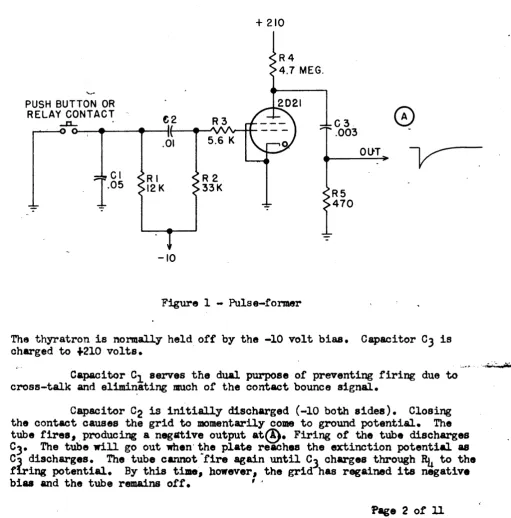
this signal with the standard clock pUlses. For the first step, a self-extinguishing thyratron circuit was chosen because an output pulse of V'ery short rise time may be easily obtained. Adjustment of circuit time constants eliminates spurious pulses due to contact bounce. This circuit' is shown in Fi~e 1.PUSH BUTTON OR
RELAY CONTACT
-Jl- .
CI
.05 RI 12K
-10
R2
33K
+
210Figure 1 - Pulse-former
C3
.003
R5 470
OlJ'T
The thyratron is norma.l.ly held off by the -10 volt bias. Capacitor C3 is charged to +210 volts. .
Capacitor C1 serves the dual purpose of preventing firing due to
cross-talk and elimi~at1ng DlUoh of the oontact bounce signal.
Capacitor C2 is initially disoharged (-10 both sides). Closing
the contact oauses the grid to momentarily come to ground potential. The
tube fires,. producing a negative output at@. Firing
or
the tube dischargesC). The tube will go out when' ~he plate reaches the extinction potential as
C,3 discharges. The tube cannot fire again until C
3
charges through1\
to thetiring potential. By this time, however, the grid has regained its negative bi.. and the tube remains
ott.
,.
,.
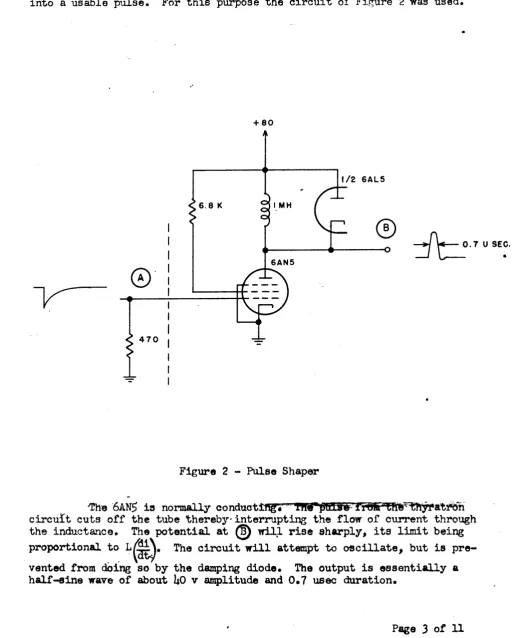
The output pulse is several microseconds wide so must be shaped into a usable pulse. For this purpose the circuit of Figure 2 was used.
+80
'/2 6AL5
6.8 K
®
~.7USE~.
470
Figure 2 - Pulse Shaper
-The "6AN5 is normally conduoting.- 'ffirtJtffii-,"rl'fli'tfl~~IIt:r:TOn
circu.1t
cuts orf the tube 'thereby' interrupting the flow of current through the inductance. The potential at®
wil.l rise sharply, its limit beingproportional to.
L~~.
The circuit will attElll1pt to oscillate, but i&pre-vented from doing so by the damping diode. The output is essentially a
hal.1' -sine wave of about
40
v amplitude and 0.7 usee duration.'-
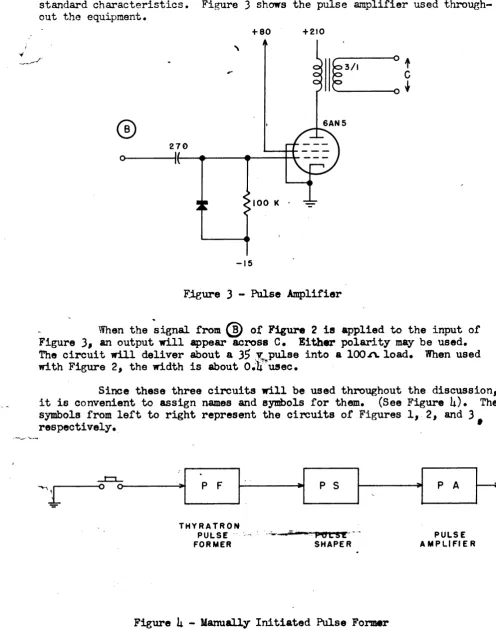
,-One more stage is necessary
to
produce a pulse approximating the standard characteristics. Figure3
shows the pulse amplifier used through-out the equipment.+80 +210
,
®
270
o
I
100 K .
-15
F~ure 3 - Pulse Amplifier
When the
~ignal
from®
ot
Figure 2 is applied to the input of Figure3,
an output will appear across C. Either polar! ty may be used. '!'he cireui t will. deliver about a35
;~...
pul8e into a loo.n.. load. When usedwith Figure 2, the width is about O~l{usec.
Since these three circuits will be used throughout the discussion,
it is convenient to assign names and eymbols for them. (See Figure
4).
The symbols from left to right represent the circuits of Figures 1,> 2, and3
respectively., '
-t::l....
·1
FI
1
p1
t--~t
0 0 p S P ATHYRATRON
PULSE ., -,~
----r.:r irt-n
-Rft5~ -- PULSE
FORMER SHAPER A MPLIFIE R
Figure
4 -
Uanually
Initiated Pulse Former•
The second step regarding manual start is the synchronizing of the manually initiated signal with the standard clock pulses.
The simplest method of accomplishing this would be the circuit of Figure
5.
CLOCK PULS£S
MANUALLY INITIATED PULSE
...
I'
GATE
L"\..
~~
X
FLIPFLOP
~
CLEAR
Figure
5 -
Elementar,y Synchronizing CircuitSINGLE
r
PULSE OUTThe gate is biased off by the flip-flop. The manually initiated, pulse triggers the flip-floPJ-on. clock pulse passes through the gate and
returns the flip-flop to the normal. condition.
With this circuit, however, 'there exists a possibility of pro-ducing as output a "runt" pulse. The initiating pulse may occur at any time with respect to the clock pulsesJ the gate may be only partially enabled when a clock pulse occurs. To eliminate this possibility, the arrangement of Figure
6
was used.CLOCK PULSES
•
SINGLE
~-... - - - - . P,ULSE
MANUALLY
INITIATED --~----'
PULSE
x
FFIx
FF 2Figure 6 - Synchronizing Circuit
OUT •
I U SEC: DELAY
,
Now i t a ttruntft pulse is emitted from Gate 1 it will either trigger
FF2 or it will not. If it does, FF2 has ample time to completely enable G2
·before the next clock pulse occurs. If it does not, the next one will. The purpose of the delay in the cleat" line is to avoid the possibility of "con-fusing" FF2 by pulsing both sides simultaneously with signals of different amplitudes. (Gl is putting out a pulse simultaneously with that from G2).
The Task
13
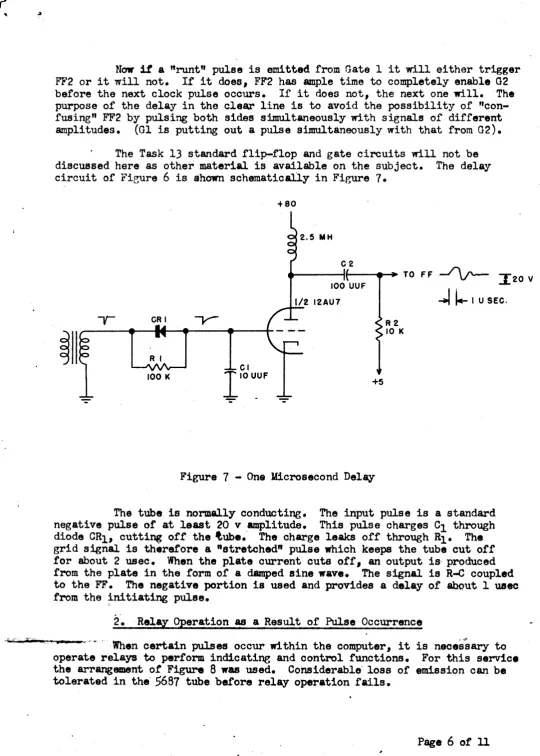
standard flip-flop and gate circuits will not be discussed here as other material is available on the subject. The delay circuit of Fieure6
is shown schematically in Figure7.
RI
100 K
+80
.---ft·----t~ TO F F
--/\!'--
I 2 0 V+5
Figure
1 -
Ona
Microsecond Delay R2 10 K~
t.-
I U SEC.The tube is normally conducting. The input puls e is a standard negative pulse of at least 20 v amplitude. This pulse charges 01 through diode CRl, cutting off the tube." The charge leaks off through Rl. The grid signal. is there.fore a "stretched" pulse which keeps the tube cut off tor about 2 usec. When the plate current cuts otf, an output is" produced from the plate in the form of a damped sine wave. The signal is R-C coupled
to
theFF.
The negative portion is used and provides a delay of abQut1
usee from the ~nitiating pulse.2". .
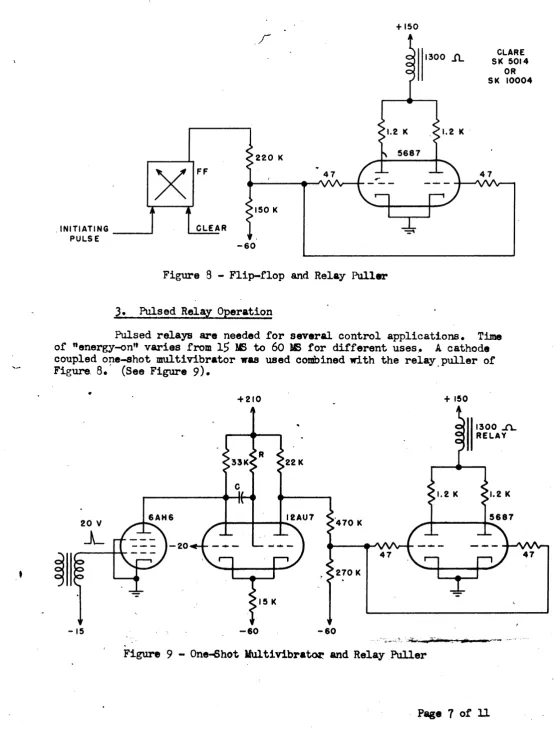
Relay Operation as a Result of Pulse Occurrence"."~
When certain pulses occur within the computer, it is necessar.y to operate relays
to
perform indicating and control functions. For this service the arrangementot
Figure 8 was used. Considerable' loss of emission can be tolerated in the"5681
tube before relay operation fails.Page
6
of 11,..
.
-.
•
,INITIATING _ _ ---' PULSE
220 K
150 K
CLEAR
-60
Figure
8 -
Flip-flop and Relay Puller3.
Pulsed Relay Operation+150
1300 1L SK 5014 CLARE
OR
SK 10004
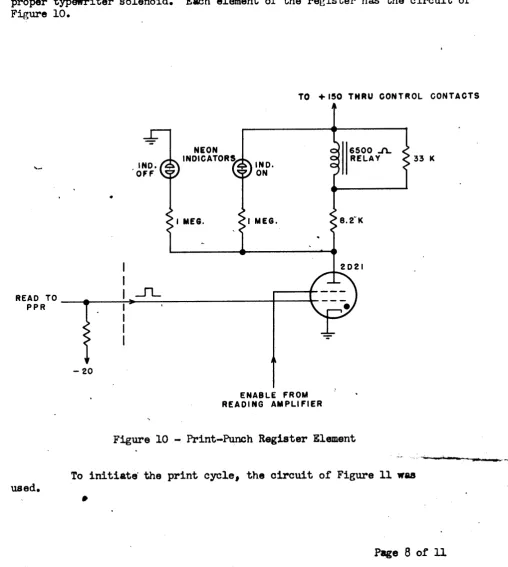
Pulsed relays
are
needed for several control applications. Timeof nenergy-on" varies from
15
MS to 60 IE for different uses.. A cathode coupled one-shot multivibrator was used combined with the relay puller ofFigure.
8.'
(See Figure9).
.
•
-15
-20
+210
R
22 K
ItAU7 .--I1----4~-...
-60
+150
-60
1300..n... RELAY
~ . . . _ _ . ' 0 " '
Figure
9 -
One-Shot Mllltivibrator and
Relay Puller" .
The pulse duration is equal to kRC; for this circuit k
=
.28 within the range used.4.
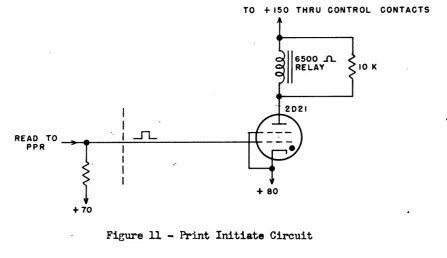
Providing Information to the Output SystemIt was
requiredto print
outa
character corresponding t \ asix-digit binary number. The information was read out of storage to a
hyratron-relay registor. These hyratron-relays energize the hyratron-relay translator which selects the
proper typewriter solenoid. Each element of the register has theAcircuit of
Figure 10.
•
NEON INDICATORS
IND. ON
I MEG.
TO + 150 THRU CONTROL CONTACTS
33 K
READ TO ____
....--~+-JL---~~--+-PPRused.
-20
ENABLE FROM READING AMPLIFIER
Figure 10 - Print-Punch Register Element
To initiate" the print cycle I the circui t of Figure 11 was
•
.~
N
~
0)
r-<f
I
~ TO + 150 THRU CONTROL CONTACTS
10 K
READ TO ~--..~_...:..._.sL _ _ _ _ _ _ _ _
-++-PPR
+
80+70
Figure 11 - Print Initiate Circuit
The purpose of the resistors paralleling the relays in both Figures 10 and 11 is to ~vid. a resistive load to insure rapid ignition.
When the typewriter had printed it was necessary to produce an
"acknowledge" signal to inform the electronic circuits of this fact. Figure 12 is a block diagram of the cir\cuit.
NORMALLY CLOSED
K I
"
TO ELECTRONIC CONTROL CIRCUITS
~~, The relay contact
n
is normally blosed} this relay is pulsed when thetypewriter function is completed. A single sHkped pulse 1s
emitted
from
the amplifier.5.
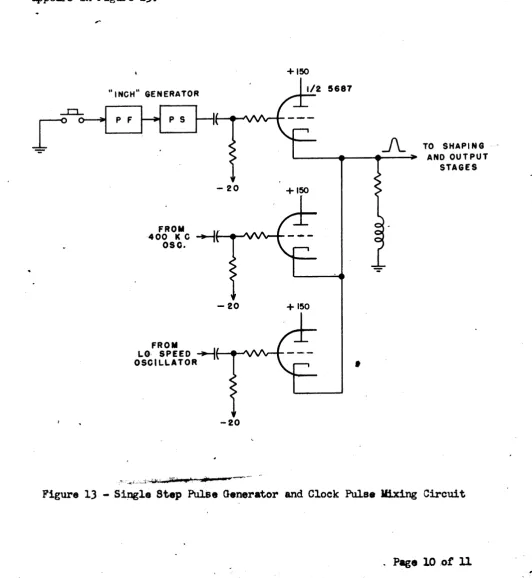
Single Step OperationFor test purposes, the equipment is often operated in the "inch" condition. One· clock pulse is produced for each closure of a push-button switch. These clock pulses must look exactly like the normal high speed pulses. For this reason, the shaping and output stages of the clock generator were common to all pulse rates. A block diagram of the circuit
appears in Figure 13.
+150
"INCH" GENERATOR 1/2 5687
A
TO SHAPING-L...-_ _ . . . . _ _ . . . . _~ AND OUTPUT STAGES - 20 +150
FROM ---1.
400 K C - - , ' - -... "'~." ... 050.
FROM
LO- SPEED
-+-I
OSCILLATOR-20
-20
+150
,
Figure 13 - Single Step PulSe Generator and Cloek Pulse Ifix1ng Circui t
SUMMARY,
, For producing sharp pulses from contact closures, a
6e1£-extinguishing thyratron circuit is used in combination with a pulse
shaper and pulse amplifier. The input circuit has an RC filter to avoid spurious pulses due to contact bounce.
To ope~ate relays as a result of a' pulse occurrence, either a flip-flop or a one-ehot multivibrator is used in conjunction with a
hard tube amplifier termed'a "rel~ puller".
To transrer intelligence to th, output system, a thyratron-relay register is used.
Te.
9.h.,~~A~
4_F.
c.
Mill;~
•
Rererence, For a discussion oL Task
13
standard circuits see Instruction I Bookexm
e9.ui~e~~ (C9nfidential) Section3.
"Detailed Theory" •• ",.!!'PII;4a&n, Q'JI!I~", _.:tII.»_, =-wuC!';:~,_\~ ... :ac:3C.== ... ~~, .... :Iio;---"'<~ Z'~< •
Page 11 of 11