R E S E A R C H
Open Access
Error analysis and implementation considerations
of decoding algorithms for time-encoding
machine
Xiangming Kong
1*, George C Valley
2and Roy Matic
1Abstract
Time-encoding circuits operate in an asynchronous mode and thus are very suitable for ultra-wideband applications. However, this asynchronous mode leads to nonuniform sampling that requires computationally complex decoding algorithms to recover the input signals. In the encoding and decoding process, many non-idealities in circuits and the computing system can affect the final signal recovery. In this article, the sources of the distortion are analyzed for proper parameter setting. In the analysis, the decoding problem is generalized as a function approximation problem. The characteristics of the bases used in existing algorithms are examined. These bases typically require long time support to reach good frequency property. Long time support not only increases computation complexity, but also increases approximation error when the signal is reconstructed through short patches. Hence, a new approximation basis, the Gaussian basis, which is more compact both in time and frequency domain, is proposed. The reconstruction results from different bases under different parameter settings are compared.
Keywords:Time encoding sampling, reconstruction, function approximation
Introduction
Time encoding is an asynchronous process for mapping the amplitude information of a band-limited signalx(t) into a sequence of strictly increasing time points (tk).
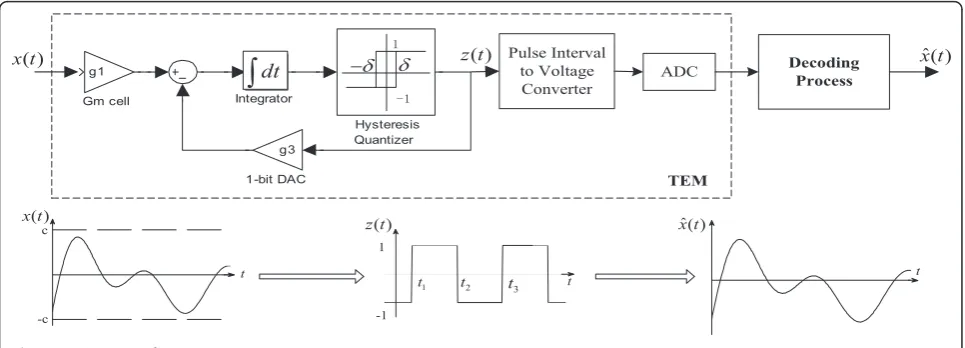
Well-known nonlinear asynchronous analog circuits can be used to build a time-encoding machine (TEM). For example, the TEM shown in Figure 1 consists of an input transconductance amplifier, a feedback 1-bit DAC, an integrator, and a hysteresis quantizer. The output of such a TEM is a train of asynchronous pulses that change sign attk. Using a TEM to transform the input
analog signal into such pulses avoids the clock jitter that limits traditional ADCs for ultra-wideband applications [1] and provides better timing resolution. Furthermore, all the information in the original signal is preserved in the durations of the pulses. Hence, time encoding can also be used as a modulation scheme that modulates input analog signals onto pulses. Processing the input signal can be performed using the pulse durations in a
similar manner as conventional signal processing with repetitively pulsed, amplitude quantized pulses. Proces-sing on the asynchronous pulses has two main advan-tages: (1) it overcomes the limits of voltage resolution of analog signals in deep-submicron processes; (2) it over-comes the limits on the programmability of traditional analog processors. The pulses can also be used for direct communication of signals in very wideband systems as an alternative to existing UWB signals.
Lazar and Tóth [2] have proved that band-limited sig-nals encoded by TEM can be perfectly recovered in the-ory. However, the reconstruction algorithm requires the inversion of an infinite matrix. This problem can be solved by reconstructing small intervals of the signal ("clips”) and stitching these“clips” together [3]. A Toe-plitz formulation of the reconstruction problem was proposed by Lazar and co-workers [4] to increase the speed of the reconstruction algorithm. In both recon-struction algorithms, the inversion of an infinite matrix is replaced by a finite matrix inversion, but the recov-ered signal is no longer a perfect reconstruction. In addition, numerical errors and circuit noise in real
* Correspondence: [email protected]
1The Aerospace Corporation, Los Angeles, CA, USA
Full list of author information is available at the end of the article
systems limit the reconstruction accuracy. These non-idealities replace clock jitter as the limiting sources of errors. Understanding the effect of these non-idealities is necessary for determining the optimal design para-meters for applying the TEM in a real system. In addi-tion, by analyzing the non-idealities, we can determine the circuit specifications based on the system perfor-mance requirements, which is an important step in many applications.
The reconstruction process can be thought of as a generalized function approximation problem and choice of a proper basis is critical for function approximation. In this article, a new basis that overcomes some short-comings of the bases used previously in the existing decoding algorithms is proposed.
A detailed study of the non-idealities encountered in the encoding and decoding process is carried out and reported in this article. We will base our analysis on the system model in Figure 1. In particular, we analyze the error sources and their effects on the final reconstruc-tion SNR. In the encoding side, the errors mainly come from circuit imperfections, including the non-linearity of the amplifier, the deviation of circuit parameter from their set values in the hysteresis quantizer, and the quantization noise of the ADC. In the decoding side, the major error contributors are the basis approximation error and the numerical computation errors, including the matrix inversion errors and the matrix boundary problems. Since these errors come from software algo-rithm and theoretical analysis, they are all incorporated in the Decoding Process block in Figure 1. All errors will be analyzed individually.
This article is organized as follows. The next section reviews existing reconstruction algorithms and
intro-duces the new reconstruction basis. In “Non-ideality
analysis,” the origin of the non-idealities is analyzed and
their effects are examined. Concluding remarks are drawn finally.
Reconstruction algorithms
Before discussing reconstruction algorithms, it is useful to understand the sampling process. Unlike traditional sampling processes, the TEM does not measure the amplitude of the input signal directly. Instead, it con-verts the amplitude information into time information through the nonlinear components in the TEM. For the circuit model in Figure 1, the operation equation of the TEM can be expressed as:
tk+1
tk
g1x(u) + (−1)kg3
du= (−1)k2δ (1)
For a signal with maximum amplitudec, the interval
between two time pointsTk=tk+1-tksatisfies:
2δ
g3+g1c ≤ Tk≤
2δ
g3−g1c
(2)
Lazar and Tóth [2] proved that a finite energy signal band-limited to [-Ω,Ω] can be perfectly recovered once the following condition is satisfied: the maximum inter-val between time points in (2) should be less than the half of the minimum periodπ/Ω, i.e.,
2δ
g3−g1c≤
π ⇒r=
2δ
g3−g1c
π
<1 (3)
The oversampling ratio (OSR) of a time-encoding
sys-tem is the Nyquist periodπ/Ωdivided by the average of
the Tk’s. According to (2), 1 r =
π
/
maxTk
<OSR. In fact, in function approximation where time limited basis are used, there is no perfect signal reconstruction. The
Pulse Interval to Voltage Converter Integrator
1 s
Hysteresis Quantizer Gm cell
g1
1-bit DAC g3
dt
³
G G( )
x t z t( ) Decoding
Process
ˆ( )
x t
TEM
( )
x t
t
c
-c -1
1
( )
z t
t t
ˆ( )
x t
1
t t2 t3
ADC
parameterroften plays an important role in the perfor-mance of the reconstruction algorithms. Hence, we believe it is a fair comparison of algorithms only if each reaches same level of OSR. We will include the OSR value in many of our comparison results too.
Reconstruction method I: iterative algorithm
Since time-encoding sampling is an asynchronous pro-cess, time points are not sampled on a uniform time grid. Hence, time encoding has many similarities to other non-uniform sampling processes. Typical non-uni-form sampling reconstruction algorithms involve an iterative process [5]. Similarly, Lazar et al. proved that the iterative operation of (4) can reach perfect recon-struction:
xl+1=xl+A(x−xl) (4)
where xl is the reconstructed signal in the lth
itera-tion.Ais an operator defined as:
[Ay](t) =
k∈Z ⎡ ⎣
tk+1
tk
y(u) du ⎤
⎦g(t−sk)
g(t) = sin(t)/πt, sk= (tk+1+tk)/2
(5)
Reconstruction method II: sincbasis
In the iterative algorithm, the result from the lth itera-tion can be expressed as [2]
xl(t) = l
n=0
(I−A)nAx
(t) (6)
Taking limit as lgoes to infinity, the final reconstruc-tion result can be expressed in matrix format as
ˆ
x(t) = lim
l→∞xl(t) =g
TG+q=cTg
(7)
where
g=g(t−sk)
, q=(−1)k2δ−(tk+1−tk)
G=[Glk]= ⎡ ⎣
tl+1
tl
g(u−sk) du ⎤
⎦ (8)
andG+denotes the pseudo-inverse ofG.
Reconstruction method III: Toeplitz formulation
Replacing the scaled sinc functiong(t) by its approxima-tion g(t)≈α N
n=−N
ejn
Nt,α=
(2N+ 1)
, the recovered
signal in (7) can be expressed as [4]:
x(t)≈j N
N
n=−N
nejn
Nt[c]n (9)
The coefficients care obtained through the equation:
PSHc=q⇒c= (SSH)−1SP−1q (10)
where
[q]k= (−1)k(2δ−(tk+1−tk))
[S]n,k=e−jntk/Ns, [P−1]l,k=
−1 ifl≤k
0 ifl>k
(11)
This method is so named because the matrixSSH is a
Hermitian Toeplitz matrix.
For a given space, we can express any signal in the space as a linear combination of basis functions of the space. Then in essence, the reconstruction process is a function approximation problem, i.e., finding the coeffi-cients associated with the basis functions. Uniformly spaced sincfunctions are a complete set of bases for the space of band-limited signals. In traditional uniform sampling, the bases are orthogonal to each other [6]. The sampled values are the coefficients for the bases. However, once the samples are not uniformly taken,
sinc bases are no longer orthogonal to each other.
Hence, we cannot directly use the sampled values as the coefficients. Instead, we have to solve for the coeffi-cients. Following this concept, we can see that the major difference between methods III and II is that the bases of method II are scaled sinc functions and that of method III are scaled sine waves
nejn Nt.
Using the same basis, the reconstruction process can also be formulated by a Vandermonde system as in [3]:
x(t)≈
N
n=0 j
−n2 N
e
j
−+n2
N
[c]n
The coefficient c can then be obtained through the
equation
Vc=DPq
whereqis the same as in (11) and
[V]nm=ejm2tn/N, D= diag
ejtn
[P]nm=
1 ifn<m+ 1
0 ifn≥m+ 1
.
Remark: The scaled sine basis is one type of trigono-metric polynomial kernels. Other similar trigonotrigono-metric polynomials kernels such as the Dirichlet kernel can also be used. One advantage of using these kernels is that they have closed form integration, reducing compu-tation complexity.
Reconstruction method IV: Gaussian basis
The bases in methods II and III are both infinite in time, but in practice, we have to use a finite basis. Hence, the bases have to be truncated. Although the infinite sincfunctions can faithfully represent the signal, the same is no longer true for the truncated basis, which means that the sinc basis may not be the best basis for signal reconstruction. Similarly, the trigono-metric polynomial kernels can approximate periodic sig-nals very well. But it can generate large error in approximating general nonperiodic band-limited signals. Instead, a basis that is more compact than the sincbasis may be a better candidate for our application. Since we focus on band-limited signals, we also want the basis to be compact in the frequency domain. This motivates us to use the Gaussian function which has the smallest time-frequency window [8]. The Gabor transform, which uses the Gaussian function as the basis, also finds wide use for expanding functions that are simulta-neously limited in both time and frequency [9]. A basis derived from the Gaussian function, which has flatter frequency response and also exhibits similar properties is given by [10]:
K(x) =G0(x, 2γ)−γG2(x,y)−γ 3
24G 6(x,γ)
G0(x,β) =√1 2πβe
−x2/2β
, GM(x,β) = ∂
M
∂xMG
0(x,β)
γ = 1 2π
1
√ 2+ 1 +
15 24
2
= 0.8656
(12)
In the approximation history, many different basis functions have been found and studied. Each has its own merit. Research by Lehmann et al. [11] shows that this Gaussian basis has the flattest passband and smal-lest side lobes among all the finite time bases they com-pared. Hence, we developed the reconstruction method IV using the Gaussian basis to reconstruct the signal as:
x(t) =
l∈Z
clK(t−sl) (13)
The coefficients ofcare obtained through the
equa-tion:
Kc = q (14)
where
[K]k,l= tk+1
tk
K(u−sl) du,
qk= (−1)k(2δ−(tk+1−tk)) (15)
For all these methods, we make the bases finite by applying a window function w(t) to cut the signal into clips as in [3]:
x(t) =
n∈Z
x(t)w(t−nT)
=
n∈Z
w(sl−nT)>0
clw(t−nT)f(t−sl)
(16)
Within each window, we solve equations to get the coefficientscas before.
For convenience of expression, the matrices Gin (8),
SSH
in (10) andKin (15) will all be designated hereafter as“Basis”matrices.
Non-ideality analysis
Although in certain theoretical cases, the signal sampled through TEM can be perfectly recovered, in all practical applications, there are multiple non-idealities that lead to reconstruction errors both in the encoding and in the decoding processes. In this section, several common non-idealities are analyzed. Some reconstruction errors are affected by the choice of parameters used in the sys-tem. Sometimes, a parameter can have opposite effects on two different types of non-idealities, and a tradeoff study is required to find the optimal parameters. In pre-vious error analysis, the authors assume an OSR of 2-3 [2]. Here, we are interested in a system with a much smaller OSR because when sampling ultra wideband sig-nals, a smaller OSR means smaller bandwidth require-ments on the TEM and decoder circuitry. In our analysis and simulations, we restrict the OSR to be less than 2. In this case, the parameter rin (3) is close to 1, and hence reconstruction method I converges slowly. Measurement errors caused by non-idealities in the TEM circuit accumulate over iterations, and this limits the reconstruction accuracy. In our test, as long as there is reasonable quantization noise in the measured time intervals, this method always generates high reconstruc-tion mean square error (MSE). In the following error analysis and comparison, this method is not included.
Sensitivity analysis and parameter selection
still exist: quantization noise (which includes thermal noise, comparator ambiguity, etc.) and circuit nonlinearity. There are also numerical errors in calculating the coeffi-cients for the bases in the reconstruction process. Another circuit non-ideality is the implementation error of the cir-cuit parameters.
Circuit parameter mismatch
Several circuit parameters are involved in the decoding process, including the gain of the amplifiers, the trigger-ing level of the hysteresis quantizerδas well as the out-put voltage level of the quantizer. The effect of the amplifier will be analyzed later. Here, we will focus on the parameters of the hysteresis quantizer. In previous analysis, we have assumed the output voltage of the quantizer is +1/-1. In the real circuit, this value will be a voltageb. The exact value ofbwill not affect the result as long as we know this value accurately. However, the mismatch between the positive level and the negative level as well as the imperfect knowledge of the value will cause the decoding error to increase. This is also
true for the triggering level of the quantizer δ. The
effect ofδ has been thoroughly analyzed in [2]. Notice
thatδandb only appear in the calculation of the
mea-surementqfor all non-iterative methods as can be seen
in Equation 8, 11, and 15. Rewriting these equations using the real voltage valueb, we get
qk=(−1)k
2δ−b1(tk+1−tk)
qk+1=(−1)k+1
2δ−b2(tk+2−tk+1)
(17)
Following the compensation principle in [2], by sum-ming up the consecutive measurements as
qk+qk+1=(−1)kb1
b2 b1
Tk+1−Tk
(18)
we can get reconstruction algorithm that is insensitive toδas
BKc=Bq (19)
where elements ofB= [Bkl] are given byBkl= 1 fork
=lor k=l+ 1 and zero otherwise. The matrixKhere
refers to the “Basis” matrix in the three methods. By
applying the compensation principle, the imperfection in
the knowledge δ of will not affect the reconstruction
result. Hence, we will assume perfect knowledge ofδ. From Equation 18, we can see that the mismatch between the positive and the negative voltage level of the quantizerb1 andb2will further increase the
inaccu-racy in the time interval measurement. To an extent, this mismatch can be incorporated in the quantization noise discussed next. Since it is a multiplicative factor, its effect on the reconstruction result will be very com-plicate and is left for future study.
Quantization noise
The quantization noise mainly comes from the ADC that is used to measure the interval between the transi-tion time pointstk. Equation 2 can be used to determine
the ADC’s voltage range and DC bias. By removing the
DC bias, we can set the ADC voltage range to be 4 δg1c/(g32-g12c2) instead of 2δ/(g3 -g1c). This is
equiva-lent to adding one extra bit to the ADC forg3= 1,g1c=
0.33.
In the decoding machine analysis [2], the authors ana-lyzed the effect of quantization noise on the Tk’s, but
did not include the accumulation of noise with
increas-ing k. Since the time points tk’s are monotonically
increasing, it is not realistic to measure the time points themselves. Instead, what are measured in real circuits are the time intervals, i.e., the Tk’s. The time points are
then calculated from the measured intervals. The quan-tization noise in each measurement is independent iden-tically distributed [12]. Since the time points are calculated as the summation of measured time intervals, the variance of the quantization error of time points increases with time. To overcome this problem, we developed a“resynchronization” scheme. After everyNr
time intervals are measured, the difference between the calculated time points and the true time pointδt is mea-sured. The true time points can be obtained from a highly accurate external clock. This difference is then
used to calibrate each time interval through
˜
Tk=Tk+δt/Nk=1Tk. In this way, we can reduce or
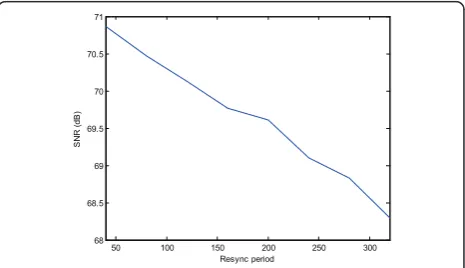
eliminate the quantization error accumulation. The effect of the resynchronization periodNr is plotted in
Figure 2. From this figure, we can see that the recon-struction SNR decreases linearly with the size of the resynchronization period. Since the resynchronization process requires extra measurements, the optimal resyn-chronization period is determined by a tradeoff between efficiency and reconstruction SNR.
50 100 150 200 250 300
68 68.5 69 69.5 70 70.5 71
S
NR (
dB
)
Resync period
Figure 2The reconstruction error versus the resynchronization
Amplifier nonlinearity
Although the TEM is a nonlinear system, its linear com-ponents still need to maintain high linearity to avoid distortion in the measurements. An important linear component in the system is the amplifier (the Gm cell in Figure 1). When the amplifier is nonlinear, not only does it fail to amplify the signal as much as assumed, but it also generates harmonics of the signal. We can use a simple hyperbolic function to model the nonli-nearity of the amplifier. Letnlrepresent the strength of
the nonlinearity. When the input is composed of two tones, the output of the amplifier is:
1
nl
tanhnl
a1sin(w1t) +a2sin(w2t)
(20)
The effect of the amplifier nonlinearity is simulated and shown in Figure 3. The reconstruction signal-to-noise and distortion ratio (SNDR) is converted to effec-tive number of bits (ENOB) through the equation
ENOB =(SNDR−1.76)/6.02 (21)
At low nonlinearity, the TEM system performs much better than the traditional ADC. When nonlinearity increases, the performance of the TEM system deterio-rates quickly and is worse than that of the traditional ADC at high nonlinearity.
Basis approximation error
The uniformly spaced infinite length sinc functions form a complete basis for the space of band-limited signals.
However, when the sinc functions are time limited and
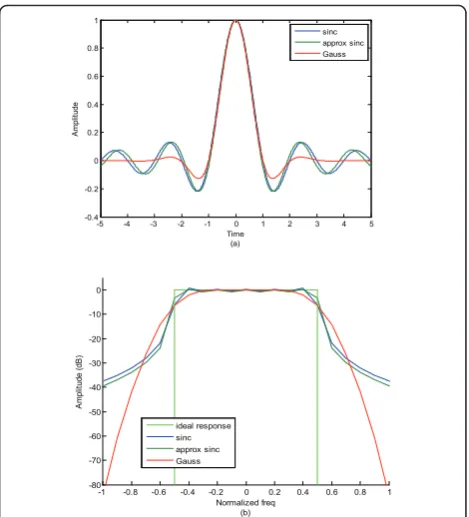
non-uniformly spaced, they are no longer a complete basis. The bases used in other reconstruction methods are not complete for the space of band-limited signals either. Using any of these bases to approximate the input signal generates approximation error. Intuitively, we want the basis to closely resemble the boxcar shape of the infinite sincfunction’s frequency response. To compare how good the bases are in approximation, the
time and frequency response of the three bases in reconstruction methods II-IV are shown in Figure 4a,b. All bases are cut off att = 5 to make them time-limited. The frequency in the plot is normalized so that the
bandwidth of the signal 2Ω is 2Ω. We denote
(2N+ 1)π
N
n=−Nejnt/N for N = 12, the approximate
sinc basis, which is the basis used in the Toeplitz
formation.
As can be from Figure 4a, the envelope of the sincand
approximate sinc basis decreases slowly. Note that a
long time window is necessary for these bases to have good frequency response. However, a long time window increases the condition number of the basis matrix, resulting in higher numerical error, which will be dis-cussed next. The Gaussian basis is compact in the time domain; hence, its basis matrix has a much lower condi-tion number, resulting in smaller numerical error. How-ever, it is not very flat in the passband from -0.5 to 0.5 in Figure 4b. The transition from the passband to the stopband is not very sharp either. By sacrificing its time
compactness through increasinggin (10), we can reduce
the transition band. But expanding the basis in time cor-responds to reducing bandwidth. Hence, the Gaussian basis typically requires higher OSR than the other two bases for the same recovery error.
Figure 3Effect of amplifier nonlinearity. Red line is calculated
from the reconstruction SNDR of a traditional ADC; black line is from the reconstruction SNDR of the TEM system.
-5 -4 -3 -2 -1 0 1 2 3 4 5
-0.4 -0.2 0 0.2 0.4 0.6 0.8 1
Time (a)
A
m
plit
ud
e
sinc approx sinc Gauss
-1 -0.8 -0.6 -0.4 -0.2 0 0.2 0.4 0.6 0.8 1 -80
-70 -60 -50 -40 -30 -20 -10 0
Normalized freq (b)
Am
pl
itu
de
(
dB)
ideal response sinc approx sinc Gauss
Figure 4The time and frequency response of the three basis
Matrix inversion
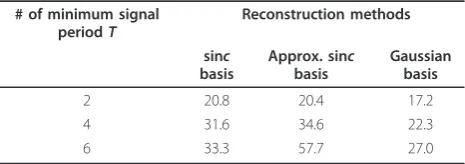
All three reconstruction methods used in our study require basis matrix inversion. Unfortunately, the basis matrices usually have large condition number, especially when the size of the matrices is large, and the inverse of such a matrix usually has very large elements that amplify the noise in the measurements. There may also be disastrous cancellation that brings computation error [7]. Using a short window is one way to control the noise amplification, but a shorter window adversely affects the frequency response of the basis. The base 2 logarithm of the condition numbers of the three basis matrices at different window sizes (measured in number of minimum signal period 2π/Ωis listed in Table 1. In the test, we set the oversampling ratio to be 1.55. Hence, the Gaussian basis is expanded a little bit in time to improve its performance, but its condition num-ber is also larger. However, as can be seen in Table 1, the Gaussian basis still has a much smaller condition number than the other two bases. We found setting the window size to be four times the minimum signal per-iod generally gives best results.
Another way to control the noise amplification pro-blem is to use the pseudo-inverse of the coefficient matrix. By setting a tolerance level, the pseudo-inverse procedure will treat any singular value of the matrix that is less than the tolerance level as noise and set it to zero. In this way, the inverse matrix will not contain very large elements. However, high tolerance level is only good when the quantization noise is high. When the quantiza-tion noise is small, error generated in matrix inversion will dominate and hurts the reconstruction result. Because of its low condition number, the Gaussian basis is not very sensitive to the choice of the tolerance level.
As mentioned in“Reconstruction method III: Toeplitz
formulation,” the Toeplitz reconstruction method can
be replaced by a Vandermonde formulation which avoids matrix inversion completely. Under this formula-tion, pseudo-inverse is not necessary. However, the con-dition number of the Vandermonde matrix still affects
the reconstruction error as in other methods, although to a less extent. The gain of the Vandermonde formula-tion and formulating other methods in a similar fashion will be an extension to this article.
Boundary effect
At the boundary of each reconstruction window, the reconstruction result is very inaccurate. This phenom-enon is known as the Runge phenomphenom-enon. Employing
2M time points outside the reconstruction window is
suggested in [3]. SettingM to a large value reduces the boundary effect and improves the reconstruction result, but the improvement levels off quickly. In addition,
increasing M also increases the basis matrix condition
number and the computational complexity of the
recon-struction algorithm. Hence, the value of M should be
kept small. In our simulations, we found M = 3 is a
good choice.
Reconstruction method comparison
Based on the previous analysis, we can balance the dif-ferent error sources by setting parameters properly. To compare the reconstruction methods, we try to set their parameters to have the same value unless a different value significantly improves the result. The values of the aforementioned parameters for the different methods are listed in Table 2.
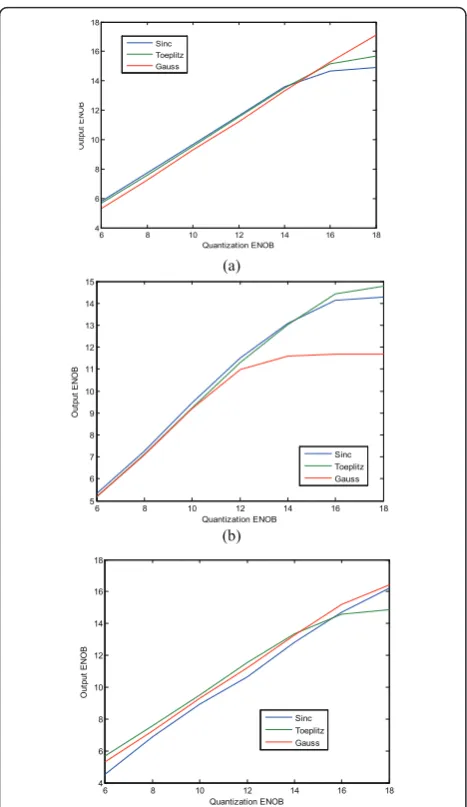
Figure 5a,b shows the output ENOB as a function of the ADC quantization ENOB at two different OSRs. The matrix inversion tolerance level (MITL) is set to balance the low noise and high noise performance. It is clear that output ENOB levels off when the quantization noise is low and the matrix inversion error dominates. At OSR = 1.55, the Gaussian basis cannot approximate the signal well and hence its output ENOB saturates with low quantization noise. But when the OSR is increased to 1.9, the ENOB for the Gaussian basis does not saturate as a function of quantization ENOB while results for the other two bases saturate because of the low tolerance level. In contrast, if we set the tolerance level of the other two methods to a low value to boost the low noise performance, their performance would be much worse at high noise level, as shown in Figure 5c
(for example the performance of the sinc basis-blue
curve-is 7.7 dB worse than in Figure 5a when input ENOB is 6). An interesting observation from Figure 5c is that even though the Toeplitz matrix also has a large condition number, it is not sensitive to the tolerance level until a critical level because of its robustness against small noise [3,7]. When the tolerance is below 2.5e-13, its output ENOB cannot pass 10.5 bits.
Conclusion and discussion
In this article, several reconstruction algorithms for the TEM are reviewed and generalized as a function Table 1 Log2of the condition numbers of coefficient
matrices
# of minimum signal periodT
Reconstruction methods
sinc
basis
Approx. sinc
basis
Gaussian basis
2 20.8 20.4 17.2
4 31.6 34.6 22.3
6 33.3 57.7 27.0
approximation problem. Based on the generalization, a new reconstruction method using Gaussion basis func-tion is derived. Compare to other basis, this basis has the smallest time-frequency window, which is particu-larly important in the ultra-wideband applications. Sources of reconstruction error are analyzed and TEM circuit and reconstruction parameters are selected to
minimize recovery error by balancing different error sources. Finally, results from different reconstruction
methods are compared. The sincand approximate sinc
bases have bad condition number, but by properly con-trolling the matrix inversion procedure, they can still have good performance at high noise level, although the low noise performance will be sacrificed. The
Vander-monde formulation of the approximate sincbasis, which
avoids matrix inversion completely, may remove this trade-off. But large entries from division operation in solving the Vandermonde system may still amplify the quantization noise contained in the measurements. The exact gain of the Vandermonde formulation is still under investigation. On the other hand, the Gaussian basis is more robust to the quantization noise, but due to its worse frequency response, it usually requires high OSR to reach good results. Overall, the best results for ENOB less than about 14 bits are obtained using the sinc basis at an OSR of 1.9. In this case the output
ENOB of the TEM is only a few 1/10’s of an ENOB
worse than the theoretical limit given by the quantiza-tion ENOB.
Endnotes
1
The theoretical analysis in [2] shows that the MSE caused by quantization error is inversely proportional to
δ and (1 - r)2. When r is close to 1, this value can be very large. Although the MSE in the simulation results given in [2] is much smaller than the theoretical bound, our simulations that use a different signal model and a
longer signal period show that the MSE with r = 0.91
reaches -53 dB. With no other sources of error, this MSE translates into an SNR of 36 dB, which is too low for our applications.
Abbreviations
ENOB: effective number of bits; MITL: matrix inversion tolerance level; MSE: mean square error; OSR: oversampling ratio; SNDR: signal-to-noise and distortion ratio; TEM: time encoding machine.
Acknowledgements
This work was supported by DARPA under the Analog-to-Information program through grant DARPA N00014-09-C-0324. Approved for Public Release, Distribution Unlimited. The views, opinions, and/or findings contained in this article/presentation are those of the author/presenter and should not be interpreted as representing the official views or policies,
Table 2 Simulation parameters
Parameters Reconstruction methods
Sinc basis Approx sinc basis Gaussian basis
Window size (in periodsT) 4 4 4
Boundary pointsM 3 3 3
Resync period (in # of time points) 40 40 40
MITL (Figure 5a,b) 1e-8 1e-10 1e-12
MITL (Figure 5c) 1e-12 1e-12 1e-12
6 8 10 12 14 16 18
4 6 8 10 12 14 16 18
Quantization ENOB
O
utp
ut
EN
O
B
Sinc Toeplitz Gauss
(a)
6 8 10 12 14 16 18 5
6 7 8 9 10 11 12 13 14 15
Quantization ENOB
O
ut
pu
t
EN
O
B
Sinc Toeplitz Gauss
(b)
6 8 10 12 14 16 18 4
6 8 10 12 14 16 18
Quantization ENOB
Ou
tp
ut
E
N
OB
Sinc Toeplitz Gauss
Figure 5Output ENOB vs. quantization noise:(a)OSR = 1.9;(b)
either expressed or implied, of the Defense Advanced Research Projects Agency or the Department of Defense.
Author details 1
The Aerospace Corporation, Los Angeles, CA, USA2HRL Laboratories, LLC, Malibu, CA, USA
Competing interests
The authors declare that they have no competing interests.
Received: 19 October 2010 Accepted: 13 May 2011 Published: 13 May 2011
References
1. RH Walden, Analog-to-digital converter survey and analysis. IEEE J Sel Areas Commun.17, 539–550 (1999). doi:10.1109/49.761034
2. AA Lazar, LT Tóth, Perfect recovery and sensitivity analysis of time encoded bandlimited signals. IEEE Trans Circuits Syst I.51, 2060–2073 (2004). doi:10.1109/TCSI.2004.835026
3. AA Lazar, EK Simonyi, LT Tóth, An over-complete stitching algorithm for time decoding machines. IEEE Trans on Circuits Syst I.55, 2619–2630 (2008) 4. AA Lazar, EK Simonyi, LT Tóth, A Toeplitz formulation of a real-time
algorithm for time decoding machines. Proceedings of the Conference on Telecommunication Systems, Modeling and Analysis (ICTSM’05). (2005) 5. HG Feichtinger, K Grochenig, Theory and practice of irregular sampling. in
Wavelets: Mathematics and Applications, ed. by Benedetto JJ, Frazier MW (CRC Press, Boca Raton, 1994), pp. 305–363
6. M Unser, Sampling-50 years after Shannon. Proceedings of the IEEE.88, 569–587 (2000). doi:10.1109/5.843002
7. GH Golub, CF Van Loan, Matrix Computation. (The Johns Hopkins University Press, Baltimore, 1996), 3
8. TK Sarkar, C Su, A tutorial on wavelets from an electrical engineering perspective, Part 2: the continuous case. IEEE Antenna Propag Mag.40, 36–49 (1998). doi:10.1109/74.739190
9. D Gabor, Theory of communications. J IEE.93, 429–457 (1946)
10. CR Appledorn, A new approach to the interpolation of sampled data. IEEE Trans Med Imaging.15, 369–376 (1996). doi:10.1109/42.500145
11. TM Lehmann, C Gönner, K Spitzer, Survey: interpolation methods in medical image processing. IEEE Trans Med Imaging.18(11):1049–1075 (1999). doi:10.1109/42.816070
12. WR Benett, Spectra of quantized signals. Bell Syst Tech J.27, 446–472 (1948)
doi:10.1186/1687-6180-2011-1
Cite this article as:Konget al.:Error analysis and implementation considerations of decoding algorithms for time-encoding machine.
EURASIP Journal on Advances in Signal Processing20112011:1.
Submit your manuscript to a
journal and benefi t from:
7Convenient online submission 7Rigorous peer review
7Immediate publication on acceptance 7Open access: articles freely available online 7High visibility within the fi eld
7Retaining the copyright to your article