Volume 2006, Article ID 54649, Pages1–9 DOI 10.1155/ASP/2006/54649
Analysis of Effort Constraint Algorithm in Active
Noise Control Systems
F. Taringoo, J. Poshtan, and M. H. Kahaei
Faculty of Electrical Engineering, Iran University of Science and Technology, Tehran 16846, Iran
Received 11 February 2005; Revised 25 November 2005; Accepted 30 January 2006
Recommended for Publication by Shoji Makino
In ANC systems, in case of loudspeakers saturation, the adaptive algorithm may diverge due to nonlinearity. The most common al-gorithm used in ANC systems is the FXLMS which is especially used for feed-forward ANC systems. According to its mathematical representation, its cost function is conventionally chosen independent of control signal magnitude, and hence the control signal may increase unlimitedly. In this paper, a modified cost function is proposed that takes into account the control signal power. Choosing an appropriate weight can prevent the system from becoming nonlinear. A region for this weight is obtained and the mean weight behavior of the algorithm using this cost function is achieved. In addition to the previous paper results, the linear range for the effort coefficient variation is obtained. Simulation and experimental results follow for confirmation.
Copyright © 2006 Hindawi Publishing Corporation. All rights reserved.
1. INTRODUCTION
Adaptive algorithms are widely used for feed-forward con-trol systems, in which the mean-square error is minimized using the method of steepest descent, with no constraint on the magnitude of the control signals. In recent years, adap-tive signal processing has been developed and applied to the expanding field of active noise control (ANC) [1]. ANC is achieved by introducing a canceling antinoise wave through an appropriate secondary source as shown inFigure 1. These secondary sources are interconnected through an electric sys-tem using a specific signal processing algorithm for the par-ticular cancellation scheme [2].
In ANC systems the reference signalx(n) synthesizes with the same frequency component as primary noise [3]. The adaptive filterW(n) produces an antinoise signal which is amplified and transmitted into the acoustical system using a canceling loudspeaker to control the system. An error mi-crophone located close to the loudspeaker receives both the primary and canceling signals to generate the error signal e(n). Most adaptive system analyses assume that nonlinear effects can be neglected, and hence model both the unknown system and the adaptive path as linear with memory. Lin-earity simplifies the mathematical problem and often per-mits a detailed system analysis in many important practi-cal circumstances. However, more sophisticated models must be used when nonlinear effects are significant to the system
Noise
source Primarynoise
Error microphone Nonacoustic
sensor signalSync
Canceling loudspeaker S(z)
Signal gen
x(n) Adaptive filter
S(z) algorithmAdaptive
x´(n)
e(n)
y(n)
Adaptive controller
Figure1: FXLMS block diagram.
function is presented. This cost function does not guarantee system linearity, but it achieves suitable ranges as a necessary condition for linearity. Simulation and experimental results considering several cost functions confirm the idea.
2. ANC SYSTEMS USING FXLMS ALGORITHM
In general there are two digital filter structures that can be used for adaptive filtering. The FIR filter is one of them that incorporates only zeros, and hence the filter is always stable and can provide a linear phase response. Its response is com-puted as
y(n)=
N−1
i=0
wi(n)x(n−i), (1)
wherewi(n) is the filter coefficient updated by the adaptive
algorithm. Suppose the input vector at timenis defined as
X(n)=x(n) x(n−1) · · · x(n−N+ 1)T (2)
and the weight vector is
W(n)=w0(n) w1(n) · · · wN−1(n)
T
. (3)
So (1) can be expressed by a vector operation as
y(n)=WT(n)X(n)=XT(n)W(n). (4)
The error signale(n) can be calculated as
e(n)=d(n)−y(n), (5)
where d(n) is the signal received at the error microphone when the ANC system is off, andy(n) is the secondary path (S(z)) output signal, given by
y(n)=
M−1
i=0
siy(n−i), (6)
W(z) Sat(x) y(n) S(z) + e(n)
y(n)
d(n)
x(n)
x(n)
S(z) LMS
Figure2: Nonlinear FXLMS system.
S = [s0 s1 · · · sM−1] is the secondary path impulse
re-sponse, whereasS=[s0 s1 · · · sM−1] is the secondary path impulse response estimate; seeFigure 2. The filter coefficients are updated according to the LMS algorithm as
W(n+ 1)=W(n)−μ
2∇Wζ, (7)
whereμis the step-size parameter which controls the con-vergence speed of the algorithm, andζ is the cost function defined as
ζ=e2(n), (8)
∇
Wζ= −2e(n)
M−1
i=0
siX(n−1)
. (9)
Equation (9) shows that the system cost function highly de-pends on the secondary transfer function response. In real-ity, however, only estimates of the secondary path impulse response can be available. Using the estimated coefficients in (9), the adaptive filter taps adaptation will become
W(n+ 1)=W(n) +μe(n) M−1
i
siX(n−i)
. (10)
In this algorithm, the control signaly(n) may be unbounded, and a probable saturation can affect system performance [4]; seeFigure 2. The problem may be solved [6] as described in the next section.
3. CONTROL ALGORITHM CONSIDERING NONLINEARITY
To avoid the nonlinearity caused by the saturation of the con-trol signal, a modified cost function may be introduced as
ζ= e(n)2+βy(n)2. (11)
(5) yields
e(n)=d(n)−
M−1
i=0
siXT(n−i)W(n−i) (12)
and also
∇
Wζ= −2e(n)
s(n)∗X(n)+ 2βy(n)X(n)
= −2e(n) M−1
i=0
siX(n−i)
+ 2βy(n)X(n).
(13)
Forβ=0, the algorithm reduces to the normal FXLMS.
3.1. Optimum weight vector
The optimum weight vector was obtained for the conven-tional FXLMS in [9]. Here a similar procedure will be applied to obtain this vector for the modified cost function. With the cost function as in (11), the modified mean-square error is given by
Ee2(n) +βy2(n)
=Ed2(n)−2 M−1
i=0 siPiT
W
+WT
M−1
i=0
M−1
j=0 sisjRj−i
W+β WTR XXW
,
(14)
wherePi=E[d(n)X(n−i)] are the cross-correlation vectors
between the primary and reference signals, and
Rj−i=E
X(n−i)XT(n−j), R XX =E
X(n)XT(n)
(15)
are the autocorrelation matrices of the input vector.
Minimizing (14) with respect toW yields the optimum weight vector
Wopt= Rss+βRXX
−1
Ps, (16)
whereRss =
M−1
i=0 M−1
j=0 sisjRj−iis the autocorrelation
ma-trix for the filtered reference input, andPs=
M−1
i=0 siPiis the
crosscorrelation vector betweend(n) and the filtered refer-ence signal.
3.2. Mean weight behavior
Substituting (13) in (7) yields
W(n+ 1)=W(n)+μ
e(n)
M−1
i=0
siX(n−i)
−βy(n)X(n)
.
(17)
LetV(n)=W(n)−Wopt; then
V(n+ 1)=V(n) +μ
d(n)−
M−1
i=0
siXT(n−i) V(n−i)
+Wopt M−1
i=0
siX(n−i)
−βXT(n)Wopt+V(n)
X(n)
.
(18)
This can be simplified as
V(n+ 1)=V(n)−μβXT(n)Wopt+V(n)
X(n)
+μ
M−1
i=0
sid(n)X(n−i)
−μ
M−1
i=0
M−1
j=0
sisjXT(n−i)V(n−i)X(n−j)
−μ M−1
i=0
M−1
j=0
sisjXT(n−i)X(n−j)
Wopt.
(19)
Taking the expected value of (19) yields
EV(n+ 1)=EV(n)−μβEXT(n)W
opt+V(n)
X(n)
+μ
M−1
i=0 siE
d(n)X(n−i)
−μ
M−1
i=0
M−1
j=0 sisjE
XT(n−i)V(n−i)X(n−j)
−μ M−1
i=0
M−1
j=0 sisjE
XT(n−i)X(n−j)
Wopt
(20)
which, according to [9], may be rewritten as
EV(n+ 1)=EV(n)−μβRXXE
V(n)
+μ M−1
i=0 siPi−
M−1
i=0
M−1
j=0
sisjRi−jE
V(n−i)
−μ M−1
i=0
M−1
j=0 sisj
Wopt
.
(21)
In the steady-state condition, define
V∞=nlim→∞EV(n). (22)
its optimum weight in the steady state. IfS=S, then
EV(∞)
= βRXX+Rss
−1
Ps−
M−1
i=0
M−1
j=0
sisjWopt+βRXXWopt
,
(23)
whereRss=
M−1
i=0 M−1
j=0 sisjRj−i.
3.3. Suitable range ofβto limit control signaly(n)
From the above, the steady-state behavior of the control sig-naly(n) can be written as
y(∞)=XT(∞)W
opt. (24)
Substituting (16) in (24) yields
y(∞)=XT(∞) M−1
i=0
M−1
j=0
sisjRj−i+βRXX
−1M−1
i=0 siPi
(25)
or simply
y(∞)=XT(∞) R
ss+βRXX
−1
Ps. (26)
To analyze the steady-state behavior, we assume that the filter converges to optimum weights. Now define
y∗(n)=XT(n)W
opt=WoptT X(n), (27) whereX(n) is the system input after convergence.
To avoid nonlinearity in steady state, theL∞ norm [10]
can be used:
y∗ ∞=sup
∀t
y∗(t). (28)
Now if y∗
∞is in a permissible range, the system will be
linear in steady state. Therefore y∗
∞≤γ, (29)
whereγis the maximum control signal amplitude.
Consider two normed linear vector spaces (V, · L∞) and (W, · L∞) and a linear transformationL:V−W. The induced norm of the transformation is defined as [10]
L L∞→L∞ sup
vL∞=0 L(v)
L∞ v L∞
. (30)
When · ∞is used inRnandRm, the following induced
norm is obtained:
A ∞→∞=max
i n
j=1
ai j, i=1,. . .,m. (31)
Hence, ifX(n)∈RN,y(n)∈R1, andA=WT
opt ∈R1×N,
then WT
opt∞→∞=maxi wopt,i=max i
Rss+βRXX
−1 Ps T i , (32)
where [·]idenotes the vectorith element.
Assuming X(n)
∞≤α, (28) is satisfied when
max
i
Rss+βRXX
−1 Ps T i ≤γ
α, (33)
αis the maximum available range for the input signal mag-nitude that could be applied to the system. The optimumβ will be obtained as
βopt=min
β
max
i
Rss+βRXX
−1 Ps T i ≤ γ α . (34)
Choosing minβin (34) is based on the fact that a lowerβ results in a lower cost function. It has been shown however, that one will face a tradeoffbetween steady-state error and system nonlinearity.
From (11), the minimum value of the cost function ζmin=E[e2(n) +βy2(n)]|W=Woptmay be easily obtained from
(14) and (16):
ζmin=E
e2(n) +βy2(n)
W=Wopt
=Ed2(n)]−PT
ss(Rss+βRXX)−1Pss.
(35)
This clearly verifies the fact that the cost function increases withβ. IfS=S, then
W∞
=βRXX+Rss
−1
Ps−
M−1
i=0
M−1
j=0
sisjWopt+βRXXWopt
+Wopt.
(36)
In the simplest form, we assume thatM =M,si = si+δi,
whereδiis the uncertainty in secondary path model
param-eters. Accordingly, the optimalβwill be obtained from
βopt=min
β maxi ∀δi∈i=0,. . .,M−1,
2I−
M−1
i=0
M−1
j=0
(si+δi)sj+βRXX
Wopt T i ≤ γ α, (37)
andIis a unit matrix.
4. SIMULATION RESULTS
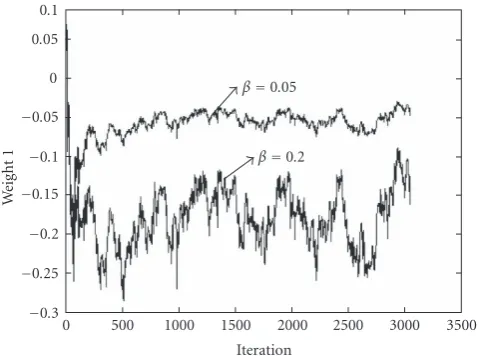
In the first simulation, to investigate the validity of the math-ematical representation of adaptive filter weights behavior, the FXLMS algorithm was simulated using the modified cost function. The primary and secondary path transfer functions were chosen as FIR models without uncertainty. SeeTable 1
−0.3
−0.25
−0.2
−0.15
−0.1
−0.05 0 0.05 0.1
W
eig
ht
1
0 500 1000 1500 2000 2500 3000 3500 Iteration
β=0.05
β=0.2
Figure3: Behavior of first adaptive filter tap (W1).
−1.4
−1.2
−1
−0.8
−0.6
−0.4
−0.2 0 0.2
W
eig
ht
2
0 500 1000 1500 2000 2500 3000 3500 Iteration
β=0.05 β=0.2
Figure4: Behavior of second adaptive filter tap (W2).
Table1: Simulation assumption.
Primary path transfer function Z−1+ 2Z−2−Z−3
Secondary path transfer function Unit delay
FIR order 4
Primary noise source Gaussian white
Power=0.0001
β 0.05, 0.2
In Figures3to6, the convergence behavior of adaptive filters coefficients is plotted forβ = .05 andβ = .2. The final values read from these plots are consistent with those computed from (16) with the secondary and primary trans-fer functions as described inTable 1.
0 0.2 0.4 0.6 0.8 1 1.2 1.4 1.6 1.8 2
W
eig
ht
3
0 500 1000 1500 2000 2500 3000 3500 Iteration
β=0.05
β=0.2
Figure5: Behavior of third adaptive filter tap (W3).
0 0.1 0.2 0.3 0.4 0.5 0.6 0.7 0.8 0.9 1
W
eig
ht
4
0 500 1000 1500 2000 2500 3000 3500 Iteration
β=0.05
β=0.2
Figure6: Behavior of fourth adaptive filter tap (W4).
The second simulation is based on the estimated sec-ondary and primary acoustical paths obtained experimen-tally in a laboratory duct, Figures9,10,11. Figures7and8
represent the control signal and the error signal in the single-channel ANC systems forβ =0 andβ=0.03, respectively.
Figure 7shows that withβ=0, control signal increases mak-ing the system nonlinear, while choosmak-ingβ =0.03 restricts the control signal amplitude and hence avoids nonlinearity.
Figure 8shows error signals in both cases after convergence, respectively. It is clear that the residual error in the FXLMS algorithm is much larger than the residual error using the modified cost function.
−1.5
−1
−0.5 0 0.5 1 1.5
C
o
nt
ro
l
sig
nal
0 200 400 600 800 1000 1200 1400 1600 1800 2000 Iteration
β=0
(a)
−1.5
−1
−0.5 0 0.5 1 1.5
C
o
nt
ro
l
sig
nal
0 200 400 600 800 1000 1200 1400 1600 1800 2000 Iteration
β=0.03
(b)
Figure7: Control signal in nonlinear system with FXLMS (a) and proposed system (b).
−0.4
−0.2 0 0.2 0.4
Er
ro
r
sig
nal
0 200 400 600 800 1000 1200 1400 1600 1800 2000 Iteration
β=0
(a)
−0.1 0 0.1 0.2 0.3
Er
ro
r
sig
nal
0 200 400 600 800 1000 1200 1400 1600 1800 2000 Iteration
β=0.03
(b)
Figure8: Residual error signal in nonlinear system with FXLMS (a) and proposed algorithm (b).
5. EXPERIMENTAL RESULTS
The laboratory setup used to implement the ANC system, pictured in Figure 9, consists of an open-ended polyvinyl chloride (PVC) duct with the following major elements: ac-tuating device named the primary speaker, a compensating
device named the secondary speaker, and an error micro-phone used to detect the residual noise.
Figure9: Laboratory setup of ANC in a duct.
−100
−90
−80
−70
−60
−50
−40
−30
−20
−10 0
dB
0 50 100 150 200 250 300 350 400 450 500 Hz
Figure10: Primary path transfer function.
Table2: Experimental characteristics.
Primary noise Pure sine wave
Frequency of primary noise 270 Hz
Amplitude of primary noise .05 V
Adaptive filter order 32
Adaptation gain .00001
Loud-speaker saturation limit 20 V
β .0173
Sampling frequency 1 KHz
The corresponding signals received by the error microphone were then measured as the outputs. Finally FIR models were estimated for both paths using the input/output signals.
The coefficients of an adaptive filter were updated us-ing an LMS algorithm. Now in order to compare the per-formance of the proposed algorithm with the conventional FXLMS, a 270 Hz sine wave was chosen as the input noise and the ANC system was run in both cases. Solving (34) for the experimental characteristics of the setup, the optimum value ofβwas obtained. SeeTable 2
The FFT of the control signal for both the FXLMS and the proposed algorithms are plotted inFigure 12. From this
−100
−90
−80
−70
−60
−50
−40
−30
−20
−10 0
dB
0 50 100 150 200 250 300 350 400 450 500 Hz
Figure11: Secondary path transfer function.
−160
−140
−120
−100
−80
−60
−40
−20 0
FFT
of
co
nt
ro
l
sig
nal
0 100 200 300 400 500 600 700 800 900 1000 Hz
FXLMS
Proposed algorithm
Figure12: FFT of control signals.
−30
−20
−10 0 10 20 30 40
FFT
of
er
ro
r
sig
nal
0 50 100 150 200 250 300 350 400 450 500 Hz
Figure13: FFT of error signal (ANC off).
−80
−70
−60
−50
−40
−30
−20
−10 0 10 20
FFT
of
er
ro
r
sig
nal
0 100 200 300 400 500 600 700 800 900 1000 Hz
FXLMS
Proposed algorithm
Figure14: FFT of error signal (ANC on).
algorithm. However, as observed from Figure 14, the error signal related to the FXLMS algorithm contains high-fre-quency components, while this is not the case for the pro-posed algorithm. Since in acoustical systems, signals with higher frequencies are better heard, an ANC system using the proposed algorithm is expected to have better performance.
6. CONCLUSION
In this paper, the behavior of the FXLMS algorithm was in-vestigated assuming a modified cost function. The modified cost function was chosen so as to avoid nonlinearity in ANC systems by applying a control signal constraint condition which was derived to guarantee the system linearity in steady
state. It was also shown how without this assumption (nor-mal FXLMS), higher harmonics in the control signal (and hence in the error signal) are activated resulting in the de-terioration of the ANC system performance. An important factor in this algorithm is that just the steady state of linear systems behavior was considered for design, and this will not guarantee linearity of system during its transient behavior.
ACKNOWLEDGMENT
The authors would like to thank Dr. B. Ghanbari and Dr. M. Hakkak from the Iran Telecommunication Research Center (ITRC) for their support.
REFERENCES
[1] S. M. Kuo and D. Morgan,Active Noise Control Systems, John Wiley & Sons, New York, NY, USA, 1996.
[2] S. J. Elliott and P. A. Nelson, “Active noise control,”IEEE Signal Processing Magazine, vol. 10, no. 4, pp. 12–35, 1993.
[3] S. J. Elliott, “Optimal controllers and adaptive controllers for multi-channel feed-forward control of stochastic distur-bances,”IEEE Transaction on Signal Processing, vol. 48, no. 4, pp. 1053–1060, 2000.
[4] M. H. Costa, J. C. M. Bermudez, and N. J. Bershad, “Stochastic analysis of the LMS algorithm with a saturation nonlinearity following the adaptive filter output,”IEEE Transactions on Sig-nal Processing, vol. 49, no. 7, pp. 1370–1387, 2001.
[5] S. J. Elliott, I. M. Stothers, and P. A. Nelson, “A multiple er-ror LMS algorithm and its application to the active control of sound and vibration,”IEEE Transactions on Acoustics, Speech, and Signal Processing, vol. 35, no. 10, pp. 1423–1434, 1987. [6] S. J. Elliott and K. H. Baek, “Effort constraints in adaptive
feed-forward control,”IEEE Signal Processing Letters, vol. 3, no. 1, pp. 7–9, 1996.
[7] X. Qui and C. H. Hansen, “A study of time domain FXLMS algorithm with control output constraint,”The Journal of the Acoustical Society of America, vol. 109, no. 6, pp. 2815–2823, 2001.
[8] X. Qui and C. H. Hansen, “Applying effort constraints on adaptive feed forward control using the active set method,”
Journal of Sound and Vibration, vol. 260, no. 4, pp. 757–762, 2003.
[9] O. J. Tobias, J. C. M. Bermude, and N. J. Bershad, “Mean weight behavior of the filtered-X LMS algorithm,”IEEE Trans-actions on Signal Processing, vol. 48, no. 4, pp. 1061–1075, 2000.
[10] R. S. Sanchez and M. Sznaier,Robust System Theory and Appli-cation, John Wiley & Sons, New York, NY, USA, 1998.
J. Poshtan received his B.S., M.S., and Ph.D. degrees in electrical engineering from Tehran University, Tehran, Iran, in 1987, Sharif University of Technology, Tehran, Iran, in 1991, and University of New Brunswick, Canada, in 1997, respectively. Since 1997, he has been with the Depart-ment of Electrical Engineering at Iran Uni-versity of Science and Technology. He is in-volved in academic and research activities in
areas such as control systems theory, system identification, and es-timation theory.
M. H. Kahaeireceived his B.S. degree from Isfahan University of Technology, Isfahan, Iran, in 1986, the M.S. degree from the Uni-versity of the Ryukyus, Okinawa, Japan, in 1994, and the Ph.D. degree in signal pro-cessing from the School of Electrical and Electronic Systems Engineering, Queens-land University of Technology, Brisbane, Australia, in 1998. He jointed the Depart-ment of Electrical Engineering, Iran