by Barry Shelby
Scotland
FOR
DUMmIES
‰4
TH EDITION
with
For Dummies
Covering the most popular destinations in North America and Europe,
For Dummies travel guides are the ultimate user-friendly trip planners.
Available wherever books are sold or go to www.dummies.com
And book it with
our online partner,
Frommers.com
Book airfare, hotels and packages
Find the hottest deals
Get breaking travel news
Enter to win vacations
Share trip photos and stories
And much more
Available wherever books are sold.
Go to www.dummies.com or call 1-877-762-2974 to order direct.
The fun and easy wa
y
™to travel!
U.S.A.
Also available:
Alaska For Dummies Arizona For Dummies Boston For Dummies California For Dummies Chicago For Dummies Colorado & the Rockies For Dummies
Florida For Dummies Los Angeles & Disneyland For Dummies
Maui For Dummies National Parks of the American West For Dummies
New Orleans For Dummies New York City For Dummies San Francisco For Dummies Seattle & the Olympic Peninsula For Dummies Washington, D.C. For Dummies
RV Vacations For Dummies Walt Disney World & Orlando For Dummies
EUROPE
Also available:
England For Dummies Europe For Dummies Germany For Dummies Ireland For Dummies London For Dummies
Paris For Dummies Scotland For Dummies Spain For Dummies
OTHER DESTINATIONS
Also available:
Bahamas For Dummies Cancun & the Yucatan For Dummies Costa Rica For Dummies Mexico’s Beach Resorts For Dummies
Montreal & Quebec City For Dummies
Vancouver & Victoria For Dummies
by Barry Shelby
Scotland
FOR
DUMmIES
‰4
TH EDITION
Scotland For Dummies, 4th Edition
Published by
Wiley Publishing, Inc.
111 River St.
Hoboken, NJ 07030-5774
www.wiley.com
Copyright © 2007 by Wiley Publishing, Inc., Indianapolis, Indiana Published simultaneously in Canada
No part of this publication may be reproduced, stored in a retrieval system, or transmitted in any form or by any means, electronic, mechanical, photocopying, recording, scanning, or otherwise, except as permit-ted under Sections 107 or 108 of the 1976 Unipermit-ted States Copyright Act, without either the prior written permission of the Publisher, or authorization through payment of the appropriate per-copy fee to the Copyright Clearance Center, 222 Rosewood Drive, Danvers, MA 01923, 978-750-8400, fax 978-646-8600. Requests to the Publisher for permission should be addressed to the Legal Department, Wiley Publishing, Inc., 10475 Crosspoint Blvd., Indianapolis, IN 46256, 317-572-3447, fax 317-572-4355, or online at http:// www.wiley.com/go/permissions.
Trademarks: Wiley, the Wiley Publishing logo, For Dummies, the Dummies Man logo, A Reference for the Rest of Us!, The Dummies Way, Dummies Daily, The Fun and Easy Way, Dummies.com and related trade dress are trademarks or registered trademarks of John Wiley & Sons, Inc., and/or its affiliates in the United States and other countries, and may not be used without written permission. Frommer’s is a trade-mark or registered tradetrade-mark of Arthur Frommer. Used under license. All other tradetrade-marks are the prop-erty of their respective owners. Wiley Publishing, Inc., is not associated with any product or vendor mentioned in this book.
LIMIT OF LIABILITY/DISCLAIMER OF WARRANTY: THE PUBLISHER AND THE AUTHOR MAKE NO REPRESENTATIONS OR WARRANTIES WITH RESPECT TO THE ACCURACY OR COMPLETENESS OF THE CONTENTS OF THIS WORK AND SPECIFICALLY DISCLAIM ALL WARRANTIES, INCLUDING WITH-OUT LIMITATION WARRANTIES OF FITNESS FOR A PARTICULAR PURPOSE. NO WARRANTY MAY BE CREATED OR EXTENDED BY SALES OR PROMOTIONAL MATERIALS. THE ADVICE AND STRATEGIES CONTAINED HEREIN MAY NOT BE SUITABLE FOR EVERY SITUATION. THIS WORK IS SOLD WITH THE UNDERSTANDING THAT THE PUBLISHER IS NOT ENGAGED IN RENDERING LEGAL, ACCOUNTING, OR OTHER PROFESSIONAL SERVICES. IF PROFESSIONAL ASSISTANCE IS REQUIRED, THE SERVICES OF A COMPETENT PROFESSIONAL PERSON SHOULD BE SOUGHT. NEITHER THE PUBLISHER NOR THE AUTHOR SHALL BE LIABLE FOR DAMAGES ARISING HEREFROM. THE FACT THAT AN ORGA-NIZATION OR WEBSITE IS REFERRED TO IN THIS WORK AS A CITATION AND/OR A POTENTIAL SOURCE OF FURTHER INFORMATION DOES NOT MEAN THAT THE AUTHOR OR THE PUBLISHER ENDORSES THE INFORMATION THE ORGANIZATION OR WEB SITE MAY PROVIDE OR RECOMMEN-DATIONS IT MAY MAKE. FURTHER, READERS SHOULD BE AWARE THAT INTERNET WEB SITES LISTED IN THIS WORK MAY HAVE CHANGED OR DISAPPEARED BETWEEN WHEN THIS WORK WAS WRITTEN AND WHEN IT IS READ.
PLEASE BE ADVISED THAT TRAVEL INFORMATION IS SUBJECT TO CHANGE AT ANY TIME AND THIS IS ESPECIALLY TRUE OF PRICES. WE THEREFORE SUGGEST THAT READERS WRITE OR CALL AHEAD FOR CONFIRMATION WHEN MAKING TRAVEL PLANS. THE AUTHOR AND THE PUBLISHER CANNOT BE HELD RESPONSIBLE FOR THE EXPERIENCES OF READERS WHILE TRAVELING.
For general information on our other products and services, please contact our Customer Care Department within the U.S. at 800-762-2974, outside the U.S. at 317-572-3993, or fax 317-572-4002. For technical support, please visit www.wiley.com/techsupport.
Wiley also publishes its books in a variety of electronic formats. Some content that appears in print may not be available in electronic books.
Library of Congress Control Number: 2007923989 ISBN: 978-0-470-06930-1
About the Author
Barry Shelbywas born in 1960 in Berkeley, California, where he
graduated from the University of California in 1982. He later received a master’s degree in journalism from Northwestern University in Illinois.
For 13 years, he was an editor at World Press Reviewmagazine in
Man-hattan. Since moving to Scotland in 1997, Shelby has been a castle care-taker on the Clyde Coast, a “temp” with the national railway company, and a freelance contributor to newspapers and magazines, including the Guardian, Glasgow Herald,and The Listmagazine, among others. The
author of Frommer’s Edinburgh & Glasgowguide, he is married to a Scot
Editorial
Editors: Jamie Ehrlich, Development
Editor; M. Faunette Johnston, Production Editor
Copy Editor: Jennifer Connolly
Cartographers:Elizabeth Puhl;
Roberta Stockwell
Editorial Assistant: Melinda Quintero
Senior Photo Editor:Richard Fox
Cover Photos: Front cover,
© Clay Perry/Corbis; back cover, © Greg Gawlowski/Lonely Planet Images
Cartoons: Rich Tennant
(www.the5thwave.com)
Composition Services
Project Coordinator:Lynsey Osborn
Layout and Graphics: Claudia Bell,
Joyce Haughey, Barbara Moore, Julie Trippetti
Special Art:Anniversary Logo Design:
Richard Pacifico
Proofreaders:Laura Albert,
John Greenough, Aptara
Indexer:Aptara
Publishing and Editorial for Consumer Dummies
Diane Graves Steele, Vice President and Publisher, Consumer Dummies
Joyce Pepple, Acquisitions Director, Consumer Dummies
Kristin A. Cocks, Product Development Director, Consumer Dummies
Michael Spring, Vice President and Publisher, Travel
Kelly Regan,Editorial Director, Travel
Publishing for Technology Dummies
Andy Cummings,Vice President and Publisher, Dummies Technology/
General User
Composition Services
Gerry Fahey,Vice President of Production Services
Debbie Stailey,Director of Composition Services
Publisher’s Acknowledgments
We’re proud of this book; please send us your comments through our Dummies
online registration form located at www.dummies.com/register/.
Contents at a Glance
Introduction ...1
Part I: Introducing Scotland ...7
Chapter 1: Discovering the Best of Scotland ...9
Chapter 2: Digging Deeper into Scotland ...21
Chapter 3: Deciding Where and When to Go ...35
Chapter 4: Following an Itinerary: Five Fine Options ...51
Part II: Planning Your Trip to Scotland...61
Chapter 5: Managing Your Money ...63
Chapter 6: Getting to Scotland ...78
Chapter 7: Getting Around Scotland ...85
Chapter 8: Booking Your Accommodations ...94
Chapter 9: Catering to Special Travel Needs or Interests ...101
Chapter 10: Taking Care of the Remaining Details ...107
Part III: Edinburgh and Glasgow...117
Chapter 11: Edinburgh...119
Chapter 12: Glasgow ...186
Chapter 13: Going Beyond Edinburgh and Glasgow: Day Trips...254
Part IV: The Major Regions...265
Chapter 14: Southern Scotland...267
Chapter 15: Ayrshire and Argyll ...283
Chapter 16: Fife to the Trossachs...307
Chapter 17: Tayside and the Northeast...332
Chapter 18: The Highlands ...345
Chapter 19: Hebridean Islands ...368
Chapter 20: Orkney and Shetland Islands ...389
Part V: The Part of Tens ...401
Chapter 21: Ten Outstanding Golf Courses...403
Chapter 22: Ten Can’t-Miss Castles and Historic Sites ...406
Chapter 23: Ten Distinctive Distilleries ...409
Chapter 24: Ten Stunning Natural Attractions ...412
Appendix: Quick Concierge...415
Maps at a Glance
Edinburgh Orientation ...126
Edinburgh Accommodations ...130
Edinburgh Dining ...140
Edinburgh Attractions ...156
Glasgow Orientation...195
Glasgow Accommodations ...198
Glasgow Dining ...206
Glasgow Attractions ...220
Day Trips from Edinburgh ...255
Day Trips from Glasgow...257
Southern Scotland ...269
Ayrshire ...285
Argyll ...287
Oban ...289
Fife ...309
St. Andrews ...319
Around Stirling and the Trossachs...321
Stirling ...323
Tayside and the Northeast ...335
The Highlands ...347
Inverness ...357
Hebridean Islands...371
The Isle of Skye ...373
The Shetland Islands ...391
Table of Contents
Introduction ...1
About This Book...1
Conventions Used in This Book ...2
Foolish Assumptions ...3
How This Book Is Organized...4
Part I: Introducing Scotland...4
Part II: Planning Your Trip to Scotland...4
Part III: Edinburgh and Glasgow...4
Part IV: The Major Regions ...4
Part V: The Part of Tens ...4
Icons Used in This Book...5
Where to Go from Here...5
Part I: Introducing Scotland ...7
Chapter 1: Discovering the Best of Scotland ...9
The Best Travel Experiences ...9
The Best Accommodations in Edinburgh and Glasgow...10
Edinburgh ...10
Glasgow ...11
The Best Small and Country House Hotels...11
The Best Dining in Edinburgh and Glasgow ...12
Edinburgh ...12
Glasgow ...13
The Best Rural Restaurants ...13
The Best Castles...14
The Best Cathedrals, Churches, and Abbeys ...15
The Best Art Galleries ...15
The Best Museums and Historic Attractions ...16
The Best Historic Houses and Gardens...17
The Best Small Towns ...18
The Best Distilleries...19
The Best Golf Courses ...19
The Best Pubs and Bars ...20
Chapter 2: Digging Deeper into Scotland ...21
Scotland 101: The Main Events ...21
Early history ...22
The Dark and Middle Ages...22
Union and the Jacobites...23
The Scottish Enlightenment and economic growth ...24
The 20th and 21st centuries ...25
Taste of Scotland: Not just Haggis or Haddock ...25
Braving the Burr: Scottish English...27
Gaelic and Scots...28
Pub Life in Scotland ...29
Join ’em for a pint of beer...29
Whisky galore ...30
Other cocktail concoctions ...30
Tuning Your Ear to Scottish Music ...30
Visiting Golf’s Hallowed Ground ...31
Exploring Scotland’s Great Outdoors ...31
Background Check: Recommended Movies and Books ...32
Films ...32
Books...33
Chapter 3: Deciding Where and When to Go ...35
Going Everywhere You Want to Be ...35
Edinburgh and Glasgow ...36
Southern Scotland ...37
Ayrshire and Argyll ...37
Fife and the Trossachs ...38
Tayside and Northeast Scotland...38
The Highlands ...39
The Hebridean Islands ...39
Shetland and Orkney islands...39
Scheduling Your Time...40
Mild weather thanks to the Gulf Stream ...40
Here comes the sun ...41
Revealing the Secrets of the Seasons ...41
Summer ...41
Fall ...42
Winter...43
Spring ...44
Perusing a Calendar of Events...45
January...45
February...45
March ...46
April ...46
May ...46
June...47
July...48
September...49
October ...49
November ...50
December...50
Chapter 4: Following an Itinerary:
Five Fine Options...51
Seeing Many Highlights in One Week...52
Day 1 ...52
Day 2 ...52
Day 3 ...52
Day 4 ...52
Day 5 ...53
Day 6 ...53
Day 7 ...53
Touring the Best of Scotland in Two Weeks ...53
Days 1, 2, and 3...53
Day 4 ...54
Day 5 ...54
Days 6 and 7...54
Day 8 ...54
Day 9 ...54
Day 10 ...54
Day 11 ...55
Day 12 ...55
Day 13 ...55
Day 14 ...55
Discovering Scotland with Kids ...55
Touring Scotland’s Great Highlands ...56
Touring the Western Highlands and Islands...57
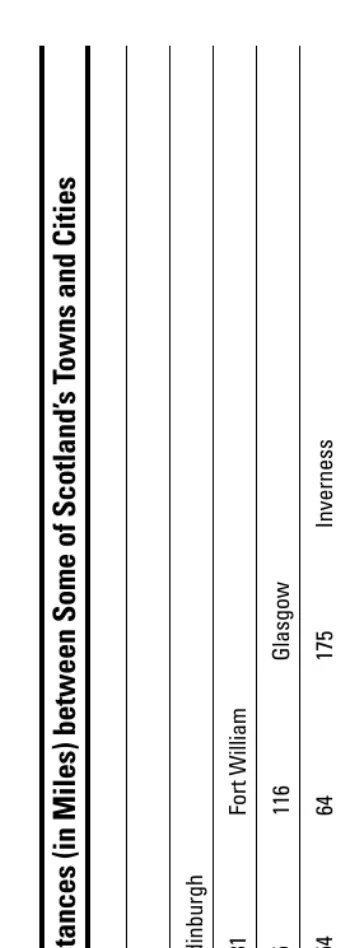
Planning Your Trip: Mileage Chart...58
Part II: Planning Your Trip to Scotland...61
Chapter 5: Managing Your Money ...63
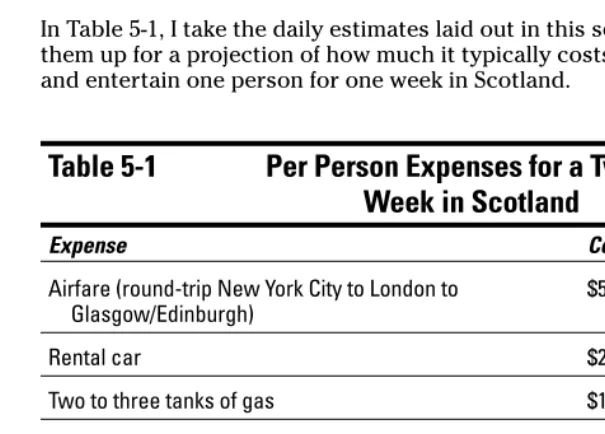
Planning Your Budget ...64
Transportation ...64
Lodging...64
Dining ...65
Sightseeing...65
Shopping ...65
Nightlife...66
Cutting Costs without Cutting the Fun...66
Handling Money ...70
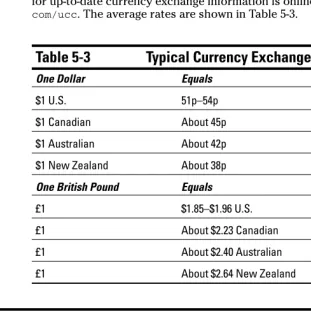
The local currency: What it’s worth to you...71
Charging ahead with credit cards...74
Toting traveler’s checks...74
Taking Taxes into Account...75
Protecting Yourself and Your Money...76
Chapter 6: Getting to Scotland ...78
Flying to Scotland...78
Identifying your airline options ...78
Getting the best deal on your airfare ...79
Booking your flight online ...80
Taking the Train ...80
Joining an Escorted Tour ...82
Choosing a Package Tour ...83
Chapter 7: Getting Around Scotland ...85
Getting Around by Car...86
Safety tips to know before you get behind the wheel...88
Renting a Car ...88
Taking the Train ...91
Seeing Scotland by Bus ...92
Finally, by Ferry...93
Chapter 8: Booking Your Accommodations ...94
Getting to Know Your Options ...94
Knowing What You’ll Pay ...95
Determining Your Accommodations Needs...96
Hotels ...96
Bed-and-breakfasts (B&Bs)...97
Self-catering cottages ...97
Hostels...98
Finding the Best Room at the Best Rate...99
Surfing the Web for hotel deals...100
Chapter 9: Catering to Special Travel
Needs or Interests...101
Traveling with the Brood: Advice for Families ...101
Getting to Scotland and exploring with kids ...102
Finding a family-friendly hotel ...103
Making Age Work for You: Advice for Seniors ...103
Accessing Scotland: Advice for Travelers with Disabilities ...104
Travel agencies and organizations ...104
Transportation ...105
Following the Rainbow: Advice for Gay and Lesbian Travelers ...105
Chapter 10: Taking Care of the Remaining
Details ...107
Getting a Passport...107
Applying for a U.S. passport...107
Applying for other passports ...108
Playing It Safe with Travel and Medical Insurance ...109
Trip-cancellation insurance...109
Medical insurance...109
Lost luggage insurance ...110
Staying Healthy When You Travel...110
Staying Connected by Cellphone or E-mail...111
Using a cellphone outside the U.S. ...111
Accessing the Internet ...112
Scotland Unplugged: Getting Your Electric Stuff to Work ...113
Keeping Up with Airline Security Measures ...114
Part III: Edinburgh and Glasgow...117
Chapter 11: Edinburgh...119
Getting to Edinburgh ...120
By air ...120
By train...121
By bus...121
By car ...122
Orienting Yourself in Edinburgh...122
Introducing the neighborhoods ...123
Finding information after you arrive ...125
Getting Around Edinburgh ...125
By bus...125
By taxi...128
By car ...128
By bicycle...129
On foot...129
Staying in Style ...129
The top hotels ...132
Runner-up hotels and B&Bs ...137
Dining Out ...138
Prices...139
Tipping ...139
Smoking...142
The top restaurants and cafes ...142
Exploring Edinburgh ...153
The top attractions...154
Guided tours...167
Suggested one-, two-, and three-day itineraries...169
Taking a walking tour ...170
Shopping in Edinburgh ...173
Best shopping areas ...174
Shopping complexes ...174
What to look for and where to find it ...174
Living It Up After Dark ...178
The performing arts ...178
Bars and pubs ...182
Going to the cinema...183
Fast Facts: Edinburgh ...183
Chapter 12: Glasgow ...186
Getting to Glasgow...187
By air ...187
By train...188
By bus...189
By car ...189
Orienting Yourself in Glasgow ...190
Introducing the neighborhoods ...191
Finding information after you arrive ...194
Getting Around Glasgow ...194
By subway...194
By bus...196
By taxi...196
By car ...196
By bicycle...197
On foot...197
Staying in Style ...197
The top hotels and B&Bs ...200
Runner-up hotels and B&Bs ...204
Dining in Glasgow...205
Prices...208
Tipping ...208
Smoking...208
The top restaurants and cafes ...209
Exploring Glasgow ...219
The top attractions...222
More cool things to do and see...229
Guided tours...232
Suggested one-, two-, and three-day itineraries...233
Shopping in Glasgow ...239
Best shopping areas ...239
Shopping complexes ...240
What to look for and where to find it ...240
Living It Up After Dark ...244
The performing arts ...245
Comedy ...246
Dance clubs ...247
Folk music...247
Rock, pop, and jazz...247
Some top bars and pubs ...248
Going to the movies...251
Fast Facts: Glasgow...252
Chapter 13: Going Beyond Edinburgh
and Glasgow: Day Trips ...254
East Lothian ...254
Getting there...256
Orienting yourself ...256
Seeing the sights ...256
Dining locally...259
West Lothian ...260
Getting there...260
Orienting yourself ...260
Seeing the sights ...261
Dining locally...262
The Clyde Valley...262
Getting there...263
Seeing the sights ...263
West of Glasgow ...263
Part IV: The Major Regions...265
Chapter 14: Southern Scotland ...267
Getting There ...267
Spending the Night...268
Dining Locally ...272
Exploring Southern Scotland...273
The top attractions...274
More cool things to see and do...279
Shopping for Local Treasures...280
Hitting the Local Pubs ...281
Chapter 15: Ayrshire and Argyll ...283
Getting There ...284
Spending the Night...286
Dining Locally ...293
Exploring Ayrshire and Argyll ...296
The top attractions...297
Golfing heavens: Troon and Turnberry ...301
Other cool things to see and do ...303
Shopping for Local Treasures...305
Doing the Pub Crawl ...305
Fast Facts: Ayrshire and Argyll...306
Chapter 16: Fife to the Trossachs...307
Getting to Fife and the Trossachs ...308
Spending the Night...308
Dining Locally ...313
Exploring Fife to the Trossachs...317
The top attractions...318
More cool things to see and do...328
Shopping for Local Treasures...329
Doing the Pub Crawl ...330
Fast Facts: Fife and the Central Highlands...331
Chapter 17: Tayside and the Northeast...332
Getting There ...333
Spending the Night...333
Dining Locally ...337
Exploring Tayside and the Northeast...338
The top attractions...339
Other cool things to see and do ...342
Shopping for Local Treasures...343
Doing the Pub Crawl ...343
Fast Facts: Tayside to the Northeast ...344
Chapter 18: The Highlands ...345
Getting There ...346
Spending the Night...346
Dining Locally ...353
Exploring the Highlands...355
Guided tours...356
The top attractions...356
Other cool things to see and do ...365
Shopping in the Highlands...366
Doing the Pub Crawl ...366
Chapter 19: Hebridean Islands ...368
Getting to the Islands ...369
Spending the Night...370
Dining Locally ...377
Exploring the Hebrides...379
The top attractions...380
Other cool things to see and do ...386
Shopping the Hebridean Islands ...387
Doing the Pub Crawl ...388
Fast Facts: The Hebridean Islands ...388
Chapter 20: Orkney and Shetland Islands ...389
Getting There ...390
Spending the Night and Dining Locally ...391
Exploring Orkney and Shetland ...394
Joining a guided tour...395
The top attractions...395
Other Cool Things to See and Do ...398
Fast Facts: Orkney and Shetland...398
Part V: The Part of Tens ...401
Chapter 21: Ten Outstanding Golf Courses...403
Carnoustie...403
Gairloch Golf Club...403
Muirfield ...404
Prestwick...404
Royal Dornoch Course ...404
Royal Troon ...404
St. Andrews ...404
Traigh...405
Turnberry...405
Western Gailes ...405
Chapter 22: Ten Can’t-Miss Castles
and Historic Sites...406
Bannockburn ...406
Calanais Standing Stones ...406
Castle Tioram ...407
Culloden Moor Battlefield ...407
Culzean Castle ...407
Doune Castle...407
Eilean Donan Castle ...407
Glasgow Cathedral ...408
Melrose Abbey...408
Chapter 23: Ten Distinctive Distilleries...409
Caol Ila ...409
Dalwhinnie ...409
Edradour ...410
Glenfiddich...410
Glen Grant ...410
Glenlivet ...410
The Glenturret ...410
Laphroaig ...411
Strathisla ...411
Talisker ...411
Chapter 24: Ten Stunning Natural Attractions ...412
Ardnamurchan Peninsula...412
Arthur’s Seat and Holyrood Park ...412
Cuillin Hills ...413
Fingal’s Cave ...413
Glen Coe ...413
Inverewe Garden ...413
Loch Lomond...414
Loch Ness...414
Sands of Morar ...414
Sandwood Bay ...414
Appendix: Quick Concierge ...415
Fast Facts ...415
Toll-Free Numbers and Web Sites ...418
Where to Get More Information ...420
Introduction
T
his guide is a departure from conventional travel guidebooks. Ratherthan just throwing out dizzying reams of information for you to sift through until you’re too tired to distinguish Edinburgh from Inverness, Scotland For Dummies,4th Edition, separates the old wheat from the chaff (so you don’t have to).
This book walks you through the whole process of putting together your trip to Scotland, from the ins and outs of a manageable itinerary to advice on choosing the right places to stay or how much time to allot for attrac-tions and activities. My recommendaattrac-tions may not be perfect for every-one, of course. The goal here is to help you see what may interest you (whether it’s castles, museums, pubs, or open countryside) and what probably will not. Your time is valuable, so this book strives to get right
to the point. Scotland For Dummies,4th Edition, is designed to give you a
clear picture of what you need to know and what your options are, so that you can make informed decisions easily and efficiently about travel-ing in Scotland.
About This Book
Some parts of Scotland are bound to interest you more than others, so don’t feel as if you have to read this book cover to cover. If you want to focus on the metropolitan life, for example, then simply concentrate on Part III’s chapters devoted to Edinburgh and Glasgow. If the lore of the Loch Ness monster, or the lure of the Hebridean islands, intrigues you, then you can find valuable information in Part VI. And if you’re drawn to picturesque settings that are less touristy than the famous attractions,
then Scotland For Dummies,4th Edition, can point you in the right
direc-tion as well.
Although the information is laid out in the logical order of a step-by-step manual, you don’t need to read the book in order from front to back. You’re also not expected to remember everything you read — you can just look up and revisit specific information as you need it. Each section and chapter is as self-contained as possible, a feature that allows you to concentrate on what’s important to you (and skip the rest).
Please be advised that travel information is subject to change at any time — and this is especially true of prices. It never hurts to check the Internet or write or call ahead for confirmation of the “current” situation when making your travel plans. The author, editors, and publisher can’t be held responsible for the experiences of readers while traveling. Your safety is important to us, however, so we encourage you to stay alert and be aware of your surroundings. Keep a close eye on cameras, purses, and wallets, all favorite targets of thieves and pickpockets.
Conventions Used in This Book
The goal of Scotland For Dummies,4th Edition, is to be a quick read in
any order that you desire, so the listings for hotels, restaurants, and sights are consistently standardized throughout the chapters. Each list-ing offers you an idea of what the place is like and then gives you details about specific addresses, prices, and hours of operation.
Other conventions include:
Abbreviations for commonly accepted credit cards used
through-out this book.
• AE: American Express
• DC: Diners Club
• MC: MasterCard
• V: Visa
An alphabetical listing of hotels, restaurants, and attractions in
each chapter.
Page references for maps, given whenever possible, to help you
locate hotels, restaurants, attractions, and the like. If a hotel, restaurant, or attraction is in an out-of-the-way area, however, it may not appear on a map. In chapters on the major cities, informa-tion about bus routes, and, in Glasgow, subway stops, is given as well.
Dummies Post-it
®Flags
As you’re reading this book, you’ll come across information that you may want to ref-erence as you plan or enjoy your trip — whether it be a new hotel, a must-see
attrac-tion, or a must-try walking tour. Use the handy Post-it®Flags included in this book to
Prices listed in British pounds sterling (£), with the dollar equiva-lent given in parentheses. The conversion rate (always changing in the real world, of course) used to make these calculations is £1 equals $1.85.
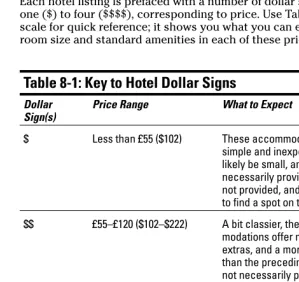
Price is normally a factor when choosing hotels and restaurants. The rel-ative costs of accommodations and meals are indicated with dollar signs. Specific prices are given, too, but the dollar signs are a quick way for you to see if a place is in your price category before reading any more information. My scale for accommodations and restaurants ranges from one dollar sign ($) to four ($$$$). Most hotel prices are per night for double rooms (rather than per person per night). The cost of a meal gen-erally means dinner with at least two courses and a drink per person. The following table helps you decipher what the dollar signs mean.
Cost Hotel Restaurant
$ Less than £55 ($100) About £10 ($19)
$$ £55–£120 ($100–$225) £10–£25 ($19–$48)
$$$ £121–£175 ($226–$330) £26–£35 ($50–$70)
$$$$ More than £176 ($332) More than £35 ($70)
The hotels in Chapters 11 and 12 are divided into two categories — favorites and those that don’t quite make my preferred list, but still get my seal of approval. Don’t hesitate to consider the “runner-up” hotels — the amenities and the services they offer make them all reasonable choices as you decide where to rest your head at night.
Foolish Assumptions
This book makes some assumptions about you and what your needs may be as a traveler. Here’s what I’ve assumed about you.
You’re an experienced traveler who hasn’t had much time to
explore Scotland but wants expert advice when you finally do get a chance to enjoy any part of the region.
You’re an inexperienced traveler looking for guidance when
deter-mining whether to take a trip to Scotland and how to plan for it.
You’re not looking for a book that provides all the information
avail-able about Scotland or that lists every hotel, restaurant, or attrac-tion available to you. Instead, you want a book that focuses on the places that will give you the best or most unique experience in Scotland.
If you fit any of these criteria, then Scotland For Dummies,4th Edition, is
How This Book Is Organized
Scotland For Dummies,4th Edition, consists of five parts. The chapters within each part cover specific components in detail.
Part I: Introducing Scotland
This part introduces you to the very best of Scotland and touches on issues you need to consider before actually getting down to the nitty-gritty of trip planning. It includes a brief history of Scotland as well as recommended reading, when and where to go, and detailed itineraries to consider.
Part II: Planning Your Trip to Scotland
This part gets down to the nuts and bolts of travel planning, including information on managing your money, how best to get to Scotland, get-ting around the country, and reserving hotel rooms. It also addresses special considerations for families, seniors, travelers with disabilities, and students, as well as gay and lesbian travelers.
Part III: Edinburgh and Glasgow
You may only have time to see the two major cities in Scotland, and so I’ve devoted an entire chapter to each, with details on hotels, restau-rants, top attractions, shopping, walking tours, and nightlife. Plus, you can find information on how to get around, how much time you need to see things, suggested itineraries, and recommended side trips.
Part IV: The Major Regions
This part offers chapters on Scotland’s major regions: from Southern Scotland to the Highlands, from Ayrshire and Argyll to the Hebridean Islands. Each chapter has suggestions on accommodations, places to dine out, and attractions, not to mention some useful information on shopping and nightlife. For a more thorough overview of Scotland, including a brief description of these regions, flip to Chapter 3.
Part V: The Part of Tens
Every For Dummiesbook has a Part of Tens. These more breezy chapters
have quick and handy lists that highlight the best golf courses, castles, natural attractions, and more in Scotland.
In the back of this book, I’ve included an appendix— your Quick
Icons Used in This Book
You can’t miss the icons (little pictures) sprinkled throughout the mar-gins of this book. Think of them as signposts that highlight special tips, draw your attention to things you don’t want to miss, and give you a heads-up on a variety of topics.
Keep an eye out for the Bargain Alert icon as you seek out money-saving tips and/or great deals.
Best of the Best icons highlight the best each destination has to offer in all categories — hotels, restaurants, attractions, activities, shopping, and nightlife.
Watch for the Heads Up icon to identify annoying or potentially danger-ous situations such as tourist traps, unsafe neighborhoods, budgetary rip-offs, and other things to beware.
This icon points to useful advice on things to do and ways to schedule your time.
Look to the Kid Friendly icon for attractions, hotels, restaurants, and activities that are particularly hospitable to children or people traveling with kids.
This icon points out secret little finds or useful resources that are worth the extra bit of effort to get to or find.
Where to Go from Here
This travel guide isn’t designed to be read from beginning to end (although you’re certainly welcome to do so). Instead, it provides detailed and well-organized information on loads of topics — from get-ting your passport to finding the best restaurants. So, choose your own adventure and look for the topics or destinations you want to explore by using the Table of Contents or the Index.
Part I
In this part . . .
S
cotland — with its rich, evocative past — has much tooffer the traveler. But visitors don’t come here just for the history: The country’s vibrant cities, natural beauty, indigenous culture, and friendly people are all additional draws.
Chapter 1
Discovering the Best
of Scotland
In This Chapter
Staying in the top hotels and dining in the best restaurants
Discovering the best castles and museums
Drinking in the best pubs and bars
T
o start things off, I begin with some of the highlights: the best thatScotland has to offer visitors, from memorable travel experiences, excellent hotels, or top-rated restaurants to first-class castles, museums, golf courses, pubs, and more. (Each entry is listed not by preference, however, but in alphabetical order under each main heading.) Many of these are highlighted by those alluring “Best of the Best” icons when they appear elsewhere in this book: So keep your eyes peeled.
The Best Travel Experiences
Ardnamurchan Peninsula:One of the more easily reached but
seemingly remote areas of the Highlands, the peninsula is the most westerly point in the entire British mainland. See Chapter 18.
Butt of Lewis:On the Isle of Lewis, these beautiful high cliffs over
the ocean have views that are worth the drive to the tip of the island. You can see seabirds, seals, and spectacular windblown waves crashing against the rocks. See Chapter 19.
Edinburgh Old Town:This area is probably the most visited
loca-tion in Scotland and not without good reason. Running along the spine of a hill and extending from the castle to the Palace of Holyroodhouse, Old Town is a delight to wander through. Make sure you take time to explore the alleyways. See Chapter 11.
Glasgow City Centre:This area shows off the thriving heart of a
Glen Coe:With a visitor center near Glencoe village, Glen Coe is such a beautiful valley that it’s hard to reconcile the natural beauty with the bloody historical event that took place there. See Chapter 18.
The Hebrides: If you like unspoiled scenery, windswept sands,
quiet country lanes, craggy shorelines, and the occasional ferry ride, then you must go to see some of the islands off of Scotland’s west coast. See Chapter 19.
Loch Lomond:Located quite near Glasgow, this loch is the largest
inland body of water in all of Great Britain. It’s only about a 30- to 45-minute drive or train ride from the Glasgow city limits. When you reach the loch, you can hike, canoe, or just relax. See Chapter 16.
Loch Ness:This loch is mysterious and legendary — if somewhat
overrated. In addition to looking for the elusive monster, you should seek out other local attractions, such as Urquhart Castle. See Chapter 18.
Sands of Morar:Near Mallaig, the Sands of Morar offer beautiful
bleached beaches set against postcard-pretty seas. You can see the Hebridean islands Rhum and Eigg from here. See Chapter 18.
Sandwood Bay:This area near Blairmore has a beach that, by most
accounts, is the most beautiful and unsullied in all of Great Britain’s mainland. See Chapter 18.
The Best Accommodations
in Edinburgh and Glasgow
Edinburgh
Best Boutique Hotel: The Bonham.In an upscale, western New
Town neighborhood, The Bonham offers some of the most alluring accommodations in a city filled with fine hotels. See Chapter 11.
Best Traditional Hotel: Balmoral.With a Michelin-star restaurant,
doormen in kilts, and a romantic pile to rival any others, Balmoral is legendary, and its location is smack in the heart of the capital. See Chapter 11.
Best Rooms near the Castle: The Witchery by the Castle.As its list
of celebrity guests testifies, the Witchery offers opulence and indi-viduality in a manner not seen anywhere else in the Old Town. See Chapter 11.
Best Hotel in Leith: Malmaison.At the port of Leith, Malmaison is
Best Hotel Health Spa: Sheraton Grand.Near the city’s conference center, the Sheraton Grand has wonderful facilities in an adjoining building. Especially noteworthy is the roof-top indoor/outdoor pool. See Chapter 11.
Glasgow
Best Boutique Hotel: One Devonshire Gardens.In a West End
neighborhood filled with similar sandstone-fronted town houses, One Devonshire Gardens still stands out. It’s a re-creation of a high-bourgeois, very proper Scottish home from the early 1900s, boast-ing antique furnishboast-ings and discreetly concealed modern comforts. See Chapter 12.
Best Hip Hotel: Brunswick Hotel.With only 18 rooms, the
Brunswick Hotel exudes cool in the city’s Merchant City. The design is modern and minimalist but is executed with character and class. See Chapter 12.
Best in the Commercial Centre: Malmaison.Linked to the hotel
with the same name in Edinburgh (see listing in previous section), this Malmaison is in a building that dates from the 1800s. It wel-comes visitors with Scottish hospitality and houses them with quite a bit of style. See Chapter 12.
Best Moderately Priced Hotel: The Town House.Near One
Devonshire Gardens, it may lack that hotel’s posh quotient, but this small guest house is very comfortable and pretty classy, too. See Chapter 12.
The Best Small and Country House Hotels
An Lochan,Tighnabruaich, Argyll: Formerly the Royal, this hotel
dates to the mid–19th century, but today it is fully modernized inside, with plush rooms that overlook the sea and the hotel’s own moorings. Great fish and seafood, too. See Chapter 15.
Ardanaiseig,Kilchrenan, Argyll: This stone Scottish baronial pile
built in the 1830s offers a bit of luxury in an out-of-the-way corner. See Chapter 15.
Argyll Hotel,Iona, the Hebrides: This charming traditional hotel in
the village of Iona is comfortable and environmentally conscious, with its own organic garden and an ethos of not disturbing the frag-ile island ecology. See Chapter 19.
Ballachulish House,Ballachulish, the Highlands: This 17th-century
laird’s house includes a history said to be the inspiration for key
passages in Robert Louis Stevenson’s masterpiece, Kidnapped.See
Darroch Learg,Ballater, the Northeast: This hotel is one of the more highly regarded hotels in the Royal Deeside region near the Queen’s estate at Balmoral. See Chapter 17.
Glenapp Castle,Ballantrae, South Ayrshire: Glenapp is a beautifully
decorated pile close to Stranraer, with Victorian baronial splendor and antiques, oil paintings, and elegant touches. See Chapter 14.
Glengarry Castle Hotel,Invergarry, the Highlands: The 26-room
Victorian mansion, with its own castle ruins (the real Glengarry Castle), is on extensive wooded grounds with nice views of Loch Oich. See Chapter 18.
Knockinaam Lodge,near Portpatrick, Dumfries, and Galloway:
With a Michelin-star restaurant, Knockinaam combines exquisite meals with a secluded seaside setting on the Rhinns of Galloway. See Chapter 14.
Prestonfield,Edinburgh: Although in the city, this hotel rises
in Jacobean splendor amid gardens, pastures, and woodlands below Arthur’s Seat on the south side of the Scottish capital. See Chapter 11.
The Best Dining in Edinburgh and Glasgow
Edinburgh
Best French Restaurant: Restaurant Martin Wishart.With one of
the city’s precious Michelin stars and its most talented chef/owner, Restaurant Martin Wishart is where the leading out-of-town chefs dine when they visit Edinburgh. See Chapter 11.
Best Cafe: Spoon.In the heart of Old Town, Spoon forks out some
the best salads and sandwiches in Edinburgh — and the freshly made soups are even better. See Chapter 11.
Best Italian Restaurant: Santini.Although many of the more
estab-lished Italian restaurants in town don’t like hearing it, Santini con-tinually gets rave reviews and sets the highest standards. See Chapter 11.
Best Modern Scottish Restaurant: Atrium.Owned by Andrew and
Lisa Radford, Atrium offers dishes prepared with flair and imagina-tion but not excessive amounts of fuss or over-fancy presentaimagina-tion. See Chapter 11.
Best Restaurant Views: Olorosoor Forth Floor.This category is a
Glasgow
Best Fine Dining Restaurant: Michael Caines @ ABode.A fairly
new arrival, but the eponymous owner/chef has two Michelin stars to his name. The staff he has hired for this branch in Glasgow has aspirations for stars of their own. See Chapter 12.
Best Indian Restaurant: The Dhabba.Glasgow loves its Indian
cui-sine, but this restaurant offers something a bit better than most, favoring dishes from the northern part of the subcontinent. See Chapter 12.
Best Modern Scottish Restaurant: The Wild Bergamot.In the
northwestern suburbs of the city, this tiny restaurant offers some of the most ambitious cooking in greater Glasgow, using mostly local and seasonal ingredients. See Chapter 12.
Best Cafe: Cafe Gandolfi.Perhaps more of a bistro than cafe, Café
Gandolfi offers straightforward and delicious dishes, whether you choose a bowl of Cullen skink (smoked haddock chowder) or a sir-loin steak sandwich. See Chapter 12.
Best Pub Food: Stravaigin.With an award-winning restaurant in
the basement, the ground floor pub Stravaigin offers similarly top-notch quality food — at a fraction of the restaurant price. See Chapter 12.
Best on a Budget: Wee Curry Shop.A brief stroll from the
shop-ping precincts of Sauchiehall Street, the Wee Curry Shop is a tiny gem of a restaurant, serving freshly prepared Indian cuisine at bar-gain prices. See Chapter 12.
The Best Rural Restaurants
Andrew Fairlie at Gleneagles,Auchterarder, near Stirling: It may
be the finest dining experience in the country, and Fairlie is arguably the most talented chef in Scotland at present. See Chapter 16.
Applecross Inn,Applecross, the Western Highlands: The inn may
not be the easiest place in Scotland to reach, but many visitors agree that the twists and turns of the road to Applecross are well worth the journey for a meal here. See Chapter 18.
Braidwoods,Dalry, North Ayrshire: One of the standout
restau-rants in Ayrshire and holder of a Michelin star and other accolades, Braidwoods is expensive but worth the price. See Chapter 15.
Creagan House,Strathyre, the Trossachs: Run by Cherry and
Gordon Gunn, the restaurant is part of a charming inn in a 17th-century farm house. See Chapter 16.
Seafood Cabin, Skipness, Argyll: I love this place on a sunny
the picnic benches with a view of a castle and isle of Arran. See Chapter 15.
Three Chimneys Restaurant,Colbost, Isle of Skye: Probably the
most popular restaurant on Skye, the Three Chimneys serves superb Scottish cuisine paired with produce from Skye, its island home. See Chapter 19.
The Best Castles
Blair Castle,Blair, Perthshire: Blair’s chock-full o’ stuff: art, armor,
flags, stag horns, and more goodies not typically found on the stan-dard furniture-and-portrait castle tour. See Chapter 17.
Caerlaverock Castle,Dumfries and Galloway: Long a target of
English armies, Caerlaverock remains one of Scotland’s more clas-sic Medieval castles. See Chapter 14.
Castle Tioram,Blain, Ardnamurchan: This classic medieval fortress
now in ruins sits along the picturesque shores of Loch Moidart. You can enjoy some good hiking trails near the castle, too. See Chapter 18.
Cawdor Castle,Cawdor, the Highlands: Cawdor is one of my
favorites, largely because the room-by-room self-guided tour cards are well written and humorous. See Chapter 18.
Doune Castle,near Stirling: Fans of the film Monty Python and the
Holy Grailmay recognize Doune. Thanks to its limited restoration, visitors get a good idea of what living here in the 14th century was like. See Chapter 16.
Duart Castle,Craignure, Isle of Mull: Duart was abandoned in 1751,
but thanks to the efforts of Fitzroy Maclean, it was restored from ruins in 1911. Making your way up the narrow, twisting stairs is worth it because you can walk outside on the parapet at the top of the castle. See Chapter 19.
Eilean Donan,Dornie, the Highlands: This is probably the most
photographed stone pile in Scotland (after Edinburgh Castle, that is). On an islet in Loch Duich, Eilean Donan is a quintessential castle. See Chapter 18.
Stirling Castle,Stirling: This castle was the residence of Mary
Queen of Scots, her son James VI of Scotland (and later James I of England), and other Stuart monarchs. Recently restored, the Great Hall stands out for miles thanks to the creamy, almost yellow ex-terior that apparently replicates its original color. See Chapter 16.
Threave Castle,Castle Douglas, Dumfries and Galloway: Threave is
The Best Cathedrals, Churches, and Abbeys
Dunfermline Abbey and Palace,Dunfermline, Fife: This abbey is
on the site of a Celtic church and an 11th-century house of worship dedicated to the Holy Trinity; traces of this history are visible beneath gratings in the floor of the old nave. See Chapter 16.
Glasgow Cathedral,Glasgow: This cathedral is also known as the
cathedral of St. Kentigern or St. Mungo’s, and it dates to the 13th century. The edifice is mainland Scotland’s only complete medieval cathedral. See Chapter 12.
High Kirk of St. Giles,Edinburgh: Just a brief walk downhill from
Edinburgh Castle, this church — and its steeple, in particular — is one of the most important architectural landmarks along the Royal Mile. See Chapter 11.
Iona Abbey and Nunnery, Iona, the Hebrides: This spiritual
land-mark is a significant shrine to the earliest days of Christianity in Scotland. See Chapter 19.
Jedburgh Abbey,Jedburgh, the Borders: This abbey is one of four
Borders abbeys commissioned by Scots King David I in the 12th century. See Chapter 14.
Melrose Abbey,Melrose, the Borders: The heart of Scots King
Robert the Bruce is rumored to be buried somewhere on the grounds of this abbey, which sits amidst somewhat spectacular ruins. See Chapter 14.
St. Vincent Street Church,Glasgow: This church offers limited
access to visitors, but it’s the most visible landmark attributed to the city’s great architect, Alexander “Greek” Thomson. See Chapter 12.
The Best Art Galleries
The Burrell Collection,Glasgow: This gallery houses the treasures
left to Glasgow by Sir William Burrell, a wealthy ship owner and industrialist who had a lifelong passion for art. He started collect-ing at age 14 and only ceased when he died at the age of 96 in 1958. See Chapter 12.
Gallery of Modern Art (GOMA),Glasgow: This gallery is housed
in the former Royal Exchange. The permanent collection has works by Stanley Spencer and John Bellany as well as art from the “new Glasgow boys.” See Chapter 12.
Hunterian Art Gallery,Glasgow: The Hunterian holds the artistic
Kelvingrove Art Gallery and Museum,Glasgow: This is the remarkable flagship of the city’s well-regarded municipal art collec-tion, housed in the recently restored masterpiece of Victorian architecture. See Chapter 12.
Kirkcaldy Museum and Art Gallery,Kirkcaldy, Fife: I have a
partic-ular soft spot for this modest provincial gallery and museum because I think it has one of the single best collections of Scottish Colourist paintings and other Scottish works from the 19th and 20th centuries. See Chapter 16.
National Gallery of Scotland, Edinburgh: The National Gallery
offers a collection that has been chosen with great care and expanded by bequests, gifts, loans, and purchases. See Chapter 11.
Scottish National Gallery of Modern Art,Edinburgh: This gallery
houses Scotland’s national collection of 20th-century art in a con-verted 1828 school set on 4.8 hectares (12 acres) of grounds. See Chapter 11.
Scottish National Portrait Gallery,Edinburgh: Designed by
Rowand Anderson, the gallery gives you a chance to stand before the faces of many famous people from Scottish history. See Chapter 11.
The Best Museums and Historic Attractions
Bannockburn,near Stirling: Bannockburn is believed to be the
famous battlefield site where King Robert the Bruce’s soldiers van-quished the English troops of Edward II. The heritage center offers an excellent audiovisual presentation of the site’s unique history. See Chapter 16.
Burns Cottage and Museum,Alloway, Ayrshire: This attraction may
be basic, but it remains a must-see for even casual fans of Scots poet Robert Burns. See Chapter 15.
Calanais Standing Stones,Lewis, the Hebrides: This ancient
cross-shaped formation of large stones is best known as the “Scottish Stonehenge.” See Chapter 19.
Calton Hill,Edinburgh: This landmark mound of rock and earth
rises about 105m (350 ft.) above the city and is crowned with mon-uments. It’s mainly responsible for Edinburgh’s being called the “Athens of the North.” See Chapter 11.
Culloden Moor Battlefield,near Inverness, the Highlands: This
bat-tlefield is where the hopes of Bonnie Prince Charlie’s Jacobite uprising of 1745 (begun at Glenfinnan) ended in complete defeat in 1746. See Chapter 18.
Gladstone’s Land, Edinburgh: This 17th-century merchant’s house,
furnishings, features colorful paintings of flowers and fruit, and has a sensitively restored timber ceiling. See Chapter 11.
Glasgow School of Art,Glasgow: This building was designed by
Scotland’s great architect Charles Rennie Mackintosh, whose global reputation rests in large part on this magnificent building on Garnethill above Sauchiehall Street. See Chapter 12.
Glenfinnan Monument,Glenfinnan, the Highlands: This monument
marks the hopeful start of the 1745 Jacobite rebellion, led by Bonnie Prince Charlie, who was trying to reclaim the English and Scottish crowns for his Stuart family lineage. See Chapter 18.
Kilmartin House Museum,Kilmartin: This museum traces
Scot-land’s earliest civilizations, history, and culture. See Chapter 15.
Museum of Scotland,Edinburgh: A most impressive modern
sand-stone building not far from the Royal Mile, the museum is home to exhibits that follow the story of Scotland, including archaeology, technology, and science, the decorative arts, royalty, and geology. See Chapter 11.
The Palace of Holyroodhouse,Edinburgh: The palace was built in
the 16th century adjacent to an Augustinian abbey that David I established in the 12th century. Today, the royal family stays here whenever they visit Edinburgh. When they’re not in residence, which is most of the time, the palace is open to visitors. See Chapter 11.
Skara Brae,Orkney: This is the best-preserved prehistoric
beach-side village in northern Europe. For an idea of what you’ll see here, think Pompeii-meets-the-Neolithic. See Chapter 20.
The Best Historic Houses and Gardens
Abbotsford, near Galashiels, the Borders: Abbotsford is the
man-sion that Scotland’s best known novelist Sir Walter Scott built and lived in from 1817 until his death. You can visit extensive gardens and grounds on the property, plus the private chapel added after Scott’s death. See Chapter 14.
Culzean Castle,South Ayrshire: This castle overlooking the Firth of
Clyde is a fine example of Robert Adam’s “castellated” style (built with turrets and ramparts). It replaced an earlier castle kept as the family seat of the powerful Kennedy clan. See Chapter 15.
Hill House, Helensburgh, West Dumbartonshire: The design of this
Holmwood House,Glasgow: This 1858 villa designed by Alexander “Greek” Thomson is probably the best example of his innovative style as applied to stately Victorian homes. See Chapter 12.
Inverewe Garden, Poolewe: On the south-facing shores of Loch
Ewe, Inverewe has the most impressive collection of plants, set out in its sprawling garden, in the Highlands. See Chapter 18.
Little Sparta,Dunsyre: This garden was devised by one of Scotland’s
most intriguing artists of the 20th and 21st centuries, Ian Hamilton Finlay. See Chapter 14.
Logan Botanic Garden,Port Logan: This garden has palms, tree
ferns, and other exotic plants that you wouldn’t expect to see in Scotland, such as towering flowering columns of echium pininanas native to the Canary Islands. See Chapter 14.
Mount Stuart,Isle of Bute: This mansion belongs to the Marquess
of Bute’s family, but it’s open to the public for much of the year. See Chapter 15.
Royal Botanic Garden,Edinburgh: Royal Botanic, with its acres of
land to explore, is one of the grandest gardens in all of Great Britain, which is certainly saying something. See Chapter 11.
Traquair House,Innerleithen: This house dates to the 10th century
and is perhaps Scotland’s most romantic house, rich in its associa-tion with Mary Queen of Scots and the Jacobite uprisings. See Chapter 14.
The Best Small Towns
Culross:Thanks largely to the National Trust for Scotland, Culross,
in Fife, shows what a Scottish village from the 16th to 18th cen-turies was like, with its cobbled streets lined by stout cottages fea-turing crow-stepped gables. See Chapter 16.
Dirleton:Midway between North Berwick and Gullane and east of
Edinburgh, Dirleton is cited by many as the prettiest village in Scotland. It’s picture-postcard perfect, not like a real town at all, but rather one that appears to have been created for a movie set. See Chapter 13.
Kirkcudbright:On the southern coast of the Scottish mainland,
near the Solway Firth, this quaint village of charming cottages, many with colorful pastel paint jobs, was once a leading artists’ colony. See Chapter 14.
Plockton:Located not far from Eilean Donan castle, Plockton is
Portpatrick:A small holiday resort on the Rhinns of Galloway, Portpatrick is most certainly one of the most picturesque towns in southwest Scotland. See Chapter 14.
Ullapool:This town is the busiest fishing port in the northwest of
Scotland, and it’s also a popular resort — the last outpost before the sparsely populated north. See Chapter 18.
The Best Distilleries
Edradour Distillery,Pitlochry, Perthshire: Visitors get a good
primer on the whisky-making process at this mini-distillery. See Chapter 17.
Glenfiddich Distillery,Dufftown, the Northeast: In contrast to
Edradour, this is one of Scotland’s largest whisky factories, set amid the rolling wooded hills of the famous Speyside region. See Chapter 17.
Laphroaig Distillery,Islay, Argyll: Islay, with more than a
half-dozen distilleries, is Scotland’s whisky island. Laphroaig has a dis-tinctive peaty flavor with a whiff of sea air (some say they can even taste a little seaweed). See Chapter 15.
The Best Golf Courses
Muirfield Golf Course,Gullane, East Lothian: Muirfield is ranked
among the world’s great golf courses. It’s the home course of the Honorable Company of Edinburgh Golfers — the world’s oldest club. See Chapter 13.
Royal Troon,South Ayrshire: The city and its environs offer
sev-eral sandy links courses, most prominently the Royal Troon Golf Club. But try the municipal courses for a bargain round as well. See Chapter 15.
St. Andrews, Fife: Surely Scotland’s most famous golf mecca, St.
Andrews offers five 18-hole courses as well as one 9-hole course for beginners and children, all owned by a trust and open to the public. See Chapter 16.
Turnberry Hotel Golf Courses, South Ayrshire: Like the Royal
The Best Pubs and Bars
Café Royal Circle Bar,Edinburgh: This New Town pub stands out
as a longtime favorite, boasting lots of atmosphere and Victorian trappings. It attracts a sea of drinkers, with locals as well as visi-tors. See Chapter 11.
Claichaig Inn,Glencoe, the Highlands: This hotel has a rustic pub
with a wood-burning stove, although it’s really the staff’s sunny dis-positions that warm the woody lounge and bar. Claichaig Inn is especially popular with hikers. See Chapter 18.
Drover’s Inn,Inverarnan, Loch Lomond: This hotel has an
atmos-pheric pub with an open fire burning, barmen in kilts, and plenty of travelers by foot and car nursing their drinks at the north end of Loch Lomond. See Chapter 16.
The Horse Shoe,Glasgow: With its long, horseshoe-shaped bar and
central location, this pub is a throwback to the days of so-called Palace Pubs in Scotland. See Chapter 12.
Mishnish,Tobermory, Isle of Mull: This pub on the Isle of Mull is a
rather big quayside bar for such a diminutive town. See Chapter 19.
The Pot Still,Glasgow: This pub gets the nod because of its
selec-tion of single malts that numbers easily into the hundreds. See Chapter 12.
Prince of Wales,Aberdeen: With the longest bar in town and a
con-vivial atmosphere, this pub is possibly the best place to grab a pint in Aberdeen. See Chapter 17.
The Shore,Edinburgh: This pub in Leith fits seamlessly into its
sea-side port surroundings without resorting to a lot of the usual decora-tions of cork and netting. It has excellent food, too. See Chapter 11.
Whistlebinkies,Stirling: The name may make Whistlebinkies sound
Chapter 2
Digging Deeper
into Scotland
In This Chapter
Brushing up (briefly) on Scottish history
Talking (a wee bit) like a Scot
Understanding what’s best to eat and drink
Getting a grip on key books and movies about Scotland
I
n this chapter, I give you a concise bit of history to elevate yourknowledge of a country whose national origins are among the oldest in Europe. I also show you how to tackle the language. Yes, it’s English but not the same English you’re used to. I also cover the basics of Scottish food, which is often as misunderstood as the natives’ accents. Interested in the Scottish folk music scene? You can find some basic info here, plus check out my suggested list of must-see films about — or at least set in — Scotland and books about the country and its people.
Scotland 101: The Main Events
The key to comprehending — and, in part, enjoying — Scotland is to know at least a bit of the country’s long and sometimes complex history. For much of its existence, Scotland had full (if disputed) autonomy from England, its larger, more populous, and sometimes pushy neighbor to the south. Although the Scottish and English crowns were joined (1603) and the countries were unified into Great Britain (1707), they remain dis-tinct nations.
Early history
Standing stones, brochs(circular stone towers), and burial chambers are
the best remaining signs of Scotland’s earliest residents, but little is known about these first tribes that were living in parts of the country hundreds, indeed thousands, of years before Romans arrived. When the
Romans invaded in about A.D. 82, much of the land was occupied by a
people they called the Picts (the Painted Ones). Despite some
spectacu-lar bloodletting, the Romans never really conquered the indigenous people in Scotland, and the building of Hadrian’s Wall (well south of the current border with England) effectively marked the northern limits of
Rome’s influence. Sometime before A.D. 500, however, the Irish Celtic
tribes, called (however confusingly) “Scots,” began to successfully colo-nize the land, beginning with western coastal areas nearest Northern
Ireland, creating the kingdom Dalriada.
The Dark and Middle Ages
The Celtic Scots and the Picts were united around 843, while pressures of invasion from the south and Scandinavia helped mold Scotland into a relatively cohesive unit. Under Malcolm II (1005–1034), tribes who occu-pied the southwest and southeast parts of the Scottish mainland were merged with the Scots and the Picts.
However small, Scotland’s terrain is full of lochs (not lakes; see “Braving the Burr: Scottish English” for more local terminology) and mountains, and they divide the territory very effectively. It can take a long time to cover a small distance on foot or even horseback. The country was often preoccupied with the territorial battles of clan allegiances.
Is that a chip I spy?
Some of Scotland’s most legendary heroes lived during the 13th century,
particularly William Wallace(1270–1305), who drove the English out of
Perth and Stirling. Later Robert the Bruce(1274–1329) beat English
forces at Bannockburn. Crowned at Scone in 1306, he decisively defeated Edward II of England in 1314.
In 1320, after decades of war against English invaders and occupiers, barons loyal to Scottish King Robert the Bruce put their names on a
letter to the Pope, the Declaration of Arbroath.The letter not only
clearly affirmed the country’s independence but also addressed notions of freedom and liberty — abstract ideals that most nations didn’t con-template for hundreds of years. In the 15th and 16th centuries, the royal
Stuart line was established, providing a succession of kings (and one
notable queen).
The Reformation
The passions of the Protestant Reformation arrived on an already turbulent Scottish scene in the 16th century. The main protagonist was
undoubtedly John Knox,a devoted disciple of the Geneva firebrand
John Calvin. Knox had a peculiar mixture of piety, conservatism, strict morality, and intellectual independence that many see as a pronounced feature of the Scottish character today.
Knox helped shape the democratic form of the Scottish Church: Primary among his tenets were provisions for a self-governing congregation, including schools. Thus, Knox effectively encouraged literacy.
Knox vehemently opposed the reign of one of Scotland’s most famous
(and tragic) monarchs: Mary Queen of Scots(1542–1587). When Mary
eventually took up her rule, she was a Roman Catholic Scot of French upbringing trying to govern a land (about which she knew little) in the throes of the Reformation.
Following some disastrous political and romantic alliances, Mary fled Scotland to be imprisoned in England — her life eventually ended by the executioner’s ax on orders of her cousin, Elizabeth I. Ironically, Mary’s
son — James VI of Scotland— succeeded the childless Elizabeth and
became king of England (James I) in 1603.
Union and the Jacobites
Thirty years later, Charles Edward Stuart (the Young Pretender), better
known as Bonnie Prince Charlie,picked up the gauntlet. He was the
central figure in a 1745 revolt that nearly worked. Initially successful, starting from the Highlands, Stuart and his supporters easily reached Derby, only 125 miles from London. The British capital was reportedly in a panic. But Charlie and the Jacobites made an ill-conceived tactical
retreat to Scotland, where they were eventually crushed at the Battle of
Culloden,near Inverness.
The Scottish Enlightenment and economic growth
During the 18th century, rapid progress in the emerging industrial age produced prominent Scots who made broad and sweeping contributions to practically all fields of endeavor. The Scottish Enlightenment broughtforward important philosophers, such as David Humeand Adam Smith.
Many industrial inventions that altered the history of the developing world — such as the steam engine — were either invented or perfected by Scottish genius and industry.
Scotland’s union with England and Wales began to reap dividends, and the Scottish economy underwent a radical transformation. As trade with British overseas colonies increased, the port of Glasgow, in particular, flourished. Its merchants grew rich on the tobacco trade with Virginia and the Carolinas.
A few famous Scots
Robert Burns (1759–1796): Scotland’s plowman poet, known in many languages
and countries
Sir Alexander Fleming (1881–1955): Nobel Prize winner who discovered penicillin
David Hume (1711–1776): Laid the foundation for intellectual and philosophical
pursuits using the concept of secular morality
David Livingstone (1813–1873): Medical missionary and African explorer who
named Victoria Falls on the Zambezi River
Flora Macdonald (1725–1790): Key person in rescuing Bonnie Prince Charlie from
British troops after his defeat at Culloden
John Muir (1834–1914): Pioneering conservationist who discovered California’s
Yosemite Valley and founded the Sierra Club
Sir Walter Scott (1771–1832): Romantic novelist and poet who occupies a position
of preeminence in English literature
Adam Smith (1723–1790): Author of the book The Wealth of Nations, which
The infamous Highland Clearances(1750–1850) expelled small farmers, or crofters,from their ancestral lands to make way for sheep grazing. Similarly, people in the Scottish Lowlands were forcibly moved. Increased industrialization and migration into urban centers changed the national demographic forever, while a massive wave of emigration created a
global Scottish Diaspora.
Edinburgh’s New Townwas begun in the mid-1700s and today is a World
Heritage Site recognized by the United Nations. Later, Victorian builders turned Glasgow into a showcase of 19th-century architecture.
The 20th and 21st centuries
By the 1960s and 1970s, Scotland found that its industrial plants couldn’t compete with the emerging industrial powerhouses of Asia and else-where. A glimmer of light appeared on the Scottish economic horizon in
the 1970s: The discovery of North Sea oillifted the British economy
considerably.
In 1997, under a newly elected Labour government in London, the Scottish
electorate voted on devolution— a fancy word for limited sovereignty.
The referendum passed, allowing Scotland to have its own legislature for
the first time since the 1707 union with England. The Scottish Parliament,
centered at Edinburgh, has limited taxing powers and can enact laws regarding health, education, transportation, and public housing — but it has no authority over matters of finance, defense, immigration, and for-eign policy.
Taste of Scotland: Not just Haggis or Haddock
For too many years, restaurants in Scotland were known for boiled meats and watery, overcooked vegetables. But in the past 20 years or so, independent restaurants have displayed significant improvements in culinary Scotland, where the best ingredients that the country produces have been married with other styles and influences.
Let’s begin with traditional Scottish cooking, which is hearty. Staples
include fish(such as haddock and often smoked), potatoes (called
tat-ties), turnips(called neeps), oatcakes, porridge oats,and local game
such as grouseor venison. And haggis,which remains Scotland’s
national dish — though it’s perhaps more symbolic than gustatory.
But modern Scottish cuisine is more diverse and innovative, borrowing from French and even Far Eastern techniques, using local produce such as scallops or lamb. One of Scotland’s best-known food exports is
Aberdeen Angusbeef, but equally fine is free-range Scottish lamb,
known for its tender, tasty meat. Fish, in this land of seas, rivers, and lochs, is a mainstay, from wild halibut to the herring that’s transformed
into the elegant kipper(see the sidebar “Culinary lingo”). Scottish
Scottish shellfish is world-class, whether oysters and crabs or lobsters
and their smaller or delicate relative, langoustines, which have become
a hit in posh Manhattan restaurants. Ranging from pheasant and grouse to rabbit and venison, game also has a key spot in the Scottish natural larder.
Scotland timeline
6000 B.C.: The earliest known residents of Scotland establish settlements on the
Argyll peninsulas.
A.D. 90: Romans abandon the hope of conquering Scotland, retreating to England
and the relative safety of Hadrian’s Wall.
400–600: Celtic Scots from Ireland bring Christianity and establish the Dalriadic
kingdom in Western Scotland.
1270: William Wallace, key patriot in deflecting the forces of Edward I of England,
who wishes to conquer Scotland, is born.
1306–1328: Robert the Bruce leads an open rebellion against English hegemony,
and England eventually recognizes Scotland’s sovereignty.
1424: James I is crowned, establishing the Stuart royal line and succession when
his son is made king in 1437.
1587: Mary, Queen of Scots, is executed on orders of her cousin, Queen El