THE ARCHITECTURE OF THE GENE REGULATORY NETWORK MODEL FOR
MICROMERE LINEAGE SPECIFICATION
Thesis by
Roger Revilla-i-Domingo
In Partial Fulfillment of the Requirements
for the Degree of
Doctor of Philosophy
California Institute of Technology
Pasadena, California
2007
© 2007
Roger Revilla-i-Domingo
To my father, my mother,
and my brothers, Dani, David and Ferran, who provided the foundation and support
ACKNOWLEDGEMENTS
First of all I want to thank my advisor, Eric Davidson. There are many reasons for which
I am grateful to him. Some are especially important to me. I want to thank him first for
opening the door of his lab to a “backpacker” with no knowledge of biology whatsoever.
Secondly, because at key points of this PhD he has believed in my ability to learn biology
and to do experiments more than I have myself. Third, and most important to me, for
having illuminated a path toward my deepest intellectual dream: that of understanding
how life works. In my view he has opened a whole scientific life in front of me, both in a
practical and in an intellectual sense. Finally, I want to thank him for his scientific
intuition that has impressed me throughout the course of this PhD, and which I can best
illustrate with an email I received from him on August 3, 2006, just a few months before
discovering that hesC, a HES class factor, was the repressor of micromeres: “Dear Roger
I still think the Id misadventure is not a total loss. Most likely it is interacting with an E2A type transcriptional activator, and so it will lead us to the activator if we can determine what its partner is. E2A proteins bind E-box target sites. But another class of bHLH factors binds a subset of these same sites and acts as a dominant repressor, the HES factors (sometimes in complex with E2A also). [...] R of mic could be a HES class factor, Id a level titrator of the E2A activator and the E2A and HES see the same site, sort of like the scratch drawings we were making last night. [...].
Eric”
I also want to especially thank Ellen Rothenberg. Her teaching, her interests, and
our numerous discussions have been an invaluable source of inspiration. Through her I
have discovered the fascinating scientific questions to which I hope to devote my
academic future. I am extremely grateful to her for the enormous help and very precious
Special thanks also to Jaume Gabarro, a mentor long before I started this PhD,
who first motivated me to explore the world of scientific research, and whose work and
ideas have had a great impact on my views of science.
I want to thank my thesis committee for their assistance throughout this PhD. And
the Davidson lab in general for creating an incredibly diverse and fertile environment in
which to grow, technically and intellectually, as a scientist. Special thanks to Paola
Oliveri. Her work set the ground for the project that has constituted this thesis; she taught
me how to microinject sea urchin embryos; and she has collaborated with me in what has
turned out to be a very enjoyable and fruitful part of my PhD. I am also especially
grateful to Joel Smith, my companion in my intellectual explorations. I thank him for
sharing with me his scientific thoughts and ideas, and for feeding me tons of interesting
papers. To Jongmin Nam for extremely useful discussions and criticism of the fourth
chapter of this thesis in particular, and for teaching me how to scare people in general. To
Veronica Hinman for joining me in the “punishment room”; and for publishing a paper
that inspired me enormously. To Samdar Ben-Tabou de-Leon, for being right in telling
me that the previous version of the introduction to this thesis needed to be completely
rewritten. To Sagar Damle for his unbeatable WMISH technical service, for
accompanying me in the scuba diving course, and for letting me take out from his drawer
more than I put in. To Stefan Materna for the runs and hikes. To Albert Erives for being
my first teacher in the lab. To Andy Ransick for teaching me the most useful microscopy
techniques, like how to role alive embryos on a slide. To Julie Hahn for enormous help
with preparing mutation constructs. To Jane Rigg for those many little things, and some
especially remember that she gave me the first bowls and cups I ever owned when I
arrived in Pasadena with empty pockets. And to Deanna Thomas for her patience with
my picky and always rushed ordering requests.
I also very especially want to thank those who have been closest to me in the lab,
physically but also, I believe, at a personal level: the past and present members of 017K.
Jane Wyllie for understanding me from the very first day. Cesar Arenas-Mena for an
attitude toward science that I admire. Takuya Minokawa for never getting upset (except
once) to my asking way too many questions; for teaching me an enormous number of
technical tricks; and most importantly for the daily discussions, through which I
discovered vast and fascinating new horizons in biology. Qiang Tu for being a real “soul
mate”; for being born the same day as me, May 26, 1975; for the bike trip to Mexico
border, definitely my best adventure in California; and most of all, for his quiet, but
always present readiness to help a friend. And finally, my most special thanks to the one
person in the lab that has walked with me every step of this PhD: Pei Yun Lee. I thank
her most of all for her unconditional and continued signs of friendship, which have more
than once been the only good news of some tough weeks.
Many thanks to all my friends from Caltech. First and foremost, to Dr. Gilberto
Hernandez for putting me back on track on many occasions, and because from him I have
learned why the Spartans were seldom defeated. To Maria Eugenia Hernandez for
sharing with me adventures, misadventures, stories and dreams. To Agustin Rodriguez
for his views on humankind, which have influenced my own. To Javier for staying at my
place every once in a while, and for talking to me about his projects. To Macarena for
my neighbors Juanse and Clari for providing free internet access. And also to Beto, Leila,
Lavi, Theo, Roya, Julia, Jernej, Debrah and Paola.
Thanks to my friends from UCLA, whose parties have been the best: especially to
Lan, but also to Paco, Nacho, Patricia, Laura, Marc, Marta, David, Israel, Nikos, Tom,
and many others.
I also thank my friends from Manresa for not having forgotten me after all these
years: el Xevi, el Xul.le, el Jorba, l’Elena Lloses, el Pol and la Celia, la Mariona,
l’Emma, l’Elena Sixtu, el Marc, la Nadina, el Joan, el Dominguix, el Ferro, el Potra, la
Celeste, la Nuria, l’Oriol, la Nuria, el Tom and many others. Also Albert Armenteres for
being a great teacher.
Finally, I am very especially thankful to my family, for their strong moral support
and encouragement. To my grandparents: avi Pasqual, iaia Maria, avi Albert and iaia
Lola. To my uncles and cousins: Mariu, Merce, Aleix, Queralt, Gerard, Jaume,
Montserrat, Pol, Dunia, Lis, Carme, Nil, Carla and Ricard. And to my sisters-in-law,
ABSTRACT
During the specification of the endomesoderm of the sea urchin embryo, mesodermal and
endodermal cell types derive from common progenitors. The Delta signal, a ligand of the
Notch receptor, serves as the spatial cue that triggers the segregation between these two
fates. Expression of the delta gene exclusively in the micromere lineage early in development is essential for Delta to be able to correctly serve this role. According to a
model of the gene regulatory network (GRN) underlying this process, the mechanism by
which the micromere lineage is specified as a distinct domain, and by which the delta gene is expressed exclusively there, depends on a double repression system. A gene
encoding a transcriptional repressor, pmar1, is activated specifically in the micromeres, where it represses transcription of a second repressor that is otherwise active globally.
Zygotic expression of delta and micromere specific control genes depends on ubiquitous activators, and localization in the micromere lineage depends on repression by the second
repressor everywhere else. In this model the second repressor is an unidentified gene, the
existence of which is implied by numerous experiments. The work presented in this thesis
experimentally validates the double repression architecture for micromere lineage
specification and localization of delta expression. To prove the existence of the double repression system a genomic screen was devised to identify the gene playing the role of
the second repressor. hesC, a transcription factor of the HES family, was found to be this gene. It is expressed at the right time and place, and its function is to repress micromere
-regulatory module (CRM) was recovered. This CRM, named R11, is shown to be able to
drive the expression of a reporter gene exclusively in the micromere lineage at the right
time. Dissection of R11 and its response to blockade of hesC expression show that R11 expression depends on ubiquitously present activators, and on HesC-dependent
TABLE OF CONTENTS
Dedication iii
Acknowledgements iv
Abstract viii
Table of Contents x
Introduction 1
Chapter 1: Developmental Gene Network Analysis 9 Chapter 2: R11: A cis-Regulatory Node of the Sea Urchin Embryo
Gene Network that Controls Early Expression of SpDelta
in Micromeres 38
Chapter 3: A “Missing Link” in the Sea Urchin Embryo Gene Regulatory Network: hesC and the Double Negative Specification
of Micromeres 77
Chapter 4: Regulatory Functions in the delta R11 cis-Regulatory Element 97
Conclusions 115
Appendix 1: A Provisional Regulatory Gene Network for Specification
INTRODUCTION
During the process of development an enormous amount of complexity arises from a single egg. Through specification, a large number of domains, each expressing a distinct set of genes, are established in a coordinated manner in time and space. This requires a sophisticated capability of processing information. The spatial information provided by asymmetries in the egg needs to be translated into the institution of distinct domains. At each succeeding stage, spatial and temporal cues from preceding stages need to be interpreted, and new cues need to be correctly positioned so that each domain can be further partitioned. A fundamental question, a small aspect of which will be addressed in this thesis, is how the genome controls this process.
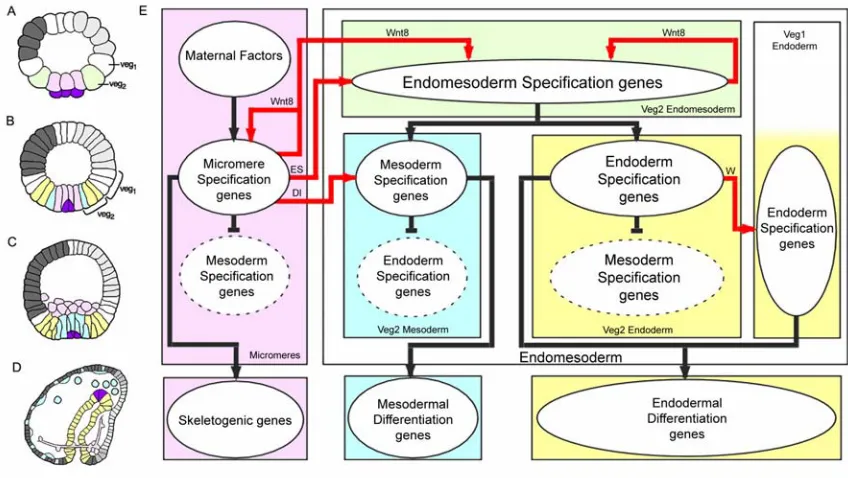
Fig. 0.1: Endomesoderm specification in the sea urchin embryo. (A-D) Schematic diagrams of
sea urchin embryos displaying specified domains. The color coding shows the disposition of specified endomesoderm components: lavender indicates skeletogenic lineage; dark purple indicates small micromere precursors of adult mesoderm; green indicates endomesoderm lineage that later gives rise to endoderm, yellow, and mesoderm, blue; light grey indicates oral ectoderm; dark grey indicates aboral ectoderm; white indicates regions yet to be specified at the stages shown. (A) 7th cleavage embryo (about 10 h after fertilization). (B) Blastula stage embryo at
about 9th cleavage (about 15 h after fertilization). (C) Mesenchyme blastula stage embryo (about
24 h after fertilization). (D) Late gastrula stage embryo (about 55 h after fertilization). The
drawing shows the later disposition of all the endomesodermal cell types about midway through embryonic morphogenesis. (E) Process diagram describing endomesoderm specification events in
Fig. 0.1E show a diagram that describes the specification events and the genetic functions that underlie the process just described. Two of these events are important for what follows. The first one relates to the specification of the skeletogenic mesenchyme lineage. These cells are autonomously specified (reviewed by Davidson, 2006). The spatial cue that triggers their specification consists of maternal factors that are localized at the vegetal pole of the egg. The second event is the segregation between the non-skeletogenic mesodermal cell types and the endodermal cell types from common progenitors. The spatial cue that triggers this event is a signaling molecule, Delta (Dl in Fig. 0.1E). The gene encoding this signal is exclusively expressed in the micromere lineage from late cleavage and during blastula stage. Localization of delta expression in these cells at this time is essential. Between 7th and 9th cleavage, the Delta signal activates a Notch receptor in adjacent endomesodermal (veg2) cells, and this is required for normal specification of mesodermal fate (McClay et al., 2000; Sweet et al., 1999; Sweet et al., 2002). Thus, the cells of the veg2 territory immediately adjacent to the micromere descendants are specified as mesoderm, while the rest of the cells of the veg2 territory will become endoderm.
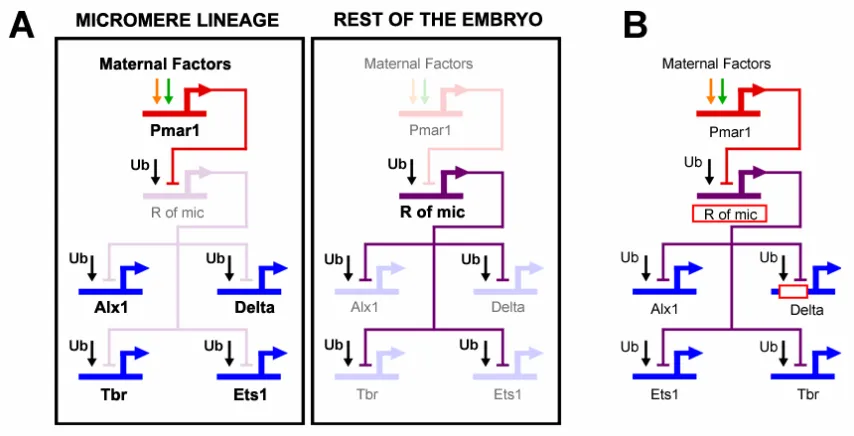
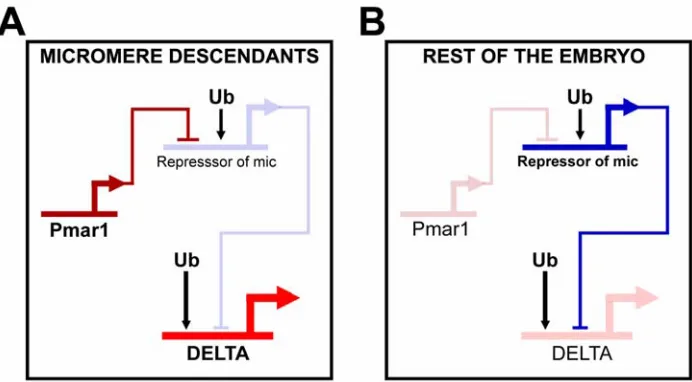
encodes a transcriptional repressor. A second repressor, named repressor of micromeres, or r of mic, is proposed to be zygotically expressed everywhere in the embryo, except in the micromere lineage, where it is repressed by Pmar1. R of mic in turn represses the zygotic expression of delta and of at least three regulatory genes (alx1, ets, and tbr) which are responsible for the activation of the rest of the micromere skeletogenic program. The zygotic expression of delta, alx1, ets, and tbr depends on ubiquitously present activators, and its localization in the micromere lineage depends on repression by R of mic everywhere else in the embryo (Fig. 0.2A).
Fig. 0.2: The double negative gate for micromere lineage specification and localization of
delta expression. (A) GRN model. Within the micromere lineage a distinct specification program
is activated. In the rest of the embryo, the same program is actively repressed by R of mic. Genes that are active in the respective domain are shown in strong color. Genes that are inactive are shown in light color. (B) The red rectangles represent predictions of the GRN model.
micromere lineage and the expression of delta. It is a subcircuit of the GRN, i.e., a set of linkages with a particular developmental job (Davidson, 2006). Its architecture is revealing. The use of two repressors in regulatory tandem, and ubiquitous activators, is not the only way to produce a localized expression pattern. The alternative is of course localized expression of activators. But these two GRN architectures are not functionally equivalent. The double negative gate provides de facto, the active repression of regulatory states outside the correct domain of their expression. Thus, it acts as an “exclusion effect” (Oliveri and Davidson, 2007), actively ensuring silence of target genes in ectopic locations while at the same time ensuring their expression in correct locations.
the pmar1 gene product naturally acts as a repressor; that delta, tbr, ets and alx1 are controlled by ubiquitous activators; and that localization of expression of these genes to the micromere lineage in normal embryos depends on their repression by R of mic everywhere else in the embryo. In particular, the possibility that any of these three genes is upstream of delta, or of each other, is ruled out.
To prove that the double negative gate for micromere lineage specification exists, and that it is responsible for the localization of expression of delta in the micromere lineage, it is necessary to experimentally validate the predictions of Fig. 0.2B. This means: a) to find the gene playing the role of r of mic; and b) to recover the relevant delta CRM and to demonstrate that it executes the predicted regulatory functions, i.e., ubiquitous activation and R of mic-dependent repression.
In this thesis I set out to validate the predictions of Fig. 0.2B. The first step was to recover the CRM that drives the expression of delta in the micromere lineage at the right time. I then could verify that the recovered CRM responds to the Pmar1 repression system as is predicted by the model. This work is described in chapter 2. It confirms that the localization of delta expression in the micromere lineage is transcriptionally controlled.
The third step was to confirm that the CRM recovered in chapter 2 executes the predicted regulatory functions: activation by ubiquitously present factors, and R of mic-dependent repression. This is described in chapter 4.
The work described in chapter 4 strongly supports, but does not demonstrate, that the interaction between HesC and the recovered CRM is direct, as predicted by the GRN model. A demonstration that this is the case is the subject of ongoing work.
REFERENCES
Davidson, E. (2006). "The Regulatory Genome: Gene Regulatory Networks In Development and Evolution." Academic Press,
Ettensohn, C. A., Illies, M. R., Oliveri, P., and De Jong, D. L. (2003). Alx1, a member of the Cart1/Alx3/Alx4 subfamily of Paired-class homeodomain proteins, is an essential component of the gene network controlling skeletogenic fate specification in the sea urchin embryo. Development 130, 2917-2928.
Logan, C., and McClay, D. (1997). The allocation of early blastomeres to the ectoderm and endoderm is variable in the sea urchin embryo. Development 124, 2213-2223. McClay, D., Peterson, R., Range, R., Winter-Vann, A., and Ferkowicz, M. (2000). A
micromere induction signal is activated by beta-catenin and acts through notch to initiate specification of secondary mesenchyme cells in the sea urchin embryo. Development 127, 5113-5122.
Oliveri, P., Carrick, D. M., and Davidson, E. H. (2002). A Regulatory Gene Network That Directs Micromere Specification in the Sea Urchin Embryo. Developmental Biology 246, 209-228.
Oliveri, P., and Davidson, E. H. (2007). DEVELOPMENT: Built to Run, Not Fail 10.1126/science.1140979. Science 315, 1510-1511.
Ruffins, S., and Ettensohn, C. (1996). A fate map of the vegetal plate of the sea urchin (Lytechinus variegatus) mesenchyme blastula. Development 122, 253-263.
Ruffins, S. W., and Ettensohn, C. A. (1993). A Clonal Analysis of Secondary Mesenchyme Cell Fates in the Sea Urchin Embryo. Developmental Biology 160, 285-288.
Sweet, H., Hodor, P., and Ettensohn, C. (1999). The role of micromere signaling in Notch activation and mesoderm specification during sea urchin embryogenesis. Development 126, 5255-5265.
CHAPTER 1
Developmental Gene Network Analysis
Roger Revilla-i-Domingo and Eric H. Davidson
Published in International Journal of Developmental Biology 47: 695-703 (2003)
ABSTRACT
and diversify. Comparison of the network of cis-regulatory interactions with a portion of that underlying the specification of the endomesoderm of the starfish illustrates how the similarities and differences provide insights into how the programs for development work, and how they evolve.
KEY WORDS: Gene network, genetic program, evolution and development, genomic regulatory system, sea urchin
INTRODUCTION
The genetic programs that control the processes by which the body plans of animals are built were invented, and shaped, by the evolutionary process. How these programs work, if nothing else, is a matter of great curiosity. Because gene networks constitute the control systems for development, analysis of such networks explains both the process of development and the process by which development has evolved (Davidson, 2001).
Spatial cues are always required in order to trigger specification in development. These spatial cues sometimes consist of localized maternal regulatory factors that are distributed to particular cells with the egg cytoplasm, and are partitioned during cleavage. Alternatively they can also consist of signaling ligands produced by other cells, in consequence of their own prior state of specification. Ultimately, these spatial cues affect the course of events in development by causing the activation (or repression), in a certain region of the embryo, of particular genes encoding transcription factors. Through this process, new, more refined, domains of specification are created, and the complexity of the embryo increases. But although it is the spatial cues that trigger the events of spatial specification, the locus of programmatic control for each developmental event is the sequence of the particular cis-regulatory elements that respond to the inputs presented (Davidson, 2001).
The experiments reviewed here represent a step toward the goal of determining the complete network of DNA-based interactions that underlie one particular major process of development, namely, the specification of the endomesoderm of the sea urchin embryo. Given that evolution occurs by changing the program for development of the body plan, we also illustrate briefly how developmental gene network analysis sheds light on the process by which morphological features are maintained and diversify.
UNRAVELING THE GENE REGULATORY NETWORK THAT UNDERLIES THE PROCESS OF ENDOMESODERM SPECIFICATION IN THE SEA URCHIN EMBRYO
The armature of the network
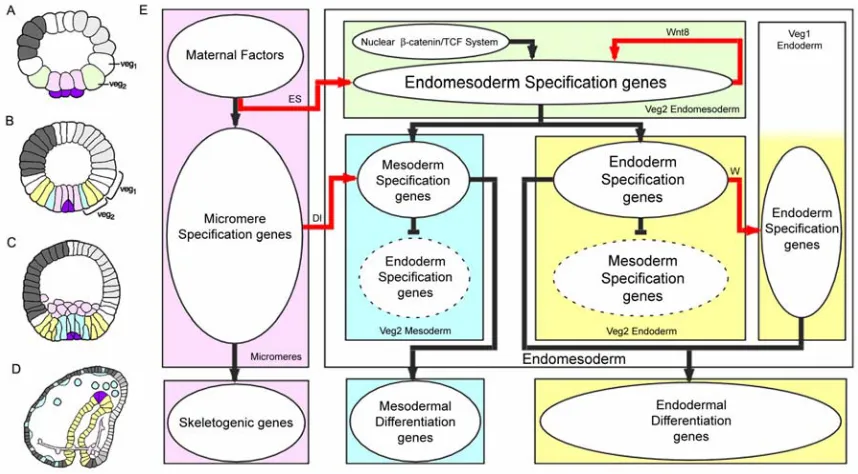
Figure 1.1 illustrates the process of endomesoderm specification in the sea urchin embryo (Fig. 1.1A-D), and it shows a diagram (Fig. 1.1E) that describes the specification events and the genetic functions that underlie this process.
and aboral ectoderm. The lower half consists of the veg1 ring, their sister cells of the veg2 ring immediately below, and the large and small micromeres at the vegetal pole. In the undisturbed embryo, the large micromeres (the population of cells colored lavender in the diagram) will produce all the cells of the skeletogenic mesenchyme lineage, and the progeny of veg1 and veg2 will produce the rest of the endomesoderm. At the ciliated swimming-blastula stage (Fig. 1.1B), the veg2 lineage has been segregated into two distinct domains: the inner veg2 ring consists of cells that will give rise to mesodermal cell types, including pigment cells; and the rest of the veg2 domain will give rise to endodermal cells (Ruffins and Ettensohn, 1993, 1996). At the mesenchyme blastula stage (Fig. 1.1C), the skeletogenic mesenchyme cells have ingressed into the blastocoel, leaving behind a now fully specified central disc of prospective mesodermal cell types, and peripheral to them, the endodermal precursors (reviewed by Davidson et al., 1998). After this, the adjacent veg1 progeny will become specified as endoderm as well (Logan and McClay, 1997), and gastrular invagination ensues.
-9th cleavage, and is executed by the ligand Delta (Sherwood and McClay, 1999; Sweet et al., 1999; McClay et al., 2000; Sweet et al., 2002). The cells in the inner veg2 ring, which are exposed to the Delta signal from the micromeres, are specified as mesoderm. The rest of the veg2 cells will acquire endodermal fate. The result is that the initial crude pattern of specification, which defines veg2 as endomesoderm, has now been refined into two distinct specification states. Finally, another signaling event from the veg2 endoderm triggers the specification of the surrounding veg1 also as endoderm (Logan and McClay, 1997; Ransick and Davidson, 1998).
Fig. 1.1.Endomesoderm specification in the sea urchin embryo.(A-D) Schematic diagrams of
sea urchin embryos displaying specified domains, from Davidson et al. (2002b). The color coding
Blastula stage embryo at about 9th cleavage (about 15 h after fertilization). (C) Mesenchyme
blastula stage embryo (about 24 h after fertilization). (D) Late gastrula stage embryo (about 55 h
after fertilization). The drawing shows the later disposition of all the endomesodermal cell types about midway through embryonic morphogenesis. (E) Process diagram describing
endomesoderm specification events in the sea urchin embryo. Boxes represent domains of specification according to the color of their background. The color coding represents the same endomesoderm components as in the schematic diagrams A-D. Ovals in the boxes represent sets of genes that execute certain developmental function. Arrows indicate that the set of genes in the oval where the arrow originates triggers the developmental function executed by the genes in the oval where the arrow ends. In particular, red arrows represent signaling events. Barred lines indicate repression of the developmental function executed by the genes in the oval where the barred line ends. Developmental time in the process diagram runs from top to bottom in accordance with the stages represented by the schematic diagrams A-D. “ES” stands for “Early Signal”; “Dl” stands for “Delta”; “W” stands for “Wnt8.” Evidence is reviewed in Davidson et al.
(2002a), and from P. Oliveri, A. Ransick, D.R. McClay and E.H. Davidson, unpublished data.
The knowledge summarized in Fig. 1.1E provides us with the armature on which the network of gene interactions is subsequently built. It tells us what specification functions must be executed by the genes in each domain: for example we know that the genes in the lavender box (Fig. 1.1E) must be able to translate the maternally localized spatial cues into a skeletogenic program of differentiation, and they must also be able to cause expression of the ligand Delta; and that the genes in the blue box must be able to listen to the spatial information given by the Delta signal in order to create a state of specification on which the mesodermal differentiation program is then installed.
Useful as the knowledge contained in Fig. 1.1E might be, it should be made clear that this knowledge by itself does not provide us with any real understanding of the developmental process. Figure 1.1E by itself fails to show us the explicit mechanisms of specification, the instructions followed by each cell on its way to becoming specified. These instructions are encoded in the genomic DNA. It is the goal of the following to unravel the network of DNA-based interactions from which the instructions for development can be read.
Building the network of cis-regulatory interactions
In order to clothe with real genes the armature of interactions indicated in Fig. 1.1E, a major gene discovery effort was undertaken by performing several differential macroarray screens (Rast et al., 2000). The goal of each of these screens was to isolate cDNA transcripts that are differentially expressed in a given domain of the endomesoderm. To this end, different specification events were interfered with so as to generate populations of RNA transcripts lacking given classes of endomesodermal sequence, and these populations were compared to normal embryo RNA or to RNA from embryos in which the RNA populations contained larger amount of endomesodermal sequences than normal. By using a very sensitive subtractive hybridization technology on these populations of transcripts, probes were created in which sequences differentially expressed in the chosen endomesodermal domain were greatly enriched. These probes were then used to screen large-scale arrays of ~105 clone cDNA libraries (macroarrays)
In order to determine the interactions among the different genes, a large-scale perturbation analysis was carried out, in which the expression of many genes was individually altered experimentally, and the effect on all other relevant genes in the network was then measured by quantitative polymerase chain reaction (QPCR) (Davidson et al., 2002a). Given the cis-regulatory interactions predicted by the QPCR experiments, direct cis-regulatory analysis is used to test the predicted network linkages, and in certain instances to unravel the key information processing functions executed by the relevant cis-regulatory elements.
THE CIS-REGULATORY NETWORK: THE CONTROL SYSTEM FOR THE SPECIFICATION PROCESS
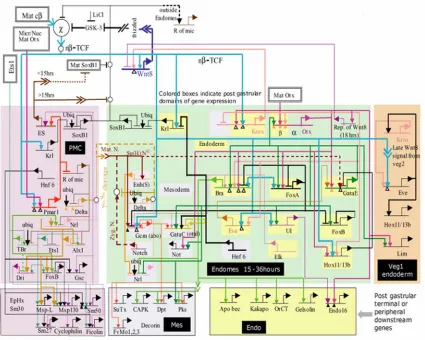
A model for the process of endomesoderm specification is shown in Fig. 1.2 in the form of a network diagram that combines all significant perturbation data; information on time and place of gene expression, as determined by whole mount in situ hybridization (WMISH) and QPCR measurements; cis-regulatory data where available; and all the underlying information of experimental embryology.
Even though not all the cis-regulatory interactions that underlie the specification of the endomesoderm of the sea urchin embryo have yet been identified, and even though not all the identified interactions have yet been tested, the model of Fig. 1.2 allows us to see how the network of cis-regulatory interactions controls the specification process. The model shows how the cis-regulatory interactions control the specification functions that need to be executed for the different domains of the endomesoderm of the sea urchin to become what they become.
Fig. 1.2.Regulatory gene network model for endomesoderm specification from fertilization
to just before gastrulation. This is a recent version of the model originally presented by
Davidson et al. (2002a, 2002b). The current version of the model and the perturbation data on
Network Update) and www.its.caltech.edu/~mirsky/qpcr.htm (End-mes Network QPCR Data), respectively. Short horizontal lines from which bent arrows extend represent cis-regulatory
elements responsible for expression of the genes named beneath the line. The arrows and barred lines indicate the inferred normal function of the input (activation or repression), as deduced from changes in transcript levels due to the perturbations. Each input arrow constitutes a prediction of specific transcription factor target site sequence(s) in the cis-regulatory control element. Dotted
lines indicate inferred but indirect relationships. Arrows inserted in arrow tails indicate intercellular signaling interactions. Large open ovals represent cytoplasmic biochemical interactions at the protein level. The spatial domains are color coded as in Fig. 1.1, and genes are placed therein according to their loci of expression. The interactions at the top of the diagram, with no background color, are very early interactions. The rectangles in the lower tier of the diagram show downstream differentiation genes. “Ubiq” indicates an inferred ubiquitously active positive input. “Mat cβ” indicates maternal cytoplasmic β-catenin. “nβ/TCF” indicates nuclear β -catenin complexed with TCF. For further details see Davidson et al. (2002a, 2002b) and
www.its.caltech./~mirsky/endomes.htm. For evidence see text, Davidson et al. (2002a, 2002b),
Oliveri et al. (2002), Ransick et al., (2002), Rast et al., (2002),
www.its.caltech./~mirsky/endomes.htm.
Interpreting the spatial cues: Specification of the micromeres
The network model of Fig. 1.2 indicates the mechanism by which maternal spatial cues in the micromeres are interpreted and translated into the specification state that is specific to the micromere lineage.
everywhere in the embryo by the same repressor gene. Immediately after the micromeres are born at 4th cleavage, the pmar1 gene is activated specifically in these cells. This gene has a repressor function that shuts down the expression of “r of mic”. Now, delta, and the skeletogenic regulators tbr, alx and ets are allowed to be expressed exclusively in the micromeres, and as a result the skeletogenic program is set in train (Oliveri et al., 2002).
The mechanism just described ensures that once the pmar1 is activated, the micromere specification program will be installed without the need for any further spatial cues. If pmar1 is ectopically expressed everywhere in the embryo, the skeletogenic regulator tbr, the signaling ligand Delta, and the skeletogenic differentiation gene sm50 are all also expressed everywhere, and the whole embryo is now expressing the functions normally executed only by the cells of the micromere lineage (Oliveri et al., 2002, 2003). The fact that pmar1 is sufficient to establish the skeletogenic program, together with the fact that pmar1 is activated by factors that are all either maternally present or autonomously localized in the micromere nuclei, tells us why the micromeres are autonomously specified. The most important general point is that the explanation of this embryological phenomenon is now provided in terms of the genomically encoded map of cis-regulatory interactions.
Refining the specification pattern: Specification of the pigment cells
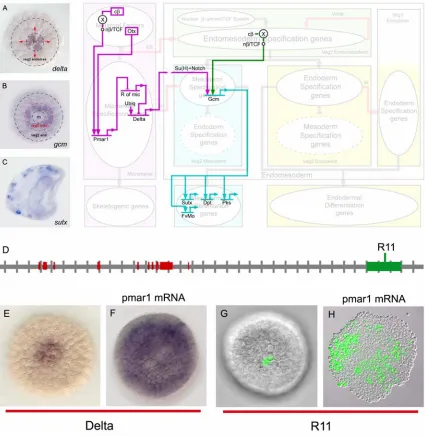
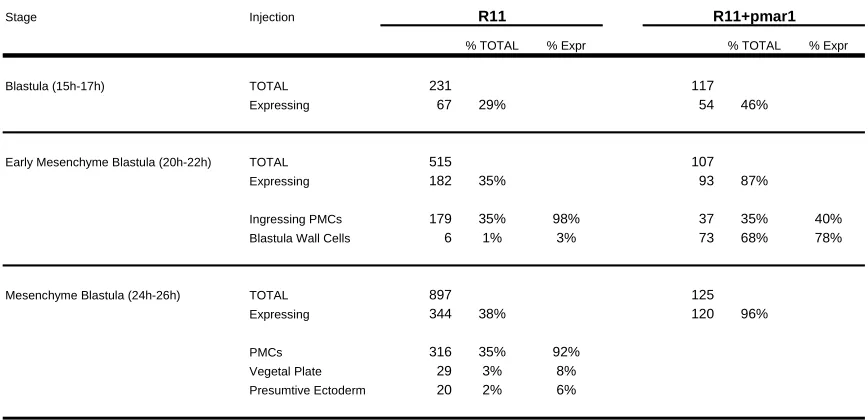
micromeres between 7th and 9th cleavage serves as the spatial cue that triggers the segregation of the mesodermal and endodermal fates of veg2 descendant cells (Fig. 1.3 A-B). Expression of the ligand Delta in the micromere descendants activates a Notch (N) receptor in the adjacent veg2 cells, which is required for normal specification of mesodermal fate in these cells (Sweet et al., 1999; McClay et al., 2000; Sweet et al., 2002). Localization of the Delta signal in the micromere descendants depends on the operation of the pmar1 repression system, as explained above and illustrated in the diagram of Fig. 1.3. The response of Delta to the pmar1 repression system depends on the cis-regulatory element named R11 (Fig. 1.3D-H) (R. Revilla-i-Domingo and E. Davidson, unpublished data). In normal embryos R11 drives expression of a reporter construct in the micromere descendants. When “r of mic” is repressed everywhere in the embryo by ectopic expression of pmar1, the delta gene is activated in every cell (Fig. 1.3 E-F), and in the same embryos R11 also drives expression of the reporter construct everywhere (Fig. 1.3 G-H) (R. Revilla-i-Domingo and E. Davidson, unpublished data).
inputs from the Notch transduction pathway, and the β-catenin/TCF system. In normal embryos this element drives the expression of a reporter construct in a localized region in the vegetal plate. But if a portion of this element, containing binding sites for the Notch transduction pathway, is eliminated, expression of the reporter construct is expanded to a broader region that includes the whole of the veg2 domain (A. Ransick and E. Davidson, unpublished data). In other words, now the cis-regulatory element that controls gcm expression is 'blind' to the mesoderm-endoderm border established by the activation of the Notch transduction pathway.
Ultimately, the gene gcm is expressed in the pigment cells (a prominent subset of the veg2 mesodermal cell types), where it activates a number of differentiation genes (see diagram of Fig. 1.3), the products of some of which are likely to be required for synthesis of the red quinone pigment that these cells produce (Davidson et al., 2002b; Ransick et al., 2002; Calestani et al., 2003). If translation of gcm transcripts is blocked experimentally, the perturbed embryos show a perfectly normal morphology, except that they have no pigment cells (A. Ransick and E. Davidson, unpublished data).
the embryo (the veg2 mesoderm), by setting a new border in the specification pattern; and then to install the program for pigment cell differentiation in the cells of the new domain. Other similar network subelements not yet resolved are undoubtedly responsible for differentiation of additional mesodermal cell types.
Fig. 1.3.Segregation of the veg2 domain into mesodermal and endodermal territories and
installation of the pigment cell differentiation program. The diagram shows key interactions,
installation of the pigment cell differentiation program. The dimmed background shows the process diagram of Fig 1.1E to indicate the domains where the interactions shown happen, and the developmental functions that the genes shown execute. (A) Between 7th and 9th cleavage the
micromeres express the signaling ligand Delta (Oliveri et al., 2002; Sweet et al., 2002). The
figure shows a whole mount in situ hybridization photomicrograph, from P. Oliveri, displaying
the expression of delta gene 12 h after fertilization (around 8th cleavage). “m” indicates micromeres domain. Red arrows indicate the signaling event from the micromeres to the surrounding veg2 endomesodermal cells. (B) The veg2 endomesodermal cells that receive the
Delta signal from the micromeres become specified as mesoderm, and express the gene gcm; the
rest of the veg2 endomesodermal cells become specified as endoderm (Sherwood and McClay, 1999; Sweet et al., 1999; McClay et al., 2000; Ransick et al., 2002; Sweet et al., 2002). The
figure shows a whole mount in situ hybridization photomicrograph, modified from Ransick et al.
(2002), displaying the expression of gcm gene 12 h after fertilization (around 8th cleavage). The
red dotted circle indicates the newly formed border that segregates the veg2 domain into mesodermal and endodermal territories. (C) Ultimately, a subset of the veg2 mesodermal cells
differentiate into pigment cells, and express the gene sutx (Calestani et al., 2003), among other
pigment cell differentiation genes. The figure shows a whole mount in situ hybridization
photomicrograph, modified from Calestani et al. (2003), displaying the expression of sutx gene in
a gastrula stage embryo. (D-H) The cis-regulatory element R11 controls the localization of delta
gene expression in the micromeres. (D) R11 element consists of a sequence of genomic DNA
near the coding sequence of the Delta gene. Each tic on the horizontal grey line representing genomic sequence demarcates 1 kb from the previous tic. 5' direction is to the left. Red blocks on the sequence indicate positions of the delta gene coding sequence. The green box on the sequence
indicates the position of the R11 element. (E-F) pmar1 mRNA injection results in delta
expression everywhere in the embryo. The figures show whole mount in situ hybridization
photomicrographs, modified from Oliveri et al. (2002), comparing the expression of delta gene in
normal blastula stage embryos (E), and embryos that have been injected with pmar1 mRNA (F).
(G-H) R11 element is responsible for localizing the expression of delta gene in the micromeres of
normal embryos, and for driving the expression of the gene in every cell of embryos that have been injected with pmar1 mRNA (R. Revilla-i-Domingo and E. Davidson, unpublished data). The
photomicrographs compare the expression of the GFP reporter gene in blastula stage embryos that have been injected with R11 reporter construct (G), and embryos that have been injected with
Stabilizing states of specification: The endoderm
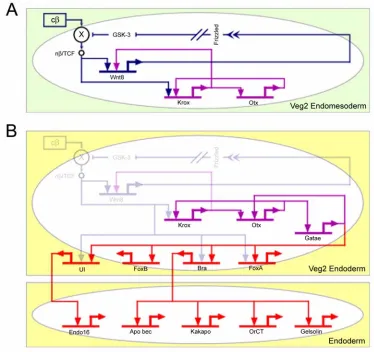
Fig. 1.4. Stabilization of the endomesoderm specification state and installation of the
endoderm differentiation program. The diagram shows key interactions, extracted from the
model of Fig 1.2, that control the stabilization of the endomesoderm state of specification and the installation of the endoderm differentiation program. (A) The box with green background shows
the interactions that operate in the veg2 endomesoderm domain up to about 9th cleavage.
Nuclearization of β-catenin is autonomous, and results in the activation of two regulatory subcircuits. Dark blue subcircuit: Wnt8 intercellular signaling among cells of the veg2 domain
stimulates the nuclearization of β-catenin and establishes a "community effect," which defines and locks the endomesodermal state of specification in the veg2 cells. Purple subcircuit: krox and
otx cross-regulate, which results in a reinforcing loop that renders the endomesoderm state of
specification independent of the initial inputs. (B) The box labeled “Veg2 Endoderm” shows the
interactions that operate in the veg2 endoderm domain, from about 9th cleavage to mesenchyme blastula stage. Gatae is added to the krox-otx feedback loop (purple interactions), and together
β-catenin/TCF/Wnt8 inputs disappear, the stabilization loop maintains the endodermal specification program active, which eventually results in the activation of endodermal differentiation genes (lower box in the diagram labeled “Endoderm”).
During the late blastula stage, β-catenin disappears from the nuclei of the veg2 endodermal domain (Logan et al., 1999). But by this time, a network of stable intergenic interactions has been installed, so that the β-catenin inputs used earlier to set up transcriptional specification are no longer needed (Fig. 1.4B).
We see here that the cis-regulatory interactions control the operation of at least three different regulatory devices that are directly responsible for establishing at least part of the endoderm differentiation program. The first device consists of the "community effect," which first defines and then locks on the endomesodermal specification state in the veg2 domain (dark blue connections in Fig. 1.4A). The second device depends on a feedback loop, including krox and otx (purple connections in Fig. 1.4A), which generates a robust and resilient regulatory structure in the already defined endomesoderm domain. The third device consists of the addition of gatae to the krox-otx feedback loop (purple connections in Fig. 1.4B), which ensures the operation of many endodermal regulatory genes in the endoderm. The result is a control system that drives the specification process forward as a progression of states, and it prevents it from reversing direction when the initial cues that trigger the specification process disappear. Progressivity and stability are fundamental properties of the developmental process. They derive from regulatory devices consisting of assemblages of cis-regulatory interactions.
UNDERSTANDING DEVELOPMENT AND EVOLUTION
2001). It has been clear for a long time that the evolution of body plans has occurred by change in the genomic programs for the development of these body plans (Britten and Davidson, 1971), and it is now clear that we need to consider this in terms of change in the regulatory devices that execute these programs. The bilaterians all rely on essentially the same repertoire of regulatory genes to control the developmental organization of their body plans. Analysis of cis-regulatory networks affords the means to focus on the significance of preserved uses of these genes, and on the exact consequences of differences in their use (Davidson, 2001).
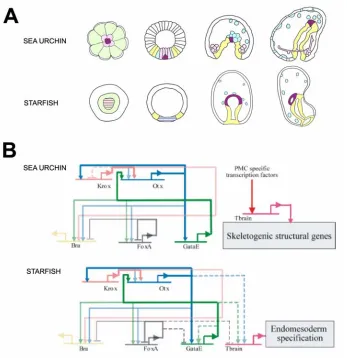
Figure 1.5 compares the way certain genes are utilized in the specification of the endomesoderm of two different bilaterians, namely, the sea urchin and the starfish. All genes in Fig. 1.5, except for tbr, are central elements that control the specification of the endoderm in the sea urchin (see Fig. 1.2 and Fig. 1.4). The tbr gene, on the other hand, is activated exclusively in the micromere derived skeletogenic cells (see Fig. 1.2) (Croce et al., 2001; Fuchikami et al., 2002; Oliveri et al., 2002). Its regulation depends on other genes specifically expressed in the micromere lineage (Oliveri et al., 2002), and in turn, it drives expression of larval skeletogenic differentiation genes (Davidson et al., 2002a; Oliveri et al., 2002 and www.its.caltech.edu/~mirsky/endomes.htm). While the formation of the endoderm is at least superficially similar in the two species (Fig. 1.5A), starfish embryos do not have a micromere lineage, nor do they produce a larval skeleton (Fig. 1.5A).
This set of identical cis-regulatory interactions must serve conserved evolutionary roles, since the possibility of convergence is ruled out by the number of similar functional starfish and sea urchin cis-regulatory interactions.
Fig. 1.5. Comparison of sea urchin and starfish gene regulatory networks. The figure
compares portions of the gene regulatory networks underlying the specification of the endomesoderm in the sea urchin and the starfish embryos. (A) Comparison of the fate maps.
Schematic diagrams of sea urchin embryos (top row) and starfish embryos [lower row, modified from Hinman et al. (2003)] at selected stages. Stages are (from left to right): cleavage/early
coelomic cells; purple stripes indicate domains that might contain a subset of cells that will contribute exclusively to coelomic cells; yellow indicates cells that will become endodermal. (B)
Comparison of portions of the underlying gene regulatory networks. The top diagram, corresponding to the sea urchin, is extracted from Fig. 1.2. The bottom diagram, corresponding to the starfish, is from Hinman et al. (2003). Regulatory connections are represented as described in
Fig. 1.2. In this figure dashed lines indicate a regulatory connection observed in sea urchin not present in starfish, or vice versa. The positive feedback loops between krox, otx and gatae that are
present in both echinoderms are highlighted in bold.
gut development (Reuter, 1994; Maduro et al., 2002; Patient and McGhee, 2002). What makes the reinforcing loop especially useful, and hence likely to be preserved during evolution, may therefore be that it controls the installation and stabilization of the expression of the gatae gene in the endoderm (Hinman et al., 2003). Other intergenic feedback loops are used across the Bilateria to serve similar functions. For example a reinforcing feedback loop is found in the hox gene network that controls rhombomere specification in the mouse hindbrain (Nonchev et al., 1996; Barrow et al., 2000), in the regulatory network for tracheal placode specification in Drosophila (Zelzer and Shilo, 2000), and in specification of the oral ectoderm in sea urchin embryos (Amore et al., 2003), among others. It seems a general property of the developmental process to use feedback loops as a mechanism to achieve the progressivity of the process.
The tbr gene, on the other hand, is used in completely different ways in the starfish and sea urchin embryos (Fig. 1.5B). It is required for the formation of the archenteron in the starfish embryo, and its expression is under the control of endodermal regulators (Otx, Gatae) (Hinman et al., 2003), whereas it is involved solely in skeletogenic functions in the sea urchin embryo (Croce et al., 2001; Fuchikami et al., 2002; Oliveri et al., 2002 and www.its.caltech.edu/~mirsky/endomes.htm). The skeletogenic micromere lineage is a relatively recent echinoid invention (Wray and McClay, 1988; Tagawa et al., 2000). This suggests that in the sea urchin the skeletogenic use of tbr may have been coopted from an adult skeletogenic regulatory system, while an original embryonic endomesodermal regulatory element was lost (Hinman et al., 2003).
can be "wired" into the specification system as the result of evolutionary change. How the intrinsic behavior of the subroutine is preserved in the new context, and how the rest of the developmental control system can cope with this change without disrupting its workability, speaks directly to the intrinsic robustness of the subroutine, and the robustness of the developmental process in general. Regulatory networks serve as the link between development and evolution. They provide a new means to address specific questions about the robustness of the developmental process, and about the preservation of aspects of the process through evolutionary time. Questions such as these can only be answered by considering evolution and development together.
CONCLUSIONS
ACKNOWLEDGMENTS
We are very grateful to Dr. Takuya Minokawa for very useful criticism and fruitful discussions. We especially thank Dr. Paola Oliveri for providing a photomicrograph displaying the expression of delta gene 12 h after fertilization, and for useful discussions. We are particularly indebted to Dr. Veronica Hinman for allowing us to discuss her unpublished data regarding the comparison of sea urchin and starfish genomic sequences, and for useful criticism; to Dr. Andy Ransick for allowing us to discuss his unpublished data regarding the analysis of the cis-regulatory element of the gcm gene; and also to Pei Yun Lee for allowing us to discuss her unpublished data regarding the role of the gatae gene in the specification of the endoderm of the sea urchin embryo, and for helpful discussions. This research was supported by NIH Grants HD37105 and GM61005 and by NASA/Ames Grant NAG2-1587.
REFERENCES
AMORE, G., YAVROUIAN, R.G., PETERSON, K.J., RANSICK, A., McCLAY, D.R. and DAVIDSON, E.H. (2003). Spdeadringer, a sea urchin embryo gene required separately in skeletogenic and oral ectoderm gene regulatory networks. Dev. Biol., in press.
BARROW, J., STADLER, H. and CAPECCHI, M. (2000). Roles of Hoxa1 and Hoxa2 in patterning the early hindbrain of the mouse. Development 127: 933-944.
BOWRING, S. and ERWIN, D. (1998). A new look at evolutionary rates in deep time: Uniting paleontology and high-precision geochronology. GSA Today 8: 2.
BRITTEN, R.J. and DAVIDSON, E.H. (1971). Repetitive and non-repetitive DNA sequences and a speculation on the origins of evolutionary novelty. Quart. Rev. Biol. 46: 111-138.
CAMERON, R.A., HOUGH-EVANS, B.R., BRITTEN, R.J. and DAVIDSON, E.H. (1987). Lineage and fate of each blastomere of the eight-cell sea urchin embryo. Genes & Dev. 1: 75-85
CAMERON, R.A., FRASER, S.E., BRITTEN, R.J. and DAVIDSON, E. H. (1991). Macromere cell fates during sea urchin development. Development 113: 1085-1092 CROCE, J., LHOMOND, G., LOZANO., J.-C. and GACHE, C. (2001). Ske-T, a T-box
gene expressed in the skeletogenic mesenchyme lineage of the sea urchin embryo. Mech. Dev. 107: 159-162.
DAVIDSON, E.H. (2001). Genomic Regulatory systems: Development and Evolution. San Diego, Academic Press.
DAVIDSON, E.H., CAMERON, R.A. and RANSICK, A. (1998). Specification of cell fate in the sea urchin embryo: Summary and some proposed mechanisms. Development 125: 3269-3290.
DAVIDSON, E.H. et al. (2002a). A provisional regulatory gene network for specification of endomesoderm and the sea urchin embryo. Dev. Biol. 246: 162-190.
DAVIDSON, E.H. et al. (2002b). A genomic regulatory network for development. Science 295: 1669-1678.
ETTENSOHN, C.A., ILLIES, M.R., OLIVERI. P. and DE JONG, D.L. (2003). Alx1, a member of the Cart1/Alx3/Alx4 subfamily of Paired-class homeodomain proteins, is an essential component of the gene network controlling skeletogenic fate specification in the sea urchin embryo. Development 130, 2917-2928.
FUCHIKAMI, T. et al. (2002). T-brain homologue (HpTb) is involved in the archenteron induction signals of micromere descendant cells in the sea urchin embryo. Development 129: 5205-5216.
GROSS, J.M. and McCLAY, D.R. (2001). The role of Brachyury (T) during gastrulation movements in the sea urchin Lytechinus variegates. Dev. Biol. 239: 132-147.
GURDON, J. (1988). A community effect in animal development. Nature 336: 772-774. GURDON, J., KATO, K. and LEMAIRE, P. (1993). The community effect, dorsalization
and mesoderm induction. Curr. Opin. Genet. Dev. 3: 662-667.
HINMAN, V.F., NGUYEN, A., CAMERON, R.A. and DAVIDSON, E.H. (2003). Developmental gene regulatory network architecture across 500 MYA of echinoderm evolution. In press.
HÖRSTADIUS, S. (1939). The mechanics of sea urchin development, studied by operative methods. Biol. Rev. Cambridge Philos. Soc. 14: 132-179.
KUROKAWA, D., KITAJIMA, T., MITSUNAGA-NAKATSUBO, K., AMEMIYA, S., SHIMADA, H. and AKASAKA, K. (1999). EpEts, an ets-related transcription factor implicated in primary mesenchyme cell differentiation in the sea urchin embryo. Mech. Dev. 80: 41-52.
LOGAN, C.Y. and McCLAY, D.R. (1997). The allocation of early blastomeres to the ectoderm and endoderm is variable in the sea urchin embryo. Development 124: 2213-2223.
LOGAN, C.Y., MILLER, J.R., FERKOWICZ, M. and McCLAY, D.R. (1999). Nuclear beta-catenin is required to specify vegetal cell fates in the sea urchin embryo. Development 126: 345-357.
elegans POP-1 parallels Wnt-inhibited transcriptional repression. Dev. Biol. 248: 128-142.
McCLAY, D.R., PETERSON, R., RANGE, R., WINTER-VANN, A. and FERKOWICZ, M. (2000). A micromere induction signal is activated by beta-catenin and acts through notch to initiate specification of secondary mesenchyme cells in the sea urchin embryo. Development 127: 5113-5122.
NONCHEV, S. et al. (1996). Segmental expression of Hoxa-2 in the hindbrain is directly regulated by Krox-20. Development 122: 543-554.
OLIVERI, P., CARRICK, D.M. and DAVIDSON, E.H. (2002). A regulatory gene network that directs micromere specification in the sea urchin embryo. Dev. Biol. 246: 209-228.
OLIVERI, P., DAVIDSON, E.H. and McCLAY, D.R. (2003). Activation of pmar1 controls specification of micromeres in the sea urchin embryo. Dev. Biol. 258: 32-43. PATIENT, R.K. and McGHEE, J.D. (2002). The GATA family (vertebrates and
invertebrates). Curr. Opin. Genet. Dev. 12: 416-422.
RANSICK, A. and DAVIDSON, E.H. (1993). A complete second gut induced by transplanted micromeres in the sea urchin embryo. Science 259: 1134-1138.
RANSICK, A. and DAVIDSON, E.H. (1995). Micromeres are required for normal vegetal plate specification in sea urchin embryos. Development 121: 3215-3222. RANSICK, A. and DAVIDSON, E.H. (1998). Late specification of veg1 lineages to
endodermal fate in the sea urchin embryo. Dev. Biol. 195: 38-48.
RANSICK, A., RAST, J.P., MINOKAWA, T., CALESTANI, C. and DAVIDSON, E.H. (2002). New early zygotic regulators expressed in endomesoderm of sea urchin embryos discovered by differential array hybridization. Dev. Biol. 246: 132-147. RAST, J.P., AMORE, G., CALESTANI, C., LIVI, C.B., RANSICK, A. and
DAVIDSON, E.H. (2000). Recovery of developmentally defined gene sets from high-density cDNA macroarrays. Dev. Biol. 228: 270-286.
RAST, J.P., CAMERON, R.A., POUSTKA, A.J. and DAVIDSON, E. H. (2002). brachyury target genes in the early sea urchin embryo isolated by differential macroarray screening. Dev. Biol. 246: 191-208.
REUTER, R. (1994). The gene serpent has homeotic properties and specifies endoderm versus ectoderm within the Drosophila gut. Development 120: 1123-1135.
RUFFINS, S.W. and ETTENSOHN, C.A. (1993). A clonal analysis of secondary mesenchyme cell fates in the sea urchin embryo. Dev. Biol. 160: 285-288.
RUFFINS, S.W. and ETTENSOHN, C.A. (1996). A fate map of the vegetal plate of the sea urchin (Lytechinus variegatus) mesenchyme blastula. Development 122: 253-263.
SHERWOOD, D. and McCLAY, D.R. (1999). LvNotch signaling mediates secondary mesenchyme specification in the sea urchin embryo. Development 126: 1703-1713. SMITH, A. (1988). Echinoderm Phylogeny and Evolutionary Biology. Oxford,
Clarendon Press.
SPRINKLE, J. and KIER, P. (1987). Fossil Invertebrates. Cambridge, MA, Blackwell Science.
SWEET, H.C., GEHRING, M. and ETTENSOHN, C.A. (2002). LvDelta is a mesoderm-inducing signal in the sea urchin embryo and can endow blastomeres with organizer-like properties. Development 129: 1945-1955.
TAGAWA, K., HUMPHREYS, T. and SATOH, N. (2000). T-Brain expression in the apical organ of hemichordate tornaria larvae suggests its evolutionary link to the vertebrate forebrain. J. Exp. Zool. 288: 23-31.
WRAY, G. and McCLAY, D.R. (1988). The origin of spicule-forming cells in a 'primitive' sea urchin (Eucidaris tribuloides) which appears to lack primary mesenchyme cells. Development 103: 305-315.
YUH, C.-H., BOLOURI, H. and DAVIDSON, E.H. (2001). cis-Regulatory logic in the endo16 gene: Switching from a specification to a differentiation mode of control. Development 128: 617-629.
CHAPTER 2
R11: A cis-Regulatory Node of the Sea Urchin Embryo Gene Network that Controls Early Expression of SpDelta in Micromeres
Roger Revilla-i-Domingo, Takuya Minokawa, and Eric H. Davidson
Published in Developmental Biology 274: 438-451 (2004)
ABSTRACT
endogenous delta gene is expressed, and that temporally, spatially, and quantitatively it responds to the pmar1 repression system just as predicted for the delta gene in the endomesoderm GRN. This work illustrates the application of cis-regulatory analysis to the validation of predictions of the GRN model. In addition, we introduce new methodological tools for quantitative measurement of the output of expression constructs, that promise to be of general value for cis-regulatory analysis in sea urchin embryos.
Keywords: cis-Regulatory element; Gene regulatory network; delta; Endomesoderm specification; Sea urchin
INTRODUCTION
In the process of development a network of gene regulatory interactions underlies each specification event (Davidson et al., 2002a). These interactions occur at genomic cis-regulatory elements which respond to the set of inputs (i.e., transcription factors) presented in each cell, and which control the expression of each gene, in each domain of the embryo. The properties of the set of all relevant cis-regulatory elements ultimately determine the architecture of the gene regulatory network (GRN) that underlies embryonic specification.
experimental perturbation analysis. The full explanatory power of the model, however, can only be achieved when we have in our hands the key fragments of genomic DNA that execute the cis-regulatory interactions predicted by the model. These cis-regulatory elements will serve to provide the ultimate tests for the correctness of the model. Also, their identification will eventually make possible experiments in which chosen parts of the network of cis-regulatory interactions can be deliberately modified, thereby highlighting the roles of specific portions of the circuitry.
Fig. 2.1. Network interactions predicted to be responsible for expression of delta in micromere
lineage cells (modified from Davidson et al. (2002b), and Oliveri et al., (2002)). Thick horizontal lines from which bent arrows extend represent cis-regulatory elements responsible for expression
of the genes named beneath the lines. cis-Regulatory elements represented in dimmed color
indicate that the gene they control is silent. cis-Regulatory elements represented in full color
indicate that the gene they control is active. The arrows and barred lines indicate the inferred normal function of the input (activation or repression). (A) In the micromere lineage the pmar1
gene is active, and it represses a gene encoding a yet unknown, otherwise globally expressed repressor (repressor of mic), resulting in the activation of delta exclusively in these cells. (B) In
Oliveri et al. (2002) demonstrated that the program of gene expression specific to the skeletogenic primary mesenchyme cell (PMC) lineage is set in train by the pmar1 gene, acting through a double repression system. Two developmental functions that are specific to the PMC lineage are set in action as a direct consequence of the operation of this repression system. The first of these is the emission of the Delta signal, which serves as a spatial cue that triggers the specification of mesodermal cell types from the common endomesodermal progenitor cells. Expression of the ligand Delta between 7th and 9th cleavages in the micromere lineage, the precursors of the PMCs, activates a Notch receptor in the adjacent endomesodermal (veg2) cells, and this is required for normal
specification of mesodermal fate in these cells (Sweet et al., 1999; McClay et al., 2000; Sweet et al., 2002). Thus the cells of the veg2 territory immediately adjacent to the
micromere descendants are specified as mesoderm; the rest of the cells of the veg2
these three regulatory genes are expressed specifically in the micromere descendants due to cis-regulatory interactions that include the same mechanism used to localize the expression of delta, i.e., the pmar1 repression system summarized in Fig. 2.1. In particular, this prediction rules out the possibility that any of these three genes is upstream of delta or of each other, in agreement with the fact that none of these three genes affects the expression of delta or of each other (Oliveri et al., 2002).
The goal of the present study was to test the GRN model by identifying a fragment of genomic DNA from the Strongylocentrotus purpuratus delta gene, here referred to as delta, that executes the predicted cis-regulatory interactions. We first set ourselves to recover the cis-regulatory element that drives the expression of delta in the micromere descendants at the right time. We were then able to ask whether it responds to the pmar1 repression system as in the GRN model prediction.
MATERIALS AND METHODS
Isolation and analysis of BAC clones containing Spdelta and Lvdelta genes
BAC clones of both species were sequenced by DOE’s Joint Genome Institute. These sequences are available at www.sugp.caltech.edu (under Resources/Annotation). The exons of the delta gene in Strongylocentrotus purpuratus and L. variegatus BAC clones were identified using the sequence of both a partial S. purpuratus and a complete L. variegatus cDNA clones (Sweet et al., 2002). The sequences were annotated using the SUGAR software package (Brown et al., 2002). This software was used to identify coding sequences of genes neighboring delta in the BAC clones.
Comparison of the genomic sequence around the delta genes of S. purpuratus and L.
variegatus
The FamilyRelations software package (Brown et al., 2002) was used to compare the BAC sequences of S. purpuratus and L. variegatus. Window sizes used in the comparison ranged from 10 bp to 200 bp. The pairwise view of the software was used to identify conserved regions. The Dot Plot view was used in some cases to identify the boundaries of the conserved regions found.
Preparation of reporter constructs
Reporter constructs R1-GFP through R12-GFP were prepared by cloning the amplified regions R1 thru R12, respectively, into the multiple cloning site of the universal S. purpuratus expression vector EpGFPII (Cameron et al., 2004). That the correct sequences had been cloned was confirmed by restriction mapping. The vector EpGFPII contains the region around the start of transcription of the endo16 gene (from -117 to +20). The activity of this basal promoter element has been described in detail elsewhere (Yuh and Davidson, 1996; Yuh et al., 1996; 1998). The EpGFPII expression vector also contains the coding sequence of the GFP protein. All reporter constructs were linearized by restriction digestion upstream of the cloned fragment.
Animals and microinjection of reporter constructs
Microinjection solutions were prepared containing 350-1000 molecules/pl of the reporter construct to be microinjected, together with 4- to 9-fold molar excess of HindIII-digested carrier sea urchin DNA and 0.12 M KCl (Franks et al., 1990).
Microinjected embryos were reared at 14 ºC to various developmental stages. Some embryos were reared that had not been microinjected, and that had been obtained from the same female and prepared in a similar way as the microinjected embryos. These uninjected embryos were used to control for possible developmental anomalies caused by microinjection.
Simultaneous microinjection of R11-GFP reporter construct and pmar1 mRNA
The preparation of pmar1 mRNA by plasmid transcription was performed as described (Oliveri et al., 2002). Microinjection solutions were prepared containing 400 molecules/pl of R11-GFP reporter construct and 22 ng/µl of pmar1 mRNA, together with 7-fold molar excess of HindIII-digested carrier sea urchin DNA and 0.12 M KCl. Nuclease-free water was used to prepare the microinjection solutions. ~5 pl of the microinjection solution was microinjected into the embryos using the same method as described above for the microinjection of reporter constructs.
Determination of GFP expression in microinjected embryos
Microinjected embryos were visualized on an epifluorescence Axioskop 2 Plus microscope (Zeiss, Hallbergmoos, Germany), equipped with the recording device AxioCam MRm (Zeiss). Expression of GFP in each embryo was determined by the presence of cells fluorescing at a level significantly higher than background. For each GFP-expressing embryo, the location of the GFP-expressing cells was determined according to the morphology of the embryo.
Quantification of R11-GFP DNA in microinjected embryos
Quantification of GFP, delta and pmar1 mRNA in microinjected embryos
Samples for which the amount of R11-GFP construct DNA had been measured were then treated with DNase I using the DNA-free kit (Ambion, Austin, TX), as described in the manufacturer’s manual, in order to remove all existing DNA. QPCR was conducted as described above to confirm that no DNA remained in the samples.
cDNA was prepared from the samples by reverse transcription-PCR (RT-PCR). The TaqMan Reverse Transcription Reagents Kit (Applied Biosystems, Foster City, CA) was used for this purpose. 38.5 µl of the RNA preparation was used in a 100 µl reverse transcription reaction (note, though, that in more recent experiments 30 µl were used instead of 38.5 µl, and this seems to improve the efficiency of the RT-PCR).
quantification of the number of GFP and delta mRNA transcripts in microinjected embryos.
RESULTS
Spatial and temporal expression pattern of delta during endomesoderm specification
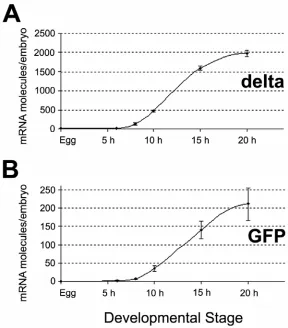
Sweet et al. (2002) showed that in Lytechinus variegatus the delta gene is expressed starting at around 7th cleavage in the micromere descendants. As the PMCs ingress into the blastocoel, the expression of Lvdelta in the micromere descendants disappears, and expression starts in the presumptive secondary mesenchyme cells (SMCs). Whole mount in situ hybridization (WMISH) experiments carried out by Oliveri et al. (2002) indicated a similar pattern of expression in S. purpuratus. The delta gene is expressed in the micromeres starting no later than 8 h after fertilization, and the transcripts remain in their descendants at 18 h. We carried out further WMISH experiments which show that in S. purpuratus, delta transcripts remain present in the micromere lineage until these cells ingress into the blastocoel at 20 h (data not shown). At this time, expression of delta ceases in the micromere lineage, and as reported for the Lvdelta gene (Sweet et al., 2002), expression is then activated in the presumptive SMCs (data not shown). By 24 h, expression of delta is seen only in the presumptive SMCs.
responsible for the specific expression of delta in the micromere lineage, from 6-8 h to 20 h after fertilization.
Fig. 2.2. Temporal expression pattern of endogenous delta gene compared to the temporal
expression pattern of GFP mRNA from the R11-GFP reporter construct. (A) QPCR data indicating levels of delta mRNA at different developmental stages. Experimental data are
indicated by dots. The line joining these dots is inferred. The error bars represent one standard deviation. Note: For the sake of accuracy in the comparison, the levels of delta mRNA were
measured in the same sample of embryos as in (B). Although these embryos had been injected with R11-GFP, measurement of the levels of delta mRNA in uninjected embryos of the same
batch showed that injection of R11-GFP has no effect in the levels of delta mRNA. (B) QPCR
of R11-GFP DNA molecules incorporated in the genome of the microinjected embryos in each case. The timing at which GFP mRNA expression starts, nevertheless, is accurately reproduced in each experiment.
Genomic sequence surrounding the delta gene
The sequence in the vicinity of the delta gene was annotated in order to determine the regions where its cis-regulatory system might likely be found. A BAC clone containing the delta gene was sequenced, and the positions of the delta exons in this clone are indicated in Fig. 2.3A. This BAC clone contains the complete 2394 bp of Delta coding sequence, divided into 11 exons, which together extend over almost 15 kb of the genome. Application of the SUGAR annotation package (Brown et al., 2002), revealed the presence of the coding sequence of an unnamed gene about 37 kb upstream of the
delta start of translation, and another gene is predicted about 33 kb downstream of the termination of the delta coding sequence (Fig. 2.3A). Therefore the cis-regulatory regions that control the expression of delta are likely to reside within the 85 kb of genomic sequence between the genes identified upstream and downstream of delta.
Identification of conserved genomic sequences as putative cis-regulatory elements