International Journal of Research (IJR)
e-ISSN: 2348-6848, p- ISSN: 2348-795X Volume 2, Issue 4, April 2015Available at http://internationaljournalofresearch.org
A Study of Relation between Self concept, self worth and Academic
achievements among High School Students in Vellore District
*K.Gajendiran **Dr.M.Arumugam
*Research Scholar, Department of Education, Bharathiar University,Coimbatore. **Assistant Professor, Dept of Education History, Govt College of Education, Vellore.
Abstract
This present study examined the achievement and its relationship between self concepts versus self worth along with academic achievement motivation among the high school students in Vellore district, Tamilnadu. The subjects consisted of 25 students from a public school of the Vellore district at the higher secondary level. The integral sections like section A, B and C of all students enrolled in 9th grade were involved in the study. An ‘Academic Self-Description Questionnaire’ with prioritization to self concept, self worth and ‘General academic Achievement’ was used. The findings of this study revealed information on how to assist administrators, parents, educators, and school counsellors with understanding the effects of self discrimination on academic self-concept and academic achievement, in contrast, it was suggested that teachers must use motivational strategies to involve students in academic activities for improving their grades.
Keywords:
Academic achievement motivation; Self-Concept; Self-Description; Self-Worth and Questionnaire
1. Introduction
School mobility can be described as a school enrolment change that is not initiated by a school system or dissatisfaction with current residence. For example, school mobility may occur because of
Factors associated with dissatisfaction with
schools in a particular geographic location,
Alterations in family structure due to divorce
or parental separation, Change in parents employment, and Other stressful life events,
(Gruman, Harachi, Abbott, Catalano, &
Fleming, 2008).
Variations in learning environments and changes in the educational settings of students can determine the student’s academic achievement and overall academic performance. Researchers have indicated that these students may have a greater risk of low grades, behavioural problems, and other academic difficulties (Gruman et al., 2008; Mehana & Reynolds, 2004).
Although studies exist on school mobility and the effects on academic performance, they are based primarily on urban versus rural school higher education, therefore, differences associated with school mobility need to be explored. Because changes in environment and educational settings due to mental mobility may be associated with variations in students’ academic self-concept, understanding the potential relationship between academic self-concept, self worth
self discrimination and academic
achievement was a primary concern of this research.
1.1 Statement Problem
International Journal of Research (IJR)
e-ISSN: 2348-6848, p- ISSN: 2348-795X Volume 2, Issue 4, April 2015Available at http://internationaljournalofresearch.org
or self-esteem, which concerns individual’s affects, emotions, or feelings about
themselves or evaluations of themselves. It
can mean taking pride in his or her and their behaviour, feeling good about themselves and accomplishments, and having a general positive image of their own. In addition, self-worth is usually a more diffuse and less specific reaction to the self than a specific appraisal of personal ability to do a specific task or of competence in a specific domain (Harter, 1985a, 1990). In contrast, the self- discrimination also said as social control activities also reported to display behaviours less well suited to the school’s learning environment, in this study we came forward and looked for discrimination by teachers and school administrators. In particular, they have looked for curricular track placements that, adjusting for prior performance, are disadvantageous for ethnic minority students. They have also looked for the possibility that teachers hold lower expectations for, and are less encouraging to, minority students. The evidence on these statement problem matters is mixed. It is suggested that, with the cooperation of school administrators and teachers, district-specific studies of these issues might be undertaken, using both local
administrative data and
participant-observational methods.
1.2 Purpose of the Study
The purpose of this research was to examine the overall academic achievements among
the 9th standard students in Vellore district,
Tamilnadu, who recently transitioned from an urban to a rural environment to determine the relationship between the self-worth, self
discrimination and their academic
achievement and academic self-concept. The goal of this study was to promote awareness about underrepresented student populations and to assist educators in gaining insight into the transitional experiences of these students in order to provide effective programming. Thus, the findings of this study generated information to assist administrators, parents, educators, and school counsellors with
understanding the effects of geographic mobility on academic self-concept and academic achievement and with providing additional educational supports to those students who may be negatively impacted.
1.3 Research Questionnaire involved in this study
Research Questions guiding this research study include:
1) What is the relationship between
academic self-concept (Academic Self-Concept Scale) and academic achievement (Test of Basic Skills and grade point averages) of Vellore district students in Grades 9, who have experienced transition from an urban to a rural environment and those who have not?
2) How do the students attitudes toward
teachers relate to academic self-concept and academic achievement?
3) How does the students respond when
some social control activities done in case of self- discrimination?
4) Do teachers motivate students in
social activities as it a part of Self-worth?
5) What is the current data gained
through overall academic achievements of
the 9th grade students, produce as a data
report?
For the research questions, academic self-concept was measured by the Academic Self-Concept Scale (ASCS; Reynolds, 1988; Reynolds, Ramirez, Magrina, & Allen, 1980). Academic achievement was measured by scores on the Test of Basic Skills (TBS) and grade point averages (GPAs). Academic self perceptions and peer perceptions were measured by the modified School Attitude Assessment Survey (SAAS; McCoach, 2002) and the School Attitude Assessment Survey-Revised (SAAS-R; McCoach & Siegle, 2003). These measures are discussed in more detail in Methodology.
2. Literature Review
self-International Journal of Research (IJR)
e-ISSN: 2348-6848, p- ISSN: 2348-795X Volume 2, Issue 4, April 2015Available at http://internationaljournalofresearch.org
concept in relation to academic achievement
and self-discrimination operational in
different settings and population groups. The studies revealed that the self-concept of boys and girls is different. Some studies revealed boys to be having better self-concept as compared to girls whereas some studies found exactly the reverse (Wang 1997). Academic Achievement was found to be having significant relationship with self-concept (Trautwein et al., 2006 and Tracy 2007). Self-worth was found to be influencing self-concept in one way or the other. Hence, it is imperative to understand the complete abilities and potentialities of the children in educating the children. Cognitive
and non-cognitive abilities such as
intelligence, creativity, personality interests, aptitudes and attitudes are important factors which have to be studied before a teacher starts teaching an individual. For better understanding teacher should know first the self-concept of the student what he thinks of
himself. Hence, these variables academic
achievement, home environment and self-concept of the students need inquiry for proper understanding of a student. Moreover, no such coherent endeavour has been undertaken on Students and hence the present study is an attempt to search an empirical database with certain hypotheses.
3. Methodology
The methodology studied here is to find out the relationship between Self-concept versus Self-worth versus Self-discrimination and Academic Achievement and to study the relationship between them.
3.1 Research Design
The study was conducted on subjects consisted of 25 students from a public school of the Vellore district at the higher secondary level. The integral sections like section A, B
and C of all students enrolled in 9th grade
were involved in the study.
3.1.1. Theoretical Framework
The following tools were selected and used in the study:
1. Self-concept List (Old Personality Word List) by Deo (1998)
2. Self-worth and Self-discrimination
(Theory of Education) by Chang (1986) 3. Academic achievement was taken as the
percentage of marks obtained 9th grade
Students.
Thus the study was conducted on
representative subjects of 25 Students of 9th
grade Standard on the basis of randomized technique of sampling from different government schools of Vellore City.
3.1.2 Approach
The Students were selected randomly approached from different schools in Vellore City. Cooperation of the principal of schools was sought and efforts were made to establish rapport with the subjects. Before administering tests, they were made clear about the purpose of collecting the data and the research tools namely concept, self-worth, self-discrimination and academic achievements list was scored as per the procedure given in the manual. The
instructions for data collection as well as
scoring as given in the manual were strictly adhered to.
3.2 Research Tools used for the Questionnaires
International Journal of Research (IJR)
e-ISSN: 2348-6848, p- ISSN: 2348-795X Volume 2, Issue 4, April 2015Available at http://internationaljournalofresearch.org
2003). The ASCS was developed to measure general self-concept as it relates to academic achievement and the student’s perception of academic success (Reynolds, 1988). Marsh and Yeung (1997) conducted a longitudinal evaluation of self-concept and academic achievement and examined influences of school grades and teacher ratings on student’s academic performance, resulting in a more critical understanding of causal effects on self-concept. McCoach (2002) developed the SAAS to measure students’ concept, motivation, and self-regulation along with attitudes toward school and teachers to examine the effects on academic achievement. Evaluating students’ global scores on the ASCS and their subscale scores on the modified SAAS/ SAAS-R also provided insight into influences on academic achievement and performance.
3.2.1 Participant Enrolments and Recruitment
Permission to conduct research was granted by written consent from the district level and school administrator level. To achieve a moderate level for detecting moderate effect
among 9th students indicated a minimum of
three sections A, B and C in each of the two groups of interest in this study. The focus of recruitment for the study was to obtain as many participants as possible to increase the statistical power.
3.2.2 Data Collection
A sample of 25 male students from each sections (Section A/Section B and Section C) who had transitioned to Iowa were administered the scales, and the analysis was based on gender and the length of time since transition as reported by the students. The researcher converted time since transition into months for data analysis. A length of time beyond 7 months was not considered as a recent transition for determining the influence of urban to rural transition on
academic self-concept and academic
achievement.
Students were asked to sign an assent form agreeing to participate in the research as a means of allowing the students to understand the procedures for the study. Students were asked to complete a demographic form, the Academic Self Concept Scale (ASCS), and the Modified School Attitude Assessment Survey/School Attitude Assessment Survey-Revised (SAAS/SAASR). The surveys were administered in paper and pencil format, and students had a maximum time of 30 minutes to complete the measurements. This was also done to ensure that neither school personnel nor the researcher could identify student responses.
3.2.3 Statistical Analysis
The following analyses were used to answer the research questions related to this study. The relationship between academic self-concept and academic achievement of transitioned and non-transitioned students (Research Question 1) was investigated by correlating (a) the global scores of the ASCS, (b) ITBS composite scores, and (c) cumulative GPAs. Correlation was used to examine the relationship between students’ attitude toward teachers and their academic self-concept and academic achievement (Research Question 2). Correlation was also used to determine how does the students respond when social activities done in class in case of self-discrimination (Research Question 3). The relationship between the teachers and the students in motivation is done as part of self-worth (Research Question 4) was identified through a
multivariate analysis of variance
(MANOVA), using independent variables of time since transition and dependent variables of motivation/self regulation and attitude toward school. Last but not the least, the current data gained through overall academic
achievements of the 9th grade students,
International Journal of Research (IJR)
e-ISSN: 2348-6848, p- ISSN: 2348-795X Volume 2, Issue 4, April 2015Available at http://internationaljournalofresearch.org
4. Results
The purpose of this study was to examine the relationship of Academic Self concept versus Self worth versus Self discrimination and
academic achievement of 9th grade students
in Vellore district. Thus the results of this study were used to examine if there was a relationship between academic self-concept, academic achievement, and other variables influencing these factors. As discussed in methodology, participants were convenience subjects of 25 male students (Sec.A-25+Sec.B-25+Sec.C-25) with a significant increase in students transitioning to those Vellore schools.
4.1 Data for Research Question 1
Results for this question were obtained by computing the correlations for (a) ASCS global scores, (b) ITBS composite scores, and (c) cumulative GPAs. The overall sample mean for academic self-concept in this study was 45.5, with a standard deviation of 9.5. The relationship between academic self-concept and cumulative GPA was statistically significant at the .01 significance level (r =.25).
However, ITBS composite scores were not significant (r =.75, p >.05; see Table 1). A significant relationship also resulted when comparing students’ cumulative GPA to ITBS composite scores, providing additional information about the influence of GPA on
other academic measures.
Table 1. Correlation between ASCS, ITBS, and CGPA
Variable ASCS level ITBS level CGPA
ASCS level 1
ITBS level 25 1
CGPA 34** 64** 1
** Correlation is significant at the .01 level (2-tailed).
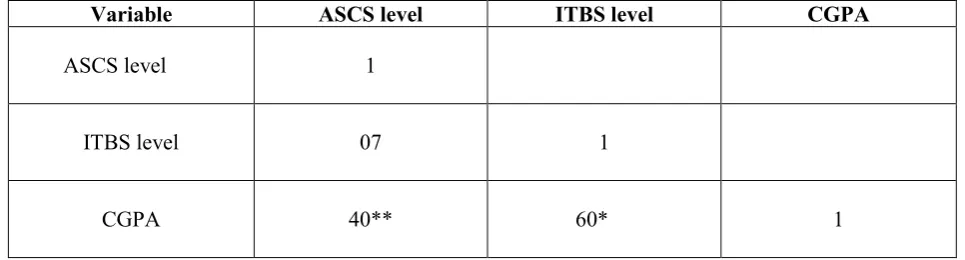
The length of time since transition was also addressed in this question to determine if time influenced ASCS measures or academic measures. The relationship between time and ASCS, ITBS, and GPA scores was not significant; however, ITBS scores were statistically significant at the .05 significance level with cumulative GPA for those students who had transitioned within the past 7 months (r=.60, see Table 2). For students whose length of time since transition was more than 24 months, there was a significant relationship between the ITBS and GPA at the .01 level (r=.71, see Table 3).
Table 2. Correlation between times since transition (less than 7 months)
Variable ASCS level ITBS level CGPA
ASCS level 1
ITBS level 07 1
CGPA 40** 60* 1
International Journal of Research (IJR)
e-ISSN: 2348-6848, p- ISSN: 2348-795X Volume 2, Issue 4, April 2015Available at http://internationaljournalofresearch.org
Table 3. Correlation between times since transition (more than 7 months)
Variable ASCS level ITBS level CGPA
ASCS level 1
ITBS level 19 1
CGPA 52** 71* 1
* Correlation is significant at the .01 level (2-tailed).
4.2 Data for Research Question 2
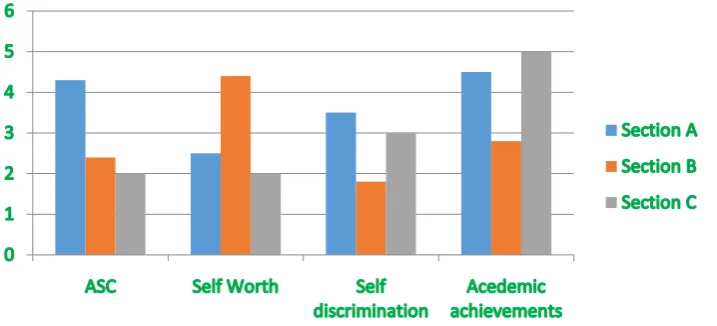
The data analysis for students attitude towards teachers to Academic self-concept (ASC), Self-worth, Self-discrimination and Academic achievements.
Student’s attitude towards teachers to Academic self-concept (ASC), worth, Self-discrimination and Academic achievements.
4.3 Data for Research Question 3
Table.4 The coefficient of correlation of self-discrimination with academic achievement among Students
Variables No.Of.Students (Sec-A+B+C) ‘r’ Value Significance Level
Self-discrimination 30 0.05 NS
Academic
International Journal of Research (IJR)
e-ISSN: 2348-6848, p- ISSN: 2348-795X Volume 2, Issue 4, April 2015Available at http://internationaljournalofresearch.org
4.4 Data for Research Question 4
Teachers motivation versus Students Self-Worth
4.5 Data for Research Question 5
Data gained through the overall academic achievements of the 9th grade level students
5. Discussion
As per the general principle in education, a student needs good academic self-concept in order to be successful academically. To achieve this success, schools can involve their students academic self-concept by developing an organized, orderly and supportive legal environment. Teachers should teach students good study habits end self management skills together with
appropriate self-attribution strategies. The findings of the present study highlight the importance of promoting a positive self-concept in every aspect in various psychosocial contexts. Thus, positive self-concept is key factors for successful learning, general behavioural patterns and high
participation in school activities.
Additionally, reflecting on student skills, strengths, and achievement in school can continue to boost student motivation toward Self-Concent
41%
Self-discrimination 16%
Others 7% Academic Achivements
36% Self-worth
43%
International Journal of Research (IJR)
e-ISSN: 2348-6848, p- ISSN: 2348-795X Volume 2, Issue 4, April 2015Available at http://internationaljournalofresearch.org
school and goal valuation. Although many students in this study indicated significant
motivation/self-regulation to attaining
academic desires, school-based professionals could increase recognition of student
achievement. Reflection on student
achievements and recognition can serve as an
acknowledgement of student
accomplishments and a catalyst for students to continue striving for success in school. For example, having a student highlight board on display in the school building could
be helpful for encouraging student
achievement, along with having individual meetings with students who are identified as
needing more academic assistance.
Acknowledging students who are motivated and achieving in school not only helps to build student morale but also serves as an appreciation of teachers and others involved in the student’s life.
6. Conclusion
The results suggest a significant relationship among variables of academic self-concept
versus self-worth versus academic
achievement, and other factors influencing student outcomes. This research supports enhancing the quality of interactions between students and teachers and encouraging others associated with students education to be involved as these factors relate to student perceptions of academic ability and actual performance on academic measures.
7. Acknowledgement
I especially thank the 9th grade level student
Vellore district for cooperating with me to find my research findings in this academic achievements, I deeply thank the staffs and the administration for supporting my research study.
Students of integral sections participated in this research study
References
[1.] Alka 1991. A Study of Discrepancy
between Intelligence and Academic
Achievement in Relation to Self- Concept of the Individual. M.Ed. Dissertation, Punjab University, Chandigarh.
[2.] DeoPratibha., 1998. Manual for
Self-concept List. Agra: National Psychological Corporation.
[3.] Desai, H.G., and Uchat, D.A. 1983.
Selfconcept of high-achieving and
lowachieving students of first year classes of
colleges. Journal of Educational Research and Extension, 9(3): 155-161.
[4.] Foluke-Henderson Nzinga, E., 2007.
Selfconcept, ethnic identity and world view of African American males from urban United States of America. Dissertation Abstracts International, 67(12): 449-A.
[5.] Hamachek, D., 1995. Self-concept
and school achievement: Interaction
International Journal of Research (IJR)
e-ISSN: 2348-6848, p- ISSN: 2348-795X Volume 2, Issue 4, April 2015Available at http://internationaljournalofresearch.org
[6.] Kobal, D., and Musek, J., 2001.
Self-concept and academic achievement: Slovenia and France. Personality and Individual Differences, 30(5): 887-899.
[7.] Lau Kit Ling., 1995. Family
Relationship, Self-concept and Delinquency among Hong Kong Students . Phil. Thesis in Education, the Chinese University of Hong
[8.] Kong. Lyon Mark, A., 1993.
Academic SelfConcept and its Relationship to Achievement in a Sample of Junior High
School Students. Educational and
Psychological Measurement, 53(1): 201210.
[9.] McClelland, D.C. (1961). The
achieving society. Princeton, New Jersey: Van Nostrand. McClelland, D.C., & Winter,
D.G. (1969). Motivating economic
achievement. New York: Free Press.
[10.] McInerney, D.M. (1997).
Relationship between motivational goals, sense of self, self-concept and cademic achievement for Aboriginal students. 10th Annual Aboriginal Studies Association Conference, University of Western Sydney, Bankstown Campus, Milperra, 12-14 July, 2000.
[11.] Noar, S. M., Anderman, E. M.,
Zimmerman, R. S. & Cupp, P. K. (2005). Fostering Achievement Motivation in Health Education, Journal of Psychology & Human Sexuality, 16: 4, 59-76
[12.] Ommundsen, Y., Haugen, R., &
Lund, T. (2005). Academic Self-concept, Implicit Theories of Ability, and Self-regulation Strategies, Scandinavian Journal of Educational Research, 49:5, 461-474
[13.] Tella, A. (2007). The impact of
motivation on student’s academic
achievement and learning outcomes in mathematics among secondary school students in Nigeria. Eurasia Journal of
Mathematics, Science & Technology
Education, 3(2), 154
[14.] Wang, J., & Lin, E. (2008). An
Alternative Interpretation of the Relationship between Self-Concept and Mathematics Achievement: Comparison of Chinese and US Students as a Context, Evaluation & Research in Education, 21: 3,154-174