The Use of Basic Principles in the
Classification of Range Vegetation
HERBERT C. HANSON
Department of Biology, The Catholic University of America, Woshiirugtonb D. C.
Knowledge of communities as they occur on the range is essential to good management ; their compo- sition, structure, site relations, suc- cessional status, forage values, and classification. The classification of range vegetation is challenging, and at the same time baffling. In the classification of any kind of objects it is necessary, first of all, to possess considerable information about their properties. Our knowl- edge of range vegetation is, how- ever, fragmentary. At the present time it is inadequate for a sound, comprehensive classification. The evaluation of principles can serve as a guide to aid in the collection of data which will be most useful in classification. To be of greatest validity a classification must be based upon principles pertaining to properties that are inherent in the vegetation itself. When other substances are classified, such as soils, species of plants and animals, or chemical compounds, it is taken for granted that the inherent prop- erties of these substances are used.
Criteria Emplo’yed in Varioss
Classifications
As mentioned by Braun-Blanquet (1951: 553), many roads lead to Rome, so various criteria have’ been used to classify communities. The following five have been the most commonly employed. (1) The physi- ognomy, or general appearance, of the vegetation, such as forest, chaparral, and bunchgrass. (2) Habitat relations, with emphasis on the causal influence of the en- vironment such as sand-dune, salt- flat, and gravel-slide. (3) Geo- graphic distribution, such as alti- tudinal and latitudinal zonation. (4) Successional status, or the re-
lation to the climax. (5) Floristics, or the kinds of species that make LIP the community.
In some classifications two or more of these bases have been used jointly, often with the emphasis varying from one to others. In the classification of major grasslands of North America the chief basis is physiognomy, but geographic dis- tribution and florist& are also important. The eight kinds are (1) tallgrass prairie, (2) coastal prai- rie, (3) mixed prairie, (4) short- grass plains, (5) desert grassland or desert-plains, (6) Pacific prai- rie, (7) Palouse prairie, and (8) fescue grassland ( Coupland and Brayshaw 1953, Moss 1955). Dif- ficulties exist, as in the classification of most biological objects, in as- signing some grassland areas to one or another of these groups. Transi- tions and interdigitation occur. The validity of giving equal status to each of these eight kinds may be questioned. The classification, how- ever, is valuable in that it recog- nizes important differences in spe- cies composition, in life-forms, in regional distribution, and in domi- nance of species. The classification also reflects important differences in climatic conditions of the vari- ous regions in which they occur.
The vegetation in each of these major grasslands shows a great variety of types, caused by local differences in environmental condi- tions, by various kinds of treat- ment, and by differences in the inherent capacities of numerous species. Much difficulty is encoun- tered in the classification of these minor communities, largely because of insufficient knowledge.
I n this discussion the term “com- munity” applies to one or more
26
stands in which the vegetation shows considerable similarity in species composition throughout, particularly in the dominants and constants, in physiognomy, in cover, and in frequency or con- stancy. A single stand may be called a “concrete community,” a number of similar stands an “ab- stract community” or type. Anal- ysis of stands is essential in studying communities for, as Dan- sereau (1952 :351) stated, “the only truly precise definition of a com- munity is that which can be ob- tained by abstracting the observed quantitative notations of rather extensive quadratting.”
The environment plays a large role in causing the occurrence of similarities and dissimilarities in vegetation. Dissimilarities are caused in part because environ- mental conditions vary from place to place. Each place with its own environmental conditions is a hab- itat or site with its own specific effects upon the plants. Similari- ties in vegetation are caused in part because many disconnected habitats are essentially similar
(Dyksterhuis 1949). The sites may be sharply differentiated from one another when moisture or other environmental gradients fire steep, or transitional zones may occur when the gradients are grad- ual. It appears that gradients are steeper and therefore communities are more sharply differentiated under the drier conditions and greater physiographic variations in western grassland formations than in the tall-grass prairie (cf. Hanson and Whitman 1938, Han- son 1955, Weaver 1954). This de- duction is supported by the inten- sification of types and additional fragmentation into types that oe- curred in the tall-grass prairie during the dry period of 1934 to 1940 in eastern Nebraska and Kan- sas (Weaver & Darland 1944).
Basic Principles
relations of species of the com- munity to the environment; B, those dealing with relations be- tween species within the commu- nity; and C, those dealing with the ecological success of a species with- in a community.
Class A. This class, the rela-
tions of the species of a community to the environment, includes three principles.
1. Every species has certain re- quirements for water, radiant energy, nutrient salts, and others. The site must provide these re- quirements in minimum quantity, which varies with the species, or the species will not be able to grow.
2. Each species has a certain range of environmental conditions, or an ecological amplitude, in which it can grow. Western wheat- grass ( Agropyrolz smith& ) , for example, grows under a wider range of soil salinity than blue grama (Bouteloua gracilis). Re- lated to this principle of ecological amplitude is that of tolerance to extreme conditions. Each species has an ecological amplitude under which it grows best. This applies also to the community, “each type of community has an inherent spectrum of toleration to normal extremes of adverse conditions to which it is subjected” (Allee, et al. 1949 539).
3. Each species has a certain capacity or efficiency to utilize the available resources of the commu- nity in which it occurs. Two species may be fairly similar in ecological amplitude, such as prairie June- grass (Koeleria cristata) and needle-and-thread (Xtipa corn&a) ,’ but under a given set of conditions one may flourish more than the other. In early stages of secondary succession, forbs such as Russian thistle (Salsola kali), are often more efficient than grasses in uti- lizing the environmental resources such as wind for dissemination of seeds and soil moisture and nutri- ents for germination and growth.
1 Nomenclature is according to Weber (1953).
The greater efficiency of one spe- cies as compared to another under similar conditions may be brought about in a number of ways such as by a more extensive root system or by a higher rate of photosyn- thesis (Figs. 1 and 2).
Class B. This class, the relations between species in the communit,y, includes two principles.
1. Species differ in competitive capacity, which depends upon the biological equipment of the species. The biological equipment includes all the properties of a plant which are involved in its growth and re- production. For example, some spe- cies propagate by means of runners or rhizomes while others have no vegetative means of propagation. Some are highly resistant to drought, others succumb quickly. It appears that a species has its maximum competitive power when it is growing within its optimum ecological amplitude.
2. Species differ in the capacity of adjustment to one another, often called the association of species. Plants differing in life-form such as needle-and-thread and blue grama, or bunch grasses and single- stalked forbs, are more often associ- ated than those that are similar. Association of species may be re- lated to grazing intensity, as for example, plants of high palatability growing in clusters of prickly pear cactus or in dense sagebrush.
Class C. This class deals with the ecological success of each species in the community in which it oc- curs. This depends upon its capac- ity to cope with its environment and associated species in relation- ships outlined in the five preceding principles. The degree of success of a species in a given community can be evaluated by such character- istics as vitality, sociability, cover, numerical abundance, frequency, constancy, fidelity, and dominance
(Hanson 1950).
Vitality is the vigor of a plant. Knowledge of the appearance of normal plants at various stages of growth is necessary in order to ap- praise the degree of vigor. A num- ber of criteria may be used in de-
terming the vitality such as rate of growth, height attained, yield of herbage, color, extent of dam- age by parasites or drought, area of crowns or herbage, number of new shoots, extent of dead portions, and number and condition of flower stalks.
Sociability refers to the ability of plants to grow close together, to form dense aggregations. Many spe- cies that spread only by seed often show a high degree of sociability, especially in early. stages of suc- cession. Western wheatgrass, by means of its rhizomes, has been especially effective in forming dense aggregations in areas damaged by drought or deposition of wind- blown soil. The degree of sociabil- ity that a species will develop is often determined by the environ- mental conditions and the ecologi- cal amplitude of the species.
Cover.-Cover applies to the herbage area, i.e., the area of ground covered by the leaves, stems, and inflorescences when viewed from above; or to the basal area, i.e., th,e area of ground actually occupied by the crown, or the area penetrated by the stems (corre- sponds to “density” as used in range management). Basal area may also refer to the area occupied by the plant in a horizontal plane half an inch or more above the ground.
Numerical abundance.-This re- fers to the number of stalks or in- dividual plants per unit area.
28
possessing it finds the environment- al conditions suitable. Species with constancy ratings of, 80 percent or more in a type are important in characterization and are called “constants.” Constants with high cover value are good competitors, those with low cover values are usually poor competitors.
Fidelity.-This refers to the de- gree to which a species is restricted to a particular kind of community. Constancy deals with the occur- rence of the same species in dif- ferent stands within the same kind of community ; fidelity deals with the occurrence of species in differ- ent kinds of communities. Fidelity is a useful indicator of the ecologi- cal amplitude of a species. The spe- cies having a high degree of fidelity are valuable in characterizing a community and such species have been widely used in grassland clas- sification in central Europe.
Dominance.-This characteristic of vegetation expresses the differen- tial development of plants in a com- munity, showing clearly the high degree of ecological success attained by some species. Usually the domi- nants are those species which are able to utilize the resources of the habitat most advantageously, and which by their influence on the habitat and on other species de- termine to a considerable extent the conditions under which the species associated with them must grow. Many qualities. are needed by a species to become a dominant. Cheatgrass has become dominant on large areas in western United States since 1900 because of its large production of seed, rapid germination and growth of roots and shoots even when conditions are only fairly favorable, early maturity, and the large number of plants per unit area.
Use of Criteria in the Analysis
of Communities
The most successful species in a given site are the dominants and other species having the highest ratings in cover, numerical abun- dance, frequency or constancy, and
H. C. HANSON
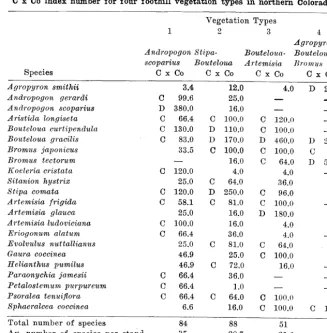
vitality. To facilitate comparison and the selection of the most suc- cessful species a figure combining at least abundance or cover and frequency or constancy is desirable. This has been done in Table 1 in the columns with the heading “C x Co”, C for constancy in percentage, Co for herbage cover ratings. The possible range of this combined rating is from 1.0 to 600. The low- est rating or index number would occur when a species is found in only one stand and has 10 percent or less herbage cover. A rating of 600 would indicate that a species occurs in all of the stands with 75 to 100 percent herbage cover.
Limitations of time for field work often restrict the gathering of data to 3 or 4 characteristics, such as cover, frequency, vitality, and dominance. It should be men- tioned, however, that a complete characterization requires use of all the characteristics (Hanson 1950). One method of securing the field data is to locate systematically 20 one-meter-square quadrats per stand and to use 10 stands for each kind of community when possible. A larger number of smaller sample units may be used in place of the
meter-square quadrat. The data are tabulated by species for each stand, summarized, and then as- sembled in an “association table” (Hanson 1955). A more rapid method of securing the field data is to locate one sample area, about 3 x 4 meters in size, in each stand. This procedure enables one to study a greater number of stands within a given time. The data in Table 1 are based upon this latter method. The association table gives a com- prehensive analytic summary of the stands and the community. The table is indispensable in comparing stands, in classifying stands into abstract communities or types, and in comparing communities.
ditions or influences. The subordi- nate species, because of their frequently narrower range of eco- logical amplitude, may sometimes be the most valuable in classifica- tion. It seems reasonable and de- sirable, therefore, to classify in the same group, or abstract community or type, those stands which have much similarity in the kind, cover, density, and frequency of domi- nants and constants, and, at times, species high in fidelity. And, in turn, abstract communities may be grouped into larger classes if they possess similarities, particularly in composition and abundance of spe- cies. When site conditions are simi- lar within a restricted geographic area, and the species composition varies considerably, one may expect to find destructive influences such as fire or overgrazing in operation now or in the past.
Important features of site con- ditions, especially rainfall, topog- raphy, and soil, are described for each stand. Data on present usage and history of each stand are es- sential for understanding the vege- tation at the time the analysis is made. Whenever possible the suc- cessional status, and productivity under present conditions and the maximum that the site would per- mit, should be described. The more thoroughly a stand or com- munity is characterized in relation to its site, the more precise can be the range condition classification, and the better it will serve in the determination of vegetation trend.
This kind of classification of range vegetation is scientific be- cause it is based upon inherent characteristics of the vegetation itself, and these characteristics are related to the physical conditions in which the vegetation occurs. When descriptions of the inherent characteristics of the communities and sites are available, various uses can be made of them, in addi- tion to classification. They can be the basis for the survey of exten- sive areas or regions. They can be used in the determination of range condition and trend. They can be used in the evaluation of sites by
using the communities as indi- cators.
Example Illustrating the Use of These Principles
Results secured by the applica- tion of these principles, and by the method briefly outlined above, are given in the following example. The field work was done in the lower foothills, west of Berthoud, in northern Colorado. This study is described more fully by Hanson (1955) and Hanson & Dahl (in press). Four of the most common types were analyzed to yield data on most of the characteristics which denote ecological success of the species in each type. The data were assembled in association tables, of which portions are given in Table 1.
It may be seen at a glance in the
table that Type 4, the Agropyro?z smith%Bouteloua grwilis-Bromus tectorum type, differs more from the other three types than these three differ among themselves. In the field there was a marked dis- continuity between this type and the others. Type 3, the Bouteloua gracilis-Artemisiu glauca type, was to some extent in an intermediate position, usually occurring in a zone between Types 2 and 4. It re- sembled Type 2 more closely, how- ever. The types may therefore, be arranged in two classes, the first three in one class, the last one in a class by itself. The four types may be arranged in a series, from the most mesic to the most xeric, in the order shown in the table. On the basis of the complete association tables, which show all the species present in all of the areas sampled,
Table 1. Portion of association table showing dominants (D), constants (C), and C x Co index numbor for four foothill vegetation types in northern Colorado.*
Species
Vegetation Types
1 2 3 4
Agropyron- Andropogon Stipa- Bouteloua- Bouteloua- scoparius Boutelouu Artemisia Rromus
c x co c x co c x co c x co
Agropyron smithii Andropogon gerardi Andropogon scoparius Aristida longiseta Bouteloua curtipendula Bouteloua gracilis Bromus japonicus Bromus tectorum Koeleria cristata Sitanion hystrix Stipa comata Artemisia frigida Artemisia glauca Artemisia ludoviciana Eriogonum alatum Evolvulus nuttallianus Gaura coccinea Helianthus pumilus Paraonychia jamesii Petalostemum purpureum Psoralea ten&flora Sphaeralcea coccinea
3.4 C 99.6
D 380.0 C 66.4 c 130.0 C 83.0 33.5 - c 120.0
25.0 c 120.0 C 58.1 25.0 c 100.0 C 66.4 25.0 46.9 46.9 C 66.4 C 66.4 C 66.4 6.6
12.0 25.0 16.0 c 100.0 D 110.0 D 170.0 c 100.0 16.0 4.0 C 64.0 D 250.0 C 81.0 16.0 16.0 36.0 C 81.0 25.0 C 72.0 36.0 1.0 C 64.0 16.0
4.0
- - c 120.0 c 100.0 D 460.0
c 100.0 C 64.0 4.0 36.0
C 96.0 c 100.0 D 180.0 4.0 4.0 C 64.0 c 100.0 16.0 - -
c
100.0 c 100.0D 200.0 - - - -
D 230.0 C 83.0
D 510.0 - 9.9 9.9 - 6.6 3.4 - 3.4 6.6 - - - 46.9 c 100.0
Total number of species 84 88 51 28
Av. number of species per stand 35 28.7 21.6 11.2
Number of stands analyzed 6 10 5 6
30 H. C. HANSON
and on the basis of data on site con- often a high degree of adjustment sites. The soil is deep and fairly ditions, the types may be charac- to one another or to other species loose, with numerous rocks and terized as follows. (Class B principles). The species gravel throughout. The pH is 6.8 The stipa-Boutelo,ua Type) with medium ratings probably to 8.0 and the lime content is medi- Dominants : Stipa coma& Bou- have less efficient relations with the urn high, containing fewer lime
teloua gracilis, B. curtipendula. environment, and they possess less flecks than in the Stipa-Bouteloua Constants : Aristida Zon~iset~~ capacity for competition or adjust- ment, especially with the dom- type. This type probably receives
Bromus japonicus, Sitanion hys- runoff at times from the upper
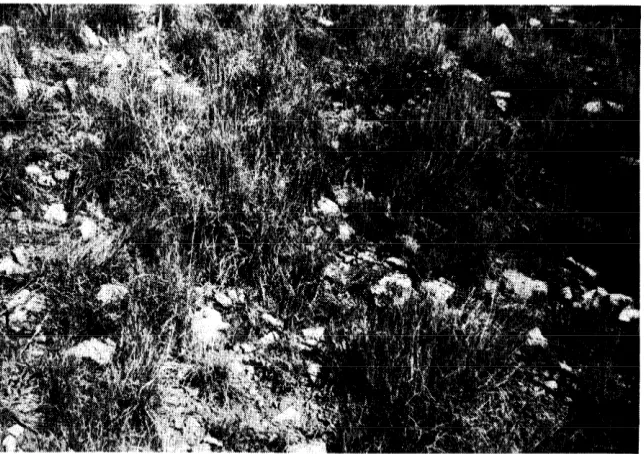
trix, Artemisia frigida, Evolvulus inants under the prevailing site part of the slope and possibly sub- nwttallianus, Helianthus pumilus, conditions. Bromus japonicus pos- surface drainage. Water pene- and Psoralea tenuiflora. sesses a high degree of adjustment trates fairly well but during Site conditions.-This type (Fig. to the dominants, but low competi- tive capacity. The species with low heavy showers the runoff is prob- ably high because of the steepness 1) occurs mostly on moderate to
steep upper slopes (2-25” ). Much ratings are deficient in capacity for of the slope. Soil moisture supply is adequate for a long growing sea-
i
gravel and many rocks are on the competition or adjustment, and a
surface and below. The soil is the number, such as others not shown in the table, par- Petalostemum, and son, as indicated by the presence and vigor of Andropogon sco- most shallow and has the smallest t-cularly buffalograss and sand
amount of clay, compared to the d parks, A. gerardi, and other spe- other three type sites. The upper 1’ imits ropseed, are probably so near the ties. Erosion by water varies from six inches is sandy loam ;
of their ecological ampli- none to moderate in most places, 6-E tudes that they cannot utilize effi-
inches is sandy clay loam; 12-18 but is rapid where the cover is
inches is sandy loam to loam. All Gently the resources of the en- poor.
horizons are fairly loose, with a vironment (Class A, principles 1 This is the most luxuriant of the high lime content, and pH usually and 2). If our knowledge of the four types. It is characterized by is 8.0 to 8.2. The color is dark red- ecology and physiology of the spe- ties were adequate the ratings of the high dominance of A. sco- dish brown to dark brown at O-12 each of the 88 species in this type pa&us, with a C x Co rating of inches, and light brown gray to could probably be explained ac- 380. It is far more successful than brown at 12-18 inches. The water cording to the principles. the other species in this kind of
penetrates fairly readily and it is site. Noteworthy constants are
adequate for a moderately long The cover in the various stands Andropogon gerardi, Koeleria cris- growing season and for the contin- varies from low to high, 25 to 85 tata, Bouteloua curtipendula, ued existence, year after year, of percent, averaging 28.7. The total Stipa comata, and Artemisiu ludo- the dominants and a rich variety number of species, 88, which was viciana. It is essentially a prairie of other species. Runoff during found in all of the stands, is high. type. The herbage cover is medium heavy showers may be large. The Andropogon scoparius Type to high, 50-80 percent, averaging
vegetation was green in August, 67 percent. The number of species
1953, when nearby stands of Agro- Dominant . : Andropogon sco- per stand is high, ranging from 31
withstand the competition of the many vigorous perennials in this stand. Even low perennials, such as Sphaeralcea coccinea, are handi- capped.
Bouteloua gracillis-Artemisia glauca Type1
Dominants : Bouteloua gracilis,
Artemisia glauca.
Constants : Aristida long&eta,
Bouteloua curtipendula, Bromus japonicus, B. tectorum, Artemisia frigida, Stipa comata, Gaura coc- cinea, Evolvulus nuttallianus, Psoralea ten&flora, and Sphae- ralcea coccinea.
Site conditions.-Stands of this type are situated on slight to mod- erate lower slopes (l-15” ) or in valleys. The medium hard soil is intermediate in depth to the Stipa- Bouteloua type and the Agro- pyron-Bouteloua-Bromus type.
The profile consists of dark reddish brown to red sandy clay loam from 0 to 6 inches and 6 to 12 inches, and reddish brown to weak red sandy clay loam to clay loam at 12- 18 inches. A moderate number of gravel particles and rocks are scat- tered throughout. The lime content is usually high and the pH is 8.0 to 8.2. The absorption and pene- tration of water are fairly good. The length of the growing season is moderately long. Loss of surface soil occurs from some of the small openings between the plants. Com- pactness of the soil favors runoff during hard showers.
This type is intermediate be- tween the Stipa-Bouteloua and the Agropyron-Bouteloua-Bromus
types, but, as indicated by the kind’ and number of constants, it is more similar to the former. The cover is about medium, 60 to 70 percent, averaging 68 percent. The number of species is fairly low, ranging from 18 to 27, and averag- ing 21.6. The total number of spe- cies occurring in all the sands is 51. The greatly reduced number of species in this type and in the following one, as compared with the two preceding, indicate less favorable site conditions (Class A
principles). Bouteloua gracilis is the outstanding species, with the very high C x Co rating of 460. The most successful competitors, besides Artemisia glauca, are the constants Aristida long&eta, Boute- loua curtipendula, Bromus japoni- cus, Stipa comata, Artemisia frigida, Psoralea tenuifiora, and Sphaeralcea coccinea. These domi- nants and constants make it diffi- cult for other species to grow
(Class B principles), thus reduc- ing the average number of species per stand to 21.6. The more mesic prairie species such as Andropogon gerardi and A. scoparius do not occur, and Koeleria is apparently
near the limits of its ecological
amplitude.
Agropyron smithii-Bouteloua gracil.kBromus tectorum Type
Dominants : Agropyron smithii,
Bouteloua gracilis, Bromus tec- torum.
Constants: Bromus japonicus, Sphaeralcea coccinea.
Site conditions.-This type (Fig. 2) is found in valleys or on lower slopes (O-5” ) . The soil profile shows dark gray brown sandy loam at O-6
inches, dark gray brown sandy clay loam at 6-12 inches, gray brown to reddish sandy clay loam at 12-18 inches. The soil is deep, hard, and compact; the upper three inches often looser and lighter in color than below. Often much Bromus straw lies on the surface. The gravel content throughout the pro- file is much less than in the other three type sites. The lime content varies from low to high, and the pH is 7.0 to 8.2. The penetration of water below three inches is slow. Runoff is slowed down be- cause of the slight slope and the large amount of debris. The short growing season is probably caused by the soil moisture becoming non- available early in the summer. Erosion is usually none, but depo- sition occurs instead. This is indi- cated by the crowns and rhizomes of Agropyron being deeper than normal and by the fine material, often stratified, in the soil.
32 H. C.
HANSON
than to interrelations with other species. The paucity of constants, as well as in the number of species, appears to be caused partly by the compactness of the soil which fa- vors runoff and hinders penetra- tion of moisture into the soil. Many species, such as dominants and constants of the other types, do not occur in this type because adequate relations with the en- vironmental conditions apparently cannot be established. The three dominants have the capacity to utilize efficiently the resources of the site, which are more limited than those of the sites of the other three types (Class A principles).
When the spring and early sum- mer are dry, Bromus tectorum is less successful than the other two dominants. In the moist early sea- son of 1953 Bromus had the un- usually high rating of 510. This dense growth provided severe competition for all other species, even the dominants (Class B prin- ciples) . In the following year con- ditions were much less favorable for Bromus; Agropyron and Bou- teloua gracilis made much better growth in the decreased abundance of Bromus, in spite of the drier conditions. This indicates the close interrelations of principles in the various classes. In years of favor- able precipitation the cover in this type is high, 80 to 95 percent. The average number of species per stand is low, averaging 11.2, and ranging from 8 to 13. The total number of species in all the stands was only 28.
Discussion
The greater similarity. in the vegetation of the first three types is found also in the sites. The site of the fourth type, Agropyron- Bouteloua - Bromus, showed evi- dence of deposition, while the other three sites often showed evidence of slight to moderate erosion. The percentage of gravel in the upper- most 6 inches is also considerably less in the fourth type, with a mean of 2.2 percent, range O-5.0
has a mean gravel content of 15.6 percent, range 4.5-27.6 ; Stipa-
Bouteloua, mean 33.0 percent, range 7.5-54.2 ; and Andropogon, mean 21.2 percent, range 14.0-38.4. The effects of erosion apparently have been to increase the per- centage of gravel in the eroded areas, while the sands, silt, and clays have been removed to a con- siderable extent downslope. Hub- bard (1950) stated that many kinds of grasses, especially bunch- grass such as Stipa, corn&a, are unable to grow in heavy clay soils because the cracking of the soil caused by swelling and shrinking disrupts crowns and roots. But in Agropyron smith6 the tearing ac- tion tends to separate young plants from older ones by breaking the rhizomes, without other pro- nounced injury.
The gravel content of the Boute- loua-ArtimGa site is intermediate to the Agropyron-Bowteloua-Bro- mus and the Stipa-Bouteloua sites. This was indicated by its location in the field, usually between the other two. The principal differ- ence in site condition between the Stipa-Bouteloua and the Andro- pogon types is probably in the longer period of available soil moisture in the latter.
Stands of the first three types had been subjected to light to mod- erate gra,zing intensity by cattle; the fourth type, Agropyron-Bou-
telouarBromus, to fairly heavy in- tensity. The Andrepogon’ and St&z-Boutelou,a types are in near- climax condition for the kind of sites on which they occur. This is indicated by the large number and kinds of species in each, their vi- tality, and their apparent adjust- ment to the sites. They appear to have existed as such for a long time. The Agropyron-Bouteloua- Bromus type is not in climax con- dition, as indicated by the kinds and abundance of species that are present. Apparently because of the intensity of grazing, the abun- dance and vigor of Bromus tec- torum are too great in comparison
reduced the vegetation on this site to fair to poor condition, and it would probably take a number of years of light to moderate grazing to restore it to near-climax condi- tion. The Bouteloua - Artem&%
type, as stated, is intermediate. Its successional status is not clear. It could conceivably develop into the Stipa-Bouteloua type as the gravel content increases; or if deposition takes place, into the Agropyron- Bouteloua-Bromus type.
In the foothills on which these types occur the Boutelowz-Arte- misia type occupies the smallest area ; Agropyron-Bouteloua-Bro-
mus and Stipa-Boutelow the larg- est areas. Other types, such as Stipa viriduk, and shrub types, especially Cercocarpw montalnus, also occur in distinctive sites. Some mixtures of types are also found. On the whole, the vegetation forms a pattern of types according to sites, and can be evaluated and mapped, similar to the mapping and characterizing of soils.
consideration in all sorts of range studies.
Often in making range surveys the time is insufficient, or funds are inadequate, for making de- tailed analysis of communities, ’ that would include association tables. It would be most desirable, however, that each type in a. range survey be supported by as com- plete a description as possible, in- cluding the association table. This would be analogous to descriptions of soil types in soil survey work. Each description should, of course, be accomplished by a full descrip- tion of the site of each type.
Summary
1. The description and classifica- tion of range types should be based upon principles pertain- ing to properties that are inher- ent in the vegetation.
2. Principles to consider may be arranged in three classes.
A. Principles dealing with the
relations of the species to the
environment are (1) each
species has certain minimum
requirements that the site
must satisfy, (2) each spe-
cies has a certain ecological
amplitude, and (3) each
species has a certain efficien-
cy in utilizing the resources of the environment.
B. Principles dealing with rela-
tions between species are
( 1) species differ in competi-
tive capacity, and (2) spe-
cies differ in capacity of ad- justment to one another.
C. The ecological success of a
species in a community can
be evaluated by such char-
acteristics as vitality, socia-
bility, cover, numerical
abundance, frequency, con-
stancy, fidelity, and domi-
nance.
3. An example is given to illus-
trate the use of the principles
arid characteristics in analyzing
and classifying four grassland
types. Relations of the types to
site, succession, and range use
are described.
4. Application of the principles
and the classification to range
management are indicated.
LITERATURE CITED
ALLEE, W. C., A. E. EM~.SON, et al. 1949.
Principles of animal ecology. Philadel- phia, W. B. Saunders Co. 837 pp.
BRAUN-BLANQUET, J. 1951. Pflanzenso- ziologie. Wien, Springer-Verla,g. 631 PP.
COUPLAND, R. T., AND C. BRAYSHAW. 1953. The fescue grassland in Sas- katchewan. Ecology 34 : 386-405. DANS~~U, P. 1952. The varieties of
evolutionary opportunity. Rev. Cana- dian Biol. 11: 305-388.
DYSTERHUIS, E. J. 1949. Condition and management of range land based on quantitative ecology. Jour. Range Mangt. 2: 104-11s.
HANSON, HERBERT C. 1950. Ecology of the grassland II. Bot. Rev. 16: 283- 360.
HANSON, HEKBEET C. 1955. Character- istics of the Stipa comata-Bouteloua gracilis-B. curtipendula association of northern Colorado. Ecology 36: 269- 280.
H;scs~, HERBERT C., AND E. DAHL. .(In . Some grassland communltles in the mountain-front zone in north- ern Colorado. Vegetatio.
HANSON, HERBERT C., AND W. C. WHIT- MAN. 1938. Characteristics of major grassland types in western North Da- kota. Ecol. Monogr. 8: 57-114. HUBBARD, W. A. 1950. The climate,
soils, and soil-plant relationships of an area in southwestern Saskatchewan. Sci. Agr. Canada. 30: 327-342. Moss, E. H. 1955. The vegetation of
Alberta. Bot. Rev. 21: 493-567. WEAVER, J. E. 1954. North American
prairie. Lincoln, Johnsen Publ. Co. 348 pp.
WEAVFB, J. E., AND R. W. DARLAND. 1944. Grassland patterns in 1944. Ecol-
ogy 25: 202-215.
WEBER, W. A. 1953. Handbook of plants of the Colorado Front Range. Univ. Colo. Press, Boulder. 232 pp.
PHOTOGRAPH CONTEST
Members of the1 American Society of Range Man- agement are invited to participa,te in the Photographic Contest to be held at the 10th Annual Meeting in Grea,t Falls, Montana,, January 29 to .February 1, 1957. Members may participate in absentia.
An individual may have a maximum of five) exhibits, bnt not more than one in each category. Black and white photographs should be 8 x 10 inches with non- glossy surface, mounted with borders at least three inches wide. A description, 50 wo?ds or less, typed on a 3 x 5 card designating title, location and da.te should accompany each photograph, and the contest- ant’s name and address placed on the back of each print. Entries may be made in the following cate- gories :
1. Black and white
a.. Individual range plants
bi. Range condition and destruction
c. Range improvements or management prac- tices
d. Range or ranch scenes e. Individual range animal 2. Color slides (35 mm.)
a. Individual range plant
Nb. Range condition and destruc.tion c. Individual range animal d. Range or ranch scenes