ISSN: 2574 -1241
Analysis on The Physiological and Biochemical
Parameters of Weekly Pre-Competition Training
Session for Men’s Lightweight Rowers
Weiliang Lin
1*, Jialin Wu
1, Zhuoru Chen
1and Nian Li
21School of physical education and sports science, Guangzhou University, Guangzhou, China 2College of physical education and sports science, Shaanxi Normal University, Xi’an, China
*Corresponding author: Weiliang Lin, School of physical education and sports science, Guangzhou, China
DOI: 10.26717/BJSTR.2019.18.003150
Received: May 24, 2019 Published: May 29, 2019
Citation: Weiliang L, Jialin W, Zhuoru C, Nian L. Analysis on The Physiological and Biochemical Parameters of Week-ly Pre-Competition Training Session for Men’s Lightweight Rowers. Biomed J Sci & Tech Res 18(3)-2019. BJSTR. MS.ID.003150.
Keywords: Physiological and Biochem-ical Parameters; Men Lightweight Row-ers; Weekly Pre-Competition; Training Session
ARTICLE INFO abstract
This paper conducts a physiological and biochemical regulation analysis on the elite rowers’ weekly pre-competition training session, taking Guangdong men’s lightweight rowing team as study object. Methods: literature study, expert interview, test and mathematical statistics. Results: Firstly, the weekly training session consists different-distance rowing on water, core strength training on land with proper load-intensity, which mainly focuses on aerobic training and intensifies training according to the rowers’ weak points during the full length rowing; Secondly, the performance in simulation games and the final game indicate the effectiveness of the training with improvement of whole distance rowing results, the rowers’ lactic acid indexes rise as their performances improve. Conclusions: the weekly rowing training mode reasonably allocates land training and water training, which proves its effectiveness through analyzing the rowers’ physiological and biochemical changes during training sessions and games. This research is applicable to the monitoring of physiological and biochemical index for elite rowers’ weekly pre-competition training session.
Introduction
There are many factors that influence the improvement of rowing performance such as the rowers’ skills, physical ability, tactics and their pre-competition state are always the focus of training [1]. In the monitoring of exercise load, physiological and biochemical parameters for rowers’ training, which includes exercise load, aerobic system, energy supply, physiological and biochemical indexes. Such as the different incremental load exercise in rowing [1,2]; Physiological monitoring in training helps to monitor the quality of training special youth rowing athletes and having competitive level of young athletes [3]; The high body fat percentage is one of the main factors restricting the improvement of result [4]; The profile of energy contributions in longer time trials is met by aerobic energy system [5]; Full-scale measurement instruments lies in building a biomechanical model and a diagnosis evaluation system [6-10]. The elements of rowers’ quality include strength, stamina, coordination, balance and flexibility like Rowing
requires the qualities of strength, stamina, coordination, balance, rhythm and determination of quality [11-15]; The core strength of rowing training is the important to specific physical fitness training [16]; The elements of fast strength and core strength training, flexibility and balance ability of ontology stability training are import for rowers’ capability improvement [17].
sprinting, longer sprinting and two-pole faster tactics and higher age. But, there is currently a lack of references on the physiological and biochemical parameters analysis on the elite men rowers’ weekly pre-competition training session. The pre-competition training session includes technique, core strength, cycle power, performance in simulation games, rowers’ lactic acid indexes. so, the applied research program on the integrated approach of the elite men rowers’ weekly pre-competition training session is conducive to the improvement of the players’ performance and has a practical significance.
Research Objects and Methods
Research Objects
Take 5 men lightweight elite rowers from Guangdong Rowing Training Base as study object in China, analyze the training mode before the target competition. The rowers are between 19-30 years old, averaged 22. Their performances are shown in Table 1.
Table 1: Awards won in 2012 National Rowing.
Men’s Lightweight Name Rank
LM4- Zhang Ye, Qiu Guoxiong
Fan Junjie, Huang Zhongming First
LM1X Shan Jiangong Fourth
Research Methods
Literature Study: References consulted include literatures on the forms of men Lightweight-simulation game in different seasons and the relevancy between biochemistry and the rowers’ performance under different stroke rates.
Interview: Collect opinions and suggestions of rowing experts from Guangdong, Zhejiang, and Shandong Province through interviews. Further analyze the rowers’ performances through interview to make sure the clearance of the rowing team’s special physical ability in the provincial team’s weekly training plan, annual plan, pre-competition physical regulation and test and the application of simulation game, and their opinions on the new idea of physical ability.
Heart Rate Test: Use the Finnish Polar heart rate monitor Mode S610 to monitor the multilevel load of heart rates in rest state, immediately after a certain intensity and 1 minute after that, then make a heart rate-intensity change curve by the software Microsoft Excel 2003.
Blood Lactic Acid Test: Collect the ear peripheral blood respectively in rest state, immediately after every intensity level and 1 minute after that, then use Kyoto handheld lactic automatic analyzer to measure and make a lactic-exercise intensity change curve.
Mathematical Statistics: A test was conducted on the rowers of adults lightweight single, pair and multi-human from Guangdong Rowing Training Base to analyze the 8 weeks training sessions before 2012 Olympic Games and National Rowing Championship, it is planned to collect the changes of physiological and biochemical indexes of the men rowers during the pre-competition training, and the relevant data will be processed with conventional mathematical statistics by the software SPSS 19.0.
Mode of The Training Sessions
Basics of The Training Sessions
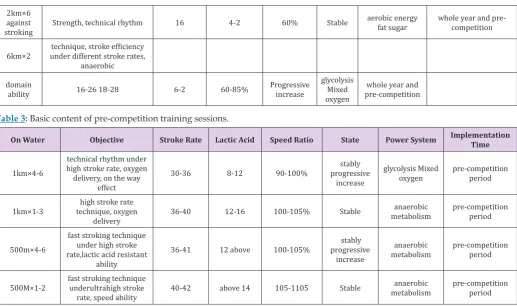
Basic Content And Purpose Of Pre-Competition On Water Training Sessions: The annual on water training sessions consist of 2km and 6km aerobic stroking exercise with low, medium and high stroke rates in 2-3 groups; 20km, 14-16km and 15-20 set-out stroking; 2km against stroking, which aim to improve the rowers’ long-distance stroking ability, short-distance stroking ability and against stroking ability. Its purpose, stroke rates, lactic acid range, velocity ratio, state and functional system are shown in the Table 2. The pre-competition on water training sessions’ basic content includes 1km on the way stroking under high stroke rate, 500m fast stroking under high or ultrahigh stroke rate and the exercise of velocity ability, whose purpose, stroke rate, lactic acid, speed ration, state and functional system are shown in the Table 3. To sum up, the requirements of the corresponding stroke rate, lactic acid indexes, speed ratio and functional system are different in the on water different distance rowing combination. Low speed stable long stroke rate is 16-22 str/min, and is used for the training of aerobic ability and technique; medium speed stable long stroke rate is 24-28 str/min, and is used to improve technique’s economic efficiency, Anaerobic valve capacity and on water special strength; high stroke rate improves speed, anaerobic capacity and velocity change; the mixing of different stroke rates helps to train technical rhythm, and the allocation of aerobic and anaerobic exercise. Interval training method improves anaerobic activities and speed endurance, and the pre-competition interval stroking mainly consists of 500m-2000m different groups of on water rowing, the interval form is rest or slow stroking Table 3.
Table 2: Annual basic content and purpose of on water training.
On Water Objective Stroke Rate Lactic Acid Speed Ratio State Power System Implementation Time
20km technique, aerobic, stroke efficiency 16 1.5-2 55% Stable aerobic energy fat whole year and pre-competition
14-16km technique, aerobic, stroke efficiency 16 1.5-3 55% Stable aerobic energy fat sugar whole year and pre-competition Set out
with 15-20
strokes Anaerobic capacity, switch 40-46 Fastest ATP.CP
2km×6 against
stroking Strength, technical rhythm 16 4-2 60% Stable
aerobic energy
fat sugar whole year and pre-competition
6km×2 under different stroke rates, technique, stroke efficiency anaerobic domain
ability 16-26 18-28 6-2 60-85% Progressive increase
glycolysis Mixed oxygen
whole year and pre-competition
Table 3: Basic content of pre-competition training sessions.
On Water Objective Stroke Rate Lactic Acid Speed Ratio State Power System Implementation Time
1km×4-6
technical rhythm under high stroke rate, oxygen delivery, on the way
effect
30-36 8-12 90-100% progressive stably increase
glycolysis Mixed
oxygen pre-competition period
1km×1-3 technique, oxygen high stroke rate
delivery 36-40 12-16 100-105% Stable
anaerobic
metabolism pre-competition period
500m×4-6
fast stroking technique under high stroke rate,lactic acid resistant
ability
36-41 12 above 100-105% progressive stably increase
anaerobic
metabolism pre-competition period
500M×1-2 fast stroking technique underultrahigh stroke
rate, speed ability 40-42 above 14 105-1105 Stable
anaerobic
metabolism pre-competition period
The Content Mode of Land Core Strength Training from Land Training: Core strength training is to improve the relevant muscle groups of the core body parts of the rowers, enhance the flexibility and stability of the muscles. Core strength training improves the muscles on both sides of the spine, such as muscles of
shoulders, abdomen, spine and pelvis. The content includes squat with a rod, side bridge, lunge swirl, bend down elbow support, side lunge, bend down hand reaching, weight hard pull, back bridge, and abdominal curl, exercise time is 45 minutes. The exercise combination is shown in Table 4.
Table 4: Content of core strength.
No Project Men’s Lightweight(Kg) Time Times
1 squat with a rod 15
2 side bridge about 45 second
3 Lunges swivel 10 20
4 bent down elbow support 45 second
5 Side lunges 15
6 bend down hand reaching about 45 second
7 Weight hard pull 40 15
8 back bridge about 45 second
9 abdominal curl 45 second
Simulation Game of The Training Sessions: 2000m joint training simulation game, techniques, functions, qualities at every stage; sequencing competition simulation.
a) 3-Level Test: Conduct 3-level test on the rowers in the 31st week and the 35th week. The intensity (take 2000m average
power as 100%) on the dynamometer adjust to 65%, 75% and 85% respectively, keep a 8 minutes progressive increase of load in uniform velocity, then collect blood lactic acid data, heart rate at the end of every level 1 minute later; record 3 min, 5 min blood lactic acid data at the end of level 3 and use interpolation method formula to calculate 4mmol/L lactic acid value. Collect
ear blood immediately to measure the blood lactic acid value when the load of every level is over and use Three-Point teat to calculate the lactic acid valve power.
b) Test of The Simulation Game: The summer training would be held in Hekou, Dandong, Sep. 9th and 16th, 2012 (the
36th week and 37th week), and the 2km joint exercise would
external and internal conditions when training. The exercise load and intensity can make the rowers’ body adapt to new conditions, which can improve the rowers’ adaptability to training and competition, immediate response ability, sense of time and space, sense of speed and sense of rhythm.
End of The Training Sessions
The end part consists of land and water parts. The land part includes massage for each other, auxiliary pull, free hand stretching exercise. Rowers massage different body parts for each other for
15 minutes, heart rate is 110-130/min. Auxiliary pull is conducted with the help of team doctor to stretch the rowers’ body parts to improve their limbering work of their passive muscles, the time is 20 minutes. Hand free stretching exercise is conducted by the rowers themselves to stretch their bodies, 20 minutes and heart rate recovers to 110-125/min Table 5. 2km-4km slow stroking is adopted on water limbering work, 15-20 minutes, heart rate recovers to 115-140/min, which helps rowers to recover from tiredness Table 5.
Table 5: The form of end of the training sessions.
Form Content Amount of Exercise Time Exercise Intensity (HR)
Land
Massage for each other Group 1 15min 110-130/min
Auxiliary pull Group 2 20min 110-120/min
Free hand stretching exercise 1-2 groups 20min 110-125/min
On water 2km on water rowing Group 1 15min 120-140/min
4km on water rowing Group 1 20min 115-140/min
Mode of Weekly Training
Table 6: 8 weeks lightweight training plan before national championship.
Week 32(1) 33(2) 34(3) 35(4) 36(5) 37(6) 38(7) 39(compe-tition)
Date August 6th August 13th
August 20th
August 27th
September 3rd
September 10th
September 17th
September 24th
Periodicarrangement
training stages summer training stage 3 the 7th week (pre-competition period)
Purpose of
training keep aerobic ability, improve velocity and ability of special.
quality strength cycle strength+special strength+on water speed strength
endurance keep endurance
Training velocity improve velocity
coordination keep coordinating ability
Technology
fast rowing techniques (coherent, support, transmit)
load of training high high high low medium high medium low competition
weekly exercise intensity
200 180 160 140 120 100
weekly load of training
4 3 2 1
Mode of Weekly Training Before Target Competition: pre-competition period (7 weeks): use 2 plus 1 period training mode, change the intensity of every period constantly on the basis of keeping aerobic ability. This period is to steady the technical ability under high stroke rate; improve the multi-player rowing technique and team working ability; Increase the body parts’ capacity for the
flexible and coordinating ability at the same time. Coordination exercise: skipping backward, outreach high leg lifts, half push-up stand up acceleration, forward front kick, cross kick, pile, single leg jump and single leg down, close eyes lunge step back turn, arms crossed front and back pendulum and etc. This part belongs to the warming up section and limbering work section, which helps to relieve the muscular tension and keep the flexibility of the muscles. The weekly training intensity take the schedule of two highs with one low, low intensity will be conducted one week before the target game as an adjustment; the load of training decreased gradually and low intensity will be conducted one week before the target game as an adjustment; the allocation of different load of training is displayed in Table 6.
Different Distance Rowing Results Control Mode During
7 Weeks Pre-Competition Training
It is found that the corresponding boat speed rhythm modes are different under different stroke rates from LM4- boat different
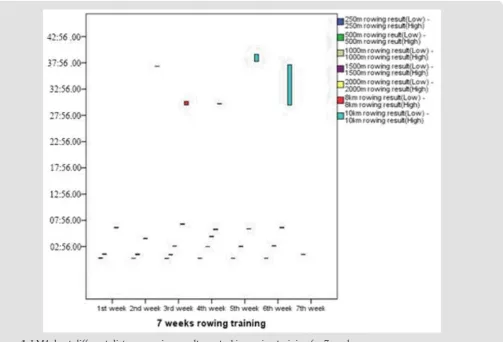
distance rowing results control test for seven weeks. 250m rowing are arranged in the first week to the 6th week, 250m (2-4 groups, interval 5 min), 1-2 times the maximal stroke rate set-out technique simulation exercise a week, rowers use their maximal heart rate, LA10-12mmol, to test their set-out ability of different conditions such as against wind and counter current, favorable wind and stream and still water Figure 1. 500m rowing are arranged in the first, second and seventh week, 500m (2-4 groups, interval 8min, stroke rate 28-30-32-34-36-38 str/min×6 or 36-38str/min), 1 time on the way stroke simulation exercise under different stroke rates a week, rowers’ heart rate, HR170-190/min, LA10-11mmol, test their on the way stroking ability of different conditions such as against wind and counter current, favorable wind and stream and still water. L4M-boat’s results: slowest 1:34.07, fastest 1:22.07, average 1:28.15. Against wind and current, average 1:29.46, favorable wind and current, average 1:25.45, still water, average 1:28.13 Figure 1.
Figure 1: LM4- boat different distance rowing results control in rowing training for 7 weeks.
1km rowing are arranged in the third, fourth, fifth and sixth week, 2-3 groups, interval 8min, stroke rate 32-34-36 str/min×2-3 groups, 1 time on the way stroke simulation exercise under different stroke rates a week, rowers’ heart rate, HR170-190/min, LA11-13mmol, test their on the way stroking ability of different conditions such as level 1 minor side and against wind, flat wave and against wind, flat wave and favorable wind Figure 1 1.5km rowing are arranged in the second and fourth week, interval
counter current. 10km rowing are arranged from the first to the sixth week, 2-3 groups, interval 20min, stroke rate 18-20str/min, 1 time session exercise a week, rowers’ heart rate, HR140-155/min, LA<2mmol, test their aerobic long distance stroking ability in the condition of against wind and counter current Figure 1.
Two Weeks Pre-Competition Adjusting Training
Two Weeks Pre-Competition Training Load Adjustment: Two weeks before the target competition, keep the on water aerobics long distance exercise and decrease load of training, specific forms are as follows: 22 training hours in total in the 37th week before the game, 17 hours and 176km on water, 2hours strength, 3hours general activity; the task of the training sessions includes first, improve the rowers comprehensive skills and team working ability; second, pay more attention on aerobic exercise and improve speed capacity; third, stress quality, enhance recovery (emphasize stretching after training).
a) Analysis on Heart Rate Load Intensity: The allocation of different training content and the rowers’ heart rate load intensity are reflected specifically in the weekly training content and the rowers’ load intensity mode. Two groups of 10km aerobic long distance stroking on Monday morning, 18-20str/ min, rowers’ heart rate, HR140-160/min, LA<2mmol; 1 cycle strength in the afternoon, rowers’ heart rate, HR140-160/min, LA2-4mmol, and 1 technical rhythm on water rowing, rowers’ heart rate, HR 120-140/min, LA<2mmol. Three groups of 2km strength rowing on Tuesday morning, single and pair 24-stroke rowing, multiple rowers 26-stroke rowing, interval 12min, rowers’ heart rate, HR155-175/min, LA4-6mmol; Afternoon recovery. Two groups of 10km aerobic long-distance stroking on Wednesday morning, 18-20str/min, rowers’ heart rate, HR140-160/min, LA<2mmol; 16km aerobic long distance rowing in the afternoon, 18-20 str/min, rowers’ heart rate, HR 140-160/ min, LA<2mmol. 1km on the way stroking on Thursday, 32-34-36 str/min, interval 8min, rowers’ heart rate, HR 170-190/min, LA11-13mmol, and 10km relaxing rowing exercise, rowers’ heart rate, HR120-140/min, LA<2mmol; afternoon recovery. 30 min core strength training on Friday morning, rowers’ heart rate, HR130-150/min, LA<2mmol; two sets of 8km aerobic long-distance rowing in the afternoon, 18-20 str/min, rowers’ heart rate, HR140-160/min, LA<2mmol. Two sets of 250m speed rowing on Saturday morning, interval 5min, rowers’ heart rate, HR185-200/min, LA<2mmol; afternoon recovery. One set of 2km whole team joint exercise (simulation game) under the maximal stroke rate on Sunday morning, rowers’ heart rate, HR 192-200/min, LA>10mmol; afternoon recovery. This week’s training intensity is mainly medium, the purpose is to first improve the rower’s comprehensive skills and team working ability; second, pay more attention on aerobic exercise and improve speed capacity; third, stress training quality, enhance recovery, stretch after training.
b) Analysis On Lactic Acid Load Intensity: There are 15 training hours in total in the 6th week before the game, 12 hours and 120 km training on water, 1hour strength, 2hours general activity, which shows the features of a low intensity training week, the task of the training sessions includes first, pay much attention to the rowers’ health and recovery; second, control body weight; third, enhance the adjustment of the rowers’ competing state. The content of basic part and intensity load control in the week before the target game, the amplitude of fluctuation of different content load on land and water and the combination exercise mode of land and water. The load and intensity both decreases, adjust the rowers’ body to the best state for their recovery. Two groups of 8km aerobic long distance stroking on Monday morning, 18-20 str/min, rowers’ heart rate, HR 140-160/min, LA<2mmol; 12km technical rhythm rowing in the afternoon, 16-18 str/min, rowers’ heart rate, HR 120-140/min, LA<2mmol, and set-out 5-7 stroke fast rowing, rowers’ heart rate, HR187-200/min, LA>10mmol. Two sets of 500m on the way stroking on Tuesday morning, 36-38 str/min, interval 8min, rowers’ heart rate, HR170-190/min, LA10-12mmol, and 8km technical rhythm rowing exercise, rowers’ heart rate, HR130-150/min, LA<2mmol; afternoon recovery.
Technical rhythm stroking with dynamometer on Wednesday morning, 16-18 str/min, 60min, rowers’ heart rate, HR130-150/ min, LA<2mmol; one set of cycle exercise in the afternoon, rowers’ heart rate, HR140-160/min, LA2-4mmol. Rest on Thursday and travel from Guangzhou to Xi’an. Rest and reach the competition site and fix and adjust equipment; 14km technical rhythm rowing in the afternoon, rowers’ heart rate, HR120-140/min, LA<2mmol; 16 km technical rhythm stroking on Saturday morning, 16-18str/min, rowers’ heart rate, HR 120-140/min, LA<2mmol; Rowers rest in the afternoon. 1km on the way stroking on Sunday morning, 32str/min, rowers’ heart rate, HR170-190/min, LA8-10mmol, and 6 km relax rowing exercise, rowers’ heart rate, HR 120-140/min, LA<2mmol; Rowers rest in the afternoon. Prepare to the game.
Results and Analysis
Analysis of The Simulation Game
finishing the 2000m test, and it shows a reasonable use of physical energy to avoid over increase of lactic acid also helps to get a good result Tables 7 & 8. The LM4 boat adopt high stroke rate for set-out, effective higher stroke rate helps accelerate the boat, the speed
rhythm ability is reflected with the well-balanced high rate stroking ability and effective stroke rate. It is the feature of elite rowers to still keep the superior speed of on the way stroking to the finishing phase Tables 7 & 8.
Table 7: 2012-09-09 2Km Rull Gathering Testing.
Name Event 500m 1000m 1500m 2000m LA
Result Str/min Result Str/min Result Str/min Result
LM1X 01:45.3 32 03:30.0 30.5 05:17.3 31.8 07:04.3
Shan 01:45.3 01:44.7 01:47.3 01:47.0 13.27
xx LM4- 01:44.1 01:42.9 01:45.5 01:44.8
Zhang 01:27.5 39.1 02:57.0 37 04:28.4 37.2 05:58.2 14.09
Fan
Qiu 01:27.5 01:29.5 01:31.4 01:29.9 12.9
Huang 12.75
Table 8: 2012-09-16 2Km Rull Gathering Testing.
Name Event 500m 1000m 1500m 2000m LA
Result Str/min Result Str/min Result Str/min Result
LM1X 01:49.0 31 03:38.0 30.08 05:26.0 30.5 07:15.0
Shan 01:49.0 01:49.0 01:48.0 01:49.0 13.62
xx LM4- 01:44.1 01:42.9 01:45.5 01:44.8
Zhang 01:30.0 38.9 03:01.0 47.4 04:32.0 37.8 06:02.0 12.66
Fan 14.26
Qiu 01:30.0 01:30.0 01:30.0 01:30.0 10.55
Huang 12.05
Analysis of The Performance of Target Competition
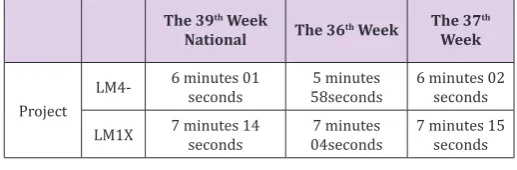
The weather conditions such as wind directions and tempera-ture has major influence on the performance of the rowing test, but form the table 9, we find that the performances of different rowing games generally rise and keep stable in the games after the applica-tion of specific training before the naapplica-tional games. The systematic weekly pre-competition training content, load target implementa-tion, aerobic test and regulation plan 2 weeks before the competi-tion all reflect the effectiveness of the mode design Table 9.Table 9: A comparison between the performances of target
competition and simulation games of Guangdong rowing team.
The 39th Week
National The 36th Week The 37 th Week
Project
LM4- 6 minutes 01 seconds 58seconds5 minutes 6 minutes 02 seconds
LM1X 7 minutes 14 seconds 04seconds7 minutes 7 minutes 15 seconds
Conclusion
The weekly rowing training mode reasonably allocates land training and water training, which proves its effectiveness through analyzing the rowers’ physiological and biochemical changes during training sessions and games. It will help rowers perform more steadily in target competition to improve the scientificity of
rowing training, the reasonableness of the weekly pre-competition training intensity, the rowers’ recovery ability and adaptability to changes in simulation games. This research is applicable to the monitoring of physiological and biochemical index for elite rowers’ weekly pre-competition training session.
Acknowledgment
This paper is one of the phased results of Olympic and nation games special research program funded by Guangdong Sports Bureau (code:20120NS052) and Young & Middle-Age Teachers Overseas Training Project of International Exchange and Cooperation Project of Guangzhou University (Build High Level University, Comprehensive Budget for Physical Education Department), please allow me to express my gratitude to Guangdong Boat Training Base and Guangzhou University, it was their helpe specially Coach Ma Qun,,Ji Renxu, Dong Wenfen and the track & field teachers of school of physical education and sports science and other the related students in research team, that made sure this research can be carried out successfully.
References
1. Bi Xuecui, Zheng Xiaohong (2016) Comparing the effects of two different incremental load exercise on outstanding rowers’ endurance training. China school physical education 3(5): 77-81.
3. Gao Binghong, Meng Zhijun (2013) Progress of the study on the monitoring methods of the specific training of rowing. Sport science research 34(5): 52-59.
4. Gao Jianshen (2013) Comprehensive factors effecting rowing training and competition analysis. Contemporary sports technology 3(25): 32-36.
5. Ji Renxu (2017) Information analysis of new zealand’s open-men rower’s pair oars world competition. Hubei sports science 36(4): 374-376. 6. Li Lei, Hou Yuanyuan, Wang Jianbin Cui Yonghui (2014) Establishment
and evaluation of core strength training system of rowing athletes. Journal of Hebei institute of physical education 28(5): 23-27.
7. Li Tao, Gao binghong (2014) Study on the changes of composition and AT4 power of Elite female rowers before and after races. Sport science research 35(3): 49-52.
8. Li Yongming, Zi Wei, Chen Xiaoping (2017) Energy contributions in rowing time trials on ergometer with different durations. China sport science 37(3): 51-57.
9. Liu xiaochun, Zhai Liwu, Li Keli (2009) Consideration of training outline designs for the national-wide sport games in rowing events. Journal of hubei sports science 28 (3): 366-367.
10. Liu Yingjie (2010) Construction of a strength quality evaluation system for rowers in big training cycles. Journal of Shenyang sport university 29(5): 108-109.
11. Ma Huanhuan (2017) Characterics of body shape and special quality of rowing athletes in Huai An city. Contemporary sports technology 3(7): 254-256.
12. Mao Cheng (2015) Research on energy supply of excellent rowers simulating match (2000m) with ergometer. Zhejiang sport science 37(1): 122-125.
13. Wang Hui, Wang Hongtao, Fan Mengjiao (2013) Body-function monitoring of male rowing athletes and evaluation of training before competition. Shandong sports science & technology 35(2): 79-83. 14. Wang Jianyue, Sun Peng Ding Yong (2017) An analysis on the changes in
physiological function and training effect of women’s open class rower. Liaoning sport science and technology 39(6): 56-59.
15. Wang Zhao zheng, Xu Yu, Hu Shenggui (2015) Investigation and analysis of strength training of chinese rowing athletes. Hubei sports science 34(11): 998-994.
16. Xu Kaisheng, Xu Kaijuan, The research progress of rowing techniques. Journal of Shanghai.
17. Zhou Jianfang, Zhang Wenbing (2015) Design of the GNSS Rowing monitoring service system. Computer knowledge and technology 11(10): 96-98.
18. Zi Wei (2016) The analysis of training load in winter training of Elite male rowers of Henan province preparing for the national regatta in 2013. Journal of Anhui sports science 37(3): 80-85.
19. Zi Wei, Chen Xiaoping (2013) Current rowing world pattern and developing trend based on London Olympic regatta. China sports science and technology 49(3): 84-88.
Submission Link: https://biomedres.us/submit-manuscript.php
Assets of Publishing with us • Global archiving of articles
• Immediate, unrestricted online access • Rigorous Peer Review Process • Authors Retain Copyrights • Unique DOI for all articles
https://biomedres.us/ This work is licensed under Creative
Commons Attribution 4.0 License ISSN: 2574-1241
DOI: 10.26717/BJSTR.2019.18.003150