The Double Ratchet: Security Notions, Proofs, and
Modularization for the Signal Protocol
Jo¨el Alwen∗ Wickr Inc. [email protected]
Sandro Coretti† New York University
Yevgeniy Dodis‡ New York University
February 21, 2020
Abstract
Signal is a famous secure messaging protocol used by billions of people, by virtue of many se-cure text messaging applications including Signal itself, WhatsApp, Facebook Messenger, Skype, and Google Allo. At its core it uses the concept of “double ratcheting,” where every message is encrypted and authenticated using a fresh symmetric key; it has many attractive properties, such as forward security, post-compromise security, and “immediate (no-delay) decryption,” which had never been achieved in combination by prior messaging protocols.
While the formal analysis of the Signal protocol, and ratcheting in general, has attracted a lot of recent attention, we argue that none of the existing analyses is fully satisfactory. To address this problem, we give a clean and general definition ofsecure messaging, which clearly indicates the types of security we expect, including forward security, post-compromise security, and immediate decryption. We are the first to explicitly formalize and model the immediate decryption property, which implies (among other things) that parties seamlessly recover if a given message is permanently lost—a property not achieved by any of the recent “provable alternatives to Signal.”
We build a modular “generalized Signal protocol” from the following components: (a) con-tinuous key agreement (CKA), a clean primitive we introduce and which can be easily and generically built from public-key encryption (not just Diffie-Hellman as is done in the current Signal protocol) and roughly models “public-key ratchets;” (b)forward-secure authenticated en-cryption with associated data (FS-AEAD), which roughly captures “symmetric-key ratchets;” and (c) a two-input hash function that is a pseudorandom function (resp. generator with in-put) in its first (resp. second) input, which we term PRF-PRNG. As a result, in addition to instantiating our framework in a way resulting in the existing, widely-used Diffie-Hellman based Signal protocol, we can easily get post-quantum security and not rely on random oracles in the analysis.
We further show that our design can be elegantly extended to include other forms of “fine-grained state compromise” recently studied at CRYPTO’18, but without sacrificing the im-mediate decryption property. However, we argue that the additional security offered by these modifications is unlikely to justify the efficiency hit of using much heavier public-key cryptog-raphy in place of symmetric-key cryptogcryptog-raphy.
∗Partially supported by the European Research Council under ERC Consolidator Grant (682815 - TOCNeT) †Supported by NSF grants 1314568 and 1319051.
‡Partially supported by gifts from VMware Labs, Facebook and Google, and NSF grants 1314568, 1619158,
Contents
1 Introduction 2
1.1 Our Results . . . 4
1.2 Related Work . . . 7
2 Preliminaries 9 2.1 Game-Based Security and Notation . . . 9
2.2 Authenticated Encryption . . . 10
2.3 Key-Encapsulation Mechanism . . . 10
2.4 Pseudorandom Generators . . . 11
3 Secure Messaging 11 3.1 Syntax . . . 12
3.2 Security . . . 12
3.3 Simplified Properties . . . 17
4 Building Blocks 18 4.1 Continuous Key Agreement . . . 19
4.2 Forward-Secure AEAD . . . 24
4.3 PRF-PRNGs . . . 27
5 Secure Messaging Scheme 29 5.1 The Scheme . . . 29
5.2 Differences to Signal . . . 32
5.3 Security of the SM Scheme . . . 34
6 On Stronger Security Notions 41 6.1 Security against Fine-Grained Compromise . . . 42
6.2 Public-Key Secure Messaging . . . 43
6.3 RECOVER Security . . . 46
A Simplified Properties Imply Full SM Security 50 A.1 Dealing with Correctness . . . 50
A.2 Getting Rid of Injections . . . 51
A.3 Substituting Random Encryptions . . . 52
B Additional Preliminaries 53 B.1 Public-Key Encryption . . . 53
B.2 Digital Signatures . . . 54
C Key-Encapsulation Mechanisms 54 C.1 ElGamal KEM . . . 54
1
Introduction
Signal [25] is a famous secure messaging protocol, which is—by virtue of many secure text messaging applications including Signal itself, WhatsApp [31], Facebook Messenger [12], Skype [23] and Google Allo [24]—used by billions of people. At its core it uses the concept ofdouble ratcheting, where every message is encrypted and authenticated using a fresh symmetric key. Signal has many attractive properties, such as forward security and post-compromise security, and it supports immediate (no-delay) decryption. Prior to Signal’s deployment, these properties had never been achieved in combination by messaging protocols.
Signal was designed by practitioners and was implemented and deployed well before any security analysis was obtained. In fact, a clean description of Signal has been posted by its inventors Marlinspike and Perrin [25] only recently. The write-up does an excellent job at describing the double-ratchet protocol, gives examples of how it is run, and provides security intuition for its building blocks. However, it lacks a formal definition of the secure messaging problem that the double ratchet solves, and, as a result, does not have a formal security proof.
A first formal treatment of Signal’s security is provided in recent work by Cohn-Gordonet al.[7], who spell out numerous low-level details of Signal (including a number of enhancements required for a robust practical implementation). Their security definition, however, is quite involved and complex, and it is specifically targeted towards the existing Signal protocol—as opposed to the general secure messaging problem that Signal is trying to solve. Moreover, said paper does not define and address the immediate decryption feature of Signal, which is essential for justifying Signal’s relative complexity compared to simpler protocols that do not have this feature.
Immediate decryption and its importance. One of the main issues any messaging scheme must address is the fact that messages might arrive out of order or be lost entirely. Additionally, parties can be offline for extended periods of time and send and receive messages asynchronously. Given these inherent constraints, immediate decryption is a very attractive feature. Informally, it ensures that when a legitimate message is (eventually) delivered to the recipient, the recipient can not only immediately decrypt the message but is also able to place it in the correct spot in relation to the other messages already received. Furthermore, immediate decryption also ensures an even more critical liveness property, termed message-loss resilience (MLR) in this work: if a message is permanently lost by the network, parties should still be able to communicate (perhaps realizing at some point that a message has never been delivered). Finally, even in settings where messages are eventually delivered (but could come out of order), giving up on immediate decryption seems cumbersome: should out-of-order messages be discarded or buffered by the recipient? If discarded, how will the sender (or the network) know that it should resend the message later? If buffered, how to prevent denial-of-service attacks and distinguish legitimate out-of-order messages (which cannot be immediately decrypted) from fake messages? While these questions could surely be answered (perhaps by making additional timing assumptions about the network), it appears that the simplest answer would be to design a secure messaging protocol which support immediate decryption. Indeed, to the best of our knowledge, all secure messaging services deployed in practice do have this feature (and, hence, MLR).
• Forward secrecy (FS): if the state of a party is leaked, none of the previous messages should get compromised (assuming they are erased from the state, of course).
• Post-compromise security (PCS) (aka channel healing): once the exposure of the party’s state ends, security is restored after a few communication rounds.
In isolation, fulfilling either of these desirable properties is well understood: FS is achieved by using basic steam ciphers (aka pseudorandom generators (PRGs)) [3], while PCS [8] is achieved by some form of key agreement executed after the compromise, such as Diffie-Hellman. Unfortunately, these techniques, both of which involve some form ofkey evolution, are clearly at tension with immediate decryption when the network is fully asynchronous. Indeed, the main elegance of Signal, achieved by its double-ratchetalgorithm, comes from the fact that FS and PCS are not only achieved together, but also without sacrificing immediate decryption and MLR.
Goals of this work. One of the main drawbacks of all formal Signal-related papers [2, 28, 18, 11], following the initial work of [7], is the fact that they all achieve FS and PCS byexplicitly giving up
not only on immediate decryption, but also MLR. (This is not merely a definitional issue as their constructions indeed cease any and all further functionality when, say, a single message is dropped in transit.) While such a drastic weakening of the liveness/correctness property considerably simplifies the algorithmic design for these provably secure alternatives to Signal, it also made them insufficient for settings where message loss is indeed possible. This can occur, in practice, due to a variety of reasons. For example, the protocol may be using an unreliable transport mechanism such as SMS or UDP. Alternatively, traffic may be routed (via more reliable TCP) through a central back-end server so as to facilitate asynchronous communication between end-points (as is very common for secure messaging deployments in practice). Yet, even in this setting, packet losses can still occur as the server itself may end up dropping messages due to a variety of unintended events such as due to outages or being subject to a heavy work/network load (say, because of an ongoing (D)DOS attack, partial outages, or worse yet, an emergency event generating sudden high volumes of traffic). With the goal of providing resilient communication even under these and similar realistic conditions, the main objectives of this work are to:
(a) propose formal definitions of secure messaging as a cryptographic primitive that explicitly mandates immediate decryption and MLR; and
(b) to provide an analysis ofSignal itself in a well-definedgeneral model for secure messaging.
Our work is the first to address either of these natural goals. Moreover, in order to improve the general understanding of secure messaging and to develop alternative (e.g., post-quantum secure) solutions, this paper aims at
1.1 Our Results
Addressing the points (a)-(c) above, this paper’s main contributions are the following:
• Providing a clean definition of secure messaging that clearly indicates the expected types of security, including FS, PCS, and—for the first time—immediate decryption.
• Putting forth a modulargeneralized Signal protocol from several simpler building blocks:
(1) forward-secure authenticated encryption with associated data (FS-AEAD), which can be easily built from a regular PRG and AEAD and roughly models the so-called symmetric-key ratchet of Signal;
(2) continuous key agreement (CKA), which is a clean primitive that can easily be built generically from public-key encryption and roughly models the so-called public-key ratchet of Signal;
(3) a two-input hash function, calledPRF-PRNG, which is a pseudorandom function (resp. generator) in its first (resp. second) input and helps to “connect” the two ratchet types.
• Instantiating the framework such that we obtain the existing Diffie-Hellman-based protocol and observing that one can easily achieve post-quantum security (by using post-quantum-secure public-key encryption, such as [1, 5, 17]) and/or not rely on random oracles in the analysis.
• Extending the design to include other forms of “fine-grained state compromise” recently studied by Poettering and R¨osler [28] and Jaeger and Stepanovs [18] but, once more, without sacrificing the immediate decryption property.
The secure messaging definition. The proposed secure messaging (SM) definition encom-passes, in one clean game, (Figure 2) all desired properties, including FS as well as PCS and immediate decryption. The attacker in the definition is very powerful, has full control of the order of sending and receiving messages, can corrupt parties’ state multiple times, and even controls the randomness used for encryption.1 In order to avoid trivial and unpreventable attacks, a few
restric-tions need to be placed on an attacker A. In broad strokes, the definition requires the following properties:
• When parties are uncompromised, i.e., when their respective states are unknown to A, the protocol is secure against active attacks. In particular, the protocol must detect injected ciphertexts (not legitimately sent by one of the parties) and properly handle legitimate ci-phertexts delivered in arbitrary order (capturing correctness and immediate decryption).
• When parties are uncompromised, messages are protected even against future compromise of either the sender or the receiver, modelingforward security.
• When one or both parties are compromised and the attacker remains passive, security is restored “quickly,” i.e., within a few rounds of back-and-forth, which modelsPCS.
1Namely, good randomness is only needed to achieve PCS, while all other security properties hold even with the
While the proposed definition is still rather complex, we believe it to be intuitive andconsiderably shorter and easier to understand compared to the recent works of [18, 28], which are discussed in more detail in Section 1.2.
It should be stressed that the basic SM security in this paper only requires PCS against a passive attacker. Indeed, when an active attacker compromises the state of, say, partyA, it can always send ciphertexts to the partner B in A’s name (thereby even potentially hijacking A’s communication withBand removingAfrom the channel altogether) or decrypt ciphertexts sent byBimmediately following state compromise. As was observed by [18, 28] at CRYPTO’18, one might achieve certain limited forms of fine-grained security against active attacks. For example, it is not a priori clear if the attacker should be able to decrypt ciphertexts sent by A to B (if A uses good randomness) or forge legitimate messages from B to A (when A’s state is exposed). We comment on these possible extensions in Section 6.3 but notice that they are still rather limited, given that the simple devastating attacks mentioned above are inherently non-preventable against active attackers immediately following state compromise. Thus, our main SM security notion simply disallows all active attacks for∆SM epochs immediately following state compromisewhere ∆SMis the number of rounds of communication required to refresh a compromised state.
The building blocks. Since the original Signal protocol is quite subtle and somewhat tricky to understand, one of the main contributions of this work is to distill out three basic and intuitive building blocks used inside the double ratchet.
The first block is forward-secure authenticated encryption with associated data (FS-AEAD)and models secure messaging security inside a single so-called epoch; an epoch should be thought of as a unidirectional stream of messages sent by one of the parties, ending once a message from the other party is received. As indicated by the name, an FS-AEAD protocol must provide forward secrecy, but also immediate decryption. Capturing this makes the definition of FS-AEAD somewhat non-trivial (cf. Figure 5), but still simpler than that of general SM; in particular, no PCS is required (which allows us to define FS-AEAD as a deterministic primitive and not worry about poor randomness).
Building FS-AEAD turns out to be rather easy: in essence, one uses message counters as associated data for standard AEAD and a PRG to immediately refresh the secret key of AEAD after every message successfully sent or received. This is exactly what is done in Signal.
The second block is a primitive called continuous key agreement (CKA)(cf. Figure 3), which could be viewed as an abstraction of the DH-based public-key ratchet in Signal. CKA is a syn-chronous andpassive primitive, i.e., partiesAandBspeak in turns, and no adversarial messages or traffic mauling are allowed. With each message sent or received, a party should output a fresh key such that (with “sending” keys generated byAbeing equal to “receiving” keys generated by Band vice versa). Moreover, CKA guarantees its own PCS, i.e., after a potential state exposure, security is restored within two rounds. Finally, CKA must be forward-secure, i.e., past keys must remain secure when the state is leaked. Forward security is governed by a parameter ∆CKA ≥ 0, which, informally, guarantees that all keys older than ∆CKA rounds remain secure upon state compromise. Not surprisingly, minimizing ∆CKA results in faster PCS for secure messaging.2 Fortunately, optimal CKA protocols achieving optimal ∆CKA = 0 can be built generically from key-encapsulation mechanisms. Interestingly, the elegant DH-based CKA used by Signal achieves slightly sub-optimal ∆CKA= 1, which is due to how long parties need to hold on to their secret exponents. However, the
2Specifically, the healing time of the generic Signal protocol presented in this work is ∆
Signal CKA saves about a factor of 2 in communication complexity, which makes it a reasonable trade-off in practice. We show that a similar tradeoff can also be achieved for schemes based on LWE. A general study of KEMs for which key generation and encapsulation can be merged has recently been put forth in follow-up work by Drucker and Gueron [10].
The third and final component of the generalized Signal protocol is a two-argument hash func-tion P, called a PRF-PRNG, which is used to produce secret keys for FS-AEAD epochs from an entropy pool refreshed by CKA keys. More specifically, with each message exchanged using FS-AEAD, the parties try to run the CKA protocol “on the side,” by putting the CKA messages as associated data. Due to asynchrony, the party will repeat a given CKA message until it receives a legitimate response from its partner, after which the CKA moves forward with the next message. Each new CKA key is absorbed into the state of the PRF-PRNG, which is then used to generate a new FS-AEAD key.
Informally, a PRF-PRNG takes as inputs a state σ and a CKA keyI and produces a new state σ0 and a (FS-AEAD) key k. It satisfies a PRF property saying that if σ is random, then P(σ,·) acts like a PRF (keyed by σ) in that outputs (σ0, k) on adversarially chosen inputsI are random. Moreover, it also acts like a PRNG in that, if the inputI is random, then so are the resulting state σ0and keyk. Observe that standard hash functions are assumed to satisfy this notion; alternatively, one can also very easily build a PRF-PRNG from any PRG and a pseudorandom permutation (cf. Section 4.3).
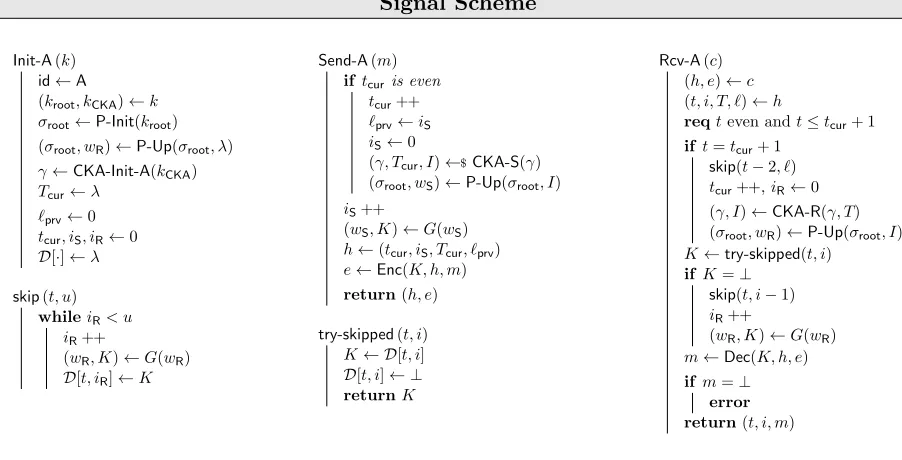
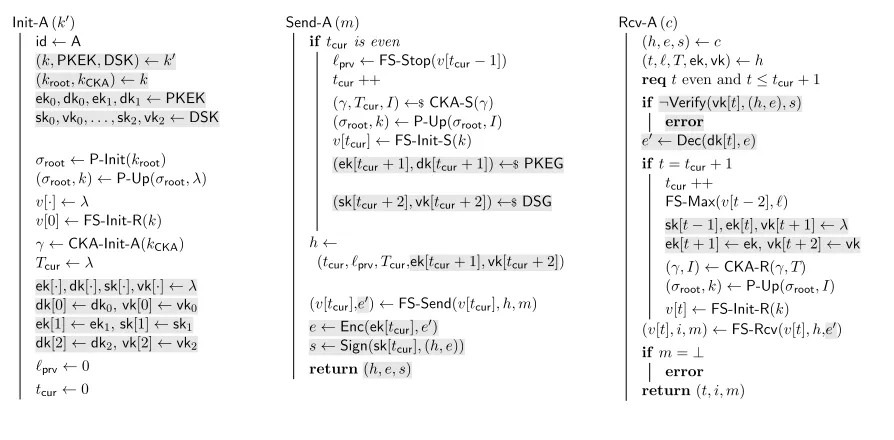
Generalized signal. Putting the above blocks together properly yields the generalized Signal protocol (cf. Figure 8). As a special case, one can easily obtain the existing Signal implementation3
by using the standard way of building FS-AEAD from PRG and AEAD, CKA using the Diffie-Hellman based public-key ratchet mentioned above, and an appropriate cryptographic hash function in place of PRF-PRNG. However, many other variants become possible. For example, by using a generic CKA from DH-KEM, one may trade communication efficiency (worse by a factor of 2) for a shorter healing period ∆SM(from 3 rounds to 2). More interestingly, using any post-quantum KEM, such as [1, 5, 17] results in apost-quantum secure variant of Signal. Finally, we also believe that our generalized double ratcheting scheme is much more intuitive than the existing DH-based variant, as it abstracts precisely the cryptographic primitives needed, including the two types ratchets, and what security is needed from each primitive.
Beyond double ratcheting to full signal. Following most of the prior (and concurrent) work [2, 28, 18, 11] (discussed in the next section), this paper primarily concerned with formalizing the double-ratchet aspect of the Signal protocol. This is certainly the most elegant and ingenious part of Signal, but it assumes that any set of two parties can correctly and securely agree on the initial secret key. The latter problem is rather non-trivial, especially (a) in the multi-user setting, when a party could be using a global public key to communicate with multiple recipients, some of which might be malicious, (b) when the initial secret key agreement is required to be non-interactive, and (c) when state compromise (including that of the master secret for the PKI) is possible, and even frequent. Some of those subtleties are discussed and analyzed by Cohn-Gordonet al.[7], but, once again, in a manner specific to the existing Signal protocol (rather than a general secure messaging primitive). Signal also suggests using the X3DH protocol [26] as one particular way to generate the
3For syntactic reasons having to do with our abstractions, our protocol is a minor variant of Signal, but is logically
initial shared key. Certainly, studying (and even appropriately defining) secure messaging without idealized setup, and analyzing “full Signal” in this setting, remains an important area for future research.
1.2 Related Work
The OTR (off-the-record) messaging protocol [4] is an influential predecessor of Signal, which was the first to introduce the idea of the DH-based double ratchet to derive fresh keys for each encrypted message. However, it was mainly suitable for synchronous back-and-fourth conversations, so Signal’s double ratchet algorithm had to make a number of non-trivial modifications to extend the beautiful OTR idea into a full-fledged asynchronous messaging protocol.
Following the already discussed rigorous description of DH-based double ratcheting by Marlin-spike and Perrin [25], and the protocol-specific analysis by Cohn-Gordon et al. [7], several formal analyses of ratcheting have recently appeared [2, 28, 18, 11]; they design definitions of various types of ratcheting and provide schemes meeting these definitions. As previously mentioned, all these works have the drawback of no longer satisfying immediate decryption.
Bellare et al. [2] looked at the question of unidirectional ratcheting. In this simplified variant of double (or bidirectional) ratcheting, the receiver is never corrupted, and never needs to update its state. Coupled with giving up immediate decryption, this allowed the authors to obtain a rather simple solution: in essence, generate fresh DH-key gxi (which was sent and authenticated as associated data of the previous message mi−1) for each new message mi, and perform
(non-interactive) DH-exchange between gxi and the fixed receiver key gy to derive the key for m
i.
Unfortunately, extending this simple model (which does not appear to have direct applications) and solution to the case of bidirectional communication appeared non-trivial and was left to future work.
Bidirectionality has recently been achieved in two very similar work by Jaeger and Stepanovs [18] and Poettering and R¨osler [28], both appearing at CRYPTO’18. The papers differ in syntax (one treats secure messaging while the other considers key exchange) and hence use different definitions. However, in spirit both papers attempt to model a bidirectional channel satisfying FS and PCS (but not immediate decryption). Moreover, both consider “fine-grained” PCS requirements which are not met by Signal’s double ratchet protocol (and not required by the SM definition in this work). Namely, while Signal (and our work) do not offer any privacy and authenticity for messages immediately following state compromise (and until standard PCS kicks in), these papers demand “semi-security” even right after corrupting a party: privacy (but not authenticity) of outgoing
messages and authenticity (but not privacy) ofincomingmessages. This semi-security is, no doubt, at least of theoretical interest. However, it seems unclear whether there are many realistic scenarios in which such a notion is sufficient. For example, one of the most important attacks not covered by Signal is when the attacker A learns A’s secret state and can easily disrupt her session with
such key-updatable public-key encryption rely onierarchical identity-based encryption [13] (HIBE), which is extremely inefficient compared to primitives used by Signal (nor are HIBEs even nearly as widely and robustly implemented). Finally, the formal definitions given by both papers are quite involved and hard to parse, having lots of variables and many lines of pseudocode, making it difficult to work with when analyzing new schemes. Overall, we feel that assuming a passive attacker for few messages before full PCS would kick in seems to be a good compromise between preventing many realistic attacks, while keeping the resulting schemes and definitions practical, efficient and with a limited amount of implementation overhead. More discussion can be found in Section 6.1, including a practical compromise: an (informally stated) extension to Signal which achieves a slightly weaker form of fine-grained compromise than [28, 18], yet still using only constant sized states, bandwidth and computation as well as comparatively lightweight (and widely implemented) public-key primitives (i.e., regular signature and public-key encryption).
Finally, the notion of immediate decryption is reminiscent in spirit to the zero round trip time (0-RTT) communication with forward secrecy which was recently studied by [15, 9]. However, the latter primitive is stateless on the sender side, making it more difficult to achieve (e.g., the schemes of [15, 9] use a heavy tool calledpuncturable encryption [14]).
Concurrent and Independent Work. We have recently become aware of two concurrent and independent works by Durak and Vaudenay [11] and Jost, Maurer and Mularczyk [19]. Like other prior works, these works (1) designed their own protocols and did not analyze Signal; and (2) do not satisfy immediate decryption or even message-loss resilience (in fact, they critically rely on receiving messages from one party in order). Both works also provide formal notions of security, including privacy, authenticity, and a new property called unrecoverability by [11] and post-impersonation authentication by [19]: if an active attacker sends a fake message to the recipient immediately following state compromise of the sender, the sender can, by design, never recover (and, thus, will notice the attack by being unable to continue the conversation). We find this property very interesting and briefly comment our initial thoughts on it in Section 6.3. We also notice that the work of [11] requires computation linear in the number of messages within an epoch (both for sending and for receiving); moreover, this linear computation involves public-key operations (in fact, no symmetric keys are used at all). The work of [19] also uses public-key operations for every message sent, even within a single epochs. Hence, our generalized Signal protocol appears to be much more efficient than the solutions of [11, 19].
2
Preliminaries
2.1 Game-Based Security and Notation
All security definitions in this work are game-based, i.e., they consider games executed between a challenger and an adversary. The games have one of the following formats:
• Unpredictability games: First, the challenger executes the special init procedure, which sets up the game. Subsequently, the attacker is given access to a set of oracles that allow it to interact with the scheme in question. The goal of the adversary is to provoke a particular, game-specificwinning condition. Theadvantage of an adversaryAagainst constructionCin an unpredictability game ΓC is
AdvCΓ(A) := P[A wins ΓC].
• Indistinguishability games: In addition to setting up the game, theinitprocedure samples a secret bitb∈ {0,1}. The goal of the adversary is to determine the value of b. Once more, upon completion of init, the attacker interacts arbitrarily with all available oracles up to the point where it outputs a guess bit b0. The adversary wins the game if b=b0. Theadvantage
of an adversary Aagainst constructionC in an indistinguishability game Γ is
AdvCΓ(A) := 2·P[A wins ΓC]−1/2 .
With the above in mind, to describe a any security (or correctness) notion, one need only specify theinit oracle and the oracles available to A. The following special keywords are used to simplify the exposition of the security games:
• reqis followed by a condition; if the condition is not satisfied, the oracle/procedure containing the keyword is exited and all actions by it are undone.
• win is used to declare that the attacker has won the game; it can be used for both types of games above.
• enddisables all oracles and returns all values following it to the attacker.
Moreover, the descriptions of some games/schemes involvedictionaries. For ease of notation, these dictionaries are described with thearray-notation described next, but it is important to note that they are to be implemented by a data structure whose size grows (linearly) with the number of elements in the dictionary (unlike arrays):
• Initialization: The statement D[·]←λinitializes an empty dictionary D.
• Adding elements: The statement D[i] ← v adds a value v to dictionary D with key i, overriding the value previously stored with key iif necessary.
• Retrieval: The expression D[i] returns the valuev with key iin the dictionary; if there are no values with keyi, the valueλis returned.
• Deletion: The statementD[i]←λdeletes the valuev corresponding to key i.
Oracles for AEAD Game
init K← K e∗←λ b← {0,1}
encrypt(a, m)
ifb= 0
e∗←Enc(K, a, m)
else e∗← C returne∗
decrypt(a, e)
ife=e∗orb= 1
return⊥ returnDec(K, a, e)
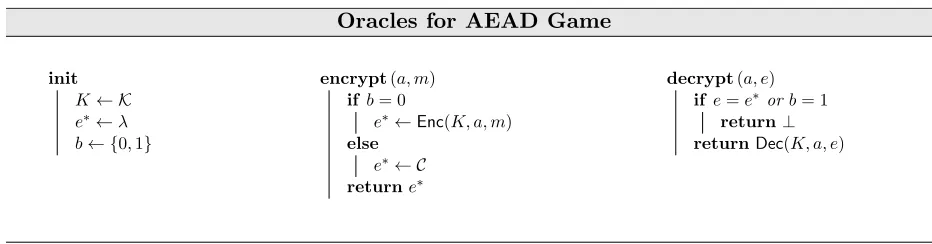
Figure 1: Oracles of the IND-CCA security game for an AEAD scheme (Enc,Dec), where encrypt is a one-time oracle.
2.2 Authenticated Encryption
Definition 1. An authenticated encryption with associated data (AEAD) scheme is a pair of algorithms AE= (Enc,Dec) with the following syntax:
• Encryption: Enc takes a key K, associated dataa, and a messagemand produces a cipher-text e←Enc(K, a, m).
• Decryption: Dectakes a keyK, associated dataa, and a ciphertexteand produces a message
m←Dec(K, a, e).
All AEAD schemes in this paper are assumed to be deterministic, i.e., all randomness stems from the key K.
Correctness. An AEAD scheme is correct if for all keys K and all pairs (K, a),
Dec(K, a,Enc(K, a, m)) = m .
Security. In order to be used in the constructions in this paper, AEAD schemes need only satisfy one-time IND-CCA security. This is captured by the game depicted in Figure 1. It provides access to a one-time encryption oracle that returns either an encryption of the message specified by the attacker or a random ciphertext from the spaceCof all ciphertexts, depending on a randomly chosen bitb. Moreover, the attacker may query a decryption oracle arbitrarily many times (except on the challenge ciphertext), which, however, always returns ⊥ ifb = 1. The advantage of an adversary A attacking an AEAD scheme AEis denoted by AdvAEot-cca(A); the attacker is parametrized by its running timet.
Definition 2. An AEAD scheme AE is (t, ε)-one-time-CCA-secure if for allt-attackers A,
AdvAEot-cca(A) ≤ ε .
2.3 Key-Encapsulation Mechanism
• Key generation: Gen takes a (implicit) security parameter and outputs a fresh key pair
(pk,sk)←$Gen.
• Encapsulation: Enc takes a public key pk and produces a ciphertext and a symmetric key
(c, k)←$Enc(pk).
• Decapsulation: Dec takes a secret keysk and a ciphertextcand recovers the symmetric key
k←Dec(sk, c).
Correctness. A KEM must satisfy the following standard correctness property:
P[(pk,sk)←$ Gen,(c, k)←$ Enc(pk), k0 ←Dec(sk, c) :k=k0] = 1 .
Security. KEMs are required to satisfy IND-CPA security, which asks that no adversary be able to tell a random symmetric key from an encapsulated one (without the decapsulation key). This is captured by considering the following game: it chooses a random bitb← {0,1}, produces a key pair (pk,sk) ← Gen, and generates (c, k0) ← Enc(pk) as well as a uniform random key k1; an attacker
A wins the game if it correctly guesses b, given pk, c, and kb. The advantage of A is denoted by
AdvKEMcpa (A); the attacker is parametrized by its running timet.
Definition 4. A key-encapsulation mechanismKEM is (t, ε)-CPA-secure if for allt-attackersA,
AdvKEMcpa (A) ≤ ε .
Section C of the appendix briefly recapitulates the standard El-Gamal KEM based on DDH and the Frodo KEM [6], which is based on learning with errors (LWE).
2.4 Pseudorandom Generators
Apseudorandom generator (PRG)is a functionG:W → W ×Ksuch thatG(U) is indistinguishable fromU0 for uniformly randomU ∈ W and U0∈ W × K. The advantage of an attackerAat distin-guishing between these two distributions is denoted by AdvGprg(A); the attacker is parametrized by its running timet.
Definition 5. A pseudorandom generatorG is (t, ε)-secure if for allt-attackers A,
AdvGprg(A) ≤ ε .
3
Secure Messaging
Asecure messaging (SM)scheme allows two partiesAandBto communicate securely bidirectionally and is expected to satisfy the following informal requirements:
• Correctness: If no attacker interferes with the transmission, B outputs the messages sent by Ain the correct order and vice versa.
• Authenticity: While the parties’ states are uncompromised (i.e., unknown to the attacker), the attacker cannot change the messages sent by them or inject new ones.
• Privacy: While the parties’ states are uncompromised, an attacker obtains no information about the messages sent.
• Forward secrecy (FS):All messages sent and received prior to a state compromise of either party (or both) remain hidden to an attacker.
• Post-compromise security (PCS, aka “healing”): If the attacker remains passive (i.e., does not inject any corrupt messages), the parties recover from a state compromise (assuming each has access to fresh randomness).
• Randomness leakage/failures: While the parties’ states are uncompromised, all the se-curity properties above except PCS hold even if the attacker completely controls the parties’ local randomness. That is, good randomness is only required for PCS.
This section presents the syntax of and a formal security notion for SM schemes.
3.1 Syntax
Formally, an SM scheme consists of two initialization algorithms, which are given an initial shared keyk, as well as a sending algorithm and a receiving algorithm, both of which keep (shared) state across invocations. The receiving algorithm also outputs a so-called epoch number and an index, which can be used to determine the order in which the sending party transmitted their messages.
Definition 6. A secure-messaging (SM) scheme consists of four probabilistic algorithms SM = (Init-A,Init-B,Send,Rcv), where
• Init-A(and similarly Init-B) takes a key k and outputs a state sA←Init-A(k),
• Send takes a state s and a message m and produces a new state and a ciphertext (s0, c)←$
Send(s, m), and
• Rcv takes a state s and a ciphertextc and produces a new state, an epoch number, an index, and a message(s0, t, i, m)←Rcv(s, c).
3.2 Security
3.2.1 Basics
The security notion for SM schemes considered in this paper is intuitive in principle. However, formalizing it is non-trivial and somewhat cumbersome due to a number of subtleties that naturally arise and cannot be avoided if the criteria put forth at the beginning of Section 3 are to be met. Therefore, before presenting the definition itself, this section introduces some basic concepts that will facilitate understanding of the definition.
• The two counters are never more than one epoch apart, i.e., |tA−tB| ≤1 at all times. • When A receives an epoch-t message fromB for t=tA+ 1, it setstA ←t (even). The next
timeA sends a message,tA is incremented again (to an odd value).
• Similarly, when B receives an epoch-t message from A for t =tB + 1, it sets tB ← t (odd). The next time Bsends a message, tB is incremented again (to an even value).
Message indices. Within an epoch, messages are identified by a simple counter. To capture the property of immediate decryption and MLR, the receive algorithm of an SM scheme is required to output the correct epoch number and indeximmediately upon reception of a ciphertext, even when messages arrive out of order.
Corruptions and their consequences. Since SM schemes are required to be forward-secure and to recover from state compromise, any SM security game must allow the attacker to learn the state of either party at any given time. Moreover, to capture authenticity and privacy, the attacker should be given the power to inject malicious ciphertexts and to call a (say) left-or-right challenge oracle, respectively. These requirements, however, interfere as follows:
• When either party is in a compromised state, the attacker cannot invoke the challenge oracle since this would allow him to trivially distinguish.
• When either party is in a compromised state, the attacker can trivially forge ciphertexts and must therefore be barred from calling the inject oracle.
• When the receiver of messages in transmission is compromised, these messages lose all security, i.e., the attacker learns their content and can replace them by a valid forgery. Consequently, while any challenge ciphertext is in transmission, the recipient may not be corrupted. Simi-larly, an SM scheme must be able to deal with forgeries of compromised messages (once the parties have healed).
These issues require that the security definition keep track of ciphertexts in transmission, of chal-lenge ciphertexts, and of compromised ciphertexts; this will involve some (slightly cumbersome) record keeping.
Natural SM schemes. For simplicity, SM schemes in this work are assumed to satisfy the natural requirements below.4
Definition 7. An SM scheme SM = (Init-A,Init-B,Send,Rcv) is natural if the following criteria are satisfied:
(A) Whenever Rcv outputs m=⊥, the state remains unchanged.
(B) Any given ciphertext corresponds to an epochtand an index i, i.e., the values (t, i) output by
Rcv are an (efficiently computable) function of c.
(C) Algorithm Rcv never accepts two messages corresponding to the same pair (t, i).
4
(D) A party always rejects ciphertexts corresponding to an epoch in which the party does not act as receiver
(E) If a party, say A, accepts a ciphertext corresponding to an epoch t, then tA ≥t−1.
3.2.2 The Security Game
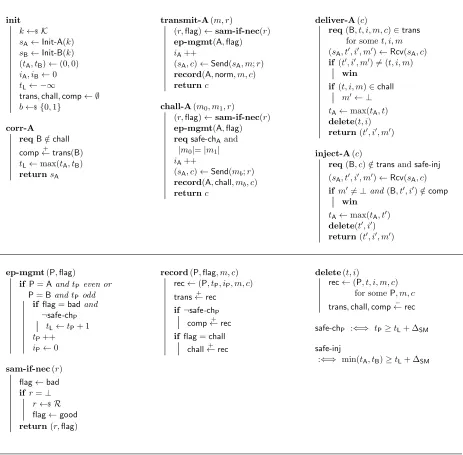
The security game, which is depicted in Figure 2, consists of an initialization procedureinitand of
• two “send” oracles,transmit-A(normal transmission) andchall-A(challenge transmission); • two “receive” oracles,deliver-A(honest delivery) andinject-A(for forged ciphertexts); and • a corrupt oraclecorr-A
pertaining to party A, and of the corresponding oracles pertaining to B. Moreover, Figure 2 also features an epoch-management function ep-mgmt, a function sam-if-nec explained below, and two record-keeping functions record and delete; these functions cannot be called by the attacker. The game is parametrized by ∆SM, which relates to how fast parties recover from a state compromise. All components are explained in detail below, following the intuition laid out above.
The advantage of A against an SM scheme SM is denoted by AdvSMsm,∆
SM(A). The attacker is parameterized by its running time t, the total number of queries q it makes, and the maximum number of epochs qep it runs for.
Definition 8. A secure-messaging schemeSMis (t, q, qep,∆SM, ε)-secureif for all(t, q, qep)
-attack-ers A,
AdvSMsm,∆
SM(A) ≤ ε .
Initialization and state. The initialization procedure chooses a random key and initializes the states sA and sB of A and B, respectively. Moreover, it defines several variables to keep track of the execution: (1) tA and tB are the epoch counters for A and B, respectively; (2) variables iA and iB count how many messages have been sent by each party in their respective current epochs; (3) tL records the last time either party’s state was leaked to the attacker and is used, together with tA and tB, to preclude trivial attacks; (4) the setstrans,chall, and comp will contain records and allow to track ciphertexts in transmission, challenge ciphertexts, and compromised ciphertexts, respectively; (5) the bit bis used to create the challenge.
Sampling if necessary. The send oracles transmit-A and chall-A allow the attacker to pos-sibly control the random coins r of Send. If r = ⊥, the function samples r ←$ R (from some appropriate setR), and returns (r,good), wheregood indicates that fresh randomness is used. If, on the other hand, r 6= ⊥, the function returns (r,bad), indicating, via bad, that adversarially controlled randomness is used.
Security Game for Secure Messaging
init k←$K sA←Init-A(k)
sB←Init-B(k)
(tA, tB)←(0,0)
iA, iB←0
tL← −∞
trans,chall,comp← ∅ b←${0,1}
corr-A
reqB∈/chall comp←+ trans(B)
tL←max(tA, tB)
returnsA
transmit-A(m, r)
(r,flag)←sam-if-nec(r)
ep-mgmt(A,flag)
iA++
(sA, c)←Send(sA, m;r)
record(A,norm, m, c)
returnc
chall-A(m0, m1, r)
(r,flag)←sam-if-nec(r)
ep-mgmt(A,flag)
reqsafe-chAand
|m0|=|m1|
iA++
(sA, c)←Send(mb;r)
record(A,chall, mb, c)
returnc
deliver-A(c)
req(B, t, i, m, c)∈trans for somet, i, m
(sA, t0, i0, m0)←Rcv(sA, c)
if(t0, i0, m0)6= (t, i, m)
win
if(t, i, m)∈chall
m0← ⊥ tA←max(tA, t)
delete(t, i)
return(t0, i0, m0)
inject-A(c)
req(B, c)∈/transandsafe-inj (sA, t0, i0, m0)←Rcv(sA, c)
ifm06=⊥and(B, t0, i0)∈/comp
win tA←max(tA, t0)
delete(t0, i0)
return(t0, i0, m0)
ep-mgmt(P,flag)
ifP=AandtP even or
P=BandtPodd
ifflag=badand
¬safe-chP
tL←tP+ 1
tP++
iP←0
sam-if-nec(r) flag←bad
ifr=⊥ r←$R flag←good
return(r,flag)
record(P,flag, m, c) rec←(P, tP, iP, m, c)
trans←+ rec
if¬safe-chP
comp←+ rec
ifflag=chall chall←+ rec
delete(t, i)
rec←(P, t, i, m, c) for someP, m, c
trans,chall,comp←− rec
safe-chP :⇐⇒ tP≥tL+ ∆SM
safe-inj
:⇐⇒ min(tA, tB)≥tL+ ∆SM
Figure 2: Oracles corresponding to party A of the SM security game for a scheme SM = (Init-A,Init-B, Send,Rcv); the oracles for Bare defined analogously.
the ciphertext corrupted. This captures that randomness should only be used for PCS (but for none of the other properties mentioned above).
and cthe ciphertext.
Whenever record is called, the new record is added to the settrans. If a party is not in a safe state, the record is also added to the set of compromised ciphertextscomp. If the function is called
with flag = chall, the record is added to chall. The function delete takes an epoch number and
an index and removes the corresponding record from all three record keeping sets trans,chall, and
comp.
Sometimes, it is convenient to refer to a particular record (or a set thereof) by only specifying parts of it. For example, the expression B ∈/ chall is equivalent to there not being any record (B,∗,∗,∗,∗) in the set chall. Similarly, trans(B) is the set of all records of this type intrans.
Send oracles. Both send oracles,transmit-Aandchall-A, begin withif-nec, which sam-ples fresh randomness if necessary, followed by a call toep-mgmt. Observe that the flag argument is set to flag ← good by sam-if-nec if fresh randomness is used, and to flag ← bad otherwise. Subsequently:
• transmit-AincrementsiA, executesSend, and creates a record usingflag=norm, indicating that this is not a challenge ciphertext. Observe that if Ais not currently in a safe state, the record is added to comp.
• chall-A works similarly to transmit-A, except that one of the two inputs is selected ac-cording tob, and the record is saved withflag=chall, which will cause it to be added to the challengeschall. Note thatchall-A can only be called whenAis not in a compromised state, which is captured by the statementreq safe-chA.
The oracles forB are defined analogously.
Receive oracles. Two oracles are available by which the attacker can getA to receive a cipher-text: deliver-A is intended for honest delivery, i.e., to deliver ciphertexts created by B, whereas inject-A is used to inject forgeries. These rules are enforced by checking (viareq) the set trans.
• deliver-A: The ciphertext is first passed through Rcv, which must correctly identify the valuest,i, andm recorded whencwas created; if it fails to do so, the correctness property is violated and the attacker immediately wins the game. In casecwas a challenge, the decrypted message is replaced by ⊥ in order to avoid trivial attacks. Before returning the output of
Rcv,tA is incremented if tis larger thantA, and the record corresponding to cis deleted.
• inject-A: Again, the ciphertext is first passed through Rcv. Unless the ciphertext corre-sponds5 to (t, i)∈comp, algorithmRcvmust reject it; otherwise, authenticity is violated and the attacker wins the game. The final instructions are as indeliver-A. Oracleinject-Amay only be called if neither party is currently recovering from state compromise, which is taken care of by flag safe-inj.
The oracles forB are defined analogously.
By deleting records at the end of deliver-A and inject-A, the game enforces that no replay attacks take place. For example, if a ciphertextc that at some point is in transis accepted twice,
5
the second time counts as a forgery. Similarly, if two forgeries for a compromised pair (t, i) are accepted, the attacker wins as well. Note, however, that natural schemes do not allow replay attacks (cf. Property (C) in Definition 7).
Corruption oracles. The corruption oracle forA,corr-A, can be called whenever no challenges are in transit from Bto A, i.e., when B∈/ chall. If corruption is allowed, all ciphertexts in transit sent byBbecome compromised. Before returningA’s state, the oracle updates the time of the most recent corruption. The corruption oraclechall-BforB is defined similarly.
3.3 Simplified Properties
Proving SM security is facilitated by considering the three simplified properties correctness, au-thenticity, and privacy. These properties together imply full SM security, as stated at the end of this section. All three of them are obtained by modifying the original SM game (cf. Figure 2).
Correctness. For the correctness game, there are no oracles chall-A and chall-B, and only
reduced inject oracles are available, which differ from the normal ones as follows:
• if ciphertext c does not correspond to (t0, i0) ∈ comp, inject-A and inject-B immediately return (t0, i0,⊥);6
• theif-clause is removed completely.
Essentially, the reduced inject oracle only processes ciphertexts corresponding to (t, i) ∈ comp, which is unavoidable even after healing since the attacker knows the keys with which to decrypt and authenticate these messages. Observe that the only way to win the game is via the win instruction indeliver-Aordeliver-B. The advantage of Ain the correctness game is denoted by AdvSMcorr,∆SM(A).
Definition 9. A secure-messaging scheme SM is (t, q, qep,∆SM, ε)-correct if for all (t, q, qep)
-at-tackers A,
AdvSMcorr,∆SM(A) ≤ ε .
Authenticity. In the authenticity variant of the SM game, there are no oracles chall-A and chall-B, and thewin-instruction inside deliver-A and deliver-B is removed. Furthermore, the attacker must call init with two argumentst∗L and t∗ witht∗ ≥t∗L+ ∆SM, wheret∗ is the epoch it is trying to attack and t∗L is the last corruption event before the attempt. To formally define this, consider the case wheret∗ iseven, i.e.,Bis the sender andAthe receiver in the epoch under attack; the case where t∗ is odd works analogously. Then, the authenticity game additionally differs from the original as follows:
• if at any point tL ∈ {t∗L+ 1, . . . , t∗−1}, the attacker loses the game immediately;
• ifA(the receiver in epocht∗) is corrupted any time oncetA > t∗L, the attacker loses the game immediately;
6
• the inject oracles are reduced (see above) except for ciphertexts corresponding to epocht∗.
The advantage of Ain the authenticity game is denoted by AdvSMauth,∆SM(A).
Definition 10. A secure-messaging scheme SM is (t, q, qep,∆SM, ε)-authentic if for all (t, q, qep)
-attackers A,
AdvSMauth,∆
SM(A) ≤ ε .
Privacy. The privacy variant only provides reduced inject oracles (see above), and the if-clause with thewin instruction indeliver-Ais removed completely. Furthermore, the attacker must call init with two argumentst∗L and t∗ witht∗ ≥t∗L+ ∆SM, wheret∗ is the epoch it is trying to attack and t∗L is the last corruption event before the attempt. Formally, this is enforced as follows:
• if at any point tL ∈ {t∗L+ 1, . . . , t∗−1}, the attacker loses the game immediately (i.e., the outcome of the game is a uniformly random bit);
• the challenge oracle forP∈ {A,B} has an additionaltP=t∗ constraint in thereq-statement.
Observe that the condition tP = t∗ effectively means that only one challenge oracle is available (chall-A ift∗ is even; chall-Bif t∗ is odd). The advantage of A in the privacy game denoted by AdvSMpriv,∆SM(A).
Definition 11. A secure-messaging scheme SM is (t, q, qep,∆SM, ε)-private if for all (t, q, qep)
-at-tackers A,
AdvSMauth,∆
SM(A) ≤ ε .
Combining the properties. The following theorem relates the simplified properties to the full SM security definition; its proof can be found in Appendix A.
Theorem 1. Assume an SM scheme SM is
• (t0, q, qep,∆SM, εcorr)-correct,
• (t0, q, qep,∆SM, εauth)-authentic, and • (t0, q, qep,∆SM, εpriv)-private.
Then, it is also (t,∆SM, q, qep, ε)-secure, where
ε ≤ εcorr+qep2 ·(εauth+εpriv) .
4
Building Blocks
4.1 Continuous Key Agreement
This work distills out the public-ratchet part of the Signal protocol and casts it as a separate primitive called continuous key agreement (CKA). This step is not only useful to improve the intuitive understanding of the various components of the Signal protocol and their interdependence, but it also increases modularity, which, for example, would—once the need arises—allow to replace the current CKA mechanism based on DDH by one that is post-quantum secure.
4.1.1 Defining CKA
At a high level, CKA is a synchronous two-party protocol betweenAand B. Odd rounds iconsist of A sending and B receiving a message Ti, whereas in even rounds, B is the sender and A the
receiver. Each roundi also produces a keyIi, which is output by the sender upon sending Ti and
by the receiver upon receivingTi.
Definition 12. A continuous-key-agreement (CKA) scheme is a quadruple of algorithms CKA= (CKA-Init-A,CKA-Init-B,CKA-S,CKA-R), where
• CKA-Init-A (and similarly CKA-Init-B) takes a key k and produces an initial state γA ←
CKA-Init-A(k) (andγB),
• CKA-S takes a state γ, and produces a new state, message, and key (γ0, T, I)←$ CKA-S(γ), and
• CKA-Rtakes a stateγ and messageTand produces new state and a key(γ0, I)←CKA-R(γ, T).
Denote by K the space of initialization keys k and by I the space of CKA keys I.
Correctness. A CKA scheme is correct if in the security game in Figure 3 (explained below), A
and Balways, i.e., with probability 1, output the same key in every round.
Security. The basic property a CKA scheme must satisfy is that conditioned on the transcript T1, T2, . . ., the keysI1, I2, . . .look uniformly random and independent. An attacker against a CKA
scheme is required to be passive, i.e., may not modify the messages Ti. However, it is given the
power to possibly (1) control the random coins used by the sender and (2) leak the current state of either party. Correspondingly, the keysIi produced under such circumstances need not be secure.
The parties are required to recover from a state compromisewithin 2 rounds.7
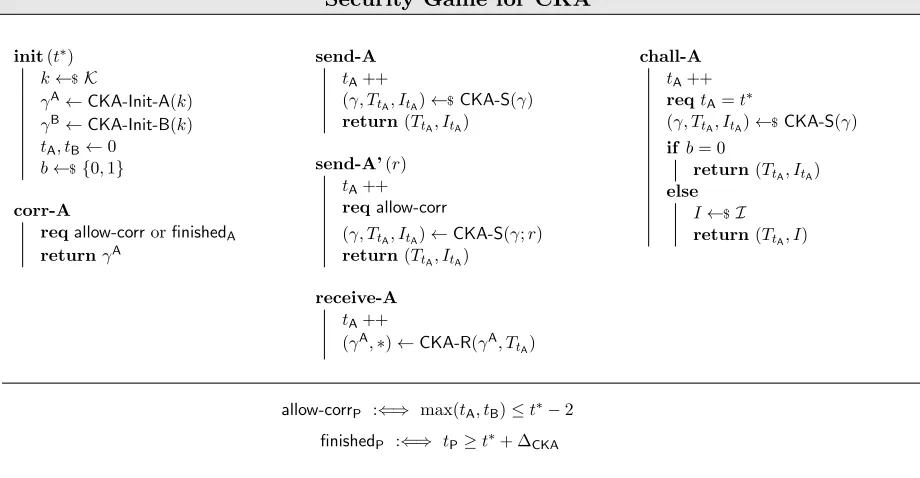
The formal security game for CKA is provided in Figure 3. It begins with a call to the init oracle, which samples a bit b, initializes the states of both parties, and defines epoch counters tA andtB. Procedure inittakes a valuet∗, which determines in which round the challenge oracle may be called.
Upon completion of the initialization procedure, the attacker gets to interact arbitrarily with the remaining oracles, as long asthe calls are in a “ping-pong” order, i.e., a call to a send oracle for
Ais followed by a receive call for B, then by a send oracle forB, etc. The attacker only gets to use the challenge oracle for epocht∗. No corruption or using bad randomness (send-A’and send-B’) is allowed less than two epochs before the challenge is sent (allow-corr).
7Of course, one could also parametrize the number of rounds required to recover (all CKA schemes in this work
Security Game for CKA
init(t∗)
k←$K
γA←CKA-Init-A(k)
γB←CKA-Init-B(k)
tA, tB←0
b←${0,1}
corr-A
reqallow-corrorfinishedA
returnγA
send-A tA++
(γ, TtA, ItA)←$CKA-S(γ)
return(TtA, ItA)
send-A’(r)
tA++
reqallow-corr
(γ, TtA, ItA)←CKA-S(γ;r)
return(TtA, ItA)
receive-A tA++
(γA,∗)←CKA-R(γA, T
tA)
chall-A tA++
reqtA=t∗
(γ, TtA, ItA)←$CKA-S(γ)
if b= 0
return(TtA, ItA)
else I←$I return(TtA, I)
allow-corrP :⇐⇒ max(tA, tB)≤t∗−2
finishedP :⇐⇒ tP≥t∗+ ∆CKA
Figure 3: Oracles corresponding to partyA of the CKA security game for a scheme CKA= (CKA-Init-A, CKA-Init-B,CKA-S,CKA-R); the oracles forB are defined analogously.
The game is parametrized by ∆CKA, which stands for the number of epochs that need to pass aftert∗ until the states do not contain secret information pertaining to the challenge. Once a party reaches epocht∗+∆CKA, its state may be revealed to the attacker (via the corresponding corruption oracle). The game ends (not made explicit) once both states are revealed after the challenge phase. The attacker wins the game if it eventually outputs a bit b0 =b.
The advantage of an attacker A against a CKA scheme CKA with ∆CKA = ∆ is denoted by AdvCKAror,∆(A). The attacker is parameterized by its running timet.
Definition 13. A CKA scheme CKAis (t,∆, ε)-secure if for allt-attackersA,
AdvCKAror,∆(A) ≤ ε .
4.1.2 Instantiating CKA
CKA from KEMs. A CKA scheme with ∆ = 0 can be built from a KEM in natural way: in every epoch, one party sends a public keypk of a freshly generated key pair and an encapsulated key under the key pk0 received from the other party in the previous epoch. Specifically, consider a CKA scheme CKA = (CKA-Init-A,CKA-Init-B,CKA-S,CKA-R) that is obtained from a KEM KEM
as follows:
• The initial shared state k = (pk,sk) consists of a (freshly generated) KEM key pair. The initialization forA outputspk←CKA-Init-A(k) and that forBoutputssk←CKA-Init-B(k).
• The send algorithmCKA-Stakes as input the current stateγ =pkand proceeds as follows: It
1. encapsulates a key (c, I)←$ Enc(pk), 2. generates a new key pair (pk,sk)←$ Gen, 3. sets the CKA message toT←(c,pk),
4. sets the new state to γ ←sk, and
5. returns (γ, T, I).
• The receive algorithm CKA-R takes as input the current state γ = sk as well as a message T= (c,pk) and proceeds as follows: It
1. decapsulates the keyI ←Dec(sk, c),
2. sets the new state to γ ←pk, and
3. returns (γ, I).
Theorem 2. Assume KEMis a (t0, ε)-secure KEM. Then, the above CKA scheme CKAis(t,∆, ε) -secure for t≈t0 and ∆ = 0.
Proof. The theorem is proved by showing that for every attacker A against the CKA security of
CKA, there exists an attackerBsuch that
AdvCKAror,∆(A) ≤ AdvKEMcpa (B) .
Assume w.l.o.g. that t∗ is odd, i.e., A sends the challenge; the case where t∗ is even is handled analogously. The reduction B is straight-forward: Let (pk, c, k) be a KEM challenge (where k is either embedded in cor random and independent). Then,
• in epoch t∗−1, the reduction embedspk intoB’s CKA message Tt∗−1, and
• in epocht∗, the reduction embedsc intoA’s messageTt∗ and useskas the CKA keyIt∗ that
Aoutputs.
Observe that A’s simulated state may safely be revealed once she reaches epoch t∗ + ∆CKA = t∗ since at that ponit her state contains a secret key that is unrelated to the challenge. Similarly, once
CKA from DDH. Observe that if one instantiates the above KEM-based CKA scheme with the ElGamal KEM (cf. Section C.1)ver some group G, both the public key and the encapsulated key are elements of G. Hence, the Signal protocol uses an optimization of the ElGamal KEM where a single group element first serves as an encapsulated key sent by, say, A and then as the public key B uses to encapsulate his next key. Interestingly, this comes at the price of having ∆ = 1 (as opposed to ∆ = 0) due to the need for parties to hold on to their exponents (which serve both as secret keys and encapsulation randomness) longer.
Concretely, a CKA scheme CKA = (CKA-Init-A,CKA-Init-B,CKA-S,CKA-R) can be obtained from the DDH assumption8 in a cyclic groupG=hgi as follows:
• The initial shared state k = (h, x0) consists of a (random) group element h = gx0 and its
discrete logarithm x0. The initialization for A outputs h ← CKA-Init-A(k) and that for B
outputsx0 ←CKA-Init-B(k).
• The send algorithmCKA-Stakes as input the current stateγ =hand proceeds as follows: It
1. chooses a random exponentx,
2. computes the corresponding key I←hx, 3. sets the CKA message toT←gx, 4. sets the new state to γ ←x, and
5. returns (γ, T, I).
• The receive algorithm CKA-R takes as input the current state γ = x as well as a message T=h and proceeds as follows: It
1. computes the keyI =hx,
2. sets the new state to γ ←h, and
3. returns (γ, I).
For the theorem below, let a group G be (t, ε)-secure if every attacker with running time at most thas advantage at most εat distinguishing DDH triples from random triples.
Theorem 3. Assume groupGis(t, ε)-DDH-secure. Then, the above CKA schemeCKAis(t,∆, ε) -secure for t≈t0 and ∆ = 1.
Proof. Assume w.l.o.g. thatt∗isodd, i.e.,Asends the challenge; the case wheret∗is even is handled analogously. Let (ga, gb, gc) be a Diffie-Hellman or random triple. The reduction simulates the CKA protocol in the straight-forward way but embeds the triple into the CKA as follows:
• in epocht∗−1, it usesTt∗−1=ga andIt∗−1=gxa, wherex is the exponent used to simulate Tt∗−2 =gx.
• in epoch t∗, it usesTt∗ =gb and It∗ =gc; and • in epoch t∗+ 1, for a random x0, it usesTt∗+1 =gx
0
andIt∗+1=gbx 0 .
8The DDH assumption states that it is hard to distinguish DH triples (ga, gb, gab) from random triples (ga, gb, gc),
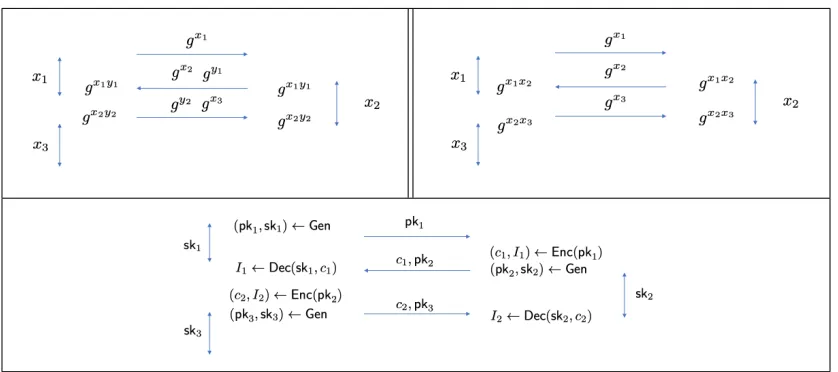
Figure 4: Comparison between CKAs with ∆CKA = 0 based on generic KEMs (bottom) resp. El-Gamal
(left) and ElGamal-based CKA with ∆CKA = 1(right). The figure shows the lifetimes of secret state values
alongside the protocol. Consider the state of parties A and B once the third protocol message is delivered: In the∆CKA = 0 protocols, A has a secret key sk3 resp. an exponentx3 that is not used yet, and B’s state
contains no secret information; hence, no past keys can be computed upon state compromise. In the ElGamal protocol with∆CKA = 1,Astores secret exponent x3, which allows to compute keygx2x3.
It is easy to verify that this correctly simulates the CKA experiment. In particular, note that A’s simulated state may safely be revealed once she reaches epoch t∗+ ∆CKA = t∗+ 1 since at that point she would have deleted her exponentbin the actual game. Bwould delete his exponentaas soon as he reaches t∗, i.e., even beforet∗+ ∆CKA.
CKA based on LWE. A similar public-key-ciphertext-reuse idea can be applied to the Frodo KEM [6] (cf. Section C.2 for an explanation of notation), which is based on learning with errors (LWE). Concretely, a CKA scheme, in which A and B actually have slightly different algorithms for sending and receiving, can be obtained as shown next. The scheme is parametrized by a size parameters nand ¯n, a modulusq, and an error distribution χ overZq.
• The initial shared state k consists of a matrix A ∈ Zn×n
q chosen uniformly at random,
and independently sampled matrices S,E ← χ(Znq×n¯), where χ(Znqׯn) is the distribution
on matrices obtained by sampling each entry independently according toχ. Ainitially stores (A,S)←CKA-Init-A(k), andB’s initial state is (A,B:=AS+E)←CKA-Init-B(k).
• B’s send algorithm CKA-S-B takes as input the current state γ = (A,B) and proceeds as follows: It
1. choosesS0,E0∼χ(Zqn¯×n), and ˜E0∼χ(Znq¯×¯n) independently,
2. computes B0 ← S0A+E0,
3. computes V0 ← S0B+ ˜E0,
6. sets the CKA message toc= (B0,C0),
7. sets the new state to γ ←(A,S0), and
8. returns (γ, T, I).
• A’s send algorithmCKA-S-Aproceeds analogously, but it multiplies byS0 from the right. • A’s receive algorithmCKA-R-Atakes as input the current stateγ = (A,S) as well as a message
T= (B0,C0) and proceeds as follows: It
1. computes the keyI =rec(B0S,C0),
2. sets the new state to γ ←(A,B0), and
3. returns (γ, I).
• B’s receive algorithm CKA-R-Bproceeds analogously, but it multiplies byS0 from the left.
The security of the above CKA scheme based on LWE is proved by reduction to the CPA security of the Frodo KEM.
Theorem 4. Assume Frodo is a (t, ε)-CPA-secure KEM. Then, the above CKA scheme CKA is
(t,∆, ε)-secure for t≈t0 and ∆ = 1.
Proof. Depending on the challenge epoch t∗, the reduction is either to the security of the original Frodo (as laid out in Section C.2) or to a variant where the encryptor multiplies from the right and the decryptor from the left. For this proof sketch, assume w.l.o.g. thatt∗ is even, i.e., the challenge ciphertext is sent byB and the reduction is to the original Frodo scheme.
Similarly to all previous CKA proofs, the reduction simply embeds a particular instance of the Frodo KEM into the full CKA game. Specifically, let A,B, V0,C0, andK be the KEM instance, whereK is either the key as computed by Frodo or uniformly random.
In epoch t∗−1, the reduction embeds B into the execution of CKA-S-A, instead of choosing valuesSandEand computingB←AS+Eitself. It then picks ˜E∼χ(Zqn×n¯), setsV ←B0t∗−2S+ ˜E (where B0t∗−2 was sent by B in epoch t∗ −2), and computes C = hVi2B as well as I ← bVe2B. Once Bobtains Band C,CKA-R-Brecovers the key I asrec(S0B,C).
In epoch t∗, the reduction embedsB0,V0,C0, and I←K intoCKA-S-B, instead of computing these values as CKA-S-Bnormally would. Once AreceivesB0 and C0,CKA-R-Asimply outputs K instead of computingrec(B0S,C0).
By inspection, one can verify that this correctly simulates the CKA experiment. In particular, note that B’s simulated state may safely be revealed once he reaches epoch t∗+ ∆CKA = t∗ + 1 since at that point he would have deleted his secret value S0 in the actual game. A would delete her secret valueS as soon as she reachest∗, i.e., even beforet∗+ ∆CKA.
4.2 Forward-Secure AEAD
4.2.1 Defining FS-AEAD
Definition 14. Forward-secure authenticated encryption with associated data (FS-AEAD) is a tuple of algorithmsFS-AEAD= (FS-Init-S,FS-Init-R,FS-Send,FS-Rcv), where
• FS-Init-S (and similarly FS-Init-R) takes a key k and outputs a state vA ←FS-Init-S(k),
• FS-Send takes a statev, associated dataa, and a messagem and produces a new state and a ciphertext(v0, e)←FS-Send(v, a, m), and
• FS-Rcv takes a state v, associated data a, and a ciphertext e and produces a new state, an index, and a message (v0, i, m)←FS-Rcv(v, a, e).
Observe that all algorithms of an FS-AEAD scheme are deterministic.
Memory management. In addition to the basic syntax above, it is useful to define the following two functions FS-Stop (called by the sender) and FS-Max (called by the receiver) for memory management:
• FS-Stop, given an FS-AEAD state v, outputs how many messages have been received and then “erases” the FS-AEAD session corresponding tov form memory; and
• FS-Max, given a statev and an integer`, remembers `internally such that the session corre-sponding to v is erased from memory as soon as`messages have been received.
These features will be useful in the full protocol (cf. Section 5) to be able to terminate individual FS-AEAD sessions when they are no longer needed. Providing a formal requirement for these additional functions is omitted. Moreover, since an attacker can infer the value of the message counter from the behavior of the protocol anyway, there is no dedicated oracle included in the security game below.
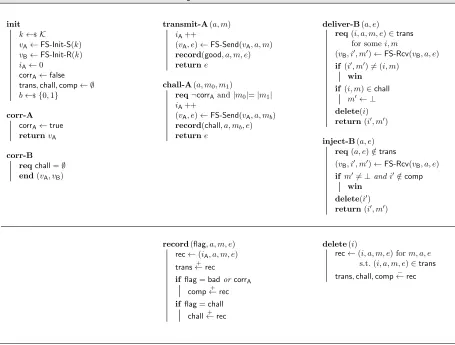
Correctness and security. Both correctness and security are built into the security game de-picted in Figure 5. The game is the single-epoch analogue of the SM security game (cf. Figure 2) and therefore has similarly defined oracles and similar record keeping. A crucial difference is that as soon as the receiverBis compromised, the game ends with a full state reveal as no more security can be provided. If only the sender A is compromised, the game continues and uncompromised messages must remain secure.
The advantage of an attacker A against an FS-AEAD scheme FS-AEAD is denoted by the expression AdvFSfs--aeadAEAD(A). The attacker is parameterized by its running time t and the total number of queriesq it makes.
Definition 15. An FS-AEAD scheme FS-AEAD is (t, q, ε)-secure if for all(t, q)-attackersA,
AdvFSfs--aeadAEAD(A) ≤ ε .
4.2.2 Instantiating FS-AEAD
An FS-AEAD scheme can be easily constructed from two components:
• an AEAD schemeAE= (Enc,Dec), and
Security Game for FS-AEAD
init
k←$K
vA←FS-Init-S(k)
vB←FS-Init-R(k)
iA←0 corrA←false trans,chall,comp← ∅ b←${0,1}
corr-A
corrA←true
returnvA
corr-B reqchall=∅
end(vA, vB)
transmit-A(a, m) iA++
(vA, e)←FS-Send(vA, a, m)
record(good, a, m, e)
returne
chall-A(a, m0, m1)
req¬corrAand|m0|=|m1|
iA++
(vA, e)←FS-Send(vA, a, mb)
record(chall, a, mb, e)
returne
deliver-B(a, e)
req(i, a, m, e)∈trans for somei, m
(vB, i0, m0)←FS-Rcv(vB, a, e)
if (i0, m0)6= (i, m)
win if (i, m)∈chall
m0← ⊥
delete(i)
return(i0, m0)
inject-B(a, e)
req(a, e)∈/trans
(vB, i0, m0)←FS-Rcv(vB, a, e)
if m06=⊥andi0∈/comp
win delete(i0)
return(i0, m0)
record(flag, a, m, e) rec←(iA, a, m, e) trans←+ rec
if flag=badorcorrA comp←+ rec
if flag=chall chall←+ rec
delete(i)
rec←(i, a, m, e) form, a, e s.t. (i, a, m, e)∈trans
trans,chall,comp←− rec
Figure 5: Oracles corresponding to party A of the FS-AEAD security game for a scheme FS-AEAD = (FS-Init-S,FS-Init-R,FS-Send,FS-Rcv).
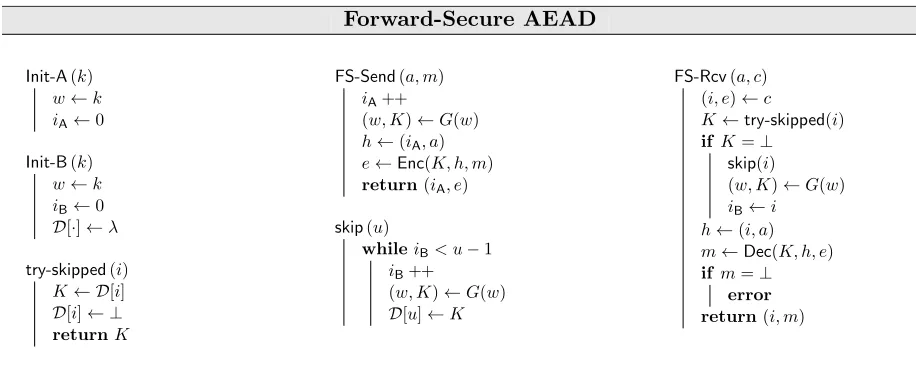
The scheme is described in Figure 6. For simplicity the states of sender A and receiver B are is not made explicit; it consists of the variables set during initialization. The main idea of the scheme, is that theAand Bshare the statewof a PRGG. Statewis initialized with a pre-shared key k∈ W, which is assumed to be chosen uniformly at random. Both parties keep local counters iA and iB, respectively.9 A, when sending the ith message m with associated data (AD)a, usesG to expand the current state to a new state and an AEAD key (w, K) ← G(w) and computes an AEAD encryption underK of mwith AD h= (i, a).
Since B may receive ciphertext out of order, whenever he receives a ciphertext, he first checks whether the key is already stored in a dictionary D. If the index of the message is higher than expected (i.e., larger than iB + 1), B skips the PRG ahead and stores the skipped keys in D. In either case, once the key is obtained, it is used to decrypt. If decryption fails, FS-Rcv throws an exception (error), which causes the state to be rolled back to where it was before the call toFS-Rcv.
9
Forward-Secure AEAD
Init-A(k)
w←k iA←0
Init-B(k)
w←k iB←0
D[·]←λ
try-skipped(i)
K← D[i]
D[i]← ⊥ returnK
FS-Send(a, m)
iA++
(w, K)←G(w)
h←(iA, a)
e←Enc(K, h, m)
return(iA, e)
skip(u)
whileiB< u−1
iB++
(w, K)←G(w)
D[u]←K
FS-Rcv(a, c) (i, e)←c
K←try-skipped(i)
if K=⊥ skip(i)
(w, K)←G(w)
iB←i
h←(i, a)
m←Dec(K, h, e)
if m=⊥ error return(i, m)
Figure 6: FS-AEAD scheme based on AEAD and a PRG.
Theorem 5. AssumeAEis a (t0, εaead)-OT-CCA secure AEAD scheme and Gis a (t0, εprg)-secure PRG. Then, the above FS-AEAD scheme FS-AEAD is (t, q, ε)-secure for t≈t0 and
ε ≤ q·(εaead+εprg) .
Proof. The proof is a straight-forward hybrid argument: Let H0 denote the actual FS-AEAD
security game.
• In the first hybrid experimentH1, all PRG outputs are replaced by uniform random values.
The indistinguishability ofH1 from the original experimentH0 follows immediately form the
security of the PRG.
• In the second hybrid experiment H2, the win condition inside the deliver-A oracle is
re-moved. The prefect correctness of the proposed FS-AEAD scheme is easily seen by inspection, and henceH1 and H2 are indistinguishable.
• In the third hybrid experimentH3, all AEAD ciphertexts are replaced by random ciphertexts
and any (uncompromised) injections are always rejected. Since in H2 all keys used for the
AEAD scheme are random, the indistinguishability ofH3 from H2 follows immediately from
the security of the AEAD scheme. Moreover, the advantage of any attacker in H3 is 0.
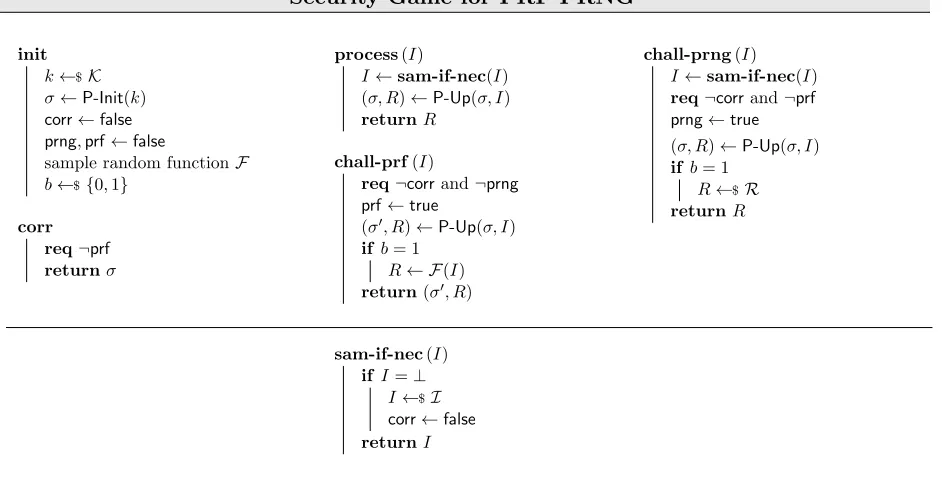
4.3 PRF-PRNGs
4.3.1 Defining PRF-PRNGs
![Figure 8: Secure-messaging scheme based on a FS-AEAD, a CKA scheme, and a PRF-PRNG. The figureonly shows the algorithms for A; B’s algorithms are analogous, with “even” replaced by “odd” (and with Init-Binitializing v[0] via FS-Init-S).](https://thumb-us.123doks.com/thumbv2/123dok_us/7969767.1321704/31.612.78.537.93.278/secure-messaging-gureonly-algorithms-algorithms-analogous-replaced-binitializing.webp)