to Information Conservational Security
Wen-Ran Zhang
Department of Computer Science Georgia Southern University, Statesboro, GA USA
ABSTRACT—Whereas it is widely deemed an impossible task to scale down One-Time Pad (OTP) key length without sacrificing information theoretic security or network traffic, this project started with the attempt to develop a paradigm of Scalable One-Time Pad (S-OTP) ciphers based on information conservational computing/cryptography (ICC). This line of research, however, hits a dead-end at the limitation of information entropy and computational precision for full information conservation when long messages are transmitted. The dead-end suggests a 2-phase study. First, to explore the boundaries of scalability with data compression to reduce a long message to a tiny minimum but assuming only partial information conservation. Second, to explore the possibility of scalability with full information conservation but with limited increase of network traffic for transmitting long messages with information theoretic security. This paper reports results of the first phase. This study suggests two future directions of ICC: (1) using S-OTP to scale down key length at the expense of limited increase of network traffic for full information conservation (See solution at https://eprint.iacr.org/2019/913.pdf ); (2) develop a type of quantum crypto machine for full information conservation.
KEYWORDS: Black Hole Data Compression; Partial Information Conservational Security; Post-Quantum Cryptography; Partially Scalable One-Time Pad
1. INTRODUCTION
1.1 Post-Quantum Cryptography
Cryptography is essential for the security of digital communication. However, many commonly used cryptosystems will be completely broken by a quantum algorithm for integer factorization [1] once large quantum computers are commercially applicable. Post-quantum cryptography is to counter such quantum attacks and to keep digital com-munication secure [2]. A key for success is to identify mathematical operations for which quantum algorithms offer little advantage in speed, and then to build crypto-graphic systems around them. Although progress has been made most proposed methods incur serious costs, especially in network traffic. A major challenge is to reduce encryption key length.
1.2 Information Theoretic Security
One-Time Pad (OTP) [3] [4] is often regarded the only cipher with proven information theoretic security (ITS) [5]. Acryptosystem with ITS derives its security purely from in-formation theory [6]. A key concept of information theory is entropy—a measure of disor-der of a system that provides a basis for unicity distance [5]. The distance can be defined as the minimum amount of ciphertext required to permit a computationally unlimited ad-versary to recover the unique encryption key in a brute force attack.
unbreak-Shannon, the inventor of information theory, who used it to prove that the OTP cipher was secure [5]. ITS bas been used for the most sensitive communications, such diplomatic and high-level military communications to counter the great efforts enemy governments ex-pend toward breaking them.
OTP can now be used together with quantum key distribution (QKD)—a well-devel-oped application of quantum cryptography. QKD uses quantum communication to estab-lish a shared key between two parties— sender Alice and receiver Bob. The key is then shared. If a third party Eve tries to eavesdrop on the communication between Alice and Bob, the quantum communication will fail for security protection [8]. Once the key is es-tablished, it is typically used as a symmetric key for digital communication such as using OTP. Since OTP is quantum proof to quantum factorization, it is a good candidate for post-quantum cryptography [2]. Unfortunately, the key requirement of equal or greater length than the original message hinders the general application of OTP even though QKD is a well-developed partner technology. As a result, OTP is generally limited at present time to transmitting relatively short messages with high security requirement.
1.3 Information Conservational Security
History shows that, when Shannon invented OTP in 1946 [6], the first computer was not out yet. Since then, computing theory and technology have advanced beyond anyone’s imagination. Although it was proven [5] that any cipher with the perfect secrecy property must use keys with effectively the same requirements as OTP keys, these proofs, however, did not take later computing theories and technological development into consideration. For instance, when entropy became a key concept in information theory, information con-servational computing/cryptography (ICC) with quantum intelligence [9,10,11,12] was not incepted yet. On other hand, before the first computer was put on the drawing board, IEEE binary64, 128, and 256 double-precision floating-point format for a wide dynamic range of numeric values was unimaginable. The wide dynamic range makes equilibrium-based ICC practical and opened the possibility of OTP scalability with partial or full information con-servation and limited traffic increase.
With the new theoretical and technological advances, the information conservational approach to security attempts to incorporate holistic and set-theoretic data compression into OTP as an extension to information theoretic security. In this approach, a partially scalable one-time pad (S-OTP) cipher does not attempt to falsify Shannon's theorem, it bypasses the assumptions of the theorem by reducing the message length to be enciphered with black-hole-like information conservational data compression but still enable the shar-ing of holistic information such as document size, structure, and perhaps digest. This type of data compression is named black hole data compression (BHDC).
Cryptosystems often compress the plaintext before encryption for added security. When properly implemented, compression greatly increases the unicity distance [5] by re-moving patterns that might facilitate cryptanalysis. However, many ordinary lossless com-pression algorithms produce headers, wrappers, or other predictable output that might in-stead make cryptanalysis easier. Thus, cryptosystems must utilize compression algorithms that can hide these predictable patterns. BHDC is used to explore some limits.
Now we have the question: Can S-OTP really make OTP partially scalable through BHDC?
This paper presents S-OTP based on BHDC to explore some boundary assuming only partial or minimum information conservation. It is shown that, with ICC, BHDC can com-press a large data set to a tiny minimum with partial information conservation. In this way, S-OTP makes OTP keys much shorter Partial information conservational security condi-tions are established. Quantum-fuzzy collective precision is proposed. Quantum machinery development of S-OTP is briefly discussed. In general, some boundaries are explored for future study.
This paper is organized in five sections. Section II presents the theoretical basis with illustrations BHDC and S-OTP. Section III examines some optimization of the S-OTP par-adigm. Section IV presents an architectural design of S-OTP quantum dream machinery. Section V draws a few conclusions and identifies a number of major theoretical and prac-tical challenges.
2 THEORETICAL AND METHODOLOGICAL FORMULATION WITH IL-LUSTRATION
2.1 Theoretical Formulation
It is shown [3] [4] that an OTP cipher is information theoretically secure and unbreak-able [5] [6] provided that the message to be ciphered is unknown to attackers, and a cipher key meets the four conditions of OTP: (a) truly random; (b) never reused; (c) kept secret from all possible attackers; (d) of equal or greater length than the message. Based on the four security conditions, we consider the scalability and partial scalability of OTP.
Definition 1a. Information conservational transformation (ICT) is referred to as a set of set-theoretic mathematical functions that forms an transformation T to transform the bit pattern of a long message in form F1 to another pattern in form F2 systematically such that
there exists a reverse transformation T’ that can fully recover F1 from F2 without
infor-mation loss. Formally we have: T(F1): F1→F2 such that T’ and T’(F2): F2→F1. Partial information conservational transformation (PICT) is referred to as a set of set-theoretic mathematical functions that forms an transformation T to transform the bit pattern of a long message in form F1 to another significantly shorter pattern in form F2 systematically such
that there exists a reverse transformation T’ that can partially or minimally recover F1 from
F2. Formally we have: T(F1): F1→F2 such that T’ and T’(F2): F2→F3, where F1F3 results
the partially reserved information including document size and structure. (Note: PICT is part of ICT.)
Definition 1b. Scalability is referred to as using ICT once or multiple times systemat-ically to transform a long message or large data set into one or a series of short forms such that cipher keys are reduced to a minimum for enciphering the short forms as OTP pads for secure transmission. In this case, An OTP pad is called a scalable OTP (S-OTP) pad. When PICT is used an S-OTP pad is called partially scalable. In S-OTP, a key is assumed reusable if the reuse can be concealed in another unbreakable S-OTP pad.
Based on Definitions 1a and 1b, we extend information theoretic security (ITS) of OTP to information conservational security (ICS) of S-OTP and partial information conserva-tional security (PICS).
Definition 2a. An S-OTP cipher is said having ICS if full ICT is used. An S-OTP cipher is said having PICS if PICT is used.
Definition 2b. Given 0<i<N, a minimum length form is a message form Fx = (X, {xi/X})
that cannot be further reduced in binary length through ICT/PICT in theory. An absolute minimum length form is the minimum form when N = 2.
a long sought goal in physics and information theory without a breakthrough until recently [11,12]; (2) The key length problem of OTP has been a well-known long standing impasse; (3) ICS is essentially information theoretic in nature that qualifies to be a systematic ex-tension to ITS for further research [9,10].
The inception of ICS accounts for the new development in computing technology. Dou-ble precision floating-point format of IEEE binary64, 128, or 256 is used as a technological basis for analysis that was not available when information theory was initially developed [6].
Theorem 1a (Possibility Theorem). PICT for PICS is possible based upon OTP and IEEE binary64, 128, or 256. Formally, let {x} be the data set of a long integer L representing a sufficiently long message divided into sections, some set {xi}, 0<i<N, exists such that (X, {xi/X}) is significantly shorter than the long integer L, where X = ∑ 𝑥𝑖 𝑖 is a math summation
(not XOR), and {xi/X} a percentage distribution. However, The original message L can only
be partially recovered from (X, {xi/X}) due to the limitation of double precision and
infor-mation loss.
Proof. To show possibility, let L=16K bits divided into 32 of 512-bit sections or integers {xi}, 0<i<32. That would leads to one 64, 128, or 256-bit double floating point summation X=∑ 𝑥𝑖 𝑖 and
32 of 64, 128, or 256-bit percentage distributions {xi/X}, respectively, total 8K+256, 4K+128, or
2K+64 bits vs. 16K, a nearly 2-4-8-fold reduction of key length and network traffic. This could be further hierarchically scaled (reduced) to a minimum form or until the pair (X, {xi/X}) is short enough
to be randomized and enciphered with a significantly shorter key. Thus, ICS is achievable. However full information conservation is achievable only when the message length is in the range of the effec-tive digits for precision limited by double precision floating point formal of IEEE binary64, 128, or 256, but not achievable in general. (Note: Since a possibility theorem is not an optimality theorem, a generic example is sufficient for its proof. However, the possibility opened the door to partial scala-bility of OTP.) ∎
Theorem 1b (Minimum Length Theorem). For any message in an intermediate PICT transformation, given the number of data divisions N, a minimum length form Fx = (X, {xi/X}) exists in theory where length(X) = length(xi/X)—one double precision floating point number length, 0<i<N. An absolute minimum length also exists in theory, which equals
length(three double precision floating point numbers), that would be 192, 384, or 768 bits for IEEE binay64, 128, and 256, respectively.
Proof. Given any PICT T, we must have a form in length Fx = (X, {xi/X}), 0<i<N, such that at
certain point we must have T(Fx):Fx→Fy and length(Fy) = length(Fx) because (1) given 0<i<N,
length({xi/X}) is irreducible; (2) if length(X) length(one double precision floating point number)
it becomes irreducible either. Then we must have an absolute minimum length for N, where one double precision floating point number is for the summation, two are for the distribution in double precision floating point format, that would be three of them. ∎
Theorem 1c (Reachability of Minimum). Given the number of data divisions N2, a minimum or absolute minimum length form can be reached through a recursive PICT T(T(X)) if sufficient computational power is available.
Proof. It follows from the proof of Theorem 1b. ∎
Theorem 1d (Randomization Theorem). A bit pattern L with a tiny minimum number of bits resulted from BHDC can always be randomized with another bit pattern R in limited length for enhanced unicity distance regardless of any header, wrapper, or other predictable output in L.
Proof. It follows from the commonsense that, if L is a tiny minimum, a small number of random
bits in R can be inserted into L as paddings for enhanced unicity distance. Thus, any necessary head-ers, wrapphead-ers, or other predictable output can be randomized before the text is enciphered that, otherwise, would be patterns facilitating cryptanalysis by attackers in a brute force attack [5]. The paddings can be removed by a receiver based on a key (e.g. Key code 0101080302R2 stands for “Pad 1 random bit at the beginning and insert 1 random bit for every 8 bits after bit position 3, then pad 2 random bits at the end. Repeat the padding with double distance that is: Pad 1 random bits at the beginning and insert 1 random bits for every 8 bits after bit position 3 2 = 6, then pad 2 random bits at the end.”) ∎
2.2 Method1: Add, Divide, and Conquer
The rationale of S-OTP is that, given an unsigned big integer L representing the long message or large data item D to be transmitted, L can be divided into a set of shorter long integers {xi} = x1, x2, .., xi, .. xn representing sectors or sections of D to be transmitted. The
summation X = x1 + x2 + ...+ xi+...+xncan be obtained which could be represented as a
long integer or a floating-point decimal much shorter than L to transmit. The set of per-centage distribution {xi/X} is a type of most primitive information conservational key that
can be encrypted and transmitted together with X in ciphertext for recovering {xi} to L and
then D in the receiver side. This leads to S-OTP-Method1—a one key cipher.
S-OTP1-Method1
Assume sender Alice and receiver Bob share a private key K distributed through QKD.
Part I. Encryption
Step 1. Let math summation X = ∑ 𝑥𝑖 𝑖(not XOR).
Step 2. Calculate percentage distribution {xi/X};
Step 3. Encrypt the text U = {X, {xi/X}} with one key K to ciphertext E=KU where is XOR (not
math summation).
Step 4. Alice Transmits E to Bob.
Part II. Decryption
Step 1. Use K to decipher E to obtain X and {xi/X};
Step 2. Use {xi/X} to decrypt the summation X and recover {xi};
Step 3. Recover transmitted message from {xi} with concatenation.
2.3 Illustration of S-OTP1-Mehrod1
Assuming the plaintext data D to be transmitted is represented by the big integer L = 1048549998213983988, we divide L into the three sections 1048549, 998213, and 983988.
Assume sender Alice and receiver Bob share a private key K distributed through QKD.
Part I - Encryption
(1) Let x1 = 1048549, x2 = 998213, x3 = 983988, and
(2) X = x1 + x2 + x3 = 3030750;
(3) Calculate percentage distribution {xi/X}={34.5970%, 32.9362%, 32.4668%};
(4) Encrypt the plaintext U={3030750, {34.5970%, 32.9362%, 32.4668%}} to result in ciphertext E=KU;
(5) Transmit E to Bob; Part II - Decryption:
(1) Use K to recover U={3030750, {34.5970%, 32.9362%, 32.4668%}}; (2) Use U to recover x1=1048549, x2=998213, and x3=983988;
(3) L = concatenate(x1, x2, x3) = 1048549998213983988;
It can be argued that S-OTP1-Mehrod1 does not reduce the key length. The counter
argument is that, as a simple example the illustration is already in a minimum form. It does not really need S-OTP because a single OTP is sufficient. As proven in Theorem 1, S-OTP does reduce key length the same way with sufficiently long dada sections for partial infor-mation conservation. The problem is precision.
2.4 Method2—ICC with Collective Precision
Percentage distribution has its own limitation due to sequential computation. When the math summation gets huge that is usually the case, the precision of a single percentage will be a problem. The computation of such a percentage can be avoided with the massive par-allel collective precision property of ICC [9,10]. In ICC a big total can be divided into many subtotals or integers representing data sections. If each subtotal is further divided into bipolar import-export values, each can be normalized by its corresponding column subtotal. A information conservational matrix can then be derived through column-major normalization for massive parallelism and collective precision without using the grand to-tal.
ICC is made achievable with bipolar fuzzy sets [13-17]. Bipolar fuzzy set theory forms an equilibrium-based mathematical abstraction—a set theoretic or information theoretic extension to fuzzy set theory [18]. It is a generalization of truth-based computing which can still be used freely as long as equilibrium conditions are not violated. Bipolar fuzzy set theory was once rescued by Zadeh [19].
In this subsection, we show an ICC example. We then examine and explain the prop-erties of the example in next two subsections. A key concept in ICC is an information conservational bipolar matrix M. With M an energy or information total or summation can be decrypted through equilibrium-based rebalancing to result in all the subtotals in parallel with percentage distribution built into M. This makes it possible to develop digital or quan-tum machinery with massive parallelism in collective precision that is not achievable with linearly normalized percentage distribution.
M consists of bipolar elements. The energy and/or information of a bipolar (import-export) element or variable x = (a, b) is defined as the length of a bipolar interval where a is negative and b positive.
Energy of x: |x| = |(a, b)| = b – a = |a| + |b|. (1) For instance, |(-2.5, 3.5)|=3.5-2.5=2.5+3.5=6.
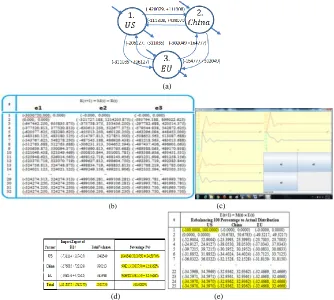
A 3-partner US-China-EU trade example is used to illustrate the basic idea of ICC with collective precision. First, the 3-parners’ bipolar import-export data for 2014 are shown in Fig. 1a as a cognitive map (CM) in million Euros. The total energy/information in the trade scenario is characterized by the total import/export
|(-3030750, +0)| = |(-0, +3030750)| = 3030750.
Using collective bipolar interaction in ICC, accurate calculation can be carried out with the bipolar quantum cellular automaton (BQCA) E(t+1) = M E(t) based on a column-major normalized bipolar cognitive map matrix M that does not need the calculation of percentage distribution. (Note: The illustrations in this paper are in fix-point format for readability. In real computing, they are in floating-point format.)
C(t) =[
(0, 0) (−420,079, +111,308) (−311,035, +206,127) (−111,308, +420,079) (0, 0) (−164,777, +302,049)
(−206,127, +311,035) (−302,049, +164,777) (0, 0) ].
M = normalize(CT(t)) = [(−0.401 0.106)(0.000 0.000) (−0.112 0.421) (−0.209 0.316)(0.000 0.000) (−0.307 0.167) (−0.297 0.197) (−0.165 0.303) (0.000 0.000)
].
Equilibrium-based rebalancing is illustrated in Fig. 1b and curved in Fig. 1c. Fig. 1d verifies such rebalancing with sequential computing. Fig. 1e shows 200% is balanced to a perfect percentage distribution built in M. Thus, matrix M can be deemed the encryption of a percentage distribution.
While sequential computing does not support parallel processing, equilibrium-based rebalancing can balance a total to a perfectly equilibrium state with percentage distribution coded in M in an iterative and massively parallel process without the need for individual percentages. Although a perfect equilibrium-state may be neither practical nor desirable in economics, equilibrium-based rebalancing provides a new approach to post-quantum cryp-tography. Most importantly, it finds a way for quantum-fuzzy collective precision.
(a)
(b) (c)
(d) (e)
S-OTP1-Method2
Assume key K1 is shared by sender Alice and receiver Bob through QKD. Part I. Encryption
Step 1. Data Transformation. Given binary data D to be transmitted, let the unsigned integer number
set {di} = {d1, d2, .., di, .., dn}, represent the data sections of D. Let the sum X=d1+d2+...+di ...+
dn.
Step 2. Bipolar Cognitive Mapping. Construct an i/o-consistent BCM C based on {di} such that {di}
is decomposed into an unbalanced relational data set {eij} = {(eij-,eij+)} where each bipolar link
weight eij = (eij-,eij+) and |di| ∑ |𝑗 |𝑒𝑖𝑗 (energy/information of row i) with ratio |eij-|/|eij+| > l, a
threshold for non-zero bipolar elements. Thus, {eij} forms a BCM C with total information
X=∑ |𝑑𝑖|. (Note: C is not unique – an area of further research where bipolar linguistic fuzzy sets
can be used for the optimization of l and C.)
Step 3. Bipolar Energy/Information Normalization. Normalize CT (transpose of C) to an
infor-mation conservational matrix M (a bipolar quantum-fuzzy logic gate (BQFLG) or a bipolar quantum-fuzzy cognitive map (BQFCM)) under the conditions of Eq. (3) such that the BQCA E(t+1)=M × E(t) is asymptotic to an equilibrium state [10,11].
Step 4. Data Encryption. Use K1 to encipher U={X,M} to E=UK1 = {X,M}’. Step 5. Transmit the pair E={X,M}’.
Part II. Decryption
Step 1. Use K1 to decrypt E to {X,M}; use K2.
Step 2. Use M to decipher and depolarize X to recover {di};
Step 3. Recover D from {di} with concatenation.
Applying S-OTP1-Method2 we have the decryption example in Fig. 1. The total
infor-mation of the last row of Fig. 1b approximate to exactly the same result as that of S-OTP1
-Mehrod1:
d1=||(-731114, +317435)=1048549; d2=||(-276085, +722128)=998213; d3=||(-508176, +475812)=983988
D=Concatenate(d1, d2, d3)=1048549998213983988.
2.5 The Quantum Nature of Information Conservation
Given an nn square bipolar interactive matrix M and an n1 column bipolar vector
E(t) such that E(t+1)=M × E(t), if ∀j, the absolute energy/information subtotal |εcol|M∗j(t)
of each column j of M (but not necessarily each row) equals 1.0, or |εcol|M∗j(t)1.0, M is
defined as an information conservational bipolar quantum logic gate (BQLG) matrix or a bipolar quantum-fuzzy cognitive map (BQFCM) [9,16], and we must have the bipolar quantum cellular automata (BQCA):
|ε|E(t+1) = |ε|(M × E(t)) ≡ |ε|E(t). (2)
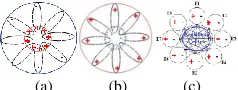
Eq. (2) leads to a general-purpose BQCA theory – an equilibrium-based unification of matter and antimatter for ICC. Computationally, a BQCA can be regulated to achieve in-formation conservation, regeneration, degeneration and oscillation. BQCA is thus a type of quantum-cellular model (Fig. 2). This leads to Method2 and the theory of ICC.
The transpose CT(t) is used to obtain its column-major normalized BQLG matrix M for
ICC. The normalization follows Eq. (3). An i/o-consistent CM can always be designed and normalized to M for a BQCA to be asymptotic to a bipolar equilibrium state even though some link weights are weaker and need more iterations (t) to be balanced. This property provides a basis for quantum and post-quantum cryptography.
M(i,j) = (CT(i,j))/|ε
(a) (b) (c)
Figure 2. A BQCA unification of matter and antimatter atoms (adapted from [11]) In Eq. (3), the denominator |εcol|(CT∗j) denotes the absolute energy/information subtotal
of column j in CT. But the notation |ε
col|(M∗j) denotes the normalized absolute
energy/information subtotal of column j of matrix M.
2.6 The Digital Nature of S-OTP-Method2
Notably, S-OTP-Method2 is based on bipolar equilibrium-based rebalancing. Bipolar-ity is a quantum feature that form the bipolar realBipolar-ity of negative-positive particles. The bipolar property, however, can be depolarized for digital cryptography.
A unipolar CM can be revealed from a bipolar one with depolarization. Since a bipolar representation is a generalization of unipolar representation and subsumes unipolar cases, all the elements of a polarized map can simply have zero negative energy/information which leads to the simplified CM as in Fig. 3 coded as a unipolar matrix C(t)—a positive relation that does not distinguish import and export with symmetrical subtotals.
Depolarization leads to a unipolar cipher named S-OTP1R1-Method2 that is basically
the same as S-OTP1-Method2 except using a positive CM and a positive matrix M. Fig. 3
shows a decryption example using S-OTP1R1-Method2 where in the last row we have the
same result as for the bipolar case.
d1 = ||(-0, +1048549) = 1048549; d2 = ||(-0, +998213) = 998213; d3 = ||(-0, +983988) = 983988;
D = Concatenate(d1, d2, d3) = 1048549998213983988.
(a) (c)
(b)
Figure 3. Information-conservational unipolar rebalancing: (a) depolarized CM; (b) Positive distribution; (c) Positive curve (scaled)
2.7 Two Puzzles Explained
(A) How can matrix C(t) in symmetry (C(t)(i,j)= C(t)(j,i)) be used in cryptography?
be non-linear and asymmetrical because the normalization is by dividing its column sub-total of CT(t) (data section subtotal), but not by the global total (corresponding to the overall
summation). For instance,
C(t) = [
0 531587 517162
531587 0 466826
517162 466826 0
]; M = 0 1 2 [
0.000 0.532 0.526 0.507 0.000 0.474 0.493 0.468 0.000 ];
where C is symmetrical but M is not. The non-linear asymmetrical property of M can be characterized with a set of linear equations. Let the three subtotals (or data sections) be x,
y, and z, respectively, for the 33 matrix M we have m10x– m01y= 0; m20x– m02z= 0; and m21y– m12z= 0; and mij mji. The set of equations have infinite number of solutions
because all column coefficients of M correlate linearly with each other due to non-linear normalization based on different local column subtotals. This is fundamentally dif-ferent from percentage distribution where all percentages are normalized with a global total and linearly independent.
(B) If a unipolar positive matrix is sufficient, why do we need a bipolar equilibrium-based matrix in cryptography? There are three top answers to this question: (1) The uni-verse consists of negative-positive particles. Without bipolarity, there would be no bipolar information conservation and bipolar quantum computing [9,10]. Thus, bipolarity leads to a quantum model compatible to digital computing (further discussed later). (2) A bipolar matrix avoids large denominators, doubles the number of elements in a unipolar matrix, doubles the parallel computing power, and doubles collective precision with equilibrium-based rebalancing (further discussed later). (3) Bipolarity is set-theoretically different from bilinearity or bijection [12]. One defines a 2-to-2 mapping of equilibrium-based non-linear bipolar dynamic entanglement with logically definable causality, another defines a 1-to-1 mapping without non-linearity, entanglement, and definable causality.
2.8 On the Security of Method1 and Method2
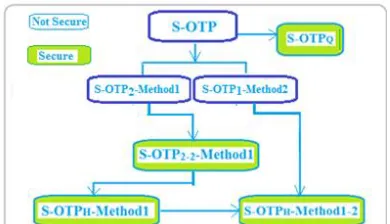
Method1 is based on percentage distribution. It provides a basis for both theoretical analy-sis and practical development. The goal is to search for secure information conservational S-OTP ciphers by analyzing different approaches that may or may not be secure.
Theorem 2a. Under the conditions of Definition 2, S-OTP1-Method1 is information
conservationally not secure.
Proof. It follows from that the transmitted message consists of numerical meta data
with fixed format. Such knowledge could potentially weaken the ITS of OTP. ∎
Based on the Randomization Theorem (Theorem 5d), The above problem can be re-solved by adding random bits to the metadata as paddings before the text being enciphered. The paddings can be removed when being decrypted by receiver. This is made possible with BHDC that can compress a long message to a tiny minimum such that sufficient ran-dom padding bits can be used for the ranran-domization.
Theorem 2b. Under the conditions of Definition 2, S-OTP1-Method1 would have PICS
provided that a sufficient number of random bits are inserted as paddings to the metadata to be enciphered and removed when being decrypted by the receiver. Full ICS is possible if all data items are within the limits for 100% computational precision.
Proof. With the provision, the conditions of S-OTP as defined in Definition 2 remain either intact
or partially intact. ∎
The one key version (S-OTP1) suggests that, two different keys (S-OTP2) might be
considered for an information conservational solution.
(1) S-OTP2-Mehrod1: Use key K1 to encipher the summation X = ∑ 𝑥𝑖 𝑖 to X’; Use key K2 to encipher
the text of {𝑥𝑖/X} to {𝑥𝑖/X}’; Transmit the packaged pair {X’, {𝑥𝑖/X}’} without key reuse;
(2) S-OTP2-2-Mehrod1: First, use a random number of bits specified in key K1 as random paddings
for altering the numerical format of {X, {𝑥𝑖/X}} to {X, {𝑥𝑖/X}}’ (See Theorem 1d.); Then, use K2
as a key to encipher {X, {𝑥𝑖/X}}’ to {X, {𝑥𝑖/X}}’’; Transmit {X, {𝑥𝑖/X}}’’.
Theorem 3a. Under the conditions of Definition 2,S-OTP2-Mehrod1 is information
conservationally not secure.
Proof. It follows the proof of S-OTP1-Mehrod1. ∎
Theorem 3b. Under the conditions of Definition 2,S-OTP2-2-Mehrod1 is information
conservationally secure for ICS or PICS based on precision limitation.
Proof. With sufficient random bits as paddings specified by the first key and a regular second
key, the message and its format are randomized and concealed in an unbreakable pad that does not weaken the security of OTP. However, the message only partially preserve original information be-yond the limit of precision. ∎
Evidently, if a percentage distribution {𝑥𝑖/X} is replaced with an information conserva-tional matrix M we will have different 1-key or 2-key versions of S-OTP-Mehrod2 with similar security conditions as that of S-OTP-Mehrod1.
3 ANALYSIS AND OPTIMIZATION—TOWARD SECURE POST-QUANTUM CRYPTOGRAPHY
3.1 Minimal BQCA Theorem
Theorem 4. Mehtod1 is the minimal case of Method2.
Proof. Mehtod2 entails an N𝑁 square matrix multiplied by a column vector in an information conservational BQCA. When N𝑁 is reduced to N1, the matrix becomes a column vector of per-centage distributions 𝑤𝑖 = {𝑥𝑖/X} summing up to 1.0, the single number must be the summation X of
N sections, such that the column vector multiplied by a single element matrix results in a column vector energy/information distribution {𝑥𝑖}. The Matrix multiplication can be deemed the minimal
BQCA which requires a final equilibrium state be reached in a single step with high precision such as
( 𝑤0
𝑤1
𝑤𝑖+1
𝑤𝑛
) [𝑋] = ( 𝑥0
𝑥1
𝑥𝑖+1
𝑥𝑛 ). ∎
Theorem 4 proves that Method1 is suitable for reducing network traffic, and Method2 can be used for computational precision. Theorems 1-4 provide a basis for applicability and efficiency analysis of a new crypto paradigm using either Method1 (percentage distri-bution) or Method2 (information conservational matrix) or a combination of the two. Based on IEEE binary64-128-256 standard, double precision floating-point format provides us an upper limit for long messages. Major considerations are on the key length for enciphering both the math summation and the percentage distribution. According to IEEE binary64 standard, exponents range from −1022 to +1023 that allows the representation of numbers between 10−308 and 10308, with full 15–17 decimal digits precision. By compromising
pre-cision, it allows even smaller values up to about 5 × 10−324. Using IEEE binary128 or 256, a significantly larger portion of the information can be preserved.
3.2 Applicability and Efficiency of Method1
Using S-OTP2-2-Method1, the percentage distribution {xi/X} needs to be enciphered,
where each double precision floating-point number xi/X requires 64 bits for IEEE binary64.
While a 1M = 220 bits message needs an impractical same length OTP key, if the 1M-bit
message is divided into 512-bit sections, the division leads to N = 220/29 = 211 data sections
with a math summation less than 512+11 = 523 bits. N = 211 double precision
floating-point numbers are needed for the percentage distribution {xi/X} that entails 21126 =
compared with the message length. The upper limit of the exponent is +1023 for signed integers based on IEEE binary64. At the limit, the key length saving approaches 16-fold. It seems to be a clean solusion. But, there are still unsolved problems. First, 128K+523 bits data plus K1 for random paddings is still too long to be a practical key length. Second, when
the grand total is huge, the percentage distribution will have a precision problem because a percentage is normalized by the grand total as the denominator.
3.3 Applicability and Efficiency of Method2
While for 1M-bit long messages the key length requirement for OTP is not practical, it is much less a problem with percentage distribution using Method1, but still a problem with Method2. A 1M-bit message divided into 2K 512-bit sections would need a 211×211
sparsely populated information conservational matrix M. Assuming each column has an average of no more than 8 non-zero elements in 64-bit double precision floating-point for-mat plus one index that leads to 8×64=23×26 bits per column. A total of 8×64×211=220 bits
plus a 513-bit summation need to be transmitted in ciphertext—more than the original 1M bits.
While Method2 is inefficient and impractical, its information conservational property is still quite attractive. In terms of digital computing, its column-major normalization does not use the grand total but a much smaller section subtotal as the denominator and a much smaller sender designated percentage of a subtotal as the numerator. Remarkably, it can divide-and-conquer the high precision requirement into lower precision requirement. On the quantum side, its equilibrium-based rebalancing property reflects the bipolar reality of particle-antiparticle coexistence [9-12].
3.4 Hierarchical Optimization
Without entirely enciphering both a summation and its percentage distribution or ma-trix M, Method1 and Method2 cannot achieve ICS. Since enciphering matrix M does not reduce key length, S-OTP2-2-Method1 is a candidate for hierarchical scalability as in Fig.
4 based on IEEE binary64.
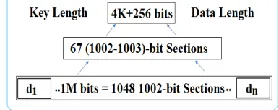
Figure 4. A 3-Level Hierarchy of S-OTPH for 1M bits
First, we assume that 1M = 1048576 bits data divided into 1048 1000-bit sections. We would have a maximum of 1012-bit summation X associated with a 104864 = (210 + 24) 26 = 216 + (24 26) = 64K + (16+8) 26 = 64K + 1K + 512 bits percentage distribution
D. The summation can be converted to a 64-bit double precision floating-point number. The pair {X, D} would consists of 64K + 1K + 576 bits = 67136 bits. Second, the 67136 bits can be divided into 67 of 1002-1003-bit sections. That leads to 67 of 64-bit double precision floating-point numbers for the percentage distribution plus a maximum of 1008-bit summation. Again, the summation can be converted to a 64-1008-bit double precision float-ing-point number. The 67+1 double precision numbers need 6864 = 212 + 256 = 4K + 256
bits. Third, 4K + 256 bits can be further scaled to 1K-bits plus K1 as a less than1K-bit
randomizer to result in a 2K-bit key K2. Evidently, due to the short length the two keys are
no longer a drawback. Formally, we have S-OTPH-Method1. Similarly, 1 Gaga bits = 1K
S-OTPH-Method1
For every 1M bits of data to be transferred, assume sender Alice and receiver Bob share two private keys K1 and K2distributed through QKD.
Part I – Encryption: Use BHDC to achieve S-OTP
(1) L=1; if the data length is short enough for an OTP cipher key, print message “Please use OTP without hierarchy”;
(2) L=L+1; determine summation X ={ ∑ 𝑥𝑖 𝑖} and derive the percentage distribution D={𝑥𝑖/X};
(3) If the data is too long for an OTP cipher key and its length is reducible (>minimum), go to Step (2);
(4) If the data is too long for an OTP cipher key and its length is unreducible, stop and restart with different number of scalable pads;
(5) Apply S-OTP2-2-Method1 to encipher {X,D,L} to {X,D,L}’’ with key K1 for sufficient random
pad-dings and K2 as a cipher key;
(6) Transmit the ciphertext {X,D,L}’’ to the receiver. Part II – Decryption: Use BBIR to recover the message
(1) Decipher {X,D,L}’’ to {X,D,L} with K2 and K1;
(2) Use X and D to find next layer {{𝑥𝑖}, D}, L = L-1, if L>1, repeat step (2) until L = 1;
(3) Cast {xi} to string format {di};
(4) Recover the original message or data set D by concatenating {di}.
Theorem 5. Under the conditions of Definition 2, S-OTPH-Method1 has PICS or full
ICS if computation is within precision limit.
Proof. It follows from the proofs of Theorem 1d, 2b and the security of S-OTP2-2-Method1. ∎
3.5 Collective Precision
While Method1 uses percentage distribution, Method2 uses information conservational encryption. In Method1 each data section depends on a single percentage resulted from linear normalization by a grand total. When the data length is long, Method1 will have a precision problem. In Method2, each data section depends on all columns of matrix M
resulted from column-major normalization by much smaller subtotals where percentage distribution is not directly calculated using the grant total. If each column has an average of n > 2 non-zero numbers, the precision requirement is n-times smaller. The larger the number n the more parallelism in high precision decryption. When n equals N, Method2 reaches maximum parallelism with N-fold precision enforcement for a positive matrix M
and 2N-fold for a bipolar matrix M. This observation leads to the inception of information conservational collective precision.
Observation 1: Asymptoticity. If M is information conservational, BQCA E(t+1) = M E(t) is asymptotic to an equilibrium state determined by M [9,10].
Observation 2: Information Conservational Computing and Cryptography. If an original message D is converted to an energy/information total E through a BQCA trans-formation, the information conservational matrix M of the BQCA can serve as a key to decode the total information to the original message D in the receiver side [9]. However, to encrypt and transmit matrix M will cost more than to encrypt and transmit the original message. Thus, Method1 is more efficient than Method2 for encryption and transmission, but only Method2 can enable collective precision and efficient decryption.
Theorem 6. If M is information conservational, BQCA E(t+1) = M E(t) can be used to derive the percentage distribution in an equilibrium state determined by the BQCA.
Proof. Given 100 (percent), Theorem 6 follows the asymptoticity theorem [9] directly (see
Theorem 7. A percentage distribution of N divisions can be converted to an NN (uni-polar or bi(uni-polar) information conservational matrix M for collective precision with maxi-mum parallelism such that M is information conservational and BQCA E(t+1) = M E(t)
is asymptotic to an equilibrium state.
Proof. Notice that M is normalized and information conservational but not unique. Theorem 7
follows from ( 𝑤0
𝑤1
𝑤𝑖+1
𝑤𝑛
) [𝐸] = ( 𝑤0𝐸
𝑤1𝐸
𝑤(𝑖+1)𝐸
𝑤𝑛𝐸
) because ( 𝑤0
𝑤1
𝑤𝑖+1
𝑤𝑛
) is strictly proportional to ( 𝑤0𝐸
𝑤1𝐸
𝑤𝑖+1𝐸
𝑤𝑛𝐸
). That is, M
can be derived from either of them ∎
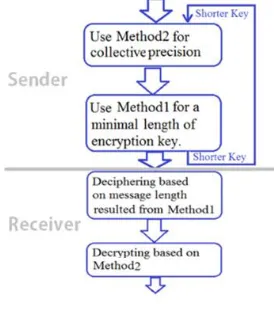
Based on the above findings we can conclude that, on the sender side, matrix M can be used for determining the percentage distribution with N-2N fold reduction of precision re-quirement due to column-major normalization (Re. Eq. (3)). On the receiver side, M can be used to decrypt a big total to subtotals (or data sections) with collective precision in a reverse way (Fig. 1b and Fig. 3b). Thus, Method1 and Method2 can be used in a combi-nation. Method2 focuses on collective precision with ICC; Method1 focuses on secure and efficient data transmission, that lead to the block diagram design in Fig. 5 impact factor followed by an optimized algorithm that combines the advantages of Method1 and Method2 while eliminating their drawbacks.
Figure 4. Sender and Receiver
S-OTPH-Method1+2
For every 1M bits of data to be transferred, assume sender Alice and receiver Bob share two private keys K1 and K2 distributed through QKD.
Part I – Sender Side: Use BHDC to achieve S-OTP
(1) L=1; if the data length is short enough for an OTP cipher key, print message “Please use OTP” without hierarchy;
(2) L=L+1, compute summation X ={ ∑ 𝑥𝑖 𝑖}, derive information conservational matrix M, and
deter-mine percentage distribution D={𝑥𝑖/X} with BQCA E(t+1) = ME(t) (see Fig. 1e);
(3) If the data is too long for an OTP cipher key and its length is reducible (>minimum), go to Step (2);
(4) If the data is too long for an OTP cipher key and its length is unreducible, go to Step (2) with a smaller N such that 0<i<N and N2;
(5) Apply S-OTP2-2-Method1 to encipher {X,D,L} to {X,D,L}’’ with key K1 for sufficient random
pad-dings and K2 as a cipher key;
(6) Transmit the ciphertext {X,D,L}’’ to the receiver. Part II – Receiver Side: Use BBIR to recover the message (1) Decipher {X,D,L}’’ to {X,D,L} with K2 and K1;
(2) Construct information conservational matrix M from D; (3) Use X and M in a BQCA to find next layer {{𝑥𝑖},M}, L=L-1;
(4) Cast {xi} to string format {di};
(5) Recover the original message or data set D by concatenating {di}.
Theorem 8. Under the conditions of Definition 2, S-OTPH-Method1+2 has PICS or
full ICS if computation is kept within the precision limit.
Proof. Since Method2 is only used for collective precision on the sender side and parallel
de-cryption on the receiver side, the theorem follows from the proof of Theorem 1d, 2b and the security of S-OTPH-Method1. ∎
3.6 Transmitting Large Dada Sets
With S-OTPH-Method1+2 a large data set can be serialized as a number of Mega bits
S-OTP pads, and each Mega bits can be securely transmitted with a 2K-4K bit short key that is practical with QKD while a 1M bit key with the same length as the message is obviously not practical.
Furthermore, noticing that S-OTPH-Method1 and S-OTPH-Method1+2 are defined
for every Mega bits of data. The data, however, can be original message or intermediate compressed data toward a tiny minimum. Thus, the methods can be hierarchically extended to work for every Gaga or every Tega bits of data.
Theorem 9. A significantly larger data set does not necessarily require a significantly longer key for PICS with partial information conservation.
Proof. It follows the Reachability of Minimum Theorem with BHDC. ∎
3.7 A Consequence of Collective Precision
Collective precision adds a number of new features to hierarchical S-OTP. On the sender side, it can be used for testing everything efficiently and precisely to guarantee that the receiver side will get the correct message or partial message. On the receiver side it can be used to decrypt a summation efficiently with collective precision and in massive paral-lelism colluding with the sender side through public protocols based on data length and number of divisions N. These are necessary auxiliary functions.
It can be observed that the percentage distribution {xi/X} is a major contributor to the
key length requirement of S-OTP. If it does not have to be enciphered but transmitted in plaintext, we only need to cipher a short summation with a much shorter key. If 1Gaga bits divided into 1K mega divisions, each 1Mega division results in a 64-bit double precision summation, 1G bits with 1K such summations would only need 64K bits to be ciphered. Of course, the summations can be hierarchically scaled further to a minimum.
Now, with collective precision, we have the challenging question: Can the percentage distribution {xi/X} be securely transmitted in plaintext if {xi} are double precision floating-point numbers due to the reuse of a double precision floating-floating-point key in multiplication or division operation instead of XOR?
Whereas this paper has assumed that a transmitted message as a long binary integer L
is divided into smaller integers {xi}, and their summation is also an integer 𝑋 = ∑ 𝑥𝑖 𝑖.
Ev-idently, X can be guessed by attackers with a trial-error method to break S-OTP if an integer key is reused for {xi} without encrypting the percentage distribution {xi/X}. Now with
col-lective precision, floating point decimals can be used instead of integers.
and the final summation could be unguessable with a trail-error method due to floating point decimal precision and non-linear operation with a decimal key. This leads to the hypothesis for future research.
Hypothesis: With double precision floating-point decimals for collective precision, the
percentage distribution {xi/X} in S-OTP can be securely transmitted in plaintext provided that (a) {xi/X} is not the actual percentage distribution but a misleading to attackers; (b) the summation 𝑋 = ∑ 𝑥𝑖 𝑖 is enciphered as an unbreakable summation. (Remark: This
hy-pothesis could close a loophole in the proof of Theorem 8 of ref. [9]. However, it may not reduce network traffic within the limit of computational precision.)
4. QUANTUM CRYPTO MACHINERY
(a)
(b)
(c)
Figure 6. (a) Bipolar quantum-digital (BQD) computing; (b) Bipolar quantum teleportation (BQT); (c) Bipolar qubit register [15,21]
BQD Machine for Information Conserva-tional Equilibrium-Based
Quantum Rebalancing
|ε|E(t+1) = |ε|(M(t)×E(t)) ≡ |ε|E(t). M(0)
Total Infor
Bipolar Equilibrium
States
Converter Bipolar
Equilibrium States
Bipolar Qubits
BQT Sender
BQT Receiver
Bipolar
Qubits
…… Converter
Bipolar Equilibrium
5 CONCLUSIONS
S-OTP has been presented based on ICC and BHDC. Security conditions have been established. Collective precision has been proposed. It has been shown that
(1) BHDC can reduce key and data length to a tiny minimum with partial information con-servation.
(2) S-OTP makes it possible for transmitting long messages or large data sets with PICS for partial information conservation.
(3) Full ICS is shown possible if computation is limited within 100% precision at the expense of network traffic.
(4) Math summation without using big primes makes S-OTP quantum proof to quantum fac-torization (cf. [1, 9, 22-27]).
(5) ICC can be massively parallel, accurate, efficient, and suitable for developing quantum-digital compatible machinery with collective precision for full information conservation.
Whereas OTP is prevented from being widely used by its key length requirement, S-OTP gets around the problem through ICC to explore some boundariess and possibilities. Thus, the S-OTP paradigm qualifies itself as a unique extension from ITS to ICS/PICS for post-quantum cryptography (Fig. 7) with full or partial information conservation. Its sig-nificance lies in the opening of a different approach to a difficult problem.
Floor-roof mysteries. According to the floor-roof theory of science [17], ITS of OTP is developed based on information theory rooted in probability and statistics—a floor of modern science; ICS/PICS of S-OTP is a set-theoretic development rooted in bipolar dy-namic equilibrium—a roof of modern science. Thus, this work has opened some major challenges. Among them are the following floor-roof mysteries for future research:
(1) Is ICS an information theoretic extension to ITS?
(2) Is S-OTP just OTP plus data compression and there is nothing new? (3) Could S-OTP become fully scalable with quantum digital machinery?
(4) Could modern science, such as modern physics and information theory [6], have been like a well-founded building with a floor of observable being and truth but with a missing roof for equilibrium and information conservation [9,10,16,17]?
Floor-roof assertions. While the above mysteries are left for future research, we have the following floor-roof assertions:
(1) Can the floor perform some functions not performed by the roof? The answer is definitely YES.
(2) Can the roof perform some functions not performed by the floor? The answer is definitely YES.
(3) Can information conservational security on the roof solve some unsolved problems by information theoretic security on the floor? The answer should be LOGICALY YES.
Figure 7. Road to information conservational security
REFERENCES
[1] P. Shor (1994). Algorithms for quantum computation: Discrete logarithms and factoring. Proc. 35thAnnual Symposium on Foundations of Computer Science, 1994, 124-134.
[2] Daniel J. Bernstein & Tanja Lange (2017). Post-quantum cryptography.
Nature, volume549, pages188–194 (14 September 2017)
[3] F. Miller (1882). Telegraphic code to insure privacy and secrecy in the transmission of telegrams. C.M. Cornwell.
[4] S. Bellovin, M. Steven (2011)."Frank Miller: Inventor of the One-Time Pad". Cryptologia35 (3): 203– 222.
[5] C. Shannon (1949). "Communication Theory of Secrecy Systems". Bell System Technical Journal 28 (4): 656–715.
[6] C. Shannon (1948). "A Mathematical Theory of Communication.” Bell System Technical Journal.27(3):379–423.
[7] W.-R. Zhang (2018). Scalable One-Time Pad—From Information Theoretic Security to Information Conservational Security. Technical Report. https://eprint.iacr.org/2018/1095.pdf
[8] J. Park (1970). "The concept of transition in quantum mechanics". Foundations of Physics. 1: 23-33. [9] W.-R Zhang (2017). From Equilibrium-Based Business Intelligence to Information Conservational
Quantum-Fuzzy Cryptography — A Cellular Transformation of Bipolar Fuzzy Sets to Quantum Intelligence Machinery. (IEEE Explore 3/24/2017) IEEE Trans. on Fuzzy Systems, Volume: 26, Issue: 2, April 2018, 656 – 669.
[10] W.-R. Zhang (2017). Programming the Mind and Decrypting the Universe—A Bipolar Quantum-Neuro-Fuzzy Associative Memory Model for Quantum Cognition and Quantum Intelligence. Proc. of Int’l J. Conf. on Neural Networks (IJCNN 2017), Anchorage, Alaska, USA, May 14–19, 2017, 1180 - 1187.
[11] W.-R. Zhang (2012). YinYang Bipolar Atom – An Eastern Road toward Quantum Gravity. J. of Modern Physics, 2012, 3, 1261-1271. (open access) DOI: 10.4236/jmp.2012.329163.
[12] W.-R. Zhang (2016). G-CPT Symmetry of Quantum Emergence and Submergence – An Information Conservational Multiagent Cellular Automata Unification of CPT Symmetry and CP Violation for Equilibrium-Based Many World Causal Analysis of Quantum Coherence and Decoherence. J. of Quantum Infor. Sci., Vol. 6, No. 2, 2016, pp. 62-97. (open access) DOI: 10.4236/jqis.2016.62008.
[13] W.-R. Zhang (1998). (Yin)(Yang) Bipolar Fuzzy Sets. Proc. of IEEE World Congress on Computational Intelligence, Anchorage, Alaska, May, 1998, Fuzz-IEEE pp835-840.
[14] W.-R. Zhang and L. Zhang (2004). YinYang Bipolar Logic and Bipolar Fuzzy Logic. Inform. Sciences, Vol. 165, 3-4, 2004, pp265-287.
[15] W.-R. Zhang (2011), YinYang Bipolar Relativity: A Unifying Theory of Nature, Agents and Causality with Applications in Quantum Computing, Cognitive Informatics and Life Sciences. IGI Global, Hershey and New York, 2011.
[16] W.-R. Zhang (2016). Information Conservational YinYang Bipolar Quantum-Fuzzy Cognitive Maps – Mapping Business Data to Business Intelligence. Proc. of IEEE World Congress on Computational Intelligence – Fuzz-IEEE, Vancouver, July 2016, 2279-2286.
[17] W.-R. Zhang (2018), The Road from Fuzzy Sets to Definable Causality and Bipolar Quantum Intelligence — To The Memory of Lotfi A. Zadeh. To appear, Journal of Intelligent & Fuzzy Systems xx (20xx) x–xx. DOI:10.3233/JIFS-172159, IOS Press
[18] L. A. Zadeh (1965). Fuzzy sets. Information and Control, 8(3): 338–353.
[19] L. A. Zadeh (2006). Fuzzy logic. Scholarpedia, 3(3):1766, Created: 10 July 2006, reviewed: 27 March 2007, accepted: 31 March 2008.
quantum anomalous Hall insulator–superconductor structure. Science 21 Jul 2017: Vol. 357, Issue 6348, pp. 294-299
[21] W.-R. Zhang (2013). Bipolar Quantum Logic Gates and Quantum Cellular Combinatorics — A Logical Extension to Quantum Entanglement, J. of Quantum Information Science, Vol. 3 No. 2, 2013, pp. 93-105. (open access) DOI: 10.4236/jqis.2013.32014.
[22] National Cryptographic Solutions Management Office (NCSMO) (2015). Cryptography Today. (Date Posted: Jan 15, 2009; Last Modified: Aug 19, 2015; Last Reviewed: Aug 19, 2015)
[23] D. Hayford (2014). The Future of Security: Zeroing in on Un-Hackable Data with Quantum Key Distribution. WIRED.
[24] C. Dillow (2013), Unbreakable Encryption Comes to the U.S. Forture. OCTOBER 14, 2013, 9:00 AM EDT. [25] W. Diffie and Martin E Hellman (1976). Multiuser cryptographic techniques. In Proceedings of national
computer conference and exposition, pages 109–112. ACM, 1976.
[26] J. Chu (2016). The beginning of the end for encryption schemes? New quantum computer, based on five atoms, factors numbers in a scalable way. MIT News. March 3, 2016.
[27] T. Monz, D. Nigg, E. A. Martinez, M. F. Brandl, P. Schindler, R. Rines, S. X. Wang, I. L. Chuang, R. Blatt (2016). Realization of a scalable Shor algorithm. Science 04 Mar 2016: Vol. 351, Issue 6277, pp. 1068-1070.
[28] A. Kolmogorov (1963). "On Tables of Random Numbers". Sankhyā Ser. A. 25: 369–375. MR 0178484. [29] A. Kolmogorov, (1998). "On Tables of Random Numbers". Theoretical Computer Science. 207(2): 387–
395.
![Figure 6. (a) Bipolar quantum-digital (BQD) computing; (b) Bipolar quantum teleportation (BQT); (c) Bipolar qubit register [15,21]](https://thumb-us.123doks.com/thumbv2/123dok_us/7967928.1321460/17.612.191.418.104.333/figure-bipolar-computing-bipolar-quantum-teleportation-bipolar-register.webp)