Western University Western University
Scholarship@Western
Scholarship@Western
Electronic Thesis and Dissertation Repository
10-31-2012 12:00 AM
The Behavior of a Falling Particle in a Funnel
The Behavior of a Falling Particle in a Funnel
Tahani Hassn Aldahri
The University of Western Ontario
Supervisor Dr. John deBruyn
The University of Western Ontario
Graduate Program in Physics
A thesis submitted in partial fulfillment of the requirements for the degree in Master of Science © Tahani Hassn Aldahri 2012
Follow this and additional works at: https://ir.lib.uwo.ca/etd
Part of the Condensed Matter Physics Commons
Recommended Citation Recommended Citation
Aldahri, Tahani Hassn, "The Behavior of a Falling Particle in a Funnel" (2012). Electronic Thesis and Dissertation Repository. 929.
https://ir.lib.uwo.ca/etd/929
This Dissertation/Thesis is brought to you for free and open access by Scholarship@Western. It has been accepted for inclusion in Electronic Thesis and Dissertation Repository by an authorized administrator of
The Behavior of a Falling Particle in a
Funnel
(Spine title: Falling Particle in a Funnel))
(Thesis format: Monograph)
by
Tahani Hassan Aldahri
Graduate Program in
Physics
A thesis submitted in partial fulfillment of the requirements for the degree of
Master of Science
School of Graduate and Postdoctoral Studies The University of Western Ontario
London, Ontario, Canada
c
Certificate of Examination
THE UNIVERSITY OF WESTERN ONTARIO
SCHOOL OF GRADUATE AND POSTDOCTORAL STUDIES
Chief Advisor: Examining Board:
Dr. John deBruyn Dr. Giovanni Fanchini
Advisory Committee: Dr. Margaret Campbell-Brown
Dr. Jeffrey L. Hutter Dr. Roger E. Khayat
Dr. Lyudmila Goncharova
The thesis by Tahani Hassan Aldahri
entitled:
The Behavior of a Falling Particle in a Funnel
is accepted in partial fulfillment of the requirements for the degree of
Master of Science
Date:
Chair of Examining Board Holt, Dr. Richard
Abstract
Recent theoretical work has suggested that a frictional, inelastic, spherical particle falling under gravity through a symmetric funnel will display interesting behavior as a function of the angle of the funnel walls. We have studied this system experimentally, using high-speed video to record the particle trajectories. By analyzing the video images, we have analyzed the time the ball spends in the funnel and its energy loss as functions of the angle of the walls with respect to the horizontal. The coefficient of restitution was also varied by using different balls and funnel materials. We found the time spent in the funnel increases for angles greater than 45◦ as a result of ex-istence a neutrally quasiperiodic orbits. Also, the time spent in the funnel is more independent on the initial location of the particle in the funnel at higher angles than at small angles. These results are similar to the theoretical predictions. On the other side, our experimental results show that the anomalous behavior is more pronounced for high restitution coefficient than small restitution coefficient, which disagrees with the theoretical prediction.
Acknowledgements
Now, after two years full of rich science knowledge I can only thank those bright candles that helped to light the way for me to get to the stage where ambition met with reality. The first words of gratitude go to Dr. John deBruyn, who supervised my project and illuminated my path through his guidance. He did not hesitate to provide assistance for the implementation of this project. I appreciate his humility and good scientific guidance which helped my research succeed.
A big thank you to Mr. Brian Dalrymple and Mr. Frank Van Sas, machinists in the Department of Physics and Astronomy, U.W.O, who gave me advice and practical help during my project. Also, thanks to everyone in the department, especially Jodi, Clara, Doug, Peter Frank, Henry, Jackie, Phin, and Nelia for their help and kindness that helped me to pursue my studies in Canada successfully.
Thanks to my colleagues here, Nan, Ruiping, Maryam, and Maria. They gave me a warm and friendly atmosphere to study and work in.
I give special thanks to my sponsor, the Saudi Arabian Cultural Bureau, and Taibah University, K.S.A, for their financial support over the last three years. I also thank J.Wylie for his cooperation and sending us his computer code. I don’t want to forget to thank the Natural Science and Engineering Research Council of Canada for the research funding.
I have more words of thanks and appreciation to my father and mother for their love, support, and compassion that has not been interrupted for one day, and for their prayers for my with success. My parents are symbols of patience and tenderness.
In conclusion, I extend my thanks and gratitude to my husband and children, and all my sisters and brothers for their help and sacrifices for me throughout my study period. I wish them all good health and longevity.
Table of Contents
Certificate of Examination . . . ii
Abstract . . . iii
Acknowledgements . . . iv
List of tables . . . vi
List of figures . . . vii
1 Introduction . . . 1
1.1 Granular materials . . . 1
1.2 Previous work . . . 3
1.2.1 The work of Wylie and co-workers . . . 4
1.3 Outline of this work . . . 7
2 Experimental Apparatus and Procedure . . . 9
2.1 Restitution experiment . . . 9
2.2 Funnel system . . . 13
2.3 Data analysis . . . 15
3 Results . . . 17
3.1 Restitution Coefficient Experiment . . . 17
3.2 Funnel Experiment . . . 18
4 Discussion and Conclusion . . . 31
4.1 Discussion . . . 31
4.2 Conclusion . . . 34
4.3 Future work . . . 35
Refrences . . . 36
Appendices A The Matlab Code . . . 38
B The operation of the Matlab programs . . . 54
Curriculum Vitae . . . 57
List of Tables
3.1 Ball Measurements. . . 19 3.2 Restitution Coefficients for different combinations of balls and plates. 19
List of Figures
1.1 Simulation results showing the nondimensionalized average time spent in the funnel as a function of funnel angle for a system with restitu-tion coefficient e = 0.99. Simulations were performed using a Matlab
program provided by Prof. J. Wylie. . . 6
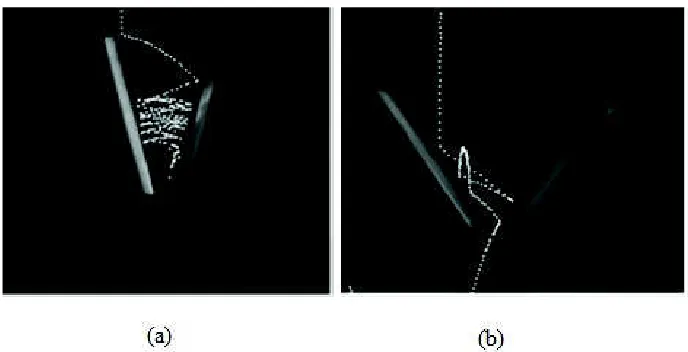
1.2 Experimentally observed particle trajectories for funnels with (a) θ = 60◦ and (b) θ= 40◦. . . 6
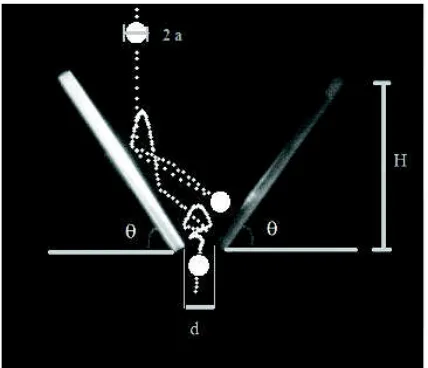
1.3 An image from my experiment showing the system that is used in this thesis for our study of a particle falling through a funnel. H is the height from the bottom of the funnel, ais the radius of the ball, dthe gap at the bottom of the funnel, and θ is the angle of funnel’s walls with the horizontal. . . 8
2.1 Photograph of the experiment used to measure the coefficient of resti-tution. . . 12
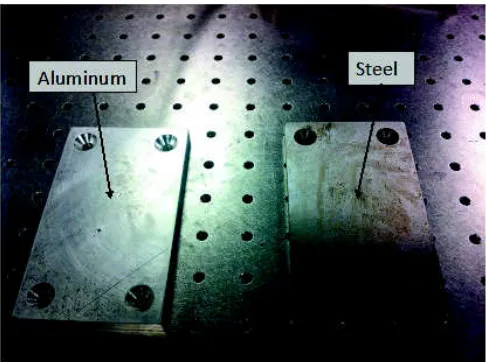
2.2 Schematic of the device used in the coefficient of restitution experiment. 14 2.3 Materials used in restitution coefficient experiment. . . 14
2.4 Photograph of the funnel experiments. . . 16
3.1 Trajectory of an aluminum ball bouncing on the steel plate. . . 19
3.2 Balls used in the restitution coefficient and funnel experiments. . . 20
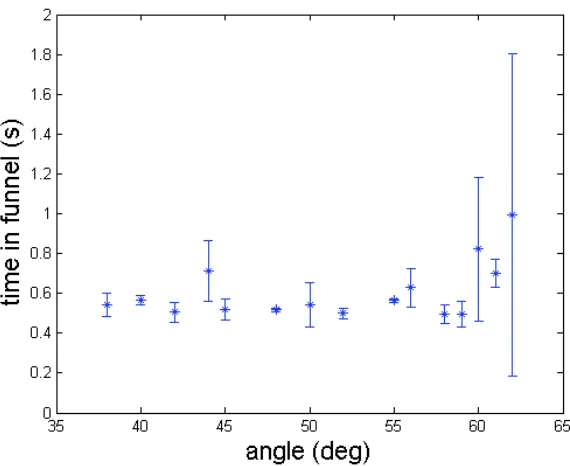
3.3 Time in funnel vs. funnel angle for the ceramic ball and aluminum funnel, restitution coefficient = 0.79±0.10. . . 20
3.4 Simulation results for nondimensionalized time in funnel vs. funnel angle for the ceramic ball and aluminum funnel, restitution coefficient = 0.79±0.10. . . 24
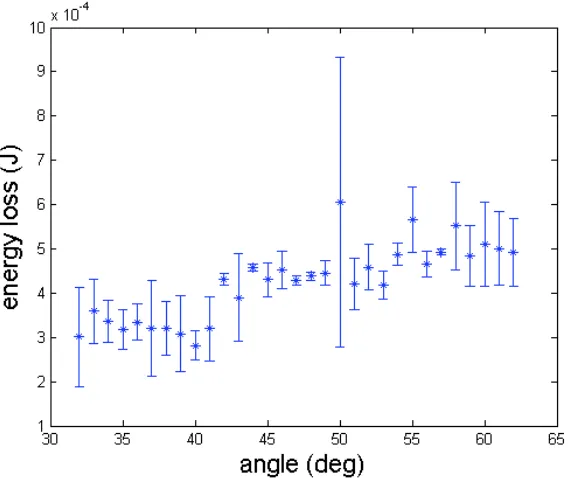
3.5 Energy loss vs. funnel angle for the ceramic ball and aluminum funnel, restitution coefficient = 0.79±0.1 . . . 24
3.6 Time in funnel vs. funnel angle for the Plexiglas ball and steel funnel, restitution coefficient = 0.93±0.01. . . 25
3.7 Simulation results for nondimensionalized time in funnel vs. funnel angle for the Plexiglas ball and steel funnel, restitution coefficient = 0.93±0.01. . . 25
3.8 Energy loss vs. funnel angle for the Plexiglas ball and steel funnel, restitution coefficient = 0.93±0.01. . . 26
3.9 Time in funnel vs. funnel angle for the aluminum ball and steel funnel, restitution coefficient = 0.87±0.05. . . 26
List of Figures
3.10 Simulation results for nondimensionalized time in funnel vs. funnel angle for the aluminum ball and steel funnel, restitution coefficient = 0.87±0.05. . . 27 3.11 Energy loss vs. funnel angle for the aluminum ball and steel funnel,
restitution coefficient = 0.87±0.05. . . 27 3.12 The trajectory of a ball falling through the funnel measured in six
experiments. (a) Plexiglas ball and steel funnel, e = 0.93±0.01, θ = 60◦. (b) aluminum ball and steel funnel, e = 0.87±0.05, θ = 60◦. (c) ceramic ball and aluminum funnel, e = 0.79±0.1, θ = 60◦. (d) Plexiglas ball and steel funnel, e = 0.93±0.01,θ = 40◦.(e) aluminum ball and steel funnel, e = 0.87±0.05, θ = 40◦.(f) ceramic ball and aluminum funnel, e= 0.790.1, θ = 40◦. . . 28 3.13 Time spent in funnel vs. the initial release location of the ball for the
Plexiglas ball and the steel funnel. (a)θ = 40◦; (b)θ= 50◦; (c) θ= 60◦. 29 3.14 Time spent in funnel vs. the initial release location of the ball for the
aluminum ball and the steel funnel. (a)θ= 40◦; (b)θ = 50◦; (c)θ= 60◦. 30
B.1 Individual high-speed video images Some images by Matlab for bounc-ing aluminum ball on steel flat plate. . . 55 B.2 The trajectory of the bouncing aluminum ball on the steel plate. . . . 55 B.3 Some individual images of the ceramic ball falling through the
alu-minum funnel. . . 56 B.4 The trajectory of the ceramic ball falling through the aluminum funnel
determined by the Matlab program. . . 56
1
Chapter 1
Introduction
The research reported in this thesis involved studying the dynamics of a single
par-ticle falling through a symmetric funnel under gravity. In this Chapter I introduce
granular materials, review some previous work in areas related to my thesis topic,
and briefly outline my work and the organization of this thesis.
1.1
Granular materials
Granular materials are made up of large numbers of distinct solid particles.
Physi-cists and engineers are interested in understanding the behavior of granular materials
for many reasons. First of all, matter is typically classified as solid, liquid, or gas,
but granular materials are different from all of these and have unique behavior and properties. Sometimes they behave like liquids, as dry sand takes the shape of a
container it is poured into [1]. Although equations that describe the behavior of
tra-ditional solids, liquids and gases are well known, granular materials do not generally
obey these equations and there is no general mathematical description of granular
materials.
Second, granular materials are of great importance and are widely found in our daily life. They were also important in the ancient world and play an important role
in many industries. For example, granular materials are used extensively in farming,
mining, the construction of houses and roads, food products, pharmaceuticals, and
Chapter 1: Introduction 2
In nearly all applications, contact interactions between particles or between
particles and boundaries are important in determining how the granular materials
behave. Moreover, granular materials often flow through chutes and hoppers but our
understanding of their behavior in these situations is limited [4]. For instance, some
factories use devices to store and transport granular materials that depend on the flow of particles through funnels to direct particles to a desired location, or to control their
speed and flow rate. Understanding the physics of granular flows will help to increase
productivity and maintain the quality and effectiveness of their machines. According
to Ref. [3], many factories that transport and sort granular materials waste 60% of
their power. This is a result of our poor understanding of the behavior of granular
materials. As a result, any improvement in our understanding of how these materials
Chapter 1: Introduction 3
1.2
Previous work
In recent years there has been a great deal of interest in the behaviour of granular
flow through funnels and many groups of scientists have obtained significant results
on this and related subjects.
Early work to examine the properties of glass beads flowing in a two dimensional
funnel was done by Le Pennec and co-workers [5] who found a direct link between the flow characteristics and the geometry of the funnel. The behavior of a spherical
particle bouncing inelastically on a vertically vibrating flat surface has been studied
by Mehta and Luck. They found that the particle behaved in a complicated way,
and that the dynamics of the system were difficult to predict [6, 7]. McNamara and
Young discovered that an infinite number of collisions could occur in a finite time in
a system of a finite number of falling particles [8]. Wylie and co-workers studied the
behavior of a one–dimensional system of inelastic particles of different masses flowing through a funnel. They observed that the inelastic particles move in one orbit as a
result of the breakdown a large number of complicated periodic orbits [9, 10]. Gao
and co-workers studied a spherical, inelastic, frictionless particle bouncing in a corner
and found that the particle will either leave the system after making a limited number
of collisions or undergo an unlimited number of collisions in certain time [11].
More recently, there has been a number of studies on the effect of friction on the behavior of granular materials falling through a funnel, such as that by Fang et al. [9],
who showed that the time that the particle spent in the funnel did not decrease
mono-tonically as the angle of the funnel’s walls increased. Spheres in a two-dimensional
vibrating box were modeled by Luding. He found that the behavior of the system
de-pended on the friction of both particles and walls [12]. Brilliantov et al. introduced a
model for collisions in a granular material based on dissipative viscoelastic collisions.
They used the impact velocity to calculate the restitution coefficients for normal and tangential motion. They found there is a direct link between the kind of collision and
Chapter 1: Introduction 4
measured the attributes of collisions between small spheres or between small spheres
and a flat plate. Their results showed that a collision model that included friction,
normal restitution, and tangential restitution explained the observed impact behavior
over a large range of incident angles [14].
1.2.1
The work of Wylie and co-workers
Fang et al. [15] performed simulations of a simple system consisting of a single,
inelas-tic, and frictionless particle falling through a symmetric funnel under gravity. They
noted that for certain funnel wall angles, the particle spent more time in the funnel and lost more energy than expected. These phenomena were more pronounced when
the coefficient of restitution of the system was large than when it was small. Figure
1.1 shows the average time spent by the particle in the funnel as a function of the
angle of funnel walls with the horizontal for a restitution coefficient equal to 0.99.
These data where calculated using a simulation code provided to us by Dr. J. Wylie.
While the time spent by the particle in the funnel generally decreases as the angle
increases, there are several peaks in the plot, including a large peak around an angle of 50◦. The simulations of Fang et al. indicated that in these peaks, the particle bounces back and forth between the walls in a simple repeating pattern. This leads
the particle to spend a long time in the funnel. In contrast, away from these peaks
the particle’s trajectory is much more random. Fang et al. also observed that the
sequence of collisions the ball makes with the funnel walls is highly sensitive to the
initial position of the falling ball and to the wall angle. At small angles, the collision
sequence is quite random for all initial positions on the funnel walls, both near to the
centre of the funnel and far from it. At large angles, however, the particle follows a more uniform pattern, especially for initial positions near to the centre of the funnel.
This is illustrated in Figure 1.2, which shows some experimental results that will be
discussed in more detail in Chapter 3. Their theoretical analysis showed that these
phenomena are a result of the existence of neutrally stable quasiperiodic orbits at
Chapter 1: Introduction 5
Zhang et al. [4] incorporated friction into these simulations. This is physically
close to the system that we studied experimentally. In their simulations, the system
showed phenomena quite similar to those observed without friction. However, the
frictional system showed the anomalous behaviour at all funnel angles steeper than 45◦ rather than just the small ranges of angles in the frictionless system. Although friction causes the particle to rotate and the dynamics of the particle’s collisions
become more complicated, the particle trajectory at large angles shows a relatively
simple repeating pattern of collisions as in Fig 1.2(a), while at small angles it
Chapter 1: Introduction 6
Figure 1.1: Simulation results showing the nondimensionalized average time spent in the funnel as a function of funnel angle for a system with restitution coefficient e= 0.99. Simulations were performed using a Matlab program provided by Prof. J.
Wylie.
Chapter 1: Introduction 7
1.3
Outline of this work
For this research, I built a system to study experimentally the behavior of a single
particle falling under gravity through a symmetric funnel as in Figure 1.3. In order
to choose appropriate materials to use for the funnel walls and the ball, I also carried
out an experiment to measure the coefficient of restitution of a variety of different
material combinations. Using funnels made from the chosen materials, I recorded
the trajectory of the balls as they fell through the funnel using a high speed camera. Matlab programs were written to analyze the data obtained from these experiments.
Finally, I compared my results with the theoretical results of Refs. [4, 15]. Our
re-sults are in partial agreement with the theoretical rere-sults of Zhang et al. that were
reported in Ref. [4].
The remaining chapters of the thesis are as follows: In Chapter 2 I describe
the apparatus and the experiments performed. In Chapter 3 I present our results. In addition, I will compare our observations and results with the theoretical results.
Chapter 1: Introduction 8
Figure 1.3: An image from my experiment showing the system that is used in this thesis for our study of a particle falling through a funnel. H is the height from the bottom of the funnel, ais the radius of the ball, d the gap at the bottom of the
9
Chapter 2
Experimental Apparatus and Procedure
As part of the work carried out for this thesis an experimental apparatus for studying
the behavior of a particle falling through a symmetric funnel was designed. In this chapter, we describe our apparatus and discuss the experimental procedures.
2.1
Restitution experiment
An experiment was carried out to measure the restitution coefficient e for various combinations of balls and plates. The restitution coefficient is the ratio of the speed
after a collision to the speed before the collision. Its value is between 0 and 1. e= 0
means the collision is perfectly inelastic ande= 1 means it is perfectly elastic. 1−e2 is the fraction of kinetic energy that remains after a collision between two objects.
The restitution coefficient is an important parameter in our funnel experiments
be-cause the particle loses energy as it falls through the funnel as a result of inelastic
collisions. Ifeis small, the anomalous behavior reported in Ref. [4] is less pronounced, while it is more pronounced for large values.
The apparatus used to measure the restitution coefficient is shown in Figure
2.1; the schematic diagram in Fig 2.2 illustrates the setup of the device. The ball is
dropped from a holder onto a metal plate. The holder has a mechanism to control the
ball’s release. Two plates were used for this experiment, one made from aluminium
and the other from steel. The size of the plates was 12.1 cm x 7.6 cm. The plates are fixed on an optical table by four screws at their corners as seen in Figure 2.3. A high
Chapter 2: Experimental Apparatus and Procedure 10
the particle as it bounces on the plate. A MiDAS Motion Trigger device is used to
trigger the camera when the ball bounces on the plate. The camera is connected to a
computer which is used to save and analyze the data, and to calculate the restitution
coefficient. Two 500 watt halogen lights are used to illuminate the funnel and the
ball to make them clearly visible in the recorded images.
At the beginning of the experiment, the ball was dropped from a height H
onto the flat plate. The ball is released from the holder with zero initial velocity
and without applying any force other than gravity by moving a small metal tab that
holds the ball in place. The ball bounces several times on the plate before stopping.
The high speed camera records the position of the bouncing ball. The highest height
recorded by the ball after the first collision is h. A matlab program was used to determine h and to calculate the restitution coefficient as follows. The restitution
coefficient is
e= vf
vi
, (2.1)
whereviandvf are the velocity of the ball before and after it hits the plate. Since the
ball is released from rest, its velocity when it hits the plate is given by conservation
of energy as
vi=p2gH, (2.2)
wheregis the acceleration due to gravity. The ball bounces off the plate with velocity
vf =evi (2.3)
and rises to a height h. Applying conservation of energy after the collision gives
Chapter 2: Experimental Apparatus and Procedure 11
so
e= vf
vi =
r
h
Chapter 2: Experimental Apparatus and Procedure 12
Chapter 2: Experimental Apparatus and Procedure 13
2.2
Funnel system
The system used for the funnel experiment reported here consists of a ball holder, the
funnel itself, a high speed camera, and a computer. The ball was released with zero
initial velocity from a height H above the bottom of the funnel and at a horizontal
location x0 measured from the central axis of the funnel (see Figure 1.3). The
com-ponents of the apparatus are shown in Figure 2.4, which is a photograph of the actual
experimental system. The apparatus mainly consisted of a ball holder which has at its top end a mechanism that controls the ball’s release. The release mechanism was
operated by pulling a thread that moved a metal key, allowing the ball to fall out of
the ball holder. The holder was mounted on a post 40 cm tall. It was also fixed on
a plate that could be moved by adjusting a micrometer screw to adjust the particle’s
starting position. Two different funnels were used for this experiment, one made from
aluminium and the other from steel. The size of the funnel plates was 15.1 cm x 5.3
cm. They are attached by hinges to a pair of horizontal plates as shown in Figure 2.4. The angle of the funnel walls could be adjusted, and was measured with a protractor
with 1.0◦ accuracy. One of funnel walls was fixed on a plate that could be moved by micrometer to adjust the gapdat the bottom of the funnel. The gapdwas measured
using Vernier calipers with 0.02 mm accuracy. A high speed camera was used to
record the position of the particle from the time it enters to the time it leaves the
funnel. The camera is triggered by a MiDAS Motion Trigger when the ball enters the
funnel. The recorded images and the time at which they were taken were sent to the computer for analysis using a Matlab program which is included in Appendix A. The
Matlab program tracked the position of the ball and then calculated its velocity in
each video frame. It then calculated the energy loss at each collision with the funnel
walls, the total energy lost in the funnel, and the time spent in the funnel. Two 500
watt halogen lights illuminate the funnel and the ball to make them clearly visible in
Chapter 2: Experimental Apparatus and Procedure 14
Figure 2.2: Schematic of the device used in the coefficient of restitution experiment.
Chapter 2: Experimental Apparatus and Procedure 15
2.3
Data analysis
In order to calculate the total energy that is lost by the sphere, the Matlab code
determined the total energy
E =P +K, (2.6)
E=mgh+ 1
2mv
2, (2.7)
where P is the potential energy, K is the kinetic energy, m is the mass of the
par-ticle in kg, g is gravitational acceleration in m.s−2, h is the particle height above the bottom of the funnel, and v is the particle’s velocity in m/s. E, h, v vary with
time while the particle is in the funnel. We calculated the total energy of the ball
when it enters and leaves the funnel using Eq. (2.7) and subtracted these quantities
to get the energy loss. The trajectory of the sphere is determined by the sequence
of collisions it has against the walls, with free-fall motion under gravity between the collisions. We studied the dependence of these quantities on the wall angle θ, e, and
Chapter 2: Experimental Apparatus and Procedure 16
17
Chapter 3
Results
3.1
Restitution Coefficient Experiment
The restitution coefficient of several materials was investigated by measuring the
height to which a ball bounced after colliding with plates of different metals. The
restitution coefficient experiment was performed to aid in selecting materials to use
for the funnel experiments. In particular, we wanted to find a system with a high coefficient of restitution in order to make the effects predicted in Ref. [4] more visible.
Figure 3.1 shows an example trajectory followed by an aluminum ball bouncing
on a steel plate. These data are used to calculate the restitution coefficient as outlined
in section 2.2. The results presented here were obtained using ceramic, aluminium
and Plexiglas balls on steel and aluminium plates. Figure 3.2 shows the balls used,
and Table 3.1 gives their mass and radius. Table 3.2 shows the measured values of the
restitution coefficient e for all six ball and plate combinations. These measurements are the average over 30 measurements for each combination and the uncertainties are
found by using the standard deviation of these values. From Table 3.2, we see that the
Plexiglas ball has the highest restitution coefficient with both metal plates. Although
the combination of Plexiglas ball and aluminium plate had a slightly higher
restitu-tion coefficient, we chose to use the combinarestitu-tion of Plexiglas ball and steel plate for
our funnel experiment because we found the phenomena predicted in Ref. [4] were
Chapter 3: Results 18
3.2
Funnel Experiment
In our experiment, measurements were done on several ball / plate combinations: a
ceramic ball with an aluminum funnel, Plexiglas ball with a steel funnel, and an alu-minum ball with a steel funnel. We studied the time the particle spent in the funnel
and its energy loss as functions of the angle of the funnel walls and the restitution
coefficient of the system.
Figure 3.3 shows the relationship between the angle of the funnel walls and
time the particle spends in the funnel for a ceramic ball bouncing in an aluminum
funnel. For this system, the restitution coefficient is 0.79±0.10. If we ignore the error bars, the average time spent in the funnel initially decreases as the angle of the funnel walls increases. At an angle of approximately 45◦ the time starts to increase again. Experiments were performed for a total of nine different initial positions of
the ball. The holder was positioned at three different positions along the x–axis using
a micrometer screw. At each x–position, the holder was placed at three different
y-positions by using another micrometer screw. The height from which the ball was
released was the same in all cases. The error bars in Figure 3.3 are standard
devia-tions and show how much variation exists in the experimental values. Some of error bars are quite large, suggesting that the time is very sensitive to small uncontrollable
changes of the initial conditions. In order to compare these results with the
theo-retical predictions, we used our values for the restitution coefficient and ball radius
in the simulation software provided to us by Dr. Wylie. The results are shown in
Figure 3.4. At small angles, the average time spent in the funnel decreases as the
angle increases, but the simulation show no increase at higher angles. In this case,
the theoretical and experimental results are similar at small angles but different at large angles. This difference may in part be due to the fact that the simulations were
Chapter 3: Results 19
Table 3.1: Ball Measurements.
.
Mass Radius
(g) (cm)
Ceramic Ball 4.15±0.10 0.90±0.02 Plexiglas Ball 1.26±0.10 0.70±0.02 Aluminum Ball 3.02±0.10 0.60±0.02
Table 3.2: Restitution Coefficients for different combinations of balls and plates.
.
Ceramic Ball Plexiglas Ball Aluminum Ball Aluminum Plate 0.79±0.10 0.94±0.04 0.85±0.06
Steel Plate 0.79±0.08 0.93±0.01 0.87±0.05
Chapter 3: Results 20
Figure 3.2: Balls used in the restitution coefficient and funnel experiments.
Chapter 3: Results 21
Figure 3.5 shows the average energy lost by the ball falling through funnel for
the same materials. The energy lost by the particle in this system is fairly constant at
low funnel angles, but starts to increase around 40◦. This is similar to the theoretical results of Ref. [4]. Again, error bars in Figure 3.5 are the standard deviations. The
error bars reflected the amount of variation in the results at each angle.
Figure 3.6 displays the average time spent in the system for the Plexiglas ball
and steel funnel with e = 0.93±0.01. These data are averaged over a total of nine different initial positions of the ball. The holder was positioned at three different
po-sitions along the x–axis using a micrometer screw. At each x–position, the holder was
placed at three different y–positions by using another micrometer screw. The time is
fairly constant as the funnel angle is varied at small angles, but shows a small peak approximately at 45◦ and an increase starting around 60◦. As before, the large error bars reflect a sensitivity to initial conditions. Figure 3.7 shows the theoretical result
obtained when we use our experimental parameters in Wylie’s simulation program.
At small angles the average time spent in the funnel decreases as the angle increases.
There is a peak between 45◦ and 50◦, then further decrease; there are smaller peaks at higher angles. In this case, the experimental results are quite different from the
theoretical results at small angles. The theoretical results start increasing around 45◦ while our experimental results have an increase starting around 60◦. These difference may again reflect the fact that the simulation was done for a frictionless system while
our experiment was done on a system with friction.
In this case, despite the fact thate was large, we observed much less variation
in the time then in the previous case, for which e was smaller. This contradicts the
theoretical results of Ref. [4] which predicted that the anomalous behavior should be more pronounced for a higher restitution coefficient.
Figure 3.8 shows the energy lost by the Plexiglas ball falling through the steel
funnel. The data at each angle are averaged over nine different initial positions of
Chapter 3: Results 22
behavior is seen in the theoretical results for a similar restitution coefficient in Ref. [4]
The results for the aluminum ball and the steel funnel, with restitution
coeffi-cient e= 0.87±0.05, are shown in Figures 3.9–3.11. As displayed in Figure 3.9, the average duration of the aluminum ball during the steel funnel is fairly constant with increasing angle of the funnel walls, but shows a sharp increase around 59◦. In order to compare this result with the theoretical result, we use our values of the restitution
coefficient and ball radius in Wylie’s simulation software. The results in Figure 3.10
show that the average time spent in the funnel decreases as the angle increase with a
small peak around an angle of 50◦. In this case, theoretical and experimental results are different. Again, these differences may be because the simulation were done for a
frictionless system while the experiments did have friction.
Figure 3.11 displays the average energy loss of the aluminum ball in the steel
funnel. The energy loss increases as the angle increases. This combination, which
consists of an aluminum ball and steel funnel, and the previous combination, which
consists of a Plexiglas ball and steel funnel, have similar experimental results for time
spent in the funnel and energy lost as a function of funnel walls angle. Although
these two systems have higher restitution coefficients than the ceramic ball and alu-minum funnel, we found they showed less pronounced anomalous behavior than the
system with the smallest restitution coefficient. This disagrees with the theoretical
predictions of Refs. [4, 15].
Figure 3.12 illustrates the experimentally observed trajectories of the balls as
they fall through the funnels. One observes that at large angles for all three systems
the balls bounce back and forth across the funnel many times in a regular pattern. On the other hand, at small angles, the balls bounce much more randomly through
the funnels. The former case leads to an increase in the time spent in the funnel, and
because the number of collisions increases, to a corresponding increase in the energy
Chapter 3: Results 23
Figure 3.13 and Figure 3.14 show the results of experiments performed to show
how the time spent in funnel depended on the starting locationsx0 of the ball, where
x0 is measured from the centre of the funnel. Figure 3.13 shows results for the
Plex-iglas ball and the steel funnel at angles 40◦, 50◦, and 60◦, and Figure 3.14 shows results for the aluminum ball and the steel funnel at similar angles. These figures illustrate how much the duration is sensitive to the starting location. Figure 3.13(a)
and Figure 3.14(a) show that in both systems the duration at an angle of 40◦ is quite scattered, indicating a very high sensitivity to initial location. At this angle, the ball’s
trajectory in quite random, as seen in Fig 3.12(d) and (e). On the other hand, Figure
3.13(c) and Figure 3.14(c) show that at high angles the duration varies smoothly with
initial position. At this angle, the ball’s trajectories follow a more organized pattern
Chapter 3: Results 24
Figure 3.4: Simulation results for nondimensionalized time in funnel vs. funnel angle for the ceramic ball and aluminum funnel, restitution coefficient = 0.79±0.10.
Chapter 3: Results 25
Figure 3.6: Time in funnel vs. funnel angle for the Plexiglas ball and steel funnel, restitution coefficient = 0.93±0.01.
Chapter 3: Results 26
Figure 3.8: Energy loss vs. funnel angle for the Plexiglas ball and steel funnel, restitution coefficient = 0.93±0.01.
Chapter 3: Results 27
Figure 3.10: Simulation results for nondimensionalized time in funnel vs. funnel angle for the aluminum ball and steel funnel, restitution coefficient = 0.87±0.05.
Chapter 3: Results 28
Figure 3.12: The trajectory of a ball falling through the funnel measured in six experiments. (a) Plexiglas ball and steel funnel, e= 0.93±0.01, θ= 60◦. (b) aluminum ball and steel funnel,e= 0.87±0.05, θ= 60◦. (c) ceramic ball and
aluminum funnel, e= 0.79±0.1, θ= 60◦. (d) Plexiglas ball and steel funnel, e= 0.93±0.01,θ= 40◦.(e) aluminum ball and steel funnel,e= 0.87±0.05,
Chapter 3: Results 29
(a)
(b)
(c)
Chapter 3: Results 30
(a)
(b)
(c)
31
Chapter 4
Discussion and Conclusion
4.1
Discussion
The results presented in Chapter 3 will now be discussed and compared with the
theoretical work of Refs. [4, 15]
Some of our experimental results agree well with the theoretical prediction for
a frictionless particle that falls under gravity and bounces through a 2-dimensional
funnel. On the other hand, however, we also found several differences between them.
Theoretically, for a system with e = 1, peaks in the plot of the time spent in the
funnel vs. angle are seen at certain angles at which neutrally stable periodic orbits
were shown to exist. For e < 1, the peaks observed are caused by the existence of
quasi-periodic orbits. Theoretically, peaks are found with simple orbits. For a simple orbit, the locations of the collisions tend to be relatively far from the funnel exit
which makes the particle bounce back and forth in a quasi-periodic orbit for a long
time as the particle moves down towards the exit of the funnel. However, for more
complicated orbits, the locations of the collisions are led to be relatively close to the
funnel exit which allows the particle to leave the funnel after only a short time in
the funnel. When e is small, the particle loses more energy at each collision, and so
leaves the funnel quickly even in simple orbits at highθ. Because of this, the anoma-lous behavior will become less pronounced as the value of the restitution coefficient
decreases [4, 15]. In contrast, our experimental results shown in Figures 3.3, 3.6, and
3.9 show the opposite behavior. The experimental funnel system with the smallest
Chapter 4: Discussion and Conclusion 32
with the larger restitution coefficients. This is a surprising result.
The simulation results show peaks in the time spent in the funnel around
fun-nel angles of 45◦, 60◦ because at these angles, the particle bounces back and forth many times in a coherent sequence of collisions before leaving the funnel. Comparing that with our results we also observed changes around 45◦. While we do not see a peak like that in the simulation, we do see a change in the character of the
trajec-tories, as shown in Figure 3.12, that is similar to that seen in the simulations. For
angles less than 45◦, the particles in our experiments bounced in a complicated and non-repeating pattern, while at angles greater than 45◦, they bounced in a coherent repeating pattern.
The simulation results showed that the time spent in funnel by a frictionless
particle decreases slightly as the angle of the funnel walls increases, and at angles
steeper than 45◦, the decrease continues but with small peaks around some angles. Our results also showed a decrease of the time spent in the funnel as the angle
in-crease. The reasons for that differences would be because the simulations were done
for a frictionless particle while in reality friction exists between any two contacting
surfaces and will have an effect even it is small. Ref. [4] pointed out that friction causes the ball to rotate, leading to a more complicated trajectory, but these
com-plicated orbits become more simple at high angles. Moreover, when the effects of
friction are included, the predicted behavior appeared at all angles steeper than 45◦ rather than around certain angles as for the frictionless particle. Another possible
factor that is the degree of smoothness of the funnel surfaces may contribute to the
differences between experiment and theory. Surface roughness or small craters in the
surface produced by earlier impacts could affect the results. Finally, variations in humidity and temperature of the laboratory where the experiments were performed
could also change the condition of the funnel walls.
Both the theoretical and our experimental results showed that, at small angles,
Chapter 4: Discussion and Conclusion 33
position of particle, while at higher angles, the time is much less sensitive to initial
position. At low angles, the particle bounced between the left and right funnel walls
on complicated and non-repeating trajectories, while at large angles, the particle
Chapter 4: Discussion and Conclusion 34
4.2
Conclusion
The goal of our study was to experimentally investigate behaviour of a single spherical
particle falling through a symmetric funnel. From high-speed video recording of the
trajectory of the sphere, we were able to measure the time that the particle spends
in the funnel, and the energy it loses as a function of the angle of the funnel walls for
different restitution coefficients. This behaviour was simulated by Wylie et al. and
explained theoretically by them. By comparing our results with the theoretical work, we observed that some of our results were similar to those reported in Refs. [4, 15]
while other results were not, and we interpreted our results in terms of the theoretical
predictions.
Theoretically, the anomalous behavior is predicted to be more pronounced for
higher values of the coefficient of restitution. Surprisingly, in our experimental work
these effects are more pronounced for lower values of the coefficient of restitution. Compared with the theoretical work, our experiment shows some phenomena similar
to those reported in Refs. [4, 15]. In particular, the increase in time spent in the
funnel observed above 45◦ for the ceramic ball in the aluminum funnel is consistent with the simulations discussed in Refs. [4, 15]. It is likely that this behaviour is due
to the fact that the particles bounce back and forth across the funnel many times at
steep angles, as seen in Figure 3.11 and in agreement with the theoretical work.
The time spent in the funnel for particles in all systems are highly sensitive to
the starting position of the falling particle on the funnel walls. At steep angles of the
funnel walls, the trajectory of the particle is more regular than that for small angles,
where it is quite random. The trajectories of the falling particle at angles steeper
Chapter 4: Discussion and Conclusion 35
4.3
Future work
Our experimental results provide support and confirmation for some of the simulation
results for the behavior of a single particle falling through a symmetric funnel under
gravity. On the other hand, some of our results disagree with the theoretical results.
There is a number of questions related to our results that could be addressed in future
work.
-We found the results to change when the surface condition of the ball or funnel
walls changed. It would be useful to study and understand the behavior of a particle
in a symmetric funnel for different controlled surface conditions. .
-It would be useful to investigate several different ball and funnel materials with
different restitution coefficients using the same technique that we used.
-We found some of our results agree with the theoretical work while others
disagree. These effects are complex and cannot be fully understood from our
ex-periment. It would be interesting to investigate these phenomena further by using
a larger funnel in a fully computer-controlled experiment, in which the computer is
36
References
[1] Ming Gao, Jonathan J. Wylie and Qiang Zhang, American Institute of
Mathe-matical Sciences, 8(1), 275293 (2009).
[2] Troy Shinbrot and Fernando J. Muzzio, Phys. Today, 53(3), 25 (2000).
[3] Heinrich M. Jaeger, Sidney R. Nagel, and Behringer. “The
Physics of Granular Materials”. Physics Today, 32 (1996)
http://jfi.uchicago.edu/granular/introduction.html.
[4] Qiang Zhang, Yuan Fang, and Jonathan J. Wylie, Phys. Rev. E 83, 051303 (2011).
[5] T. Le Pennec, M. Ammi, J. C. Messager, and A. Valance, Eur. Phys. J. B 7, 657
(1999).
[6] A. Mehta and J. M. Luck, Phys. Rev. Lett. 65, 393 (1990).
[7] J. M. Luck and A. Mehta, Phys. Rev. E 48, 3988 (1993).
[8] S. McNamara and W. R. Young, Phys. Fluids A 4, 496 (1992).
[9] J. J. Wylie and Q. Zhang, Phys. Rev. E 74, 011305 (2006).
[10] R. Yang and J. J. Wylie, Phys. Rev. E 82, 011302 (2010).
[11] M. Gao, J. J.Wylie, and Q. Zhang, Commun. Pure Appl. Anal. 8, 275(2009).
[12] S. Luding, Phys. Rev. E 52, 4442 (1995).
[13] N. V. Brilliantov, F. Spahn, J. M. Hertzsch, and T. Poschel, Phys. Rev. E 53,
5382 (1996).
[14] S. F. Foerster, M. Y. Louge, H. Chang, and Kh. Allia, Phys. Fluids 6, 1108
Appendix : Discussion and Conclusion 37
[15] Yuan Fang, Ming Gao, Jonathan J. Wylie, and Qiang Zhang, Phys. Rev. E 77,
38
Appendix A
The Matlab Code
A.1: The Matlab code used to calculate the time spent in the funnel and the energy loss for the particle
c l e a r a l l ,
c l c
c c=hsv( 3 ) ; % c o l o r scheme
d e g r e e l i s t=F o l d L i s t ; % e x t r a c t t h e l i s t o f d e g r e e f o l d e r s
a n g l e s=d e g r e e l i s t ( : , 1 : 2 ) ; % e x t r a c t t h e a n g l e s ( u s u a l l y , 20 t o 62)
%f p r i n t f ( ’%d d e g r e e f o l d e r s found\n ’ , s i z e ( d e g r e e l i s t , 1 ) ) ;
% i n i t i a l i z e t h e m a t r i x t o s t o r e t h e a v e r a g e d v a l u e s
a v e r a g e t i m e s=zeros(s i z e( d e g r e e l i s t , 1 ) , 3 ) ;
e r r o r t i m e s=zeros(s i z e( d e g r e e l i s t , 1 ) , 3 ) ;
a v e r a g e h i t s=zeros(s i z e( d e g r e e l i s t , 1 ) , 3 ) ;
e r r o r h i t s=zeros(s i z e( d e g r e e l i s t , 1 ) , 3 ) ;
a v e r a g e e n e r g i e s=zeros(s i z e( d e g r e e l i s t , 1 ) , 3 ) ;
e r r o r e n e r g i e s=zeros(s i z e( d e g r e e l i s t , 1 ) , 3 ) ;
f i g u r e( 3 )
f o r degree num =1:s i z e( d e g r e e l i s t , 1 )
d e g r e e f o l d e r=d e g r e e l i s t ( degree num , : ) ;
cd( d e g r e e f o l d e r ) ;
disp( [ ’ c u r r e n t f o l d e r : ’ d e g r e e f o l d e r ’ , c u r r e n t a n g l e : ’ ,
a n g l e s ( degree num , : ) ] ) ;
p o s i t l i s t =F o l d L i s t ; % e x t r a c t t h e l i s t o f p o s i t i o n f o l d e r s
Appendix A: The Matlab Code 39
( u s u a l l y , 1 t o 3 )
%f p r i n t f ( ’%d p o s i t i o n f o l d e r s found\n ’ , s i z e ( p o s i t l i s t , 1 ) ) ;
subplot(c e i l(sqrt(s i z e( d e g r e e l i s t , 1 ) ) ) ,
c e i l(sqrt(s i z e( d e g r e e l i s t , 1 ) ) ) , degree num ) ;
hold on ;
f o r posit num =1:s i z e( p o s i t l i s t , 1 )
p o s i t i o n f o l d e r= p o s i t l i s t ( posit num , : ) ;
cd( p o s i t i o n f o l d e r ) ;
disp( [ ’ c u r r e n t f o l d e r : ’ d e g r e e f o l d e r ’\’ p o s i t i o n f o l d e r ’ ,
c u r r e n t p o s i t i o n : ’ , p o s i t i o n s ( posit num , : ) ] ) ;
e x p e r i m e n t l i s t=F o l d L i s t ; % e x t r a c t t h e l i s t o f e x p e r i m e n t f o l d e r s
e x p e r i m e n t s=e x p e r i m e n t l i s t ( : , 2 :end) ; % e x t r a c t t h e e x p e r i m e n t
numbers ( u s u a l l y , 1 t o 1 0 )
%f p r i n t f ( ’%d e x p e r i m e n t f o l d e r s found\n ’ , s i z e ( e x p e r i m e n t l i s t , 1 ) ) ;
% i n i t i a l i z e t h e v e c t o r s used f o r a v e r a g i n g
T o t a l t i m e i n f u n n e l=zeros(s i z e( e x p e r i m e n t l i s t , 1 ) , 1 ) ;
T o t a l n u m b e r o f h i t s=zeros(s i z e( e x p e r i m e n t l i s t , 1 ) , 1 ) ;
T o t a l e n e r g y l o s t=zeros(s i z e( e x p e r i m e n t l i s t , 1 ) , 1 ) ;
f o r exp num =1:s i z e( e x p e r i m e n t l i s t , 1 )
e x p e r i m e n t f o l d e r=e x p e r i m e n t l i s t ( exp num , : ) ;
cd( e x p e r i m e n t f o l d e r ) ;
disp( [ ’ c u r r e n t f o l d e r : ’ d e g r e e f o l d e r ’\’ p o s i t i o n f o l d e r
’\’ e x p e r i m e n t f o l d e r ’ , c u r r e n t e x p e r i m e n t :
’ , e x p e r i m e n t s ( exp num , : ) ] ) ;
b m p F i l e s = d i r( ’∗. bmp ’ ) ;
[ T o t a l t i m e i n f u n n e l ( exp num ) , T o t a l n u m b e r o f h i t s ( exp num ) ,
T o t a l e n e r g y l o s t ( exp num ) ] = RunExp ( b m p F i l e s ) ;
cd . . ; % go b a c k t o e x p e r i m e n t f o l d e r s
end
plot( T o t a l t i m e i n f u n n e l , ’ c o l o r ’ , c c ( posit num , : ) , ’ LineWidth ’ , 2 ) ;
legend( s t r c a t ( ’ p o s i t i o n ’ ,num2str( p o s i t i o n s ) ) ) ;
x l ab el( ’ e x p e r i m e n t #’ ) ;
Appendix A: The Matlab Code 40
%c a l c u l a t e t h e c u r r e n t s e t d a t a
a v e r a g e t i m e s ( degree num , posit num )=sum( T o t a l t i m e i n f u n n e l )
/s i z e( T o t a l t i m e i n f u n n e l , 1 ) ;
e r r o r t i m e s ( degree num , posit num )=std( T o t a l t i m e i n f u n n e l ) ;
a v e r a g e h i t s ( degree num , posit num )=sum( T o t a l n u m b e r o f h i t s )
/s i z e( T o t a l n u m b e r o f h i t s , 1 ) ;
e r r o r h i t s ( degree num , posit num )=std( T o t a l n u m b e r o f h i t s ) ;
a v e r a g e e n e r g i e s ( degree num , posit num )=sum( T o t a l e n e r g y l o s t )
/s i z e( T o t a l e n e r g y l o s t , 1 ) ;
e r r o r e n e r g i e s ( degree num , posit num )=std( T o t a l e n e r g y l o s t ) ;
%f p r i n t f ( ’%d e x p e r i m e n t ( s ) :\n a v e r a g e time i n f u n n e l : %d\n a v e r a g e
number o f h i t s : %d\n a v e r a g e e n e r g y l o s t : %d\n ’ , exp num ,
a v e r a g e t i m e s ( degree num , posit num ) , a v e r a g e h i t s
( degree num , posit num ) , a v e r a g e e n e r g i e s ( degree num , posit num ) ) ;
cd . . ; % go b a c k t o p o s i t i o n f o l d e r s
end
hold o f f ;
cd . . ; % go b a c k t o d e g r e e f o l d e r s
end
a n g l e s=str2num( a n g l e s ) ; % c o n v e r t b e f o r e p l o t t i n g
f i g u r e( 4 )
hold on ;
f o r plot num =1:s i z e( a v e r a g e t i m e s , 2 )
%p l o t ( a n g l e s , a v e r a g e t i m e s ( : , p l o t n u m ) , ’ c o l o r ’ , cc ( plot num , : ) ) ;
errorbar( a n g l e s , a v e r a g e t i m e s ( : , plot num ) , e r r o r t i m e s ( : , plot num ) ,
’ c o l o r ’ , c c ( plot num , : ) , ’ LineWidth ’ , 2 ) ;
end
hold o f f ;
t i t l e( ’ Average t i m e s i n a f u n n e l ’ ) ;
Appendix A: The Matlab Code 41
y l ab el( ’ a v e r a g e time , s ’ ) ;
legend( ’ p o s i t i o n 1 ’ , ’ p o s i t i o n 2 ’ , ’ p o s i t i o n 3 ’ , ’ p o s i t i o n 4 ’ , ’ p o s i t i o n 5 ’ ) ;
f i g u r e( 5 )
hold on ;
f o r plot num =1:s i z e( a v e r a g e h i t s , 2 )
errorbar( a n g l e s , a v e r a g e h i t s ( : , plot num ) , e r r o r h i t s ( : , plot num ) ,
’ c o l o r ’ , c c ( plot num , : ) , ’ LineWidth ’ , 2 ) ;
end
hold o f f ;
t i t l e( ’ Average h i t s ’ ) ;
x l ab el( ’ a n g l e , deg ’ ) ;
y l ab el( ’ a v e r a g e h i t s ’ ) ;
legend( ’ p o s i t i o n 1 ’ , ’ p o s i t i o n 2 ’ , ’ p o s i t i o n 3 ’ , ’ p o s i t i o n 4 ’ , ’ p o s i t i o n 5 ’ ) ;
f i g u r e( 6 )
hold on ;
f o r plot num =1:s i z e( a v e r a g e e n e r g i e s , 2 )
errorbar( a n g l e s , a v e r a g e e n e r g i e s ( : , plot num ) , e r r o r e n e r g i e s ( : , plot num ) ,
’ c o l o r ’ , c c ( plot num , : ) , ’ LineWidth ’ , 2 ) ;
end
hold o f f ;
t i t l e( ’ Average e n e r g y l o s t ’ ) ;
x l ab el( ’ a n g l e , deg ’ ) ;
y l ab el( ’ a v e r a g e energy , J ’ ) ;
legend( ’ p o s i t i o n 1 ’ , ’ p o s i t i o n 2 ’ , ’ p o s i t i o n 3 ’ , ’ p o s i t i o n 4 ’ , ’ p o s i t i o n 5 ’ ) ;
%p o s i t i o n s =[1 , 2 , 3 , 4 , 5 ] ; % change t o f i t t h e e x a c t l o c a t i o n s
%f i g u r e ( 7 )
% t i t l e ( ’ Average t i m e s i n a f u n n e l ’ ) ;
%f o r p l o t n u m =1: s i z e ( a v e r a g e t i m e s , 1)
%s u b p l o t ( c e i l ( s q r t ( s i z e ( a v e r a g e t i m e s , 1 ) ) ) ,
Appendix A: The Matlab Code 42
plot( p o s i t i o n s , a v e r a g e t i m e s ( plot num , : ) ,
’ c o l o r ’ , c c ( plot num , : ) , ’ LineWidth ’ , 2 ) ;
% l e g e n d ( s t r c a t ( num2str ( a n g l e s ( p l o t n u m ) ) , ’ d e g r e e ’ ) ) ;
% x l a b e l ( ’ i n i t i a l l o c a t i o n , m’ ) ;
% y l a b e l ( ’ a v e r a g e time , s ’ ) ;
%end
f p r i n t f( ’ Done !\n ’ ) ;
\2 n d s e t{l a n g u a g e=Matlab , numbers= l e f t , c a p t i o n=The Program f o r c a l c u l a t e
t h e a v e r a g e t i m e s s p e n t and t h e a v e r a g e e n e r g i e s l o s s , c a p t i o n p o s=b}
\renewcommand\l s t l i s t i n g n a m e{Program}
function [ T o t a l t i m e i n f u n n e l , T o t a l n u m b e r o f h i t s , T o t a l e n e r g y l o s t ]
= RunExp ( b m p F i l e s )
T o t a l t i m e i n f u n n e l =0;
T o t a l n u m b e r o f h i t s =0;
T o t a l e n e r g y l o s t =0;
i f isempty( b m p F i l e s ) % no . bmp f i l e s i n t h e f o l d e r
f p r i n t f( 2 , ’No . bmp f i l e s i n t h i s f o l d e r !\n ’ ) ;
return
end
j =0;
d o t p o s i t i o n i = [ ] ;
d o t p o s i t i o n j = [ ] ;
f i l e n a m e = b m p F i l e s (round(length( b m p F i l e s ) / 2 ) ) . name ;%p i c k t h e m i d d l e s h o t
I c o l o r = imread ( f i l e n a m e ) ; %I c o l o r i s t h e m i d d l e s h o t
f i l e n a m e = b m p F i l e s ( 1 ) . name ; %p i c k t h e f i r s t s h o t
I 0 = imread ( f i l e n a m e ) ; %I 0 i s t h e f i r s t s h o t
I c o l o r m a p = I c o l o r − I 0 ; %d i f f e r e n c e image
Appendix A: The Matlab Code 43
s e n s i t i v i t y = 0 . 2 5 ;
gauge = dot max − dot max∗s e n s i t i v i t y ;
s e n s i t i v i t y f u n n e l = 0 . 7 ;
g a u g e f u n n e l = dot max − dot max∗s e n s i t i v i t y f u n n e l ;
s e n s i t i v i t y b a l l = 0 . 2 5 ;
g a u g e b a l l = dot max − dot max∗s e n s i t i v i t y b a l l ; %s e t t h e b r i g h t n e s s which
i s c o n s i d e r e d t o be a b a l l
f o r t 1 =1:(s i z e( Icolormap , 1 ) )
f o r t 2 =1:(s i z e( Icolormap , 2 ) )
d i f f = dot max − I c o l o r m a p ( t1 , t 2 ) ;
i f d i f f == 0
row pos = t 1 ; %r o w p o s i s t h e y−c o o r d i n a t e o f t h e b r i g h t e s t s p o t
c o l p o s = t 2 ; %c o l p o s i s t h e x−c o o r d i n a t e o f t h e b r i g h t e s t s p o t
end
end
end
i n d e x b a l l = f i n d( ( I c o l o r m a p ( row pos , : ) )>g a u g e b a l l ) ; %” t h e b a l l ” p o i n t s
a l o n g t h e row pos
r a d i u s b a l l = i n d e x b a l l (s i z e( i n d e x b a l l , 2 ) ) − i n d e x b a l l ( 1 ) ; %t h e w i d t h
o f t h e b a l l
m a s s b a l l = 0 . 0 0 3 0 1 9 ; %Kg
g = 1 0 ; %m/ s ˆ2
% p o s i t i o n o f t h e f u n n e l ==================================================
kk =0;
f o r i n d 0 1 =1:s i z e( I0 , 1 )
kk=kk +1;
I 0 L = [ ] ;
I0 R = [ ] ;
Appendix A: The Matlab Code 44
I 0 R c o l = [ ] ;
I 0 L c o l e n d ( kk ) = 0 ;
I 0 R c o l e n d ( kk ) = 0 ;
I 0 r o w e n d ( kk ) = i n d 0 1 ;
% L e f t h a l f o f t h e f u n n e l ===========
f o r i n d 0 2 = 1 : ( (round(s i z e( I0 , 2 ) ) ) / 2 + 1 )
i f ( I 0 ( ind01 , i n d 0 2 ))>g a u g e f u n n e l
I 0 L =[ I 0 L I 0 ( ind01 , i n d 0 2 ) ] ;
I 0 L c o l = [ I 0 L c o l i n d 0 2 ] ;
I 0 L c o l e n d ( kk ) = I 0 L c o l (s i z e( I 0 L c o l , 2 ) ) ;
end
end
% R i g h t h a l f o f t h e f u n n e l ============================
f o r i n d 0 3 =((round(s i z e( I0 , 2 ) ) ) / 2 + 2 ) : 1 : (round(s i z e( I0 , 2 ) ) )
i f ( I 0 ( ind01 , i n d 0 3 ))>g a u g e f u n n e l
I0 R =[ I0 R I 0 ( ind01 , i n d 0 3 ) ] ;
I 0 R c o l = [ I 0 R c o l i n d 0 3 ] ;
I 0 R c o l e n d ( kk ) = I 0 R c o l (s i z e( I 0 R c o l , 1 ) ) ;
end
end
end
[ f u n n e l c o l i n d e x t o p l e f t , f u n n e l r o w i n d e x t o p l e f t ] = f i n d
( I 0 L c o l e n d ˜=0 , 1 , ’ f i r s t ’ ) ;
[ f u n n e l c o l i n d e x b o t t o m l e f t , f u n n e l r o w i n d e x b o t t o m l e f t ]
= max( I 0 L c o l e n d ) ;
i n d e x = f i n d( I 0 R c o l e n d ˜=0);
Appendix A: The Matlab Code 45
f u n n e l c o l i n d e x t o p r i g h t = I 0 R c o l e n d ( i n d e x ( 1 ) ) ;
[ f u n n e l c o l i n d e x b o t t o m r i g h t , I I ] = min( I 0 R c o l e n d ( i n d e x ) ) ;
f u n n e l r o w i n d e x b o t t o m r i g h t = i n d e x ( I I ) ;
I 0 r o w = s i z e( I0 , 1 ) : (−1 ) : 1 ;
% p o i n t s d e s c r i b i n g t h e f u n n e l −−−−−−−−−−−−−−−−−−−−−−−−−−−−−−−−−−−−−−−−−−−−
y0 L = s i z e( I0 , 1 ) − f u n n e l r o w i n d e x b o t t o m l e f t ;
x0 L = f u n n e l c o l i n d e x b o t t o m l e f t ;
y1 L = s i z e( I0 , 1 ) − f u n n e l r o w i n d e x t o p l e f t ;
x1 L = f u n n e l c o l i n d e x t o p l e f t ;
y0 R = s i z e( I0 , 1 ) − f u n n e l r o w i n d e x b o t t o m r i g h t ;
x0 R = f u n n e l c o l i n d e x b o t t o m r i g h t ;
y1 R = s i z e( I0 , 1 ) − f u n n e l r o w i n d e x t o p r i g h t ;
x1 R = f u n n e l c o l i n d e x t o p r i g h t ;
t e t a L = atan( (abs( y1 L−y0 L ) ) / (abs( x1 L−x0 L ) ) ) ;
t e t a R = atan( (abs( y1 R−y0 R ) ) / (abs( x1 R−x0 R ) ) ) ;
%==========================================================================
s t a r t f r a m e n u m = [ ] ;
end frame num = [ ] ;
%================
c o l l i s i o n L w i n g = 0 ;
c o l l i s i o n R w i n g = 0 ;
%−−−−−−−−−−−−−−−−−−−
f o r k = 2 :length( b m p F i l e s )
f i l e n a m e = b m p F i l e s ( k ) . name ; %s t a r t from t h e second image
I 1 = imread ( f i l e n a m e ) ;
Appendix A: The Matlab Code 46
and t h e f i r s t one
max order = [ ] ;
f o r i n d =1:s i z e( I , 2 )
[m( i n d ) , i n d e x r o w ( i n d )]=max( I ( : , i n d ) ) ; %m( i n d ) s t o r e s t h e
max v a l u e i n t h e ” i n d ” column , i n d e x r o w ( i n d ) s t o r e s i t s row i n d e x
max order =[ max order m( i n d ) ] ; %max order s t o r e s
t h e max v a l u e s o f each column
end
[ maxim , i n d e x c o l ]=max( max order ) ; %maxim s t o r e s t h e
max v a l u e o f t h e whole image, i n d e x c o l s t o r e s i t s column i n d e x ;
%t h a t ’ s where t h e p e a k s s t a r t t o i n t e r c h a n g e
c a u s i n g t h e f a l s e d e t e c t i o n
%s e t u p an i n d e x c o l as a MIDDLE POINT o f t h e b a l l , not t h e BRIGHTEST ONE
t h e b a l l = f i n d( ( max order)>g a u g e b a l l ) ;
i f ˜isempty( t h e b a l l ) % i f t h e b a l l i s s t i l l somewhere i n t h e p i c t u r e
i n d e x c o l=round( ( t h e b a l l (1)+ t h e b a l l (end) ) / 2 ) ;
end
d o t p o s i ( k ) = i n d e x r o w ( i n d e x c o l ) ;
d o t p o s j ( k ) = i n d e x c o l ;
maximum( k ) = maxim ;
i f maxim > gauge %i f t h e maximum v a l u e ”maxim” i s w i t h i n t h e b a l l
( t h e b r i g h t n e s s i s o v e r 1 5 5 ,
%t h e i n d e x c o l s t a n d s f o r i t s column i n t h e image
%t h e i n d e x r o w s t a n d s f o r i t s row i n t h e image
% time f o r t h e b a l l t o be i n t h e f u n n e l ===============================
i f (s i z e( I ,1)−d o t p o s i ( k))>f u n n e l r o w i n d e x t o p l e f t
s t a r t f r a m e n u m = [ s t a r t f r a m e n u m k ] ;
end
Appendix A: The Matlab Code 47
end frame num = [ end frame num k ] ;
end
%======================================================================
j = j +1;
d o t p o s i t i o n i = [ d o t p o s i t i o n i s i z e( I ,1)−d o t p o s i ( k ) ] ;
d o t p o s i t i o n j = [ d o t p o s i t i o n j d o t p o s j ( k ) ] ;
%−−−−−−−−−−−−−−−−−−−−−−−−−−−−−−−−−−−−−−−−−−−−−−
end
end
%−−−−−−−−−−−−−−−−−−−−−−
I 0 f l i p u d = f l i p u d( I 0 ) ;
%f i g u r e ( 1 )
%p l o t ( d o t p o s i t i o n j , d o t p o s i t i o n i , ’ o−’)
% t i t l e ( ’ P a r t i c l e T r a j e c t o r y i n a Funnel ’ )
%f i g u r e ( 2 )
%imshow ( I 0 f l i p u d )
%h o l d on ;
%p l o t ( d o t p o s i t i o n j , d o t p o s i t i o n i , ’ w . ’ )
% f o r pp = 1 : l e n g t h ( d o t p o s i t i o n j )
% t e x t ( d o t p o s i t i o n j ( pp ) , d o t p o s i t i o n i ( pp ) , s p r i n t f ( ’(% d,%d ) ’ ,
d o t p o s i t i o n j ( pp ) , d o t p o s i t i o n i ( pp ) ) , ’ C o l o r ’ , [ . 6 . 8 . 6 ] )
% end
%s e t ( gca , ’ y d i r ’ , ’ normal ’ )
%a x i s ( [ 0 480 0 4 2 0 ] )
%a x i s ( [ 0 s i z e ( I , 2 ) 0 s i z e ( I , 1 ) ] )
%h o l d o f f ;
%−−−−−−−−−−−−
NFperS = 2 5 0 ;
n u m o f f r a m e s = end frame num ( 1 ) − s t a r t f r a m e n u m ( 1 ) ;
T o t a l t i m e i n f u n n e l = n u m o f f r a m e s∗( 1 / NFperS )∗1 0 ;
%d i s p ( [ ’ T o t a l time i n t h e f u n n e l : ’ num2str ( T o t a l t i m e i n f u n n e l ) ’ [ s e c ] ’ ] )
Appendix A: The Matlab Code 48
Hit L = 0 ; %r e s e t t h e c o u n t e r f o r l e f t−s i d e h i t s
Hit R = 0 ; %r e s e t t h e c o u n t e r f o r r i g h t−s i d e h i t s
W= [ ] ; %s t o r e t h e e n e r g i e s o f each h i t
c o l l i s i o n p o s i t i o n c o l L = [ ] ; %d e c l a r e t h e v e c t o r s t o r i n g columns o f t h e
l e f t−s i d e h i t e l e m e n t s
c o l l i s i o n p o s i t i o n r o w L = [ ] ; %d e c l a r e t h e v e c t o r s t o r i n g rows o f t h e
l e f t−s i d e h i t e l e m e n t s
c o l l i s i o n p o s i t i o n c o l R = [ ] ; %d e c l a r e t h e v e c t o r s t o r i n g columns o f
t h e r i g h t−s i d e h i t e l e m e n t s
c o l l i s i o n p o s i t i o n r o w R = [ ] ; %d e c l a r e t h e v e c t o r s t o r i n g rows o f
t h e r i g h t−s i d e h i t e l e m e n t s
E n e r g y d i f f e r e n c e L = [ ] ; %d e c l a r e t h e l e f t−s i d e e n e r g y d i f f e r e n c e v e c t o r
E n e r g y d i f f e r e n c e R = [ ] ; %d e c l a r e t h e r i g h t−s i d e e n e r g y d i f f e r e n c e v e c t o r
V in R = [ ] ; %d e c l a r e t h e r i g h t−s i d e incoming v e l o c i t i e s v e c t o r
V out R = [ ] ; %d e c l a r e t h e r i g h t−s i d e outcoming v e l o c i t i e s v e c t o r
V in L = [ ] ; %d e c l a r e t h e l e f t−s i d e incoming v e l o c i t i e s v e c t o r
V out L = [ ] ; %d e c l a r e t h e l e f t−s i d e outcoming v e l o c i t i e s v e c t o r
%d o t p o s i t i o n i − v e c t o r o f t h e b a l l ’ s v e r t i c a l c o o r d i n a t e s
%d o t p o s i t i o n j − v e c t o r o f t h e b a l l ’ s h o r i z o n t a l c o o r d i n a t e s
%d i f − v e c t o r o f t h e b a l l ’ s h o r i z o n t a l v e l o c i t i e s
f o r i i =1:(s i z e( d o t p o s i t i o n i ,2)−1)
d i f = [ d i f d o t p o s i t i o n j ( i i +1)−d o t p o s i t i o n j ( i i ) ] ;
end
%f i g u r e ( 3 )
%p l o t ( d i f )
% t i t l e ( ’ P a r t i c l e V e l o c i t y d i r e c t i o n i n a Funnel ’ )
t h r e s h = 1 . 5 ;%d e f i n e t h e t h r e s h o l d f o r t h e change
which i s c o n s i d e r e d a h i t
VERT = 1 ; %s t a r t w i t h v e r t i c a l movement
Appendix A: The Matlab Code 49
% 0 − moving v e r t i c a l l y ,
% +1 − moving t o t h e r i g h t .
d i f =[ d i f d i f (s i z e( d i f , 2 ) ) ] ; % i n c r e a s e t h e l e n g t h o f t h e d i f v e c t o r
f o r j j =2:s i z e( d i f , 2 ) %scan e v e r y l o c a t i o n
i f (abs( d i f ( j j ))<t h r e s h && VERT==1) % s l o w or no s p e e d b e f o r e
t h e f i r s t h i t
MOV( j j )=0; %t h e b a l l moves v e r t i c a l l y
end
i f ( (abs( d i f ( j j ))>= t h r e s h && d i f ( j j ) <0) | | (abs( d i f ( j j ))<t h r e s h
&& VERT==0 && d i f ( j j ) <0)) && ˜ (VERT==0 && d i f ( j j ) <0 && d i f ( j j −1)>=0
&& d i f ( j j +1) >=0) | | (VERT==0 && d i f ( j j ) >=0 && d i f ( j j −1)<0 && d i f ( j j +1) <0)
% s m a l l n e g a t i v e s p e e d a f t e r t h e f i r s t h i t or f a s t n e g a t i v e s p e e d
( e x c l u d i n g t h e one−time d i p s ) :
MOV( j j )=−1; %t h e b a l l moves t o t h e l e f t
VERT=0; %f i r s t h i t has o c c u r e d
end
i f ( (abs( d i f ( j j ))>= t h r e s h && d i f ( j j ) >=0) | | (abs( d i f ( j j ))<t h r e s h
&& VERT==0 && d i f ( j j ) >=0)) && ˜ (VERT==0 && d i f ( j j ) >=0 && d i f ( j j −1)<0
&& d i f ( j j +1) <0) | | (VERT==0 && d i f ( j j ) <0 && d i f ( j j −1)>=0 && d i f ( j j +1) >=0)
% s m a l l p o s i t i v e s p e e d a f t e r t h e f i r s t h i t or f a s t p o s i t i v e s p e e d
( e x c l u d i n g t h e one−time d i p s ) :
%f p r i n t f ( ’ At %d t h e b a l l moves t o t h e r i g h t : %d .\n ’ , j j , d i f ( j j ) ) ;
MOV( j j )=1; %t h e b a l l moves t o t h e r i g h t
VERT=0; %f i r s t h i t has o c c u r e d
end
end
%p r o c e s s t h e MOV so t h a t t h e r e ’ s no d i p s :
f o r mm=2:(s i z e(MOV,2)−1)
i f MOV(mm−1)<0 && MOV(mm) >=0 && MOV(mm+1) <0 %one−s h o t
l e f t w a l l h i t
Appendix A: The Matlab Code 50
end
i f MOV(mm−1)>=0 && MOV(mm) <0 && MOV(mm+1) >=0 %one−s h o t
r i g h t w a l l h i t
MOV(mm)=1;
end
end
f o r j j =2:s i z e( d i f , 2 )
i f MOV( j j )<MOV( j j−1) % 0−>(−1) or 1−>(−1) − r i g h t w a l l h i t
Hit R = Hit R +1;
c o l l i s i o n p o s i t i o n r o w R = [ c o l l i s i o n p o s i t i o n r o w R
d o t p o s i t i o n i ( j j ) ] ; %ok
c o l l i s i o n p o s i t i o n c o l R = [ c o l l i s i o n p o s i t i o n c o l R
d o t p o s i t i o n j ( j j ) ] ; %ok
d i n = sqrt( ( d o t p o s i t i o n j ( j j ) − d o t p o s i t i o n j ( j j −1))ˆ2
+ ( d o t p o s i t i o n i ( j j ) − d o t p o s i t i o n i ( j j −1 ) ) ˆ 2 ) ; %ok
d o u t= sqrt( ( d o t p o s i t i o n j ( j j ) − d o t p o s i t i o n j ( j j +1))ˆ2
+ ( d o t p o s i t i o n i ( j j ) − d o t p o s i t i o n i ( j j + 1 ) ) ˆ 2 ) ; %ok
v i n = d i n ;
v o u t = d o u t ;
%f p r i n t f ( ’ P o t e n t i a l : %d −−> %d\n ’ , m a s s b a l l∗g
∗d o t p o s i t i o n i ( j j −1) , m a s s b a l l∗g∗d o t p o s i t i o n i ( j j ) ) ;
%f p r i n t f ( ’ K i n e t i c : %d −−> %d\n ’ , ( 0 . 5 )∗m a s s b a l l∗( v i n ˆ 2 ) ,
( 0 . 5 )∗m a s s b a l l∗( v o u t ˆ 2 ) ) ;
E n e r g y i n = m a s s b a l l∗g∗d o t p o s i t i o n i ( j j−1)
+ ( 0 . 5 )∗m a s s b a l l∗( v i n ˆ 2 ) ;
E ne rgy out= m a s s b a l l∗g∗d o t p o s i t i o n i ( j j )
+ ( 0 . 5 )∗m a s s b a l l∗( v o u t ˆ 2 ) ;
W = [W ( E n e r gy i n−E ne rgy out ) ] ;
%E n e r g y d i f f e r e n c e R=sum (C)/ l e n g t h (C ) ;