Range Management-An Obituary?... ____. d ___._________ _______ ______ _WiZZiam F. Schroeder Effects of Fertilization on A Liitle Bluesfern Communiiy
P. 0. Reardon and D. L. Huss Response of Sub-Irrigated Meadow Vegetfafion fo Application of
Nitrogen and Phosphorous Fertilizer
J. S. Russell, E. M. Brouse, H. F. Rhoades, and D. F. Burzlaff Poteniial Economic Returns from Deer as Compared with Livestock in fhe
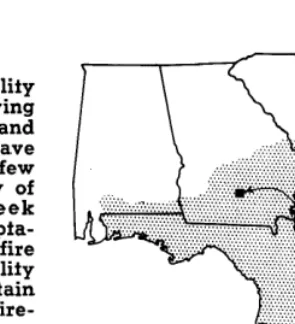
Edwards Plateau Region of Texas _._______________________ _ .___ _.CharZes W. Ramsey Fire and Forage in the Wiregrass Type ________ . . ..J. B. Hilmon and R. H. Hughes
. Cattle Distribution on Steep Slopeas ____.__ _ ____ _ _____ _ _____________________ Walter F. Mueggler Initial Stands of Interseeded Alfalfa _____ _ ______ . . ..M. D. Rumbaugh and 2’. Thorn Vegetative Composition, Forage Production, and Plant Vigor
as Influenced by Date of Mowing_.._ _________..._ _ _____..._____ _ ____ _ ____ _ .._. Don B. HazeZZ
Rl1*n;nH v1;m+ UGllc mmmma TXl;lL.nrJ P n/rnndnrwrr\hnl nm.4 VJim,. T uur**r**r * **&a& &&&&&zJ *b&U&y= . . . “I ‘C, I GUI u, I7lLl.l c&l p“$j U,‘u, ~~C‘I‘y L1. A7ide?-307i Grazing Conditions in Kenya Masailand
Geoffrey M. 0. MaZoiy and Harold F. Heady Effects of One Year’s Nitrogen Fertilization on Native Vegetation
Under Clipping and Burning ____.__..___ . .._CharZes W. Gay and Don D. Dwyer Sideoafs Grama as an Indicator of Grazing Intensify and A
Method of Determining Ifs Utilization ___.__.._._.____.___... WiZZiajn J. Waldrip Technical Notes:
Establishment of Firebreaks on Forest and Rangeland with
Herbicides._ __._______._________________ ___ ._.._..__... R. W. Bovey and M. K. McCarty Fescue Grassland in North Dakota ______________________________ _ _____ _ _... Hugh E. Cosby Big Sagebrush in Fresno County, California
Harold W. Wolfram and Morris A. Martin, Jr. Effect of Heavy Winter Rodent Infestation on Perennial
Forage Plants ____________ _ __________.____...._____________________. Ronald B. Foster Management Notes:
Progress through Performance Records ____.._.__._..._..____________________ _ . ..___. Don Cox Book Reviews:
The Wire fhaf Fenced the West (S. Clark Martin); Water Supply- Economics, Technology, and Policy (E. G. Dunford); Guide fo fhe Wood,y Plants of Utah (R. S. Campbell); New Horizons for Resources Research: Issues and Methodology (Otis L. Copeland) ___.. __._ . . .._.._____ _ .__. _ .__. _.__.__ __.._._.._.__._._.
With the Sections and Student Chapters _____ ___ _.__ ___________ ____ _ ______________ ______ ____ ___________ ____ _ News and Notes. _____ _______________________________ _____ _____ _____ _ ______ __ ____ _ ____ ______ ____ _ _...____.__ _ _.... ______________ ____
Society Business._.._ _____________ ________ _____ _.__._____ _.__._ _______...____..._.__ __.._ _ ___. _ _..___.______....___.... ___ __.._. _._.
Photo and Displays Contest Rules, 1966 Annual Meeting _._.__. _ ____________...___
Cover
See Story by
Photo-Springtime
in the Nebraska Sandhills
Don Cox on progeny testing, under Management Notes, Page235
23ti
242
247 251 255 258
261
4CC APJ
269
273
277
282 284
285
286
287
2889 291 293 295 296
Journal of
Volume 18, Number 5 September, 1965RANGE
MANAGEMENT
Range Management-An
Obituary?’
WILLIAM F. SCHROEDER*
Highlight
A commentary upon fhe multiple- use principle.
These last few days have been interesting ones in observing the exchanges between those of the federalist persuasion, the com- mercial persuasion, and those in between, who I like to think of as being of the political persua- sion. At various times in the past, I have had the pleasure of addressing each of these persua- sions on the subject of the public lands, but never before today have I addressed all of them at the same time. From past reac- tions, I believe I can fairly pre- dict that never before today have
1 Paper presented at the 18th An- nual Meeting, American Society of Range Management, Las Vegas, Nevada, February 12, 1965. 2 In addition to general law practice,
Mr. Schroeder is active in litigation affecting public lands and has be- come a widely known and quoted commentator upon pub Zic land problems. His published papers in- clude: “Cobwebs on the Public Lands”, Western Livestock Jour- nal, 1960; “The Price of Manifest Destiny”, Nevada-California Sec- tions, ASRM; and “The Common Ground”, Western Livestock Jour- nal, 1965. Mr. Schroeder received his AB Degree in 1946 from the University of Chicago, LLB from Valparaiso University in 1949, and is admitted to practice in Illinois and Oregon, before the federal court, and most federal agencies.
Attorney, Vale, Oregon
I given all of these persuasions the opportunity of disagreeing with me at the same time. If in the mutual disagreement all of you find another common ground among you, this is only a bonus, not the purpose of my remarks.
Because I am the concluding speaker of this fine convention, I am apprehensive about it, as
was the fabled Irishman who
was about to die. The priest bent over him to give him the last rites of the church and said, “Re- peat after me, ‘I renounce the devil and all his evil deeds’ “. But there was no response from Mike, and the priest repeated, more loudly: “Repeat after me, ‘I renounce the devil and all his evil deeds’ “. Still there was
no response from Mike and,
after the third try, the priest shook Mike and he opened his
eyes. “Didn’t you hear me,
Mike?” asked the priest. “Yes, I did”, replied Mike, “but you told me I was going to die, and this seems to me to be a heck of a time to antagonize anybody.”
This dialogue between all of you professionals in your respec- tive persuasions is a happy event because too often you meet one another on an isolated issue of practical consequence, and meet head-on in a context where the predilections of each of you have no opportunity for expression or understanding, with the inevita- ble result that moral chasms are created. Some become good guys
235
and others become bad guys. Almost thirty years ago, Henry Wallace’s elaborate Senate Docu- ment 199, “The Western Range”,
urged the development of the
western rangelands not only for the production of livestock, but for watershed protection, timber production, for wildlife, and for
recreation. There were slight
excursions, but it is significant that the principle justification urged for each was the creation of new wealth. In other words, that the rangelands should be re-
stored because in doing so,
wealth would be created by de- velopment of grass, water, tim- ber, wildlife and recreation. The
Western Range contended that
good watersheds serve the agri- cultural, industrial and munici-
pal dependence upon water and
deter or prevent costly floods; that wildlife had a then economic value of more than ninety mil-
lion dollars annually, which
could be increased; and that rec-
reation “draws large sums of
money that otherwise would not be received”; and so on.
Some of these objectives did not, of course, involve the crea- tion of wealth in its pure eco- nomic sense. Recreation, for in-
stance, does not make new
wealth, but the fact that it might redistribute wealth to portions of our geography that did not
formerly have it, undoubtedy
seemed to have a sufficient iden- tity with this economic concept to be justified by it.
The creation of new wealth
236
uable, and desirable; if it did not do so, it was not worth consider- ing. Therefore, it was not sur- prising that those who endorsed the idea that western rangelands should be restored, did what they could to justify restoration by the use of this conventional wisdom.
More than twenty years ago, when the classic treatise on range management expressed it, this multiple use principle had also become non-debatable. The choice of uses to be brought within the aura of this principle, or to continue within it, was also made with the use of the economic criterion. Whether any use should be embraced as one of the multiple uses was a ques- tion answered as much in eco- nomic terms as in the terms of whether the attributes of the range lent itself to the proposed use.
I remember so well an old grazier telling me of a meeting of cattlemen, sheepmen, and miners in the earliest days of the administration of the Taylor Act. Each contingent was doing its very best to secure the most favorable result for itself, and, before very long, the meeting was at a purple pitch. It almost broke up when a little lady, who up to that time had been silent, rose to inquire why those uses should be considered at all when they all would have the effect of destroying the wild flowers which she and her friends liked so much to see on the range in the spring.
It is well known that over the years there has been a tremen- dous competition between these uses. The competition was not and is not for the land itself. It is one of the facts of life that I deplore, and I believe the live- stock industry will one day de- plore with me, that it has re- jected the promise of the Taylor Act for the eventual disposition of the public lands. The competi- tion among the multiple uses has
SCHROEDER
not been for the land-they do not want it. The competition has been for emphasis, for status, for tenure, for preferred treatment, and for prior access to the public purse.
Over the years, we have heard a theorist or two attempting to placate this competition with the argument that all of these uses are mutually compatible, that there need be no competition be- tween them, that a total develop- ment upon the western range- lands can totally satisfy each of them. It is, of course, true that the same regime of diagnosis and treatment, the same dollar, can simultaneously improve the uses of a few of them. But the real problem lay in its answer; be- cause it would take a total de- velopment of a range to develop each of the uses to the maximum of their potential, tremendous amounts of public money would be required. The fact that this has not been politically possible of accomplishment within the history of the United States, neutralizes the theorist and en- courages this competition to continue.
Please do not remind me of the pilot Vale Project as a single, shining example to the contrary, since just last week its third fiscal appropriation was cut by more than fifty percent.
The uses which already had the dignity of acceptance as part of the multiple-use principle found almost their only common ground in vigorously resisting any different use which was as- piring for recognition. The sub- divider, for instance, has been and is strenuously resisted by al- most all of the accepted uses and the resistance to him and other proposed uses such as the wild flower lover has been based al- most entirely upon the relative economic unimportance of the invader at best, and the down- right theft motive of the invader at worst.
Since restoration of the west-
ern rangelands has been con- tinually urged on the strength of the conventional wisdom that wealth will be thereby created, it is natural that the competition among the uses was and still is waged with this same weapon. The livestock industry, for ex- ample, urges a superior economic status in pointing to the contri- bution to the gross national prod- uct which its production makes, in showing the economic de- pendency of the west upon it, in pointing to its capital invest- ment, the taxes upon it which substantially sup p or t the local and state governments. All of you are familiar with these and other similar arguments used by each of the other competitors. These are the arguments within the conventional wisdom and they are used for every purpose.
By name, you are a society of range management and the clas- sic definition of range manage- ment has almost always been the science and art of planning and directing range use so as to ob- tain the maximum livestock pro- duction consistent with conser- vation of the range resources. The first stated objective of this society is to advance the science and art of grazing land manage- ment. Explicit in both your name and your objective is this eco- nomic fetish of wealth produc- tion.
Moreover, I presume that you are still dedicated to the philos- ophy of Stoddart and Smith that “disuse is waste,” that “the aim of the range guardian is maxi- mum use, so long as that use is compatible with protection from permanent injury,” and that “the goal of the range manager is not conservation alone, but maxi- mum sustained production of forage, the backbone of the live- stock industry.” If you are, then your philosophy espouses this conventional wisdom.
RANGE MANAGEMENT 237
the western rangelands have generally tried to justify on the ground that rehabilitation was economically desirable in that it would be creative or productive of new wealth. The contro- versies respecting the uses of these ranges have generally been waged along these same lines.
One of the lesser unfortunate consequences of the use of this weapon is that when relative economic benefit was tested in this controversy, the image of total economic benefit suffered. When I argue that my horse is more valuable than yours, I am not only valuing my horse, but I am necessarily minimizing the value of yours, thus reducing the total value of both of them.
Of overriding consequence, however, is this. If the rehabili- tation of the western rangelands is our goal, this conventional wisdom which we have unsuc- cessfully used to inspire it, will write our obituary.
The creation or production of new wealth is now almost totally irrelevant. The conventional wis- dom has died in the existence of the affluent society. In gen- eral, the declining marginal urgency of goods has become the economic key note of our time. In particular, the affluent so- ciety has little need of the maxi- mums to which all of you dedi- cate yourselves and indeed, it is becoming more and more em- barrassed by them.
The problem of agricultural surplus has been tiring the American imagination for a long time and it has been taxing the American pocketbook as well. The surplus problem is so well known and so expensive that it has acquired a sickly pallor in the eyes of most Americans. Ex- cept for the most perspicacious among our citizens, this pallor has created a veil against dis- cussion which is, in most cases, impossible to pierce by any ra- tionalization such as, for ex- ample, that only portions of
American agriculture are in sur- plus. Whether it is true or false, the livestock industry is tied to the image of agricultural surplus and complaint about current prices which create sub-marginal operations, makes more secure the knot.
As long as there is two-dollar beefsteak in the counter of every metropolitan super-market, there will be less, rather than more interest in the problem of agriculture in general and that of the livestock industry in par- ticular. I do not wish to pursue the question today as to whether this is right or wrong; I ask only that you accept today that this image is a fact.
Almost all of the other mul- tiple uses of the public lands suffer from much the same image; if there is not a surplus, at least there is enough. Even in wholly responsible quarters there is found the recurrent theme that if there is enough, no public moneys should be spent in permitting more. Especially Reclamation Projects have be- come a focal point in this attack. The relative unimportance of the creation or production of wealth has been heralded by President Johnson in his state- ment of the Great Society. In announcing this objective at Brown University last year, he said, “For a century we labored to settle and to subdue a con- tinent. For half a century we called upon unbounded inven- tion and untiring industry to create an order of plenty for all of our people. The challenge of the next half century is whether we have the wisdom to use that wealth to enrich and elevate our national life, and to advance the quality of our American civili- zation.” In an Interior publica- tion of last year, this is found: “With economists confidently predicting a Gross National Product of at least one trillion 73 billion dollars by 1980, it is fair again to ask-what will such af-
fluence mean if, in the process of achieving this goal, we de- stroy most of the values that make for human well being? . . . Something of this solid, elemen- tal march of seas and seasons and stars communicates itself to the harried, hurried human being when he is able to find the time and the opportunity for outdoor leisure experiences. If these op- portunities are to be a part of tomorrow’s America, we must act to save them today.”
Am I suggesting that the rec- reationist has finally succeeded in the competition for the public lands? Indeed not! I am sug- gesting that there is a clear and present danger that he and all of the other multiple users of the public lands may lose in their objective of range rehabilitation, because of the overpowering im- portance of a larger and more comprehensive need.
238 SCHROEDER
In this order of things, where do you think the rehabilitation of the western rangelands will occur? Do you think your con- ventional wisdom will touch the affluent society for the moneys to accomplish it? How success- fully will your conventional wis- dom approach the affluent so- ciety which has been called to the expensive creation of a total environment, and which is more than ready to heed that ca11?3
I say it cannot, if it ever could. The concept of economic use has been and is implicit in the mul- tiple-use principle; for this rea- son, the clarion call of multiple use will not inspire range re- habilitation. The multiple-use principle has been and will con- tinue to be only productive of
controversy between the uses themselves and between the ac- cepted uses and others. If po- litical appropriations upon which range rehabilitation depends are obtainable at all, they will be ob- tained only if those controversies are permitted to die and instead a new clarion is heard in the land which can appeal to our elected representatives east of the Hundredth Meridian and their constituents. We can no longer justify the rehabilitation of the western rangelands with the conventional wisdom. We can no longer waste our talents in odious comparisons between the economic contributions of each of the multiple users of the public lands. Because of this heritage of economic competi- tion, I wish to suggest that the
3 Since this was written, “The Foul- multiple use principle in its pres- ing of the American Environment” ent frame of reference isobsolete was published in Saturday Re- and that only by discarding it view, May 22, 1965, to which the will range rehabilitation have attention of the reader is called. meaning in our time.
If the ranges are to be re- stored, we must with a single voice, justify this as part of the land conscience that has mean- ing for the future. We must, in short, accord to it a total human value which it has.
To all of you who are profes- sionals in the field of public lands, let me say that the way of accomplishing this is within your better understanding and im- plementation. If you do not, or will not understand it and move vigorously with it, I am confi- dent that this will be your obitu- ary.
For simple souls like me, I am content to suggest one of the Wordsworth sonnets which be- gins:
The land we from our father had in trust
And to our children will trans- mit, or die:
This is our maxim, this our piety.
Effects of Fertilization on
A
Little Bluestem Community
P. 0. REARDON and D. L. HUSS
Research Assistant and Assistant Professor, Range and Forestry Department, Texas A & M University, College Station
Highlight
Phosphorus fertilization subsian- fially increased liifle bluesiem pro- duction. Potassium decreased ifs pro- duction because of an increase in weeds. If appears that little blue- stem will respond fo nitrogen only with sufficieni moisture.
Little bluestem, Andropogon scoparius Michx., is well known for its ability to produce large quantities of forage. However, little is known about how it re- sponds to fertilization. Such in- formation is important; .especial- ly, if higher yields and more nutritious forage can be obtained.
The application of commercial fertilizers has been shown to
affect native forage grasses in several ways. In an Arizona test Holt and Wilson (1961) applied ammonium phosphate and am- monium nitrate to a typical desert grassland site. They re- ported that both fertilizers al- most doubled forage production over that produced on the unfer- tilized areas. Sulfur fertilization of an annual-plant range at the San Joaquin Experimental Range increased herbage produc- tion on two range sites by 59 and 57% during a five year period
(Bentley, et al., (1959). Rogler and Lorenz (1957) found that forage production on heavily grazed ranges in the Northern
Great Plains was significantly increased with nitrogen fertili- zation. The increase was due primarily to an increase in west- ern wheatgrass. Rumburg and Cooper (1961) reported that high rates of nitrogen and phosphorus fertilization changed the botani- cal composition as well as in- creased forage yields on native meadows in Oregon.
238 SCHROEDER
In this order of things, where do you think the rehabilitation of the western rangelands will occur? Do you think your con- ventional wisdom will touch the affluent society for the moneys to accomplish it? How success- fully will your conventional wis- dom approach the affluent so- ciety which has been called to the expensive creation of a total environment, and which is more than ready to heed that ca11?3
I say it cannot, if it ever could. The concept of economic use has been and is implicit in the mul- tiple-use principle; for this rea- son, the clarion call of multiple use will not inspire range re- habilitation. The multiple-use principle has been and will con- tinue to be only productive of
controversy between the uses themselves and between the ac- cepted uses and others. If po- litical appropriations upon which range rehabilitation depends are obtainable at all, they will be ob- tained only if those controversies are permitted to die and instead a new clarion is heard in the land which can appeal to our elected representatives east of the Hundredth Meridian and their constituents. We can no longer justify the rehabilitation of the western rangelands with the conventional wisdom. We can no longer waste our talents in odious comparisons between the economic contributions of each of the multiple users of the public lands. Because of this heritage of economic competi- tion, I wish to suggest that the
3 Since this was written, “The Foul- multiple use principle in its pres- ing of the American Environment” ent frame of reference isobsolete was published in Saturday Re- and that only by discarding it view, May 22, 1965, to which the will range rehabilitation have attention of the reader is called. meaning in our time.
If the ranges are to be re- stored, we must with a single voice, justify this as part of the land conscience that has mean- ing for the future. We must, in short, accord to it a total human value which it has.
To all of you who are profes- sionals in the field of public lands, let me say that the way of accomplishing this is within your better understanding and im- plementation. If you do not, or will not understand it and move vigorously with it, I am confi- dent that this will be your obitu- ary.
For simple souls like me, I am content to suggest one of the Wordsworth sonnets which be- gins:
The land we from our father had in trust
And to our children will trans- mit, or die:
This is our maxim, this our piety.
Effects of Fertilization on
A
Little Bluestem Community
P. 0. REARDON and D. L. HUSS
Research Assistant and Assistant Professor, Range and Forestry Department, Texas A & M University, College Station
Highlight
Phosphorus fertilization subsian- fially increased liifle bluesiem pro- duction. Potassium decreased ifs pro- duction because of an increase in weeds. If appears that little blue- stem will respond fo nitrogen only with sufficieni moisture.
Little bluestem, Andropogon scoparius Michx., is well known for its ability to produce large quantities of forage. However, little is known about how it re- sponds to fertilization. Such in- formation is important; .especial- ly, if higher yields and more nutritious forage can be obtained.
The application of commercial fertilizers has been shown to
affect native forage grasses in several ways. In an Arizona test Holt and Wilson (1961) applied ammonium phosphate and am- monium nitrate to a typical desert grassland site. They re- ported that both fertilizers al- most doubled forage production over that produced on the unfer- tilized areas. Sulfur fertilization of an annual-plant range at the San Joaquin Experimental Range increased herbage produc- tion on two range sites by 59 and 57% during a five year period
(Bentley, et al., (1959). Rogler and Lorenz (1957) found that forage production on heavily grazed ranges in the Northern
Great Plains was significantly increased with nitrogen fertili- zation. The increase was due primarily to an increase in west- ern wheatgrass. Rumburg and Cooper (1961) reported that high rates of nitrogen and phosphorus fertilization changed the botani- cal composition as well as in- creased forage yields on native meadows in Oregon.
FERTILIZING
LITTLE BLUESTEM
239
Procedures
The experiment was conducted on a nearly pure stand of little bluestem on a gently sloping up- land site near College Station, Texas. The soil is a typical Tabor sandy loam of low to moderate productivity. Soil tests revealed deficiencies of nitrogen, phos- phorus, potassium, and calcium.
The experiment was a pilot
study to determine if little blue-
stem plants would respond to
fertilization both wi.th and with- out weed control. The study was not intended to yield data for specific fertilization recommen-
dations and was therefore de-
signed to yield basic information through a minimum number of plots. Very high and low levels of fertilization, particularly with nitrogen, were stressed.
The basic design was a partial
and unbalanced N, P, and K
split-plot factorial. The factorial contained five levels of nitrogen, three levels of phosphorus and three levels of potassium. A uni- form lOOO-lb. calcium carbonate treatment was applied to all but the control and one treatment pertained to calcium only. Each treatment was replicated three times. The fertilization plots were 10 x 40 ft. and the fertiliza- tion treatments were completely randomized.
The fertilizer elements were applied March 22, 1963, at the
following rates of active ma-
terial per acre: 33% ammonium- nitrate at 0, 40, 80, 160, and 320 lb.; 20% superphosphate at 0, 40, and 80 lb.; and 60% muriate of potash at 0, 60, and 120 lb. Weed control was obtained by spraying one-half of each plot with 2,4-D amine at the rate of 0.5 lb. per 20 gal. of water per acre. Spray- ing was done during the early part of April and it was not nec- essary to respray.
Prior to fertilization the entire area was mowed to a uniform 6- inch stubble height. Initial varia- tion between plots was deter-
mined by frequency analyses via the inclined point-contact tech-
nique. Subsequent, frequency
analyses were also determined by the same technique.
The Student’s t test revealed that some of the plots had a significantly different initial fre- quency of little bluestem than other plots. The treatment with the highest frequency of little bluestem was the control. These
initial differences prompted a
multiple regression analysis for forage yields including 14 vari- ables: (1) time, (2) N, (3) P,
(4) K, (5) time2, (6) N2, (7) P2, (8) K2, (9) time x N, (10) time x P, (11) time x K, (12) NP, (13) NK and (14) PK. The vari- able “time” was included to de-
termine the effects brought
about by natural environmental developments such as phenologi-
cal development of the plant
community. To test for curvi- linearity, the original data were squared and included as the vari- ables N2, P2, K2 and time2. The effect of calcium fertilization
was determined by analysis of
variance.
Forage production was mea-
sured by clipping four circular quadrats containing 9.6 ft.2 on each plot on May 30, July 30 and December 5, 1963. The latter date was determined by the first frost. The forage was clipped to a two- inch stubble height and clippings were not repeated on the same plot. Production at any clipping date represents growth in weight from the beginning of the grow- ing season to that date and does
not represent accumulated
weight through repeated clip-
ping. This was deemed necessary in order to avoid any influence
that frequent clipping might
have on forage production. Resulfs
and Discussion
The study was largely influ- enced by drought during most of the growing season. Precipita- tion was less than three-fourths of the average for the area dur- ing six of the months of the yearand was below average during
eight months. Extremely low
amounts of precipitation in May, June, and August were probably the most influential in respect to plant growth and certainly to the effects obtained from fertiliza- tion. Conversely, above average rainfall during April was bene- ficial to plant growth and re- sponse to fertilization.
The species composition of the
community continually changed
throughout the study, primarily due to weeds. The occurrence of annual weeds was significantly
influenced by the variables K
and time. These weeds were
present on all plots at the begin- ning of the study and slightly in- creased with time to about May 16, then continually decreased
(Figure 1). Nitrogen and phos- phorus had no significant influ- ence on the frequency of weeds, but potassium did. As shown in Figure 1, K at both the 60 and 120 lb. rates of fertilization caused a sharp increase in weeds from March 14 through May 16. The frequency of weeds was essen- tially the same%t the beginning and the end of the growing sea- son, whereas the frequencies on May 16 of the 60 and 120 lb. levels were twice as high as for the 0 level of K. The increase in weeds due to potassium fertiliza- tion had a significant influence on the production of little blue- stem.
Fertilization definitely in-
creased the oven-dry forage pro-
LEGEND - 0 POUNDS
01
MAR. MAY JULY NOV.
DATE
240 REARDON AND HUSS
ductionof little bluestem as com- pared to no fertilization. The average increase with no weed control was 560 lb./acre-a 50% increase. This difference was not analyzed for statistical signifi- cance, but is considered impor- tant and significant, especially since the unfertilized plots had a higher initial frequency of little bluestem. The control of broad- leaf herbaceous weeds resulted in an additional 21.7% increase in forage yield.
not a statistically signif icant variable with weed control
(Table 1). Potassium also caused a sharp increase in herbage pro- duced by weeds. The 60 and 120 lb. rates of potassium produced increases in weed yields of 612 and 572 lb./acre respectively.
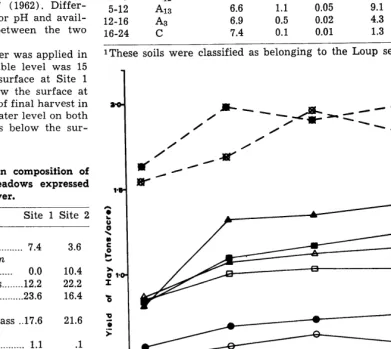
The variables related to a sig- nificant increase or decrease in the forage production of little bluestem are given in Table 1. The high regression coefficients for the phosphorus variable, both with and without weed control, indicate that the increase in for- age production through fertiliza- tion was largely related to phos- phorus. Also, the larger regres- sion coefficient under weed con- trol indicates that little bluestem plants will more efficiently re- spond to phosphorus fertilization in the absences of weeds than in their presences.
The research was designed with the hypothesis that little bluestem production would re- spond primarily to nitrogen fer- tilization. The fact that this was not true is believed to be due to the below average precipitation during the study. If this is true, then little bluestem will respond to nitrogen fertilization only with sufficient moisture. This assump- tion is partially substantiated by the significant negative curvi- linear relationship between ni- trogen and little bluestem pro- duction (Table 1). The negative curvilinearity of little bluestem production was attributed to the rainfall pattern during the study. Production increased in the spring, decreased in the summer and again increased in the fall.
The effect of=phosphorus on forage production was largely due to the 80 lb./acre rate. Fer- tilization at the 80 lb. level with no weed control brought about a 287 lb./acre increase in May, a 615 lb. increase in July and a 418 lb. increase in December. The 40 lb. level resulted in forage in- creases of only 77, 180, and 66 lb. during the same respective peri- ods. The increases were greater in the presences of weed control.
Table 1. Regression coefficieni and Sfudenf’s i of regression coefficienf for liffle bluesfern forage producfionl
Variable
No weed control Reg. Coef. t of Coef.
With no weed control, potassi- um caused a decrease in forage yields of little bluestem (Table 1). This decrease in forage pro- duction was apparently caused by the increase in weed growth and subsequent competition brought about by potassium fer- tilization. This is partially sub- stantiated by the fact that the negative and linear regression coefficient for the variable K was significant at the 5% level with no weed control. but was
N N” P P2 K K2 NP NK PK time times time x N time x P time x K
-.1535 (-2) .2331 (1) -.1133 (-2) .2070 (1) .7324 ( 0) .3497 (1) .1302 ( 1) .4106 (1) -.4373 (-0) .2018 (1)
.5060 (-2) .2660 (1) .3963 (-2) .2785 (1) -.8182 (-2) .2956 (1)
IRegression coefficients and Student’s t are given only for the variables which were significant at the 5% level. The remaining variables were eliminated by the multiple regression procedure. Regression coefficients with a positive value denote the variables which cause a significant in- crease in the forage production of that species. The coefficients with a negative value denote a significant decrease in forage production. Figures such as .1535 (-2) mean .1535 x 10-s.
However, it seems important to note that little bluestem produc- tion increased with phosphorous fertilization in spite of the drouth.
The interaction variable NK was also related to the increase in little bluestem production
(Table 1). The positive effect of this variable is interesting in that the variables N and K by themselves caused a negative effect. Perhaps the effect of the variable NK is related to the cur- vilinear relationship between ni- trogen and little bluestem pro- duction. The variable PK had no influence on little bluestem pro- duction in the absences of weed control, but was a significant variable with weed control. The negative regression coefficient indicates incompatability in the presences of weed control. Calci- um fertilization caused no in- crease or decrease in little blue- stem production.
It was observed during the growing season that the plants on the plots fertilized with nitro-
FERTILIZING LITTLE BLUESTEM 241
gen and phosphorus began their vegetative growth from one to two weeks earlier than the ones on the unfertilized plots. This was also found to be true by Hoglund, et al. (1952) and Hon- nas, et al. (1959). It was noted also that the plots which received large amounts of nitrogen pro- duced a much darker green coloration in the leaves and stems. The green color gradually faded as rainfall became a limit- ing factor. This coloration again appeared during the fall when there was sufficient precipitation to bring about growth.
Summary and Conclusions
The study was conducted on a Tabor fine sandy loam soil near College Station, Texas. The de- sign was a partial and unbal- anced split-plot NPK factorial. Weeds were controlled on one- half of each plot and all plots except the control received a base fertilization of calcium. One treatment pertained to calcium only.
The effects of fertilization were influenced by droughty conditions throughout most of the study. In spite of these con- ditions, little bluestem and the community responded in various ways to fertilization. Annual weeds increased considerably with potassium fertilization. This increase in weed frequency and consequent increase in weed her- bage production decreased the
forage production of little blue- stem.
Fertilization resulted in an ap- proximate 50% increase in little bluestem forage production. Weed control resulted in an ad- ditional 22% increase. This in- crease was largely due to phos- phorus fertilization, particularly at the rate of 80 lb./acre of ac- tive material. The relationship between nitrogen fertilization and little bluestem production was curvilinear. The negative curvilinear regression coefficient for nitrogen was attributed to the rainfall pattern during the growing season. Rainfall was high in the spring, low during the summer and again high in the fall. Potassium fertilization in the absence of weed control reduced little bluestem produc- tion In the presence of weed control, potassium had no signifi- cant effect. The variable NK was also related to the increase in little bluestem production, both with and without weed control. Calcium had no effect on the little bluestem community.
This study indicates that little bluestem in this area should not be fertilized with potassium. It appears that little bluestem will respond to nitrogen fertilization only with sufficient moisture. The species did, however, re- spond to phosphorus fertilization under droughty conditions. Only 40 and 80 lb. rates of phosphorus fertilization were employed in
this study. Future studies should include higher rates of phos- phorus.
LITERATURE CITED
BENTLEY, J. R., L. R. GREEN, AND K. A. WACNON. 1958. Herbage pro- duction and grazing capacity on annual-plant range pastures fer- tilized with sulfur. J. Range Man- age. 11: 133-140.
BRITTINGHAM, W. H., AND J. F. FUDGE. 1944. Yield, chemical analysis, and fertilizer response of eleven forage grasses. Tex. Agr. Exp. Sta. Prog. Rep. 8750. 2 p.
HILDRETH, R. J., F. L. FISHER, AND A. G. CALDWELL. 1956. Influence of rainfall on profits from fertilizer applications to East Texas forage. Tex. Agr. Exp. Sta. Misc. Pub. 184 6 P.
HOGLUND, 0. K., H. W. MILLER, AND A. L. HAFENRICHTER. 1952. Applica- tion of fertilizers to aid conserva- tion on annual forage range. J. Range Manage. 5: 55-61.
HOLT, G. A., AND DAVID WILSON. 1961. The effect of commercial fertil- izers on forage production and utilization on a desert grassland site. J. Range Manage. 14: 252-256. HONNAS, R. C., B. L. BRANSCOMB,
AND R. R. HUMPHREY. 1959. Effect of range fertilization on growth of three southern Arizona grasses. J. Range Manage. 12: 88.
OSBORN, BEN. 1950. Some effects of the 1946-1948 drought on ranges in Southwest Texas. J. Range Man- age. 3: 1-15.
ROGLER, G. A., AND R. J. LORENZ. 1957. Nitrogen fertilization of Northern Great Plains rangelands. J. Range Manage. 10: 156-160.
Response of Sub-Irrigated Meadow
Vegetation to Application of Nitrogen
and Phosphorus Fertilizer’
J. S. RUSSELL, E. M. BROUSE, H. F. RHOADES, and D. F. BURZLAFF
Former Asst. Agronomist; Asst. Agron., retired; Prof. of Agron. deceased; and Assoc. Prof. of Agronomy. Nebr. Agr. Exp Sta. Lincoln
Highlight
Combinations of nitrogen and phosphorus fertilizer gave greater yield increases than either element applied alone. Yield response and chemical composition of forage ap- peared to be a result of botanical composition changes in fhe meadow. Phosphorus fertilizer fagged with
p32 revealed fhai legumes use,d
greater amounts of applied phos- phorus than did grasses. Nitrogen fertilizer appeared fo increase ufili- zafion of applied phosphorus by grasses.
Meadow hay forms an impor- tant part of the livestock cnter- prise of the Nebraska Sandhills. Hay for winter feed is cut from meadows which lie between the sand ridges and on the bottom- lands along streams and lakes. Tall prairie grasses grow in these areas. During the last half-cen- tury the botanical composition has changed as a result of the introduction of cultivated forage species.
Hay yields on the sub-irrigated meadows of the sandhills may be influenced by applications of nitrogen and phosphorus fertil- izers (Brouse et al. 1953; 1954; Ehlers et al. 1952). There is also evidence to indicate that the nitrogen and phosphorus con- tents of the vegetation from these meadows are influenced by fertilization (Brouse et al. 1953; 1954). Based on the results ob- tained elsewhere it seems evi- dent that nitrogen and mineral
lcontribution of the Nebraska Agri- cultural Experiment Station. Pub- lished with the approval of the Di- rector as Paper No. 1659 Journal Series, Nebraska Agric. Exp. Sta.
element percentages in the hay from the subirrigated meadows will be materially influenced by the stage of plant growth and by the species present (Beeson, 1941; Vandecaveye, 1941).
Thus, in evaluating the effects of fertilizer applications on meadow vegetation not only yield responses but changes in botanical composition of the sward and chemical composition of the forage plants with ad- vance in season must be mea- sured.
Experimental Methods An experiment was conducted during 1953 at two locations in Holt County Nebraska (referred to as Sites ! and 2). The objec- tive was to determine the influ- ence of nitrogen and phosphorus fertilizers and time of harvesting on the yield and chemical com- position of meadow hay. The ex- periment was planned in a ran- domized block design of 4 repli- cations with 30 x 5 foot plots. Nitrogen as am lonium nitrate (33.5% N) at rates 0, 40 and 80 lb N/acre and phosphorus as treble-superphosphate (43% available P205) at rates of 0, 40, 80, and 160 lb PzOj/acre were ap- plied in all combinations on April 1. Phosphorus at the 80 lb rate of PZOZ was tagged with
P322. All fertilizer was applied
with a Gandy spreader with the exception of the radioactive phosphorus. It was drilled at a depth of 3/4 to 2 inches using a grain drill with a conveyor belt attachment.
242
Plant samples were obtained from Site 1 on June 16 and June 30 by clipping forage from an area 1 meter square at a height of 2 inches above ground. The entire sample from each plot was dried and weighed. At the final harvest on July 16 at Site 1 and July 17 at Site 2, strips 17.5 feet long and 3 feet wide were mowed through the center of the plot with a Jari Mower. Green weight of forage was obtained. Random samples of forage were taken from each plot for moisture determination and chemi- cal analyses. All forage samples from plots receiving similar treatments were cornposited for chemical an- alyses except for the radioactive samples.
Species separations were made of samples from 4 treatments; check, o-80-0, 40-80-0, 80-80-o. Each repli- cation was sampled but in order to obtain sufficient plant material for analysis the replications were com- posited.
Total N was determined by a modified Gunning procedure. P, Ca, Mg, K and Na were determined after wet digestion of the samples with nitric and perchlori : acids. Phos- phorus was determined by the meth- od of Sherman (1942). Cations were determined using a Beckman DU Flame Spectrophotometer with an oxy-hydrogen flame attachment. The amount of radioactive phosphorus in the plant material was determined by the briquet method of McKenzie and Dean (1950). Percentages of the plant constituents are expressed on an oven dry basis.
Vegetation on the check plots and on the non-fertilized area immedi- ately adjacent to the plots was in- ventoried in early June using the point-quadrat method of Levy and Madden (1933).
Characterization of Sites. - The flora of both sites was characterized by a combination of warm-season and cool-season grasses, rushes, sedges, and introduced legumes. The main difference between Site 1 and Site 2 was found in the varying abundances of certain legumes. Red clover3 was the only legume present
sAcknowZedgement is made to R. A. Olsen and F. E. Koehler who as- sisted in the application of P32 and in final radioactivity assay.
RESPONSE OF MEADOW VEGETATION 243
to any extent at Site 1, whereas alsike clover was dominant at Site 2
(Table 1). There was also a higher percentage of little bluestem at Site 1 than at Site 2. This accounted, to some extent for the advance in ma- turity of the forage at time of har- vest at Site 2 as compared to Site 1.
Properties of the soils in the Sand- hill area have been reported by Russell and Rhoades (1956) to be related to the depth of water table below the surface. Analysis of the soil profiles (Table 2) showed that both sites were characterized by high organic matter percentages at the soil surface with decreasing amounts at increased depth of pro- file. This relationship affected total nitrogen, cation exchange capacity and total phosphorus. The direct correlation between organic matter and cation exchange capacity was shown by Burzlaff (1962). Differ- ences were noted for pH and avail- able phosphorus between the two sites.
When the fertilizer was applied in April the water table level was 15 inches below the surface at Site 1 and 17 inches below the surface at Site 2. At the time of final harvest in July, the ground water level on both sites was 36 inches below the sur- face.
Table 1. Vegefafion composifion of experimenfal meadows expressed as perceniage cover.
Species Site 1 Site 2
Trifolium pratense
red clover __._________________ 7.4 Trifolium hybridum
alsike clover ____________ 0.0 Juncus spp. rushes.. ____.. 12.2 Carex spp. sedges.__ _.._ . ..23.6 Poa pratensis
Kentucky bluegrass ..17.6 Agrostis alba
redtop _ ____ _ __.__ ______________. 1.1
Phleum pratense
timothy _.__ ___._ _ ____..________ .5 Andropogon gerardi
big bluestem _____._.____.. 7.5 Andropogon scoparius
little bluestem ________._._ 6.9 Sorghastrum nutans
indiangrass ________ ____ _ ____ _ 8.5 Other grasses _____ ________.__ __ 5.2 Forbs ________ ______ ______ _______..___ 1.5
3.6
10.4 22.2 16.4
21.6
.l
.3
7.3
.l
8.4 3.2 4.2 Total __________________ _.__ . . . ...92.0 97.8
Experimenfai Results and phosphorus was applied but
ni-
Discussion trogen fertilizer alone had rela- Yields of dry matter.-Yields tively little effect on dry matter of dry matter were obtained at 3 production (Fig. 1). Phosphorus stages of growth at Site 1 and at fertilizer alone increased yields a final harvest at Site 2. Nitrogen but the largest responses were fertilizer increased yields where obtained with the nitrogen-phos-Table 2. Characferisfics of soil profiles from experimental areas.l Organic Cation Total Avail-
Depth, matter Nitrogen ex. cap. P able P
inches Horizon pH % % me/100 gr. ppm ppm Site 1
o- 2 Ao & AII 8.1 13.7 0.62 21.8 668 4.4
2-10 A12 8.1 5.5 0.28 13.3 456 4.0
lo-17 A3 7.7 1.7 0.09 8.1 198 3.3
17-25 C 7.3 0.1 0.01 3.0 43 1.4
Site 2
o- 2 Ao & A11 6.8 18.0 0.76 38.3 726 14.8
2- 5 A12 6.8 9.1 0.38 23.0 395 8.0
5-12 A13 6.6 1.1 0.05 9.1 89 2.5
12-16 A3 6.9 0.5 0.02 4.3 52 1.5
16-24 C 7.4 0.1 0.01 1.3 33 0.8
PY- IThese soils were classified as belonging to the Loup series.
-4
m-
0
0 -__,+_=--- --
0
/
0 --
0
-\
/
4f’
--a
r(
/cy
RrH
Site 1
Site 2
Harvested Harvested Harvested Harvested
No N N June16 ,e + June 30
July 16
July 17 -*- -*- I
Lo 80 1
P applied (lb. P20S /acre)
244 RUSSELL, ET AL.
phorus combination. At Site 1 the effect of phosphorus fertil- izer alone was much more no- ticeable at the third harvest than at the first harvest.
Changes in the vegetation com- position as a result of fertilizer were observed at both sites. Ni- trogen fertilizer alone caused a decrease in the amount of legume present. The stimulation of the grass which took place was in- sufficient to cause any significant increase in total yield. Phos- phorus fertili.zer alone caused a decided increase in the growth of legumes. When applied in combination nitrogen and phos- phorus fertilizers appeared to stimulate both grasses and leg- umes causing significant increase in yield at both sites.
and 20% for applications of 40 and 80 lb N/acre. However, where phosphorus was applied there was a considerable increase in the amount of legumes in the forage. It may be assumed that at least some of the additional nitrogen present in the forage resulted from nitrogen fixation by the legumes.
The effect of nitrogen and phosphorus fertilizer on the ni- trogen content of individual spe- cies comprising the forage was examined (Table 3) . These re-
1.50
1
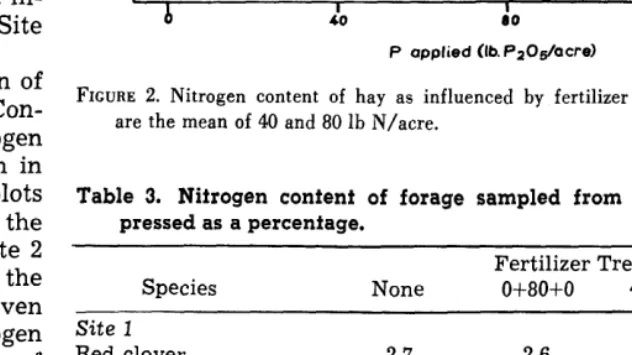
Nitrogen Content of Forage.- Nitrogen percentage of the for- age from Site 1 declined from the first to the third harvest. Dif- ferences in nitrogen content due to fertilizer treatment were small. In particular the applica- tion of nitrogen fertilizer had little effect on the nitrogen con- tent of forage from either site. However, phosphorus fertilizer resulted in an increase in the ni- trogen content of forage at Site 2 (Fig. 2) .
5 1.25-
._ 5 iii
1
c ._
2 e a
l.Oo-
Bf
NON NSite 1 Harvested July 16 %W ,_Y
Site2 Harvested July 17 .j@ - a j# - *
b ;0
P applied (lb. P2Os/acre)
The efficiency of utilization of nitrogen fertilizer was low. Con- sidering plots receiving nitrogen only, there was less nitrogen in the forage from treated plots than from the check plots at the final harvest at Site 1. At Site 2 there was a slight increase in the total nitrogen in the forage. Even so, the utilization of the nitrogen in an application of 40 lb of N/acre was only 4% and for 80 lb/acre utilization was 7%.
FIGURE 2. Nitrogen content of hay as influenced by fertilizer application. Values for N are the mean of 40 and 80 lb N/acre.
Table 3. Nitrogen confenf of forage sampled from mixed vegetation, ex- pressed as a percentage.
Species None
There was some increase in ap- parent utilization of nitrogen fertilizer when applied with phosphorus. At Site 1 utilization of nitrogen at rates of 40 lb and 80 lb N/acre was 26% and 20% respectively, when applied with phosphorus. Similarly, at Site 2 the utilization values were 38%
Site I Red clover
Kentucky bluegrass Indiangrass
Big bluestem Little bluestem Rushes
Sedges
Mixed vegetation
Site 2
Alsike clover Timothy Redtop
Mixed vegetation
sults show that changes in the nitrogen content of various spe- cies due to both nitrogen and phosphorus fertilizer were small. It seems probable therefore that the increase in nitrogen content of mixed vegetation at Site 2 was due to changes in botanical com- position and particularly to the stimulation of legume growth as a result of phosphorus applica- tion.
Phosphorus Content of Forage.-
At Site 1 there was a regular de- crease in the phosphorus percentage
Id0
Fertilizer Treatments
0+80+0 40+80+0 80+80+0
2.7 2.6 2.6 2.6
1.2 1.2 1.2 1.2
1.2 1.2 1.1 1.1
1.2 1.2 1.2 1.2
1.1 1.2 1.1 1.1
1.1 1.0 1.1 1.1
1.3 1.3 1.2 1.2
1.4 1.4 1.3 1.4
2.3 2.2 2.2 2.1
0.9 0.9 0.9 0.9
0.9 0.9 0.9 0.8
RESPONSE OF MEADOW VEGETATION 245
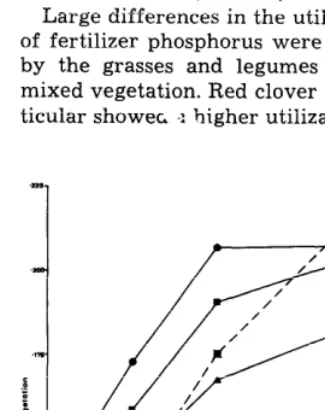
in the forage throughout the season (Fig. 3). Addition of phosphorus fer- tilizer at both sites caused large in- creases in the phosphorus percentage of the vegetation. These increases were directly related to the rate of phosphorus fertilizer applied. Addi- tion of nitrogen fertilizer caused a decrease in the phosphorus percent- age when applied alone or in com- bination with the lower rates of phosphorus fertilizer. Where applied in combination with the highest rate of phosphorus (160 lb PzO;/acre), however, nitrogen fertilizer caused a further increase in the phosphorus content of the vegetation. Average utilization of phosphorus fertilizer was 7% at Site 1 and 9% at Site 2.
Phosphorus fertilizer applied at 80 lb/acre P2O.j was tagged with Psz. This allowed a more comprehensive evaluation of utilization of the ap- plied phosphorus. Phosphorus con- tent of various species at the final harvest and the percentage derived from the applied fertilizer (Table 4) were calculated. Percentage of phos- phorus derived from fertilizer in the mixed forage and the legume and grass portions for each harvest were also determined (Table 5) .
Large differences in the utilization of fertilizer phosphorus were shown by the grasses and legumes in the mixed vegetation. Red clover in par- ticular shower .: higher utilization of
'=Y P
FIGURE 3. Phosphorus content of hay as influenced by application of phosphorus fertilizer. Values are the mean of 0, 40
and 80 lb N/acre.
Table 4. Phosphorus confenf of forage sampled from mixed vegefafion and percentage of phosphorus derived from ferfilizer by freafmenfs.
Phosphorus in forage Phosphorus in forage derived from fertilizer
%I ‘ib
Species None 0+80+0 40+80+0 80+80+0 0+80+0 40+80+0 80+80+0
Site 1
Red clover 0.17 0.19 0.19 0.20 75 69 66
Kentucky bluegrass 0.12 0.16 0.16 0.16 56 56 71
Indiangrass 0.11 0.18 0.15 0.15 39 31 39
Big bluestem 0.11 0.14 0.14 0.13 17 26 34 Little bluestem 0.09 0.13 0.14 0.12 29 34 44
Rushes 0.09 0.11 0.13 . 0.12 30 29 23
Sedges 0.15 0.16 0.16 0.15 26 15 31
Mixed vegetation 0.11 0.17 0.17 0.17 49 46 55 Site 2
Alsike clover 0.19 0.19 0.18 0.18 60 47 44
Timothy 0.09 0.13 0.16 0.15 47 50 33
Redtop 0.09 0.14 0.17 0.14 28 46 33
Mixed vegetation 0.11 0.18 0.18 0.17 44 45 42
Table 5. Percent phosphorus in fhe vegetation derived from applied phosphorus fertilizer, in relafion fime of cuiting.
Site 1 Site 2 June June July July Fertilizer 16 30 I6 17 Mixed Forage
0+80+0 37 51 49 44 40+80+0 45 50 46 45 80+80+0 50 57 55 42
Mean 44 53 50 44
Grass Separations
0+80+0 34 44 29 31 40+80+0 39 47 28 42 80+80+0 39 56 35 41
Mean 37 49 31 38
Legume Separations
0+80+0 65 65 65 53 40+80+0 62 70 61 48 80+80-r-O 64 72 62 52
Mean 64 69 63 51
fertilizer phosphorus with 75% phos- phorus in plants fertilized with 0+80+0 being derived from this source. With alsike clover the re- spective value was 60%. Grasses were lower and showed a wide range from 56% for Kentucky bluegrass to 17% for big bluestem. Utilization of phosphorus fertilizer by the grasses was usually increased by addition of nitrogen fertilizer.
Some differences in the utilization of phosphorus at the two sites was observed. The final harvest at Site 1 revealed that 31% of the phosphorus in grasses and 63% in the legumes was derived from the fertilizer. Re- spective values of forage from Site 2
were 38% for the grasses and 51% for the legumes. A dominance of red clover at Site 1 and an appreciable higher available phosphorus content in the soil at Site 2 as compared to Site 1 may explain at least part of the difference in results obtained at the two locations.
Cation Content of Forage.- Changes in the cation content of for- age throughout the season were small. The cation contents of dif- ferent species from unfertilized plots are shown in Table 6. These data emphasize the relatively high con- tent of calcium and magnesium in red and alsike clover and the low content of these cations in the ma- ture grasses.
Certain trends were observed in cation content of forages as a result of the application of nitrogen and phosphorus fertilizer although dif- ferences were not significant. Nitro- gen fertilizer decreased the calcium content of forage at all stages of growth (0.7% to 0.6% with 80 lb N/acre). Magnesium content was decreased slightly as was total cation content.
Phosphorus fertilizer tended to in- crease the calcium, magnesium and total cation content of the forage
(.lO%, .07%, 9 m.e./lOO gr, respec- tively) . Potassium content of forages was unaffected by either nitrogen or phosphorus fertilizer.
Conclusions
246 RUSSELL, ET AL.
Table 6. Cation contents of
two wet-meadow sites. differeni species from nonferfilized plots of
Species
Stage of growth
Total cation Cation percentages content, Ca Mg K Na m.e./lOOg Site 1, Harvested July 16
Red clover mid-bloom 2.1 0.60 1.6 Kentucky bluegrass pre-boot 0.6 0.24 1.2
Indiangrass mature 0.4 0.18 1.2
Big bluestem pre-boot 0.4 0.22 1.0 Little bluestem pre-boot 0.4 0.16 1.1
Rushes mature 0.4 0.20 1.3
Sedges pre-boot 0.8 0.27 1.6
Mixed vegetation 0.7 0.26 1.2
Site 2, Harvested July 17
Alsike clover past maturity 1.5 0.52 1.2
Timothy mature 0.1 0.09 1.0
Redtop mature 0.2 0.14 1.1
Mixed vegetation 0.6 0.26 1.1
0.024 199 0.013 82 0.004 63 0.009 63 0.004 62 0.005 70 0.005 105
0.013 90 0.010 148 0.004 41 0.006 47 0.005 79 of forage from hay meadows so
that harvesting can be accom- plished at the optimum time for maximum yields of the highest
quality forage. Miller et al.
(1955) in studies of high altitude meadows in Colorado found that dry weight of the plants con- tinued to increase but nitrogen
and phosphorus percentages de-
clined with advance in maturity.
Similar trends were found in
this study of subirrigated mead- ows and it is evident that much delay in harvesting after early July could result in a loss of total nitrogen and phosphorus in the forage.
It appears that the diverse re- sults that have been reported for yields of dry matter and chemi- cal composition of the forage of
fertilized meadows (Brouse et
al., 1953; 1954) can be attributed to several factors. First, the bo- tanical composition of meadows in the Nebraska Sandhills varies considerably. In particular the introduced forages red and alsike clover, timothy, and redtop show marked differences in composi- tion percentages. Second, appli- cation of fertilizer results in
changes in botanical composi-
tion. Nitrogen fertilizer stimu- lates the grass components and depresses the legume components of the sward. Phosphorus fertil-
izer stimulates the growth of
legumes. Third, there is a ten- dency for the chemical composi- tion of plants to undergo changes as a result of fertilizer applica- tion. In this study application of phosphorus fertilizer noticeably increased the phosphorus content of plants. Possibly the low initial
phosphorus content of many
plants found in this region ma- terially contributes to this effect.
Fertilizer response will depend on the interaction of these fac- tors and particularly on the im- portant role of botanical com- position of meadows.
Summary
The yield and chemical com- position of forage from two sub-
irrigated meadows in the Ne-
braska Sandhills as influenced by the application of nitrogen and phosphorus fertilizers were studied.
Nitrogen and phosphorus fer-
tilizer combinations gave the
largest yield increases. Applica- tions of phosphorus fertilizer
alone gave smaller yield in-
creases than did combinations of nitrogen and phosphorus. Nitro- gen fertilizer alone did not give any increase in forage yield.
Sampling during the growing
season showed that although
yield increased, nitrogen and
phosphorus percentages declined with advance in maturity. Cal- cium and magnesium percentages showed little change but potassi- um percentage after an initial rise also declined.
Phosphorus fertilizer was
tagged with P32 and utilization
of applied phosphorus by the
legumes was found to be con- siderably greater than by the grasses, although differences be- tween grass species were also observed. There was some evi- dence that nitrogen fertilizer in- creased the utilization of applied phosphorus by the grasses.
Large increases in phosphorus
content of mixed vegetation,
when phosphorus fertilizer is ap- plied, appear to be due to in- creases in the phosphorus con- tent of individual species and also to the stimulation of legume growth.
Variation in the yield of dry matter and chemical composition of forage of subirrigated mead- ows in response to fertilization appears to be due to vari.ations in original botanical composition and resultant changes in botani- cal composition of meadows and in the chemical comfiosition of individual plants.
LITERATURE CITED BEESON, K. C. 1941. The mineral
composition of crops with particu- lar reference to the soil in which they were grown. USDA Misc. Pub. 369 164 p.
BROUSE, E. M., P. L. EHLERS, AND GLEN VIEHMEYER. 1953. Fertilizer experiments on native subirrigated meadows in Nebraska, 1952. Nebr. Agr. Exp. Sta. Outstate Testing Circ. 28. 10 p,
BROUSE, E. M., P. L. EHLERS AND , GLENN VIEHMEYER. 1954. Fertilizer experiments on native subirrigated meadows in Nebraska, 1953. Nebr. Agr. Exp. Sta. Outstate Testing Circ. 36. 20 p.