A Potential Cloud Service by Auditing Cloud
MalaimariSuganya.P1, Padma Priya.R2
1Department of Computer Science and Information Technology Nadar Saraswathi College of Arts and Science, Theni dt-625531, Tamilnadu, India
2Department of Computer Application
Nadar Saraswathi College of Arts and Science, Theni dt-625531, Tamilnadu, India
Abstract
Let assume that each user in the audit cloud is
identified by a unique ID. Before outsourcing the
job to the data cloud, the audit cloud and the data
cloud will engage in a Service Level Agreement
(SLA), which stipulates the promised level of
consistency that should be provided by the data
cloud.In the system, a two-level auditing model is
adopted: each user records their operations in a
User Operation Table (UOT), which is referred to
as a local trace of operations. Local auditing can be
performed independently by each user with their
own UOT; periodically, an auditor is elected from
the audit cloud.
The users will communicate to exchange messages
after executing a set of reads or writes, rather than
communicating immediately after executing every
operation. Once two users finish communicating, a
causal relationship on their operations is
established.
1. Introduction
Cloud Computing
Cloud computing providing unlimited
infrastructure to store and execute customer data
and program. As customers you do not need to own
the infrastructure, they are merely accessing or
renting; they can forego capital expenditure and
consume resources as a service, paying instead for
what they use.
YOUR PERSONAL CLOUD
Storage space and processing power are the biggest
hurdles that mobile devices like smartphones and
tablets face today. Cloud computing has come to
the forefront as it overcomes these hurdles,
enabling you to access and edit your fi les and fi les
uploaded by other users without the need for
excessive hardware and support. Browser-based
email and cloud services such as Grooveshark,
Facebook, Google Docs and Youtube have
smartphone and tablet extensions, designed specifi
cally to run on the lower hardware specifi cations
of such devices.Operating systems of today like
Android, Ios and Windows 7 are also made
compatible with mobile devices and equipped with
applications that let you sync and access data
across devices via their cloud servers. Apart from
storage, developers have also used cloud
computing capabilities to develop Software as a
Service (SaaS), Platform as a Service (PaaS) and
Webtop services to make your computing
experience completely mobile.
Software as a service (saas)
Web accessible software enables users to use
programs or applications without having to
can access data hosted by companies on their cloud
servers for almost any task, like word processing,
designing or even media editing. This enables users
to carry out their work without having to purchase
software that can be installed and run only on a
single machine. You no longer need to worry about
expiration dates, downloading updates or installing
software on multiple machines. SaaS reduces the
user’s expenses by allowing you to ‘rent’ a service
and use only specifi c features rather than buying
complete packages of programs, some of which
you might not use. For instance, to use Microsoft
Word, a user must purchase the Microsoft Offi ce
auite, which gives you Word bundled with Excel,
Powerpoint,etc. These packages can be fairly
expensive.Instead, you can use a SaaS product that
allows you to sign up for free or a monthly fee and
lets you perform your word processing tasks
without any installations on your machine’s local
drive.
Platform as a service (paas)
PaaS is a form of SaaS that provides development
environments as a service. Rather than designing
software for the customers to use, companies
provide clients with the infrastructure required to
design and run software specifi c to their needs.
Clients can then use this infrastructure and develop
software applications for their use that run on the
host’s cloud servers. This form of cloud computing
gives the clients the freedom to develop software to
suit their requirements without having to worry
about the hardware. PaaS provides clients with
facilities for designing and developing applications,
hosting their applications as well as hardware for
scalability and storage.
Information Security
Security related to the information
exchanged between different hosts or
between hosts and users.
This issues pertaining to secure communication, authentication, and issues concerning single sign on and
delegation.
Secure communication issues include
those security concerns that arise during
the communication between two entities.
These include confidentiality and integrity
issues. Confidentiality indicates that all
data sent by users should be accessible to
only “legitimate” receivers, and integrity
indicates that all data received should only
be sent/modified by “legitimate” senders.
Solution: public key encryption, X.509 certificates, and the Secure Sockets Layer
(SSL) enables secure authentication and
communication over computer networks.
Cloud Computing has become
commercially popular, as it promises to guarantee
scalability, elasticity, and high availability at a low
cost. Guided by the trend of the
everything-as-a-service (XaaS) model, data storages, virtualized
infrastructure, virtualized platforms, as well as
software and applications are being provided and
consumed as services in the cloud. Cloud storage
services can be regarded as a typical service in
cloud computing, which involves the delivery of
data storage as a service, including database-like
services and network attached storage, often billed
on a utility computing basis, e.g., per gigabyte per
month. Examples include Amazon SimpleDB1 ,
Microsoft Azure storage, and so on. By using the
cloud storage services, the customers can access
data stored in a cloud anytime and anywhere using
capital investment when deploying the underlying
hardware infrastructures.
To meet the promise of ubiquitous 24/7
access, the cloud service provider (CSP) stores data
replicas on multiple geographically distributed
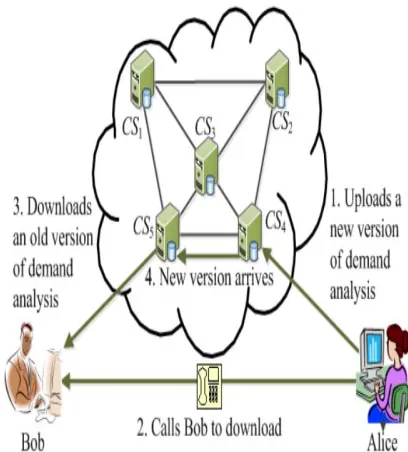
servers. A key problem of using the replication
technique in clouds is that it is very expensive to
achieve strong consistency on a worldwide scale,
where a user is ensured to see the latest updates.
Actually, mandated by the CAP principle, many
CSPs (e.g., Amazon S3) only ensure weak
consistency, such as eventual consistency, for
performance and high availability, where a user can
read stale data for a period of time. The domain
name system (DNS) is one of the most popular
applications that implement eventual consistency.
Updates to a name will not be visible immediately,
but all clients are ensured to see them eventually.
Actually, different applications have
different consistency requirements. For example,
mail services need monotonicread consistency and
read-your-write consistency, but social network
services need causal consistency. In cloud storage,
consistency not only determines correctness but
also the actual cost per transaction. In this paper,
we present a novel consistency as a service(CaaS)
model for this situation. The CaaS model consists
of a largedata cloudand multiple small audit clouds.
The data cloud is maintained by a CSP, and an
audit cloud consists of a group of users that
cooperate on a job, e.g., a document or a project. A
service level agreement (SLA) will be engaged
between the data cloud and the audit cloud, which
will stipulate what level of consistency the data
cloud should provide, and how much (monetary or
otherwise) will be charged if the data cloud violates
the SLA.
The implementation of the data cloud is
opaque to all users due to the virtualization
technique. Thus, it is hard for the users to verify
whether each replica in the data cloud is the latest
one or not. Inspired by the solution, we allow the
users in the audit cloud to verify cloud consistency
by analyzing a trace of interactive operations.
Unlike their work, we do not require a global clock
among all users for total ordering of operations. A
loosely synchronized clock is suitable for our
solution. Specifically, we require each user to
maintain a logical vector for partial ordering of
operations, and we adopt a two-level auditing
structure: each user can perform local auditing
independently with a local trace of operations;
periodically, an auditor is elected from the audit
cloud to performglobal auditingwith a global trace
of operations. Local auditing focuses on
monotonic-read and read-your-write consistencies,
which can be performed by a light-weight online
algorithm. Global auditing focuses on causal
consistency, which is performed by constructing a
directed graph. If the constructed graph is a
directed acyclic graph (DAG), we claim that causal
consistency is preserved. We quantify the severity
of violations by two metrics for the CaaS model:
commonality of violations and staleness of the
value of a read.
2. Description of consistency
Algorithms
Local Consistency Auditing
Local consistency auditing is an online
algorithm (Alg. 1). In Alg. 1, each user will record
all of his operations in his UOT. While issuing a
read operation, the user will perform local
consistency auditing independently. LetR(a)denote
a user’s current read whose dictating write is W(a),
W(b) denote the last write in the UOT, andR(c)
denote the last read in the UOT whose dictating
write isW(c). Read-your-write consistency is
monotonic-read consistency is violated if W(a)
happens beforeW(c). Note that, from the value of a
read, we can know the logical vector and physical
vector of its dictating write. Therefore, we can
order the dictating writes by their logical vectors.
Algorithm 1Local consistency auditing
Global Consistency Auditing
Global consistency auditing is an offline
algorithm (Alg. 2). Periodically, an auditor will be
elected from the audit cloud to perform global
consistency auditing. In this case, all other users
will send their UOTs to the auditor for obtaining a
global trace of operations. After executing global
auditing, the auditor will send auditing results as
well as its vectors to all other users. Given the
auditor’s vectors, each user will know other users’
latest clocks up to global auditing.
3. Proposed work
We assume that each user in the audit
cloud is identified by a unique ID. Before
outsourcing the job to the data cloud, the audit
cloud and the data cloud will engage in a Service
Level Agreement (SLA), which stipulates the
promised level of consistency that should be
provided by the data cloud.
A service level agreement (SLA) will be
engaged between the data cloud and the audit
cloud, which will stipulate what level of
consistency the data cloud should provide, and
how much (monetary or otherwise) will be
charged if the data cloud violates the SLA.
In our system, a two-level auditing model
is adopted: each user records his operations in a
User Operation Table (UOT), which is referred to
as a local trace of operations. Local auditing can be
performed independently by each user with his own
UOT; periodically, an auditor is elected from the
audit cloud.
The users will communicate to exchange
messages after executing a set of reads or writes,
rather than communicating immediately after
executing every operation. Once two users finish
communicating, a causal relationship on their
operations is established.
One of the important concerns that need to be
addressed is to assure the customer of the integrity
i.e. correctness of his data in the cloud. As the data
is physically not accessible to the user the cloud
should provide a way for the user to check if the
integrity of his data is maintained or is
compromised. In this paper we provide a scheme
which gives a proof of data integrity in the cloud
correctness of his data in the cloud. This proof can
be agreed upon by both the cloud and the customer
and can be incorporated in the Service Level
Agreement (SLA). It is important to note that our
proof of data integrity protocol just checks the
integrity of data i.e. if the data has been illegally
modified or deleted.
We propose a two-level auditing architecture,
which only requires a loosely synchronized clock
in the audit cloud. Then, we design algorithms to
quantify the severity of violations with two metrics:
the commonality of violations, and the staleness of
the value of a read. Finally, we devise a heuristic
auditing strategy (HAS) to reveal as many
violations as possible. Extensive experiments were
performed using a combination of simulations and
real cloud deployments to validate SLA.
Finally, we propose a Heuristic Auditing Strategy
(HAS) which adds appropriate reads to reveal as
many violations as possible.
Our key contributions are as follows:
1) We present a novel consistency as a
service (CaaS) model, where a group of
users that constitute an audit cloud can
verify whether the data cloud provides the
promised level of consistency or not.
2) We propose a two-level auditing
structure, which only requires a loosely
synchronized clock for ordering
operations in an audit cloud.
3) We design algorithms to quantify the
severity of violations with different
metrics.
4) We devise a heuristic auditing strategy
(HAS) to reveal as many violations as
possible. Extensive experiments were
performed using a combination of
simulations and real cloud deployments to
validate HAS.
User: In this module, user should register their details and get the secret key for login and user can
upload the file regarding the auditing.
Auditor: In this module, auditor can do the auditing based on the heuristic auditing strategy. It
relates with document verification. Auditor can
check the auditing file he can neglate or accept the
file he can revise the report and check whether its
good or bad and auditor can give revision report
like accept or waiting. If status in accept means
user can view the file else status is waiting means
user cant view the file.
Admin: In this module admin can view all the user details, user uploads details, and TPA activities
regarding the auditing strategy.
Data upload module (in cloud database): In this module, the user uploaded files can be stored in
cloud database... it can be very secure auditor can
view the file from the database it can be very
secure.
4. Conclusion and Future
Enhancement
In this paper, we presented a consistency as a
service (CaaS) model and a two-level auditing
structure to help users verify whether the cloud
service provider (CSP) is providing the promised
consistency, and to quantify the severity of the
violations, if any. With the CaaS model, the users
can assess the quality of cloud services and choose
a right CSP among various candidates, e.g, the least
expensive one that still provides adequate
consistency for the users’ applications. For our
future work, we will conduct a thorough theoretical
study of consistency models in cloud computing.
5. References
[1] M. Armbrust, A. Fox, R. Griffith, A. Joseph, R.
Katz, A. Konwinski, G. Lee, D. Patterson, A.
Rabkin, I. Stoica,et al., “A view of cloud
computing,”Commun. ACM, vol. 53, no. 4, 2010.
[2] P. Mell and T. Grance, “The NIST definition of
cloud computing (draft),” NIST Special Publication
800-145 (Draft), 2011.
[3] E. Brewer, “Towards robust distributed
systems,” in Proc. 2000 ACM PODC.
[4] ——, “Pushing the CAP: strategies for
consistency and availability,” Computer, vol. 45,
no. 2, 2012.
[5] M. Ahamad, G. Neiger, J. Burns, P. Kohli, and
P. Hutto, “Causal memory: definitions,
implementation, and programming,”Distributed
Computing, vol. 9, no. 1, 1995.
[6] W. Lloyd, M. Freedman, M. Kaminsky, and D.
Andersen, “Don’t settle for eventual: scalable
causal consistency for wide-area storage with
COPS,” inProc. 2011 ACM SOSP.
[7] E. Anderson, X. Li, M. Shah, J. Tucek, and J.
Wylie, “What consistency does your key-value
store actually provide,” in Proc. 2010 USENIX
HotDep.
[8] C. Fidge, “Timestamps in message-passing
systems that preserve the partial ordering,” inProc.
1988 ACSC.
[9] W. Golab, X. Li, and M. Shah, “Analyzing
consistency properties for fun and profit,” in Proc.
2011 ACM PODC.
[10] A. Tanenbaum and M. Van Steen, Distributed
Systems: Principles and Paradigms. Prentice Hall
PTR, 2002.
[11] W. Vogels, “Data access patterns in the
Amazon.com technology platform,” in Proc. 2007
VLDB.
[12] M. Brantner, D. Florescu, D. Graf, D.
Kossmann, and T. Kraska, “Building a database on