Attribute-based Signatures
⋆Stephen R. Tate1 and Roopa Vishwanathan2
1 Department of Computer Science, UNC Greensboro, Greensboro, NC 27402
2 Department of Computer Science, SUNY Poly, Utica, NY 13502
Abstract. Attribute-based signatures, introduced by Maji et al., are signatures that prove that an authority has issued the signer “attributes” that satisfy some specified predicate. In existing attribute-based signa-ture schemes, keys are valid indefinitely once issued. In this paper, we initiate the study of incorporating time into attribute-based signatures, where a time instance is embedded in every signature, and attributes are restricted to producing signatures with times that fall in designated validity intervals. We provide three implementations that vary in granu-larity of assigning validity intervals to attributes, including a scheme in which each attribute has its own independent validity interval, a scheme in which all attributes share a common validity interval, and a scheme in which sets of attributes share validity intervals. All of our schemes provide anonymity to a signer, hide the attributes used to create the signature, and provide collusion-resistance between users.
Keywords: Attribute-Based Signatures, Key Revocation, Key Expira-tion
1
Introduction
In some situations, users authenticate themselves based on credentials they own, rather than their identity. Knowing the identity of the signer is often less impor-tant than knowing that a user possesses certain credentials or attributes, e.g., “over 21 years old,” or “computer science major.” This form of authentication is ideal for loosely-knit situations where anonymity and unforgeability are desired, and one needs to be sure that users cannot collude to combine attributes from each other to satisfy authentication challenges. To this end, Majiet al.[10] intro-ducedattribute-based signaturesas a primitive that allows users to sign messages anonymously using a combination of their attributes. The parties involved in
⋆A shorter version of this paper appeared at the29th Annual IFIP WG 11.3
attribute-based signatures are a signature trustee (ST), an attribute-issuing au-thority (AIA), and potentially many signers and verifiers. The signature trustee acts as a globally trusted source that sets the global system parameters correctly (e.g., honestly generates a common reference string), and the attribute-issuing authority, which is trusted in more limited ways, issues signing keys for attributes to users. Although the AIA knows the signing keys and attributes of all users, it cannot tell which attributes have been used in a given valid signature, and hence cannot identify the signatures made by any user and/or link signatures made by a single user.
In the original work of Maji et al. [10], the basic scheme uses attributes that do not have any time restrictions on validity – once an attribute is issued, it is good forever (or at least as long as the global public verification key is valid). Maji et al. [10] informally describe some ideas for attribute expiration and revocation, but these issues are simply mentioned in passing. In this paper, we initiate a careful study of restricting attribute validity in attribute-based signature schemes, providing a formal framework as well as implementations that are significantly more efficient than those that were suggested in earlier work.
A user who receives a key for a set of attributes from an AIA can sign a message with a predicate that is satisfied by their attributes. Predicates, or claim predicates, are Boolean expressions over a set of attributes, and satisfying a predicate involves supplying a valid combination of attributes such that the Boolean expression evaluates to true. Signature verification tests if the signature was performed by a user with a satisfying set of attributes, without needing to know the signer’s attributes or identity. The main interesting properties of attribute-based signatures areanonymity of both the signer’s identity and spe-cific attributes used in generating the signatures, even if one has full information about which users were issued which attributes, andcollusion-resistance, where two or more users cannot pool their attributes together to satisfy a predicate that they cannot individually satisfy. Note that since traditional digital signa-tures are verified using a user-specific public key, such a signature cannot provide the anonymity property required of an attribute-based signature.
In real-world situations, a user may be issued a time-limited attribute that has a well-defined validity period consisting of an issue date and expiry date. Since explicit revocation is not possible in the anonymous setting of attribute-based signatures, attributes can be used until they expire, forcing frequent ex-piration. As a simple example that motivates revocation, an organization could issue Employee attributes to its employees, which they use for authentication. Once an employee leaves the organization, they should no longer be able to authenticate using their Employee attribute. In addition to the expiry date, it is also important to check the issue date of an attribute, or the start of va-lidity. Consider an organization where employees can anonymously certify or sign internal company documents, as long as they have valid credentials. Alice is an employee that joined the organization in March 2012, and was issued an
signatures over documents for February 2012, or any time before her start date. This property is referred to asforward security, in the signature literature.
In this paper we take an abstract view of time, with concrete instantiations for traditional notions of time (which we call “clock-based time”) and a trusted server instantiation (which we call “counter-based time”) which allows for instant revocation by incrementing a counter on a trusted time server.
Related Work.Attribute-based signature revocation was briefly mentioned by
Majiet al.[10], but they don’t give any specifics on how attribute sets can in-corporate signing key revocation or attribute set revocation. Escala et al. [4] introduce schemes for revocable attribute-based signatures, but in their paper, “revocability” refers to revoking the anonymity of a user who created a signa-ture (revealing their identity), and not revoking signing keys or attribute sets. Their revoke function is run by a party whose role is similar to that of a group manager in group signatures, and takes in an attribute-based signature, some public parameters and state information, and outputs the identity of the user who created the signature. Liet al.[9], Shahandashti and Safavi-Naini [15], and Herranz et al. [7] present attribute-based signature schemes, but do not deal with attribute and key revocation and expiry. Okamoto and Takashima [11, 12] propose efficient attribute-based signature schemes which support a rich range of predicates, and do not require any trusted setup, respectively, but do not consider revocation.
In this paper we focus exclusively on authentication and attribute-based sig-natures. A significant amount of work has been done recently in the area of attribute-basedencryption[8, 5, 13, 17, 3], but those techniques do not carry over into the signature realm and can be viewed as orthogonal to our work.
Our Contributions.The contributions of this paper are briefly summarized as
follows:
– Extension of attribute-based signature definitions to support attribute expi-ration;
– A generic notion of time that includes instantiations for not only traditional (“clock-based”) time, but also a trusted counter based notion that allows instant revocation;
– Key-update mechanisms that allow efficient extension of issued attribute sets; and
– Three implementations that vary in granularity of associating intervals with attributes and have various efficiency trade-offs.
2
Definitions
a universe of attributesA. An attributea∈Ais a generic name (e.g.,Employee),
and when we say that an attribute is “issued” to a user we are really talking about a private signing key associated with that attribute being generated by the AIA and provided to the user. Keys are associated with sets of attributes, and each instance of a attribute set signing key has a public identifierpid(users do not have individual public keys).
Attribute-based signatures are made with respect to a predicateΥ over at-tributes. For RABS we use monotone span programs to specifyΥ, the same as Maji et al. [10]. A span program Υ = (M, a) consists of an ℓ×k matrix M
over a fieldF, with a labeling functiona: [ℓ]→Athat associates each of the ℓ
rows of Mwith an attribute. The monotone span program is satisfied by a set of attributesA ⊆A, writtenΥ(A) = 1, if and only if
∃v ∈F1×ℓ : vM= [1,0,0,· · ·,0] and (∀i:vi 6= 0 =⇒a(i)∈ A) (1) Another way to view this is that the monotone span program is satisfied if and only if [1,0,0,· · ·,0] is in the span of the row vectors corresponding to the attributes held by the user.
2.1 Time and Validity Intervals
In this paper, times can be drawn from any partially ordered set (T,≤). There is a trusted time source that can report an authenticated “current time” to any party in the system, and it is required that the sequence of reported times be a totally ordered subset ofT. Time intervals are specified as closed intervals such as [ts, te], wherets≤te, and a time valuetis said to be in the interval (written
t∈[ts, te]) ifts≤t≤te. In RABS, attributes have associatedvalidity intervals, so if a ∈ Ais a non-time-specific attribute, in RABS we would typically refer
to (a,[ts, te]) meaning that this attribute is valid at all times t ∈ [ts, te]. As a more compact notation, we will sometimes use ι to denote an interval, so a time-specific attribute might be denoted (a, ι).
RABS signatures include a specific timet∈Tin the signature, so we typically write a RABS signature as σ= (t, φ), and we call this a “time-t signature.” A valid time-tsignature can only be made by a user who has been issued attributes (ai,[tsi, tei]) fori= 1, . . . , n, such thatΥ({ai|i= 1, . . . , n}) = 1 andt∈[tsi, tei]
for all i= 1, . . . , n. While it is tempting to refer to a “signature made at time
t,” it is clearly impossible to restrict when a signature is actually created — a time t signature could in fact be created at any time, as long as the signer holds (possibly old) keys that were valid at timet. Note that in one prominent application, a real-time authentication scenario in which a challenger provides the current timetand a nonce to the prover, who is then required to produce a time-tsignature over the nonce, itdoes make sense to think of this as a signature being made at time t.
weeks, or months. For example, ifT were the set of all months, then there might be a time value such ast=2014-March. These times form a totally ordered set, and larger intervals can be specified such as [2014-March,2014-June]. In clock-based time, we assume that there are a limited set ofstandard validity intervals
that are used for attributes. For example, ifT contains individuals days, then we could have standard validity intervals that represent monthly, weekly, or daily intervals, so a single-day time t =2014-Jan-09 could be in standard validity intervals [2014-Jan-01,2014-Jan-31] (monthly), [2014-Jan-06,2014-Jan-12] (weekly), or [2014-Jan-09,2014-Jan-09] (daily).
As an alternative to clock-based time, we can letT be a set of vectors over integer counter variables, where two times t1 = ht1,1, t1,2,· · ·, t1,ki and t2 = ht2,1, t2,2,· · · , t2,kiare compared by
t1≤t2 ⇐⇒ ∀i∈1,· · · , k, t1,i≤t2,i.
We call this notion “counter-based time,” and in this case the trusted time source could maintain a set of monotonic counters for each vector entry so that counters could be independently incremented on demand. While the set T is only partially ordered, since the individual counters are monotonic, the trusted time source would never output two times that are incomparable, such ash1,2i andh2,1i.
While using vectors of counters for time requires more space to specify a time, it is a significantly more powerful notion. In particular, a counter can correspond to a set of attributes, and then when an attribute in that set needs to be revoked the counter can be incremented on demand. This allows for immediate expiration of issued attributes, rather than having to wait until the end of the current time period (e.g., the end of the month) as you would have to do with clock-based time. We discuss in more depth some properties and uses of counter-based time in Section 5.
2.2 Basic Techniques
A fundamental part of making or verifying a time-t signature in RABS imple-mentations is the conversion of a span program Υ = (M, a) that does not take time into consideration into a span programΥ′ = (M′, a′) that includes
require-ments that t is in the validity interval of all attributes used to satisfyΥ. The precise form of our transformation depends on the specific implementation, so we will introduce these transformations in later sections. Recall that “issuing an attribute set” means providing a user with a signing key that corresponds to a set of attributes. We write a generic secret key as SK, and we can also add designations to this secret key to indicate that it has certain properties. For example, SKA refers to a signing key for the specified set of attributes, SKAt
refers to a signing key in which all attributes inAare valid at time t.
key into a new key. Consider the following situation: a user has been issued a large attribute setA, with hundreds of attributes — this is a very large signing key. At some point, these attributes expire and we wish to renew or reissue them for a new time period. Our goal then is to produce a small, compact ∆ that describes changes to an existing signing key, say SKt
A, so that we can apply
this ∆ to update the key. While the precise format of∆ depends on a specific implementation, our implementations treat∆as a sequence of commands such as hNew, id, SKifor replacing a component of a key, identified as id, with a new
key SK. All of these notions are combined to yield the definition of a RABS scheme, given in Definition 1.
Definition 1. A Revocable ABS (RABS) scheme has the following functions:
– RABS.TSetup(1λ)→(T P K, T SK): Run by the signature trustee to generate
a common public key or reference string,T P K, and a secret keyT SK. – RABS.Register(T SK, uid) → τ: Run by the signature trustee to register a
user.τ can bind user-specific parameters chosen by the trustee to a user id (uid). For example, in one of Maji et al.’s implementations, τ consists of some trustee and user-specific public parameters, signed by the trustee. – RABS.ASetup(T P K,1λ) →(AP K, ASK): Run by the attribute-issuing
au-thority (AIA) to generate a keypair(AP K, ASK).
– RABS.AttrGen(τ, T P K, ASK,A={(a1, ι1), . . . ,(au, ιu)})→ (SKA, pid, ψ): Run by the AIA to issue a signing key for time-specified attribute set A
for a user identified in τ. We assume that that AIA has verified τ before using this function. Outputs include the private signing keySKAto be given to the user, the public identifierpid for this key, and ψ which is the user-specific state that is maintained by the AIA as required to work with this set efficiently on future requests, such asReissueandExtend.
– RABS.Sign(T P K, AP K, SKA, m, Υ, t) → σ: Run by a user that possesses signing key SKA for attributes A which are all valid at time t, to produce a time-t signature on message m. Note that the time t is embedded in the signature, so we will sometimes writeσ= (t, φ)to make the time explicit. – RABS.Ver(T P K, AP K, m, Υ, σ)→v∈ {“accept”,“reject”}: Run by a verifier
to validate signatureσ= (t, φ). Verifies that the signature was made by some user that was issued attributesAthat were valid at timetsuch thatΥ(A) = 1. – RABS.ReIssue(τ, ψ, pid, T P K, ASK,A ={(a1, ι1), . . . ,(au, ιu)}) → (∆, ψ′):
Run by the AIA to extend the valid time intervals for all of the associated attributes. For this function,pidshould reference an existing issued attributed set for anA′ ={(a
1, ι′1), . . . ,(au, ι′u)} with the same attributes at different
(typically earlier) time intervals, and the output includes a signing key update description∆and updated AIA state informationψ′.∆compactly describes how to update the current signing key, and is sent to the user.
– RABS.Extend(τ, ψ, pid, T P K, ASK,A′ = {(a
1, ι1), . . . ,(au, ιu)})→ (∆, ψ′):
– RABS.Update(T P K, AP K, ∆, SK) → (SK′): This is a deterministic algo-rithm that is run by the user, where the user takes in an old signing key, an update description∆ generated by the attribute authority, and outputs a new signing keySK′.
3
Threat Model and Security Properties
In the attribute-based signature (ABS) model, the adversary could either be a user who was issued attributes and keys valid for a fixed time period, or could be an external party that compromised the user’s attributes and keys. Additionally, the attribute issuing authority could itself be considered an adversary colluding with a malicious user and/or external parties. We note that in our model, as well as in previous work in attribute-based signatures, the attribute-issuing au-thorities are considered malicious only in the sense that they will try to violate the anonymity of a user signing a message, and they are still trusted to correctly distribute attributes and signing keys among users. In particular, in the ABS model, one generally does not consider issues such as the attribute authorities unilaterally issuing (or re-issuing) signing keys, and using them to sign on behalf of a user. Furthermore, the signature trustee is considered to be a trusted party. We now give a formal definition of security for any RABS scheme. Consider two adversaries,S1 andS2. Both adversaries know general system parameters, such as the setT, and are given public keys of the signature trustee and attribute authority when they are generated. The goal ofS1is to guess which attributes were used to satisfy Υ, and the goal of S2 is to forge a signature that passes verification, despite not having been issued satisfying attributes that are good at the time tembedded in the signature. The definition follows, and is derived from the ABS definitions of Majiet al.[10] — more discussion is in that paper.
Definition 2. A secure RABS scheme possesses the following properties:
1. Correctness:A RABS scheme is said to be correct if for all(T P K, T SK)←
RABS.TSetup(1λ), all (AP K, ASK) ← RABS.ASetup(T P K,1λ), all
mes-sagesm, all attribute setsA, all claim-predicatesΥ such thatΥ(A) = 1, all keys (SKA, pid, ψ) ← RABS.AttrGen(τ, T P K, ASK,A), and all signatures σ←RABS.Sign(T P K, AP K, SKA, m, Υ, t), we haveRABS.Ver(T P K, AP K, m, Υ, σ) =“accept”.
2. Perfect Privacy: A RABS scheme has perfect privacy if, for T P K that are all honestly generated withRABS.TSetup, all AP K, all attribute setsA1
andA2, allSK1←RABS.AttrGen(..,A1)andSK2←RABS.AttrGen(..,A2),
and allΥ such thatΥ(A1) =Υ(A2) = 1, the distributionsRABS.Sign(T P K,
AP K, SK1, m, Υ, t)andRABS.Sign(T P K, AP K, SK2, m, Υ, t)are identical.
3. Existential Unforgeability:A RABS scheme is existentially unforgeable if adversaryS2, given black-box access to a RABS oracle O, has negligible
probability of winning the following game:
– Run(T P K, T SK)←RABS.TSetup(1λ), and(AP K, ASK)←
– S2 runs a probabilistic polynomial time algorithm in which it can make
queries to registration oracle ORABS.Register(TSK,·), key generation and
modification oraclesORABS.AttrGen(·,·,ASK,·),ORABS.ReIssue(·,·,·,·,ASK,·), and ORABS.Extend(·,·,·,·,ASK,·).
– S2 outputs (m′, Υ′, σ′).
S2 succeeds ifRABS.Ver(T P K, AP K, m′, Υ′, σ′) =“accept”, ORABS.Sign was
never queried with(m′, Υ′), andΥ′(A) = 0for allAqueried toORABS.AttrGen.
4
Implementations
In this section, we present several implementations for RABS. The implementa-tions differ in how attributes use validity intervals: each attribute can be assigned a validity interval that is independent of the others; all attributes can share the same validity interval; or attributes can be grouped into sets that share the same validity interval. All of our implementations are built on top of a secure non-time-specific ABS scheme — for Implementations 1 and 2, any ABS scheme that satisfies the security properties in Majiet al. [10] will work, but Implemention 3 has more strict requirements, as described in Section 4.4.
4.1 Implementation 1: Independent Validity Intervals
For this implementation, each attribute is assigned a validity interval that is in-dependent of any other validity interval used by any other attribute. To accom-plish this, we incorporate the validity interval into the attribute name. For ex-ample, a time-specific attribute (Employee,[2014-Jan-06,2014-Jan-12]) would be named Employee-2014-Jan-06-2014-Jan-12.
Using the notion of standard validity intervals from Section 2.1, consider a timet that is contained in kstandard validity intervals:ι1, . . . , ιk. Viewing the conditionΥ as a Boolean formula, when calling theRABS.Signfunction to make a time-tsignature we would first change every occurrence of an attributeain the Boolean formula to a disjunction of all attributes that incorporate a standard time interval that includes time t. In other words, an occurrence of attributea
in the Boolean formula would be replaced with (a-ι1∨ · · · ∨a-ιk). Viewing the conditionΥ = (M, a) as a monotone span program, since each rowi= 1, . . . , ℓ
of the original M corresponds to attribute a(i), we simply duplicate this row
k times, and map the time-specific attributes to these rows. In the example of standard validity intervals from Section 2.1, ifa(i) =Employeethen we duplicate that row 3 times and map the monthly, weekly, and daily validity intervals to these 3 rows. We will refer to the expanded matrix asΥ′= (M′, a).
This implementation is an obvious way of adding support for validity intervals to attribute-based signatures, and the overhead for signatures is not large: IfM
isℓ×kand there arectime intervals that are valid for each attribute (e.g.,c= 3 in our example above), then the resultingΥ′ used in making signatures includes
attributes frequently so that attributes can be effectively revoked without a long delay, but most of the time a user’s set of attributes will simply be reissued for the following time interval. This implementation requires the AIA to frequently reissue all attributes for every user in this situation, and if users hold lots of fine-grained attributes this is very expensive.
Theorem 1. Given a secure non-time based ABS scheme, Implementation 1 is
a secure RABS scheme.
Proof. First, note that, given a timet,Υ′ is satsfied by set of time-specific at-tributesA′ ={(a1, ι1), . . . ,(as, ιs)} if and only if t∈ιi for all i= 1, . . . , s and
Υ({a1, . . . , as}) = 1. The Correctness and Perfect Privacy properties of Imple-mentation 1 follow directly from this fact and the corresponding properties of the underlying ABS scheme. For Existential Unforgeability, note that an adver-sary playing against a RABS oracle can be easily converted into an adversary playing against an ABS oracle since none of the RABS-to-ABS conversion uses oracle-only secrets such as TSK, ASK, or signing keys forSign oracle calls. As a result, anyRABSadversary that wins with non-negligible probability can be-come aABSadversary that wins with non-negligible probability — but since the
ABSscheme is existentially unforgeable, this is impossible. ⊓⊔
4.2 Validity Attributes
The next two implementations rely on a special type of attribute called a va-lidity attribute. When a validity attribute is issued as part of an attribute set it indicates that all attributes in the set are valid during the validity attribute’s interval. A single set may contain validity attributes with different validity inter-vals, making the set valid for multiple time intervals (which is essential for our efficient RABS.ReIssue operation), but attribute sets that are separately issued cannot be combined due to the non-collusion property of the underlying ABS scheme. In other words, a user could not take a current validity attribute and combine it with an expired, previously-issued set of attributes, even if all of these attributes had been properly issued to the same user.
There can be multiple, distinct validity attribute names, and we denote the full set of validity attribute names asV. Different regular attributes may use
dif-ferent validity attributes fromV, but each regular attribute has a single validity
attribute that it can use. We define a mapv:A→Vthat gives the validity
at-tributev(a) that can be used for attributea∈A. We define the following set to
restrict attention to validity attributes that can be used for a specific attribute at a specific timet∈T:
Va,t={(v(a), ι)|ι= [ts, te] is a standard validity interval witht∈[ts, te]}
If the set of standard validity intervals for any time t is small, as we expect it would be in practical applications, then |Va,t| will be bounded by a small
constant.
Incorporating Validity Attributes into the Monotone Span Program.
a non-time-specific monotone access program Υ = (M, a), whereM is anℓ×k
matrix, to create a time-specific monotone access programΥ′= (M′, a′) for time t as follows. For each row i = 1,· · · , ℓwe add a single new column, which we refer to as columnnc(i), and add a new row for eachv∈Va(i),t which we refer
to as rownr(i, v). Each new rownr(i, v) contains a 1 in columnnc(i) and zeroes in all other columns. In addition to those 1’s, new column nc(i) also has a 1 in rowi, and zeroes in all other entries. To expand the labeling functionatoa′, we
map each new rownr(i, v) to validity attribute v. We call this transformation of span programs T, and since it depends on both the original monotone span programΥ and the timet, we can denote this asΥ′=T(Υ, t).
The following Lemma shows that a user can satisfyΥ′ if and only if she has
been issued attributes that satisfy the non-time-specific Υ as well as validity attributes that validate each attribute she uses at timet.
Lemma 1. Given a non-time-specific monotone access program Υ, the
con-structed time-specific monotone access program Υ′ = T(Υ, t), and two sets of attributes A ⊆A and V ⊆V,Υ′(A ∪ V) = 1 if and only if Υ(A) = 1 and for every a∈ Athere exists av∈ V such that v∈Va,t.
Proof. LetΥ = (M, a) andΥ′ = (M′, a′), whereMisℓ×sandM′ isℓ′×k. For
the first direction of the proof, let A and V be as described in the final clause of the lemma, so thatΥ(A) = 1, and for everya∈ Athere is av∈ V such that
v∈Va,t. We will show thatΥ′(A ∪ V) = 1. SinceΥ(A) = 1, there must be some
vectorw∈F1×ℓsuch thatwM= [1,0,· · ·,0], where every non-zero coordinate
wi corresponds to an attribute a(i) ∈ A. Constructing a w′ ∈ F1×ℓ ′
so that w′M′ = [1,0,· · ·,0] is then fairly straightforward: The first ℓcoordinates ofw are copied tow′, and for each original rowi∈ {1, . . . , ℓ} we pick onev∈Va(i),t and set coordinate w′
nr(i,v)=−wi. All otherw′ coordinates are zero. It is easy to verify that the first kcolumns in w′M′ keep the same value as in wM and each new column has two coordinates that exactly cancel each other out, so the result is thatw′M′= [1,0,· · ·,0]. Therefore,Υ(A′) = 1.
For the other direction of the “if and only if,” letA′be a set of attributes such
that Υ′(A′) = 1, and partitionA′ into setsA andV for the original attributes
and validity attributes, respectively. Then there must be a w′ ∈ F1×ℓ ′
such thatw′M′= [1,0,· · ·,0] and eachwi6= 0 corresponds to an attributea(i)∈ A′. Taking the firstℓcoordinates ofw′to formw, and noting that the firstℓcolumns of M′ have zeroes in rows ℓ+ 1 and higher, it follows that wM = [1,0,· · · ,0] and so Υ(A) = 1. Next, consider column nc(i) that was added when M′ was created, which we will denote asM′·,nc(i). Sincew′M′ = [1,0,· · · ,0], we know that w′ ·M′·,nc(i) = 0. Furthermore, since M′·,nc(i) is zero everywhere except rowiand rowsnr(i, v), which are 1’s, ifw′
i 6= 0, meaninga(i)∈ A, and the dot product is non-zero, then at least one of the w′ coordinates corresponding to rowsnr(i, v) must also be nonzero. Letvbe such thatw′
nr(i,v)6= 0, and sov∈ V andv∈Va(i),t, which completes the proof. ⊓⊔
TransformationTresults in an expanded matrixM′that hasℓ+Pℓ
intervals at timet will be a fixed set that does not depend on the attribute, so we can write this simply as (|Vt|+ 1)ℓrows bys+ℓcolumns.
4.3 Implementation 2: Common Validity Interval
In this implementation, there is only a single validity interval that applies to all issued attributes, and so all attributes will share that validity interval. The big advantage that we gain is that an entire set of attributes can be reissued for a new validity interval by just issuing a single new validity attribute to the user, making the “common case” much more efficient than Implementation 1. Fur-thermore, implementation is still straightforward using any standard non-time based attribute-based signature scheme, and the basic setup and key manage-ment functions (TSetup, Register,ASetup,Update) carry over without modifica-tion. The remaining operations are defined below. Most operations are simple extensions based on the transformation from Lemma 1, but theExtendoperation addresses one subtle issue which is explained further in the following text.
– RABS.AttrGen(τ, T P K, ASK,A = {(a1, ι1), . . . ,(au, ιu)}) : This operation fails if all ιi’s are not the same standard validity interval [ts, te]. Other-wise, define validity attribute v = (validity,[ts, te]) and callABS.AttrGen(τ,
T P K, ASK,A′ ={v, a
1, a2, . . . , au}) from the underlying standard attribute-based signature scheme, returning the result (SK, pid, ψ).
– RABS.Sign(T P K, AP K, SKA, m, Υ, t): Transformation T is used to
com-pute Υ′ = T(Υ, t), and the underlying attribute-based signature scheme
ABS.Sign(T P K, AP K, SKA, m, Υ′) is called to get a signatureφ. We return
the time-t signatureσ= (t, φ).
– RABS.Ver(T P K, AP K, m, Υ, σ): Using time tfrom the signature σ= (t, φ), computeΥ′ =T(Υ, t) as in the Sign function, and then verify signature φ
usingABS.Ver(T P K, AP K, m, Υ′, φ).
– RABS.ReIssue(τ, ψ, pid, T P K, ASK,A = {(a1, ι1), . . . ,(au, ιu)}): Performs the same checks on A as in RABS.AttrGen, and further verifies that the underlying attribute set (a1, a2, . . . , au) has not changed from the previous time period. IfAverifies, create validity attributev = (validity,[ts, te]) and callABS.Extend(τ, ψ, ASK,{v}), returning the resulting (∆, ψ′).
– RABS.Extend(τ, ψ, pid, T P K, ASK,A′ ={(a′
1, ι′1), . . . ,(a′u, ι′u)}): Recover the current attribute set A for set pid from ψ, and let U be the union of va-lidity intervals for all vava-lidity attributes that have been issued with this set (note that U may not be a contiguous interval). Next, check that all
ι′i designate the same standard validity interval [t′s, te′] and that [t′s, t′e] ⊆
U, returning an error if this is not true. Finally, if [t′s, t′e] = U we call
ABS.Extend(τ, ψ, pid, T P K, ASK,A′), returning the resulting (∆, ψ′);
oth-erwise, [t′
s, t′e] is a proper subset of U, and this operation generate an en-tirely new signing key by pairing each attribute ofAwith [t′
s, t′e] and calling
RABS.AttrGen(τ, T P K, ASK,A∪A′) to get (SK, ψ), giving (hNew, SKi, ψ)
The extra check inExtendis subtle, but important: Since we can reissue an attribute set for a new time interval by just issuing a new validity attribute, there may be older validity attributes that are carried along with the attribute set. If we did not make this test, then a new attribute added by using Extend would be in the same attribute set as an older validity attribute, allowing a dishonest user to create a signature with a time that pre-dates when they were authorized to use the new attributes. Note that in all cases the underlying attribute set is extended, even if the validity interval for the set is being restricted in this special case.
Theorem 2. Given a secure non-time based ABS scheme, Implementation 2 is
a secure RABS scheme.
Proof. Like in the proof of Theorem 1, given a RABS instance in which security properties are considered, we consider the “underlying” ABS operations that are performed in any execution of RABS operations, either in regular use or in answering oracle requests in a security game. Use of a RABS predicate Υ
in a Sign or Verify is converted using the same transformation described for Implementation 2, so the resulting ABS instance uses predicate Υ′ = T(Υ, t).
The underlying ABS instance has an enlarged set of standard attributes,A∪V,
but any semantic meaning about “time” can be ignored when considered in the ABS scheme. Consider a signatureσ= (t, φ) made by theRABS.Signoperation using a valid (i.e., issued and with appropriate time/validity attributes for time
t) set of attributes withΥ(A) = 1. By Lemma 1, the issued attributes in the ABS scheme are a set A ∪ V such thatΥ′(A ∪ V) = 1, and the Correctness of
the RABS scheme follows directly from the Correctness of the underlying ABS scheme.
Next, consider any two RABS signatures made with differing valid attribute sets for a common predicateΥ. SinceΥ′=T(Υ, t) is deterministic, these
signa-tures correspond to two signasigna-tures in the underlying ABS scheme with the same predicate Υ′, and so are identically distributed because of the Perfect Privacy
property of the underlying ABS scheme. Perfect Privacy of the RABS scheme follows.
4.4 Implementation 3: Grouped Validity Intervals
In Implementation 1, each attribute was given a validity interval that was inde-pendent of all other attributes, while in Implementation 2, all attributes shared a common validity interval. In Implementation 3 we take the middle ground: we partition the attribute set A into b buckets of size p = |A|/b so that all
attributes in the same bucket share a common validity interval. While Imple-mentation 2 supported efficient reissue of all attributes, excluding (revoking) a single attribute on reissue would require reissuing the entire set. While Imple-mentation 3 is considerably more complex, it supports efficient full-set reissue by issuing a single validity attribute, and partial-set reissue withO(logb) overhead. In order to understand this implementation, we first review some mathemat-ical and cryptographic definitions related to bilinear pairings.
Groups with Bilinear Pairings. The techniques we develop are based on
cryptographic systems built over groups with bilinear pairings with certain prop-erties, so we first define these concepts. Let G,H,GT be prime order cyclic
groups of orderp∈Z. Letg andhbe generators ofGandHrespectively. Then e : G×H → GT is a bilinear pairing if e(g, h) is a generator of GT, and if
∀a, b, it holds true thate(ga, hb) =e(g, h)ab. The following three cryptographic assumptions are commonly used in cryptographic applications of groups with bilinear pairings:
1. q-Strong Diffie Hellman assumption [1]: Theq-strong Diffie Hellman (q-SDH) assumption holds in (G,H) if, given the elements (g, gx, gx2,· · ·, gxq, h, hx)∈ Gq+1×H2, for anyx∈Zp, g∈G, h∈H, it is computationally infeasible to
compute any pair of the formc, gx1+c
∈Zp×G.
2. Symmetric External Diffie Hellman assumption [6]: The symmetric external Diffie Hellman (SXDH) assumption holds in (G,H) if the standard Decisional
Diffie Hellman assumption holds simultaneously in (Gand inH).
3. Decision Linear assumption [2]: Let G = H. The Decision Linear (DLIN)
assumption holds in Gif, given the elements (gx, gy, grx, gsy, gt)∈ G5, for
anyx, y, r, s∈Zp, it is computationally infeasible to determine if t=r+s
or iftis random inZp.
Boneh-Boyen Signatures. The first building-block we need is a signature
scheme over bilinear groups, due to Boneh and Boyen [1]. The operations of the Boneh-Boyen digital signature scheme are defined as follows:
1. (V K, SK)←DS.KeyGen(p, g): Chooseb, c, d∈Zp, computeB=gb,C=gc,
D=gd. SetV K= (B, C, D)∈G3, and setSK= (b, c, d)∈Z3 p.
2. σ←DS.Sign(SK, h, m∈Zp): Choose anr∈Zp, computeσ=hb+cm1+dr, r
∈
H×Zp. Output σ.
3. {0,1} ←DS.Ver(V K, m, σ). LetS=hb+cm1+dr. Output 1 ife(BCmDr, S) =
The Boneh-Boyen signature scheme is strongly unforgeable under the q-SDH assumption.
Non-Interactive Witness Indistinguishable Proofs of Knowledge. The
next tool we need is that of a Non-Interactive Witness Indistinguishable (NIWI) Proof of Knowledge, and the specific implementation of Groth and Sahai [6].
Definition 3. (NIWI Proofs of Knowledge)
1. NIWI.Setup: Outputs a reference string crs.
2. NIWI.Prove: On input(crs, Φ, x), whereΦis a boolean formula andΦ(x) = 1, outputs a proofπ.
3. NIWI.Verify: On input(crs, Φ, π)outputs a boolean value.
4. NIWI.SimSetup: Outputs a simulated reference string crsand trapdoor ψ. 5. NIWI.Extract: On input(crs, ψ, Φ, π), outputs a witnessx.
Definition 4. (NIWI Security Properties)
1. Completeness:NIWI.Verify(crs, Φ,NIWI.Prove(crs, Φ, x)) = 1if Φ(x) = 1. 2. Witness Indistinguishability: IfΦ(x1) = 1 andΦ(x2) = 1, then the
distribu-tions ofNIWI.Prove(crs, Φ, x1)andNIWI.Prove(crs, Φ, x2)are identical.
3. Proof of Knowledge:Thecrsoutput byNIWI.Setupis indistinguishable from thecrsoutput byNIWI.SimSetup. Furthermore, if(crs, ψ)←NIWI.SimSetup
andNIWI.Verify(crs, Φ, π) = 1, thenNIWI.Extract(crs, ψ, Φ, π)outputs a valid witness forΦwith overwhelming probability.
Groth and Sahai provide two NIWI instantiations, with security based on either the DLIN or SXDH assumption [6]. While there are other differences in these two schemes, either will work in our RABS application.
RABS Implementation 3. To refer to an attributea∈Athat was issued as
part a specific attribute set, say setpid, we will use a subscript likeapid. For ex-ample, anEmployeeattribute issued in set 512 could be written asEmployee512. When we explicitly specify thepidfor an issued attribute, likeapid, we call this as an “identified attribute.”
We define a special type of attribute, called alink attribute, which will serve as a bridge between two issued attribute sets. Like any other attribute, a link attribute is issued as part of a particular issued attribute set, say setpid, but it also specifies the issued attribute set to which it is linking, which we will denote
opid(for “otherpid”). The name of such an attribute is written aslink♯opid, and once issued we can identify a specific identified link attribute aslink♯opidpid. A link attribute indicates that issued attributes from setspidandopidcan be used together in making a signature, as if they had been issued in the same set.
a1
. . . ap
ap+1
. . . a2p
a2p+1
. . . a3p
a3p+1
. . . a4p
a5p+1
. . . a6p
a6p+1
. . . a7p
a7p+1
. . . a8p
a4p+1
. . . a5p
link#15 link#96 link#43 link#null link#null link#75 link#48 link#null
link#11 link#84
pid = 92
pid = 11 pid = 84
pid = 48 pid = 75
pid = null
pid = null pid = null pid = 15 pid = 96 pid = 43 pid = null pid = null pid = null
pid = null Node 1
Node 2 Node 3
Node 4 Node 5 Node 6 Node 7
Node 8 Node 9 Node 10 Node 1
1
Node 12 Node 13 Node 14 Node 15
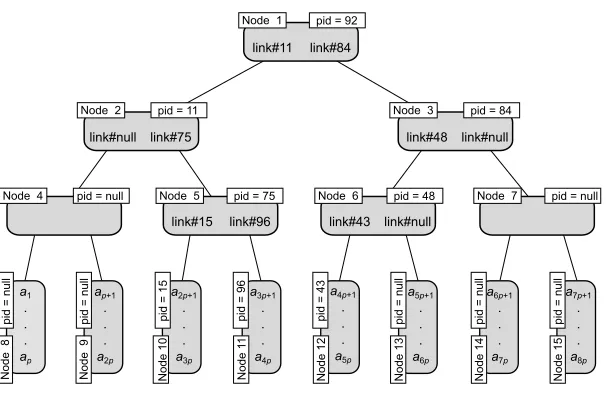
Fig. 1.Example Attribute Tree
used together to satisfy a predicate Υ. However, if the AIA issues a link♯811 attribute to the user as part of the “592” attribute set, then supplying this link attribute when making a signature would enable the signature to be made using bothEmployee592andExtendedHours811 (or any attributes from these two sets). If there are only two sets to link together, as in this simple example, it is easy to modify the RABS.SignandVerify functions to enforce the necessary properties. However, we would like to support more than just two-set scenarios, so we next describe how to build a tree of attributes so that an arbitrary number of attribute sets can be linked together and will define the sign and verify operations with respect to these attribute trees.
Attribute Trees.As described above, we partition the set Ainto bbuckets of
p=|A|/b attributes each. While we can generalize to any sizes, in this section
we assume thatbis powers of two. Consider a complete binary tree withbleaves, where each node in the tree can have an independently issued attribute set. The leaves correspond to the battribute buckets, and each internal node of the tree corresponds to an attribute set that can contain only link attributes. We use the standard 1-based numbering of nodes in a complete binary tree (as used in heaps) to identify positions in the tree, so “Node 1” is the root of the tree.
The AIA maintains such a tree for each user, with that user’s current issued attributes. An example is shown in Figure 1, where leaf nodes 10, 11, and 12 have issued attribute sets (withpids as shown in the figure), but other leaf nodes do not (indicated withpid=null). The AIA maintains a mapping between tree nodes andpids, and we can writepid[u, node] to refer to the currentpidfor user
As in the previous implementations, issued attribute sets contain validity at-tributes, and a validity attribute stored in any node of the tree overrides validity intervals specified in its children and by transitivity all of its descendants. This enables the reissue of the entire attribute set by simply adding a new validity attribute to the root node. We define two functions that are useful in describing how attribute issue and reissue work.
Given a set of attributesA, define thebucket set bs(A) to be the set of leaf nodes containing attributes fromA, and define theancestor set as(A) to be set of all proper ancestors of the bucket set. In the example in Figure 2,
bs({a2p+1, a3p+1, a4p+1}) ={Node 10,Node 11,Node 12}, and
as({a2p+1, a3p+1, a4p+1}) ={Node 1,Node 2,Node 3,Node 5,Node 6}. Whenever the AIA issues an attribute set A, it issues sets for nodes in bs(A) as well as the internal nodesas(A). The ancestor set always forms a connected subset of the attribute tree, and therefore if link attributes are interpreted as meaning “attribute sets pid andopidcan be used together,” then proving pos-session of the link attributes for the nodes in the ancestor set proves that all associated attribute sets can be used together to satisfy the predicate. After a set is issued (as represented by a connected subset of an attribute set), whenever a leaf node needs to be reissued by, for example, removing an attribute from a bucket, then we issue a new set for that leaf and link the new set in by issuing issue new sets for the internal nodes on the path from that leaf to the root.
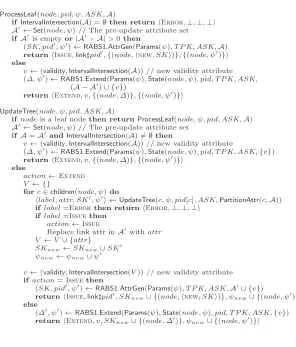
The key management operations,AttrGen,ReIssue, andExtendcan all be han-dled uniformly using theUpdateTreefunction shown in Figure 2. These functions are given access to the stateψthat the AIA saves regarding the keys in this at-tribute tree. For simplicity of notation, we define the following functions which extract parts of the information represented byψ:Set(node, ψ) denotes the set of attributes associated with any node in the tree,State(node, ψ) denotes thenode -specific state, and Params(ψ) denote the τ parameters for the attribute tree’s user. We also useIntervalIntersection(A) to denote the intersection of all intervals represented in a time-specific attribute set A. AttrGencalls UpdateTree with a null stateψsince this does not modify or build on an existing tree, whereas the two update functions (ReIssue and Extend) provide the saved state associated with the root of the tree.
Sign and Verify Operations.The previous description of attribute trees could
ProcessLeaf(node, pid, ψ, ASK,A)
ifIntervalIntersection(A) =∅then returnhError,⊥,⊥,⊥i
A′←
Set(node, ψ) // The pre-update attribute set ifA′is emptyor|A′− A|>0then
(SK, pid′, ψ′)←RABS1.AttrGen(Params(ψ), T P K, ASK,A) returnhIssue,link♯pid′,{(node,hnew, SKi)},{(node, ψ′)}i else
v←(validity,IntervalIntersection(A)) // new validity attribute (∆, ψ′)←
RABS1.Extend(Params(ψ),State(node, ψ), pid, T P K, ASK,
(A − A′ )∪ {v})
returnhExtend, v,{(node, ∆)},{(node, ψ′)}i
UpdateTree(node, ψ, pid, ASK,A)
ifnodeis a leaf nodethen returnProcessLeaf(node, ψ, pid, ASK,A)
A′←Set(node, ψ) // The pre-update attribute set ifA=A′and
IntervalIntersection(A)6=∅then
v←(validity,IntervalIntersection(A)) // new validity attribute (∆, ψ′)←
RABS1.Extend(Params(ψ),State(node, ψ), pid, T P K, ASK,{v})
returnhExtend, v,{(node, ∆)},{(node, ψ′)}i
else
action←Extend
V ← {}
forc∈children(node, ψ)do
hlabel, attr, SK′, ψ′i ←UpdateTree(c, ψ, pid[c], ASK,PartitionAttr(c,A)) iflabel=Errorthen returnhError,⊥,⊥,⊥i
iflabel=Issuethen action←Issue
Replace link attr inA′withattr V ←V ∪ {attr}
SKnew←SKnew∪SK′
ψnew←ψnew∪ψ′
v←(validity,IntervalIntersection(V)) // new validity attribute if action=Issuethen
(SK, pid′
, ψ′)←RABS1.AttrGen(Params(ψ), T P K, ASK,A′∪ {
v})
returnhIssue,link♯pid′, SKnew∪ {(node,hnew, SKi)}, ψnew∪ {(node, ψ′)}i
else
(∆′, ψ′)←RABS1.Extend(Params(ψ),State(node, ψ), pid, T P K, ASK,{v}) returnhExtend, v, SKnew∪ {(node, ∆′)}, ψnew∪ {(node, ψ′)}i
Fig. 2.Key-management functions.RABS1is a single-set RABS scheme.
In the example in Figure 2, the right child link attribute pictured for Node 5
would be the signatureDS.Sign(ASK,75klink♯96).
A signature in this attribute-based signature then is a non-interactive wit-ness indistinguishable (NIWI) proof showing that the signer knows signatures corresponding to a set of attributes that satisfy the predicateΥ. For a predicate
∃pid, σ1,· · ·, σℓ:
^
i=1,...,ℓ
(σi=⊥)∨DS.Ver(AP K, pidkai, σi) = 1
∧Υ({ai |σi6=⊥}) = 1.
(2)
Modifying this technique to use attribute trees, first note that a predicate
Υ that refers to attribute set AΥ will reference a subset of the attribute tree
with a total of nn = |bs(AΥ)|+|as(AΥ)| nodes. Therefore, Υ references nn
separately issued attribute sets and hence there arenndistinctpids to account for in the NIWI statement. In this subset of the attribute tree there arenn−1 link attributes, and since each link attribute and each base attribute is issued as a signature from the AIA, there are a total ofns=|AΥ|+nn−1 signatures.
To construct the NIWI statement, we order thenssignatures into a sequence so that σ1, . . . , σ|AΥ| are signatures for base attributes and σ|AΥ|+1, . . . , σns are
signatures for link attributes. We order the nn nodes of the attribute subtree arbitrarily so thatpid1, . . . , pidnn are the pids of the sets issued at all relevant nodes. We define a mapn: [1, . . . , ns]→[1, . . . , nn] so thatn(i) gives the node containing signature/attributeσi, so issued set for signatureσiispid[n(i)]. Since every node except the root node is linked from its parent by a link attribute, given as a signature, we define p : [1, . . . , ns] → [0, . . . , ns] so that p(i) is the parent link to the node containing σi; for the root node r we define p(r) = 0. Finally, we letlnk: [|AΥ|+ 1, . . . , ns]→[1, . . . , nn] be such that ifσirepresents
a link attribute then lnk(i) is the child node that this link attribute connects to. To simplify notation, we will useℓ(i) to denote nodei’s label, which is either
pid[n(i)]kai (for a leaf node) orpid[n(i)]klink♯pid[lnk(i)] (for an internal node). TheRABS.SignandRABS.Verifyoperations then create and verify a NIWI proof of the following predicate:
∃pid1,· · · , pidnn, σ1,· · ·, σns: ^
i=1,...,ns
(σi=⊥)∨
(DS.Ver(AP K, ℓ(i), σi) = 1)∧ p(i) = 0∨σp(i)6=⊥
∧ Υ({ai |1≤i≤n ∧ σi6=⊥}) = 1
Just like in (2), a user does not have to have signatures for all attributes in AΥ
to satisfy this statement, but if the user does supply a signature for a non-root attribute then it must also provide a signature for the link from its parent. This ensures that the attributes used by the signer (which must satisfyΥ by the last clause) are all connected by link attributes indicating that they can all be used together even though issued in different attribute sets.
Theorem 3. Under the q-SDH and either DLIN or SXDH assumptions,
Imple-mentation 3 is a secure RABS scheme.
properties. In the Groth-Sahai proof system, the prover first creates commit-ments to the witnesses and proves that the committed values satisfy equations constructed over bilinear maps.
In Equation 4.4, the prover generates bitwise commitments topid1,· · ·, pidnn, andr∈Zpfrom the underlying Boneh Boyen signature scheme. The prover then
sets∀i∈[1..nn], pidi=Σjpidij·2
jandr=Σ
jrj·2j. the prover can then gener-ate bitwise commitments topid1· · ·, pidnnandr. LetGandHbe cyclic groups of prime orderp, and letg∈G,h∈Hbe generators of their groups. The prover
generates commitments for gpidij, gri, hpidij, hri, overGand H, and proves the
following pairing equations for all values ofi, wherehvalidenotes a commitment to valueval:
e(hgpidiji, h) =e(g,hhpidiji);
e(hgrii, h) =e(g,hhrii);
e(hgpidiji,hhpidiji) =e(hgpidiji, h);
e(hgrii,hhrii) =e(hgrii, h)
Next, to show how to encode in the Groth-Sahai NIWI proof system, the prover needs to construct pairing equations over G and H for the statements
DS.Ver(AP K, pid[n(i)]kai, σi) = 1 andDS.ver(AP K, pid[n(i)]klink♯pid[lnk(i)], σi) =
1. With respect to the Boneh-Boyen signature scheme as given above,e(BCpid[n(i)]kaiDr, S) =
e(g, h) is logically equivalent to the expressionDS.Ver(AP K, pid[n(i)]kai, σi) = 1, whereσ= (S, r). And the equatione(BCpid[n(i)]klink♯pid[lnk(i)]Dr, S) =e(g, h) is logically equivalent to the expressionDS.Ver(AP K, pid[n(i)]klink♯pid[lnk(i)], σi) = 1, whereσ= (S, r). The prover then constructs and proves the following pairing equations:
e(hDri, h) =Y j
e(D2j,hhrji);
e(hCpidii, h) =Y
j
e(C2j,hhpidiji);
e(g, h) =e(BCa·2|pidi|
,hSi)e(hCpidii,hSi)e(hDri,hSi)
Finally, Groth-Sahai proofs can be instantiated using Waters’ signature scheme [16] under the Decision Linear or Symmetric External Diffie Hellman assumptions.
This completes the proof. ⊓⊔
Efficiency:Since the tree is a complete binary tree withbleaves (i.e., buckets),
there are log2blink nodes on the path from any attribute to the root. Therefore, |as(AΥ)| ≤ |AΥ|log
2b(with equality when|AΥ|= 1), and since|bs(AΥ)| ≤ |AΥ| we have nn≤ |AΥ|(1 + log2b) and ns≤ |AΥ|(2 + log2b). Therefore, compared
to the single-set NIWI proof, this implementation adds an overhead factor of
5
Counter-based Revocation (Revocation-on-Demand)
In this section, we illustrate the use of counter-based time (as defined in Sec-tion 2.1) to create an implemenSec-tion in which we can revoke attributes on de-mand. Recall that in counter-based time, time consists of a vector of integers ht1, t2,· · · , tkiwhere eachti corresponds to a monotonic counter. Each indepen-dently specifiable validity interval requires its own counter in this vector, so the vector dimension varies based on which RABS implementation we are using. For example, in Implementation 1, each attribute has an independently-specified va-lidity interval, so we require|A|counters, giving times that are |A|-dimensional
vectors. For large sets of attributes, this is very inefficient, but consider the other extreme: in Implementation 2, all attributes share the same validity interval, so in that case we only need a single counter, and a timetis just a single value for this counter. The counter-based technique is most interesting in Implementation 3, where forbbuckets we use bcounters, one for each bucket.
To provide trusted counter values, one could potentially use a “counter ser-vice” to maintain the counters, which can either be provided by the attribute-issuing authority, or by a separate dedicated server. The counter service can be implemented in software by the issuing authority, or the attribute-issuing authority (alternatively a separate, dedicated server) could be equipped with trusted hardware that maintains the counters. One way of generating a large number of counters using limited trusted hardware is the virtual mono-tonic counter construction proposed by Sarmenta et al. [14]. We use the same notation for the attribute set as in previous sections:A={(a1, ι1),· · · ,(au, ιu)}, where each ιi is of the form ιi = [tsi, tei], but in this case the time values
are vectors of counter values. Intervals are restricted in this setting, where specifying an interval [ts, te] means giving vectorsts =hts,1, ts,2,· · ·, ts,ki and
te=hte,1, te,2,· · ·, te,kiwhere, for eachi= 1, . . . , k, either
(a) ts,i=te,i or
(b) ts,i= 0 and te,i=∞.
Condition (a) gives a specific value for a counter, while condition (b) is basically a “don’t care” condition for that monotonic counter.
Example: Consider a instance of Implementation 3, with |A| = 64 and
at-tributes numbered 0, . . . ,63, an attribute tree with b = 4 buckets so that at-tributeai would be mapped to bucket number⌊i/16⌋fori= 0, . . . ,63, and we assign a counterctrito bucketifori= 0, . . . ,3. When making a signature for a predicate with AΥ ={a3, a12, a18, a55}, this involvesctr0 (fora3 and a12), ctr1
(for a18) and ctr3 (for a55). If ctr0 = 32,ctr1 = 49, ctr2 = 44, andctr3 = 12, then an interval saying that all the relevant attributes for Υ are at the “cur-rent time” could be [h32,49,0,12i,h32,49,∞,12i]. Since we have a “don’t care” condition for ctr2, signatures of the form σ= (t, φ) with t=h32,49,45,12i or
t=h32,49,46,12ior event=h32,49,324,12iwould all be in the required time interval.
Instantly revoking attributes is now easy: if user Alice has been issued both
thenctr0is incremented. This invalidates attributesa0, . . . , a15held by all users, including a3 held by Alice, so these must all be reissued. However, since this is only one fourth of the entire univers of attributes, this is more efficient than having to reissue all attributes to all users. Revoking an attributed tied to counter
ctr2 would result in incrementingctr2, but since this is a “don’t care” condition in the interval for Υ, signatures both before and after ctr2 is incremented are equally valid.
6
Conclusion
In this paper we have initiated a careful study of incorporating time intervals into attribute-signatures, so that attributes can be given a finite lifespan when they are issued. This allows for attribute revocation either at pre-defined time instances (in our clock-based techniques) or on demand (in our counter-based technique). This is preliminary work in this direction, and there are many open questions related to supporting different models of time as well as improving efficiency. One possible direction of future work is to explore revoking attributes while using non-monotone span programs [18], as this would help represent a richer range of predicates. From an efficiency standpoint, it would be useful to explore revocability in the setting of attribute-based signature construction techniques that avoid the use of non-interactive witness indistinguishable proofs.
References
1. Boneh, D., Boyen, X.: Short signatures without random oracles. In: EUROCRYPT. pp. 56–73 (2004)
2. Boneh, D., Boyen, X., Shacham, H.: Short group signatures. In: CRYPTO. pp. 41–55 (2004)
3. Boneh, D., Sahai, A., Waters, B.: Functional encryption: a new vision for public-key cryptography. Commun. ACM 55(11), 56–64 (2012)
4. Escala, A., Herranz, J., Morillo, P.: Revocable attribute-based signatures with adaptive security in the standard model. In: AFRICACRYPT. pp. 224–241 (2011) 5. Garg, S., Gentry, C., Halevi, S., Sahai, A., Waters, B.: Attribute-based encryption
for circuits from multilinear maps. In: CRYPTO. pp. 479–499 (2013)
6. Groth, J., Sahai, A.: Efficient non-interactive proof systems for bilinear groups. In: EUROCRYPT. pp. 415–432 (2008)
7. Herranz, J., Laguillaumie, F., Libert, B., R`afols, C.: Short attribute-based signa-tures for threshold predicates. In: CT-RSA’12. pp. 51–67 (2012)
8. Hohenberger, S., Waters, B.: Online/offline attribute-based encryption. In: PKC. pp. 293–310 (2014)
9. Li, J., Au, M.H., Susilo, W., Xie, D., Ren, K.: Attribute-based signature and its applications. In: ASIACCS. pp. 60–69 (2010)
10. Maji, H.K., Prabhakaran, M., Rosulek, M.: Attribute-based signatures. In: CT-RSA. pp. 376–392 (2011)
12. Okamoto, T., Takashima, K.: Decentralized attribute-based signatures. In: Public Key Cryptography. pp. 125–142 (2013)
13. Rouselakis, Y., Waters, B.: Practical constructions and new proof methods for large universe attribute-based encryption. In: ACM CCS. pp. 463–474 (2013) 14. Sarmenta, L.F.G., van Dijk, M., O’Donnell, C.W., Rhodes, J., Devadas, S.: Virtual
monotonic counters and count-limited objects using a TPM without a trusted OS. In: ACS CCS, STC. pp. 27–42 (2006)
15. Shahandashti, S.F., Safavi-Naini, R.: Threshold attribute-based signatures and their application to anonymous credential systems. In: AFRICACRYPT. pp. 198– 216 (2009)
16. Waters, B.: Efficient identity-based encryption without random oracles. In: EU-ROCRYPT. pp. 114–127 (2005)
17. Waters, B.: Functional encryption: Origins and recent developments. In: PKC. pp. 51–54 (2013)