Transparency Logs via Append-Only Authenticated Dictionaries
Alin Tomescu
Massachusetts Institute of Technology
Vivek Bhupatiraju
Lexington High School MIT PRIMES
Dimitrios Papadopoulos
Hong Kong University of Science and Technology
Charalampos Papamanthou
University of Maryland
Nikos Triandopoulos
Stevens Institute of Technology
Srinivas Devadas
Massachusetts Institute of Technology
ABSTRACT
Transparency logs allow users to audit a potentially malicious ser-vice, paving the way towards a more accountable Internet. For example, Certificate Transparency (CT) enables domain owners to audit Certificate Authorities (CAs) and detect impersonation attacks. Yet, to achieve their full potential, transparency logs must be bandwidth-efficient when queried by users. Specifically, every-one should be able to efficientlylook uplog entries by their key
andefficiently verify that the log remainsappend-only. Unfortu-nately, without additional trust assumptions, current transparency logs cannot provide both small-sizedlookup proofsand small-sized
append-only proofs. In fact, one of the proofs always requires band-width linear in the size of the log, making it expensive for everyone to query the log. In this paper, we address this gap with a new primitive called anappend-only authenticated dictionary(AAD). Our construction is the first to achieve (poly)logarithmic size for both proof types and helps reduce bandwidth consumption in trans-parency logs. This comes at the cost of increased append times and high memory usage, both of which remain to be improved to make practical deployment possible.
CCS CONCEPTS
•Security and privacy→Key management; •Theory of com-putation→ Cryptographic primitives;Data structures de-sign and analysis.
KEYWORDS
append-only; transparency logs; authenticated dictionaries; Merkle trees; bilinear accumulators; RSA accumulators; polynomials
ACM Reference Format:
Alin Tomescu, Vivek Bhupatiraju, Dimitrios Papadopoulos, Charalampos Papamanthou, Nikos Triandopoulos, and Srinivas Devadas. 2019. Trans-parency Logs via Append-Only Authenticated Dictionaries. In2019 ACM SIGSAC Conference on Computer and Communications Security (CCS ’19), November 11–15, 2019, London, United Kingdom.ACM, New York, NY, USA, 18 pages. https://doi.org/10.1145/3319535.3345652
Permission to make digital or hard copies of all or part of this work for personal or classroom use is granted without fee provided that copies are not made or distributed for profit or commercial advantage and that copies bear this notice and the full citation on the first page. Copyrights for components of this work owned by others than the author(s) must be honored. Abstracting with credit is permitted. To copy otherwise, or republish, to post on servers or to redistribute to lists, requires prior specific permission and/or a fee. Request permissions from [email protected].
CCS ’19, November 11–15, 2019, London, United Kingdom
© 2019 Copyright held by the owner/author(s). Publication rights licensed to ACM. ACM ISBN 978-1-4503-6747-9/19/11. . . $15.00
https://doi.org/10.1145/3319535.3345652
1
INTRODUCTION
Security is often bootstrapped from apublic-key infrastructure (PKI). For example, on the web,Certificate Authorities (CAs)digitally sign
certificatesthat bind a website to its public key. This way, a user who successfully verifies the certificate can set up a secure channel with the website. In general, many systems require a PKI or assume one exists [39, 40, 60, 84]. Yet, despite their necessity, PKIs have proven difficult to secure as evidenced by past CA compromises [1, 63, 77]. To address such attacks,transparency logs[29, 36, 59] have been proposed as a way of buildingaccountable(and thus more secure) PKIs. A transparency log is adictionarymanaged by an untrusted
log server. The server periodically appendskey-value pairsto the dictionary and is queried by mutually-distrustingusers, who want to know certain keys’ values. For example, inkey transparency[8, 23, 55, 59, 65, 88, 95, 104], CAs are required to publicly log certificates they issue (i.e., values) for each domain (i.e., keys). Fake certificates can thus be detected in the log and CAs can be held accountable for their misbehavior.
Transparency logging is becoming increasingly important in today’s Internet. This is evident with the widespread deployment of Google’s Certificate Transparency (CT) [59] project. Since its initial March 2013 deployment, CT has publicly logged over 2.1 billion certificates [44]. Furthermore, since April 2018, Google’s Chrome browser requires all new certificates to be published in a CT log [93]. In the same spirit, there has been increased research effort intosoftware transparencyschemes [2, 38, 49, 78, 94, 96] for securing software updates. Furthermore, Google is prototyping
general transparencylogs [36, 45] via their Trillian project [45]. Therefore, it is not far-fetched to imagine generalized transparency improving our census system, our elections, and perhaps our gov-ernment. But to realize their full potential, transparency logs must operate correctly or be easily caught otherwise. Specifically:
Logs should support lookups.When users have access to digests (instead of whole logs), the central question becomes: How can a user checkagainst their digestwhich values are registered for a certain keykin the log? Ideally, a smalllookup proof should convince the user that the server has returnednothing more or less than all valuesof keyk. Otherwise, the server could equivocate and present one set of valuesVforkto a user and a different setV′to some other user, even though both users have the same digest and should thus see the same set of values for keyk.
Logs should remain fork-consistent.An unavoidable issue is that a malicious log server can also equivocate about digests and
forkusers [29, 60]. For example, at timei, the server can append
(k,v)to one user’s log while appending(k,v′)to another user’s log. Since the two users’ logs will differ at locationi, their digests will also differ. Intuitively,fork consistency[60, 61] guarantees that if two users are given two different digests as above, they must forever be given different digests. Thus, users cangossip[28, 32, 94, 96] to check if they are seeing different digests and detect forks.
Challenges.Building transparency logs with succinct lookup and append-only proofs is a long-standing open problem. At first glance, a Merkle-based [68] solution seems possible. Unfortunately, it ap-pears very difficult to organize a Merkle tree so as to support both succinct append-only proofs and succinct lookup proofs. On one hand, trees with chronologically-ordered leaves [29, 64, 97] support logarithmic-sized append-only proofs but at the cost of linear-sized lookup proofs. On the other hand, trees can be lexicographically-ordered by key [6, 23, 30, 79] to support succinct lookup proofs at the cost of linear append-only proofs (see Section 6.2).
It might seem natural to combine the two and obtain succinct lookup proofs via the lexicographic tree and succinct append-only proofs via the chronologic tree [88]. But this does not work either, since there must be a succinct proof that the two trees “correspond”: they are correctly built over the same set of key-value pairs. While previous transparency logs [88, 104] work around this by having users “collectively” verify that the two trees correspond [26, 88, 104], this requires a sufficiently high number of honest users and can result in slow detection. An alternative, which we discuss in Sec-tion 7.1, is to use SNARKs [42, 48]. At second glance,cryptographic accumulators[13, 76] seem useful for building transparency logs (see Section 2.1). Unfortunately, accumulators are asymptotically-inefficient, requiring linear time to compute proofs or to update proofs after a change to the set. As a result, a computationally-efficient accumulator-based solution is not obvious.
Our contribution.We introduce a novel cryptographic primitive called anappend-only authenticated dictionary (AAD). An AAD maps a key to one or more values in an append-only fashion and is an abstraction for a transparency log. We are the first to give security definitions for AADs. We are also the first to instantiate asymptoticallyefficientAADs frombilinear accumulators[76] (see Section 5). Importantly, our design does not rely on collective veri-fication by users or on trusted third parties and assumes only an untrusted log server. Our AAD offers logarithmic-sized append-only proofs, polylogarithmic-sized lookup proofs and polylogarithmic worst-case time appends (see Table 1).
We implement our AAD in C++ and evaluate it. Our code is available at https://github.com/alinush/libaad-ccs2019. Our lookup
Table 1: Asymptotic costs of our construction versus previ-ous work.nis the number of key-value pairs in the dictio-nary andλis the security parameter.
Time & bandwidth Space Appendtime proof sizeLookup Append-onlyproof size
Lexicographic trees [65, 88] nlogn logn logn n
Chronologic trees [29, 59] n logn n logn
AAD(this work) λn λlog3n log2n logn
and append-only proofs are in the order of tens of KiBs and our verification time is in the order of seconds. For example, a proof for a key with 32 values in a dictionary of 106entries is 94 KiB and verifies in 2.5 seconds. While our lookup proof sizes are larger than in previous work, our small-sized append-only proofs can help significantly reduce the overall bandwidth consumption in transparency logs, as we show in Section 6.2.1.
Limitations of our approach.Our construction has high append times (i.e., a few seconds per append) and high memory usage (i.e., hundreds of GiBs for an AAD of size 220). This means it is not yet practical and we discuss how future work might improve it in Sections 6.1.1 and 6.1.4. The security of our construction relies on theq-PKE “knowledge” assumption (commonly used in SNARKs [43, 47]). Hence, we need a large set of public parameters that must be generated via atrusted setupphase, which complicates deployment. We discuss how the trusted setup can be decentralized in Section 7.
Overview of techniques.We first build an efficientappend-only authenticated set(AAS), instead of an AAD. An AAS is an append-only set of elements with proofs of (non)membership of any element. If we let elements be revoked certificates, then an AAS efficiently implements Revocation Transparency (RT) [58]. But to efficiently implementanytransparency log, we must modify our AAS into an AAD, which is more “expressive.” Specifically, an AAD can provably return all values of a key, while an AAS can only prove that an element is or is not in the set. One could attempt to build an AAD from an AAS in “black-box” fashion by representing an AAD key-value pair as an AAS element. Unfortunately, this is not sufficient if we want to convince AAD verifiers thatallvalues of a key have been returned via a lookup proof. In Section 5, we describe a non-black-box modification of our AAS into an AAD.
1.1
Related Work
The key difference between AADs and previous work [8, 23, 55, 59, 65, 88, 95, 104] is that we offer succinct proofs for everything while only relying on a single, untrusted log server. In contrast, previous work either has large proofs [59, 65], requires users to “collectively” verify the log [88, 104] (which assumes enough honest users and can make detection slow), or makes some kind of trust assumption about one or more actors [8, 55, 59, 95]. On the other hand, previ-ous work only relies on collision-resistant hash functions, digital signatures and verifiable random functions (VRFs) [71]. This makes previous work much cheaper computationally, but since bandwidth is more expensive than computation, we believe this is not necessar-ily the right trade-off. In contrast, our bilinear construction requires trusted setup, large public parameters, and non-standard assump-tions. Unlike previous work, our construction is not yet practical due to high append times and memory usage (see Sections 6.1.1 and 6.1.4). Finally, previous work [8, 55, 95, 104] addresses in more depth the subtleties of log-based PKIs, while our work is focused on improving the transparency log primitive itself by providing succinct proofs with no trust assumptions.
CT and ECT.Early work proposes the use of Merkle trees for public-key distribution but does not tackle the append-only prob-lem, only offering succinct lookup proofs [23, 56, 75]. Accumulators are dismissed in [23] due to trusted setup requirements. Certifi-cate Transparency (CT) [59] provides succinct append-only proofs viahistory trees(HTs). Unfortunately, CT does not offer succinct lookup proofs, relying on users to download each update to the log to discover fake PKs, which can be bandwidth-intensive (see Section 6.2.1). Alternatively, users can look up their PKs via one or more CTmonitors, who download and index the entire log. But this introduces a trust assumption that a user can reach at least one honest CT monitor. Enhanced Certificate Transparency (ECT) addresses CT’s shortcomings by combining a lexicographic tree with a chronologic tree, with collective verification by users (as discussed before). Alternatively, ECT can also rely on one or more “public auditors” to verify correspondence of the two trees, but this
introduces a trust assumption.
A(RP)KI and PoliCert.Accountable Key Infrastructure (AKI) [55] introduces a checks-and-balances approach where log servers man-age a lexicographic tree of certificates and so-called “validators” ensure log servers update their trees in an append-only fashion. Unfortunately, AKI must“assume a set of entities that do not collude: CAs, public log servers, and validators”[55]. At the same time, an ad-vantage of AKI is that validators serve as nodes in a gossip protocol, which helps detect forks. ARPKI [8] and PoliCert [95] extend AKI by providing security against attackers controllingn−1 out ofnactors. Unfortunately, this means ARPKI and PoliCert rely on an anytrust assumption to keep their logs append-only. On the other hand, AKI, ARPKI and PoliCert carefully consider many of the intricacies of PKIs in their design (e.g., certificate policies, browser policies, de-ployment incentives, interoperability). In addition, ARPKI formally verifies their design.
CONIKS and DTKI.CONIKS [65] uses a hash chain to periodi-cally publish a digest of a lexicographic tree. However, users must collectively verify the tree remains append-only. Specifically,in every published digest, each user checks that their own public key
has not been removed or maliciously changed. Unfortunately, this process can be bandwidth-intensive (see Section 6.2.1). DTKI [104] observes that relying on a multiplicity of logs (as in CT) creates overhead for domain owners who must check for impersonation in every log. DTKI introduces amapping logthat associates sets of domains to their own exclusive transparency log. Unfortunately, like ECT, DTKI also relies on users to collectively verify its many logs. To summarize, while previous work [8, 55, 95, 104] addresses many facets of the transparent PKI problem, it does not address the problem of building a transparency log with succinct proofs without trust assumptions and without collective verification.
Byzantine Fault Tolerance (BFT).If one is willing to move away from the single untrusted server model, then a transparency log could be implemented using BFT protocols [25, 57, 72]. In fact, BFT can trivially keep logs append-only and provide lookup proofs via sorted Merkle trees. With permissioned BFT [25], one must trust that 2/3 of BFT servers are honest. While we are not aware of permissioned implementations, they are worth exploring. For example, in the key transparency setting, it is conceivable that CAs might act as BFT servers. With permissionless BFT [72, 102], one needs a cryptocurrency secured by proof-of-work or proof-of-stake. Examples of this are Namecoin [73], Blockstack [4] and EthIKS [18].
Formalizations.Previous work formalizes Certificate Transparency (CT) [27, 34] and general transparency logs [27]. In contrast, our work formalizes append-only authenticated dictionaries (AAD) and sets (AAS), which can be used as transparency logs. Our AAD abstraction is more expressive than thedynamic list commitment (DLC)abstraction introduced in [27]. Specifically, DLCs are append-only lists with non-membership by insertion time, while AADs are append-only dictionaries with non-membership by arbitrary keys. Furthermore, AADs can be easily extended to support non-membership by insertion time. Finally, previous work carefully formalizes proofs of misbehavior for transparency logs [27, 34]. Al-though misbehavior in AADs is provable too, we do not formalize this in the paper. Neither our work nor previous work adequately models the network connectivity assumptions needed to detect forks in a gossip protocol. Lastly, previous work improves or ex-tends transparency logging in various ways but does not tackle the append-only problem [31, 37, 83].
2
PRELIMINARIES
Notation.Letλdenote our security parameter. LetH denote a collision-resistant hash function (CRHF) with 2λ-bits output. We use multiplicative notation for all algebraic groups in this paper. LetFpdenote the finite field “in the exponent” associated with a groupGof prime orderp. Letpoly(·)denote any function upper-bounded by some univariate polynomial. Let logxbe shorthand for log2x. Let [n]={1,2, . . . ,n}and [i,j]={i,i+1, . . . ,j−1,j}. Let P Pq(s)=⟨дs,дs2, . . . ,дsq⟩denoteq-SDH public parameters. and
P Pq(s,τ) = ⟨дs,дs2, . . . ,дsq,дτ s,дτ s2, . . . ,дτ sq⟩denoteq-PKE public parameters (see Appendix A). Letεdenote the empty string.
Cryptographic assumptions.Our work relies on the use of pair-ingsorbilinear maps[51, 67]. Recall that a bilinear mape(·,·)has useful algebraic properties:e(дa,дb) =e(дa,д)b = e(д,дb)a =
symmetric (Type I) pairings (although our implementation in Sec-tion 6 uses asymmetric pairings). Our assumpSec-tions can be re-stated in the setting of (the more efficient) asymmetric (Type II and III) pair-ings in a straightforward manner. Our AAS and AAD constructions from Sections 3 and 5 are provably secure under theq-SBDH [46] andq-PKE assumptions [47], which we define in Appendix A.
Theq-PKE assumption is non-standard and often referred to as “non-falsifiable” in the literature. This terminology can be confusing, since previous, so-called “non-falsifiable” assumptions have been falsified [9]. Naor explored the nuance of these types of assumptions and proposed thinking of them as “not efficiently falsifiable” [74]. For example, to falsifyq-PKE one must find an adversary and math-ematically prove thatallextractors fail for it.
2.1
Bilinear Accumulators
Abilinear accumulator[33, 76] is a cryptographic commitment to a setT ={e1,e2, . . . ,en}, referred to as theaccumulated set.
Committing to a set.LetCT(x) =(x −e1)(x−e2)· · ·(x−en) denote thecharacteristic polynomialofT andsdenote a trapdoor that nobody knows. The accumulatoracc(T)ofTis computed as acc(T) = дCT(s) = д(s−e1)(s−e2)···(s−en). The trapdoorsis gen-erated during atrusted setup phaseafter which nobody knowss. Specifically, given an upper-boundqon the set size, this phase re-turnsq-SDH public parametersP Pq(s)=⟨дs,дs2, . . . ,дsq⟩. This can be done via MPC protocols [20, 21, 54] as detailed in Section 7. Given coefficientsc0,c1, . . . ,cnofCT(·)wheren≤q, the accumu-lator is computedwithout knowingsas follows:
acc(T)=дc0(дs)c1(дs2)c2· · ·(дsn)cn =дc0+c1s+c2s2···cnsn =дCT(s)
In other words, the server computes apolynomial commitment[53, 76] to the characteristic polynomial ofT. Since the accumulator only supports elements fromFp, we assume a functionHF:D →Fp
that maps elements to be accumulated from any domainDto values inFp. If|D |>|Fp|, thenHFcan be a CRHF.
Membership proofs.Aprover who hasT can convince a veri-fierwho hasacc(T)that anelementei is in the setT. The prover simply convinces the verifier that(x−ei) | CT(x)by presenting a commitmentπ =дq(s)to a quotient polynomialq(·)such that CT(x)=(x−ei)q(x). Using a bilinear map, the verifier checks the property above holds atx=s, which is secure underq-SDH [53]:
e(д,acc(T))=?e(π,дs/дei)⇔e(д,д)CT(s)=?e(д,д)q(s)(s−ei)
Subset and disjointness proofs.To prove thatA⊆B, the prover shows thatCA(x)| CB(x). Specifically, the prover presents a com-mitmentπ =дq(s)of a quotient polynomialq(·)such thatCB(x)= q(x)CA(x). The verifier checks thate(д,acc(B))=e(π,acc(A)).
To prove thatA∩B=∅, the prover uses the Extended Euclidean Algorithm (EEA) [98] to compute Bézout coefficientsy(·)andz(·) such thaty(x)CA(x)+z(x)CB(x)=1. The proof consists of com-mitments to the Bézout coefficientsγ =дy(s)andζ =дz(s). The verifier checks thate(γ,acc(A))e(ζ,acc(B)) =e(д,д). By setting
B={e}, we get another type of non-membership proof fore<A.
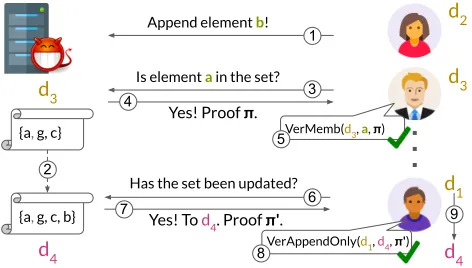
Figure 1: Our model: a single maliciousservermanages aset
and manyclientsquery the set. Clients will not necessarily have the digest of the latest set. The clients can (1) append a new element to the set, (2) query for an element and (3) ask for an updated digest of the set.
Fast Fourier Transform (FFT).We use FFT [99] to speed up polynomial multiplication and division. For polynomials of degree-boundn, we divide and multiply them inO(nlogn)field opera-tions [85]. We interpolate a polynomial from itsnroots inO(nlog2n) field operations [100]. We compute Bézout coefficients for two poly-nomials of degree-boundnusing the Extended Euclidean Algorithm (EEA) inO(nlog2n)field operations [98].
3
APPEND-ONLY AUTHENTICATED SETS
We begin by introducing a new primitive called anappend-only authenticated set(AAS). An AAS can be used for Revocation Trans-parency (RT) as proposed by Google [58]. In Section 5, we modify our AAS into anappend-only authenticated dictionary(AAD), which can be used for generalized transparency [36].
Overview.An AAS is a set ofelementsmanaged by anuntrusted serverand queried byclients. The server is the sole author of the AAS: it can append elements on its own and/or accept elements from clients. Clients can check membership of elements in the set (see Steps 3-5 in Figure 1). Clients, also known asusers, are mutually-distrusting, potentially malicious, and do not have identities (i.e., no authorization or authentication). Initially, the set starts out empty atversionzero, with new appends increasing its size and version by one. Importantly, once an element has been appended to the set, it remains there forever: an adversary cannot remove nor change the element. After each append, the server signs and publishes a new, small-sizeddigestof the updated set (e.g., Step 2).
Clients periodically update their view of the set by requesting a new digest from the server (e.g., Step 6 and 7). The new digest could be for an arbitrary versionj>i, whereiis the previous version of the set (not just forj=i+1). Importantly, clients always ensure the set remainsappend-onlyby verifying anappend-only proof πi,j
between the old and new digest (e.g., Step 8). This way, clients can be certain the malicious server has not removed any elements from the set. Clients will not necessarily have the latest digest of the set. Finally, clients securely check if an elementkis in the set via a
(non)membership proof (e.g., Steps 3-5 in Figure 1).
afork consistentview [60, 61] of the set by checking append-only proofs. As a consequence, if the server ever withholds an append from one client, that client’s digest will forever diverge from other clients’ digests. To detect suchforks, clients cangossip[28, 32, 94, 96] with one another about their digests. This is crucial for security in transparency logs.
This model is the same as in history trees (HTs) [29], assuming only a gossip channel and no trusted third parties. It also arises in encrypted web applications [39, 52, 84], Certificate Transparency (CT) [59] and software transparency schemes [38, 78]. Unlike the 2- and 3-party models [6, 82, 86], there is notrusted sourcethat signs appends in this model. A trusted source trivially solves the AAS/AAD problem as it can simply vouch for the data structure’s append-only property with a digital signature. Unfortunately, this kind of solution is useless for transparency logs [59, 65, 88], which lack trusted parties.
Server-side API.The untrusted server implements:
Setup(1λ,β)→pp,V K. Randomized algorithm that returns public parametersppused by the server and averification keyV Kused by clients. Here,λis a security parameter andβ is an upper-bound on the number of elementsnin the set (i.e.,n≤β). Append(pp,Si,di,k) → Si+1,di+1. Deterministic algorithm that
appends a new elementkto the versioniset, creating a new versioni+1 set. Succeeds only if the set is not full (i.e.,i+1≤β). Returns the new authenticated setSi+1and its digestdi+1. ProveMemb(pp,Si,k)→b,π. Deterministic algorithm that proves
(non)membership for elementk. Whenkis in the set, generates a membership proofπand setsb =1. Otherwise, generates a non-membership proofπand setsb=0.
ProveAppendOnly(pp,Si,Sj)→πi,j. Deterministic algorithm that provesSi ⊆ Sj. In other words, generates anappend-only proof πi,jthat all elements inSi are also present inSj. Importantly, a malicious server who removed elements fromSj that were present inSicannot construct a valid append-only proof.
Client-side API.Clients implement:
VerMemb(V K,di,k,b,π) → {T,F}. Deterministic algorithm that verifies proofs returned byProveMemb(·)against the digestdi. Whenb=1, verifieskis in the set via the membership proofπ. Whenb=0, verifieskisnotin the set via the non-membership proofπ. (We formalize security in Section 3.1.)
VerAppendOnly(V K,di,i,dj,j,πi,j)→ {T,F}. Deterministic algo-rithm that ensures a set remains append-only. Verifies thatπi,j
correctly proves that the set with digestdiis a subset of the set with digestdj. Also, verifies thatdianddj are digests of sets at versioniandjrespectively, enforcing fork consistency.
Using the API.To use an AAS scheme, first public parameters need to be computed using a call toSetup(·). If the AAS scheme is trapdoored, a trusted party or MPC protocol runsSetup(·)and forgets the trapdoor (see Section 7). Once computed, the parameters can be reused by different servers for different append-only sets. Setup(·)also returns apublicverification keyV Kto all clients.
Then, the server broadcasts the initial digestd0of the empty set S0to its many clients. Clients can concurrently start appending elements usingAppend(·)calls. If the server is honest, it serial-izesAppend(·)calls. Eventually, the server returns a new digestdi
to clients along with an append-only proofπ0,i computed using ProveAppendOnly(·). Some clients might be offline but eventually they will receive eitherdi or a newerdj,j >i. Importantly, when-ever clients transition from versionitoj, they check an append-only proofπi,j usingVerAppendOnly(V K,di,i,dj,j,πi,j).
Clients can look up elements in the set. The server proves (non)-membership of an element usingProveMemb(·). A client verifies the proof usingVerMemb(·)against their digest. As more elements are added by clients, the server continues to publish a new digest
djand can prove it is a superset of any previous digestdi using ProveAppendOnly(·).
3.1
AAS Correctness and Security Definitions
We first introduce some helpful notation for our correctness def-initions. Consider an ordered sequence ofnappends (ki)i∈[n]. LetS′,d′ ← Append+(pp,S,d,(ki)i∈[n])denote a sequence of Append(·)calls arbitrarily interleaved with otherProveMemb(·) andProveAppendOnly(·)calls such thatS′,d′←Append(pp,Sn−1,dn−1,kn),Sn−1,dn−1←Append(pp,Sn−2,dn−2,kn−1),. . .,S1,d1 ←Append(pp,S,d,k1). Finally, letS0denote an empty AAS with empty digestd0.
Definition 3.1(Append-only Authenticated Set). (Setup,Append, ProveMemb,ProveAppendOnly,VerMemb,VerAppendOnly) is a secure append-only authenticated set (AAS) if∃a negligible func-tionε,∀security parametersλ,∀upper-boundsβ=poly(λ)and ∀n≤βit satisfies the following properties:
Membership correctness.∀ordered sequences of appends(ki)i∈[n], for all elementsk, whereb=1 ifk∈(ki)i∈[n]andb=0 otherwise,
Pr
(pp,V K)←Setup(1λ,β),
(S,d)←Append+(pp,S0,d0,(ki)i∈[n]),
(b′,π)←ProveMemb(pp,S,k): b=b′∧VerMemb(V K,d,k,b,π)=T
≥1−ε(λ)
Observation:Note that this definition compares the returned bitb′
with the “ground truth” in(ki)i∈[n]and thus provides membership correctness. Also, it handles non-membership correctness sinceb′ can be zero. Finally, the definition handles all possible orders of appending elements.
Membership security.∀adversariesArunning in timepoly(λ),
Pr
(pp,V K)←Setup(1λ,β),
(d,k,π,π′)←A(pp,V K): VerMemb(V K,d,k,0,π,)=T∧
VerMemb(V K,d,k,1,π′,)=T
≤ε(λ)
Observation:This definition captures the lack of any “ground truth” about what was inserted in the set, since there is no trusted source in our model. Nonetheless, given a fixed digestd, our definition pre-ventsallequivocation attacks about the membership of an element in the set.
Append-only correctness.∀m<n,∀sequences of appends(ki)i∈[n] wheren≥2,
Pr
(pp,V K)←Setup(1λ,β)
(Sm,dm)←Append+(pp,S0,d0,(ki)i∈[m]), (Sn,dn)←Append+(pp,Sm,dm,(ki)i∈[m+1,n]),
π←ProveAppendOnly(pp,Sm,Sn): VerAppendOnly(V K,dm,m,dn,n,π)=T
Append-only security.∀adversariesArunning in timepoly(λ),
Pr
(pp,V K)←Setup(1λ,β)
(di,dj,i<j,πa,k,π,π′)←A(pp,V K): VerAppendOnly(V K,di,i,dj,j,πa)=T∧
VerMemb(V K,di,k,1,π)=T∧
VerMemb(V K,dj,k,0,π′)=T
≤ε(λ)
Observation:This definition ensures that elements can only be added to an AAS.
Fork consistency.∀adversariesArunning in timepoly(λ),
Pr
(pp,V K)←Setup(1λ,β)
(di ,di′,dj,i<j,πi,πi′)←A(pp,V K): VerAppendOnly(V K,di,i,dj,j,πi)=T∧
VerAppendOnly(V K,di′,i,dj,j,πi′)=T
≤ε(λ)
Observation:This is our own version of fork consistency that cap-tures what is known in the literature about fork consistency [29, 61]. Specifically, it allows a server to fork the set at versioniby present-ing two different digestsdi anddi′and prevents the server from forging append-only proofs that “join” the two forks into some common digestdjat a later versionj.
4
AAS FROM ACCUMULATORS
This section presents our accumulator-based AAS construction. We focus on bilinear accumulators here and discuss how our construc-tion would benefit from RSA accumulators in Secconstruc-tion 7. We give a more formal algorithmic description in Appendix B.
As mentioned in Section 1, a bilinear accumulator overn el-ements is already an AAS, albeit an inefficient one. Specifically, proving (non)membership in a bilinear accumulator requires an
O(n)time polynomial division. As a consequence, precomputing all
nmembership proofs (naively) takesO(n2)time, which is prohibi-tive for most use cases. Even worse, for non-membership, one must precompute proofs for all possible missing elements, of which there are exponentially many (in the security parameterλ). Therefore, we need new techniques to achieve our desired polylogarithmic time complexity for computing both types of proofs in our AAS.
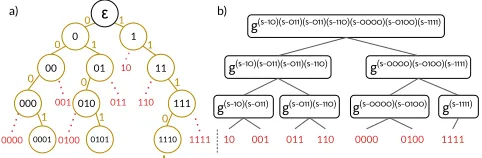
A bilinear tree accumulator.Our first technique is to deploy the bilinear accumulator in a tree structure, as follows. We start with the elementseias leaves of a binary tree (see Figure 2b). Specifically, each leaf will store an accumulator over the singleton set{ei}. Every internal node in the tree will then store an accumulator over the union of the sets corresponding to its two children. For example, the parent node of the two leaves corresponding to{ei} and{ei+1}stores the accumulator of the set{ei,ei+1}. In this way, the root is the accumulator over the full setS ={e1, . . . ,en}(see Figure 2). We stress that all these accumulators use the same public parameters. The time to compute all the accumulators in the tree is
T(n)=2T(n/2)+O(nlogn)=O(nlog2n)whereO(nlogn)is the time to multiply the characteristic polynomials of two sets of sizen in the tree. We call the resulting structure abilinear treeover setS.
Membership proofs in bilinear trees.A membership proof for elementei will leverage the fact that sets along the path from
ei’s leaf to the root of the bilinear tree are subsets of each other. The proof will consist of a sequence ofsubset proofsthat validate this (computed as explained in Section 2.1). Specifically, the proof contains the accumulators along the path fromei’s leaf to the root,
Figure 2: On the left side, we depict a trie over setS={a,b,c}. Each element is mapped to a unique path of length4in the trie. Nodes that are not in the trie but are at itsfrontierare depicted inred. On the right side, we depict abilinear fron-tier tree(BFT) corresponding to the setS. To prove that an element is not inS, we prove one of its prefixes is in the BFT.
as well as the accumulators of all sibling nodes along this path (see Figure 2b). The client verifies all these subset proofs, starting from the singleton set{ei}in the leaf. This convinces him that
ei is contained in the parent’s accumulated set, which in turn is contained in its parent’s accumulated set and so on, until the root. Our bilinear tree approach gives us membership proofs of log-arithmic size and thus loglog-arithmic verification time. Importantly, computing a bilinear tree inO(nlog2n)time implicitly computes all membership proofs “for free”! In contrast, building a standard billinear accumulator overSwould yield constant-size proofs but inO(n2)time for allnproofs. Unfortunately, our bilinear tree struc-ture does not (yet) support precomputing non-membership proofs. We devise new techniques that address this next.
Bilinear prefix trees to the rescue.To efficiently precompute non-membership proofs, we slightly modify our bilinear tree. In-stead of storing an elementei ∈ S, theith leaf will store theset of prefixesof the binary representation ofei. We assume this rep-resentation is 2λbits (or is made so using a CRHF) and can be mapped to an element inFp(which is also of size≈2λbits) and thus can be accumulated. For example, a leaf that previously stored elemente1with binary representation 0001, will now store the set
P(e1)={ε,0,00,000,0001}(i.e., all the prefixes of the binary repre-sentation ofe1, including the empty stringε). In general, for each elementei,P(ei)is the set of all 2λ+1 prefixes ofei. Also, for any set
S={e1, . . . ,en}, we define itsprefix setasP(S)=P(e1)∪· · ·∪P(en). For example, letS ={a=0001,b =0101,c =1110}. The root of
S’s bilinear tree will contain an accumulator overP(S) =P(a)∪ P(b)∪P(c)={ε,0,1,00,01,11,000,010,111,0001,0101,1110}.
We refer to such a bilinear tree as abilinear prefix tree (BPT)
Figure 3: A forest starting empty and going through a se-quence of five appends. A forest only has trees of exact size
2j for distinctj’s. A forest ofnleaves hasat mostlogntrees.
before, the client starts the proof verification from the leaf, which now stores a prefix setP(ei)rather than a singleton set{ei}.
Efficient non-membership proofs.But how does a BPT help with precomputing non-membership proofs for any elemente′
<S?
First, note that, because of our use of prefixes, to provee′ < S
it suffices to show thatany one prefixρofe′is not contained in P(S). Second, note that there might exist other elementse′′who shareρ as a prefix. As a result, the non-membership proof for
e′could be “reused” as a non-membership proof fore′′. This is
best illustrated in Figure 2a using our previous example where
S ={a,b,c}. Consider elementsd =0111 andf =0110 that are not inS. To prove non-membership for either element, it suffices to prove the same statement: 011<P(S). Thus, if we can identify all
suchshared prefixes, we can use them to prove the non-membership of (exponentially) many elements. (This technique is also used in Micali et al’s zero-knowledge sets [70].)
To do this, we insert all elements fromSin a trie as depicted in Figure 2a. Next, we keep track of the prefixes at the “frontier” of the trie depicted in red in Figure 2a. We immediately notice that to prove non-membership of any element, it suffices to prove non-membership of one of thesefrontier prefixes! In other words, elements that are not inSwill have one of these as a prefix. Thus, we formally define thefrontierofSas:
F(S)={ρ∈ {0,1}≤2λ:ρ<P(S)∧parent(ρ)∈P(S)},
whereparent(ρ)isρwithout its last bit (e.g.,parent(011)=01). Note that the size ofF(S)isO(λn), proportionate toP(S).
Most importantly, from the wayP(S)andF(S)are defined, for any elemente′it holds thate′<Sif, and only if, some prefix of e′is inF(S). Therefore, proving non-membership ofe′boils down
to proving two statements: (i) some prefix ofe′belongs toF(S), and (ii)P(S)∩F(S)=∅. We stress that the latter is necessary as a malicious server may try to craftF(S)in a false way (e.g., by adding some prefixes both inP(S)and inF(S)). To prove (i), we build a bilinear tree overF(S)which gives us precomputed membership proofs for allρ∈F(S). We refer to this tree as thebilinear frontier tree (BFT)for setS and to the proofs asfrontier proofs. To prove (ii), we compute adisjointness proof between setsP(S)andF(S), as described in Section 2.1 (i.e., between the root accumulators of the BFT and the BPT ofS). The time to build a BFT forS is
O(λnlog2n)sinceF(S)hasO(λn)elements. The disjointness proof can be computed inO(λnlog2n)time.
Static AAS construction.Combining all the above techniques, we obtain astaticAAS that does not support updates efficiently (nor append-only proofs). This construction consists of: (a) a BPT forS, (b) a BFT forS, and (c) a proof of disjointness betweenP(S)andF(S) (i.e., between the root BPT and BFT accumulators). The height of the BPT isO(logn)and the height of the BFT isO(log(λn))so the
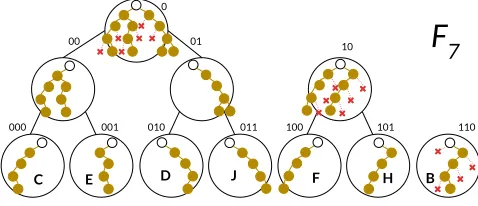
Figure 4: A dynamic AAS withλ=2for set{B,C,D,E,F,H,J}. Our AAS is a forest of BPTs with corresponding BFTs. Each node stores a BPT accumulator (and subset proof), depicted as a trie, inyellow. Root nodes store a BFT, depicted as the missingrednodes.
size and verification time of a (non)membership proof isO(logn). The digest is just the root accumulator of the BPT.
Handling appends efficiently.So far, we only discussed the case of a static setS. However, our AAS should support appending new elements toS. The main challenge here isefficiencysince updating the BPT and BFT as well as the disjointness proof after each update is very expensive (at least linear). To address this we use a classic “amortization” trick from Overmars [80] also used in [87].
Specifically, our AAS will consist not of one BPT for the entire set
S, but will be partitioned into aforestof BPTs and their correspond-ing BFTs. Initially, we start with no elements in the AAS. When the first elemente1is appended, we build itstree-pair: a BPT over the set{e1}, its BFT and a disjointness proof. When the second element
e2is appended, we “merge”: we build a size-2 tree-pair over{e1,e2}. The rule is we always merge equal-sized tree-pairs. Whene3is appended, we cannot merge it because there’s no other tree-pair of size 1. Instead, we create a tree-pair over{e1}. In general, after 2ℓ−1 appends, we end up withℓseparate tree-pairs corresponding to sets of elementsS1, . . . ,Sℓ. The final set isS=Sℓ
j=1Sjwhere |Sj|=2j. The evolution of such a forest is depicted in Figure 3 and the final data structure can be seen in Figure 4.
Let us analyze the time to merge two size-ntree-pairs forS1and
S2into a size-2ntree-pair forS=S1∪S2. To computeS’s BPT, we need to (i) compute its root accumulator, (ii) set its children to the “old” root accumulators ofS1andS2and (iii) compute subset proofs
S1 ⊂S andS2 ⊂S. Since|S1| =|S2|=n, operations (i), (ii) and (iii) takeO(λnlog2n)time. Finally, we can computeS’s BFT from scratch inO(λnlog2n)time.
To analyze the append time, consider the timeT(n)to create an AAS over a setSwithn=2ℓelements (without loss of generality). Then,T(n)is just the time to create a tree-pair overSand can be broken into (i) the time to create a tree-pair over the children ofS of sizen/2 (i.e., 2T(n/2)) (ii) the time to merge these two children BPTs (including computing subset proofs) and (iii) the time to com-pute the BFT ofS. More formally,T(n)=2T(n/2)+O(λnlog2n) which simplifies toT(n)=O(λnlog3n)time fornappends. Thus, theamortizedtime for one append isO(λlog3n)and can be de-amortized intoworst-casetime using generic techniques [80, 81].
to prove non-membership in each tree-pair separately, requiring an
O(logn)frontier proof in each of theO(logn)BFTs. This increases the non-membership proof size toO(log2n). On a good note, mem-bership proofs remain unaffected: the server just sends a path to a leaf inoneof the BPTs where the element is found. Finally, the AAS digest is set to the root accumulators of all BPTs and has size
O(logn). We analyze the complexity of our AAS in Appendix D.
Efficient append-only proofs.Our append-only proofs are sim-ilar to the ones in history trees [29]. An append-only proof must relate the root BPT accumulator(s) in the old AAS to the root BPT accumulator(s) in the new AAS. We’ll refer to these as “old roots” and “new roots” respectively. Specifically, it must show that every old root either (i) became a new root or (ii) has a path to a new root with valid subset proofs at every level. Such a path is verified by checking the subset proofs between every child and its parent, exactly as in a membership proof. At the same time, note that there might be new roots that are neither old roots nor have paths to old roots (e.g., root 111 inF5from Figure 3). The proof simply ignores such roots since they securely add new elements to the set. To summarize, the append-only proof guarantees that each old root (1) has a valid subset path to a new root or (2) became a new root.
Ensuring fork-consistency.For gossip protocols to work [28, 32], our AAS must be fork-consistent. Interestingly, append-only proofs do not imply fork-consistency. For example, consider a server who computes an AAS for set{e1}and another one for the set{e2}. The server gives the first set’s digest to userAand the second digest to userB. Afterwards, he appendse2to the first set ande1to the second one, which “joins” the two sets into a common set{e1,e2}. The append-only property was not violated (as the two users can deduce independently) but fork-consistency has been: the two users had diverging views that were subsequently merged.
To avoid this, we will “Merkle-ize” each BPT using a CRHFHin the standard manner (i.e., a node hashes its accumulator and its two children’s hashes). Our AAS digest is now set to the Merkle roots of all BPTs, which implicitly commit to all root accumulators in the BPTs. As a result, after merging BPTs for elementse1ande2, the Merkle root of the merged BPT will differ based on how appends were ordered:(e1,e2), or(e2,e1). Thus, violating fork-consistency becomes as hard as finding a collision inH(see Appendix C).
5
FROM SETS TO DICTIONARIES
In this section, we turn our attention to constructing an append-only authenticated dictionary (AAD). Recall that an AAS stores
elementsand supports (non)membership queries of the form “Is
e ∈S?” In contrast, an AAD storeskey-value pairsand supports
lookupsof the form “IsVthe complete set of values for keyk?” In other words, an AAD maps akeykto a multiset ofvaluesV in an append-only fashion. Specifically, once a value has been added to a key, it cannot be removed nor changed. For example, if a key is a domain name and its values are certificates for that domain, then an AAD can be used as a Certificate Transparency (CT) log. In general, keys and values can have any application-specific type, as long as they can be hashed to a bit string.
Our construction has great similarities with the AAS of Section 4. However, the different functionality calls for modifications. Indeed, even the security notion for AADs is different (see Appendix E).
Specifically, in an AAS, no malicious server can simultaneously produce accepting proofs of membership and non-membership for the same elementewith respect to the same digest. In contrast, in an AAD, no malicious server can simultaneously produce accepting proofs for two different sets of valuesV,V′for a keykwith respect to the same digest. This captures the related notion for an AAS since one of the sets of values may be empty (indicatingkhas never been registered in the dictionary) and the other non-empty. Next, we describe how we modify our AAS from Section 4 to get an AAD.
Encoding key-value pairs.An AAS construction can trivially support key-value pairs(k,v)by increasing the size of the domain of the underlying AAS from 2λbits to 4λbits so as to account for the valuev. That is,(k,v)would be inserted in the AAS ask|v, using the same algorithms from Appendix B. Thus AAD clients now have twice the number of public parameters:дτ,(дsi)i4=λ0+1.
Proving lookups.For simplicity, let us restrict ourselves to an AAD of size 2i (i.e., with justonetree-pair). For a keykwith no values, a lookup proof is simply a frontier proof for a prefix ofk in the BFT, much like a non-membership proof in the AAS (see Section 4). What ifkhas one or more values? First, the lookup proof contains paths to BPT leaves withk’s values (i.e., with elements of the formk|v), much like a membership proof in an AAS. But what is to guaranteecompletenessof the response? What if a malicious server leaves out one of the values of keyk? (This is important in transparency logs where users look up their own PKs and must receive all of them to detect impersonation attacks.) We use the same frontier technique as in the AAS to convince clients values are not being left out. Specifically, the server proves specific prefixes for themissing valuesofkare not in the BPTs (and thus are not maliciously being left out). This is best illustrated with an example. Suppose the server wants to provek=0000 hascompleteset of valuesV ={v1 =0001,v2 =0011}. Consider a trie overk|v1 andk|v2and note thatF[k] = {(0000|1),(0000|01),(0000|0000),
(0000|0010)}is the set of all frontier prefixes for the missing values ofk. We call this set thelower frontierofkrelative toV. The key idea to prove completeness is to prove all lower frontier prefixes are in the BFT via frontier proofs (as discussed in Section 4). Note that|F[k]|=O(λ)and each frontier proof isO(logn)-sized, result-ing in anO(λlogn)-sized proof. This idea generalizes to AADs of arbitrary size: the server (i) proves non-membership ofkin BPTs with no values fork(via the BFT) and (ii) provesVi is the com-plete set of values ofkin each remaining BPTi(via the BFT lower frontier technique). In that case, a lookup proof for a keykwith a single valuevconsists of (1) anO(logn)-sized path in some BPT with anO(λlogn)-sized frontier proof in its corresponding BFT (to guarantee completeness) and (2) anO(logn)-sized frontier proof forkin all otherO(logn)BFTs, to provekhas no values there.
prefixes ofk. We can generalize this idea: whenkhas|Vi|values in theith BFT in the forest,k’s lower frontier relative toVi has
O(|Vi|λ)prefixes. Then, for each BFTi, we split the lower frontier prefixes ofkassociated withViinto separate BFT leaves each of size at most 4λ+1. We remind the reader that clients have enough public parameters(дsi)i4=0λ+1to reconstruct the accumulators in these BFT leaves and verify the frontier proof.
Supporting large domains and multisets.To handle keys and values longer than 2λbits, we storeH(k)|H(v)in the AAD (rather thank|v), whereHis a CRHF and we can retrieve the actual value
vfrom another repository. To support multisets (samevcan be inserted twice for ak), the server can insertH(H(v)|i)for thei-th occurrence of(k,v).
Supporting inclusion proofs.Another useful proof for a trans-parency log is aninclusion proof which only returnsone of the valuesof keyk(while lookup proofs returnallvalues of a keyk). For example, in Certificate Transparency (CT), browsers are sup-posed to verify an inclusion proof of a website’s certificate before using it. Our AAD supports inclusion proofs too. They consist of a path to a BPT leaf with the desired key-value pair. Since they do not require frontier proofs, inclusion proofs are onlyO(logn)-sized.
6
EVALUATION
In this section, we evaluate our AAD (not AAS) construction’s proof sizes, append times and memory usage. We find that append times and memory usage are too high for a practical deployment and dis-cuss how they might be improved in future work (see Sections 6.1.1 and 6.1.4). If they are improved, we find AADs can save bandwidth relative to CT and CONIKS and we describe exactly when and how much in Section 6.2.1.
Codebase and testbed.We implemented ouramortizedAAD con-struction from Section 5 in 5700 lines of C++. Itsworst-caseappend time isO(λnlog2n)while its amortized append time isO(λlog3n). We used Zcash’slibff[90] as our elliptic curve library with sup-port for a 254-bit Barretto-Naehrig curve with a Type III pairing [7]. We usedlibfqfft[91] to multiply polynomials andlibntl[92] to divide polynomials and compute GCDs. Our code is available at:
https://github.com/alinush/libaad-ccs2019.
We ran our evaluation in the cloud on Amazon Web Services (AWS) on a r4.16xlarge instance type with 488 GiB of RAM and 64 VCPUs, running Ubuntu 16.04.4 (64-bit). This instance type is “memory-optimized” which, according to AWS, means it is “designed to de-liver fast performance for workloads that process large data sets in memory.”
6.1
Microbenchmarks
6.1.1 Append times. Starting with an empty AAD, we append
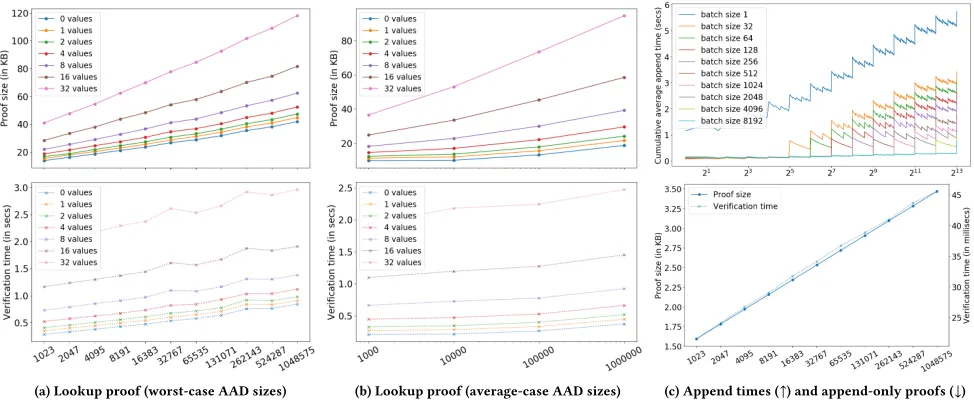
key-value pairs to it and keep track of thecumulative average append-time. Recall that appends are amortized in our construction (but can be de-amortized using known techniques [80, 81]). As a result, in our benchmark some appends are very fast (e.g., 25 milliseconds) while others are painfully slow (e.g., 1.5 hours). To keep the running time of our benchmark reasonable, we only benchmarked 213=8192 appends. We also investigate the effect of batching on append times. Batchingk =2i appends together means we only compute one
BFT for the full tree of sizekcreated after inserting the batch. In contrast, without batching, we would computekBFTs, one for each new forest root created after an append. Figure 5c shows that the average append time is 5.75 seconds with no batching and 0.76 seconds with batch size 8192. (For batch sizes 32,64, . . . ,4096, the average times per append in milliseconds are 3422, 3064, 2644, 2361, 1848, 1548, 1353 and 976 respectively.) These times should increase by around 3.5 seconds if we benchmarked 220appends.
Speeding up appends.The bottleneck for appends is comput-ing the BFTs. Although we usedlibff’s threaded multi-exponentiation to compute accumulators faster, there are other ways to speed up appends that we have not explored. First, we can parallelize computing (1) the polynomials on the same level in a BFT, (2) the smaller accumulators at lower levels of the BFT, where multi-threaded multi-exponentiation does not help as much and (3) the subset proofs in the forest. Second, we can reuse some of the previously computed accumulators when computing a new BFT. Third, our BPT and BFT constructions require “extractable” counter-parts of the accumulators, which almost triple the time to commit to a polynomial. We hope to remove this expensive requirement by proving our construction secure in the generic group model, similar to new SNARK constructions [48]. Finally, techniques for distributed FFT could speed up polynomial operations [103].
6.1.2 Lookup proofs.We investigate three factors that affect lookup proof size and verification time: (1) the dictionary size, (2) the num-ber of trees in the forest and (3) the numnum-ber of values of a key. Our benchmark creates AADs of ever-increasing sizen. For speed, in-stead of computing accumulators, we simply pick them uniformly at random. (Note that this does not affect the proof verification time.) We measureaverageproof sizes for keys withℓvalues in an AAD of sizen, whereℓ∈ {0,1,2,4,8,16,32}. (Recall that a key withℓvalues requiresℓfrontier proofs.) To get an average, for everyℓ, we set up 10 differenttargetkeys so each key hasℓ val-ues. The rest of the inserted keys are random (and simply ignored by the benchmark). Importantly, we randomly disperse the target key-value pairs throughout the forest to avoid having all values of a key end up in consecutive forest leaves, which would artificially decrease the proof size. Once the dictionary reaches sizen, we go through every target key withℓvalues, compute its lookup proof, and measure the size and verification time. Then, for eachℓ, we take an average over its 10 target keys. We repeat the experiment for increasing dictionary sizesnand summarize the numbers in Figures 5a and 5b. Proof verification is single-threaded.
Worst-case versus best-case dictionary sizes.Recall that some dictionary sizes are “better” than others because they have fewer trees in the forest. For example, a dictionary of (worst-case) size 2i− 1 will haveitrees in the forest and thusiBFTs. Thus, a lookup proof must include frontier proofs in alliBFTs. In contrast, a dictionary of size 2ionly has a single tree in the forest, so a lookup proof needs only one frontier proof. Indeed, our evaluation shows that lookup proofs are smaller in AADs of size 10i(see Figure 5b) compared to 2i −1 (see Figure 5a). For example, for a key with 32 values, the proof averages 95 KiB for size 106and 118 KiB for size 220−1.
6.1.3 Append-only proofs.This benchmark appends random
(a) Lookup proof (worst-case AAD sizes) (b) Lookup proof (average-case AAD sizes) (c) Append times (↑) and append-only proofs (↓)
Figure 5: The x-axes always indicate AAD sizes. Sections 6.1.1 to 6.1.3 explain the experiments. In Figure 5c (↑), “spikes” occur when two trees of sizeBare merged, which triggers a new BFT computation, whereBis the batch size.
measures the append-only proof size (and verification time) be-tween AADs of sizenandm=2i−1. We benchmarked on 2i −1 AAD sizes to illustrate worst-caseΘ(i)append-only proof sizes. To speed up the benchmark, we randomly pick accumulators in the forest. Append-only proof verification is single-threaded. Our results show append-only proofs are reasonably small and fast to verify (see Figure 5c). For example, the append-only proof between sizes 219−1 and 220−1 is 3.5 KiB and verifies in 45 milliseconds.
6.1.4 Memory usage.Our lookup proof benchmark was the most
memory-hungry: it consumed 263 GiB of RAM for AAD sizen= 220−1. In contrast, the append-only proof benchmark consumed only 12.5 GiBs of memory, since it did not need BFTs. As an example, whenn = 220−1, all BFTs combined have no more than 390n nodes. Since we are using Type III pairings, each node stores three accumulators (two inG1and one inG2) in 384 bytes (due tolibff’s 3x overhead). Thus, the BFT accumulators require no more than 147 GiB of RAM. The rest of the overhead comes from our pointer-based BFT implementation and other bookkeeping (e.g., polynomials). The
q-PKE public parameters could have added 64 GiBs of RAM, but these two benchmarks did not need them.
Improving memory.A new security proof could eliminate the ad-ditionalG1andG2accumulators and reduce BFT memory by 2.66x and the size of the public parameters by 1.33x (see Section 6.1.1). A more efficient representation of group elements thanlibff’s could also reduce BFT memory by 3x. An efficient array-based imple-mentation of BPTs and BFTs could further reduce memory by tens of gigabytes. Finally, the 390x overhead of BFTs can be drastically reduced by carefully grouping upper frontier prefixes together in a BFT leaf, similar to the grouping of lower frontier prefixes from Section 5. However, doing this without increasing the lookup proof size too much remains to be investigated.
6.2
Comparison to Merkle tree approaches
How do AADs compare to Merkle prefix trees or History Trees (HTs), which are used in CONIKS and Certificate Transparency (CT) respectively? First of all, appends in AADs are orders of magnitude slower because of the overheads of cryptographic accumulators and remain to be improved in future work (see Section 6.1.1).Lookup proofs in prefix trees are much smaller than in AADs. In a prefix tree of size 220, a proof consisting of a Merkle path would be around 640 bytes. In comparison, our proofs for a key with 32 values are 152 times to 189 times more expensive (depending on the number of trees in the forest). On the other hand, append-only proofs in AADs areO(logn), much smaller than theO(n)in prefix trees. For example, our Golang implementation of prefix trees, shows that the append-only proof between trees of size 219 and 220is 32 MiB (as opposed to 3.5 KiB in AADs). The proof gets a bit smaller when the size gap between the dictionaries is larger but not by much: 14.6 MiB between 105and 106.
Lookup proofs in history trees (HTs) areO(n)-sized, compared toO(log2n)in AADs. This is because, to guarantee completeness, the HT proof must consist of all key-value pairs. On the other hand, append-only proofs in AADs are slightly larger than in HTs. While our proofs contain approximately the same number of nodes as in HT proofs, our nodes store two BPT accumulators inG1and a subset proof inG2(in addition to a Merkle hash). This increases the per-node proof size from 32 bytes to 32 + 64 + 64 = 160 bytes.
6.2.1 When do AADs reduce bandwidth?Asymptotically, AAD
usage are not yet sufficiently fast for a practical deployment (see Section 6.1.1).
Consider a key transparency log with approximately one billion entries (i.e., an entry is a user ID and its PK). If this were a CONIKS log, then each user must check their PK in every digest published by the log server. LetDdenote the number of digests published per day by the log server. This means the CONIKS log server will, on average, send 960·Dbytes per day per user (without accounting for the overhead of VRFs [71] in CONIKS). If this were an AAD log, then each user (1) gets the most recent digest via an append-only proof and (2) checks their PK only in this digest via a lookup proof. LetCdenote the number of times per day a user checks his PK (and note that, in CONIKS,C =D). Since the lookup proof is for the user’s PKs not having changed, it only needs to contain frontier proofs. Extrapolating from Figure 5b, such an average-case lookup proof is 40 KiB (in an AAD of size one billion). Similarly, an append-only proof would be 7 KiB. This means the AAD log server will, on average, send 47·1024·Cbytes per day per user. Thus, AADs are more efficient when.0199·D/C >1. In other words, AADs will be more bandwidth-efficient in settings where log digests must be published frequently (i.e.,Dis high) but users check their PK sporadically (i.e.,C is low). For example, ifD = 250 (i.e., a new digest every 6 minutes) andC=0.5 (i.e., users check once every two days), then AADs result in 10x less bandwidth.
What about CT? Recall that CT lacks succinct lookup proofs. As a result, domains usually trust one or moremonitorsto download the log, index it and correctly answer lookup queries. Alternatively, a domain can act as a monitor itself and keep up with every update to the log. We call such domainsmonitoring domains. Currently, CT receives 12.37 certificates per second on average [44], with a mean size of 1.4 KiB each [35]. Thus, a CT log server will, on average, send 12.37·1.4·1024=17,733.63 bytes per second per monitoring domain. In contrast, AADs require 47·1024·C/86,400=.557·C bytes per second per monitoring domain. As before,Cdenotes how many times per day a monitoring domain will check its PK in the log. Thus, AADs are more efficient when 31,837/C>1. So even if domains monitor very frequently (e.g.,C=100), AADs are more bandwidth efficient. However, we stress that our append times and memory usage must be reduced for a practical deployment to achieve these bandwidth savings (see Sections 6.1.1 and 6.1.4).
7
DISCUSSION
Privacy via VRFs.When a user’s identity (e.g., email address) is hashed to determine a path in the tree, the existence of the path leaks that the user is registered. To avoid this, CONIKS proposed using averifiable random function (VRF)[65, 71] to map users to paths in the tree in a private but verifiable manner. We note that our construction is compatible with VRFs as well and can provide the same guarantees. For fairness, our comparison to CONIKS from Section 6.2.1 assumes CONIKS does not use VRFs.
Constant-sized digests.Digests in our constructions areO(logn) -sized wherenis the size of the set (or dictionary). We can make the digest constant-sized by concatenating and hashing all Merkle roots. Then, we can include the Merkle roots as part of our append-only and lookup proofs, without increasing our asymptotic costs.
Large, bounded public parameters.Our bilinear-based construc-tions from Secconstruc-tions 4 and 5 are bounded: they support at mostN appends (givenq≈4λN public parameters). One way to get an unbounded construction might be to use RSA accumulators as ex-plained later in this section. Another way is to simply start a new data structure, when the old one gets “full,” similar to existing CT practices [62]. The old digest could be committed in the new data structure to preserve the append-only property and fork consis-tency. (This will slightly increase our proof sizes for users who are not caught up with the latest digest.)
Trusted setup ceremony.Previous work shows how to securely generate public parameters for QAP-based SNARKs [47, 48] via MPC protocols [20, 21]. For our AAD, we can leverage simplified versions of these protocols, since our public parameters are a “sub-set” of SNARK parameters. In particular, the protocol from [21] makes participation very easy: it allows any number of players to join, participate and optionally drop out of the protocol. In contrast, the first protocol [20] required a fixed, known-in-advance set of players. For our scheme, we believe tech companies with a demon-strated interest in transparency logs such as Google, Facebook and Apple can be players in the protocol. Furthermore, any other in-terested parties can be players too, thanks to protocols like [21]. Finally, the practicality of these MPC protocols has already been demonstrated. In 2016, six participants used [20] to generate public parameters for the Sprout version of the Zcash cryptocurrency [50]. Two years later, nearly 200 participants used [21] to generate new public parameters for the newer Sapling version of Zcash.
RSA-based construction.In principle, the bilinear accumulator in our constructions from Sections 4 and 5 could be replaced with other accumulators that support subset proofs and disjointness proofs. Very recent work by Boneh et al [17] introduces new techniques for aggregating non-membership proofs in RSA accumulators. We believe their techniques can be used to create constant-sized dis-jointness proofs for RSA accumulators. This, in turn, can be used to build an alternative AAD as follows.
Let us assume we have an RSA accumulator overmelements. First, RSA accumulators allow precomputing allconstant-sized mem-bership proofs inO(mlogm)time [89]. In contrast, our bilinear tree precomputes all logarithmic-sized proofs inO(mlog2m)time. As a result, frontier proofs would be constant-sized rather than logarithmic-sized (i.e., the frontier tree corresponding to an RSA accumulator would be “flat”). This decreases our AAD lookup proof size fromO(log2n)toO(logn). This asymptotic improve-ment should also translate to a concrete improveimprove-ment in proof sizes. Our memory consumption should also decrease, since BFTs are no longer required. Second, RSA accumulators have constant-sized parameters rather than linear in dictionary size. This requires a simpler trusted setup ceremony [41] and further saves memory on the server. However, unless RSA accumulators can be sped up, it would result in even slower appends, due to more expensive exponentiations. We leave it to future work to instantiate this RSA construction and prove it secure.
constructions would also require non-standard assumptions [43], possibly different thanq-PKE (e.g., random oracle model, generic group model, etc.). Depending on the argument system, they might or might not require trusted setup and large public parameters.
A static AAD can be built from an argument system (e.g., a SNARK [42, 48]) as follows. The AAD maintains one unsorted tree
Uand one sorted treeSwhose leaves are sorted by key. The digest of the AAD consists of (1) the Merkle roots(d(S),d(U))ofSand
U and (2) a SNARKproof of “correspondence”π(S,U)betweenS andU. This proof shows thatS’s leaves are the same asU’sbut in a different, sorted by key, order. The SNARK circuit takes as input
U’s leaves andS’s leaves, hashes them to obtaind(U)andd(S)and checks thatS’s leaves are sorted by key.
Now, given a digest(d(S),d(U),π(S,U)), lookups can be effi-ciently proven using Merkle proofs in the sorted treeS. The append-only property of two digests(d(S),d(U),π(S,U))and(d(S′),d(U′),
π(S′,U′))can be efficiently proven using a history tree
append-only proof betweend(U)andd(U′). This provesU is a subset of
U′and, crucially, it also proves thatSis a subset ofS′, since the
SNARKπ(S,U)proves thatS“corresponds” toUandS′toU′. Un-fortunately, updates would invalidate the SNARK proof and take time at least linear in the dictionary size to recompute it. However, we can apply the same Overmars technique [80, 81] to make up-dates polylogarithmic time. (This would now require a family of circuits, one for each size 2iof the trees.)
This approach would result in much shorter lookup proofs while maintaining the same efficiency for append-only proofs, since state-of-the-art SNARKs have proofs consisting of just 3 group elements [48]. On the other hand, this approach might need more public parameters and could have slower appends. This is because, even with SNARK-friendly hashes (e.g., Ajtai-based [12], MiMC [3] or Jubjub [105]), we estimate the number of multiplication gates for hashing trees of size 220to be in the billions. (And we are not accounting for the gates that verify treeSis sorted.) In contrast, the degrees of the polynomials in our bilinear-based constructions are only in the hundreds of millions for dictionaries of size 220.
Nonetheless, optimizing such a solution would be interesting future work. For example, replacing SNARKs with STARKs [10] would eliminate the large public parameters and the trusted setup, at the cost of larger append-only proofs. This may well be worth it if the proof size and prover time are not too large. Other argument systems such as Hyrax [101], Ligero [5] and Aurora [11] could achieve the same result. Unfortunately, Aurora and Ligero would increase the append-only proof verification time to linear, which could be prohibitive. Bulletproofs [24] would further increase this verification time to quasilinear. Hyrax can make this time sublinear if the circuit is sufficiently parallel or has “a wiring pattern [that] satisfies a technical regularity condition” [101].
Recursively-composable arguments.Another interesting ap-proach is to obtain AADs from recursively-composable SNARKs [12, 14]. Such SNARKs could structure the verification of the append-only property recursively so that circuits need not operate on the entire dictionary, thus lowering overheads. We are aware of concur-rent work that explores this approach, but unfortunately it is not peer-reviewed nor published in an online archive. While such an approach could be very promising, currently implemented systems
operate at the 80-bit security level. This is because increasing the se-curity of the elliptic curves used in recursive SNARK constructions is costly, since they have low embedding degree [12]. In contrast, our implementation is 100-bit-secure after accounting for recent progress on computing discrete logs [66] and ourq-SDH assump-tion withq=220[16]. We can increase this to 118 bits, with no loss in performance, by adopting 128-bit-secure BLS12-381 curves [19].
8
CONCLUSION
In this work, we introduced the first append-only authenticated dictionary (AAD) that achieves polylogarithmic proof sizes and ap-pend times. Unlike previous work, our construction only assumes a single fully-malicious server and does not rely on users to “col-lectively” verify the dictionary. Our analysis shows that AADs can reduce the bandwidth in current CT logs and in CONIKS logs that publish digests much more frequently than users check their PK in the log. However, as our evaluation shows, AADs are not yet practical enough for deployment, particularly because they have high append times and memory usage. We hope future work can overcome this by optimizing the construction, the implementation or both. Finally, we also introduced the first efficient append-only authenticated set (AAS), which can be used to implement Google’s Revocation Transparency (RT) [58].
Open problems.We identify two interesting directions for future work. First, can we build efficient AADs with polylogarithmic proof sizes from standard assumptions, such as the existence of CRHFs? If not, what are the lower bounds? Second, can we obtain “zero-knowledge” AADs which leak nothing during queries?
ACKNOWLEDGMENTS
We would like to thank Marten van Dijk for suggesting the “sparse” prefix tree approach and Madars Virza for productive conversations that helped steer this work. We also thank the anonymous reviewers for their useful feedback. This research was supported in part from USA NSF under CNS grants 1413920, 1718782, 1514261, 1652259, by DARPA & SPAWAR under grant N66001-15-C-4066, by HK RGC under grant ECS-26208318, and by a NIST grant.
REFERENCES
[1] Heather Adkins. 2011. An update on attempted man-in-the-middle
at-tacks. http://googleonlinesecurity.blogspot.com/2011/08/update-on-attempted-man-in-middle.html. Accessed: 2015-08-22.
[2] Mustafa Al-Bassam and Sarah Meiklejohn. 2018. Contour: A Practical System for Binary Transparency. InData Privacy Management, Cryptocurrencies and Blockchain Technology.
[3] Martin Albrecht, Lorenzo Grassi, Christian Rechberger, Arnab Roy, and Tyge Tiessen. 2016. MiMC: Efficient Encryption and Cryptographic Hashing with Minimal Multiplicative Complexity. InASIACRYPT’16.
[4] Muneeb Ali, Jude Nelson, Ryan Shea, and Michael J. Freedman. 2016. Blockstack:
A Global Naming and Storage System Secured by Blockchains. InUSENIX
ATC’16.
[5] Scott Ames, Carmit Hazay, Yuval Ishai, and Muthuramakrishnan Venkitasubra-maniam. 2017. Ligero: Lightweight Sublinear Arguments Without a Trusted Setup. InACM CCS’17.
[6] Aris Anagnostopoulos, Michael T. Goodrich, and Roberto Tamassia. 2001. Persis-tent Authenticated Dictionaries and Their Applications. InInformation Security. [7] Paulo S. L. M. Barreto and Michael Naehrig. 2006. Pairing-Friendly Elliptic
Curves of Prime Order. InSelected Areas in Cryptography.