
Batching Techniques for Accumulators
with Applications to IOPs and
Stateless Blockchains
Dan Boneh, Benedikt B¨unz, Ben Fisch Stanford University
Abstract
We present batching techniques for cryptographic accumulators and vec-tor commitments in groups of unknown order. Our techniques are tailored for distributed settings where no trusted accumulator manager exists and up-dates to the accumulator are processed in batches. We develop techniques for non-interactively aggregating membership proofs that can be verified with a constant number of group operations. We also provide a constant sized batch non-membership proof for a large number of elements. These proofs can be used to build the first positional vector commitment (VC) with constant sized openings and constant sized public parameters. As a core building block for our batching techniques we develop several succinct proof systems in groups of unknown order. These extend a recent construction of a succinct proof of correct exponentiation, and include a succinct proof of knowledge of an integer discrete logarithm between two group elements. We circumvent an impossibility result for Sigma-protocols in these groups by using a short trapdoor-free CRS. We use these new accumulator and vector commitment constructions to design a stateless blockchain, where nodes only need a constant amount of storage in order to participate in consensus. Further, we show how to use these techniques to reduce the size of IOP instantiations, such as STARKs.
1
Introduction
A cryptographic accumulator [Bd94] is a primitive that produces a short binding commitment to a set of elements together with short membership and/or non-membership proofs for any element in the set. These proofs can be publicly verified against the commitment. The simplest accumulator is the Merkle tree [Mer88], but several other accumulators are known, as discussed below. An accumulator is said to bedynamic if the commitment and membership proofs can be updated efficiently as elements are added or removed from the set, at unit cost independent of the number of accumulated elements. Otherwise we say that the accumulator is static. A uni-versal accumulator is dynamic and supports both membership and non-membership proofs.
A vector commitment (VC) is a closely related primitive [CF13]. It provides the same functionality as an accumulator, but for an ordered list of elements. A VC is a
position binding commitment and can be opened at any position to a unique value with a short proof (sublinear in the length of the vector). The Merkle tree is a VC with logarithmic size openings. Subvector commitments [LM18] are VCs where a subset of the vector positions can be opened in a single short proof (sublinear in the size of the subset).
Our present work is motivated by two particular applications of accumulators and vector commitments: stateless transaction validation in blockchains, or “state-less blockchains” and short interactive oracle proofs (IOPs) [BCS16].
“Stateless” blockchains. A blockchain has become the popular term for a ledger-based payment system, in which peer-to-peer payment transactions are asyn-chronously broadcasted and recorded in an ordered ledger that is replicated across nodes in the network. Bitcoin and Ethereum are two famous examples. Verify-ing the validity of a transaction requires queryVerify-ing the ledger state. The state can be computed uniquely from the ordered log of transactions, but provides a more compact index to the information required for transaction validation.
For example, in Ethereum the state is a key/value store of account balances where account keys are the public key addresses of users. In Bitcoin, the state is the set of unspent transaction outputs (UTXOs). In Bitcoin, every transaction completely transfers all the funds associated with a set of source addresses to a set of target addresses. It is only valid if every source address is the output of a previous transaction that has not yet been consumed (i.e. “spent”). It is important that all nodes agree on the ledger state.
Currently, in Bitcoin, every node in the system stores the entire UTXO set in order to verify incoming transactions. This has become cumbersome as the size of UTXO set has grown to gigabytes. An accumulator commitment to the UTXO set would alleviate this need. Transactions would include membership proofs for all its inputs. A node would only need to store the current state of the accumulator and verify transactions by checking membership proofs against the UTXO accumulator state. In fact, with dynamic accumulators, no single node in the network would be required to maintain the entire UTXO set. Only the individual nodes who are interested in a set of UTXOs (e.g. the users who can spend these outputs) would need to store them along with their membership proofs. Every node can efficiently update the UTXO set commitment and membership proofs for individual UTXOs with every new batch of transactions. The same idea can be applied to the Ethereum key-value store using a VC instead of an accumulator.
This design concept is referred to as a “stateless blockchain” [Tod16] because nodes may participate in transaction validation without storing the entire state of the ledger, but rather only a short commitment to the state. The idea of committing to a ledgers state was introduced long before Bitcoin by Sanders and Ta-Shma for E-Cash[STS99a]. While the stateless blockchain design reduces the storage burden of node performing transaction validation, it increases the network communication due to the addition of membership proofs to each transaction payload. A design goal is to minimize the communication impact. Therefore, stateless blockchains would benefit from an accumulator with smaller membership proofs, or the ability to aggregate many membership proofs for a batch of transactions into a single constant-size proof.
Interactive oracle proofs (IOPs). Micali [Mic94] showed how probabilistically checkable proofs (PCPs) can be used to construct succinct non-interactive argu-ments. In this construction the prover commits to a long PCP using a Merkle tree and then uses a random oracle to generate a few random query positions. The prover then verifiably opens the proof at the queried positions by providing Merkle inclusion paths.
IOPs use Merkle trees as a vector commitment. Merkle trees have two significant drawbacks for this application: first, position openings are not constant size, and second, the openings of several positions cannot be compressed into a single constant size proof (i.e. it is not a subvector commitment). A vector commitment with these properties would have dramatic benefits for reducing the communication of an IOP (or size of the non-interactive proof compiled from an IOP).
1.1 Summary of contributions
Our technical contributions consist of a set of batching and aggregation techniques for accumulators. The results of these techniques have a wide range of implica-tions, from concrete practical improvements in the proof-size of IOP-based succinct arguments (e.g. STARKS) and minimizing the network communication blowup of stateless blockchains to theoretical achievements in VCs and IOPs.
To summarize the theoretical achievements first, we show that it is possible to construct a VC with constant size subvector openings and constant size public parameters. Previously, it was only known how to construct a VC with constant size subvector openings and public parameters linear in the length of the vector. This has immediate implications for IOP compilers. The Merkle-tree IOP compiler outputs a non-interactive proof that is O(λqlogn) larger (additive blowup) than the original IOP communication, where q is the number of oracle queries, n is the maximum length1 of the IOP proof oracles, and λ is the Merkle tree security parameter. When replacing the Merkle-tree in the IOP compiler with our new VC, we achieve onlyO(rλ) blowup in proof size, independent ofq andn, but dependent on the number of IOP roundsr. In the special case of a PCP there is a single round (i.e. r = 1). A similar result was recently demonstrated [LM18] using the vector commitments of Catalano and Fiore (CF) [CF13], but the construction requires the verifier to access public parameters linear inn. It was not previously known how to achieve this with constant size public parameters.
Lai and Malavolta apply the CF vector commitments to “CS-proofs”, a special case of a compiled IOP where the IOP is a single round PCP. Instantiated with theoretical PCPs [Kil92, Mic94], this results in the shortest known setup-free non-interactive arguments (for NP) with random oracles consisting of just 2 elements in a hidden order group and 240 additional bits of the PCP proof for 80-bit statistical security. Instantiating the group with class groups and targeting 100-bit security yields a proof of≈540 bytes. However, the verifier must either use linear storage or perform linear work for each proof verification to generate the public proof param-eters. In similar vein, we can use our new VCs to build the same non-interactive argument system, but with sublinear size parameters (in fact constant size). Under the same parameters our proofs are slightly larger, consisting of 5 group elements, a 128-bit integer, and the 240 bits of the PCP proof (≈1.3KB).
Our VCs also make concrete improvements to practical IOPs. Targeting 100-bit security with class groups, replacing Merkle trees with our VCs would incur only 1 KB per round of the IOP. In Aurora [BSCR+18], it was reported that Merkle proofs take up 154 KB of the 222 KB proof for a circuit of size 220. Our VCs would reduce the size of the proof to less than 100 KB, a 54% reduction. For STARKs, a recent benchmark indicates that the Merkle paths make up over 400 KB of the 600 KB proof for a circuit of 252gates [BBHR18]. With our VCs, under the same parameters the membership proofs would take up roughly 22 KB, reducing the overall proof size to approximately 222 KB, nearly a 63% reduction.
Furthermore, replacing Merkle trees with our new VCs maintains good perfor-mance for proof verification. Roughly, each Merkle path verification of ak-bit block is substituted with k modular multiplications of λ-bit integers. The performance comparison is thus logn hashes vs k multiplications, which is even an improve-ment fork <logn. In the benchmarked STARK example, Merkle path verification comprises roughly 80% of the verification time.
1
1.2 Overview of techniques
Batching and aggregation. We use the termbatching to describe a single action applied ton items instead of one action per item. For example a verifier can batch verifynproofs faster thanntimes verifying a single membership proof. Aggregation
is a batching technique that is used when non-interactively combining nitems to a single item. For example, a prover can aggregate n membership proofs to a single constant size proof.
Succinct proofs for hidden order groups. Wesolowski [Wes18] recently intro-duced a constant sized and efficient to verify proof that a triple (u, w, t) satisfies
w=u2t, where uandware elements in a group
Gof unknown order. The proof ex-tends to exponents that are not a power of two and still provides significant efficiency gains over direct verification by computation.
We expand on this technique to provide a new proof of knowledge of an exponent, which we call a PoKE proof. It is a proof that a computationally bounded prover knows the discrete logarithm between two elements in a group of unknown order. The proof is succinct in that the proof size and verification time is independent of the size of the discrete-log and has good soundness. We also generalize the technique to pre-images of homomorphisms fromZqtoGof unknown order. We prove security in the generic group model, where an adversarial prover operates over a generic group. Nevertheless, our extractor is classical and does not get to see the adversary’s queries to the generic group oracles. We also rely on a short unstructured common reference string (CRS). Using the generic group model for extraction and relying on a CRS is necessary to bypass certain impossibility results for proofs of knowledge in groups of unknown order [BCK10, TW12].
We also extend the protocol to obtain a (honest verifier zero-knowledge) Σ-Protocol of DLOG in G. This protocol is the first succinct Σ-protocol of this kind.
Distributed accumulator with batching. Next, we extend current RSA-based accumulators [CL02, LLX07] to create a universal accumulator for a dis-tributed/decentralized setting where no single trusted accumulator manager exists and where updates are processed in batches. Despite this we show how membership and non-membership proofs can be efficiently aggregated. Moreover, items can effi-ciently be removed from the accumulator without a trapdoor or even knowledge of the accumulated set. Since the trapdoor is not required for our construction we can extend Lipmaa’s [Lip12] work on accumulators in groups of unknown order without a trusted setup by adding dynamic additions and deletions to the accumulator’s functionality. Class groups of imaginary quadratic order are a candidate group of unknown order without a trusted setup[BH01].
Batching non-membership proofs. We next show how our techniques can be amplified to create a succinct and efficiently verifiable batch membership and batch non-membership proofs. We then use these batch proofs to create the first vector commitment construction with constant sized batch openings (recently called subvector commitments [LM18]) and O(1) setup. This improves on previous work [CF13, LRY16] which required superlinear setup time and linear public pa-rameter size. It also improves on Merkle tree constructions which have logarithmic sized non-batchable openings. The efficient setup also allows us to create sparse vector commitments which can be used as a key-value map commitment.
to have a CRS containing two fresh random generic group generators to circumvent the soundness lower bound.
Note that we only prove how to extract a witness from a successful prover that is restricted to the generic group model. Proving extraction from an arbitrary prover under a falsifiable assumption is preferable and remains an open problem.
1.3 Additional related work
Dynamic accumulators can be constructed from the strong RSA assumption in groups of unknown order (such as an RSA group or the class group) [BP97, CL02, LLX07, Lip12], from bilinear maps [DT08, CKS09, Ngu05], and from Merkle hash trees [Mer88, CHKO08]. These accumulators (with the excep-tion of Merkle trees) naturally support batching of membership proofs, but not batching of non-membership proofs. Vector commitments based on similar tech-niques [LY10, CF13, LRY16] have constant size openings, but large setup parame-ters.
Accumulators traditionally utilize a trusted accumulator manager which pos-sesses a trapdoor to efficiently delete elements from the accumulator. This trapdoor also allows the manager to create membership witnesses for arbitrary elements. Lip-maa [Lip12] was the first to construct a static accumulator without a trusted setup from hidden order groups.
In concurrent work, Chepurnoy et. al. [CPZ18] also note that accumulators and vector commitments can be used to build stateless blockchains. The work proposes a new homomorphic vector commitment based on bilinear maps and multivariate polynomials. This is applied to a blockchain design where each account stores a balance, and balances can be updated homomorphically knowing only the vector commitment to the current blockchain balances. However, the construction requires linear public parameters, does not have a trustless setup, and does not support batching of inclusion proofs. The linear public parameter imply that a bound on the total number of accounts needs to be known at setup time.
2
Preliminaries
Notation.
• akbis the concatenation of two lists a, b
• a is a vector of elements andai is the ith component
• [`] denotes the set of integers{0,1, . . . , `−1}.
• negl(λ) is a negligible function of the security parameter λ
• Primes(λ) is the set of integer primes less than 2λ
• x←$ S denotes sampling a uniformly random elementx∈S.
x ← A$ (·) denotes the random variable that is the output of a randomized algorithm A.
• GGen(λ) is a randomized algorithm that generates a group of unknown order in a range [a, b] such thata,b, and a−b are all integers exponential inλ.
2.1 Assumptions
The adaptive root assumption, introduced in [Wes18], is as follows.
outputs an element w∈Gand some state. Then, a random prime`in Primes(λ) is chosen and A1(`,state) outputsw1/`∈
G. More precisely, for all efficient (A0,A1):
AdvAR(A
0,A1)(λ) := Pr
u`=w6= 1 :
G←$ GGen(λ)
(w,state)← A$ 0(G)
`←$ Primes(λ)
u← A$ 1(`,state)
≤negl(λ).
The adaptive root assumption implies that the adversary can’t compute the order of any non trivial element. For any element with known order the adversary can compute arbitrary roots that are co-prime to the order. This immediately allows the adversary to win the adaptive root game. For the groupZN this means that we need to exclude {−1,1}
We will also need the strong RSA assumption for general groups of unknown order. The adaptive root and strong RSA assumptions are incomparable. The former states that it is hard to take a random root of a chosen group element, while the latter says that it is hard to take a chosen root of a random group element. In groups of unknown order that do not require a trusted setup the adversary A
additionally gets access to GGen’s random coins.
Definition 2(Strong RSA assumption). GGen satisfies the strongRSAassumption if for all efficient A:
Pr "
u` =g and ` is an odd prime: G $
←GGen(λ), g←$ G,
(u, `)∈G×Z← A$ (G, g) #
≤negl(λ).
2.2 Generic group model for groups of unknown order
We will use the generic group model for groups of unknown order as defined by Damgard and Koprowski [DK02]. The group is parameterized by two integer public parameters A, B. The order of the group is sampled uniformly from [A, B]. The group G is defined by a random injective function σ : Z|G| → {0,1}
`, for some `
where 2` |G|. The group elements areσ(0), σ(1), . . . , σ(|G| −1). Ageneric group algorithm A is a probabilistic algorithm. LetL be a list that is initialized with the encodings given toA as input. The algorithm can query two generic group oracles:
• O1 samples a randomr∈Z|G| and returnsσ(r), which is appended to the list of encodings L.
• When L has size q, the second oracle O2(i, j,±) takes two indices i, j ∈ {1, . . . , q}and a sign bit, and returns σ(xi±xj), which is appended to L.
Note that unlike Shoup’s generic group model [Sho97], the algorithm is not given |G|, the order of the groupG.
2.3 Argument systems
An argument system for a relationR ⊂ X × W is a triple of randomized polynomial time algorithms (Pgen,P,V), where Pgen takes an (implicit) security parameter
λ and outputs a common reference string (crs) pp. If the setup algorithm uses only public randomness we say that the setup is transparent and that the crs is unstructured. The prover P takes as input a statement x ∈ X, a witness w ∈ W, and the crs pp. The verifier V takes as input pp and x and after interaction with P outputs 0 or 1. We denote the transcript between the prover and verifier by hV(pp, x),P(pp, x, w)i and write hV(pp, x),P(pp, x, w)i = 1 to indicate that the verifier accepted the transcript. If V uses only public randomness we say that the protocol is public coin.
Definition 3 (Completeness). We say that an argument system (Pgen,P,V) for a relation R iscomplete if for all (x, w)∈ R:
We now define soundness and knowledge extraction for our protocols. The ad-versary is modeled as two algorithms A0 and A1, where A0 outputs the instance
x ∈ X after Pgen is run, and A1 runs the interactive protocol with the verifier using astateoutput byA0. In slight deviation from the soundness definition used in statistically sound proof systems, we do not universally quantify over the instance
x (i.e. we do not require security to hold for all input instances x). This is due to the fact that in the computationally-sound setting the instance itself may encode a trapdoor of the crs pp (e.g. the order of a group of unknown order), which can enable the adversary to fool a verifier. Requiring that an efficient adversary outputs the instancex prevents this. In our soundness definition the adversaryA1 succeeds if he can make the verifier accept when no witness for x exists. For the stronger
argument of knowledge definition we require that an extractor with access to A1’s internal state can extract a valid witness wheneverA1 is convincing. We model this by enabling the extractor to rewind A1 and reinitialize the verifier’s randomness.
Definition 4 (Arguments (of Knowledge)). We say that an argument system
(Pgen,P,V) is sound if for all poly-time adversaries A= (A0,A1):
Pr "
hV(pp, x),A1(pp, x,state)i= 1
and @w (x, w)∈ R:
pp←$ Pgen(1λ) (x,state)← A0(pp)
#
=negl(λ).
Additionally, the argument system is an argument of knowledge if for all poly-time adversariesA1 there exists a poly-time extractorExtsuch that for all poly-time adversaries A0:
Pr
hV(pp, x),A1(pp, x,state)i= 1
and (x, w0)6∈ R:
pp←$ Pgen(1λ) (x,state)← A0(pp)
w0 ←$ Ext(pp, x,state)
=negl(λ).
Any argument of knowledge is also sound. In some cases we may further restrict A in the security analysis, in which case we would say the system is an argument of knowledge for a restricted class of adversaries. For example, in this work we con-struct argument systems for relations that depend on a groupGof unknown order. In the analysis we replace Gwith a generic group and restrictA to a generic group algorithm that interacts with the oracles for this group. For simplicity, although slightly imprecise, we say the protocol is an argument of knowledge in the generic group model. Groth [Gro16] recently proposed a SNARK system for arbitrary re-lations that is an argument of knowledge in the generic group model in a slightly different sense, where the generic group is used as part of the construction rather than the relation and the adversary is a generic group algorithm with respect to this group generated by the setup.
Definition 5(Non interactive arguments). Anon-interactive argument system
is an argument system where the interaction between P and V consists of only a
single round. We then write the prover Pas π←$ Prove(pp, x, w) and the verifier as
{0,1} ←Vf(pp, x, π).
The Fiat-Shamir heuristic [FS87] and its generalization to multi-round pro-tocols [BCS16] can be used to transform public coin argument systems to non-interactive systems.
3
Succinct proofs for hidden order groups
knowledge for a discrete-log relation, and more generally for knowledge of the in-verse of a homomorphismh:Zn→G, whereGis a group of unknown order. Using the Fiat-Shamir heuristic, the non-interactive version of this protocol is a special purpose SNARK for the pre-image of a homomorphism.
3.1 A succinct proof of exponentiation
Let G be a group of unknown order. Let [`] := {0,1, . . . , `−1} and let Primes(λ) denote the set of odd prime numbers in [0,2λ]. We begin by reviewing Wesolowski’s (non-ZK) proof of exponentiation [Wes18] in the groupG. Here both the prover and verifier are given (u, w, x) and the prover wants to convince the verifier thatw=ux
holds in G. That is, the protocol is an argument system for the relation
RPoE= (u, w ∈G, x∈Z); ⊥
: w=ux∈G .
The verifier’s work should be much less than computing ux by itself. Note that
x∈Zcan be much larger than|G|, which is where the protocol is most useful. The protocol works as follows:
Protocol PoE(Proof of exponentiation) forRPoE [Wes18]
Params: G←$ GGen(λ); Inputs: u, w∈G, x∈Z; Claim: ux=w
1. Verifier sends`←$ Primes(λ) to prover.
2. Prover computes the quotientq=bx/`c ∈Zand residuer ∈[`] such that
x=q`+r.
Prover sends Q←uq∈G to the Verifier.
3. Verifier computes r ← (xmod`) ∈[`] and accepts if Q`ur =w holds in G.
The protocol above is a minor generalization of the protocol from [Wes18] in that we allow an arbitrary exponent x ∈ Z, where as in [Wes18] the exponent was restricted to be a power of two. This does not change the soundness property captured in the following theorem, whose proof is given in [Wes18, Prop. 2] (see also [BBF18, Thm. 2]) and relies on the adaptive root assumption for GGen.
Theorem 1(Soundness PoE [Wes18]). Protocol PoE is an argument system for Re-lationRPoE with negligible soundness error, assuming the adaptive root assumption holds for GGen.
For the protocol to be useful the verifier must be able to compute r =xmod`
faster than computing ux ∈ G. The original protocol presented by Wesolowski assumed that x = 2T is a power of two, so that computing xmod` requires only log(T) multiplications in Z` whereas computing ux requiresT group operations.
For a general exponent x ∈Z, computing xmod` takes O((logx)/λ) multipli-cations inZ`. In contrast, computingux∈GtakesO(logx) group operations inG. Hence, for the current groups of unknown order, computing ux takes λ3 times as long as computingxmod`. Concretely, when`is a 128 bit integer, a multiplication in Z` is approximately 5000 time faster than a group operation in a 2048-bit RSA group. Hence, the verifier’s work is much less than computing w =ux in Gon its own.
Note that the adaptive root assumption is not only a sufficient security re-quirement but also necessary. In particular it is important that no known or-der elements are in the group G. Assume for example that −1 ∈ G such that (−1)2= 1∈G. Ifgx=y then an adversary can succeed inPoE(g,−y, x) by setting
Q0 ← −1·gbx/`c. It is, therefore, important to not directly use the multiplicative RSA groupG:= (Z/N)∗ but ratherG+:=G/{−1,1} as described in [BBF18].
The PoE protocol can be generalized to a relation involving any homomorphism
3.2 A succinct proof of knowledge of a discrete-log
We next show how the protocol PoE can be adapted to provide an argument of knowledge of discrete-log, namely an argument of knowledge for the relation:
RPoKE=
(u, w∈G); x∈Z
: w=ux∈G .
The goal is to construct a protocol that has communication complexity that is much lower than simply sending x to the verifier. As a stepping stone we first provide an argument of knowledge for a modified PoKE relation, where the base u ∈ G is fixed and encoded in a CRS. Concretely let CRS consist of the unknown-order group G and the generator g. We construct an argument of knowledge for the following relation:
RPoKE∗= w∈G; x∈Z : w=gx∈G .
The argument modifies the PoE Protocol in thatx is not given to the verifier, and the remainder r∈[`] is sent from the prover to the verifier:
Protocol PoKE∗ (Proof of knowledge of exponent) for RelationRPoKE∗
Params: G ←$ GGen(λ), g ∈ G; Inputs: w ∈ G; Witness: x ∈ Z; Claim:
gx=w
1. Verifier sends`←$ Primes(λ).
2. Prover computes the quotient q ∈ Z and residue r ∈ [`] such that x =
q`+r. Prover sends the pair (Q←gq, r) to the Verifier. 3. Verifier accepts ifr ∈[`] and Q`gr =w holds in G.
Here the verifier does not have the witness x, but the prover additionally sends
r := (xmod`) along with Q in its response to the verifier’s challenge. Note that the verifier no longer computes r on its own, but instead relies on the value from the prover. We will demonstrate an extractor that extracts the witness x ∈ Z from a successful prover, and prove that this extractor succeeds with overwhelming probability against a generic group prover. In fact, in the next section we will present a generalization ofProtocol PoKE∗to group representations in terms of bases{gi}ni=1 included in the CRS, i.e. a proof of knowledge of an integer vectorx∈Znsuch that Q
ig xi
i =w. We will prove that this protocol is an argument of knowledge against a generic group adversary. The security of Protocol PoKE∗ above follows as a special case. Hence, the following theorem is a special case of Theorem 7 below.
Theorem 2. Protocol PoKE∗ is an argument of knowledge for relation RPoKE∗ in the generic group model.
An attack. Protocol PoKE∗ requires the discrete logarithm baseg to be encoded in the CRS. When this protocol is applied to a base freely chosen by the adversary it becomes insecure. In other words,Protocol PoKE∗ is not a secure protocol for the relationRPoKE.
To describe the attack, let g be a generator of G and let u = gx and w = gy wherey6= 1 andxdoes not dividey. Suppose that the adversary knows both xand
y but not the discrete log ofw base u. Computing an integer discrete logarithm of
w baseu is still difficult in a generic group (as follows from Lemma 3), however an efficient adversary can nonetheless succeed in fooling the verifier as follows. Since the challenge`is co-prime withx with overwhelming probability, the adversary can compute q, r ∈ Z such that q`+rx = y. The adversary sends (Q =gq, r) to the verifier, and the verifier checks that indeed Q`ur = w. Hence, the verifier accepts despite the adversary not knowing the discrete log ofw baseu.
This does not qualify as an “attack” when x = 1, or more generally when x
dividesy, since then the adversary does know the discrete logarithmy/xsuch that
Extending PoKE for general bases. To obtain a protocol for the relation RPoKE we start by modifying protocolPoKE∗ so that the prover first sends z=gx, for a fixed baseg, and then executes twoPoKE∗ style protocols, one base gand one base u, in parallel, showing that the discrete logarithm of w base u equals the one ofz baseg. We show that the resulting protocol is a secure argument of knowledge (in the generic group model) for the relationRPoKE. The transcript of this modified protocol now consists of two group elements instead of one.
Protocol PoKE(Proof of knowledge of exponent)
Params: G←$ GGen(λ), g∈G; Inputs: u, w∈G; Witness: x∈Z; Claim: ux =w
1. Prover sendsz=gx ∈Gto the verifier.
2. Verifier sends`←$ Primes(λ).
3. Prover finds the quotientq ∈Z and residue r∈[`] such that x=q`+r. Prover sends Q=uq and Q0 =gq and r to the Verifier.
4. Verifier accepts ifr ∈[`], Q`ur=w, and Q0`gr=z.
The intuition for the security proof is as follows. The extractor first uses the same extractor forProtocol PoKE∗ (specified in Theorem 7) to extract the discrete logarithm x of z base g. It then suffices to argue that this extracted discrete log-arithm x is a correct discrete logarithm of w base u. We use the adaptive root assumption to argue that the extractedx is a correct discrete logarithm ofw base
u.
We can optimize the protocol to bring down the proof size back to a single group element. We do so in the protocolPoKE2 below by adding one round of interaction. The additional round has no effect on proof size after making the protocol non-interactive using Fiat-Shamir.
Protocol PoKE2(Proof of knowledge of exponent)
Params: G←$ GGen(λ); Inputs: u, w∈G; Witness: x∈Z; Claim: ux =w
1. Verifier sendsg←$ G to the Prover. 2. Prover sendsz←gx∈Gto the verifier. 3. Verifier sends`←$ Primes(λ) and α←$ [0,2λ).
4. Prover finds the quotientq ∈Z and residue r∈[`] such that x=q`+r. Prover sends Q=uqgαq andr to the Verifier.
5. Verifier accepts ifr ∈[`] and Q`urgαr=wzα.
The intuition for the security proof is the same as for Protocol PoKE, but we ad-ditionally show that (in the generic group model) a similar extraction argument holds when the prover instead sends Q←uqgq and r such that Q`urgr=wz. The extraction argument uses the fact that with overwhelming probability the generic adversary did not obtain g from any of its group oracle queries prior to forming
w and therefore the adversary’s representation of w does not contain g as a base with a non-zero exponent. The extractor is able to obtain an exponentx such that (gu)x = wz. This alone does not yet imply that ux = w, however if the prover sends Q, rsuch thatQ`urgαr =wzα, then the extractor obtains a fixed xsuch that (gαu)x =wzα with high probability over the random choice ofα. This implies that either ux =w or w/ux is an element of low order, which breaks the adaptive root assumption. We summarize this in the following theorem. See Appendix C for the proof.
Theorem 3 (PoKE Argument of Knowledge). Protocol PoKE and Protocol PoKE2 are arguments of knowledge for relation RPoKE in the generic group model.
We can also construct a (honest-verifier) zero-knowledge version of the PoKE argument of knowledge protocol using a method similar to the classic Schnorr Σ-protocol for hidden order groups. This is covered in Appendix A.4.
3.3 Aggregating Knowledge of Co-prime Roots
Unlike exponents, providing a root of an element in a hidden order group is already succinct (it is simply a group element). There is a simple aggregation technique for providing a succinct proof of knowledge for multiple co-prime roots x1, ..., xn simultaneously. This is useful for aggregating PoKE proofs.
When the roots are all for the same elementαthen the witness is trivially a root
α1/x∗ wherex∗ =x1· · ·xn. From this witness one can publicly extract thexith root of α for each i. We show a method where the elements need not be the same, i.e. the witness is a list of elements w1, ..., wn for public elementsα1, ..., αn and public integersx1, ..., xnsuch thatwixi =αifor eachiandgcd(xi, xj) = 1∀i, j∈[1, n], i6=j. The size of the proof is still a single element.
Concretely the PoKCRprotocol is a proof for the relation:
RPoKCR=
α∈Gn; x∈Zn : w=φ(x)∈G .
The proof is the product of witnesses, w ← w1· · ·wn. From this product and the public xi’s and αi’s it is possible to extract an xith root of each αi. (This is not necessarily the same aswi as roots are not unique). Moreover, the verification algorithm does not need to run this extraction procedure in full, it only needs to check that wx∗ = Q
iα x∗/xi
i . This equation can be verifier with O(nlogn) group exponentiations with exponents of size at most maxi|xi|using the optimized recursiveMultiExp algorithm shown below.
Protocol PoKCRfor RelationRPoKCR
Input: G,α1, ..., αn∈G,x1, ..., xn∈Z s.t. gcd(x1, ..., xn) = 1; Witness: w∈Gn s.t. wxi
i =αi 1. Prover sendsw←Qn
i=1wi to the Verifier. 2. Verifier computesx∗ ←Qn
i=1xi, and y←Qni=1α x∗/xi
i using MultiExp(n,α,x). Verifier accepts if wx∗ =y.
MultiExp(n,α,x): 1. if n= 1 return α
2. αL←(α1, ..., αn/2); αR ←(αn/2+1, ..., αn) 3. xL←(x1, ..., xn/2);xR←(xn/2+1, ..., xn) 4. x∗L←x1· · ·xn/2; x∗R←xn/2+1· · ·xn
5. L←MultiExp(n/2,αL,xL);R←MultiExp(n/2,αR,xR)
6. return Lx∗R·Rx∗L
Lemma 1. ProtocolPoKCR is an argument of knowledge for Relation RPoKCR.
Proof. We show that given any wsuch that wx∗ =y=Qn i=1α
x∗/xi
i it is possible to compute directly anxith root ofαifor alli. For eachiandj6=iletzij =x∗/(xixj). For eachi, letAj =Qi6=jα
zij
i , then we can expressy=A xi
j α x∗/x
i
i . This shows that the element u = w(x∗/xi)A−1
j is an xith root of αx
∗/x
i
i . Since gcd(x∗/xi, xi) = 1, there exist Bezout coefficientsa, b such thata(x∗/xi) +bxi= 1. Finally,uaαbi is an
xith root of αi as (uaαbi)xi =α (ax∗/x
i)+bxi
i =αi.
λ: Security Parameter
t: A discrete time counter
At: Accumulator value at timet
St: The set of elements currently accumulated wt
x, utx: Membership and non-membership proofs
pp: Public parameters implicitly available to all methods upmsg: Information used to update proofs
Setup(λ, z)→pp, A0 Generate the public parameters
Add(At, x)→ {At+1,upmsg}Update the accumulator
Del(At, x)→ {At+1,upmsg} Delete a value from the accumulator
MemWitCreate(At, S, x)→wtxCreate an membership proof
NonMemWitCreate(At, S, x)→utx Create a non-membership proof
MemWitUp(At, wtx, x,upmsg)→wtx+1 Update an membership proof
NonMemWitUp(At, wxt, x,upmsg)→utx+1Update a non-membership proof
VerMem(At, x, wxt)→ {0,1}Verify membership proof
VerNonMem(At, x, utx)→ {0,1} Verify non-membership proof
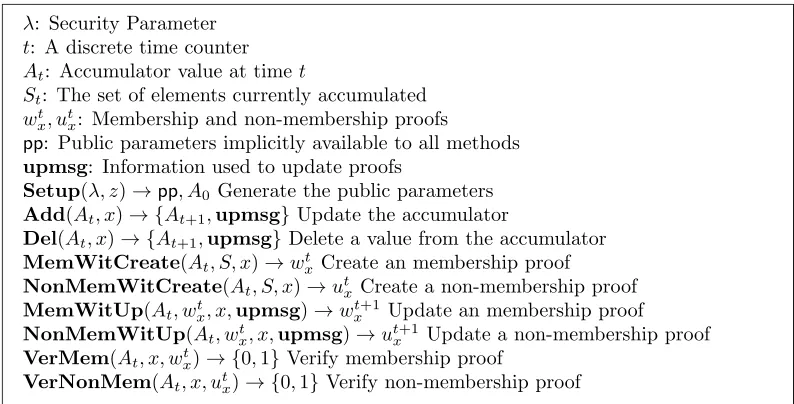
Figure 1: A trapdoorless universal accumulator.
using a collision-resistant hash function H as a heuristic substitute for a random oracle. In our protocols, the verifier’s challenges are sampled from Primes(λ) and G. Therefore, the non-interactive version must involve a canonical mapping of the output seedσof the random oracle to a random prime or element ofG. Furthermore, it is important that hashing to an element g ∈ G does not reveal the discrete log relation betweengand any another element (i.e. g←uσis not secure). The simplest way to map σ to a prime in Primes(λ) is find the smallest integer i such that the first λbits of H(σ, i) is prime. More efficient methods are described in Section 7. It is these non-interactive, succinct, and efficiently verifiable proofs that are most useful for the applications discussed later in this paper. Appendix D summarizes the non-interactive proofs that will be used later.
AggregatingPoKEproofs Several non-interactivePoE/PoKE/PoKE2proofs can be aggregated using the PoKCR protocol. The value Q sent to the verifier in this proof is the`th root ofyg−r. As long as the primes sampled in each proof instance are distinct then these proofs (specifically the valuesQi) are a witness for an instance of PoKCR. Since the primes are generated by hashing the inputs to the proof they need not be included in the proof.
4
Trapdoorless Universal Accumulator
In this section we describe a number of new techniques for manipulating accumu-lators built from the strong RSA assumption in a group of unknown order. We show how to efficiently remove elements from the accumulator, how to use the proof techniques from Section 3 to give short membership proofs for multiple elements, and how to non-interactively aggregate inclusion and exclusion proofs. All our tech-niques are geared towards the setting where there is no trusted setup. We begin by defining what an accumulator is and what it means for an accumulator to be secure. Our presentation of a trapdoorless universal accumulator mostly follows the defi-nitions and naming conventions of [BCD+17]. Figure 1 summarizes the accumulator syntax and list of associated operations. One notable difference in our syntax is the presence of a common reference stringppgenerated by theSetupalgorithm in place of private/public keys.
The security definition we follow [Lip12] formulates an undeniability property for accumulators. For background on how this definition relates to others that have been proposed see [BCD+17], which gives generic transformations between different accumulators with different properties and at different security levels.
and a non-membership witness utx where wxt shows that x is in the accumulator and ut
x shows that it is not. Lipmaa [Lip12] also defines undeniability without a trusted setup. In that definition the adversary has access to the random coins used by Setup.
Definition 6 (Accumulator Security (Undeniability)).
Pr
pp, A0∈G←$ Setup(λ)
(A, x, wx, ux) $
← A(pp, A0)
VerMem(A, x, wtx)∧VerNonMem(A, x, utx)
=negl(λ)
4.1 Accumulator construction
Several sub-procedures that are used heavily in the construction are summarized below. Bezout(x,y) refers to a sub-procedure that outputs Bezout coefficients
a, b∈Zfor a pair of co-prime integersx, y(i.e. satisfying the relation ax+by = 1). ShamirTrick uses Bezout coefficient’s to compute an (xy)-th root of a group el-ement g from an x-th root of g and a yth root of g. RootFactor is a procedure that given an element y = gx and the factorization of the exponent x = x
1· · ·xn computes an xi-th root of y for all i= 1, . . . , n in total time O(nlog(n)). Naively this procedure would take time O(n2). It is related to the MultiExp algorithm described earlier and was originally described by [STSY01].
ShamirTrick(w1, w2, x, y): [Sha83] 1. if w1x6=w2y return⊥
2. a, b←Bezout(x, y) 3. return wb1wa2
Hprime(x): 1. y ←H(x)
2. while y is not odd prime: 3. y←H(y)
4. return y
RootFactor(g, x1, . . . , xn): 1. if n= 1 return g 2. n0 ← bn
2c 3. gL←g
Qn0 j=1xj
4. gR←g Qn
j=n0+1xj
5. L←RootFactor(gR, x1, . . . , xn0)
6. R←RootFactor(gL, xn0+1, . . . , xn)
7. return LkR
Groups of unknown order The accumulator requires a procedure GGen(λ) which samples a group of unknown order in which the strong root assumption (Def-inition 2) holds. One can use the quotient group (Z/N)∗/{−1,1}, where N is an RSA modulus, which may require a trusted setup to generate the modulus N. Al-ternatively, one can use a class group which eliminates the trusted setup. Note that the adaptive root assumption requires that these groups have no known elements of low order, and hence the group (Z/N)∗ is not suitable because (−1) ∈ (Z/N)∗ has order two [BBF18]. Given an element of order two it is possible to convince a PoE-verifier thatgx=−y when in factgx=y.
The basic RSA accumulator. We review he classic RSA accumulator [CL02, Lip12] below, omitting all the procedures that require trapdoor information. All accumulated values are odd primes. If the strong RSA assumption (Definition 2) holds in G, then the accumulator satisfies the undeniability definition [Lip12].
The core procedures for the basic dynamic accumulator are the following:
• Setup generates a group of unknown order and initializes the group with a generator of that group.
• Add takes the current accumulator At, an element from the odd primes do-main, and computesAt+1=At.
• Deldoes not have such a trapdoor and therefore needs to reconstruct the set from scratch. The RootFactor algorithm can be used for pre-computation. Storing 2k elements and doing n·k work, the online removal will only take (1−1
2 k
• A membership witness is simply the accumulator without the aggregated item.
• A membership non-witness, proposed by [LLX07], uses the fact that for any x 6∈ S, gcd(x,Q
s∈Ss) = 1. The Bezout coefficients (a, b) ← Bezout(x,Q
s∈Ss) are therefore a valid membership witness. The actual wit-ness is the pair (a, gb) which is short because|a| ≈ |x|.
• Membership and non-membership witnesses can be efficiently updated as in [LLX07]
Setup(λ):
1. G←$ GGen(λ)
2. g←$ G 3. return G, g
Add(At, S, x):
1. if x∈S :returnAt 2. else :
3. S←S∪ {x} 4. upmsg←x
5. return Axt,upmsg
Del(At, S, x):
1. if : x6∈S:return At 2. else :
3. S←S\ {x} 4. At+1←g
Q
s∈Ss
5. upmsg← {x, At, At+1} 6. return At+1,upmsg
MemWitCreate(A, S, x) : 1. wxt ←g
Q
s∈S,s6=xs
2. return wtx
NonMemWitCreate(A, S, x) : 1. s∗ ←Q
s∈Ss
2. a, b←Bezout(s∗, x) 3. B ←gb
4. return utx← {a, B}
VerMem(A, wx, x) :
1. return 1 if (wx)x =A
VerNonMem(A, ux, x) : 1. {a, B} ←ux
2. return 1if AaBx =g
Theorem 4 (Security accumulator [Lip12]). Assume that the strong RSA assump-tion (Definiassump-tion 2) holds in G. Then the accumulator satisfies undeniability
(Defi-nition 6) and is therefore secure.
Proof. We construct an ARSA that given an AAcc for the accumulator breaks the strong RSA assumption. ARSA receives a group G ← GGen(λ) and a challenge
g←$ G. We now runAAccon inputGandA0=g. AAccreturns a tuple (A, x, wx, ux) such that VerMem(A, x, wx) = 1 and VerNonMem(A, x, ux) = 1. ARSA parses (a, B) = ux and computes B ·(wx)a as the xth root of g. x is an odd prime by definition and (B·wxa)x=Bx·Ab=g. This contradicts the strong RSA assumption and thus shows that the accumulator construction satisfies undeniability.
Updating membership witnesses [CL02, LLX07] Updating membership wit-nesses when an item is added simply consists of adding the item to the witness which itself is an accumulator. The membership witness is anxth root of the accumulator
At. After removal of ˆx, At+1 is an ˆxth root of At. We can use the ShamirTrick to compute an x·xˆth root of At which corresponds to the updated witness. Up-dating the non-membership witnesses is done by computing the Bezout coefficients betweenxand the newly added/deleted item ˆxand then updating non-membership witness such that it represents the Bezout coefficient’s between x and the product of the accumulated elements. For a complete description and correctness proof see [LLX07].
4.2 Batching and aggregation of accumulator witnesses
holds for an accumulator construction with aggregated membership witnesses. The succinct proof of exponentiation (NI-PoE) enables us to produce a single membership witness that can be verified in constant time. The verification VerAggMemWit simply checks the proof of exponentiation.
Aggregating existing membership witnesses for elements in several distinct accu-mulators (that use the same setup parameters) can be done as well. The algorithm MemWitX simply multiplies together the witnesses wx for an element x ∈ A1 and wy for y ∈ A2 to create an inclusion proof wxy for x and y. The verification checks wxxy·y =Ay1Ax2. If x and y are co-prime then we can directly recover wx and
wy from the proof wxy. In particularwx =ShamirTrick(Ay1, A1, wyxyA−21, y, x) and
wy =ShamirTrick(Ax
2, A2, wxyx A
−1 1 , x, y).
AggMemWit(A, wx, wy, x, y) :
1. wx·y ←ShamirTrick(A, wx, wy, x, y) 2. return wx·y,NI-PoE(wx·y, x·y, A) MemWitCreate*(A,{x1, . . . , xn}) :
1. x∗=Qn i=1xi
2. wx∗ ←MemWitCreate(A, x∗)
3. return wx∗,NI-PoE(x, wx∗, A)
VerMem*(A,{x1, . . . , xn}, w={wx, π}): 1. return NI-PoE.verify(Qn
i=1xi, w, A, π)
MemWitX(A1, A2, wx, wy, x, y) : 1. return wxy ←wx·wy
VerMemWitX(A1, A2, wxy, x, y) : 1. if gcd(x, y)6= 1
2. return ⊥ 3. else
4. return wxxy·y ←Ay1Ax2
Distributed accumulator updates In the decentralized/distributed setting, the accumulator is managed by a distributed network of participants who only store the accumulator state and a subset of the accumulator elements along with their membership witnesses. These participants broadcast their own updates and listen for updates from other participants, updating their local state and membership witnesses appropriately when needed.
We observe that the basic accumulator functions do not require a trapdoor or knowledge of the entire state, summarized in Figure 2. In particular, deleting an item requires knowledge of the item’s current membership witness (the accumulator state after deletion is this witness). Moreover, operations can be performed in batches as follows:
The techniques are summarized as follows:
• BatchAddAnNI-PoEproof can be used to improve the amortized verification efficiency of a batch of updates that add elementsx1, ..., xmat once and update the accumulator to At+1 ← Ax
∗
t . A network participant would check that
x∗ =Q
ixi and verify the proof rather than compute them exponentiations.
• BatchDelDeleting elements in a batch uses theAggMemWitfunction to a compute the aggregate membership witness from the individual membership witnesses of each element. This is the new state of the accumulator. ANI-PoE proof improves the verification efficiency of this batch update.
• CreateAllMemWitIt is possible for users to update membership and non-membership witnesses [LLX07]. The updates do not require knowledge of the accumulated set S but do require that every accumulator update is pro-cessed. Since this is cumbersome some users may rely on service providers for maintaining the witness. The service provider may store the entire state or just the users witnesses. Creating all users witnesses naively requires O(n2) operations. Using the RootFactor algorithm this time can be reduced to
O(nlog(n)) operations or amortizedO(log(n)) operations per witness.
1
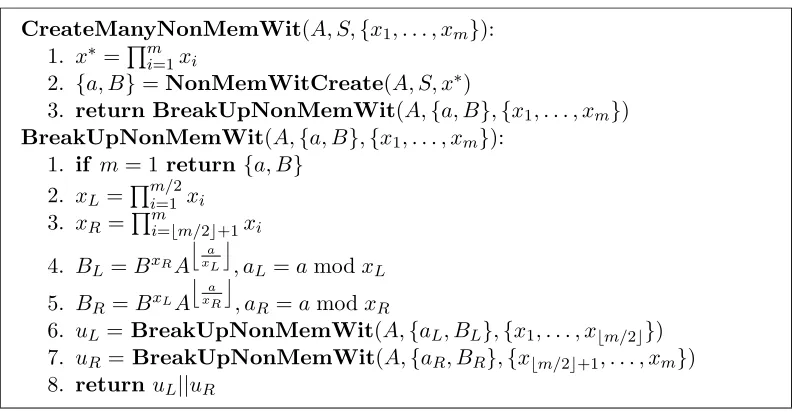
• CreateManyNonMemWitSimilarly toCreateAllMemWitit is possible to create m non-membership witness using O(max(n, m) +mlog(m)) opera-tions. This stands in contrast to the naive algorithm that would takeO(m·n) operations. The algorithm is in Figure 4.2.
Add(At, x):
1. returnAx t
BatchAdd(At,{x1, . . . , xm}):
1. x∗←Qm
i=1xi
2. At+1←Ax ∗
t
3. returnAt+1,NI-PoE(x∗, At, At+1)
DelWMem(At, wxt, x):
1. if VerMem(At, wtx, x) = 1
2. returnwtx
BatchDel(At,(x1, wtx1). . . ,(xm, w
t xm)):
1. At+1←wxt1 2. x∗←x1
3. fori←2, i≤m
4. At+1←ShamirTrick(At+1, wxti, x, xi)
5. x∗←x∗·xi
6. returnAt+1,NI-PoE(x∗, At+1, At)
CreateAllMemWit(S) : 1. return RootFactor(g, S)
Figure 2: Distributed and stateless accumulator functions.
Batching non-membership witnesses A non-membership witness ux forx in an accumulator with state A for a set S is ux = {a, gb} such that as∗ +bx = 1 for s∗ ← Q
s∈Ss. The verification checks Aagbx = g. Since gcd(s
∗, x) = 1 and
gcd(s∗, y) = 1 if and only if gcd(s∗, xy) = 1, to batch non-membership witnesses we could simply construct a non-membership witness for x ·y. A prover com-putes a0, b0 ← Bezout(s∗, xy) and sets uxy ← a0, gb
0
. This is still secure as a non-membership witness for both x and y because we can easily extract a non-membership witness for x as well as for y from the combined witness (a0, B0) by setting ux = (a0,(B0)y) and uy = (a0,(B0)x).
Unfortunately, |a0| ≈ |xy| so the size of this batched non-membership witness is linear in the number of elements included in the batch. A natural idea is to set
uxy = (V, B)←(Aa
0
, gb0)∈G2 instead of (a0, B)∈Z×Gas the former has constant size. The verification would check thatV Bxy =g. This idea doesn’t quite work as an adversary can simply setV =gB−xy without knowing a discrete logarithm between
AandV. Our solution is to use theNI-PoKE2protocol to ensure thatV was created honestly. Intuitively, soundness is achieved because the knowledge extractor for the NI-PoKE2can extracta0 such that (a0, B) is a standard non-membership witness for
xy.
The new membership witness is V, B, π ← NI-PoKE(A,v;b). The size of this witness is independent of the size of the statement. We can further improve the verification by adding a proof of exponentiation that the verification equation holds: NI-PoE(x·y, B, g ·V−1). Lastly, recall from Section 3 that the two independent
CreateManyNonMemWit(A, S,{x1, . . . , xm}): 1. x∗=Qm
i=1xi
2. {a, B}=NonMemWitCreate(A, S, x∗)
3. return BreakUpNonMemWit(A,{a, B},{x1, . . . , xm}) BreakUpNonMemWit(A,{a, B},{x1, . . . , xm}):
1. if m= 1return {a, B} 2. xL=Qm/i=12xi
3. xR=Qmi=bm/2c+1xi
4. BL=BxRA j
a xL
k
, aL=amodxL
5. BR=BxLA j
a xR
k
, aR=amodxR
6. uL=BreakUpNonMemWit(A,{aL, BL},{x1, . . . , xbm/2c})
7. uR=BreakUpNonMemWit(A,{aR, BR},{xbm/2c+1, . . . , xm}) 8. return uL||uR
NI-PoKE2 andNI-PoEproofs can be aggregated into a single group element. We present the non-membership protocol bellow as NonMemWitCreate*. The verification algorithmVerNonMem* simply verifies theNI-PoKE2 andNI-PoE.
NonMemWitCreate*(A, s∗, x∗) : // A=gs∗,s∗=Q
s∈Ss,x=
Q
xi, xi∈Primes(λ)
1. a, b←Bezout(s∗, x∗) 2. V ←Aa, B←gb
3. πV ←NI-PoKE2(A, V;a) // V =Aa 4. πg ←NI-PoE(x∗, B, g·V−1)// Bx=g·V−1 5. return {V, B, πV, πg}
VerNonMem*(A, u={V, B, πV, πg},{x1, . . . , xn}):
1. return NI-PoKE2.verify(A, V, πV)∧NI-PoE.verify(Qni=1xi, B, g·V−1, πg)
Soundness of batch non-membership witnesses Using the knowledge extrac-tor for NI-PoKE2 and relying on the soundness of NI-PoE, and given an adversary who outputs a valid batch non-membership witness (V, B, πV, πg) for a set of odd prime elementsx1, ..., xkwith respect to an accumulator stateA, we can extract indi-vidual non-membership witnesses for eachxi. The knowledge extractor forNI-PoKE2 (Theorem 3) obtainsasuch thatV =Aa and the soundness of NI-PoE(Theorem 1) guarantees that Bx∗ ·V = g where x∗ = Q
ixi. Given a and B we can compute
a non-membership witness for xi|x∗ as B
x∗
xi,abecause (B x∗
xi)xiAa =Bx∗V =g
Re-call that we proved the existence of a knowledge extractor only for the interactive form ofPoKE2and soundness for the interactive form ofPoE, relying on the generic group model. The existence of a knowledge extractor for NI-PoKE2 and soundness of NI-PoEare derived from the Fiat-Shamir heuristic.
Batch accumulator security We now formally define security for an accumula-tor with batch membership and non-membership witnesses. The definition naturally generalizes Definition 6. We omit a correctness definition as it follows directly from the definition of the batch witnesses. We assume that correctness holds perfectly.
Definition 7 (Batch Accumulator Security (Undeniability)).
Pr
pp, A0 ∈G←$ Setup(λ)
(A, I, E, wI, uE) $
← A(pp, A0) :
VerMem*(A, I, wI)∧VerNonMem*(A, S, uS)∧I∩S6=∅
=negl(λ)
From the batch witnesses wI and uS we can extract individual accumulator witnesses for each element in I and S. Since the intersection of the two sets is not empty we have an element x and extracted witnesses wx and ux for that element. As in the proof of Theorem 4 this lets us compute and xth root ofg which directly contradicts the strong RSA assumption. Our security proof will be in the generic group model as it implies the strong RSA assumption, the adaptive root assumption and can be used to formulate extraction for thePoKE2protocol. Our security proof uses the interactive versions of PoKE2 and PoEprotocols but extraction/soundness holds for their non-interactive variants as well.
Theorem 5. The batch accumulator construction presented in Section 4.2 is secure (Definition 7) in the generic group model.
Proof. We will prove security by showing that given an adversary that can break the accumulator security we can construct an efficient extractor that will break the strong RSA assumption (Definition 2). This, however, contradicts the generic group model in which strong RSA holds [DK02]. Given a strong RSA challenge g∈Gwe setA0 the accumulator base value tog. Now assume there exists such an adversary Athat on input (G, g) with non-negligible probability outputs (A, I, E, wI, uE) such that wI and uE are valid witnesses for the accumulator A and the inclusion proof elements I intersect with the exclusion proof elements E. Let x ∈ I ∩S be in
the intersection. The batch membership witness wI is such that w Q
xi∈Ixi
with overwhelming probability. This follows directly from the soundness of the accompanyingPoEproof (Theorem 1). We can directly computewx =w
Q
xi∈I,xi6=x
I ,
i.e. a membership witness forx.
The batch non-membership witness uE consists ofB, V ∈Gas well as aPoKE2 and a PoE We now use the PoKE2 extractor to compute a ∈ Z, B ∈ G. Given that the extractor succeeds with overwhelming probability (Theorem 3) and the overwhelming soundness of PoE(Theorem 1), a, B satisfy AaB
Q
xi∈Exi
= g. From this we can compute B0 = B
Q
xi∈E,xi6=xxi such that AaB0x = g. As in the proof of Theorem 4 we can now compute B0wax as an xth root of g. This is because
B0x(wax)x=B0xAa=g. This, however, contradicts the strong RSA assumption.
Aggregating non-membership witnesses We have shown how to create a con-stant sized batch non-membership witness for arbitrary many witnesses. However this process required knowledge of the accumulated setS. Is it possible to aggregate multiple independent non-membership witnesses into a single constant size witness? We show that we can aggregate unbatched witnesses and the apply the same batch-ing technique to the aggregated witness. This is useful in the stateless blockchain setting where a node may want to aggregate non-membership witnesses created by independent actors. Additionally it will allow us to aggregate vector commitment openings for our novel construction presented in Section 5.
Given two non-membership witness ux = {ax, Bx} and uy = {ay, By} for two distinct elementsx and y and accumulator Awe want to create a witness for x·y. As shown for batch non-membership witnesses a non-membership witness for x·y
is equivalent to a witness forx and y ifx and y are co-prime.
Concretely we will computeaxy ∈ZandBxy ∈Gsuch that AaxyBxyx·y =g. First we computeα, β ← Bezout(x, y). Then we setB0 ← BxβByα and set a0 ← βaxy+
αayx. Note thatB0 ∈G,a0 ∈Z already satisfyAa
0
B0xy = (AaxBx
x)βy(AayB y y)αx =
gβy+αx =g but that |a0| is not necessarily less thanxy. To enforce this we simply
reduce a0 mod xy, setting axy ← a0 modxy and Bxy ← B0Ab
a0
xyc. The verification
equation AaxyBxy
xy =Aa
0
B0xy =g is still satisfied. The full protocol is presented below:
AggNonMemWit(A, x, y, ux = (ax∈[x], Bx∈G), uy = (ay, By)) : 1. α, β ←Bezout(x, y)
2. B0←BxβByα 3. a0 ←βaxy+αayx 4. axy ←a0 modxy
5. Bxy ←B0A
ba0 xyc
6. return {axy, Bxy}
As in Theorem 5, non-membership witnesses for x and y individually can be com-puted from an aggregated non-membership witness for x and y. Note that we can also use aPoKE proof and apply the non-membership batching technique presented above to make the proof constant size. The final witness can be verified using the VerNonMem* algorithm.
5
Batchable Vector Commitments with Small
Parame-ters
5.1 VC Definitions
We review briefly the formal definition of a vector commitment. We only consider static commitments that do not allow updates, but our scheme can naturally be modified to be dynamic.
Vector commitment syntax A VC is a tuple of four algorithms: VC.Setup, VC.Com,VC.Open,VC.Verify.
1. VC.Setup(λ, n,M) → pp Given security parameter λ, length n of the vector, and message space of vector components M, output public parameters pp, which are implicit inputs to all the following algorithms.
2. VC.Com(m)→τ, comGiven an inputm= (m1, ..., mn) output a commitment
com and adviceτ.
3. VC.Update(com, m, i, τ) → τ, com Given an input message m and position i
output a commitmentcom and adviceτ.
4. VC.Open(com, m, i, τ)→ π On inputm ∈ M and i∈[1, n], the commitment
com, and advice τ output an opening π that proves m is the ith committed element ofcom.
5. VC.Verify(com, m, i, π) → 0/1 On input commitment com, an index i ∈ [n], and an opening proof π output 1 (accept) or 0 (reject).
If the vector commitment does not have an VC.Update functionality we call it a
static vector commitment.
Definition 8(Static Correctness). A static vector commitment schemeVCis correct if for allm∈ Mn and i∈[1, n]:
Pr
VC.Verify(com, mi, i, π) = 1 :
pp←VC.Setup(λ, n,M)
τ, com←VC.Com(m)
π ←V C.Open(com, mi, i, τ)
= 1
The correctness definition for dynamic vector commitments also incorporates up-dates. Concretely wheneverVC.Update is invoked the underlying committed vector
mis updated correctly.
Binding commitments The main security property of vector commitments (of interest in the present work) is position binding. The security game augments the standard binding commitment game
Definition 9 (Binding). A vector commitment scheme VC is position binding if for all O(poly(λ))-time adversaries A the probability overpp←VC.Setup(λ, n,M)
and (com, i, m, m0, π, π0) ← A(pp) the probability that VC.Verify(com, m, i, π) =
VC.Verify(com, m0, i, π0) = 1 and m6=m0 is negligible in λ.
5.2 VC construction
We first present a VC construction for bit vectors, i.e. using the message space M={0,1}. We then explain how this can be easily adapted for a message space of arbitrary bit length.
Our VC construction associates a unique prime2 integer pi with eachith index of the bitvector m and uses an accumulator to commit to the set of all primes
2
Examples include Hprime (described earlier), or alternatively the function that maps i to the next prime afterf(i) = 2(i+ 2)·log2(i+ 2)2, which maps the integers [0, N) to smaller primes than
corresponding to indices where mi = 1. The opening of the ith index to mi = 1 is an inclusion proof of pi and the opening to mi = 0 is an exclusion proof ofpi. By using our accumulator from Section 4, the opening of each index is constant-size. Moreover, the opening of several indices can be batched into a constant-size proof by aggregating all the membership witnesses for primes on the indices opened to 1 and batching all the non-membership witnesses for primes on the indices opened to 0.
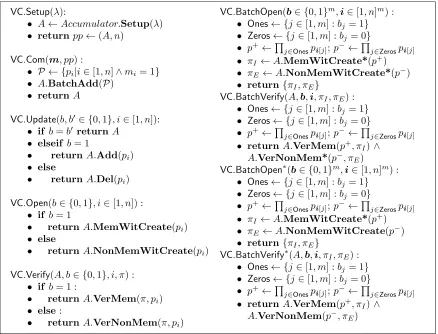
The VC for vectors on a message space of arbitrary bit length is exactly the same, interpreting the input vector as a bit vector. Opening a λ-bit component is then just a special case of batch opening several indices of a VC to a bit vector. The full details are in Figure 4.
VC.Setup(λ):
• A←Accumulator.Setup(λ)
• returnpp←(A, n)
VC.Com(m, pp) :
• P ← {pi|i∈[1, n]∧mi= 1}
• A.BatchAdd(P)
• returnA
VC.Update(b, b0 ∈ {0,1}, i∈[1, n]):
• if b=b0 returnA
• elseif b= 1
• returnA.Add(pi)
• else
• returnA.Del(pi)
VC.Open(b∈ {0,1}, i∈[1, n]) :
• if b= 1
• returnA.MemWitCreate(pi)
• else
• returnA.NonMemWitCreate(pi)
VC.Verify(A, b∈ {0,1}, i, π) :
• if b= 1 :
• returnA.VerMem(π, pi)
• else :
• returnA.VerNonMem(π, pi)
VC.BatchOpen(b∈ {0,1}m,i∈[1, n]m) :
• Ones← {j∈[1, m] :bj = 1}
• Zeros← {j∈[1, m] :bj = 0}
• p+ ←Q
j∈Onespi[j];p−←Qj∈Zerospi[j]
• πI ←A.MemWitCreate*(p+)
• πE ←A.NonMemWitCreate*(p−)
• return{πI, πE}
VC.BatchVerify(A,b,i, πI, πE) :
• Ones← {j∈[1, m] :bj = 1}
• Zeros← {j∈[1, m] :bj = 0}
• p+ ←Q
j∈Onespi[j];p−←Qj∈Zerospi[j]
• returnA.VerMem(p+, πI)∧ A.VerNonMem*(p−, πE)
VC.BatchOpen∗(b∈ {0,1}m,i∈[1, n]m) :
• Ones← {j∈[1, m] :bj = 1}
• Zeros← {j∈[1, m] :bj = 0}
• p+ ←Q
j∈Onespi[j];p−←Qj∈Zerospi[j]
• πI ←A.MemWitCreate*(p+)
• πE ←A.NonMemWitCreate(p−)
• return{πI, πE}
VC.BatchVerify∗(A,b,i, πI, πE) :
• Ones← {j∈[1, m] :bj = 1}
• Zeros← {j∈[1, m] :bj = 0}
• p+ ←Q
j∈Onespi[j];p−← Q
j∈Zerospi[j]
• returnA.VerMem(p+, πI)∧ A.VerNonMem(p−, πE)
Figure 4: Vector commitment scheme from accumulator with batchable membership and non-membership witnesses.
Both the accumulator’s CRS as well asPrimeGencan be represented in constant space independent ofn. This means that the public parameters for the vector com-mitment are also constant-size and independent ofn, unlike all previous vector com-mitments withO(1) size openings [CF13, LRY16, LM18]. The batch opening of sev-eral (mixed value) indices consists of 2 elements inGfor the aggregate membership-witness and an additional 5 elements in G for the batch non-membership witness, plus one λ-bit integer.
Aggregating Openings Just as for our accumulator construction we can aggre-gate vector commitment openings. The aggregation does not require knowledge of the vector contents and the running time of the aggregation is independent of the length of the vector. The opening of a bit in the vector commitment consists of an accumulator inclusion proof and an exclusion proof, both of which we can aggregate as shown in Section 4.2.
256-bit component of the vector, VC.BatchOpen∗ could be used instead so that these openings can be later aggregated. While the output size of VC.BatchOpen∗ grows linearly in m, the number of batched indices, it still contains only three group elements and an integer whose size is proportional to the product of at most m λ-bit primes. These are the unique primes associated with indices of the vector and heuristically can be chosen to be much smaller thanλbits, i.e. closer to lognbits. After the aggregation step is completed, the aggregate non-membership witness can be further compressed with a PoKE proof.
This aggregation protocol is important for the account-based stateless blockchain application, described in more detail in Section 6. In this application, there is a distributed network of participants who who each hold openings for only a partial number of the vector components (e.g. every user knows the value corresponding to their own account data). A batch of transactions will typically contain many openings (of small values) produced by many different participants in the network. In this case, it makes sense for the participants to each produce an opening of the form VC.BatchOpen∗ so that after the individual participants post all the openings they can be aggregated into a single constant size value that is persisted in the transaction log.
Optimization The number of group elements can be reduced by utilizing a PoKCR for all of the PoE and PoKE roots involved in the membership/non-membership witness generation. It is important that all PoE and PoKE protocols use different challenges. These challenges are then guaranteed to be co-prime. This reduces the number of opening proof elements to 4∈Gand 1 λ-bit integer.
5.3 Comparison
Table 5.3 compares the performance of our new VC scheme, the Catalano-Fiore (CF)[CF13] RSA-based VC scheme, and Merkle trees. The table assumes the VC input is a length n vector of k bit elements with security parameter λ. The per-formance for the CF scheme include batch openings which were introduced by Lai and Malatova[LM18]. We note that theMultiExpalgorithm from Section 3.3 also applies to the CF scheme. In particular it can improve the Setup and Open time. The comparison reflects these improvements.
Metric This Work Catalono-Fiore [CF13, LM18] Merkle Tree Setup
Setup O(1) O(n·log(n)·λ)G O(1)
|pp| O(1) O(n)G O(1)
Com(m)→c O(n·log(n)·k)G O(n·k)G O(n)H
|c| 1 G 1 G 1|H|
Proofs
Open(mi, i)→π O(k·nlogn)G O(n·(k+λ))G. O(logn)H
Verify(mi, i, π) O(λ)G+k·lognF O(k+λ)G O(logn)H
|π| O(1)|G| 1|G| O(logn)|H|
Open(m,i)→πi O(k·nlogn)G O(nlogn·(k+λ))G O(nlogn)H
Verify(m,i, πi) O(λ)G+O(k·nlogn)F O(nk)G O(nlogn)H
|πi| 4 |G|+λ 1|G| O(nlogn)|H|
Aggregatable Yes No No
5.4 Key-Value Map Commitment
Our vector-commitment can be used to build a commitment to a key-value map. A key-value map can be built from a sparse vector. The key-space is represented by positions in the vector and the associated value is the data at the keys position. The vector length is exponential in the key length and most positions are zero (null). Our VC commitment naturally supports sparse vectors because the complexity of the commitment is proportional to the number of bit indices that are set to 1, and otherwise independent of the vector length.
Optimization with honest updates In order to commit to arbitrary length values we can hash the value and then commit to the resulting hash. Unfortunately this still requires setting λ bits in the vector commitment which corresponds to addingλ,λ-bit primes to the underlying accumulator. This can make updating the commitment computationally quite expensive. In some settings we can do better than this. Note that the VC and the accumulator definitions (Definition 6) assume that the adversary outputs the commitment. This requirement is too strong for settings where every update follows the rules of the system, i.e. is performed by the challenger. In this case we can implement a key-value map commitment by storing in the VC which keys exist and storing in the accumulator a key, value tuple. If the key already exists then an update will update the entry in the accumulator. Otherwise it will add an entry to the accumulator and set the corresponding VC bit to 1. The construction requires only 1 bit to be stored per key in the VC and 1 entry in the accumulator. The construction also is not secure if the adversary can output an accumulator value as it could contain multiple entries for the same key. We omit a formal security definition and proof but note that security follows directly from the binding guarantees of the underlying accumulator and vector commitment con-structions. The VC ensures that each key appears at most ones in the accumulator and the accumulator ensures the integrity of the committed data.
6
Applications
6.1 Stateless Blockchains
UTXO commitment We first consider a simplified blockchain design which closely corresponds to Bitcoin’s UTXO design where users own coins and issue transaction by spending old coins and creating new coins. We call the set of un-spent coins the UTXO set. Updates to the blockchain can be viewed as asyn-chronous updates to the UTXO set. In most current blockchain designs (with some exceptions[MGGR13a, BCG+14]) nodes participating in transaction validation store the whole UTXO set and use it to verify whether a coin was unspent. Instead, we consider a blockchain design where the network maintains the UTXO set in a dy-namic accumulator [STS99a, TMA13, Tod16, Dra]. We instantiate this accumulator with our new construction from Section 4.1, taking advantage of our distributed batch updates and aggregate membership proofs.
Each transaction block will contain an accumulator state, which is a commit-ment to the current UTXO set. To spend a coin, a user provides a membership witness for the coin (UTXO) that is being spent inside a transaction. Any validator (aka miner) may verify the transactions against the latest accumulator state and also usesBatchDel to delete all spent coins from the accumulator, derive its new state, and output a proof of correctness for the deletions. The proof is propagated to other validators in the network. For the newly minted coins, the validator uses BatchAdd to add them to the accumulator and produce a second proof of cor-rectness to propagate. Other validators are able to verify that the accumulator was updated correctly using only a constant number of group operations and highly efficient arithmetic over λ-bit integers.
![Table 5.3 compares the performance of our new VC scheme, the Catalano-Fiore(CF)[CF13] RSA-based VC scheme, and Merkle trees](https://thumb-us.123doks.com/thumbv2/123dok_us/7964910.1321100/21.612.109.536.577.768/table-compares-performance-scheme-catalano-fiore-scheme-merkle.webp)
