c e-ISSN: 2348-6848, p- ISSN: 2348-795X Volume 3, Issue 01, January 2016
International Journal of Research (IJR)
Available at http://internationaljournalofresearch.org
Application of Dynamic Voltage Restorer for Mitigating Voltage
Sag
1
Ms. Manjari Gaur
M.Tech. Scholar, Swami Keshwanand Institute of Technology, Jaipur
1[email protected],
2Mr. Bharat Modi
Assistant Professor, Swami Keshwanand Institute of Technology, Jaipur
2[email protected]
ABSTRACT:Many researches have been done to monitor and improve the quality of power. Many measures have been implemented and even we have gone so far in improving as well as maintaining the quality of power. Dynamic voltage restorer is a power electronic based device. It protects sensitive loads from the various types of disturbances of the power supply. The basic principle of DVR is to restore the voltage sag to a pre-sag value by injecting a desired value of voltage. Conventional DVR uses Sinusoidal Pulse Width Modulated Voltage Source Inverter. But in this thesis, Space Vector Pulse Width Modulation technique is used. The main function of VSC is that it converts the DC voltage which is supplied by the Energy Storage Unit into an AC form of voltage. The DVR power circuit uses step up voltage injection transformer, therefore a VSI with even a low voltage rating would result to be sufficient.
Keywords: DVR; Voltage Sag; Power Quality
I. INTRODUCTION
From decades, power quality has always been an important issue. Many researches have been done to monitor and improve the quality of power. Many measures have been implemented and even we have gone so far in improving as well as maintaining the quality of power. But still there is a lot to be done, due to advancement in technology and use of new electronic as well as electrical devices, a lot of power quality problems are arising[1].The first DVR that was installed was in North America in 1996. It was a
12.47kV system and was located in Anderson city of South Carolina. Since then, DVR is constantly being applied to protect critical loads of various fields. Today, the DVR is one of the most effective devices in solving voltage sag problems. However, the cost and the installation restrictions have limited the implementation of DVR to where be the obvious requirement for a stable voltage supply. Major application of DVR is for voltage sag mitigation. DVR have been implemented in various fields including power quality improvement which is an important issue of recent day. According to previous studies, a DVR can handle both balanced and unbalanced situations without any kind of difficulties and can inject appropriate voltage component for correcting any voltage sag in the supply voltage in order to keep the voltage balanced and constant. There are a lot of new issues that have triggered the interest and motivation in improving power quality. Due to the recent use of automation in almost every industry and the IT-Technology, there is an increase in requirement of good quality of power which can be considered reliable as well.
II. LITERATURE REVIEW
c e-ISSN: 2348-6848, p- ISSN: 2348-795X Volume 3, Issue 01, January 2016
International Journal of Research (IJR)
Available at http://internationaljournalofresearch.org
Bingsen Wang, GiriVenkataramanan, [9],
presented a new series of power controlling system by using a matrix converter with the help of energy storage which was proposed to cope with voltage sag problem. In order to compensate deep voltage sags of long durations in case of some weak systems, adequate energy storage device is very important. When flywheel is chosen as a preferred energy storage device, a single ac/ac power converter is used by the proposed solution for grid interface, as opposed by a more conventional ac/dc/ac converter, which leads to a higher power density and increases system reliability. The paper develops a dynamic model of the complete system which includes matrix converter in dual synchronous reference frame coupled to flywheel machine and grid respectively. This dynamic model is used to design a vector control system which seamlessly integrates the functions of load voltage compensation and manages the energy storage during voltage sag and idling modes.
P. Ananthababu, B. Trinadha, K. Ram Charan,
[10], presents Dynamic Voltage Restorer and its control using Pulse Width Modulation (PWM) technique. As the today power system has become complex, voltage sags are becoming one of most significant power quality problem now a days. Voltage sag if exceeds two to three cycles, then manufacturing systems make use of the sensitive electronic equipment and are likely to be affected that leads to a major problem. Ultimately, it leads to wastage of resources and financial losses. This problem can be solved using custom power devices such as DVR, DSTATCOM, UPS. The DVR is most effective solution. Two pulse width modulation based techniques i.e. sinusoidal PWM and the space vector PWM have been presented that is used for controlling the electronic valves in the two level Voltage source converters (VSC) that is used in the DVR system.
Rosli Omar, N. A. Rahim, [11], presented a paper
discussing the design and the development of Dynamic Voltage Restorer for unbalanced voltage
compensation by using d-q-o transformation
technique. The d-q-o coordinates controllers give a better performance than the conventional controllers. The variable in d-q-o coordinates are controlled which are then transformed inversely to original voltages and produces reference voltage to the DVR. The new proposed topology can mitigate the various disturbances of the network. The experimental results showed that the performance of the DSP controller
was satisfactory for mitigating the various
disturbances of network such as voltage swells, sag and the unbalanced voltage of low voltage distribution system.
H. P. Tiwari, Sunil Kumar Gupta, [12], presented
Dynamic Voltage Restorer according to various load conditions. DVR provides the most effective solution in mitigating the voltage sag by injecting the voltage and power into the system. The capability of mitigation is mainly influenced by maximum load; power factor and the maximum voltage dip that is to be compensated. The maximum feeder load is another important task for the DVR system operation and the desired voltage sag compensation. The journal suggested that load amount is major factors to estimate the DC storage value. Various investigations were carried out for the various cases of loads at 11 kV feeder. The DC storage rating and load defines how effective a DVR is. When a particular amount of load increases on the 11 kV feeders, voltage levels decreases at the load terminals.
ParagKanjiya, Bhim Singh, P. Jayaprakash, [13],
c e-ISSN: 2348-6848, p- ISSN: 2348-795X Volume 3, Issue 01, January 2016
International Journal of Research (IJR)
Available at http://internationaljournalofresearch.org
DVR control was implemented through derived reference load terminal voltages.
III. POWER QUALITY
Voltage sag is one of important power quality problems in comparison to other problems like harmonics, noise etc. Loads suffer detrimental effect due to voltage sag which results in economic loss. Voltage sag is caused due to drop in the root mean square value (RMS) of voltage which is mostly between 0.1 to 0.9 per unit and which may last for a duration from a half cycle or may be one minute, and is characterized by the remaining voltage. The transmission level or distribution level faults cause the most severe voltage sags. The voltage sags are caused due to a sudden increase of load, due to faults or may be due to motor starting. Voltage swell occurs when there is an increase in root mean square (RMS) value of voltage from 1.1 to 1.8 per unit and which may last for duration of half cycles to 1 min. Voltage swell is less important than voltage sag due to their absence in the distribution system. Starting and stopping of heavy loads, switching of large capacitors are the various causes for the voltage swell to occur. A temporary and undesirable voltage may occur in the power supply line known as voltage transient. They are over-voltage disturbances and usually last for a very short time period. Due to non-linearity of customer loads, another problem is caused called Harmonics. This is a growing power quality problem. Harmonics is caused by such devices that withdraw non-sinusoidal current that too from sinusoidal voltage sources. Such harmonics interacts with the impedance of power system giving rise to harmonics voltage distortion. There is a tolerable limit for this distortion, if the limit is exceeded; it causes heating of electrical machines and wires. Harmonics also affects computers and various electronics processes that may show data error or may operate out of sequence. Harmonic distortion also causes premature failure of the capacitors used for power factor correction.
Electrical energy is generated in power stations which are generally situated far from the load centres.
Therefore there is a requirement of a power system network between the generation and the loads. This network can be classified into two parts, transmission and distribution system. The transmission lines are for transmitting bulk electrical power from one place power station to another power station, without any supply for consumers in between. A distribution system basically supplies power directly to the consumers. The transmission system of a particular area is called a grid. Such grids are interconnected among each other with the help of tie lines and are called a regional grid which is further connected among them to form a national grid.
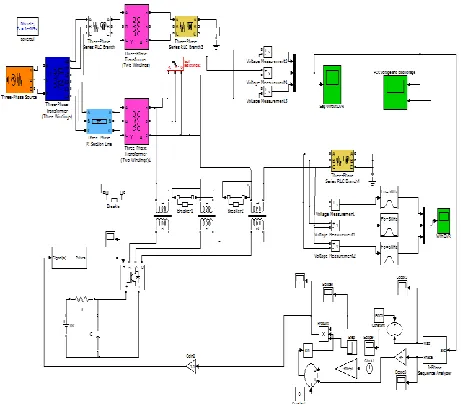
Fig.1: Screenshot from simulink MATLAB model for DVR
c e-ISSN: 2348-6848, p- ISSN: 2348-795X Volume 3, Issue 01, January 2016
International Journal of Research (IJR)
Available at http://internationaljournalofresearch.org
IV. APPLICATION OF DVR
Conventional DVR uses Sinusoidal Pulse Width Modulated Voltage Source Inverter. But in this thesis, Space Vector Pulse Width Modulation technique is used. The main function of VSC is that it converts the DC voltage which is supplied by the Energy Storage
Unit into an AC form of voltage. The DVR power
circuit uses step up voltage injection transformer, therefore a VSI with even a low voltage rating would result to be sufficient. This paper approaches the study of DVR and its application for the voltage sag mitigation.
Fig.2: Screenshot from MATLAB, mitigating voltage sag using DVR
A new approached for the DVR control system has been studied and implemented to get better results as compared to previous techniques used for controlling the DVR. A controller with Space Vector Pulse Width Modulation technique is proposed to obtain
higher amplitude index of modulation when compared to the conventional Sinusoidal Pulse Width Modulation technique. It is also easier to implement SV-PWM using the digital processors. A total of about 15 percent higher outputs are obtained if SV-PWM is used instead of the SV-PWM technique. The main aim of the control system is to maintain a constant voltage at those points where sensitive load is connected. The aim of control system is to measure the r.m.s voltage at the point of load and there is no requirement of reactive power measurement. The switching strategy of the Voltage Source Converter is based on space vector PWM technique offering better response and simplicity. Using SPWM creates some problems like generation of large noise peaks in multiple carrier frequencies. So a different control method based on Space Vector Pulse Width Modulation technique is applied to the DVR's converter. The model for DVR has been simulated in Matlab and the graph has been depicted below.
REFERENCES
[1] ParagKanjiya, Bhim Singh, P. Jayaprakash, "A
Robust Control Algorithm for Self Supported Dynamic Voltage Restorer", IEEE, 987-1-4244-7882-8, 2011
[2] RavillaMadhusudan, G. Ramamohan Rao,
"Modelling and Simulation of a Dynamic Voltage Restorer for Power Quality Problems-Voltage sags and swells", IEEE,
[3] H. Lakshmi, T. Swapna, "Modelling and
Simulation of Dynamic Voltage Restorer for Power Quality Improvement", International Journal of Scientific & Engineering Research, 2229-5518, Vol. 4, Issue 2, Feb-13
[4] Atif Iqbal, "MATLAB/SIMULINK model of
Space Vector PWM for 3-phase VSI", Aligarh Muslim University.
c e-ISSN: 2348-6848, p- ISSN: 2348-795X Volume 3, Issue 01, January 2016
International Journal of Research (IJR)
Available at http://internationaljournalofresearch.org
[6] Dorin O. Neacsu, "Space vector modulation-an
introduction", IECON'01: 27th annual conference of IEEE, 0-7803-7108-9/2001.
[7] B.N S P Venkatesh, "DVR based on space
vector pulse width modulation technique", Internation journal of engineering science and technology, ISSN: 0975-5462, Vol.3, No.7, july-2011.
[8] P.Tripura, et al, "SVPWM scheme for
two-level VSI", ACEEE Int. J. on Control System and Instrumentation, Vol.02, No. 03, Oct-2011
[9] Ahmed Helal, "Modelling & Analysis of
SVPWM based DVR", World Academy of Science, Engineering and Technology 48 2010,
[10] Ankit Pandey, Rajlakshmi, "Dynamic Voltage