Cryptanalysis of Three Certificate-Based
Authenticated Key Agreement Protocols
and a Secure Construction
Yang Lu, Quanling Zhang, Jiguo Li
College of Computer and Information Engineering, Hohai University Nanjing, Jiangsu 211100 - China
[E-mail: [email protected], [email protected], [email protected]] *Corresponding author: Yang Lu
Abstract
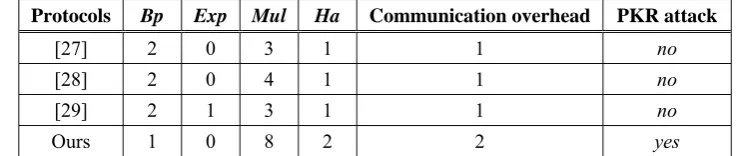
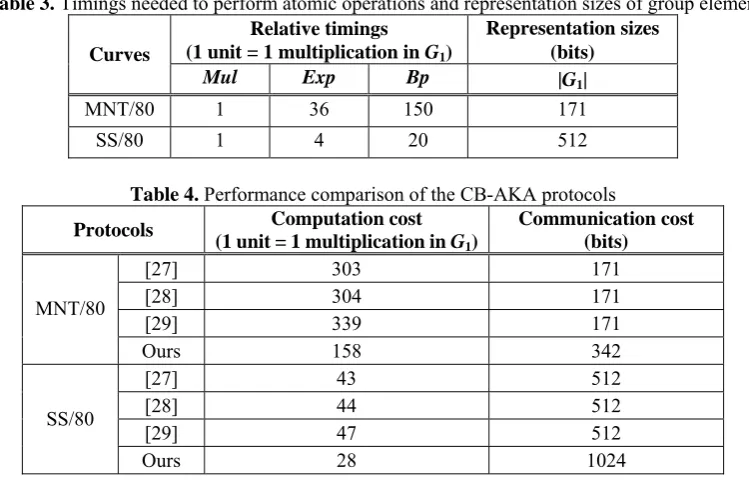
Certificate-based cryptography is a new public-key cryptographic paradigm that has very appealing features, namely it simplifies the certificate management problem in traditional public key cryptography while eliminating the key escrow problem in identity-based cryptography. So far, three authenticated key agreement (AKA) protocols in the setting of certificate-based cryptography have been proposed in the literature. Unfortunately, none of them are secure under the public key replacement (PKR) attack. In this paper,we first present a security model for certificate-based AKA protocols that covers the PKR attacks. We then explore the existing three certificate-based AKA protocols and show the concrete attacks against them respectively. To overcome the weaknesses in these protocols, we propose a new certificate-based AKA protocol and prove its security strictly in the random oracle model. Performance comparison shows that the proposed protocol outperforms all the previous certificate-based AKA protocols.
1. Introduction
K
ey agreement is an important cryptographic primitive for building secure communication channels over an insecure public network. A key agreement protocol allows two or more parties to securely establish a shared secret key for their communications in the present of an adversary.Key agreement protocols are usually designed under public key cryptography (PKC). The first practical solution to the key agreement problem is the Diffle-Hellman key exchage protocol [1]. However, the Diffle-Hellman protocol does not provide authentication to the participants and hence subjects to the man-in-the-middle (MITM) attack. Hence, the research in this area has been focusing on the design of AKA protocols, as they offer the assurance that only the participating parties of a protocol can compute the agreed key. Over the years, a number of AKA protocols under traditional PKC have been proposed [2-4]. However, the need for PKI-supported public-key certificates is considered the main difficulty in the deployment of traditional PKC.
In 1984, Shamir [5] proposed the notion of identity-based cryptography (IBC) where the identity information of a user serves as his public key and a trust third party called private key generator (PKG) is employed for generating users’ private keys. The main merit of IBC lies in that it eliminates the requirement of public-key certificates. There are numerous identity-based AKA protocols in the literature [6-9] so far. In such proposals, the PKG is unconditionally trusted and thus the protocols suffer from the key escrow problem. This may be undesirable in some scenarios where it is difficult to find such a party fully trusted by the distributed users.
In Asiacrypt 2003, Al-Riyami and Paterson [10] proposed certificateless public key cryptography (CL-PKC). Their main purpose is to solve the key escrow problem in IBC, while keeping the implicit authentication property of IBC. In CL-PKC, every user independently generates his private key by combining the partial private key from a partially trusted authority named key generation center (KGC) with the secret value chosen by the user himself. In this way, KGC does not know any user’s private key. Therefore, there is no key escrow problem in CL-PKC. Recently, several certificateless AKA protocols have been presented [11-14]. However, as KGC needs to send partial private keys to users over secure channels, certificateless AKA protocols inevitably suffer from the key distribution problem.
In Eurocrypt 2003, Gentry [15] introduced the concept of certificate-based cryptography (CBC). CBC combines traditional PKC with IBC while preserving the advantages of each. Similar to traditional PKC, each user in CBC generates his public key and private key independently, and then requests a certificate from a CA. The difference is that the certificate will be pushed only to its owner and also acts as a partial decryption key or a partial signing key. This additional functionality provides an efficient implicit certificate mechanism so that a user needs both his private key and certificate to perform cryptographic operations (such as decryption and signing), while the other parties need not obtain the fresh information on the user’s certificate status. Therefore, CBC eliminates third-party queries for the certificate status and simplifies the public key revocation problem in traditional PKC. Furthermore, there are no key escrow problem (since CA does not know users’ private keys) and key distribution problem (since the certificates can be sent to their owners publicly) in CBC.
certificate-based AKA protocols. To the best of our knowledge, only three certificate-based AKA protocols have been proposed in the literature [27-29]. The first certificate-based AKA protocol was proposed by Wang and Cao [27]. Their protocol combines Gentry’s certificate-based encryption scheme with Smart’s AKA protocol [9]. However, Lim et al. [28] pointed out that Wang-Cao’s protocol does not have resistance to leakage of ephemeral secret keys. To improve security, they proposed an improved protocol with some slight modifications on Wang-Cao’s protocol. They claimed that their protocol has resistance to all non-trivial secret exposures. However, no formal security proof is given in [28]. In 2008, Luo et al. [29] proposed the first security model for certificate-based AKA protocols. They also proposed a provably secure certificate-based AKA protocol in their security model.
Our Motivations and Contributions. The main aim of this paper is to present a provably secure certificate-based AKA protocol that resists PKR attacks. PKR attack was first introduced into CL-PKC by Al-Riyami and Paterson in [10]. In this attack, an adversary who can replace any user’s public key at its will dupes any other third parties to perform cryptographic operations (such as decryption and signature verification) using a false public key. It seems that this attack does not exist in CBC since a CA is employed for issuing a certificate for each user. Unfortunately, it does. In CBC, the CA does issue the certificates. But, as introduced above, only the owner of a certificate needs to check the validity of his certificate and others need not be concerned about the status of this user’s certificate. Thus, an adversary is able to launch the PKR attack against an ill-designed certificate-based cryptographic scheme. We have observed that all the existing three certificate-based AKA protocols [27-29] are not secure under such attack. So, it is fair to say that devising a secure certificate-based AKA protocol remains an unsolved problem until now.
In this paper, we first propose an improved security model for certificate-based AKA protocols that captures PKR attacks by extending Luo et al.’s model [29]. We show that all the existing three certificate-based AKA protocols are insecure in our improved security model. Then we proposed a new certificate-based AKA protocol. In the random oracle model, we formally prove its security under hardness of discrete logarithm problem, computational Diffie-Hellman problem and bilinear Diffie-Hellman problem. Compared with the existing certificate-based AKA protocols, our new protocol enjoys better performance and stronger security guarantee.
2. Bilinear Pairing and Complexity Problems
Letqbe a prime number,G1an additive cyclic group of prime orderqandG2a multiplicative cyclic group of the same order. A mappinge G G: 1× 1→G2is called a bilinear pairing if it satisfies the following properties:
(1) Bilinearity:e aU bV
(
,) (
=e U V,)
abfor allU V G, ∈ 1and , *q
a b Z∈ . (2) Non-degeneracy: There existsU V G, ∈ 1such that ( , ) 1e U V ≠ . (3) Computability: ( , )e U V can be efficiently computed for allU V G, ∈ 1.
The security of our proposed protocol is based on the following three complexity problems: Discrete Logarithm (DL) Problem: Given a generatorPofG1and an elementQ G∈ 1, find
an integer *
q
a Z∈ such thataP Q= .
Computational Diffie-Hellman (CDH) Problem: Given a generatorPofG1and a tuple
1
(aP bP, )∈G for unknown , *
q
Bilinear Diffie-Hellman (BDH) Problem: Given a generatorPofG1and a tuple (aP,bP, cP)∈G1for unknown , , *
q
a b c Z∈ , compute ( , )e P P abc.
3. Modeling Certificate-based AKA Protocols
3.1 Outline of a certificate-based AKA protocol
Formally, a certificate-based AKA protocol is specified by the following algorithms:
(1) Setup: This probabilistic polynomial-time algorithm takes a security parameter k as
input and generates the CA’s master key msk and a list of public parameters params.
(2) UserKeyGen: This probabilistic polynomial-time algorithm takes params as input and
returns a pair of public key and private key(PK SKU, U)for a userUwith identityIDU.
(3) CertGen: This probabilistic polynomial-time algorithm takes params, msk, an
identityIDUand a public keyPKUas input and returns a certificateCertU.
(4) KeyAgreement: This probabilistic polynomial-time interactive algorithm, which
involves two participants - an initiator A and a responder B, takes params, an initiator A’s identityIDA, public keyPKA, private keySKAand certificateCertAand a responder B’s identityIDB, public keyPKB, private keySKBand certificateCertBas input. If the protocol does not fail, the participants A and B will generate a same secret shared keyK = K = KAB BA after the algorithm is executed.
3.2 Desirable security properties for certificate-based AKA protocols
Some desired security properties are commonly required for AKA protocols in gereral [6, 29-31]. As a kind of AKA protocol, a certificate-based AKA protocol should satisfy the following security properties.
(1) Known-key security: If the protocol does not fail, each run of the protocol between two participants should generate a unique and independent session key. The other session keys should be secure even though an adversary has learned some of the session keys.
(2) Unknown key-share resilience: An adversary should be unable to force others to share a key with other participants when it is actually sharing with a different participant.
(3) Basic impersonation attacks resilience: An adversary should be unable to impersonate a participant if it does not know this participant’s private key.
(4) Forward secrecy: If the private keys of one or more participants are compromised, an adversary must have negligible advantage on compromising previously established session keys. This security property can be extended to the following three types: (a) Perfect forward secrecy: even if an adversary armed with all participants’ private keys, forward secrecy must be preserved; (b) Partial forward secrecy: even if an adversary armed with some but not all participants’ private keys, forward secrecy must be preserved; (c) CA forward secrecy: even if an adversary armed with the CA’s master key, forward secrecy must be preserved.
(5) Key compromise impersonation resilience: If the private key of a participant A is compromised, an adversary can be able to impersonate the participant A to any other participant but can not impersonate others to the participant A.
3.3 Security model for certificate-based AKA protocols
Based on the security model of Luo et al. [29] and the modified Bellare-Rogaway (mBR) model [32], we present an improved security model for certificate-based AKA protocols.
A certificate-based AKA protocol should be secure against two types of adversaries [15, 29]: Type I (denoted by A1) and Type II (denoted by A2). The adversary A1 models an uncertified participant who can replace any participant’s public key, but is not allowed to access the CA’s master key. The adversaryA2 models a malicious CA who knows the master key, but is not allowed to replace public keys. Obviously, if a certificate-based AKA protocol is secure against a Type II adversary, it will satisfy CA forward secrecy.
In our security model, we use the oracle n, i j
∏ to represent the n-th protocol session between the participantsiand j. We define a conversation for a given session to be the ordered concatenation of all messages (both incoming and outgoing). LetPID= (IDi,IDj) be a partner identity of the oracle n,
i j
∏ andSID= (IDi,IDj, n,
i j
M , n, j i
M ) be the session identity of the oracle n,
i j
∏ at participantiwhich is the transcript of the messages exchanged with participant j during the session, where the symbols n,
j i
M and n, i j
M denote the incoming message and outgoing message respectively. If two oracles n,
i j
∏ and m,
j i
∏ have the samePIDandSID, they are said to have a matching conversation with each other.
The security of certificate-based AKA protocols can be defined through the following game that is played between a challenger and an adversary A∈ {A1, A2}.
Setup. On input a security parameter k, the challenger simulates the algorithm Setup(k) to
generate msk and params, and then sends params to the adversary A. If A is a Type II adversary, the challenger also sends msk to it.
Phase 1. In this phase, A can adaptively query the following oracles:
(1) Create(IDi): This oracle allows A to create a new participant with identityIDi. On input an identityIDi, the challenger generates a private/public key pair (SKi, PKi) forIDiand then outputs PKi. For simplicity, we assume that the following oracles only respond to an identity which has been created.
(2) ReplacePublicKey(IDi,PKi′): On input an identityIDiand a valuePKi′, the challenger replaces the current public key of the identityIDiwithPKi′. This oracle is only queried by the Type-I adversary. It models the ability of a Type-I adversary to convince a legitimate participant to use a false public key and thus captures the public key replacement attacks.
(3) Certificate(IDi): On input an identityIDi, the challenger outputs a certificateCertiby running the algorithm CertGen(params, msk,IDi,PKi). If A has replaced the participant i’s
public key, it can not request i’s certificate. This restriction is imposed due to the fact that A can not obtain an illegal certificate of a replaced public key. The Type II adversary need not make such query, since itcan generate a certificate for any participant by itself.
unreasonable to expect the challenger to return a private key of a participant for which it does not know the private key.
(5) Send( n, i j
∏ , M): A can send a message M of its choice to an oracle, say n, i j
∏ , in which case participant i assumes that the message has been sent by participant j. A may also make a special Send query with M = λ to an oracle n,
i j
∏ , which instructs i to initiate a protocol run with j. An oracle is an initiator if the first message it has received is λ. If an oracle does not receive a message λ as its first message, then it is a responder oracle. Here, we requirei≠ j, i.e. a participant can not run a session with itself.
(6) Reveal( n, i j
∏ ): On input an oracle n, i j
∏ , the challenger outputs the session key held by
,
n i j
∏ to A.
Test. At some point, A asks a single Test query on a fresh oracle T, I J
∏ (see Definition 1). To respond, the challenger flips a random coinb∈{0,1}, and returns the session key T,
I J
SK held by T,
I J
∏ ifb=0or a random sample from the distribution of the session key ifb=1. Phase 2. In this phase, A continues to issue a sequence of queries as in Phase 1.
Guess. Finally, A outputs a guessb′∈{0,1}. We say that A wins the game ifb′ =band the following conditions are simultaneously satisfied: (1) A can not make a Reveal query to the test oracle T,
I J
∏ or T,
J I
∏ who has a matching conversation with T, I J
∏ (if any); (2) A cannot make a Certificate query on the identityIDJif it is a Type I adversary; (3) A cannot make a Corrupt query on the identityIDJif it is a Type II adversary. A’s advantage to win the above game is denoted to be Adv (A) = |Pr [b′ =b]-1/2|.
Definition 1. An oracle n, i j
∏ is said to be fresh if (1) n, i j
∏ has accepted the request to establish a session key; (2) n,
i j
∏ has not been revealed; (3) there is no matching conversation of session n,
i j
∏ has been revealed; (4) A has never requested the certificate of the participant jif it is a Type I adversary; (5) A has never requested the private key of the participant jif it is a Type II adversary.
Definition 2. A certificate-based AKA protocol is said to be secure if (1) In the presence of the adversary on n,
i j
∏ and m,
j i
∏ , both oracles always agree on the same session key, and the key is distributed uniformly at random; (2) For any adversary A, Adv (A) is negligible.
Remark 1.The above definition allows the Type I adversary to request both the private key and certificate of the participant I and the Type II adversary to request the private key of the participantI , thus it covers the security properties of Key-compromise impersonation resilience , Partial forward secrecy and CA forward secrecy. Furthermore, similarly to [6], if a certificate-based AKA protocol is secure under Definitioin 2, it achieves the security properties of Known-key security, Unknown key-share resilience, Partial forward secrecy and Key control.
For ease of representation, we first establish the common notations used in the existing certificate-based AKA protocols. In all these protocols, the CA has master key *
q
s Z∈ and master public keyPpub =sP. The tuple{G G e q P1, 2, , , }is defined as in Section 2, l N∈ denotes the bit-length of the shared session key. We will need the following hash functions and key derivation function: H1: G1×{0,1}*→G1, H1′: {0,1}*× G1→ G1, kdf :{0,1} {0,1}
*→ l.
In Table 1, we give a summary of user parameters for each of the protocols, where *
U q
x ∈Z anddataUdenotes a string which includes the user U’s public keyPKUand identityIDU.
Table1.Parameters for user U
Protocol PKU SKU CertU
Wang-Cao’s [27] x PU xU sH P1( pub,dataU)
Lim et al.’s [28] x PU xU sH P1( pub,dataU)
Luo et al.’s [29] x PU pub xU sH1′
(
IDU,PKU)
4.1 Wang-Cao’s certificate-based AKA protocol
In Wang-Cao’s protocol [27], Alice (A) and Bob (B) agree on a session key as follows. (1) Alice chooses a random value *
q
a Z∈ and sendsTA=aPto Bob. (2) Bob chooses a random value *
q
b Z∈ and sendsTB =bPto Alice. (3) Alice computesQB=H P1( pub,dataB), and then two shared secrets
1
A
K and 2
A
K as
1 ( pub B, B)
A e P PK
K = + aQ ,
2 ( , )
A e T SB A
K = ,
whereSA=CertA+SK QA A= (s SK Q+ A) A.
(4) Bob computesQA=H P1( pub,dataA), and then two shared secrets 1
B
K and 2
B
K as
1 ( pub A, A)
B e P PK
K = + bQ ,
2 ( , )
B e T SA B
K = ,
whereSB =CertB+SK QB B = (s SK Q+ B) B.
(5) Alice and Bob respectively compute the shared session keys as
1 2 |
( |B || A || A || B)
A K
K =kdf A K aT ,
2 1 ||
( || B || B || )
B K A
K =kdf A B K bT .
Attack. We show that if one of Alice and Bob’s public keys has been replaced by an adversary Eve, then Wang-Cao’s protocol is vulnerable to a basic impersonation attack.
Assume that Eve has replaced Bob’s public key PKB with *
B
PK =−Ppub +βP, where *
q
Z
β∈ . She impersonates Bob to Alice by choosing a random value *
q
b Z∈ and sendsTB =bPto Alice. Alice computes
1
A
K =e(Ppub+ *
B
PK , *
B
aQ ) ( , *)
B A
e T βQ
= ,
2 ( , )
A e T SB A
K = =e(Ppub+PKA,bQA),
where *
1
* ( , )
pu B b B
Q =H P data . It then derives the session key
1 ||
( || ||
=
A A
K kdf A B K
2 || )
A B
K aT . As Eve chooses both β and b, she can compute
1
A
K ,
2 = 1
A B
K K andaTB=bTA, and thus the session keyKA. Therefore, it succeeds in impersonating Bob to establish a session with Alice.
that any attack has been carried out, and both of them believe that they have established a session with each other. In fact, each of them has established a session with Eve.
4.2 Lim et al.’s certificate-based AKA protocol
To have the property of resistance to leakage of ephemeral secret keys, Lim et al. [28] modified Wang-Cao’s protocol by incorporatingSK SK PA B into the session key. In their modified protocol, Alice and Bob respectively compute the session key as follows:
1 2 || || || ||
( || )
A A A B A B
K =kdf A B K K aT SK PK ,
2 1
( || || || || || )
B B B A B A
K =kdf A B K K bT SK PK . Lim et al. claimed that their protocol has resistance to all non-trivial secret exposures. However, it is vulnerable to a key compromise impersonation attack. The concrete attack is almost as same as our presented attack against Wang-Cao’s protocol. The only difference is that Eve now is equipped with Alice’s private keySKA. Assume that Eve has replaced Bob’s public keyPKBwith *
B
PK = −Ppub+βP, where *
q
Z
β∈ . Then Alice will compute the session key
1 2
*
|| || || || || )
( A A B A B
A K K
K =kdf A B aT SK PK . As Eve knows SKA , she can compute
*
B A
SK PK and then the session keyKA. Therefore, Eve is able to impersonate Bob to establish a session with Alice.
4.3 Luo et al.’s certificate-based AKA protocol
In Luo et al.’s protocol [29], Alice and Bob agree on a session key as follows. (1) Alice chooses a random value *
q
a Z∈ and sendsTA=aPto Bob. (2) Bob chooses a random value *
q
b Z∈ and sendsTB =bPto Alice. (3) Alice computes three shared secrets
1
A
K , 2
A
K and 3
A
K as
1
A
K =e T S( B, A), 2
A
K ( , )a B B
e PK Q
= ,
3
A
K =A B aT|| || B||SK PKA B, whereSA=SK CertA A=SK sQA AandQB =H1′(IDB,PKB).
(4) Bob computes three shared secrets 1
B
K , 2
B
K and 3
B
K as
1 ( , )
B e T SA B
K = ,
2 ( , )
B e PK QA A b
K = ,
3 || || A|| B A
B A B bT SK
K = PK ,
whereSB =SK CertB B=SK sQB BandQA=H1′(IDA,PKA).
(5) Alice and Bob compute respectively the shared session keys as
1 2 3 ( || || A || || )
A A B A A
K =kdf T T K K K ,
2 1 3 ( || || B || || )
B A B B B
K =kdf T T K K K .
Attack. We first show that Luo et al.’s protocol is vulnerable to a key compromise impersonation attack if considering PKR attack.
Assume that Eve has replaced Bob’s public keyPKBwith *
B
PK =βPand also has access to Alice’s private keySKA, where *
q
Z
β∈ . She impersonates Bob to Alice by choosing a random value *
q
b Z∈ and sendsTB =bPto Alice. Alice computes
1 = ( , )
A T SB A
K e = e(TB,SK CertA A),
2
*, * *
( )a ( , )
B A B A e P B Q e T
K = K = β Q ,
3
*
|| || ||
A A B aTB SKA B
K = PK || || || *
A A B
A B bT SK PK
= , where
* *
1( , )
B IDB B
Q =H′ PK . It then derives the session key
1 2 3 ( || || A || || )
A A B A A
K =kdf T T K K K . As Eve chooses both β and b and knowsSKA, she can compute
1
A
K , 2
A
K and 3
A
We further show that Luo et al.’s protocol does not have resistance to leakage of ephemeral secret keys. Actually, if armed with a and b, it is easy for Eve to mount an outsider MITM attack against Luo et al.’s protocol. Suppose Eve respectively replaces Alice’s public keys with *
A pub
PK =αP and *
B pub
PK =βP , where , *
q
Z
α β∈ . Then we have
1 ( , )
A e T SB A
K = =e PK bQ( A, A), 2
*, *
( )
A B a B
K =e PK Q ,
3 || || B||
A A B aT A
K = βPK ,
1
*, *
( )
B A b A
K =e PK Q ,
2 ( ,A B) ( B, )
B e T S e PK B
K = = aQ ,
3 || || A||
B A B bT B
K = αPK .
Obviously, Eve will have no problem calculating all the above shared secrets if she knows the valuesaandb. Thus, Eve will respectively establish the session key with Alice and Bob.
5. Our Proposed Certificate-Based AKA Protocol
5.1 Description of the protocol
To overcome the weaknesses in the existing certificate-based AKA protocols, we propose a novel certificate-based AKA protocol which consists of the following four algorithms:
(1) Setup: Input a security parameter k and the tuple{ , , ,q e G G P1 2, } as defined in Section 2,
the CA randomly chooses *
q
s Z∈ as its master key msk and computesPpub =sP. It then chooses three hash functions H1:{0,1}*×G1→G1, H2:
*
{0,1} ×{0,1}*× 1
G× *
q
Z → *
q
Z , H3: {0,1}*× {0,1}* × 6
1
G ×G2× 3 1
G →{0,1}kand publishes the public parameters params = {k, q,e,
1
G ,G2,P,
pub
P ,H1,H H2, 3}.
(2) UserKeyGen: Given the public parameters params, a userUwith identityIDUrandomly
chooses *
U q
x ∈Z as his private keySKUand computes his public keyPKU =x PU .
(3) CertGen: Given the public parameters params, the master keymsk s= and a user U’s
identityIDUand public keyPKU, the CA computesQU =H ID PK1( U, U)and then the user U’s certificateCertU =sQU.
(4) KeyAgreement: Assume that a participant A with identityIDAhas private keySKA ,
public keyPKAand certificateCertAwhile a participant B with identityIDBhas private key
B
SK , public keyPKBand certificateCertB. A and B run the protocol in the following steps: A randomly chooses *
q
a Z∈ , computesRA=aPandWA=H ID ID Cert SK P2( A, B, A, A) ; then A sends (ID R WA, A, A)to B.
After receiving(ID R WA, A, A), B randomly chooses *
q
b Z∈ , computesRB=bPandWB=H2 (IDA,IDB,CertB,SKB)P; then B sends (ID R WB, B, B) to A.
Then both A and B could compute their shared secrets as follows: A computes
1 ( , )
A B B pub A
K =e R +Q aP +Cert ,
2 2( , , , )
A A B A B A A B
K =SK PK +H ID ID Cert SK W ,
3
A B A B
K =aPK +SK R , 4
A B
K =aR . B computes
1 ( , )
B A A pub B
K =e R +Q bP +Cert ,
2 2( , , , )
B B A A B B B A
K =SK PK +H ID ID Cert SK W ,
3
B A B A
K =bPK +SK R , 4
B A
Thus A and B could respectively compute their shared session key as
1 2 3 4
3( , , , , , , , , , , , )
AB A B A B A B A B A A A A
K =H ID ID PK PK R R W W K K K K ,
1 2 3 4
3( , , , , , , , , , , , )
BA A B A B A B A B B B B B
K =H ID ID PK PK R R W W K K K K . It is easy to deduce that
1
A
K = (e sRB+sQ aP QB, + A)= (e bPpub +Cert RB, A+QA)= 1
B
K ,
2
A
K =SK SK P+H ID ID Cert SK H ID ID Cert SK PA B 2( A, B, A, A) 2( A, B, B, B) = 2
B
K ,
3 3
A B A B A A B
K =aSK P SK bP SK R+ = +bPK =K ,
4
A B
K =aR =abP= 4
B
K . Thus,K = KAB BA=K. 5.2. Security analysis
We prove the security of our proposed certificate-based AKA protocol as follows. Lemma 1. In the presence of an adversary on n,
i j
∏ and m,
j i
∏ , both oracles always agree on the same session key, and the key is uniformly distributed at random.
Proof. From the correction analysis of out protocol in Section 5.1, we know if two oracles are matching, then both of them have the same session key. Since , *
q
a b Z∈ are randomly selected during the protocol excution, the session key can be considered as the output of the hash function H3 on a random input. Based on the properties of cryptographic hash functions, the session key is uniformly distributed.
Lemma 2. Assuming that H1 ~ H3 are random oracles and A1 is a Type I adversary against our proposed protocol with advantageε . Then there exists an algorithm C to solve the BDH
problem in G1 with advantage
3
2
c s H
q q q
ε
ε′ ≥ , whereqc, 3
H
q andqsrespectively denote the maximal number of A1’s queries to the oracle Create, A1’s queries to the random oracle H3 and sessions that each participant may be involved in.
Proof. Suppose that the algorithm C is given a random instance ( ,P aP bP cP, , )of the BDH problem. In order to use the adversary A1 to compute ( , )e P P abc, the algorithm C needs to simulate a challenger and all oracles for A1.
In the setup phase, C setsPpub =aPand sends the public parameters params = {k, q, e, G1, G2, P, Ppub, H1, H2, H3} to A1, where H1 ~ H3 are random oracles controlled by C. Furthermore, C randomly chooses distinct I, J ∈[1,qc] and T ∈[1,qs].
During the query-answer phase, the algorithm C responds A1’s various queries as follows: H1(IDi,PKi): C maintains an initially empty list L1 consisting of tuples (ID u Qi, , )i i . On
receiving a query H1(IDi,PKi), C answersQiif (ID u Qi, , )i i is on the list L1. Else ifIDi=IDJ,
C setsQi=bP, puts a new tuple (IDi, , )⊥Qi in the list L1 and returnsQi. Otherwise, C randomly
chooses *
i q
H2(IDi ,IDj,Certi,SKi): C maintains an initially empty listL2consisting of tuples (IDi, j
ID ,Certi,SKi, n, i j
w , ,n i j
W ). On receiving such a query, C answers n, i j
w if (IDi ,IDj,Certi,SKi,
,
n i j
w , ,n i j
W ) is on the listL2. Otherwise, C randomly chooses n, i j
w *
q
Z
∈ , computes ,n n, i j i j
W =w P, puts a new tuple (IDi ,IDj,Certi,SKi, n,
i j
w , ,n i j
W ) in the listL2and returns n, i j
w .
H3(IDiA,IDiB,PKiA,PKiB,RiA,RiB,WiA,WiB,Ki1,Ki2 ,Ki3 ,Ki4 ): C maintains an initially empty listL3consisting of tuples ( A
i
ID , B i
ID , A i
PK , B i
PK , A i
R , B i
R , A i
W , B i W , 1 i K , 2 i K , 3 i K , 4 i K , i
h). On receiving such a query, if ( A i
ID , B i
ID , A i
PK , B i
PK , A i
R , B i
R , A i
W , B i W , 1 i K , 2 i K , 3 i K , 4 i K , i
h) is on the listL3, C returnshias the answer. Otherwise, C does as follows: (1) If there exists a tuple ( n,
i j
∏ ,IDi, IDj,PKi,PKj, ,
n i j
w , n, i j
r , ,n i j
W , n, j i
W , n, i j
R , n, j i
R , n, i j
K ) on the listLs(maintained by the oracle Send below) such that n,
i j
K ≠⊥,IDi =IDJand
− n,
i j
∏ is an initiator and A i i
ID =ID , B i j
ID =ID , A i
PK =PKi , B i
PK =PKj, A i
R = n, i j
R , B i
R = n, j i
R ,
,
A n i i j
W =W , B i
W = n, j i
W , 1
i
K = ( n, , n, )
j i j i j pub i
e R +Q r P +Cert , 2
i
K =SK PKi j+H2(IDi,IDj,Certi,
i
SK ) n, j i
W , 3
i
K = n, i j j
r PK + n, i j i
SK R , 4
i
K = ,n n, i j j i
r R , or
− n,
i j
∏ is a responder and A i j
ID =ID , B i i
ID =ID , A i
PK =PKj, B i
PK =PKi , A i
R = n, j i
R , B i
R = n, i j
R ,
A i
W n, j i
W
= , B
i
W = ,n i j
W , 1
i
K = ( n, , ,n )
j i j i j pub i
e R +Q r P +Cert , 2
i
K =SK PKi j+H2(IDi,IDj,Certi,
i
SK ) ,n i j
W , 3
i
K = n, i j j
r PK + n, i j i
SK R , 4
i
K = ,n n, i j j i
r R , then C checks whether
4
, , , ( ,
( n n ) )
i j j i i
e R R =e K P holds. If it holds, C sets n, i i j
h =K , puts a new tuple ( A
i
ID , B i
ID , A i
PK , B i
PK , A i
R , B i
R , A i
W , B i W , 1 i K , 2 i K , 3 i K , 4 i
K ,hi) in the listL3and returns
i
h as the answer. Else, it randomly chooses {0,1}k i
h ∈ , puts a new tuple( A i
ID , B i
ID , A i
PK ,
B i
PK , A i
R , B i
R , A i
W , B i W , 1 i K , 2 i K , 3 i K , 4 i
K ,hi) in the listL3and returnshias the answer. (2) Else if there exists a tuple ( n,
i j
∏ , IDi, IDj, PKi, PKj, ,
n i j
w , ,n i j
r , ,n i j
W , n, j i
W , n, i j
R , n, j i
R , n, i j
K ) on the listLssuch that n,
i j
K ≠⊥,IDi ≠IDJand
− n,
i j
∏ is an initiator and A i i
ID =ID , B i j
ID =ID , A i
PK =PKi , B i
PK =PKj, A i
R = n, i j
R , B i
R = n, j i
R ,
,
A n i i j
W =W , B i
W = n, j i
W , 1
i
K = ( n, , n, )
j i j i j pub i
e R +Q r P +Cert , 2
i
K =SK PKi j+H2(IDi,IDj,Certi,
i
SK ) n, j i
W , 3
i
K = n, i j j
r PK + n, i j i
SK R , 4
i
K = ,n n, i j j i
r R , or
− n,
i j
∏ is a responder and A i j
ID =ID , B i i
ID =ID , A i
PK =PKj, B i
PK =PKi , A i
R = n, j i
R , B i
R = n, i j
R ,
A i
W n, j i
W
= , B
i
W = ,n i j
W , 1
i
K = ( n, , ,n )
j i j i j pub i
e R +Q r P +Cert , 2
i
K =SK PKi j+H2(IDi,IDj,Certi,
i
SK ) ,n i j
W , 3
i
K = n, i j j
r PK + n, i j i
SK R , 4
i
K = ,n n, i j j i
r R , then C setshi= n,
i j
K , puts a new tuple ( A i
ID , B i
ID , A i
PK , B i
PK , A i
R , B i
R , A i
W , B i W , 1 i K , 2 i K , 3 i K , 4 i
K ,hi) in the listL3and returnshias the answer. (3) Otherwise, it randomly chooses {0,1}k
i
h ∈ , puts a new tuple ( A i
ID , B i
ID , A i
PK , B i
PK , A i
R ,
B i
R , A i
W , B i W , 1 i K , 2 i K , 3 i K , 4 i
Create(IDi): C maintains an initially empty listLuser consisting of tuples of the form (ID SK PKi, i, i). We suppose that all the Create queries are distinct. On receiving such a query, C returnsPKias the answer if (ID SK PKi, i, i)is on the list Luser . Otherwise, C randomly chooses *
i q
x ∈Z as the private keySKifor the identityIDi, computes the corresponding public keyPKi=x Pi , puts a new tuple (ID SK PKi, i, i)in the listLuserand then returnsPKi.
Certificate( IDi ): On receiving such a query IDi , C aborts if IDi =IDJ . Otherwise, C simulates a query H1(IDi,PKi) to obtain a tuple (ID u Qi, , )i i , computesCerti=u Pi pub and
then returnsCertias the answer.
Corrupt( IDi ): On receiving such a query IDi , C searches for the corresponding tuple (ID SK PKi, i, i)in the listLuserand returnsSKias the answer.
ReplacePublicKey(IDi,PKi′): On receiving such a query, Csearches for the corresponding tuple (ID SK PKi, i, i)in the listLuserand replaces the tuple with (IDi, ,⊥ PKi′).
Send( n, i j
∏ , M): C maintains an initially empty listLsconsisting tuples ( n, i j
∏ , IDi, IDj, PKi,
PKj, n, i j
w , ,n i j
r , ,n i j
W , n, j i
W , n, i j
R , n, j i
R , n, i j
K ). On receiving query Send( n, i j
∏ , M)(if M = (M1, M2) ≠λ, C sets n,
j i
R = M1,Wj in, = M2), C returns(R Wi jn, , i j,n)as the answer if the corresponding tuple (∏i jn, ,
IDi, IDj, PKi, PKj, ,
n i j
w , ,n i j
r , ,n i j
W , n, j i
W , n, i j
R , n, j i
R , n, i j
K ) is alreadly on the listLs. Otherwise, C does as follows:
(1) If n, T, i j I J
∏ = ∏ , C first obtains a tuple (IDi,IDj,Certi,SKi, n,
i j
w , ,n i j
W ) in the listL2(after querying H2(IDi ,IDj,Certi,SKi) if necessary), and sets , ,
n n i j i j
K =r =⊥, n, i j
R =cP, n, j i
R = M1 and n,
j i
W = M2. It then puts a new tuple ( ,
n i j
∏ , IDi, IDj, PKi, PKj, ,
n i j
w , ,n i j
r , ,n i j
W , n, j i
W , n, i j
R , n, j i
R ,
,
n i j
K ) in the listLsand returns( n, , ,n)
i j i j
R W as the answer.
(2) Otherwise, C first obtains a tuple (IDi ,IDj,Certi,SKi, n, i j
w , ,n i j
W )in the listL2(after querying H2(IDi ,IDj,Certi,SKi) if necessary), randomly chooses , {0,1}
n k i j
K ∈ , *
,
n i j q
r ∈Z , and sets n, n,
i j i j
R =r P, n, j i
R = M1 and ,
n j i
W = M2. It then puts a new tuple ( ,
n i j
∏ , IDi, IDj, PKi, PKj, n, i j
w ,
,
n i j
r , ,n i j
W , n, j i
W , n, i j
R , n, j i
R , n, i j
K ) in the listLsand returns( n, , ,n)
i j i j
R W as the answer. Reveal( n,
i j
∏ ): On receiving such a query, C first searches for a tuple ( n, i j
∏ , IDi, IDj, PKi,
PKj,wi jn, ,ri j,n ,Wi j,n,Wj in, ,Ri jn, ,Rnj i, ,Ki jn, ) in the listLs. IfKi jn, ≠⊥, C returnsKi jn, as the answer.
Otherwise, C searches for a tuple(ID SK PKi, i, i)inLuserand does as follows: (1) If n, T,
i j I J
∏ = ∏ , or n,
i j
∏ is the oracle who is a matching conversation with T, I J
∏ , C aborts. (2) Else ifIDi=IDJ,
− n,
i j
∏ is an initiator and there is a tuple( A i
ID , B i
ID , A i
PK , B i
PK , A i
R , B i
R , A i
W , B i W , 1 i K , 2 i K , 3 i K , 4 i
K ,hi) inL3such thatIDi= A i
ID ,IDj= B i
ID ,PKi = A i
PK ,PKj = B i
PK , n, i j
R = A i
,
n j i
R = B i
R , ,n A i j i
W =W , n, j i
W = B i
W , 1
i
K = ( n, , ,n )
j i j i j pub i
e R +Q r P +Cert , 2
i
K =SK PKi j +H2(IDi, IDj,Certi, SKi ) n,
j i
W , 3
i
K = ,n i j j
r PK + n, i j i
SK R , 4
i
K = n, n, i j j i
r R , or
− n,
i j
∏ is a responder and there is a tuple ( A i
ID , B i
ID , A i
PK , B i
PK , A i
R , B i
R , A i
W , B i W , 1 i K , 2 i K , 3 i K , 4 i
K ,hi) inL3such thatIDj= A i
ID ,IDi= B i
ID ,PKj = A i
PK ,PKi = B i
PK , n, j i
R = A i
R ,
,
n i j
R = B i
R , n, A j i i
W =W , ,n i j
W = B i
W , 1
i
K = ( n, , ,n )
j i j i j pub i
e R +Q r P +Cert , 2
i
K =SK PKi j+H2(IDi,
j
ID ,Certi, SKi) n, j i
W , 3
i
K = ,n i j j
r PK + n, i j i
SK R , 4
i
K = ,n n, i j j i
r R , Then C checks whether
1
i
K = ( n, , ,n )
j i j i j pub i
e R +Q r P +Cert holds. If it holds, C sets n, i j
K =hi and returns the session key n,
i j
K as the answer. Otherwise, C randomly chooses n, i j
K ∈
{0,1}kand returns
,
n i j
K as the answer.
− Otherwise, Crandomly chooses n, {0,1}k i j
K ∈ and returns n, i j
K as the answer. (3) Else ifIDi≠IDJ,
− if n,
i j
∏ is an initiator and there is a tuple( A i
ID , B i
ID , A i
PK , B i
PK , A i
R , B i
R , A i
W , B i W , 1 i K , 2 i K , 3 i K , 4 i
K ,hi ) in L3 such that IDi= A i
ID , IDj = B i
ID , PKi = A i
PK , PKj = B i
PK , n, i j
R =
A i
R , n, j i
R = B i
R , ,n A i j i
W =W , n, j i
W = B i
W , 1
i
K = ( n, , ,n )
j i j i j pub i
e R +Q r P +Cert , 2
i
K =SK PKi j+H2(
i
ID , IDj ,Certi ,SKi ) n, j i
W , 3
i
K = ,n i j j
r PK + n, i j i
SK R , 4
i
K = ,n n, i j j i
r R , C sets n, i j
K = hi and returns n,
i j
K as the answer.
− if n,
i j
∏ is a responder and there is a tuple( A i
ID , B i
ID , A i
PK , B i
PK , A i
R , B i
R , A i
W , B i W , 1 i K , 2 i K , 3 i K , 4 i
K , hi ) inL3such thatIDj = A i
ID , IDj = B i
ID , PKj = A i
PK , PKi = B i
PK , n, j i
R =
A i
R , n, i j
R = B i
R , n, A j i i
W =W , ,n i j
W = B i
W , 1
i
K = ( n, , ,n )
j i j i j pub i
e R +Q r P +Cert , 2
i
K =SK PKi j+H2(
i
ID , IDj ,Certi ,SKi ) n, j i
W , 3
i
K = ,n i j j
r PK + n, i j i
SK R , 4
i
K = ,n n, i j j i
r R , C sets n, i j
K = hi and returns n,
i j
K as the answer.
− Otherwise, C randomly chooses n, {0,1}k i j
K ∈ and returns n, i j
K as the answer.
At the test phase, A1may ask a single Test query on some oracle. If A1 does not query on the oracle T,
I J
∏ , then C aborts. Otherwise, C simply returns a random bitx∈{0,1}k.
Once A1 finishes its queries and returns its guess bit which is ignored by C. It is clear that if A1 can win the game with non-negligible advantageε , then there must exist a tuple ( ,
T I J
∏ ,
I
ID ,IDJ,PKI ,PKJ, T, I J
w ,⊥, T, I J
W , T, J I
W ,cP, T, J I
R ,⊥) in the listLs. According to the above simulation, if T,
I J
∏ is an initiator oracle, then there exist a tupe ( A i
ID , B i
ID , A i
PK , B i
PK , A i
R ,
B i
R , A i
W , B i W , 1 i K , 2 i K , 3 i K , 4 i
K ,hi) in the listL3such that A T i I,J
R =R =cP, B i
R = T, J I
R = M1( if M is the received message, then it holds that M1 = ,
T J I
R ); else if T, I J
∏ is a responder, then there exist a tuple ( A
i
ID , B i
ID , A i
PK , B i
PK , A i
R , B i
R , A i
W , B i W , 1 i K , 2 i K , 3 i K , 4 i
K ,hi) in the listL3such that B T
i I,J
R =R =cP, A i
R = T, J I
R = M1 ( if M is the received message, then it holds that M1 = ,
T J I
It is easy to deduce that
1
i
K =e(M1+QJ,cPpub+CertI) =e(M1+bP acP, +u aPI )
= ( , )abc ( , ) ( 1, )
I
e P P e bP u aP e M acP e(M1,u aPI ) =
4 ( , )abc ( , ) ( , )
I i
e P P e bP u aP e K aP e(M1,u aPI ),
whereuIcan be retrieved from the tuple(ID u QI, ,I I)in the list L1. As Ccan computeZ=
4 1
( , I ) ( i, ) ( , I )
e bP u aP e K aP e M u aP , it can return 1 /
i
K Z as the solution to the given BDH problem.
We now derive C’s advantage in solving the BDH problem. From the above simulation, C fails if any of the following events occurs: (1) E1: A1 does not ,
T I J
∏ as the test oracle; (2) E2: A1 makes a query Certificate (IDJ); (3) E3: A1 makes a query Reveal (∏TI J, ). We clearly have
that Pr [¬E1] ≥1/(q qc2 s)as I, J ∈[1,qc] and T ∈[1,qs]. In addition, as ¬E1 implies ¬E2∧¬E3, we have that Pr [¬E1∧¬E2∧¬E3]≥
3
2
1
c s H
q q q .
Since C selects the correct tuple fromL3with probability 3
1/qH , we have that the advantage of C in solving the BDH problem is
3
2
c s H
q q q
ε ε′ ≥ .
Lemma 3. Assuming that H1 ~ H3 are random oracles and A2 is a Type II adversary against our proposed protocol with advantageε . Then there exists an algorithm C to solve the CDH
problem in G1 with advantage
3
2
c s H
q q q
ε
ε′ ≥ , whereqc, 3
H
q andqsrespectively denote the maximal number of A2’s queries to the oracle Create, A2’s queries to the random oracle H3 and sessions that each participant may be involved in.
Proof. Suppose that the algorithm C is given a random instance ( ,P aP bP, )of the CDH problem. In order to use the adversary A2 to computeabP, the algorithm C needs to simulate a challenger and all oracles for A2.
In the setup phase, the algorithm C chooses master key *
q
s Z∈ and computesPpub =sP, and sends the public parameters params = {k, q, e, G1, G2, P, Ppub, H1, H2, H3} andsto A2, where H1 ~ H3 are random oracles controlled by C. Furthermore, C randomly chooses distinct I, J
∈[1,qc] and T ∈[1,qs].
During the query-answer phase, the algorithm C responds A2’s various queries as follows: H1(IDi,PKi): C maintains an initially empty list L1 consisting of tuples(ID u Qi, , )i i . On
receiving a query H1(IDi,PKi), C answersQiif (ID u Qi, , )i i is on the list L1. Otherwise,
C randomly chooses *
i q