FTS THESIS
629.252 COS
30001007614367
Cosic, Ivan
Development and testing of a
variable valve timing system
A C K N O W L E D G E M E N T
I would like to gratefully thank m y supervisor, Kevin Hunt and m y co-supervisor
M a r k Armstrong for their valuable guidance, patience and advice. Without their
support this project would not have been possible.
I am grateful to Professor Geoffrey Lleonart for his patience and advice in the
correction of m y thesis.
I wish to thank the technical staff at the School of Built Environment, especially
Laurance Martin and Harry Friedrich for constructing the cylinder head test rig and
practical assistance.
I wish to thank Bruce Cameron from Holden Australia for his kind donation of a
Holden Vectra 2.0 litre twincam engine for the project.
I am thankful to MSC Software for their support and advice in ADAMS software.
Finally, I would like to thank my entire family for their support.
TABLE OF CONTENTS
ABSTRACT
1. INTRODUCTION
1.1 Background
1.3 Aim
2.1 Introduction
2.2 Phase Changing
1.2 Variable Valve Timing 3
4
1.4 Approach 4
2. L I T E R A T U R E R E V I E W 5
5
5
2.3 C a m Changing 1 0
2.4 Intake Valve Closing !5
2.5 Lost Motion Valves 18
2.6 Electrically Actuated Valves 19
2.7 Hydraulically Actuated Valves 20
2.8 Valves Actuated by T w o Cams in Parallel 21
2.9 Literature Review Summary 22
3. METHODS AND EQUIPMENT 23
3.1 Introduction 23
3.2 Engine Specification 23
3.6 Vectra Engine Cylinder Head Valve Profile
3.7 Hertzian Contact Theory 30
4. RESULTS AND DISCUSSION
3333
33
39
47 4.1 Computer Simulation
4.2 DVC Components
4.2.1 Constraints
4.3 Dynamic Valve Control
4.4 Simulation Results
4.4.1 DVC Valve Profile 52
4.4.2 Valve Velocity and Acceleration Results 69
4.5 Force and Stress Analysis of Components 81
4.5.1 Forces Acting on DVC Components 82
4.5.2 Stress Analysis 93
4.5.3 Hertz Contact Pressure "
5. CONCLUSIONS AND RECOMMENDATIONS 100
5.1 Conclusions 10°
ABSTRACT
Variable valve timing ( W T ) is an innovative design that enhances automotive engine
performance and is important in addressing fuel consumption and emission output
concerns. The purpose of the research reported here w a s to examine the concept of a
W T system because it had the promise of application in the advancement of engine
technology.
In this study, a new WT system, termed the dynamic valve control (DVC) system
w a s developed. The D V C system w a s modeled using the computer simulation
software package A D A M S , which determined the forces acting on the principal
components at operational speeds, as well as the valve timing and lift profile of the
system. Stress analysis of the rocker arm w a s carried out using Cosmos/DesignStar
software. The valve timing and lift characteristics of the D V C system were compared
to an existing standard production engine.
The results of the study showed that the proposed DVC system can essentially realise
closure of its valves and achieve variable valve lift. In addition, the D V C system
valve timing and lift profile showed better characteristics w h e n compared with those
1. INTRODUCTION
1.1 Background
Resources of fossil fuels are finite and if they are to be used to provide energy for transport
they must be used efficiently. There are also strong pressures to m a k e automotive vehicles
less environmentally polluting and one of the most important factors in reducing global
warming is the increased use of vehicles with better fuel economy. T h e U.S Department of
Energy (1998) concluded that for every litre of fuel burnt in a vehicle, 9 kilograms of carbon
dioxide, a greenhouse gas pollutant, is transferred into the atmosphere. B y choosing a vehicle
with a fuel consumption of 50 kilometres rather than 4 0 kilometres per litre can prevent
approximately 10000 kilograms of carbon dioxide from being released over the lifetime of a
vehicle.
About 15% of the energy in the fuel is used to propel a vehicle, the rest of the energy is lost
to atmosphere. Automobiles need energy to accelerate, and to overcome air resistance and
the friction from tires, wheels and axles. Fuel provides the needed energy in the form of
chemicals that can be combusted to release heat. Engines transform heat released in
combustion into useful w o r k that ultimately turns the vehicle wheels, propelling it along the
road, see U.S Department of Energy (2001).
Over the last decade there has been a significant improvement in the fuel consumption of
vehicles and as a result they have b e c o m e less polluting. T h e most effective w a y to increase
horsepower and /or efficiency is to increase an engine's ability to process air. Since the
engine valves play a major role in controlling the flow of air/fuel mixture into and out of the
cylinders, it is important to study the role of engine valve systems in relation to improving
the efficiency of automotive engines.
Valves activate the airflow of an automotive engine. The timing of air-intake and exhaust is
controlled by the shape and phase angle of cams. T o optimise the air-flow, engines require
different valve timings at different speeds, and it has been found beneficial to open the inlet
intake and exhaust periods should be increased as the engine speed increases.
Overlap refers to the period when both the intake and exhaust valves are open at the
same time. W h e n the intake valve is opened before the exhaust valve closes, a scavenging
effect occurs, in which the rush of the exhaust out of the cylinder draws in a little m o r e of the
intake charge into the cylinder.
The valves of an engine do not open and close exactly when the piston reaches the top and
bottom of its cycle. T h e intake valve begins to open before the piston reaches top dead centre
( T D C ) , and closes after the piston reaches bottom dead centre ( B D C ) . The exhaust valve
begins to open as the piston reaches the bottom, and begins to close as the piston reaches the
top. A s the engine's speed increases, air in the manifold gains m o m e n t u m , and even w h e n
the piston reaches B D C , air continues to be drawn into the cylinder. Thus, to obtain as m u c h
air as possible in the cylinder without causing inefficiencies from inertial forces, it is
desirable to have the valve timing change with the engine speed.
Previously, manufacturers have used one or more camshafts to open and close an engine's
valves. T h e camshaft is turned by a timing chain connected to the crankshaft and as the
engine speed increases or decreases, the crankshaft and camshaft rotate to keep the valve
timing close to that needed for engine operation. Increased valve duration (the length of time
that the valves are held open) yields greater power at high speed but reduces torque at low
speed. While a greater valve lift (distance that the valves are opened, usually expressed in
millimetres) without increasing duration, yields m o r e power without m u c h change in the
nature of the power curve. Generally it is impractical to optimise the valve timing for both
high and low engine speed with a simple crankshaft-driven valve train. A s a result, engine
designers have to compromise timing in the specification of the camshaft. For example, an
ordinary sedan has its valve timing optimized for mid-range engine speed so that both low
speed driving ability and high-speed output do not significantly suffer. However, this
1.2 Variable Valve Timing
A s technology has advanced, so too has the development of engine design and nowadays it is
normal for modern vehicles to have multi-valve technology. Variable valve timing ( W T ) is
seen as the next step to enhance engine efficiency.
Variable valve timing was first introduced as an innovative design that increased engine
torque and output while addressing environmental issues, such as pollutants emitted from
automotive engines. T h e variable valve timing system uses an electronic system, k n o w n as
the engine control unit ( E C U ) to electronically control the operation of the engine valves.
The system is able to detect the engine speed and adjust the valve timing accordingly. A s a
consequence, m o r e oxygen can be supplied through the air intake valve as more fuel is
injected into the combustion chamber. Greater fuel and oxygen in the combustion chamber
leads to increased power and torque.
Most variable valve timing systems are combined with lift control, which varies the lift of the
intake and exhaust valves while the engine is operating at high speed. A s the intake and
exhaust valve lift increases, a larger volume of air/fuel mixture is introduced, along with
ejection of a greater volume of exhaust gas. This results in the engine producing higher
output power while operating at high speeds. T h e variable valve timing system allows the
valve timing of an automotive engine to be ideally fixed by increasing the valve lift w h e n the
engine speed is high, which results in improved fuel economy.
In principle, variable valve timing improves fuel efficiency and performance because it
adjusts the valve timing between high and low engine speeds for optimum performance, thus
efficiency throughout the entire speed range can be improved.
The variable valve timing system proposed in this study called the dynamic valve control
system ( D V C ) is a unique system based on the concept of varying the degree of valve lift, the
duration of valve opening and capable of virtual closure of the valves.
1.3 A i m
The aim of the research program reported here w a s to develop a computer based model of a
variable valve timing system, developed by m y co-supervisor M a r k Armstrong, called
dynamic valve control ( D V C ) for automotive engines.
1.4 Approach
The present study represents the initial stage of a research and development program
involving the design and construction on an experimental D V C system to be fitted to an
existing automotive engine.
To achieve this aim a computer simulation model showing the operation of the DVC system
was constructed using A D A M S software. This virtual model was used to establish a
geometry that improves engine performance. The forces acting on the rocker arm of the D V C
system were analysed, enabling the design of this component to be refined. In addition, the
valve timing and lift characteristics of a current production engine were compared to the
2. LITERATURE R E \ T E W
2.1 Introduction
Many mechanisms have been proposed to produce variable valve timing systems. Each
mechanism varies the valve timing either in duration, phase, or both. There are numerous
versions of W T mechanisms in production today, and these W T systems can be basically
classified into seven W T models, which are reviewed below.
2.2 Phase Changing
Cam phasing WT is the simplest, cheapest and most common mechanism used presently.
Basically, it varies the valve timing by shifting the phase angle of camshafts relative to the
crankshaft. Wilson et al. (1993), concluded that intake and exhaust camshafts can be
simultaneously varied with notable improvements in fuel economy and emission reduction,
this w a s also confirmed by Ashley (1995).
The phase angle can be shifted either by the use of a phasing actuator, whereby the change in
phase angle is produced by adjusting the hydraulic flows in and out of the actuator chambers
or with the camshaft drive being connected to the camshaft through a helical spline. The
latter mechanism w a s employed by M a e k a w a (1989). The phase angle between the
driveshaft and the camshaft w a s changed as the idler gear w a s moved axially along the
camshaft or vice-versa.
Wilson et al. concluded that high performance double overhead cam (DOHC) engines had a
long valve open duration, high valve lift and produced m a x i m u m power output. However,
the large valve overlap caused poor idle stability and also reduced engine torque at low
Moriya et al. (1996) developed the Intelligent Variable Valve Timing ( W T - I ) , as depicted in
Figure 2.1. The W T - I system varies the valve timing by shifting the phase angle of
camshafts and only responds w h e n the valves open and close in relation to engine speed. It
basically consists of three parts:
Crank Position Engine Oil P u m p Sensor
Figure 2.1 - W T - 1 system
(1) WT-I Pulley - Located at the front end of the intake camshaft, it produces a timing
difference between the intake camshaft and the crankshaft by a hydraulic actuator.
(2) Oil Control Valve (OCV) - Controls oil pressure to the WT-I pulley according to ECU
c o m m a n d and continually controlling oil feeding and draining between the W T - I Pulley
and O C V achieves continual phasing.
(3) Engine Control Unit (ECU) - Computes optimal valve timing based on the engine
operating condition and drives the O C V . The O C V control current is determined by
Titolo (1991) investigated the use of a Fiat W T system for use in a V 8 engine. T h e W T
device comprised :
(1) A multi-dimensional cam-follower assembly
(2) An actuator regulator assembly
The multi-dimensional cam follower varies the valve opening/closing, both in phase and in
lifting. T h e actuator regulator assembly changes the cam-follower position by means of an
axial displacement of the camshaft, which takes place continuously as a function of engine
speed.
When the engine is running, the rotation of the camshaft begins to open the intake or the
exhaust valve. At the beginning of valve opening, an oscillating plate is in a nearly
horizontal position. A s the valve lift increases, the plate changes its inclination until it
assumes the m a x i m u m inclination at m a x i m u m lift. During the valve-closing phase, the
m a x i m u m plate inclination returns to a horizontal position.
Steinberg et al. (1998) developed a fully continuous variable camshaft timing (VCT) system
which can be applied to both intake and exhaust camshafts. T h e V C T system is shown in
Figure 2.2.
Figure 2.2 - V C T system
Sensors and triggerwheels are used to measure the camshaft position relative to Top
D e a d Centre ( T D C ) . T h e engine management system processes these data to continuously
control the c a m position via an electric current to the solenoid.
A cylindrical component, which has helical gears on its exterior and interior surface, is fitted
between the camshaft pulley and the camshafts end. The gear on the exterior surface meshes
with a corresponding gear in the bore of the camshaft pulley, while the interior gear meshes
with a gear mounted on the end of the camshaft. Opposite the camshaft, a piston is m o v e d
axially by oil pressure depending on the camshaft position. T h e axial m o v e m e n t is
transformed into a rotation of the camshaft relative to the timing pulley. Leone et al. (1996)
concluded that there were three benefits to the V C T system. Firstly, N O x is reduced due to
the increased internal residual, secondly, unburned Hydrocarbons are reduced because they
were drawn back into the cylinder to be "reburnt" during the next combustion cycle, and
Mitchell mechanical variable valve timing system. T h e system exploits angular velocity to
change valve timing.
The system can be seen in Figure 2.3, and it is the eccentricity of the driveshaft axis to the
camshaft axis that generates a change in valve timing by imposing a variable angular velocity
on the camshaft. T h e variation creates a phase lag and phase lead of the camshaft in relation
to the drive shaft that is exploited to change the valve timing.
C o m m o n driveshaft
, I Hollow camshaft L|nk
Figure 2.3 - Mitchell W T system
The Mitchell system can be applied to single or multi-cylinder engines with single or twin
camshaft configurations.
Yagi (1992) et al. developed a variable valve actuation mechanism called the shuttle cam.
T h e system, s h o w n in Figure 2.4, uses a gear-train-driven valve system with a rocker arm
that activates the valve. T h e c a m gears rotate around the idler gear and the camshafts m o v e
along the rocker-arm surface that are concentric with the idler gear. This enables variation of
lift by the alternation of the rocker-arm lever ratio and the c a m phasing changes
Figure 2.4 - Shuttle cam
A variable valve timing system called the VAST, was developed by Hannibal et al. (1998),
the system enabled the variable control of the intake and exhaust valves. It was possible to
vary the valve opening, up to approximately 50° crankshaft angle, continuously for each
valve lift movement. A s a result, fuel consumption and emissions were reduced.
Cam phasing WT systems, are simple and compact mechanisms that have minimal wear
and energy loss. H o w e v e r to date, they cannot vary the duration of valve opening, thus
allowing only earlier or later valve opening.
they allow variability in the duration of valve opening as well as the lift of the valves. They
can also switch between completely different c a m profiles, unlike other systems which can
only basically vary the timing by advancing and retarding a standard set of cams.
In 1989, Hosaka et al. (1991) introduced the valve timing electronic control (VTEC)
engine system, which w a s able to maintain a high output throughout the entire engine speed
range. Thus enabling the high speed performance of a racing engine without sacrificing low
and m e d i u m speed performance.
Heywood (1988) stated that to develop a high performance engine it is necessary to increase
the volumetric efficiency and reduce friction. A racing engine requires wider valve overlap
and increased valve lift to obtain optimum performance at high engine speed. H o w e v e r in a
conventional engine, the valve timing and degree of valve lift is set for optimum
performance at low and m e d i u m engine speeds.
Hosaka et al. (1991) identified that by designing for higher valve lift, wider valve timing and
larger valve diameter, it w a s possible to obtain a higher volumetric efficiency to cope with
high output engine speeds. With V T E C , the valve timing and lift can be adjusted at low
engine rotation to increase torque and prevent air from being forced back through the intake.
A diagrammatic view of the VTEC system is shown in Figure 2.5. The cam has three
separate profiles located at the intake and exhaust of each cylinder. T h e centre profile is used
exclusively for high speed and the t w o identical outside profiles for low speed.
® Camshaft ,=.,,. .. „
(Z} Hydraulic Piston A
® C a m Lobe for Low Speed Range ® Hydraulic Piston B
® C a m Lobe for High Speed Rane e <g, S t o p p e r p j n
9> Primary Rocker Arm @ Lost-motion Spring
® Mid Rocker Arm & E x„a u s, V a | y e
© Secondary Rocker Arm @ ln,ake V a | v e
Figure 2.5 - V T E C system
The rocker arm assembly comprises a mid rocker arm with primary and secondary rocker
arms on each side. The changeover mechanism is composed of two hydraulic pistons that are
located within the rocker arm, a stopper pin and a return spring. A lost motion spring is
located within the mid-rocker arm, so that the valve can open and close at high speeds. The
whole system is operated by a hydraulic actuator, which is controlled by the engine control
the low-speed c a m and follows the high speed cam. This effectively allows the high-speed
c a m to control the t w o valve timings. Hosaka et al. concluded that since the high-speed cam
was able to control the t w o valve settings, the engine w a s able to get sufficient air at both
low and high speeds. A s a result, the engine w a s able to perform better with an even torque
band, and more than adequate power at the high end.
Matsuki et al. (1996) conducted further research of the VTEC system by developing a three
stage V T E C lean burn engine. The mechanism developed w a s based on the previous V T E C
system but included modifications to the valve train, intake port and combustion chamber
configurations. The three-stage V T E C system had the same the valve timing and lift
switching mechanism as its predecessor, the V T E C .
As illustrated in Figure 2.6, it can be seen that the three stage VTEC system's camshaft has
three c a m lobes per valve pair and rocker arms for primary, secondary and middle cam
profiles. The three profiles are for valve inactivity, low and medium engine speeds and high
engine speed. The rocker arm integrates two hydraulic passages, which can be switched to
and from each other by a spool valve setting.
Medium-speed switching piston
High speed switching piston
Y Medium-speedcam \ High-speed c a m Inactive c a m
At medium-speed range, the hydraulic passage opens as a result of the electronic control unit
( E C U ) signal, providing hydraulic pressure to the switching piston. The primary and
secondary rocker arms are connected to each other and lift the valve using the medium-speed
cam profile. The valve timing and lift at this stage are set so that they ensure an appropriate
charging efficiency and less valve drive friction.
While in the high-speed range, the ECU allows the other hydraulic passage to open,
providing hydraulic pressure to the high-speed switching piston. A s a result, both the primary
and secondary rocker arms are connected to the middle rocker arm. Consequently accessing
the high-speed c a m profile, the valve timing and lift are optimized to generate a high power
output.
They concluded that the three-stage VTEC system can generate approximately 40% more
engine power than the original V T E C engine that Hosaka et al. (1991) developed, while
maintaining the same fuel consumption. N a k a y a m e et al. (1994) concluded that because the
V T E C systems alter the valve timing and lift according to various driving conditions, it w a s
able to use a leaner mixture than existing engines. A s a result, the V T E C systems reduce
Hydrocarbon emissions considerably due to the improvement in engine combustion.
Hatano et al. (1993), developed a WT system featuring a multi-mode valve system, it was
called Mitsubishi Innovative Valve Timing and Lift Electronic Control ( M T V E C ) . The
system enables deactivation of unnecessary cylinders during low speed cruise and improved
the engine output performance under all engine speed ranges by selecting optimum cam
0 ACTIVATED • DEACTIVATED
MODE
I
I
I
CYLINDER
NO. 1,4
C Y U N D E R S H
NO. 1,3
CYUNDEfli.
ALL CYLINDERS
ALL CYLINDERS
CAM FOLLOWER
LOW. SPEED CAM HIGH • SPEED CAW
•
0
0
.-*. • •t
•0
Table 2.1 - M I V E C valve operation
Hara and Kumaga (1989) developed a WT lift and timing control system (VLTC), which
varied the lift timing by changing the fulcrum of the rocker arm. The fulcrum w a s varied
according to the inclination of a lever that engages with a control cam. The control cam was
driven by an actuator mechanism to provide control over valve lift and timing. They
concluded that their system reduced valve train noise and delivered stable valve operation
throughout the high-speed range.
Although cam changing WT systems can vary the lift of the valves, they cannot fully close
the valves to zero lift, as well, additional cams are required to vary the lift from low-speed to
high-speed.
2.4 Intake Valve Closing
Intake valve closing is a practical concept applicable to engines in which the intake valves
can be phased relative to each other to extend the total intake opening period. Bassett et al.
eliminate most of the pumping losses (pumping loss represents the power required to p u m p
charge into and out of the cylinders) and conserve fuel. They identified that the problem of
pumping losses must be addressed, because as the engine w a s throttled, pumping losses
progressively increased until no useful output w a s generated at idle speed.
Their proposed system consists of an intake camshaft, which causes late closing of the intake
valve at all times. At high loads a reed valve situated in the intake manifold prevented the
charge from being rejected from the cylinder. At low loads, the reed valve w a s deactivated to
allow the charge to return to the inlet manifold. They asserted that the L r V C system allowed
the engine to operate with wider than normal throttle settings at low speed, thus enabling the
reduction of pumping losses.
Ma (1988) and Saunders et al. (1989) agreed with Bassett's research by also concluding that
there w a s better fuel consumption with the L I V C . Lenz and Wichart (1989) stated that with a
late intake valve closing mechanism, a torque increase of 8 % can be achieved, fuel
consumption can be improved by 4 % , along with and a 2 0 % - 5 0 % reduction in pumping
losses.
Payri et al. (1984) compared pumping losses between a standard engine and an engine fitted
with a W T system. Their conclusion w a s that pumping losses would be significantly
reduced with a W T system and the efficiency of an engine would improve. They found that
there w a s a strong pressure drop in the throttle valve of the carburetor w h e n the engine runs
at a partial load rate, this decreased the m e a n pressure along the intake and as a result,
pumping losses were increased. With a W T system, the throttle valve w a s eliminated and
load regulation w a s achieved by means of the total opening time of the intake valve. The
pressure drop during the intake process w a s minimal and the fluid inside the cylinder
expands from the m o m e n t that the intake valve w a s closed until the piston reached bottom
dead centre ( B D C ) and afterwards w a s compressed during the compression stroke.
of the engine after the required amount of charge has been induced into the cylinder. H e
found that compared to a conventional throttled engine operating at part load, the E I V C
had lower pumping loss, fuel consumption and N O x emissions. O n the other hand, Hara et al.
(1989) found that even though pumping losses were reduced with intake valve closing
mechanisms, improvement in fuel economy equivalent to the reduction in pumping losses
were not obtained. They concluded that the major contributing factor to this phenomenon
w a s the deterioration of the combustion. T h e cause of combustion deterioration w a s the drop
in cylinder gas temperature and pressure due to a decrease in the compression ratio.
Urata et al. (1993) found a solution to the combustion deterioration problem by developing a
hydraulic variable valve train ( H V T ) , which could vary the intake valve closing timing
freely. D u e to the fact that conventional engine management systems are not applicable for
non-throttling operation, they designed the H V T system, which could minimise pumping
losses and reduce fuel consumption.
A solenoid valve, was connected to the oil path, which linked the intake valve and cam to
block and release oil pressure. T h e valve lifted along its c a m profile once the soleniod valve
w a s activated. W h e n the solenoid-valve w a s activated to close during c a m lift, the valve was
lifted along the c a m profile as in conventional engines. W h e n the solenoid-valve w a s
deactivated to open at a specific time during c a m lift, oil pressure w a s released to let the
valve spring close the intake-valve, regardless of the c a m lift. Adjusting the time at which the
solenoid-valve opens, controlled the intake-valve closing timing.
Vogel et al. (1996) investigated implementing variable valve timing systems using a
secondary valve in the intake tract, which would act in accordance with the conventional
poppet valve of the engine. They found that there were t w o beneficial uses of the secondary
valve. Firstly, it enabled the control of valve overlap, thus improving low speed and low end
performance. Secondly, to use it as a load control mechanism, i.e., it would replace the
conventional throttle and reduce pumping losses that were associated with conventional
throttling. O h y a m a and Fujieda (1995) stated that by substituting the throttle with direct fuel
injection, increases the air/fuel ratio limit, thus reducing nitrogen oxide emissions.
2.5 Lost Motion Valves
Lost motion valves are operated directly by conventional cams and the timing variation is
produced by varying the length of the pushrod to produce an adjustable lash in the valve
mechanism. The rocker fulcrum or the camshaft is m o v e d to vary the valve lash. Since these
mechanisms convey output motion during only part of the c a m lift, they are called
"lost-motion" mechanisms. Lost motion mechanisms are very simple to implement and can be
used to attain very ranges of valve opening. Systems can be designed that automatically vary
duration with engine speed to provide near-optimum full throttle fuel efficiency and torque.
Herrin and Pozniak (1984) found that their lost motion mechanism, termed a variable timing
lifter ( V T L ) , can vary the timing of engine valve opening and closing, w a s durable and
precise in its control. W h e n applied to a high specific output engine, the mechanism allowed
m u c h lower idle speeds and reduced idle fuel consumption without compromising
high-speed power. The V T L can minimise the effects of fixed valve timing compromise by
providing a reduction in valve open duration and valve overlap at low engine speeds to allow
a slow and stable idle, which reduced idle fuel consumption. The device however, responds
only to engine speed and cannot optimize valve timing for changes in load.
Lee et al. (1995) developed the electronic valve timing (EVT) system that operated with a
lost motion hydraulic actuator linked to a high flow electromagnetic solenoid valve. Valve
control w a s provided by an electronic control unit, which acted upon the solenoid.
W h e n the solenoid w a s closed, a hydraulic lock w a s created and the valve motion w a s forced
to follow the c a m profile. If the solenoid w a s opened during the valve event, the valve lift
and duration were modified depending on w h e n the solenoid w a s opened. They also obtained
similar results to Herrin and Pozniak. They concluded that by advancing the intake valve
closing timing, torque can be improved at low speed condition by about 1 0 % , fuel
by electronic triggering of the solenoid valves) from the linkages to effect lost motion
between the c a m s and the engine valves. This allowed optimization of valve timing, lift and
duration for retarding and for positive power.
Lost motion systems are one of the simplest mechanisms for obtaining a large range of valve
durations, however, the valve lift off and seating impacts of valves can cause high valve
stresses and engine speeds are limited by the seating impacts.
2.6 Electrically Actuated Valves
Electrically actuated valves are operated directly by electric actuators, usually solenoids.
Varying the time of energizing and de-energizing the solenoids produces variation in the
timing.
Schechter and Llevin (1996) introduced a camless engine with independent and continuously
variable control of valve timing, lift and duration. T h e engine valve opening and closing w a s
controlled by t w o solenoid valves that were connected to high and low pressure plenums.
Valve opening w a s controlled by the solenoid valve connected to the high pressure plenum,
while valve closing w a s controlled by the solenoid valve connected to the low pressure
plenum.
Douglas (1997) developed an electromagnetic valve actuator (EVA) system that controls
valves electronically, without the need for a camshaft, rocker assembly, pulley or timing belt.
The E V A system had one actuator at each valve chamber with t w o opposing spring coils
fitted at each valve chamber providing the necessary force to open and close the valves. The
spring forces were supplemented by electromagnetic force from the E V A coils. T h e intake
and exhaust valves were independently computer controlled and timed, making it possible to
fine tune air/fiiel and exhaust flows to engine needs.
Electrically actuated systems have a high energy consumption with restricted valve duration
2.7 Hydraulically Actuated Valves
Hydraulically actuated valves are operated directly by hydraulic actuators, usually hydraulic
cylinders and the fluid is metered through either mechanical or solenoid valves.
Desantes et al. (1988) investigated the use of a hydraulically controlled variable valve timing
system, which utilised a hydraulic mechanism to open and close the valves. The system w a s
based on an axial lifting of the intake valve by a hydraulic plunger. The degree of early
intake valve closing depended on the engine running conditions, which were controlled by a
microprocessor. T h e microprocessor controlled an electrovalve, which discharged the oil
stocked under the plunger through the driven valve. The plunger w a s located at one end of
the rocker arm, which pivoted around the c a m contact point as fixed centre. The variable
closing of the intake valve depended on the m o m e n t at which the microprocessor ordered the
electrovalve opening and closure. The system is illustrated in Figure 2.7.
C a m Rocker arm
Pump —I Plunger
Crohn et al. (1990) were able to adjust the intake valve timing by the use of a hydraulic
-mechanical acting camshaft adjuster. T h e timing w a s adjusted, dependent on the load and
engine speed, by turning the intake camshaft using a hydraulic adjuster. The camshaft
adjuster w a s controlled in line with the engine speed and load by the fuel injection control
unit.
Hydraulically actuated systems are simple in their operation and have fewer mechanical
elements than most standard valve trains, however, they are prone to high fuel consumption
and limited m a x i m u m engine speed.
2.8 Valves Actuated by Two Cams in Parallel
In these systems, the valves are operated by two cams in parallel in such a way that the valve
displacement equals the larger effective displacement of either cam. Timing is varied by
changing the phase angle between each c a m and the crankshaft. The most c o m m o n
implementation of this concept employs a single c a m profile, which is actually m a d e up of
two separate cams that can be rotationally shifted relative to each other. T w o concentric
shafts usually drive the t w o cams. T h e outer camshaft drives one set of cams while slots in it
allow the second set of cams to project through from the inner shaft.
Kreuter (1998) developed a similar system called the Meta WH. It had two camshaft*,
which operate as opening and closing camshafts that rotated at the same speed and acted on
the intake valves via a follower and a transmission element. The opening camshaft w a s
driven directly by the crankshaft while the opening c a m drove the closing camshaft via a
gear drive. T h e gear drive allows a phasing between both camshafts in a range necessary to
vary lift and duration of the valves from zero to m a x i m u m . The valve lift function
corresponded to the s u m of the displacements of the t w o cams. These systems have large
valve duration ranges but are mechanically rather complex.
2.9 Literature Review S u m m a r y
The literature review indicates that variable valve timing systems presently available have
shortcomings. Principally, c a m phasing mechanisms cannot vary the duration of valve
opening and cam changing systems cannot achieve zero lift. Other mechanisms suffer from
3. M E T H O D S A N D E Q U I P M E N T
3.1 Introduction
This chapter describes the experimental procedure involved in obtaining the valve lift
profile of a cylinder head and the actual valve lift results. T h e measurement of the
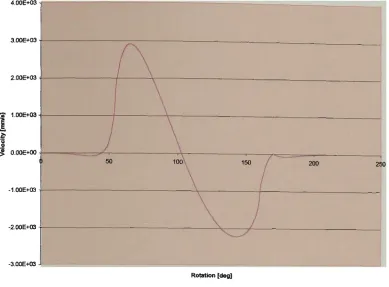
standard Vectra valve lift provided a profile from which m a x i m u m valve velocity and
acceleration could be estimated. These estimations provided input for setting upper
limits for the D V C system. T h e standard production engine selected w a s a Holden
Vectra 2.0 litre twincam engine. T o obtain the valve lift profile of the Vectra engine,
the Vectra cylinder head w a s removed from the engine and fitted to a specially
designed cylinder head test rig. T h e cylinder head test rig, w a s built in the School of
Built Environment at Victoria University of Technology. A future D V C prototype
will be trialed o n the Vectra cylinder head test rig.
To obtain the Vectra's valve lift profile, data acquisition software, DTVEE and a
LB-12/72 laser displacement sensor were used to evaluate the valve lift characteristics of
the standard Vectra cylinder head. T h e engine specifications, the details of the
construction of the test rig, the description of the data acquisition and the laser
displacement sensor and valve lift results of the Vectra cylinder head are presented.
3.2 Engine Specification
Model
Displacement
Stroke
Intake Valve Diameter
Exhaust Valve Diameter
Output
Torque
Firing Order
Compression Ratio
Engine Management
Fuel
Holden Vectra
1998 cm
386 m m
32 m m
29 m m
100 k W
185 N m
1,3,4,2
9.6:1
Simtec 5.5
Premium Unleaded Fuel
Table 3.1 - Holden Vectra engine specifications.
3.3 Cylinder Head Test Rig
The test rig is shown in Figure 3.1. The cylinder head was removed from the Holden
Vectra engine and bolted to the test rig's railings. A variable speed motor, located at
the bottom of the test rig drives the valve gear of the cylinder head. The variable
Figure 3.1 - Cylinder head test rig.
Type
Model
Input
Output
M a x i m u m Amperes
Vari Speed Motor Control
WW2SS
230 V
0.7 kW
5.5
Table 3.2 - Specifications for the variable speed motor.
3.4 Laser Displacement Sensor
Once the Vectra cylinder head was fitted to the test rig, to attain the valve lift profile
analog signals as the valves opened and closed. T h e laser displacement sensor is
illustrated in Figure 3.2. T o accurately sample signals, the reference point of the
sensor needs to be positioned within 30 to 50 m m of the intended target. If the sensor
is positioned within the acceptable measuring range, the L E D indicator will indicate
an orange colour. If the sensor is not positioned within range, the L E D indicator will
show a red colour. T h e sensor specifications can be seen in Table 3.3.
The reference position of the sensor was positioned approximately 40 mm from the
valve seat. Once the reference position w a s positioned within the acceptable range of
the valve seat, the sensor w a s switched on and as the valve opened and closed the
sensor sampled the analog signals.
L A S E R O N
3wrrtv*STAB*.fTY l - D >ncbcasc*
i ;
-too l*0>
,2x o d S
mounting bow
1f-|23;)
43
xx+n Reterence posflion
~»»10,5*»-
Type
Model
Reference Distance
Measuring Range
Light Source
Wavelength
Spot Diameter
Linearity
Resolution
Analog Voltage
Analog Impedance
Zero - Point Adjustment Range
Response Frequency
Power Supply
Current Consumption
High - Resolution
L B - 12/72
40 m m
± 10mm
Infrared Semi-Conductor Laser
780 n m
1.0 m m
l%ofF.S
2 |im (at 60 ms) /15 \xm (at 2 ms)/
50 jam (at 0.15 ms)
± 4 V (0.4 V / m m )
100 Q
30 to 50 m m
D C to 3 k H z (at 0.15 ms) (-3 dB)/ D C to 200 Hz (at 2 ms) (-3 dB)/ D C to 6Hz (at 60 m s )
12to24VDC± 10%
120 m A maximum
3.5 D T V E E Software
After the laser displacement sensor sampled the analog signals as the Vectra valves
opened and closed, the data acquisition software, D T V E E w a s used to show the
digital readout from the analog signal of the laser. A computer program w a s written to
acquire, process and save the data gathered from the laser measurements of the valve
lift of the cylinder head.
Prior to the cylinder head test, the user has to enter to the program:
(1) The analogue to digital configuration information,
(2) Data panel information
The DTVEE program basically consists of three parts, analogue to digital conversion,
data panel box and the analogue to digital sample results, which is the c a m
displacement box as seen in Figure 3.3. In the analogue to digital conversion box, one
specifies the channel to be read, the gain and the rate of data acquisition. The
information from the analogue to digital configuration box and the data panel box is
then processed and the digital readout of the measurement of the valve lift is
File E * View Defeug Ftow Bevice jrt) Data DT DataAcs Dia*av Wiidwt Jjet>
"^l^lglal »l 1 tel?|g| alfclftlftl 1 Ml I tfk.l xlfrl I •>!•»!,
HEIE3
Formula
A/D Coring A j2.014*a Result *— •H Get Data Panel
File N a m e I —J
To File
f
-' C A M D I S P L A C E M E N T
L__J
d
Figure 3.3 - D T V E E Data Acquisition Program
3.6 Vectra Engine Cylinder H e a d Valve Profile
The valve lift data was saved as an ASCII file in DTVEE, and then processed in
Microsoft Excel.
A s illustrated in Figure 3.4, the m a x i m u m valve lift of the standard Vectra engine was
10 9 8 7 6 5 4 3 2 1 0
0 90 180 270 360 450 540 camshaft rotation [deg]
Figure 3.4 - Vectra cylinder head valve lift and valve duration of two successive
lifts.
The result shows that the Vectra engine has no variable lift capability by which the
valve can be operated to suit engine speed. Its speed range is a compromise between
high and low rpm. This due to the fact that the Vectra engine uses two camshafts,
which are turned by a timing chain connected to the crankshaft, to open and close it's
valves. Therefore, as the speed of the engine increases and decreases, the crankshaft
to camshaft synchronisation is maintained to keep valve timing relatively close to
what is needed for engine operation. As can be seen from the figure the maximum
valve lift of the Vectra engine is 9 mm.
For Hertzian contact stress theory, the following assumptions can be made, see D e e
(1992):
(1) at the point of contact the shape of each of the contacting surfaces can be
described by a h o m o g e n o u s quadratic polynomial in t w o variables,
(2) both surfaces are ideally smooth,
(3) contact stresses and deformation satisfy the differential equations for stress and
strain of homogenous, isotropic and elastic bodies in equilibrium,
(4) the stress disappears at great distance from the contact zone,
(5) tangential stress components are zero at both surfaces within and outside the
contact zone,
(6) normal stress components are zero at both surfaces outside the contact zone,
(7) the stress integrated over the contact zone equals the force pushing the t w o bodies
together,
(8) the distance between the t w o bodies is zero within but finite outside the contact
(9) in the absence of an external force, the contact zone degenerates to a point.
The two cylindrical bodies in the DVC system that come into contact, which are of
significant importance, are the guideshaft and gudgeon pin. The contacting surfaces
have the only line contact that does not have an obvious arrangement in existing
engines.
The m a x i m u m Hertzian contact pressure for two cylinders pressed together by a force
is given by the equation, see Shigley (1989)
IF
* = - (3.1)
Fmax
nbl
Where
pmax = M a x i m u m contact pressure,
F = Contact force,
b = Contact half width,
3. RESULTS A N D DISCUSSION
3.1 Computer Simulation
From Chapter 3, it was seen that the measured maximum valve lift of the Vectra
engine w a s 9 m m and the valve duration w a s 130 degrees. T o obtain a comparison
between the valve lift profiles of the Vectra engine and the proposed D V C system, the
D V C prototype w a s modeled using A D A M S , a virtual prototyping software, to attain
valve lift characteristics.
Virtual prototyping technology has made significant advances in recent years and
many companies are utilising the technology in the design of products such as
automobiles, aircraft, railway, defense and industrial machinery. Virtual prototyping
enables one to realistically simulate the full motion behavior of a mechanical system,
to detect component interference, evaluate levels of vibration in the system, predict
deflection of parts and determine loads and forces on components.
ADAMS is a widely used virtual prototyping software, and the DVC system was
modeled using A D A M S . A D A M S provides the user with the tools to build a virtual
prototype, to the test the virtual prototype and to validate the performance of the
virtual prototype against k n o w n measurements.
3.2 DVC Components
The design of the DVC components, the rocker arm and guideshaft are critical to the
performance of the system and the design rationale of these components were as
follows:
(1) provide an actuating lever to interact with the top of the original valve bucket with
minimal deviation of contact from the valve axis,
(3) provide a concave, circular arc surface concentric with the axis of the guideshaft
for contact with the pin,
(4) ensure the line contact pressure on the rocker arm does not exceed what is
considered acceptable for conventional valve train components,
(5) ensure internal stresses of the rocker arm do not exceed the fatigue limit of its
material,
(6) provide a base circle surface that results in close to zero valve lift as possible
during interaction with the gudgeon pin,
(7) provide a concave arc that results in valve acceleration no greater than the
standard Holden Vectra valve train,
(8) ensure the line contact pressure of the interacting gudgeon pin does not exceed
that of conventional valve train components.
The DVC components were designed to allow rninimum modification to the standard
Vectra cylinder head.
The proposed components were constructed using SolidWorks, which is a 3D CAD
modeling software and their shells were then imported into A D A M S . T h e components
that m a k e up the D V C system can be seen from Figures 4.1, 4.2, 4.3, 4.4, 4.5, 4.6 and
4.7. The components used are the same for the inlet and exhaust valves. T h e materials
chosen were similar to conventional valve train materials and Table 4.1 details the
Component
Bucket
Valve
Rocker A r m
Valve Crank
Rockershaft
Guideshaft
Conrods
Gudgeon Pin
Material
Steel
Steel
Steel
Steel
Steel
Steel
Aluminium
Alurninium
M a s s (kg)
0.049
0.042
0.0267
0.15013
0.05661
0.03269
0.00714
0.00968
Table 4.1-Component mass property and material
Figure 4.2 - Gudgeon pin (pink component) and rockerarm as modeled using
-3 *1\
Figure 4.4 - Guideshaft as modeled using A D A M S
EJ < a BJd S«i»U. B""- S.WW look B *
All the D V C components are rigid 3 D bodies, and the extrusion tool w a s used to
create the components. SolidWorks models begin with a 2 D outline, which is then
extruded in the third dimension to form a 3 D model. The type of extrusion used
determines the shape of the desired component.
The valve and the bucket were created by sketching a half cross section with one edge
of the sketch formed by the central axis of symmetry. The torus extrusion w a s then
selected and the cross section w a s extruded through 360 degrees around the central
axis. The crankshaft, rocker and conrods required the linear extrusion tool and
the edges of the geometry were chamfered, filleted, holes and bosses were added and
the solids were hollowed. For the guideshaft, three rigid bodies were joined to create
that component. First of all the shape of the guideshaft profile w a s created and the
rockershaft w a s attached to the profile. The guideshaft can be seen in Figure 4.4.
Once the parts were created, they were imported into ADAMS. The material and mass
properties of the components were defined and the components were then arranged in
their correct co-ordinate positions.
4.2.1 Constraints
In order to correctly simulate the model, once the parts were created and positioned
correctly, they had to be constrained, that is, constraints are used to specify part
attachments and movement. H o w the parts will be attached to one another and h o w
they m o v e relative to each other has to be defined. A description of all the constraints
used can be seen in Appendix B. Figure 4.8 shows the bucket and valve, the bucket
pushes the valve open, once the rocker arm pushes o n the bucket. The same figure
also shows the constraints between the bucket and the valve. A translational joint w a s
used between the bucket and ground, so that once the rocker arm pushes o n the
bucket, it will translate along a vector aligned with respect to the valve. However,
during a simulation run the bucket separated from the valve and the valve did not
Therefore a fixed joint w a s introduced to prevent the bucket and the valve from
separating from one another during simulation. Also a coil spring is used so that the
valve will be able to close, once it opens.
Figure 4.8 - Bucket and valve as constrained using A D A M S .
The rocker arm pushes the bucket, which in turn opens the valve, however, the rocker
arm can only push the bucket due to the gudgeon pin moving backwards and forwards
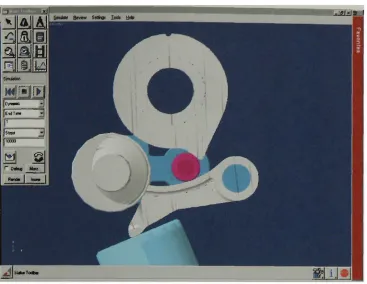
between the rocker arm and guideshaft profile. The gudgeon pin moves towards the
end of the rocker arm, which is towards the rocker shaft, this in turn allows the bucket
to be pushed by the rocker arm. Figures 4.9, 4.10, 4.11, 4.12, 4.13, 4.14, 4.15,4.16,
4.17 and 4.18 illustrate h o w the rocker arm, gudgeon pin, guideshaft, rockershaft and
Figure 4.9 - 3 D illustration of rockershaft and rocker arm
E h E * tfe" t"U JmiiaH fl»v«v» SaWngi Tooli tjsHp
J
Figure 4.13 - 3 D illustration of rockershaft, rocker arm, gudgeon pin and conrods
ft» E<a Jfrw Biid Simulate H'**" Sural look 1 M >
Figure 4.17 - 3 D illustration of rockershaft, rocker arm, gudgeon pin, conrods, valve crank and guideshaft
In order for the rocker arm to c o m e into contact with the bucket, so that the bucket
can push open the valve, a contact force needs to be applied between the rocker arm
and bucket. Before a contact force can be applied, the surfaces of the rocker arm and
bucket where the contact will occur must be specified. Originally the whole of the
rocker arm and the bucket w a s specified, however this proved to be a problem as the
rocker arm w a s constrained from pushing onto the valve. T h e problem w a s solved by
specifying only the point of contact rather than the whole component. Therefore the
tip of the rocker arm and top of the bucket were specified as the contact surfaces, and
a simulated contact force w a s applied. Also, a revolute joint w a s specified between
the rocker shaft and ground, so that the rocker arm w a s able to pivot d o w n onto the
bucket.
A problem arose when the contact surfaces of the gudgeon pin and the guideshaft
were specified, in that the gudgeon pin could not m o v e along the guideshaft profile,
namely along the activating curve of the guideshaft. This w a s due to the fact that
w h e n a contact surface is chosen, the number of points along the contact surface for
the contact force to function properly must be introduced. In this instance, too m a n y
points were allocated along the activating curve of the guideshaft profile and this
restricted the gudgeon pin's movement. A smaller number of points were designated
along the curve and the gudgeon pin w a s then able to m o v e between the guideshaft
profile and the rocker arm. Contact forces were then applied between the gudgeon pin
and rocker arm and between gudgeon pin and guideshaft.
The gudgeon pin is moved along the rocker arm and guideshaft profile by the valve
crank, which is connected to the gudgeon pin by the conrods. A s the valve crank
rotates, the pin is pushed backwards and forwards, with the amount of the valve lift
determined by the guideshaft position. B y changing the degree of rotation of the
guideshaft, the valve lift opening can be m a d e either larger or smaller. In order for the
Previously a fixed joint w a s introduced between the conrods big ends and the valve
crank. It w a s found that this prevented the conrods from rotating about the valve
crank, so instead of applying a fixed joint, a revolute joint w a s used so that the
conrods could rotate about the valve crank. T h e gudgeon pin w a s fixed to the conrods
little ends, and as the valve crank rotated, the gudgeon pin w a s able to m o v e
backwards and forwards, with the sandwiching contact forces preventing the gudgeon
pin from leaving the rocker arm or guideshaft.
3.3 Dynamic Valve Control
The system is operated by the rotation of the valve crank. A s the valve crank rotates,
the gudgeon pin, which is connected to the valve crank by the conrod's, moves
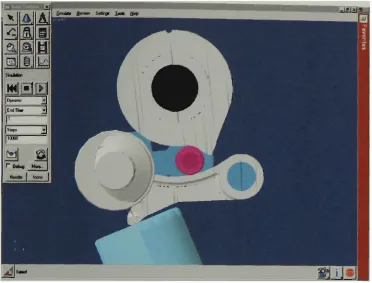
forwards and backwards along the guideshaft profile. Figure 4.19 illustrates the
gudgeon pin as it m o v e s forwards along the guideshaft and rocker arm.
It should be noted that in Figures 4.19 to 4.21, one of the conrods w a s m a d e invisible,
so that the m o v e m e n t of the gudgeon pin along the rocker arm and guideshaft could
be seen clearly. O n c e the pin reaches the activating curve of the guideshaft, it pushes
the rocker arm d o w n against the bucket, which in turn opens the valve, as illustrated
in Figure 4.20.
Figure 4.20 - G u d g e o n pin at the activating curve of the guideshaft
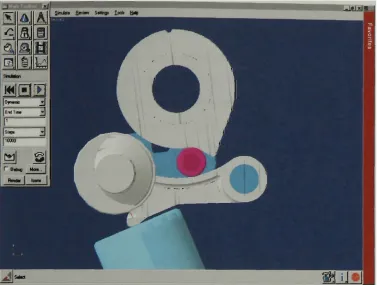
When the pin moves backwards along the guideshaft and rocker arm, the valve begins
Figure 4.21 - Valve closing as gudgeon pin m o v e s backwards along the guideshaft
Variable lift is achieved by the guideshaft, which is controlled by a hydraulic
mechanism, connected to the engine management system. The guideshaft profile
moves backwards and forwards according to engine speed and load, varying the
interaction of the gudgeon pin as it m o v e s backwards and forwards along the rocker
arm. The degree of valve lift is dependent o n the amount the guideshaft is rotated. At
idle, the pin only touches the initial portion of the actuation curve of the guideshaft,
this effectively opens the valve by a small amount. This small opening of the valve
substitutes for the throttle, a device in the engine that regulates the flow of air into the
cylinders.
The DVC system will have a continuously variable lift, this means that the valves will
be able to open to lifts of say, 5 m m , 6 m m or 7 m m , with stepless variation and does
not just open fully to its m a x i m u m lift.
guideshaft is positioned at seven degrees or at start location, while Figure 4.23
illustrates the D V C system w h e n the valve is fully opened, w h e n the guideshaft is at
357 degrees (three degrees clockwise from start location)
4.3 Simulation Results
Once the D V C model was complete, computer simulations were performed under
various operating conditions. The purpose was to determine the valve lifts, velocities,
acceleration and constraint forces generated in the D V C model. Each simulation was
for 1 second, with 50000 steps. The steps represent the total number of times output
information is provided over the entire simulation.
The engine speeds for the DVC simulation were 60 rpm, 3000 rpm, and 6000 rpm
The valve crank is a substitute for the camshaft and the camshaft rotates at half the
speed of the engine. The camshaft speeds are shown in Table 4.2.
Due to the fact there is rotational motion applied to the valve crank for it to drive the
model, these speeds were converted to degrees/sec using the equation below,
oo = RPM/60* 360 (4.1)
Engine Speed (rpm)
60
3000
6000
Camshaft Speed (rpm)
30
1500
3000 J
Converted A D A M SSpeed (deg/sec}
180
9000
18000
4.3.1 D V C Valve Profile
The rotational location of the guideshaft determines the valve lift. The guideshaft,
which is connected to the engine management system via a hydraulic mechanism,
rotates according to the engine speed and load m u c h in the same manner as that
developed by Steinberg et al. (1998). The D V C system would use a hydraulic hub
connected to the guideshaft and the E C U would control the valves that supply oil to
the hydraulic hub. However, the D V C design would be simpler because it wouldn't
rotate like those connected to a continuously spinning camshaft. Using A D A M S , the
guideshaft w a s rotated to fixed positions in increments of 1 degree between minimum
lift and m a x i m u m lift.
As the guideshaft rotates clockwise, the valve lift increases and the valve lift
decreases w h e n the guideshaft rotates anti - clockwise. The guideshaft can rotate from
minimum lift to m a x i m u m lift in a span of 10 degrees. The valve lifts of the D V C
system are shown in Figures 4.24, 4.25, 4.26, 4.27, 4.28, 4.29, 4.30, 4.31, 4.32, 4.33
ZJ J<i
25 50 75 100 125 150
Valve Crank Rotation [deg] .T.T.T.T.T.T.T.T.T.T.T.T.T.TM
_1
i
4
a
*)Al
12.00 10.00 8.00 E g 3 6.00 5 a > 4.00 2.00 0.00/ " \
\
\
/
I
\
25 50
-Guide 358d eg
75 100 125 150
Valve Crank Rotation [deg]
12.00
10.00
5 00
6.00
4 00
2.00
0.00
/ \
1
1 \
-Guide 359deg
0 25 50 75 100 125 150 175 200 225
Valve Crank Rotation [deg]
i PiifTa'm.'v'MgiP—i
I A j | JinJete fie»ie« Ssftnoi I o * a«t>
^1
a
n
AJ
M
S.niaior.p y n m c
"3
r Dttbug Mof... | Rondo Icon* JLfUBl » 12.00 10.00 8.00 3 6.00 4.00 2.00 0.00
25 50
| Guide Odeg )
75 100 125 150
Valve Crank Rotation [deg]
10.00
8.00
5
6.00 | Guide 1deg [
4.00
2.00
0.00
25 50 75 100 125 150 175 200 225
Valve Crank Rotation [deg]
12.00 10.00
(00
4.00 2.00 0.00
-Guide 2deg |
1
n
IDynam
Sfixiatc B e v w w Setimos Iooh H o p - • —
Dynamo
1
[**• 3
r Debug Mae... |
Render I Icon j %
10.00
100
j 6.00
S
1
4.00
0.00
/ \
\
/ \
25 50 75 100 125 150 Valve Crank Rotation [deg]
175 200 225
12.00
10.00
too
5 6.00 -Guide 4deg
4.00
2.00
12.00
-?
§ 6.00 -,a
> 5 >
4.00 2.00
-'
25 50
/ \ .
75 100 125 Valve Crank Rotation [deg]
150 175 200 27
— G u i d e 5deg j
5
12.00
10.00
8.00
6.00
2
4.00
-Guide 6deg |
2.00
0 . 0 0 ^
25 50 75 100 125
Valve Crank Rotation [deg]
_, OkfPJi u_j] /2
3
Aj
a
- ll S > ™ J - »
AJbm*
il
M i l
SirnJKiori
jsnaial
|D«fwrnc _*] 1 End im'-i
rr~
[si,,.,
roooo
W|
@ll
r Debug More | F k n d M | Icora j |
Bt
10.00
8.00
600 -Guide 7deg [
4.00
2.00
0.00
25 50 75 100 125 150
Valve Crank Rotation [deg]
175 200 225
Figures 4.24 to 4.34, s h o w the valve lifts from m a x i m u m lift in Figure 4.24 to almost
zero lift in Figure 4.34. T h e D V C system m o v e s the valve from a m a x i m u m lift of
10.70 m m to virtually zero lift in a span of 10 degrees rotation of the guideshaft.
M a x i m u m lift of 10.70 millimetres is achieved w h e n the guideshaft is positioned at
357 degrees (three degrees clockwise from start location), with the valve lift
decreasing at about one millimetre with every 1 degree rotation of the guideshaft. For
example, Figure 4.25 shows the valve lift w h e n the guideshaft is at 358 degrees, with
the lift being 9.73 m m , while Figure 4.26 shows the valve lift at 8.63 m m , w h e n the
guideshaft is positioned at 359 degrees. A s the guideshaft begins to rotate anti
-clockwise from the m a x i m u m valve lift position of 357 degrees, the valve lift
gradually decreases. T h e positions of the guideshaft as seen from Figures 4.24 to 4.34,
illustrate the different positions of the guideshaft and their subsequent effect o n the
valve lift. M i n i m u m lift is achieved w h e n the guideshaft is at 7 degrees, as seen in
Figure 4.34, the valve lift is 0.36 m m which is virtually zero.
This result confirms that due to the DVC system being able to achieve almost zero
valve lift, there is no need for the throttle, as the valves themselves can limit the
pressures in the cylinders and as a consequence, limit engine output. The most
important aspect that can be seen from the figures, is that the D V C system can
achieve a variation in lift, which means that any valve lift between zero to m a x i m u m
lift is quite attainable. Figure 4.35 illustrates the variable lift of the D V C system and
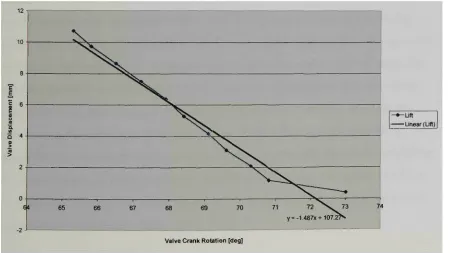
Figure 4.36 illustrates the m a x i m u m valve lift versus valve crank rotation. It can be
seen from Figure 4.36 that the relationship between m a x i m u m valve lift and valve
Figure 4.35 - Variable lift of D V C system
M a x i m u m Valve Lift versus Valve Crank Rotation