American
Society of Range Management
The American Society of Range Management was created allied technologists, and to encourage professional improvement in 1947 to foster advancement in the science and art of grazing of its members.
land management, to promote progress in the conservation and Persons shall be eligible for membership who are interested greatest sustained use of forage and soil resources, to stimu- in or engaged in practicing range or pasture management or late discussion and understanding of scientific and practical animal husbandry; administering grazing lands; or teaching, range and pasture problems, to provide a medium for the or conducting research, or engaged in extension activities in exchange of ideas and facts among society members and with range or pasture management or related subjects.
T
he JOURNAL OF RANGE MAN- AGEMENT, published bi-monthly, is the official organ of the American Society of Range Management. The Society, however, assumes no responsibility for the statements and opinions expressed by authors and contributors.Office, Executive Secretary. Address all inquiries and correspondence including memberships, renewals, replacements of JOURNALS, etc., to Executive Secretary, American Society of Range Management, P.O. Box 5041, Portland 13, Oregon. Dues. Membership dues should be sent to the Executive Secretary. The dues are $8.00 per year including a subscrip- tion to the JOURNAL OF RANGE MAN- AGEMENT. Dues for student members are $4.00 per year, including the JOURNAL. All subscriptions mailed outside the North American continent and insular possessions of the U. S. are $8.50 per year. Subscrip- tions must be paid in advance. Remit by draft or check on U. S. banks in U. S. funds. Reprinting. The reprinting of articles or parts of articles published in the JOURNAL OF RANGE MANAGEMENT is author- ized on the express condition that full credit be given the JOURNAL and the author. The date of original publication must be shown with the credit line.
Posf Office Enfry. Second-class post- age paid at Portland, Oregon, and at, ad- ditional offices.
Change of Address. Notices of change of address should be received by the Execu- tive Secretary one month before the date of issue on which the change is to take effect. Both the new and old addresses should be sent to the Executive Secretary, American Society of Range Management, P.O. Box 5041, Portland 13, Oregon.
Printers. The Nebraska Farmer Company, 1420 P Street, Lincoln, Nebraska.
Copyright 1962 by the American Society of Range Management.
JOURNAL OF RANGE MANAGEMENT EDITOR
E. J. WOOLFOLK
Pacific Southwest Forest & Range Exp. Sta. Berkeley 1, California
EDITORIAL BOARD 1960-62 F. A. BRANSON U.S. Geological Survey
Federal Center L. T. BURC~IAM
Denver, Colorado
LYNN RADER California Division of Forestry Pacific Southwest Forest
Sacramento, California & Range Exp. Sta. Susanville, California 1961-63
ROBERT W. LODGE Canada Dept. of Agric. Swift Current, Sask.
HAROLD A. PAULSEN DONALD F. BURZLAFF
Rocky Mountain Forest
& Range Exp. Station College of Agriculture Room 221 Forestry Building
Lincoln 3, Nebraska Fort Collins, Colorado
1962-64
JOHN L. LAUNCHBAUGH Kansas Aaric. Exnt. Sta. 1 C. WAYNE COOK
Hays, Kansas
V. L. DUVALL
Utah State Univ. Box 1192
Logan, Utah Alexandria, La.
OFFICERS OF THE SOCIETY President :
E. WM. ANDERSON 215 N.W. 10th President Elect:
Pendleton, Oregon M. W. TALBOT
Executive Secretary: JOHN G. CLOUSTON
2590 Cedar P. 0. Box 5041
Berkeley, California Portland 13, Oregon BOARD OF DIRECTORS
1960-62
WAYNE KESSLER GERALD W. THOMAS
6710 N. 10th Ave. Phoenix 13, Arizona
Texas Technological College Lubbock, Texas 1961-63
AVON DENHAX~ OTTO J. WOLFF
Box 4137 912 St. Patrick St.
Portland 8, Oregon Rapid City, S.D. 1962-a
C. H. WASSER ROBERT A. DARROW
Colorado State University Texas A & M College Fort Collins, Colorado College Station, Texas
Past President: V. A. YOUNG 733 West 2nd St.
Mesa, Arizona
IN THIS
ISSUE
Behavior of Forage Yields on
Inoculation for Better Pasture
Grazing Problems in Turkey
Some Range Sites in Oregon
E. William Anderson 245
and Forage Legumes in the Tropics
Roy C. Dawson 252 _______.________________---~.---~~.~---~ Donald R. Cornelius 257
Overcoming the Problems of Range Livestock Production in
Southern Souih America ________________________________________~ _____ _ _____ W. R. Chapline 259
Growth in fhe Greenhouse of Grasses and Shrubs on Soils from
Shadscale and Sagebrush Areas ._..._..______.__~________._______~.A. C. Hull, Jr. 262
A Quantitative Measure of Plant Association on Ranges in Good
and Poor Condition ._.._..._..._________~__~____C. Wayne Cook and Rex Hurst 266
Sagebrush on Relici Ranges in the Snake River Plains and
Northern Greai Basin . . . . .._.__...___________~__~___H. B. Passey and V. K. Hugie 273
Range Managemeni in Relation fo Mule Deer Habitat and
Herd Productivity in Utah _.._..._..._...______~___~___~OdeZZ Julander 278
Book Reviews: Interpretation of Aerial Photographs (Avery); Dictionary of Ecology (Hansen) ; Soil Management for Conservation and Pro- duction (Cook); Twilight on the Range: Recollections of a Latterday
Cowboy (Timmons) _________________________________________~~_~_~_~_______._______.___________.~__~___~~~~_~______ 282
National Affairs _________________________________________..______~~_~___._______.__~_________~____~_.___________.~___~__~______ 294
Cover Photo -- A Scene from the Past
~!bt#iitf&?
&i~@&
and in the home
Here’s how Phillips 66 products can help you
enjoy better living and improve profits
: (1) Phil-lips 66 high nitrogen fertilizers for bigger, higher
profit yields; (2) a complete line of highest qual-
ity Phillips 66 Oils and Greases for every farm
machinery need; (3) top car performance with
Flite-Fuel and Sixty-Six Gasolines; (4) better
and longer engine protection with Trop-Artic*
All-Season Motor Oil; (5) Philgas * clean burning,
all purpose fuel, America’s largest sellingLP-Gas.
*A trademark
PHILLIPS
PETROLEUM
COMPANY
Bartlesville,
Oklahoma
ATTEND THE ANNUAL
CONVENTION
RAPID CITY, SOUTH DAKOTA
Journdl of
RANGE
MANAGEM
Volume 15, Number 5 September, 1962
ENT
Behavior of Forage Yields on Some
Range Sites in Oregon
E. WILLIAM ANDERSON
Range Conservationist, Soil Conservation Service, Pendleton, Oregon.
Range management is a new- comer. Livestock breeding, feed- ing and disease control, pasture and hay production, marketing and transportation are old- timers, comparatively. Newcom- ers and old-timers, that is, in the field of economic evaluation as a normal part of modern range livestock ranching.
Good information about forage yields, particularly potentials, is essential for reliable economic evaluation of range improve- ments and management. Yield information, on a range site- by-range-site b a s i s, enhances the usefulness of surveys that delineate soils, range sites and range condition classes. To- gether, they provide the means for assembling a composite anal- ysis of the landscape within a pasture or ranch. This can be done irrespective of the differ- ent kinds of land involved, the pattern of occurrence, or whether the differences are due to topography, climate, soils and/or vegetation, since these make up the survey data.
The purpose of this report is to (a) explain how yield char- acteristics of some range sites in Oregon are being derived and portrayed tentatively as a nor- mal effort to learn more about range sites, their soils and po-
tentials; (b) emphasize some logical, apparent differences in the way yield behaves on differ- ent sites; (c) point out certain interpretations that seem useful for ranchers and technicians when judging cost-benefit rela- tionships; and (d) suggest the need for research assistance in this area.
Examples cited represent data from cattle ranches, primarily. Yield data are based almost en- tirely on forage from perennials. This is done to clarify the rela- tively stable forage supply and to eliminate a much as possible the influence of extreme fluctu- ations in the production of an- nuals.
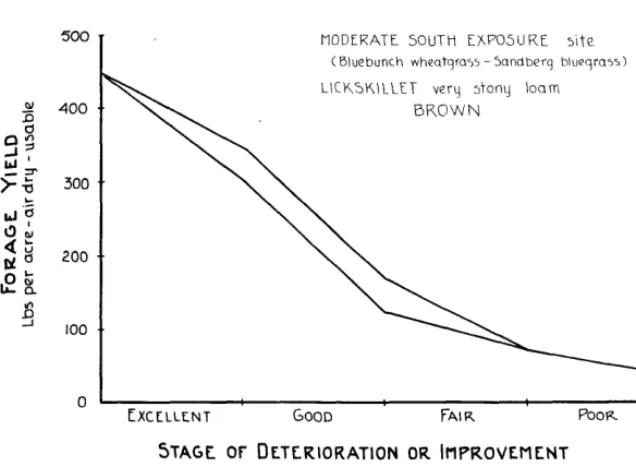
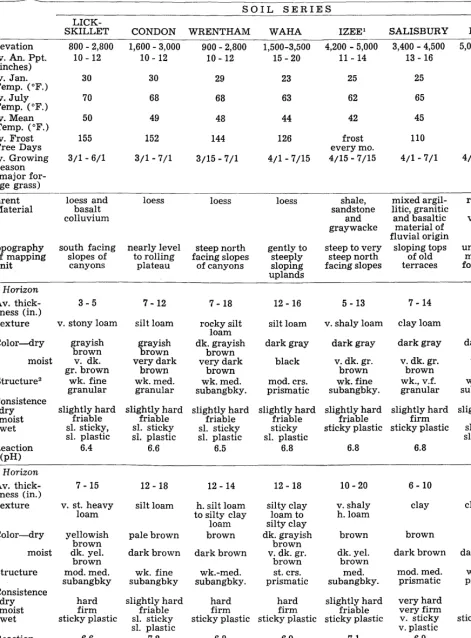
Figure 1 illustrates a typical yield-behavior curve. It repre- sents the Moderate-South-Ex- posure site in Oregon’s Columbia Basin. The original plant com- munity of this site is dominated by bluebunch wheatgrass (Agro- pyron spicatum) and Sandberg bluegrass (Pea secunda). The soil, called Lickskillet very stony loam, is classed in the Brown Great Soil Group?
The curve, or envelope, repre- sents how the forage-yielding ability of this site varies accord- ing to the ecological condition of the plant community. For ex- ample, on this site, a plant com-
245
munity that rates at the top of the Good range condition class will yield about one hundred seventy five pounds more usable forage, on the average, than if it rates at the top of the Fair class.
The curve implies that changes in yield have character. As the plant community changes from one condition class to another, the curve changes pitch and thickness. On this particular site, more producing capacity is lost -or gained-proportionately
during changes in its plant com- munity that are represented by Good condition class than for any other class. The least pro- portion is related to changes rep- resented by Poor range condition class. This suggests that returns on investments that will improve the ecological condition of this site’s plant community probably will be greater if the condition class is high Fair or Good, rather than low Fair or Poor, at the start. For ranges that are detc- riorating ecologically, the curt e provides an indication of the eco- nomic urgency for reversing the downward trend. Even doubling the yield of a low producing, Poor condition site doesn’t return much on the investment at the start.
It is important to note that the time factor is not represented in the yield-behavior curve. Each stage of improvement or deteri- oration of the plant community
246
ANDERSON
0
1
ILXCCLLCNT GOOD FAIR POOR
STAGE. 0~ DETERIORATION OR IWROKIWIU Cranqe condhon class 1
FIGURE 1. Typical yield-behavior curve representing the average amount and variation in forage yield that can be expected from a range site according to range condition class.
is represented by equal segments
of the horizontal axis. The steep
pitch in the Good class does not
indicate a greater rate of change
in forage yield. It merely indi-
cates that a greater amount of
change takes place during the
time the plant community pro-
gresses through this ecological
stage.
If time could be represented
by the segments of the horizontal
axis along with stages of im-
provement, the chart could be
made to indicate rate as well as
amount of potential forage in-
crease. Records on the amount
of time and the kind of misman-
agement it took to deteriorate a
site from one class to another
probably are available. Records
on the time and kind of good
management it took for a site to
recover from one class to an-
other probably are available,
also. An effort to obtain such
records is needed. Observations
by ranchers and technicians hav-
ing long local experience is a po-
tential source. Re-examination
of areas having old survey data
might be another source.
Use of the Curve
The curve provides a general
guideline for predicting the in-
creased yield that can be ex-
pected from a site if its plant
community can be improved
ecologically from one stage to
another. Judgment and local ex-
perience are important for ad-
justing the potential of a deteri-
orated site according to degree
of erosion and formation of stone
pavements, since these reduce
the site’s producing capacity al-
most permanently. Such guide-
lines, rough as they may be, are
helpful in judging cost-benefits
of range practices locally. They
contribute to better uniformity
of judgment between people and
help avoid undue optimism. They
aid in training young techni-
cians. They help emphasize cer-
tain principles to ranchers and
range administrators.
Many people, including ranch-
ers, work with plant communi-
ties and soils of range sites in
areas for which little specific in-
formation is available. One of
the most useful applications of
information on yield behavior
has been for predicting potential
forage production in areas for
which yield data are not avail-
able. This is done merely by as-
sociating plant communities and
soil characteristics of the un-
known sites to those of similar
sites for which yield information
is available. The procedure has
helped speed up range improve-
ment activities in certain areas
where little real investigative
range work has been done.
Theory of Curve
A variety of factors can in-
fluence the behavior of forage
yields on a range site. Change
in the make-up of the plant com-
munity surely is a major factor.
Probably, this is true whether
changes in the plant community
are of the long-lasting type as-
sociated with changes in range
condition class, or of a more tem-
porary nature associated with
short-time climatic fluctuations.
Annual climatic
fluctuation
caused by changes in amount
and timeliness of precipitation,
temperature, sunshine, wind and
so on, also is a major factor.
Changes in the vigor of major
forage plants, whether due to ad-
verse weather or excessive graz-
ing, strongly influences forage
yield.
The upper line of the curve is
based upon the average high
yield that has been recorded for
each condition class. The termi-
nal point represents the average
lowest yield that has been re-
corded for the site. Logically,
high yield is consistent with high
degree of vigor. It is concluded,
therefore, that the upper line of
the curve primarily represents
conditions where the forage
plants are as vigorous as could
be expected consistent with the
ecological condition of the plant
community.
therefore, that the lower line
primarily represents conditions
where the forage plants are as
weak as they could be and still
maintain the ecological condition
of the plant community. Further
reduction in vigor would be as-
sociated with further ecological
deterioration.
Thickness of the curve, or ver-
tical distance between the two
lines, represents the variation in
average forage yield, due to
changes in vigor caused by graz-
ing or drought, that could occur
without changing the ecological
condition of the plant commu-
nity. Using Figure 1 for example,
a plant community on this site
rating in Good class but having
weak perennial forage plants,
produces about two hundred
pounds usable forage per acre.
By improving the vigor of the
forage plants,
and without
changing the make-up or stand
of the plant community, the av-
erage yield could be raised to
about two hundred fifty pounds
per acre. Further increase in av
erage yield probably would be
accompanied by ecological im-
provement and the position of
BEHAVIOR OF YIELDS
the plant community in relation
to the horizontal axis would
change accordingly.
Top Excellent condition and
highest average yield always
would be associated with vigor-
ous forage plants. Severest de-
terioration and lowest average
yield always would be accom-
panied by weak perennial forage
plants. At these extremes, the
curve shows no yield variation
since t.hese points were used
merely to begin and end the
curve. Fluctuations
in yield
that normally occur at these
points are taken into account by
the use of average yields, as are
similar periodic fluctuations all
along each line of the curve.
Pitch of the curve, as previ-
ously stated, does not represent
rate-of -change in forage yield
since the time factor is not rep-
resented on the horizontal axis.
Pitch does indicate the relative
amount of change in forage pro-
ducing capacity for each stage
of deterioration or improvement
as measured by range condition
class.
The pitch of the curve is as-
sociated primarily with changes
LICKSKILLE? very stony lo(inl
BROWN
POOR
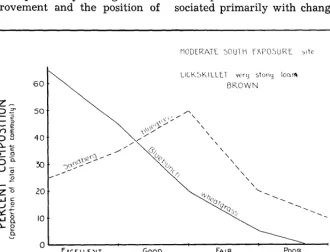
FIGURE 2. Typical behavior of two major plants, composition-wise, as the plant community of a range site changes according to range condition class under cattle use.
247
in the make-up of the plant com-
munity,
particularly
with
changes in the major forage pro-
ducing plants. This is illustrated
by comparing Figures 1 and 2.
Figure 2 illustrates how two
major forage plants on this site,
bluebunch wheatgrass and Sand-
berg bluegrass, behave compo-
sition-wise as the plant commu-
nity changes from Excellent to
Poor condition class under cat-
tle use. As the wheatgrass de-
creases in the composition, the
bluegrass increases for a time.
Eventually, due to the lack of
forage from the wheatgrass, the
grazing pressure shifts to include
the bluegrass. Being a palatable
forage plant, it, too, then de-
creases in the composition. This
chart verifies that bluebunch
wheatgrass is a strong &creaser2
and Sandberg bluegrass a strong,
palatable increaser on this site
when grazed by cattle. These
plants behave differently when
grazed by sheep.
Bluebunch wheatgrass is a
high-yielding forage plant. When
its proportion in the plant com-
munity is reduced, yield is af-
fected markedly. Sandberg blue-
grass is a small, low-yielding for-
age plant. Changes in its pro-
portion of the plant community
have little effect upon the be-
havior of yields. For these ap-
parent reasons, the yield-curve
for this site simulates the com-
position-curve
of bluebunch
wheatgrass, except that under
extreme deterioration, the blue-
grass persists and produces a
small amount of forage.
Comparison Locally
248
ANDERSON
tive plant community,
topo-
graphic position, microclimate
and soil. All three soils are de-
rived primarily from aeolian ma-
terial of the same geological age
and overlie basalt bedrock3.
The Moderate South Exposure
site represents the “poorest” en-
vironment of the three. The orig-
inal plant community of this site
is very strongly dominated by
bluebunch wheatgrass. Lickskil-
let soil, developed under this
plant community in this environ-
ment, has thinner but more dis-
tinct horizons, stronger develop-
ment and lighter colored surface
layers than the other two soils.
It has been classed as a Brown
soil.
The Rolling Hills site repre-
sents the intermediate environ-
2500 Elevation - 12’An Ppt - 47 Mean An.Temp
ROLLING HALLS site .Q!3A!KAL_PU~ c,OPII7UNlTY
wheatqrass --60x ---___
0 X - Idaho fescue - _---- I5 X __--___ 80 g 20 X -5andtJerq blueqrass - -- I5 X -~--~ I__ I
IO %-F’erennlal forbs -__ IO Z-- 3 t; -5hrubs -~--- -- ~- 0% -
‘5
53
20'
,I v. st. loam
vdk.qr brown --- \I V. st. loam
dark h-own _--- e vst clatj loam
dark brown __---_
Basalt bedrock
LICK~KI LLLT v. stony loam
0ROWN
1200
1000
800
600
400
200
0
ROLLING H\LLS
CONDON xlt loam CHESTNUT
1
MODERATE SOUTH EXPOSURE . .LICKSKILLET very stony loam . BROWN
1
/I slit lOamvdk qr brown To vdk Mown ---_ 2 31lt loam
Y dk.qr brown to dark WOW I\
v dark brow~r
dark brown ----_-__
slit loam dark brown
dark brown
---
Basalt txdrock
bczdroc.k
CONDON WRENTHAM
slit loam slit loam
CHESTNUT CHERNOZEtl
STCEP NORTH EXPOSURE
1
Ext. GOOD FAIR POOU
STAGE OF DETERIORATION OR IIIPROVEWENT Cranqe condition CICIJS~
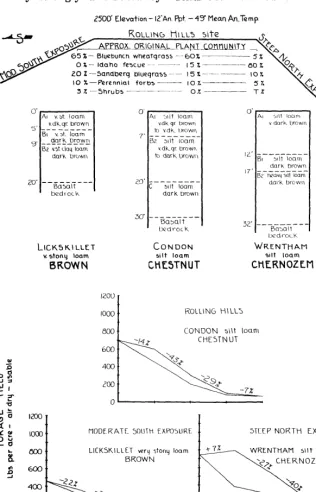
FIGURE 3. Comparison of three range sites that occur on the same hill, illustrating differences in yield behavior related to plant communities in different effective environments.
ment of the three. Bluebunch
wheatgrass dominates and Idaho
fescue
(Festuca idahoensis)is
prominent in the composition of
the original plant community.
Condon soil, developed under
this plant community in this en-
vironment, has moderately thick
but very indistinct
horizons,
weak development and is inter-
mediate in color of the surface
layers. It has been classed as a
Chestnut soil.
The Steep North Exposure site
represents the “best” environ-
ment of the three. Idaho fescue
strongly dominates the original
plant community. Wrentham
soil, developed under this plant
community in this environment,
has moderately thick, distinct
horizons, moderate development
and is darker colored in surface
layers than the other two. It has
been classed as a Chernozem
soil.
Several differences are appar-
ent in the yield-behavior curves
of these three range sites:
a. As the environment improves,
so does the potential forage-pro-
ducing capacity of the site. This
is indicated on the vertical axes
of the charts.
b. Based upon the top line of the
curves, the sites differ somewhat
as to the proportion of the po-
tential yield that is related to
changes in the plant community
as represented by each range
condition class. The “poorer”
the enviroment, the greater is
the proportion
lost during
0’
0’
I 4’
32
BEHAVIOR OF YIELDS 249
KLAMATH SNAKE R\VEK JOHN DAY BLUE. MTS. munity. In the “best” environ-
ment, the thick curve indicates that the forage plants on this site can stand considerable reduction in vigor before they decline in the composition. Ability of the plant community to retain its composition with low-vigor for- age plants is reduced as deteri- oration progresses. This is indi- cated by the narrowing of the curve toward Fair and Poor con- dition classes.
d. Yields decline steadily throughout the process of de- terioration on two of these sites. The Steep North Exposure site with Wrentham soil, however, is one of those sites on which the yields increase during early stages of deterioration, provided that bluebunch wheatgrass, a large forage-producing increaser on this site, remains vigorous. 35%
10% IOX 15% IQ% 70% -
APPROX ORIGINAL PLANT COMMUNITY
70 % - Idaho fescue 65% I OI - Bluebunch wheatqrassp 5 %
5% - Sandberq blueqrasse 5 % 2X-Other qrasses-- 5% I 0% -Perenn\al forbs---- IO% 2% --Shrubs - IO%
65X 10% 10% 5% IOZ
1% RANGE SITE
CLAYEY TERRACE STEEP NORTH ROLLING HILL5
1 loam v. dK. brown
5 loam
dK.qr WOW n
2 clay loam dk. brown
uf f breccla
DENT loam
CHESTNUT
1200
1000 .I
800..
dark brown
5anastone
SALISBURY lZEE
c\ag loam v. ehalq IOCim
CHESTNUT CHE5TNUT
ROLLING HILL5 0’
AI self loam blacK 5.
A3 x\t loam black
16. . ELI
lvght 51 clay lo01 2 0’ blacK
62 511ty clay loan to silty clay v.dk.qr. brown
30’ -
f5asalt bedrocK
WAHA s\lt loam PRAlRl~
ROLLING HI LL5 STEEP NORTH EXPOSURt: (Klamat h 1 (dohn Day)
DENT loam IZEE v. shaly loam
CHESTNUT CHESTNUT
CLAYElY TERRACE KOLL\NG HILLS
(Snake Riwr) (Blue IIts)
SALISBURY clay loam ., WAHA silt loam
CHE.STNUT
01 I I
EXC. GOOD FAIR POOR WC. coo0 FAIR F0OR STAGE OF DETERIORATION OK IMPROVEMENT
,,‘1Ll4 5orl L-.anr.~ro‘,on SrWrcP (ranqe condition class) ~W<IC~n A”&-rson Qsa
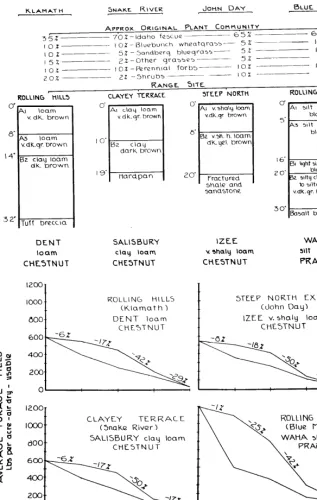
FIGURE 4. Yield behavior of four widely separated sites having original plslllt ctimmunities dominated by Idaho fescue. Comparison with the Columbia Rasin site having Wrentham soil illustrates apparent widespread conformity of yield behavior on sites having comparable effective environments.
palatable forage plants tempo- rarily increase in the plant com- munity as the original major forage plants decrease in the stand. Decline in yield is delayed until these palatable &creasers also diminish in the stand. c. The thickness of the curve varies with changes in the en- vironment. In the “poorest” en-
vironment, the thin curve re- flects the inability of that plant community to maintain a stable composition with low-vigor for- age plants. On this site, it doesn’t take much excessive grazing or adverse weather before the re- duced vigor is accompanied by further deteriorating changes in the make-up of the plant com-
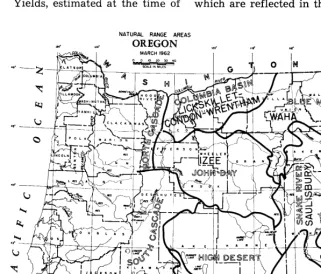
Widespread Comparison Relationships of yield to en- vironment that exist on this one hill apparently hold true for zonal soils generally over a wide area. This is illustrated by Fig- ure 4, which depicts yield curves and soils for four widely separ- ated sites in eastern Oregon, as shown in Figure 5. Each of these four sites has an original plant community dominated by Idaho fescue and, in this way, is com- parable to the Columbia Basin site with Wrentham soil.
Marked similarities in yield behavior are apparent between these five sites. On each, the decline in yield is proportion- ately greatest in Fair condition class. Other condition classes are comparable. Relatively thick curves are typical.
250 ANDERSON Table 1. Some characferisfics and qualifies of soils cited.
SOIL SERIES
LICK-
SKILLET CONDON WRENTHAM WAHA IZEEl SALISBURY DENT’
Elevation A(vnve.s 1 p”“.
Av. Jan. Temp. (OF.) Av. July
Temp. (OF.) Av. Mean
Temp. (OF.) Av. Frost
Free Days As;afor;wing
(major for- age grass)
800 - 2,800 1,600 - 3,000 900 - 2,800 1,500-3,500 4,200 - 5,000 3,400 - 4,500 5,000 - 6,000
10 - 12 10 - 12 10 - 12 15 - 20 11 - 14 13 - 16 12 - 16
30 30 29 23 25 25 23
70 68 68 63 62 65 62
50 49 48 44 42 45 42
155 152 144 126 frost 110 100
every mo.
3/l - 6/l 3/l - 7/l 3/15-7/l 4/l - 7/15 4/15 - 7/15 4/l -7/l 4/15 - 7/15
Parent Material
*. *
loess and basalt colluvium
loess loess loess shale,
sandstone and graywacke
mixed argil- residium litic, granitic from
and basaltic volcanic material of tuff fluvial origin
sloping tops undulating
of old mountain
terraces foot-slopes Topography south facing nearly level steep north gently to steep to very
of mapping slopes of to rolling facing slopes steeply steep north
unit canyons plateau of canyons sloping facing slopes
uplands
A Horizon
Av. thick- 3-5
ness (in.)
Texture v. stony loam
ll- 21
7 - 12 7- 18 12 - 16 5 - 13 7 - 14
silt loam v. shaly loam clay loam loam silt loam rocky silt
loam dk. grayish
brown very dark
brown wk. med. subangbky.
Color-dry
ffr7z;
i3T&i$
v. dk. very dark
gr. brown brown
wk. fine wk. med.
granular granular
dark gray dark gray
v. dk. gr. v. dk. gr.
brown brown
wk. fine wk., v.f. subangbky. granular
dark gray dark gray
black
moist v. dark
brown wk. med. subangbky.
Structure2 mod. crs.
prismatic Consistence
dry moist wet
slightly hard slightly hard
friable friable slightly hard friable sl. sticky, sl. sticky
sl. plastic sl. plastic sl. plastic sl. sticky
6.4 6.6 6.5
slightly hard friable sticky sl. plastic
6.8
slightly hard slightly hard
friable firm
sticky plastic sticky plastic
slightly hard friable sl. sticky sl. plastic
6.6
6.8 6.8
B Horizon Av. thick-
ness (in.) Texture
7 - 15 12 - 18 12 - 14 12 - 18 10 - 20 6- 10 12 - 18
v. st. heavy
loam silt loam to silty clay h. silt loam v. shaly h. loam clay clay loam loam
brown
silty clay loam to silty clay dk. grayish
brown v. dk. gr.
brown st. crs. prismatic
Color-dry yellowish
brown dk. yel.
brown mod. med. subangbky
pale brown
dark brown
brown brown It. yel.
brown dark brown dark brown
moist dark brown dk. yel.
brown med. subangbky.
Structure wk. fine wk.-med.
subangbky subangbky. mod. med. prismatic prismatic wk. med.
Consistence dry moist wet
very hard very firm v. sticky v. plastic
6.9
hard friable sticky plastic hard
firm sticky plastic
slightly hard friable sl. sticky sl. plastic
7.2
hard hard slightly hard
firm firm friable
sticky plastic sticky plastic sticky plastic
Reaction
(pH) 6.6 6.8 6.9 7.1
6.6
Underlying
material bedrock basalt (related)
basalt basalt basalt Fractured Indurated Tuff breccia
bedrock bedrock bedrock sandstone silica- (related)
BEHAVIOR OF YIELDS 251
Great Soil BROWN CHESTNUT CHERNOZEM PRAIRIE CHESTNUT CHESTNUT CHESTNUT
Group3
Av. Effective 16 --3o 30 30 30 18 32
Depth
Perme- moderately moderate moderately moderately moderate slow moderate
ability4 slow slow slow
Moisture low fair high high good good high
Supplying Capacity5
’ These soils have not been correlated and the names are tentative
2 Grades of structure and consistence are defined in Soil Survey Manual, USDA Handbook No. 18, pages 225-234 3 Great Soil Groups are defined and discussed in 1938 Yearbook of Agriculture, SOILS AND MEN. Improvements
in the soil classification system being currently developed may somewhat change the present classification of certain soil series mentioned in this paper.
4 Defined in Soil Survey Manual, page 167 as “that quality of the soil that enables it to transmit water or air”. Classes are very slow, slow, moderately slow, moderate, moderately rapid, rapid, very rapid.
5 Defined in Soil Survey Manual, page 416 as “relative capacity of the soil to take in and hold supply of moisture in amounts favorable to most crop plants. It reflects slope, infiltration capacity, moisture retentiveness and depth of the soil”. Classes are very high, high, good, fair, low or very low.
fescue-dominant original plant community, three are classed as Chestnuts, one as Chernozem and one as Prairie. The Great Soil Group is a man-defined category of a system for classi- fying soils. Edaphic character- istics are used solely as differ- entiating criteria. Other environ- mental factors, such as micro- climate, that strongly influence the kind of plant community lo- cally, are not necessarily repre- sented, according to current con- cepts, by edaphic characteristics. Therefore, a direct relationship between yield behavior and Great Soil Group should not be expected always. If it does occur, the local limitation of this re- lationship should be observed carefully.
Great Soil Groups do, how- ever, generally reflect environ- mental conditions, both broadly and locally, that are expressed by yield behavior. For example, of the five soils that produce similar plant communities, the three classed as Chestnuts have lower potential production than the other two. The production potential of the Chernozem soil, Wrentham, lies between the Chestunts and the Prairie, as it should. The Chestnut soil, Con- don, on which bluebunch wheat- grass dominates, has lower pro- duction potential than the Chest- nut soils on which Idaho fescue dominates. The Brown soil has a lower potential than the soils that classify in the Chestnut
Thickness of yield curve, too, follows a logical pattern for these widely varying environ- mental situations.
Source of Dafa
The data from which yield curves are developed originate in soil-range site-range condi- tion surveys of ranches that are made for conservation planning purposes. They are supported by carefully recorded notes taken during soil survey progress re- views and for special plots. Yields, estimated at the time of
the surveys, are tabulated col- the surveys, are tabulated collec- tively for each range site and ar- ranged according to range condi- tion class. For example, the tab- ulation for the site represented by Figure 1 contains 172 samples taken from surveys made be- tween 1949 and 1960 on seventy one cattle ranches representing about 400,000 acres in the Colum- bia Basin.
During the survey period, a reasonably normal range of weather conditions occurred, which are reflected in the tabu-
NATURAL RANGE AREAS
tZ4* OREGON
FIGURE 5. General location in which each of the seven soils cited occur in eastern Oregon and their relation to Oregon’s natural range areas.
252
lated yields. Following is the precipitation for each year of the survey period averaged for twelve weather stations that rep- resent the survey area.
Inches Precipitation 1959 1958 1957 1956 1955 1954
9.1 13.4 14.3 11.1 12.9 9.6 1953 1952 1951 1950 1949
14.6 9.1 12.1 15.5 7.8 For the survey period, the av- erage for the twelve stations is 11.8 inches. The long-time aver-
ANDERSON
age for these stations is 11.0 inches. Timeliness of precipita- tion, temperature, wind, sun- shine and other important fac- tors that influence forage pro- duction obviously are not re- flected by precipitation records.
The many inaccuracies associ- ated with estimated yield data, due to differences between peo- ple, varying standards, and so on, are acknowledged. Accuracy and statistical reliability of sam- pling is not implied herein. A relatively large number of re-
cordings of estimated yield for each condition class and site, made by a variety of trained peo- ple over a widespread area and during a number of years, how- ever, adds credence to the pat- terns of yield-behavior. The con- sistency with which certain fun- damental yield-site-soil relation- ships have been repeated under widespread testing in eastern Oregon indicates reliability of certain principles that have been presented.
Inoculation For Better Pasture and
Forage Legumes in the Tropics
ROY C. DAWSON
Technical Officer, North American Regional Office, Food and Agriculture Organization of the United Nations, Washington 25, D. C.
Need For Tropical Pasture Legumes
Attention has been called by Whyte (1953) to the lack of a suitable pasture legume which will maintain itself in association with grasses under moderate to heavy grazing conditions in the tropics. Whyte, Nilsson-Leissner and Trumble (1953) have made a rather comprehensive review of the use of legumes in the various tropical and subtropical coun- tries. The review was based mainly on answers obtained as a result of circulating a question- naire among the various govern- ments. It was an attempt to ful- fill the need for information on the availability of species and varieties of tropical legumes, their use in crop rotations, their effect on soil fertility and their incorporation into pasture and fodder mixtures. Why t e and Moir (1959) have stressed the need for grain legumes in the low-lying w e t tropics where there are no livestock or grain crops, and the people live on starchy foods. W h y t e (1962) suggests that the protein re- quirements of dairy and beef
cattle in the tropics might best be met by concentrating on the production of high yielding fodder legumes, rather than by searching for an elusive type that w o u 1 d withstand heavy grazing. A number of alterna- tives, in use in various areas of the tropics, a r e suggested for providing a leguminous compo- nent to tropical grazing feeds.
During a technical meeting on “Legumes in Agriculture a n d Human Nutrition,“l discussions on tropical pasture legumes were included. Limitations on live- s t o c k production in tropical Africa were largely attributed to the low quality of natural pas- tures, a situation that could be corrected by the use of a suitable tropical legume. The problem is to find one that could fill the place of the clovers and lucerne in temperature areas.
Some Promising Tropical Pasture Legumes
Progress has been made in the humid tropics where Pueraria phaseoZoides,2 Stylosanthes grac- ilis and Phaseolus Zathyroides
are grown and grazed to a con-
siderable extent. The problem is more difficult in the dry tropics although Stylosanthes sundaica
shows promise in northern Queensland, Australia.
Leguminous pastures are the key to increased agricultural and pastoral production on some 70 million acres of well-watered but comparatively underdeveloped subtropical country in Queens- 1 a n d (anonymous, 1959”). A worldwide s e a r c h extending over several decades has resulted in the introduction of several promising species now under test on experimental pastures. Loto- nonis bainesii and Dolichos Zab- lab show promise and attempts are being made to breed suitable varieties of lucerne. Indigofera
spicata is also promising but is toxic to animals. It is quite possi- ble that leguminous shrubs and trees will play an important role in tropical and subtropical pas- tures.
Centrosema pubescena was found to grow well with Cyano- don plectostachyum in equatorial pastures in Nigeria and to com- pare favorably with temperate
‘Held jointly by the Food and Agri- culture Organization of the United Nations and the Commission for Technical Cooperation in Africa South of the Sahara, in Bukavu, (Belgian) Congo, 1 O-15, Nov. 1958. aPlant names are from published
252
lated yields. Following is the precipitation for each year of the survey period averaged for twelve weather stations that rep- resent the survey area.
Inches Precipitation 1959 1958 1957 1956 1955 1954
9.1 13.4 14.3 11.1 12.9 9.6 1953 1952 1951 1950 1949
14.6 9.1 12.1 15.5 7.8 For the survey period, the av- erage for the twelve stations is 11.8 inches. The long-time aver-
ANDERSON
age for these stations is 11.0 inches. Timeliness of precipita- tion, temperature, wind, sun- shine and other important fac- tors that influence forage pro- duction obviously are not re- flected by precipitation records.
The many inaccuracies associ- ated with estimated yield data, due to differences between peo- ple, varying standards, and so on, are acknowledged. Accuracy and statistical reliability of sam- pling is not implied herein. A relatively large number of re-
cordings of estimated yield for each condition class and site, made by a variety of trained peo- ple over a widespread area and during a number of years, how- ever, adds credence to the pat- terns of yield-behavior. The con- sistency with which certain fun- damental yield-site-soil relation- ships have been repeated under widespread testing in eastern Oregon indicates reliability of certain principles that have been presented.
Inoculation For Better Pasture and
Forage Legumes in the Tropics
ROY C. DAWSON
Technical Officer, North American Regional Office, Food and Agriculture Organization of the United Nations, Washington 25, D. C.
Need For Tropical Pasture Legumes
Attention has been called by Whyte (1953) to the lack of a suitable pasture legume which will maintain itself in association with grasses under moderate to heavy grazing conditions in the tropics. Whyte, Nilsson-Leissner and Trumble (1953) have made a rather comprehensive review of the use of legumes in the various tropical and subtropical coun- tries. The review was based mainly on answers obtained as a result of circulating a question- naire among the various govern- ments. It was an attempt to ful- fill the need for information on the availability of species and varieties of tropical legumes, their use in crop rotations, their effect on soil fertility and their incorporation into pasture and fodder mixtures. Why t e and Moir (1959) have stressed the need for grain legumes in the low-lying w e t tropics where there are no livestock or grain crops, and the people live on starchy foods. W h y t e (1962) suggests that the protein re- quirements of dairy and beef
cattle in the tropics might best be met by concentrating on the production of high yielding fodder legumes, rather than by searching for an elusive type that w o u 1 d withstand heavy grazing. A number of alterna- tives, in use in various areas of the tropics, a r e suggested for providing a leguminous compo- nent to tropical grazing feeds.
During a technical meeting on “Legumes in Agriculture a n d Human Nutrition,“l discussions on tropical pasture legumes were included. Limitations on live- s t o c k production in tropical Africa were largely attributed to the low quality of natural pas- tures, a situation that could be corrected by the use of a suitable tropical legume. The problem is to find one that could fill the place of the clovers and lucerne in temperature areas.
Some Promising Tropical Pasture Legumes
Progress has been made in the humid tropics where Pueraria phaseoZoides,2 Stylosanthes grac- ilis and Phaseolus Zathyroides
are grown and grazed to a con-
siderable extent. The problem is more difficult in the dry tropics although Stylosanthes sundaica
shows promise in northern Queensland, Australia.
Leguminous pastures are the key to increased agricultural and pastoral production on some 70 million acres of well-watered but comparatively underdeveloped subtropical country in Queens- 1 a n d (anonymous, 1959”). A worldwide s e a r c h extending over several decades has resulted in the introduction of several promising species now under test on experimental pastures. Loto- nonis bainesii and Dolichos Zab- lab show promise and attempts are being made to breed suitable varieties of lucerne. Indigofera
spicata is also promising but is toxic to animals. It is quite possi- ble that leguminous shrubs and trees will play an important role in tropical and subtropical pas- tures.
Centrosema pubescena was found to grow well with Cyano- don plectostachyum in equatorial pastures in Nigeria and to com- pare favorably with temperate
‘Held jointly by the Food and Agri- culture Organization of the United Nations and the Commission for Technical Cooperation in Africa South of the Sahara, in Bukavu, (Belgian) Congo, 1 O-15, Nov. 1958. aPlant names are from published
LEGUMES 253
zone legumes in its contribution to soil nitrogen (Moore, 1960). Stylosanthes gracilis, introduced into Niger ia in 1947 from Queensland (Nwosu, 1960) is a protein-rich source of livestock fodder and is high in mineral content. It can be economically produced and converted into a meal suitable for dry season feeding. The standing crop is grazed only sparingly because of its content of harsh hairs.
Hunter river lucerne, in com- bination with Rhodes grass, green panic and buffel grass (Gayndah strain) proved to be suitable for rotational grazing in the subtropics of Queensland, Australia ( You n g, Fox and Burns, 1959). All mixtures carried beef cattle at a heavy rate through a severe drought.
Leucue& gluucu, a widely dis- tributed leguminous tropical tree is well suited as a high protein forage for cattle (Anonymous, 1959”) (Compere, 1959) (Gantt, 1958) ( H e n k e, 1958) (Work, 1958). It is deep rooted and quick growing and withstands drought and repeated cutting. Unfortu- nately, it contains an alkaloid, mimosine, which has a depilatory effect on non-ruminating animals and may cause an undesirable taste in milk if fed prior to milk- ing. Research is under way in Australia to obtain, by introduc- tion or by breeding, high yield- ing strains of L. gluucu of low mimosine content.
Extensive studies have been made by Crowder and coworkers
(Crowder, Ramirez and Cha- verra, 1961) (Crowder, Vanegas, Lotero and Michelin, 1959) on grasses and legumes that occur in Colombia and on introductions obtained from other sources. As a result of these studies a num- ber of promising species of pas- ture legumes, suited to different climatic zones of Colombia, have been found. For example, tropi- cal Kudzu was very productive in the lower areas and mixes well with para or guinea grass. Desmodium species- were found
in almost all pastures and ap- peared to contribute a note- worthy amount of forage to the pasture mixture in the warm area (2500-6500 feet). Legumes suitable to the low-lying hot re- gions (o-2500 ft.) were indeed limited.
Mostert (1955) found Psoruleu obtusifoliu (Wild Lucerne) well nodulated and suggested it for use in association with grasses as a ley in South African pastures.
Masefield (1958) cites a num- ber of examples where grasses grown in association with leg- umes show an increase in yield and protein content.
Moore (1960) believes that the inefficiency of nitrogen fixation by tropical legumes is due to lack of proper rhizobia, lack of proper nutrients, or both. Work at Ibadan, Nigeria, indicated that under suitable conditions leg- umes in pastures growing under equatorial conditions may con- tribute amounts of nitrogen to the soil similar to those added by legumes in temperature pastures.
Norris (195gb) reports that the genus Trifolium contains a little- known group of species inhabit- ing the high mountain regions of tropical Africa. Some of these species constitute an important part of the pasturage of these re- gions and have a potential use in tropical and subtropical uplands provided effective nodulation can be obtained.
Ef f ecfive And Inef f ecfive Rhizobia
Bowen (1956b) studied the re- sponse to inoculation with iso- lates of rhizobia of a number of tropical legumes grown in wall- urn-heath soils of Queensland, an area where tropical legumes abound. No significant response was obtained as a result of inocu- lation of Vignu sinensis, Phuseo- Zus Zuthyroides and Stylosunthes grucilis. Increased yields were obtained, however, by inoculat- ing Glycine mux and G. juvunicu. Yields and protein content were increased by inoculating Pu-
eruriu phuseoloides, Centrosemu pubescens, Clitoriu ternuteu and Indigoferu hirsutu.
Saubert (1958)) working at the Plant Physiological Institute of the University of Pretoria, stud- ied the nitrogen-fixing efficiency of 17 South African and exotic strains of Rhixobium Zegumi- nosurum on seven species or varieties of vetch (Viciu). The test plants consisted of a variety of Viciu sutivu f r 0 m Italy, France, Bulgaria and South Afri- ca, V. grundifloru from Italy and two imported varieties of V. villosu. The r e s u 1 t s indicated clearly that the various strains of rhizobia differed markedly in their effect on yield and nitrogen content of the different species and varieties of vetch. A marked incompatibility was found be- tween V. grundifloru and V. su- tivu. S a u b e r t emphasizes the need for polyvalent inoculants containing tested strains of rhi- zobia effective for all commonly grown varieties of a given spe- cies of legume.
Eight species of Trifolium f r 0 m equatorial mountain re- gions of Africa were tested by Norris (195gb) against a range of strains of rhizobia derived from clovers . of European and Mediterranean origin, in com- parison with two strains of rhi- zobia derived from African clovers. Effective symbiosis was obtained only with an African strain derived from 2’. rueppel- Ziunum. Varying degrees of in- effective symbiosis w e r e ob- tained with strains of rhizobia from clovers of European origin. These findings are of particular significance to the plant intro- duction officer and the taxon- omist.
254 DAWSON
but did beautifully when the soil was inoculated with a strain isolated from nodules of L. bainesii from S o u t h Africa, where the particular variety had originated. This rhizobia strain forms red colonies when cul- tured. Furthermore it appears to be the only strain that will effec- tively nodulate ‘I,. bainesii, a tropical pasture legume.
Leucaena glauca, a tropical tree legume of forage value, also failed initially until the proper strain of rhizobia, obtained from Indonesia and New Britain, was provided. Trifolium rueppelli- unum and T. semipilosum intro- duced from the high mountains of Central Africa, failed to nodu- late in the tablelands of Queens- land until inoculated with bac- terial strains obtained from their original habitat.
Some Legumes Nodulaie With Difficulty Or Not At All For many years it was assumed that nodule formation was a property common to all legumi- nous species. Only a fraction of the known species of legumes have been examined for the pres- ence of nodules, and a portion of those examined were found to be without nodules. In view of the evidence that receptiveness or resistance of legumes to nodula- tion is genetic the plant breeder may be able to produce, by breeding, a nodulating f o r m with improved agronomic pros- pects f r o m a non-nodulating form.
Mostert (1955) examined a number of legumes of South Africa for nodules and concluded that not all t h e leguminous species are able to symbiose with nodule bacteria. Mostert recog- nized, however, that a plant may be well nodulated under certain conditions and entirely lacking in nodules under others.
Masefield (1958) has pointed out some of the difficulties en- countered in determining the ex- tent of nodulation of deep-rooted tree legumes, in which nodules
may come and go, or nodule- bearing roots may easily break off, or the site of nodulation may change with age.
The available information on nodulation and cross-inoculation of legumes indigenous to Queens- land has been assembled by Bowen (1956”). The s u r v e y shows some nodulation in all areas of the tropics, including 29 previously unlisted indigenous species and two unlisted genera.
Bonnier and S e e g e r (1958) made a study of the extent of nodulation of various species of legumes in tropical soils. They observed that in tropical forests, where all vegetation is returned to the soil thereby maintaining its nitrogen content in equilibri- um at a high level, nodulation was rare. Furthermore, nodula- tion was observed in savanna soils only after disturbance of this equilibrium, such as that caused by fire. They concluded that only in cultivated soil, where the crops and their nitro- gen are removed, is fresh nitro- gen required in the nitrogen cycle. In such cases fixation by legumes is an important and efficient means.
Nodule-inhibiting substances have been demonstrated in the seed coat of Centrosema pubes- tens by Bowen (1961) and in root excretions of a non-nodulat- ing strain of soybean by Elkan
(1961).
Red Strain Of Rhizobium A strain of nodule bacteria that is red in color was isolated in pure culture and its cultural characteristics and r e s u 1 t s of cross-inoculation test described by Norris (1958). The red strain was found in the nodules of Lotononis, a genus containing about 120 species of herbs and small shrubs. Attempts to nodu- late L. bainesii introduced into Australia met with failure until inoculated with a red strain ob- tained from nodules attached to the roots of L. bainesii grown in South Africa. This is reported to
be the first red strain of rhizobia found as a normal field associate of a legume. Norris suggests that in the past colored strains of leg- ume nodule bacteria have been discarded as contaminants dur- ing isolation and cautions against repetition of such mistakes, es- pecially when dealing with un- familiar tropical species.
The Need For Legume Inoculation The real significance of leg- umes in agriculture was first understood as a result of inves- tigations reported by Hellriegel and Wilfarth (1888). These Ger- man scientists demonstrated that legumes grown in sterilized soil were free from root nodules and did not thrive as well as nodule- bearing plants grown in unsteri- lized soil. The foundation was thus 1 a i d for a considerable amount of research on symbiotic nitrogen fixation, research which has paid for itself many times over in increased yields and value of leguminous crops.
Legume inoculation is needed because not all soils contain the specific bacteria necessary to produce nodules and fix atmos- pheric nitrogen symbiotically.
Deficiency In Knowledge Of Tropical Legumes And Their
Symbionfs
Bisset (1959) studied the char- acteristics of 12 strains of rhi- zobia isolated from wild and cul- tivated tropical legumes growing in the Congo. Bisset shares the view advanced by Norris (1959”) that tropical members of the leg- uminosae and strains of rhizobia associated with them are primi- tive.
The hypothesis is advanced by Nor r i s (1956) that legumes originated in the tropics and that some temperate-zone species and their rhizobia have become high- ly specialized.
LEGUMES
255
nitrogen-fixing bacteria based on
temperate-zone experiences. He
particularly stressed the need for
an open mind regarding the fol-
lowing:
(a) Root hair infection. Per-
haps this takes place only in a
minority of cases. Peanut root
hairs, for example, are few and
play no part in infection since
nodules are initiated by wound
infection at the point of emer-
gence of lateral roots.
(b) Cultural
characteristics.
Classical strains of rhizobia are
white, cream or translucent,
while red strains have been iso-
lated from Lotononis
bainesii(Norris, 1958) and a rusty brown
one from Mimosa pudica.
(c) Cross-inoculation groups.
Strain specific groups like the
clovers represent a condition of
degenerate specialization while
freely cross-inoculating species
such as those found in the cow-
pea group are primitive.
(d) Claims that tropical leg-
umes fail to nodulate.
Such
claims should be treated with
reserve until more information
is available.
(e) Claims that tropical leg-
umes fail to fix nitrogen. This
may be due to the presence of
nitrates.
(f) Inoculation of tropical leg-
umes. There is just as great a
need in the tropics as elsewhere
for careful bacterial strain test-
ing and selection of highly effec-
tive types.
(g) Calcium nutrition of rhi-
zobia. Norris (1959”) claims that
he has shown that magnesium
rather than calcium, is needed.
Our deficiency of knowledge
about host plant/rhizobia rela-
-tionships of tropical forms has
been emphasized also by Corby
(1959) who points out that little
has been done to isolate agricul-
turally useful strains. Further-
been established at Grasslands
Agricultural Research Station at
Marandellas, Southern Rhodesia,
to isolate and prepare locally ef-
fective inocula and techniques
for applying them. This is pro-
posed as a first step toward im-
proving local cultures of leg-
umes.
Effect Of Temperature On
Survival Of Rhizobium
Following field observations of
poor nodulation of legumes sown
on hot days, Bowen and Kennedy
(1959) studied the effects of high
temperature on legume bacteria.
Eighty-seven strains of legume
bacteria on nutrient agar showed
maximum temperatures
for
growth of 31-38.4”C for clover,
32-32.7”C for pea, 36.5-42.5”C for
medic and 30-42°C for tropical
legumes strains of rhizobia.
Studies of the decline of viable
population on sterile wallum-
heath sand at 40°C indicated the
rapid death of pea and clover
strains and the death of tropical
legume strains within 10 hours.
There was an initial drop in
numbers of lucerne organisms
followed by a lesser death rate.
Survival of legume bacteria on
seed sown at 40°C in moist soil
varied with strain of organism,
initial concentration of inocu-
lum, and time of subjection to
high temperature.
Studies on pre-inoculated al-
falfa and clover seed stored at
5°C and 25°C for three weeks
showed that temperature was a
very important factor in the sur-
vival of rhizobia (Erdman-1960).
Viability of the microorganisms
decreased with increase in tem-
perature over the range of 5°C
to 25°C.
Some Reasons Why Legumes Do Not Respond To Inoculation
Some cases have been reported
where results of legume inocula-
these are as follows:
(1) The soil may already con-
tain an abundant supply of ef-
ficient nitrogen-fixing symbiotic
bacteria of the proper strain for
the legume under cultivation.
This condition rarely prevails,
especially if the legume has not
been grown recently with suc-
cess on that particular field.
(2) The inoculant may be inef-
ficient, non-viable, contaminated
with antagonistic organisms or
unsuited for the particular
species or strain of legume being
cultivated.
(3) Environmental conditions
in the soil may be unfavorable
(pH, moisture, temperature, aer-
ation, antagonistic microflora).
(4) Direct contact with ferti-
lizers, seed disinfectants or toxic
chemicals.
(5) Lack of certain major
(Ca,P) or minor elements (MO).
(6) Presence in the soil of spe-
cific bacteriophage.
For these reasons, considerable
vigilance is required in order to
assure the farmer that he is get-
ting the proper strains of nitro-
gen-fixing bacteria for his leg-
umes and that they are delivered
to him in a viable condition. He
must then be taught how and
when to apply the inoculant.
Selecfing Effective Strains Of Rhizobia