GLOOTT Model: A Pedagogically-Enriched Design
Framework of Learning Environment to Improve Higher
Order Thinking Skills
WEE CHUEN TAN Southern College Skudai, Johor Malaysia
BAHARUDDIN ARIS AND MOHD SALLEH ABU University Technology of Malaysia
Skudai, Johor Malaysia [email protected] [email protected]
The World Wide Web (WWW or Web) has mesmerized educators for over a decade now with its potential of distributive learning and universal education resource delivery. This has brought a shift in the way people learn and teach. Viewed from this perspective, changes pertaining to the instruc-tional design and delivery appear to be inevitable to facilitate effective and up to date learning and teaching. However, it must be strongly noted that technology itself does not bring about the learning. Instead, such changes should involve an appropriate blend of, learning theory, instructional approach, as well as optimal use of technology.
The idea of information in small chunks, which are reusable and flexible in a learning environment, has gained a lot of applause with educators and instructional designers of e-learning environments. According to Reigeluth and Nelson (1997), when teachers first gain access to instructional materials, they often break the materials down into their constituent parts and then reassemble these parts in ways that support their instructional goals. Thus, the notion of small and reusable units of learning content, learning compo-nents, and learning objects have the potential to provide the flexibility and reusability by simplifying the assembly and disassembly of instructional design and development. This has brought the transition from the one-size-fits-all approach to customization with the growing use of the learning objects design (Learning Technology Standards Committee [LTSC], 2000).
In the rapid development of Information Communication Technology (ICT) in teaching and learning, the amount of information available through computers and the media appears to have outstripped people’s abilities to process and use the information. They are not only required to learn, but also to critically analyze and evaluate the validity and reliability of informa-tion received. They need to know how to acquire the knowledge, as well as testing the new knowledge against existing ones. As a result, the education system should emphasize the learner as a lifelong learner and teach them how to be producers in life and not simply consumers of information. These activities call for learners to acquire and practice certain kinds of the higher order thinking. In terms of skills, the cognitive psychologists and education-ists usually refer the skills associated with these types of thinking activities as higher order thinking skills (HOTs).
1983; Hollingworth & McLoughlin, 2003; Jonassen, Wilson, Wang, & Grabinger, 1993). However, in most teaching and learning, HOTs received little or no attention (Ivie, 1998). As described by Onosko (1990), school is seen as a landscape of mindlessness. The conventional education system is dominated by lecture-related “knowledge transmission activities,” with learners passively receiving information or responding to the exercise or examination that requires only recall and simple understanding of learning.
A SHORT REVIEW IN LEARNING OBJECTS, GENERATIVE LEARNING AND HOTS
In short, a learning object is a small, reusable digital component that can be selectively applied alone or in combination by computer software, learning facilitators, or learners themselves, to meet individual needs for learning or performance support (Shepherd, 2000). To date, the discussion of learning object design is commonly associated with the concerns for establishing standards and mainly focuses in the technical issues about the learning object. Most of the applications and literature related to learning objects are mainly focused on technological attributes, metadata standards, issues such as granularity, sequencing, and interoperability (Singh, 2000; Wiley, 2002; Bannan-Ritland, Dabbagh, & Murphy, 2000). The real contribution of learning objects in assisting learners to learn new concepts is still not well researched (Shi, Rodriguez, Chen, & Shang, 2004). In addition, very little is known about the impact of the learning object design especially those pertaining to the implementation and learning evaluation in higher education (Van Zele, Vandaele, Bottledooren, & Lenaerts, 2003).
constructivist’s learning theory. However, Agostinho, Bennett, Lockyer, & Harper (2003) noted that there is little research being conducted about the incorporation of the learning objects with the constructivism learning environment and learner centered approach learning. Thus, there is a need for research and development work to study the impact of learning objects on the learning and teaching process that is grounded in certain pedagogical aspect.
The learning object design is commonly seen in association with a relatively new idea of learning model called generative learning. In fact, many researchers suggested that generative learning is an important constructivist learning (Bannan-Ritland, Dabbagh, & Murphy, 2000; Dunlap & Grabinger, 1996; Duffy & Jonassen, 1992; Morrison & Collins, 1996; Grabowski, 1996; Bonn & Grabowski, 2001). Besides, Bonn and Grabowski pointed out that the generative learning model provides the necessary theoretical framework for research in a constructivist perspective. In addition, the generative learning model has been applied in development of technology-based constructivist learning environment (Cognition and Technology Group at Vanderbilt [CTGV], 1993; Grabinger, 1996). As described by CTGV (1993), the generative learning is the first required element of constructivism learning environment.
Wittrock (1974, 1991) proposed the idea of generative learning with the assumption that active mental participation of the learner is required for learning to occur. The focus of generative learning is that learners are active participants in the instructional process where they construct knowledge through information in the instructional environment to their prior knowl-edge and previous experience (Grabowski, 1996). From this view, the knowledge construction is a generative process.
thinking activities. These types of activities are in contrast to those which are simply copying down information and memorizing, where learners passively receiving information or responding to the exercise or examina-tion that requires only fact recalling and simple understanding.
With the dynamic characteristics of a learning object in its’ flexibility and highly engaging technology-based environment, the learning object has great potential to capitalize on the learning process as well as permitting learners to associate instructional content with their prior knowledge as found in the generative learning strategy. Bannan-Ritland, Dabbagh, and Murphy (2000) took this position farther by saying that the learning object should be configured as generative learning environments because its nature aligns well with a generative pedagogical approach. The attributes and nature of learning objects match well with a generative learning environ-ment. To this point, the attributes of the learning object that allow learner centered, generative-oriented activities have not yet been fully explored and may reveal significant implications for the development of the learning object to education.
HOTs represent a multi-facet and complex cognitive process that develops and improves the processing and construction of information (Resnick, 1987; Swartz, 2001). Research and literature review show there appears to be a tremendous increase of focus on HOTs development in the teaching and learning process. Among the most prominent elements of HOTs are integrating skills such as analysis, synthesis, and evaluation (Ennis, 1987; Zohar, Weinberger, & Tamir, 1994; Jonassen, 1992; Tal & Hochberg, 2003).
THE GOAL
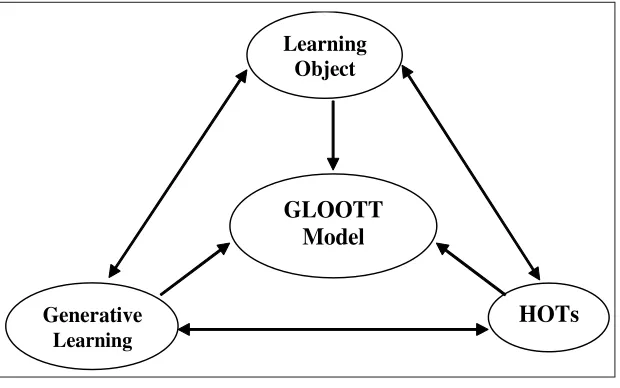
Bearing in mind the educational discrepancies and technological scenarios reviewed in the earlier section, this article aims to propose a design and development framework of a web-based learning environment designed to improve HOTs among learners in the learning of a computer system. This learning environment is called Generative Learning Object Organizer and Thinking Task (GLOOTT). The proposed model incorporates the potentials of multi-facet learning approaches; learning object design, generative learning, the essential components of HOTs, and technology-supported learning environment. In brief, GLOOTT is designed and developed to provide a learning tool that is similar to the “learner as designers” perspec-tive as noted by Jonassen and Revees (1996).
The Proposed Design and Development Framework of GLOOTT
Figure 1. Proposed theoretical framework of design and development of GLOOTT
A BRIEF DESCRIPTION OF GLOOTT
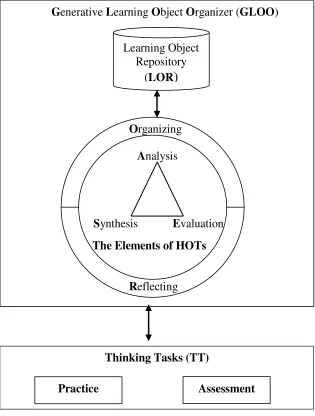
The GLOOTT consists of two main parts. These are Generative Learning Object Organizer (GLOO) and Thinking Task (TT) (Figure 2). The design of this model is based on the generative learning strategies, which consist of the generation of organization relationships between different components, integration, and elaboration of the relationships between external stimulus and memory. Besides that, the design of this model focuses on an instruc-tional planning framework for the promotion of HOTs adapted and modified from the following main sources; Johnson (1999), Swartz (2001), Jonassen (1992), and Tal and Hochberg (2003). Three main elements of HOTs are emphasized in this research, namely analysis, synthesis, and evaluation (Cradler, McNabb, Freeman, & Burche, 2002; Tal & Hochberg, 2003; Swartz, 2002; Yuretich, 2004; Johnson, 1999; Eken, 2002; Hopson, Simms, & Knezek, 2001). As discussed earlier, these three thinking skills are of utmost importance to prepare learners to be effective knowledge-workers. The model represents a multi-faceted, overlapping, and integrative knowl-edge construction (Resnick, 1987; Swartz, 2001). GLOOTT aims to facilitate the learners to engage themselves and improve their HOTs, which incorporate curricular standards in the learning of Computer System.
HOTs
GLOOTT
Model
Learning Object
Figure 2. The GLOOTT model
Thinking Tasks (TT)
Practice
Assessment
Learning Object
Repository
(
LOR
)
G
enerative
L
earning
O
bject
O
rganizer (
GLOO
)
O
rganizing
R
eflecting
S
ynthesis
A
nalysis
E
valuation
GLOOTT specifies the development of concepts to be learned as well as improves the HOTs among the learners. In GLOO, learners work with learning objects that actively engage them generating or constructing the organizational relationships between the learning objects. To facilitate generative learning, the GLOO is designed to offer learners the opportunity to construct, or reconstruct their knowledge by way of assimilating and accommodating new knowledge schemata with their existing frameworks. During the learning, the learners will be working using learning objects that require them to engage in HOTs (analyze, synthesize, and evaluate) whereas the organization and reflection process will facilitate and encourage them to use the HOTs. These activities follow idiosyncratic pathways in learning and they are complementary to each other in between: analysis, synthesis, evaluate, organizing, and reflection.
The GLOO is designed to enable and help the learners to search, include, adapt, manipulate, reflect, and organize the learning objects in designing their own learning. It allows the learners to have a certain degree of control over the selection of objects and design of learning. During the learning session, the learners participate in designing their learning by adapting and organizing the learning objects. In this case, learners act as designers that construct and design their own learning through analyzing, synthesizing, and evaluating the learning objects from a computerized database that contains learning materials of a computer system designed as learning objects. This database is called Learning Object Repository (LOR).
These higher order learning activities will engage themselves with the identified HOTs elements. However, it must be noted that the adoption of this learning approach needs proper design for a true learning experience to occur. As Wilson (1997) pointed out, constructivist learning activities do not indicate a lack of structure, indeed, some structure and discipline are needed to provide goal oriented opportunities that allow and help learners to be creative in their constructions for learning. Seen in this light, the design of the learning by learners is based on the learning objectives in the comput-er system provided by instructors. Meanwhile, an information agent will scaffold the learning process that engages learners in facilitating their reflection and improvement of HOTs.
learners to test their conceptual understandings against the new knowledge provided, as well as for them to reinforce and practice their HOTs. There are two parts in the TT, namely practice and assessment. In the practice, learners will be asked to construct a scenario that will engage them in HOTs, which needs deeper processing of instruction content. It is based on the second family of generative learning strategies mentioned earlier. It helps learners to implement what they learn, reflect on the learning content, and incorporate the learned content into related areas. The use of scenarios generation strategy was found effective in improving learners’ performance on their learning at the higher level learning in research conducted by Gao and Lehman (2003).
The assessment part contains learners’ concept maps and exercises. Concept mapping encourages learners to actively and generatively construct, de-scribe, relate, and organize their concepts (Jonassen, 2000). In addition, a concept map can be used to facilitate the promotion of HOTs among learners (Hollingworth & McLoughlin, 2003). On the other hand, exercises contains multiple-choice test to assess the learners’ understanding and helps them to reflect the learning they have designed in GLOO. In other words, it acts as a self-assessment tool to help the learners in monitoring and design-ing their learndesign-ing in GLOO.
In short, the GLOOTT is designed to incorporate the attributes of learning objects, the essentials elements in generative learning and promotion of selected elements of HOTs. Such a model not only is a knowledge acquisi-tion tool but also a cognitive tool that improves HOTs. It also guides the learner as a “learning designer.” Among the prominent properties of GLOOTT are:
1. a knowledge base that contains chunks of learning (learning objects), which allows linking;
2. consists of a knowledge domain, which is broken into smaller parts (learning objects), flexible, and reusable;
3. provides an environment in which the learning objects can be meta-tagged to describe the learning materials;
5. provides a collaborative learning environment for knowledge sharing;
6. provides a learning environment, which can be controlled, self-assessed, and self-directed by learners;
7. provides an environment for concept construction and design;
8. provides an environment to scaffold learning process that facilitate learners’ reflection and improves HOTs;
9. provides an environment for testing and reflection of the learners’ own concepts;
10. provides a dynamic environment conducive to proactive interaction; and
11. provides an environment for practicing and improving HOTs.
Besides all those mentioned, it is also important to note that the learning activities are learner-centered while the learning environment is generative-oriented. Thus, the design and development of the learning environment considers ways and means to engage learners in active learning. The proposed design and development framework in this article is one, which has the learning object design as its stem and essential elements in genera-tive learning as its pedagogical perspecgenera-tive to improve HOTs through learning the computer system.
CONCLUSION
become a common practice in a rapidly changing technological society. This is of utmost importance as the development of information technology has become ubiquitous in schools as well as higher educations. It is hoped that this little attempt would be resourceful in offering an alternative for technol-ogy-supported learning, especially those intended to improve HOTs among learners.
References
Agostinho, S., Bennett, S., Lockyer, L., & Harper, B. (2003, December). Integrating learning objects with learning designs. In G. Crisp, D. Thiele, I. Scholten, S. Barker & J. Baron (Eds.), Interact, Integrate, Impact: Proceedings of the 20th Annual Conference of the Australasian
Society for Computers in Learning in Tertiary Education (ASCILITE). Adelaide, Australia: ASCILITE.
Bannan-Ritland, B., Dabbagh, N., & Murphy, K. (2000). Learning object systems as constructivist learning environments: Related assumptions, theories and application. In D. A. Wiley (Ed.), The instructional use of learning objects: Online version. Retrieved February 13, 2006, from http://reusability.org/read/
Bonn, K.L., & Grabowski, B.L. (2001, January). Generative learning theo-ry: A practical cousin to constructivism. Paper presented at the Joint Meeting of Mathematics, New Orleans, LA
Chmura, G.A., (1998). What abilities are necessary for success in computer science? ACM SIGCSE, 30(4), 55-59.
Cradler, J., McNabb, M., Freeman, M., & Burche, R. (2002). How does technology influence learner learning? Learning and Leading with Technology, 29(8), 46-49.
Collis, B., & Strijker, A. (2003). Re-usable learning objects in context. In-ternational Journal on E-Learning, 2(4), 5-17.
Cognitive Technology Group at Vanderbilt (CTGV) (1993). Designing learning environments that support thinking. In J. Lowyck, D. H. Jo-nassen, & T.M. Duffy (Eds.), Designing environments for constructive learning. New York: Springer.
Duffy, T.M., & Jonassen, D.H. (1992). Constructivism: New implications for instructional technology. In T.M. Duffy & D. H. Jonassen (Eds.),
Constructivism and the technology of instruction: A conversation (pp. 1-16). Mahwah, NJ: Lawrence Erlbaum.
Eken, A.N. (2002). The third eye: Critical literacy and higher order think-ing skills are improved through a film studies class. Journal of Adoles-cent & Adult Literacy, 46(3), 220-231.
Ennis, R.H. (1987). A taxonomy of critical thinking dispositions and abili-ties. In J. B. Baron & R. J. Sternberg (Eds.), Teaching thinking skills— theory and practice (pp. 9-26). New York: W. H. Freeman.
Gao, T., & Lehman, J.D. (2003). The effects of different levels of interac-tion on the achievement and motivainterac-tional percepinterac-tions of college learn-ers in a web-based learning environment. Journal of Interactive Learn-ing Research, 14(4), 367-387.
Grabinger, R.S. (1996). Rich environments for active learning. In D. H. Jo-nassen (Ed.), Handbook of research for educational communications and technology. New York: Simon Schuster McMillan.
Grabowski, B.L. (1996). Generative learning: Past, present, and future. In D.H. Jonassen (Ed), Handbook of research for educational communi-cation and technology (pp. 897- 918). New York: Simon and Schuster Macmillan.
Henderson, P.B. (1986). Anatomy of an introductory to computer science course. Proceedings of the 17th SIGCSE Technical Symposium on
Com-puter Science Education, 18(1), 257-263.
Hollingworth, R.W., & McLoughlin, C. (2003, July). Even foundation lev-el learners can get the HOTS for science! 7th Pacific Rim, First Year in Higher Education Conference. Australia: Queensland University of Technology. Retrieved February 15, 2006, from http:// www.fyhe.qut.edu.au/FYHE_Previous/papers03/Refereed%20Papers/ Full%20papers/McLoughlin&Hollingworth_final.doc
Hopson, M.H., Simms, R.L., & Knezek, G.A. (2001). Using a technology-enriched learning environment to improve higher order thinking skills.
Journal of Research on Technology in Education, 34(2), 109-119. Ivie, S.D. (1998). Ausubel’s learning theory: An approach to teaching
higher order thinking skills. High School Journal, 82(1), 35-47. Johnson, C.R. (1999, October). Synthesizing information: A model that
works for everyone. Presentation at ISETA (International Society for Exploring Teaching Alternatives), Tempe, Arizona. Retrieved Febru-ary 13, 2006, from http://www.west.asu.edu/johnso/synthesis/ background.html#objective
Jonassen, D.,H. (1992). Evaluating constructivist learning. In T.M. Duffy & D.H. Jonassen (Eds.), Constructivism and the technology of instruc-tion: A conversation (pp. 137-148). Mahwah, NJ: Lawrence Erlbaum. Jonassen, D.H. (2000). Computers as mindtools for schools (2nd ed.).
En-glewood Cliffs, NJ: Prentice Hall.
Jonassen, D.H., Wilson, B.G., Wang, S., & Grabinger, R.S. (1993). Con-structivist uses of expert systems to support learning. Journal of Com-puter-Based Instruction, 20(3), 86-94.
Learning Technology Standards Committee. (2000). LTSC website. Re-trieved February 13, 2006, from http://ieeeltsc.org/
Morrison, D., & Collins, A. (1996). Epistemic fluency and constructivist learning environment. In B.G. Wilson (Ed.), Constructivist learning environments: Case studies in instructional design (pp. 107- 119). En-glewood Cliffs, NJ: Educational Technology Publications.
Onosko, J.J. (1990). Comparing teacher’s instruction to promote learners’ thinking. Journal of Curriculum Studies, 22(5), 443-461.
Osborne, R.J., & Wittrock, M.C. (1983). Learning science: A generative process. Science Education, 67(4), 489-508.
Parham, J.R. (2003). An assessment and evaluation of computer science ed-ucation. The Journal of Computing in Small Colleges,19(2), 115-127. Reigeluth, C.M., & Nelson, L.M. (1997). A new paradigm of ISD? In R.C.
Branch & B.B. Minor (Eds.), Educational media and technology year-book (Vol. 22, pp. 24-35). Englewood, Cliffs, NJ: Libraries Unlimited. Resnick, L. (1987). Educating and learning to think. Washington, DC:
Na-tional Academy Press.
Shepherd, C. (2000, December). Objects of interest. TACTIX. Retrieved February 13, 2006, from http://www.fastrak-consulting.co.uk/ tactix/ features/objects/objects.htm#Objects%20defined
Shi, H., Rodriguez, O., Chen, S., & Shang, Y. (2004). Open learning ob-jects as an intelligent way of organizing educational material. Interna-tional Journal on E-Learning, 3(2), 51-63.
Singh, H. (2000, March). Achieving interoperability in e-learning. ASTD’s Online Magazine All About E-Learning.Retrieved February 13, 2006, from http://www.learningcircuits.org/2000/mar2000/Singh.htm Swartz, C.W. (2001). Concept formation and problem solving:
Understand-ing and managUnderstand-ing two key components of higher order cognition. Re-trieved February 13, 2006, from http://www.allkindsofminds.org/ articleDisplay.aspx?articleID=18&categoryID=10
Tal, R., & Hochberg, N (2003). Assessing high order thinking of learners participating in the “WISE” project in Israel. Studies in Educational Evaluation, 29(2), 69-89.
Van Zele, E., Vandaele, P., Bottledooren, D., & Lenaerts, J. (2003). Imple-mentation and evaluation of a course concept based on reusable learn-ing objects. Journal of Computing Research, 28(4), 355-372.
Wiley, D.A. (2002). Learning objects need instructional design theory. In A. Rossett (Ed.), The ASTD e-learning handbook (pp. 115-126). New York: McGraw-Hill.
Wittrock, M.C. (1974). Learning as a generative process. Educational Psy-chologist, 11(2), 87-95.
Wittrock, M.C. (1991). Generative teaching of comprehension. The Ele-mentary School Journal, 92(2), 169-184.
Yuretich, R. F. (2004). Measuring skills in large introductory science class-es. Journal of College Science Teaching, 33(3), 40-45.