SEMANTICS ORIENTED APPROACH FOR IMAGE RETRIEVAL IN LOW COMPLEX SCENES
WANG HUI HUI
A thesis submitted in fulfilment of the requirements for the award of the degree of
Doctor of Philosophy (Computer Science)
Faculty of Computer Science and Information Systems Universiti Teknologi Malaysia
iii
“Dedicated to my beloved family and friends, without their understanding,
iv
ACKNOWLEDGEMENT
I would like to take this opportunity to thank my supervisors, Prof. Dzulkifli Mohamad and Assoc. Prof. Dr. Nor Azman Ismail for all the invaluable guidance and encouragement provided throughout this research. Thank you for the patience and support you have given to me.
I would like to acknowledge the scholarship provided by the Malaysian Ministry of Higher Education and study leave granted by Universiti Malaysia Sarawak.
I would like to thank all of my friends for their kindness and useful discussions, especially during difficult times.
v
ABSTRACT
vi
ABSTRAK
vii
TABLE OF CONTENTS
CHAPTER TITLE PAGE
DECLARATION ii
DEDICATION iii
ACKNOWLEDGMENT iv
ABSTRACT v
ABSTRAK vi
TABLE OF CONTENTS vii
LIST OF TABLES xiv
LIST OF FIGURES xv
1 INTRODUCTION 1
1.1 Motivation 1
1.2 Problem statement 3
1.3 Research questions 4
1.4 Research aim 5
1.5 Objectives 5
1.6 Scope and limitation 6
1.7 Research operation framework 8
1.8 Significance of the research 9
1.9 Organization of thesis 9
2 LITERATURE REVIEW 11
2.1 Evolution of Image Retrieval 12
viii
2.2 Gaps in content based image retrieval 16
2.2.1 Semantic gap 16
2.2.2 Intention gap 17
2.3 Image features 18
2.3.1 Text features 18
2.3.2 Visual features 18
2.4 Object detection 19
2.4.1 Colour object extraction 20
2.4.2 Colour object integrated spatial relation
extraction 21
2.5 Semantic extraction 22
2.5.1 Manual image semantic extraction 22 2.5.2 Automatic image semantic extraction 26
2.5.2.1 Image extraction 27
2.5.2.2 Region/Object semantic
extraction 30
2.5.2.3 Object spatial relationship
semantic extraction 32
2.6 Semantic representation 32
2.7 User query 34
2.7.1 Image browsing 35
2.7.2 Image search 35
2.7.2.1 Query by example 35
2.7.2.2 Query by keywords 37
2.7.3 User’s needs 39
2.8 Discussion 40
2.9 Summary 52
3 METHODOLOGY 53
3.1 Research methodology 53
3.2 Object detection 55
3.2.1 Visual image extraction 55
3.2.1.1 The image interpreter 56
3.2.1.2 The feature extraction 56 3.2.1.2.1 Extract color
features 57
ix
3.2.1.2.6 Remapping to CCD
image 60
3.2.1.2.7 CCD image
smoothing 61
3.2.2 Object identification 61
3.2.2.1 Road and building extraction 62 3.2.2.1.1 Candidate point
determination 63
3.2.2.1.2 Line creation 63 3.2.2.1.3 Best line selection 64 3.2.2.1.4 Best line drawing 65
3.2.2.2 Object location 66
3.2.2.2.1 Colour cluster
group identification 66 3.2.2.2.2 Horizontal scanning 67 3.2.2.2.3 Vertical scanning 68 3.2.2.2.4 Object cluster
identification 68
3.2.2.2.5 Object cluster
verification 69
3.2.2.2.6 Car object
identification 70
3.3 Semantic extraction and representation 71
3.3.1 Semantic object extraction 72
3.3.2 Semantic object spatial relationship
semantic extraction 73
3.3.2.1 Road slope as Z-axis
determination 73
3.3.2.2 Calculate the slope of each possible pair of objects in
image 74
3.3.2.3 Determine the relationship/
directional relationship 75 3.3.2.4 Distance of spatial relationship
semantic 79
3.3.2.5 Spatial relationship semantic
representation 79
3.4 Semantic Visual Query Builder (SeVQer) 79
3.4.1 Semantic colour perception 81
3.4.2 User query builder 82
3.4.2.1 Drag and drop object interested and their spatial relationship
arrangement 82
x
3.4.3 Image spatial semantics similarity
measurement 84
3.4.3.1 Query matching 85
3.4.3.1.1 Semantic colour
query matching 85
3.4.3.1.2 Object semantic relationship query
matching 85
3.4.3.2 Image similarity 86
3.4.3.2.1 Object semantic
colour similarity 87 3.4.3.2.2 Semantic object
spatial relationship
similarity 87
3.4.3.3 Range of image spatial
semantic similarity 88
3.5 Dataset used 88
3.6 Parameters selection 89
3.6.1 Number of colour clusters 89
3.6.1.1 Experimental setup 90
3.6.1.2 Determination of the number
of colour clusters 91
3.6.2 Size of sub area of the images 92
3.6.2.1 Experimental setup 92
3.6.2.2 Determination of the number
of colour clusters 92
3.6.3 Colour cluster distance 94
3.6.3.1 Experimental setup 94
3.6.3.2 Determination of the number
of colour clusters 94
3.6.4 Minimum size of object clusters 96
3.6.4.1 Experimental setup 96
3.6.4.2 Determination of the number
of colour clusters 96
3.7 Evaluation methods 98
3.7.1 Experiments on object detection 99
3.7.1.1 Experimental setup 99
3.7.2 Experiments on semantic extraction and
representation 100
3.7.2.1 Experimental setup 100
3.7.3 System retrieval performance 101
3.7.3.1 Experiments setup 102
3.7.3.2 User queries 102
xi
3.7.4 User retrieval performance and Subjective
Satisfaction 104
3.7.4.1 Experimental setup 105
3.7.4.2 Scenario and Tasks 105
3.7.4.3 Participants 106
3.7.4.4 Procedures 107
3.7.4.5 Measurement 108
3.8 Implementation tools 108
3.9 Summary 109
4 PROTOTYPE DEVELOPMENT 110
4.1 Algorithms 110
4.1.1 Image interpretation 111
4.1.2 Extract colour features 112
4.1.3 CCL smoothing 114
4.1.4 CCD image smoothing 115
4.1.5 Candidate points determination 117
4.1.6 Line creation 118
4.1.7 Best slope selection 118
4.1.8 Colour cluster group identification 119
4.1.9 Horizontal scanning 120
4.1.10 Vertical scanning 121
4.1.11 Object cluster identification 122
4.1.12 Object cluster verification 123
4.1.13 Semantic object extraction 124
4.1.14 Object spatial semantic relationship 125 4.1.15 Distance of spatial relationship semantic 127 4.1.16 Semantic colour query matching 127 4.1.17 Object semantic relationship query
matching 128
4.1.18 Object semantic colour similarity 129 4.1.19 Semantic object spatial relationship
similarity 130
4.2 Data structure 131
4.3 Semantic image retrieval and the components 134
4.3.1 New image group 135
4.3.2 Image group selection 136
4.3.3 Inserting images into database 137
4.3.4 Semantic colour name 137
xii
4.3.6 Image feature extraction handler 139
4.3.7 Visual query handler 142
4.3.8 Result display 144
4.4 Summary 145
5 RESULTS AND DISCUSSION 146
5.1 Experiments of colour object detection 146 5.2 Experiments of the object spatial relationships
semantic extraction and representation 150 5.3 Experiments of system retrieval performance 154 5.4 Experiments of user retrieval performance and
subjective satisfaction 163
5.4.1 Efficiency 164
5.4.2 User satisfaction 166
5.5 Summary 167
6 CONCLUSIONS 169
6.1 Contributions 170
6.2 Limitation 172
6.3 Future works 172
REFERENCES 174
xiii
LIST OF TABLES
TABLE NO TITLE PAGE
2.1 Research works on Content Based Image Retrieval based
on Visual Contents 14
2.2 The summary of the various semantic extraction
approaches reviewed 49
3.1 Experiments design on object detection. 100
3.2 Experiments design on semantic extraction and
representation 101
3.3 Characteristics of the experiments and user queries used 103
3.4 Implementation tools 109
5.1 The experiment results of the proposed object detection
method 147
5.3 The experiment results of the proposed semantic
extraction and representation method. 150
5.4 Retrieval Accuracy Experimented Results of Category I
Experiment 155
5.5 Retrieval Accuracy Experimented Results of Category II
xiv
LIST OF FIGURES
FIGURE NO TITLE PAGE
1.1 Edge detection of traffic images using Iplab’s approach 7 1.2 The overview of the research operational framework 8 2.1 General framework of keyword based image retrieval 12 2.2 General framework of content based image retrieval 13
2.3 Wikimedia image annotation interface 23
2.4 Photoblog image annotation interface 24
2.5 Fotopages image annotation interface 24
2.6 Flickr image annotation interface 25
2.7 Inotes image annotation interface 25
2.8 Facebook image annotation interface 26
2.9 Google search engine with searching of “an apple next to
a banana” 38
2.10 The evolution of image retrieval 41
2.11 Semantic and intention gaps: semantic extraction and
representation of images 42
2.12 Semantically similar images with different low level
features 43
2.13 Semantically different images but with similar low level
features 43
2.14 False objects spatial relationships semantic extraction 46 2.15 False objects spatial relationship created by using centre
of MRB as object representation
47
xv
3.1 The research operational framework 54
3.2 The image extraction process data flow 55
3.3 The visual image extraction process data flow 55
3.4 The image interpreter process data flow 56
3.5 Feature extraction process data flow 57
3.6 The 3x3 window operation extraction for CCL images 59 3.7 Window operation for CCL image to produce CCL
smoothed image 59
3.8 The data flow of object identification process 62
3.9 The design of road and building extraction 62
3.10 The changed point of image determination 63
3.11 The possible lines created from candidate points 64
3.12 The line verification 65
3.13 Building and road region separation 65
3.14 The design of object detection 66
3.15 The colour cluster group (indicated by red dotted box) 67 3.16 The colour clusters (indicated by red dotted box) 67 3.17 The individual colour cluster (indicated by red rotted
box) 68
3.18 Objects cluster identification 69
3.19 Object clusters verification 70
3.20 Object clusters (indicated by yellow boxes) 71 3.21 Object clusters and their representative colour 71
3.22 Semantic extraction 72
3.23 Object spatial relationship semantic extraction 73
3.24 Traffic images 74
3.25 Front/Back relationship determination 76
3.26 (a) Absolute Front/Back relationship and
(b) Absolute Right/Left relationship 77
3.27 Composite relation 78
xvi
3.29 Colour representation used 81
3.30 The user query data flow 82
3.31 Colour cluster generated using different HSV settings 90 3.32 Colour features extracted object cluster images using
different colour cluster setting 91
3.33 Colour features extracted object cluster images using
different sub area size of images 93
3.34 Colour features extracted object cluster images using
different colour cluster distance. 95
3.35 Colour features extracted object cluster images using
different minimum object cluster sizes. 97
4.1 The algorithms for the image interpretation 112
4.2 Algorithm for extract colour feature 113
4.3 Algorithm for the GetMinCC function 113
4.4 Algorithm for the CCL smoothing function 115
4.5 Algorithm for CCD image smoothing function 116
4.6 Algorithm for the candidate points determination
function 117
4.7 Algorithm for the line creation function 118
4.8 Algorithm for the best line drawing function 119 4.9 Algorithm for the colour cluster group identification
function 120
4.10 Algorithm for the horizontal scanning function 121 4.11 Algorithm for the vertical scanning function 122 4.12 Algorithm for the object cluster identification function 123 4.13 Algorithm for the object cluster verification function 124 4.14 Algorithm for the semantic object extraction function 125 4.15 Algorithm for the semantic relationship function 126 4.16 Algorithm for the distance of spatial relationship
semantic function 127
4.17 Algorithm for the semantic colour query matching
xvii
4.18 Algorithm for the object semantic relationship query
matching function 129
4.19 Algorithm for the object semantic colour similarity
function 130
4.20 Algorithm for the image similarity function 131
4.21 Data structure of image group 132
4.22 Data structure of colour cluster 132
4.23 Data structure of image feature 133
4.24 Data structure of object feature 133
4.25 Data structure of colour features 133
4.26 Data structure of relation features 134
4.27 The semantic based image retrieval and the components 134
4.28 Creating a new image group 136
4.29 Image group selection 136
4.30 Inserting images into database 137
4.31 Semantic colour name 138
4.32 Image browsing 139
4.33 Image feature extraction handler 140
4.34 The image feature extraction display 141
4.35 The visual query handler 143
4.36 The generated semantic features 144
4.37 Query image results 144
5.1(a) Some results of the colour object detection experiments-
detected vehicles (indicated by yellow MBR) 148 5.1(b) Some results of the colour object detection experiments-
missed car(s) (pointed by green arrow) 149
5.1(c) Some results of the colour object detection experiments-
False Detection (pointed by Green Arrow) 149
5.2 Sample dataset of Belkhatir(2009)’s work. 151 5.3(a) Experiment results for semantic extraction and
xviii
5.3(b) Experiment results for semantic extraction and
representation - false semantic features extraction 153
5.4 Retrieved results of Experiment A 157
5.5 Retrieved results of Experiment D 158
5.6 Retrieved results of Experiment E 159
5.7 Retrieved results of Experiment F 160
5.8 Missed image in retrieval for Experiment F 161
5.9 Retrieved results of Experiment H 162
5.10 Missed image in retrieval for Experiment H 163
5.11 The mean total task times 164
5.12 The mean task time, per task 165
5.13 Average subjective satisfaction for Question 5 and
CHAPTER 1
INTRODUCTION
1.1Motivation
The recently digital visual contents production has become more common and affordable. The recent technology advancement has resulted in an enormous increase in multimedia data. Researches (Datta, 2009; Lyman and Varian, 2003) reported that the annual productions of images are approximately 80 billion, and home video is approximately 1.4 billion. Online photo sharing sites are increasing such as Flickr, Photoblog and Fotopages. By December 2010, Flickr had more than 21.3 million unique registered users and there are some five billion photos and short videos stored on the site (Mellor, 2011). Thus, image retrieval research has been introduced and has been a very active research area since the 1970s (Rosenfeld, 1969; Tamura and Mori, 1977) for better image management.
2
An effective image retrieval system is needed to operate on the collection of images to retrieve the relevant images based on human perception.
However, most common methods of image retrieval are based on visual features or utilize some index methods. The metadata of images are indexed by keyword, image caption or image descriptions so that retrieval can be performed based on sample query image with indexed annotation words. As getting more visual information is available in digital archives, the need for effective image retrieval has become greater (Liu et al., 2007; Datta, 2007). In image retrieval research, researchers are moving from keyword based to content based, and then towards semantic based image retrieval.
The main problem encountered in the image retrieval research is the semantic gap that exists between the low-level features and high-level semantics in the images due to the unavailability of low level image features in describing high level concepts related to the users’ need. A machine is only able to perform automatic extraction by extracting the low level features which are represented by the colour, texture, shape and spatial from images with a good level of efficiency. Describing images in semantic terms is an important and challenging task that needs to be carried out to fulfill human satisfaction and defining a semantic meaning and representation of the input query in describing user’s needs remain as major challenges (Russ, 1999)
3
1.2 Problem Statement
“A picture is worth a thousand words"; this familiar proverb emphasizes that visual information is inherently ambiguous and semantically rich. Human beings are able to interpret images at different levels, both in low level features (colour, shape, texture and object detection) and high level semantics (abstract objects and event). However, a machine is only able to interpret images based on low level image features. Thus, it introduces an interpretation inconsistency between image descriptors and high-level semantics called semantic gap (Liu et al., 2007; Smeulders et al., 2000). In addition, users prefer to articulate high-level queries (Kherfi et al.,
2004; Smeulders et al., 2000) but CBIR systems index images using low-level features. In general, there is no automated direct link between high-level semantic concepts and visual image features. There is a persuasive need for CBIR systems to provide maximum support towards bridging the semantic gap between the visual features and high level concepts to fully support the query by semantic concept (Liu et al., 2007; Guan et al., 2009). Researchers (Chang et al., 2009; Idrissi, 2009) found
that bridging the semantic gap for image retrieval is a very challenging problem yet to be solved.
4
on semantic matching instead of semantic similarity (Belkhatir, 2009; Muda et al., 2009; Pratikakis, 2011; Yong, 2011).
User query has become one of the main challenges of research in the field of CBIR which is to find exactly what a user is looking for in more effective ways.
Most of the researches in CBIR is aimed at improving retrieval performance.
Comparatively little effort has been directed towards improving the scalability
properties of retrieval methods (Heesch, 2008). So, an intuitive and visual user query design that allows users to express their need and intent easily is needed.
1.3 Research Questions
Research questions of the study are specified as follows:
1. What is the semantic gap in image retrieval and how to bridge them?
2. How to design and demonstrate the semantics oriented approach for image retrieval in low complex scenes?
3. How to design and demonstrate an intuitive and visual user query which allows users to express their need for the image retrieval?
4. Will the use of the proposed object detection techniques, semantic extraction and representation, and the visual user query be validated by the proposed prototype?
This research attempts to answer the above questions.
5
query that are allows users to express their need was also designed in research question three. Lastly, for the fourth research questions, prototype was developed and evaluated to demonstrate the system retrieval performance, user retrieval performance and subjective satisfaction of the model and system in the image retrieval for low complex scenes
1.4 Research Aim
The aim of this research is to design and validate the semantics oriented approach for image retrieval in complex scenes. This aim can be achieved by fulfilling the research objectives stated in Section 1.5.
1.5 Objectives
1. To design and develop algorithms for object detection using colour features for low complex scenes.
2. To design and develop the semantic object spatial relationship extraction and representation for bridging the semantic gap in image retrieval.
3. To design and develop the semantic visual user query design that allows a user to express their need in image retrieval.
6
1.6 Scope and limitation
In this research domain, low complex scenes images (traffic images with “right hand” perspective view) are chosen as dataset images to perform empirical evaluation of the proposed method. The complex scenes are scenes that contain irregular shapes of objects that is viewed from any direction, with self-occlusion or partially occluded by other objects and with uniform colour intensity (Garijo et al., 2002) and complex scenes perception is humans’ remarkable perceptual abilities to perceive, navigate and interact with natural environments dramatically eclipse those of current robotic systems (IGERT Complex Scene Perception, n.d.).
The colour features with spatial distribution are selected as it is able to use to identify the objects of building and road. The car can be identified by integrating the line detection and intersection. Cars are considered as the objects of interest and main objects in traffic images from the human point of view. In the images used, only non-overlapped cars are considered.
7
Figure.1.1: Edge detection of traffic images using Iplab’s approach (Google Project Hosting, 2007).
The colour cues posses highly discriminative power as it is contrast to shape cues and invariant against scale and view (Ritter et al., 1995). Micheli et al. (1995) stated that the most important advantage of having colour information in addition to image luminance is that the “colour” of a surface is more stable under changes in geometry than the corresponding image intensity value. The surfaces arrangement and lighting conditions can be greatly changeable as well. Thus, colour plays an important role in the images.
8
1.7 Research operational framework
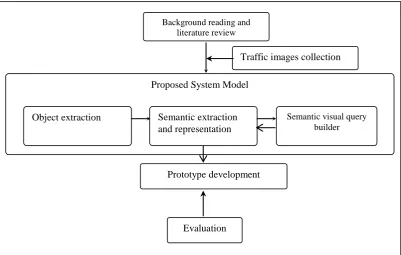
The overview of the research operational framework is illustrated as shown in Figure 1.2.
Figure 1.2: The overview of the research operational framework.
A proposed image retrieval system model was constructed based on a literature review that involves background reading, surveying and reviewing related research in the area of bridging the semantic gap in image retrieval. The studies of visual features, object detection using colour features, semantic extraction and representation, and image search were carried out. There are three main modules design of the system model, which are object detection, semantic extraction and representation and Semantic Visual Query Builder (SeVQer). In the prototype development, the Visual Basic programming, Microsoft Access database, ADO data access library were used as the enabling technologies to achieve the aim of this research. Evaluations are conducted to test the efficiency and effectiveness of the
Background reading and literature review
Proposed System Model
Object extraction Semantic extraction
and representation
Semantic visual query builder
Evaluation Prototype development
9
proposed solutions. Usability test is also conducted to evaluate the user retrieval performance and subjective satisfaction of the system model.
1.8 Significance of the research
Introducing semantic feature extraction and visual query into image retrieval is necessary to cope with a variety of users having different needs. This study attempts to fill the gaps that exist in image retrieval. By incorporating the proposed semantic extraction and representation with visual query builder, it aims to create a more effective, efficient and accurate prototype for retrieving images that conforms to human perception.
1.9 Organization of Thesis
The thesis is organized as follows:
Chapter 2 reviews the literature of previous research relevant to this work. These include (a) the evolution of image retrieval; (b) gaps in content based image retrieval; (c) images features; (d) object detection techniques; (e) semantic extraction; (f) semantic representation and (g) user query for image retrieval. A comparison summary is also discussed.
10
Chapter 4 discusses the implementation and development of the proposed prototype. The proposed prototype model presents the implementation tools, main algorithms employed, data structure as well as the system model and their components. This chapter also illustrates and explains the capabilities of the proposed prototype.
Chapter 5 presents the results and analysis of the various experiments. The experiments that were carried out include: object detection, semantic extraction and representation, the system retrieval performance, the user retrieval performance and subjective Satisfaction.
174
REFERENCES
Agrawal, R. (2009). Narrowing Down the Semantic Gap between Content and Context using Multimodal Keywords. PhD thesis. Wayne State University.2009
Bederson, B. B. (2001) Quantum Treemaps and Bubblemaps for a Zoomable Image Browser. HCIL Tech Report 2001-10, University of Maryland, College Park,
Unites State.
Belkhatir, M. (2009). An operational model based on knowledge representation for querying the image content with concepts and relations. Multimedia Tools Application, 43(1), 1–23.
Belkin, N. J. (2000). Helping people find what they don’t know. Communications of the ACM, 43(8), 58–61.
Belkin, N. J., Cool, C., Kelly, D., Lee, H.J., Muresan, G., Tang, M.C.(2003). Query length in interactive information retrieval. Proceedings of the 26th annual ACM international conference on research and development in information retrieval
(SIGIR’03), 28 July – 1 August, Toronto, CA. 205–212
Berlin, B., and Kay, P. (1991): Basic Color Terms: Their universality and Evolution. UC Press.
Bovic, A.C., Clark, M and Geisler, W. S.(1990) Multichannel Texture Ana-lysis Using Localized Spatial Filters. IEEE Transitions Pattern Analysis and Machine Intelligence, 12(1), 55-73.
Bradshaw B. (2000). Semantic based image retrieval: A probabilistic approach. Proceedings of the Eight ACM International Conference on Multimedia, 30
175
Brickley, D., and Guha, R. V. (2000). Resource Description Framework (RDF) Schema Specification 1.0, W3C. Candidate Recommendation 2000-03-27,
February 2000.
Carson, C., Belongie, S., Greenspan, H., and Malik, J. (1997). Region-based image querying. Proceeding of IEEE Workshop on Content-based Access of Image and Video Libraries, 20 June.Virgin Islands, USA. 42-49.
Carson, C., and Ogle, V. E. (1996). Storage and retrieval of feature data for a very
large online image collection. Computer Society Bulletin of the Technical Committee on Data Engineering. 19(4), 19–27
Cavazza, M., Green, R. J., and Palmer, I. J.(1998). Multimedia semantic features and image content description. Proceeding multimedia modeling, 12-15 October 1998, Lausanne, 39–46
Chan Y., Lei, Z. B., Lopresti, D., Kung S.Y. (1997). A feature-based approach for image retrieval by sketch. Multimedia Storage and Archiving Systems II. 3229, 220-231.
Chang, C.Y., Wang, H.Y., Li, C.F. (2009). Semantic analysis of real world images using support vector machine. International Journal Expert Systems with application An international journal. 36(7), 10560-10569.
Chang, S. F., Chen, W., Sundaram, H.(1998). Semantic visual templates: linking visual features to semantics. International Conference on Image Processing (ICIP), Workshop on Content Based Video Search and Retrieval. 3, 4-7 October.
Chicago, Illinois. 531–534.
Chang, S. K. and Hsu, A. (1992) Image information systems: where do we go from here?. IEEE Transition On Knowledge and Data Engineering. 5(5), 431-442.
Chen, C., Gagaudakis, G., Rosin, P. (2000). Similarity-based image browsing.
Proceeding international conference of intelligent information processing, 22
176
Chen,. J, Bouman, C., and Dalton J. (1998). Similarity pyramids for browsing and
organization of large image databases. Proceeding SPIE conference human
vision and electronic imaging III, 17 July. Bellingham, Washington. 563–575.
Chen, J. Y., Bouman, C.A., and Dalton, J.C. (2000). Heretical Browsing and Search of Large Image Database. IEEE Transitions on Image Processing, 9(3), 442-455. Chen, Z. J. (2010). Semantic Research on Content-Based Image Retrieval. Multimedia Technology, International Conference on Multimedia Technology, 29-31 October, Ningbo, China. 1-4
Choi, Y. (2010). Effects of contextual factors on image searching on the Web. Journal of the American Society for Information Science and Technology,
61(10), 2011-2018.
Choi, Y., Tasmussen, E. M., (2003). Searching for Images: The Analysis of Users’ Queries for Image Retrieval in American History. Journal of the American Society for Information Science and Technology, 54(6), 498-511.
Chris Mellor (n.d.). The register. Retrieved 10 December 2010. Website: http://www.theregister.co.uk/2011/02/02/flickr_nix_4000_pix.
Colombo, C., Bimbo, D. A., and Pala, P. Semantics in visual information retrieval. IEEE Multimedia, 6(3), 38–53.
Cox, I. J., Minka, T. P., Papathomas, T. V. and Yianilos, P. N. (2000). The bayesian image retrieval system, pichunter: Theory, implementation, and psychophysical experiments. IEEE Transaction on Image Processing, 9(1), 20-37.
Cox K. (1992). Information retrieval by browsing. Proceeding international conference new information technology, 30 November–2 December, Hong
Kong, 69-80.
Croft, W. B., and Thompson, R. H. (1987). I3R: A new approach to the design of document retrieval systems. Journal of the American Society for Information Science, 38(6), 389–404.
177
Datta, R., Joshi, D., Li, J., Wang, J. Z. (2008). Image Retrieval: Ideas, Influences, and Trends of the New Age. ACM Transactions on Computing Surveys, 40(2), 5(1-60).
Daoudi, M., and Matusiak, S. (2000). Visual Image Retrieval by Multiscale Description of User Sketches. Journal of Visual Languages and Computing 11(3), 287-301.
Descampe, A,. Vleeschouwer, C., Iregui, M., Macq, N., Marqués, F. (2007).
Prefetching and caching strategies for remote and interactive browsing of
JPEG2000 images. IEEE Transition Image Process 16(5):1339–1354.
Drucker, H., Shahraray, B., and Gibbon, D. C.(2001). Relevance feedback using support vector machine. Proceedings of the 18th International Conference on Machine Learning. 28 June -1 July. MA, USA. 122-129.
Duygulu, P., Barnard, K., Fretias, N., and Forsyth, D. (2002). Object recognition as machine translation: Learning a lexicon for a fixed image vocabulary. Proceedings of the European Conference on Computer Vision, 27 May- 2 June.
Copenhagen, 97–112.
Eakins, J. P., Briggs, P., and Burford, B. (2004). Image Retrieval Interfaces: A User Perspective. Image and Video Retrieval. 3115, 628-637.
Egenhofer, M.(1997). Query processing in spatial query by sketch. Journal of Visual Language and Computing, 8(4), 403-424.
Facebook (2004), Retrieved 3 June 2010. Website: http://www.facebook.com. Fensel, D. (2000). The semantic web and its languages. Intelligence Systems and
their applications. 15(6), 67-73.
Flicker (2004.), Retrieved 3 June 2010.
Website: http://www.flickr.com/photos/upload/done/
178
Frankel, C., Swain, M.J., and Athitsos, V.(1996). WebSeer : An image search engine for the world wide web. Technical Report. University of Chicago.
Garijo, F. J., Riguelmen, J. C., Bonilla, M. T. (2002). Advances in Artificial Intelligence. Springer; 1 edition.
Gerrig, R. J., and Zimbardo, P. G. (2001). Psychology and Life. 16 Edition. Allyn and Bacon.
Google Goggles. (2010), Retrieved 30 May 2011. Website: www.google.com/mobile/goggles/
Google: Image Search (1996).Retrieved10 December 2010, website :
http://support.google.com/images/bin/answer.py?hl=en&answer=1325808. Google project hosting (2007), Image Processing Lab (iplab). Retrieved 3 April
2011. Website : http://code.google.com/p/iplab/
Guan, H.Y., Antani, S., Long, L. R., and Thomas, G. R. (2009). Bridging the semantic gap using ranking SVM for image retrieval. Proceedings of the Sixth IEEE international conference on Symposium on Biomedical Imaging, 28 June-1
July. Boston, MA. 354-357.
Gudivada, N. V., and Raghavan, V. V (1995). Content-based image retrieval systems. Journal Computer, 28(9),18–22.
Hafner, J., Harpreet S. H., Equitz, W., Flickner, M. and Niblack, W. (1995). Efficient color histogram indexing for quadratic form distance functions. IEEE Transactions on Pattern Analysis and Ma-chine Intelligence, 17(7), 729-736
Hearn, D., and Baker, M. P. (1994). Computer Graphic. National Center for Supercomputing Applications, University of Illinois. Prentice Hall.
Heesch, D. (2008) A survey of browsing models for content based image retrieval. Multimedia Tools and Application, 40(2), 261-284.
179
Hollink, L., Nguyen, G., Schreiber, G., Wielemaker, J., and Wielinga, B. (2004). Adding spatial semantics to image annotations. The 4th International Workshop on Knowledge Markup and Semantic Annotation, 7-11 November, Hiroshima, Japan, 31-40
Hong, V., Paulus, D (2009). Parameter Study and Optimization of a Color-Based Object Classification System. International conference of Soft Computing and Pattern Recognition, 4-7 December. Melacca, Malaysia, 31-36.
Hou, T. Y.; Hsu, A., Liu, P. Y.; Chiu, M. Y. (1992). A content-based indexing technique using relative geometry features. Image Storage and Retrieval Systems, Proceeding SPIE, 1662, 59-68.
Hsu, W., Chua, T. S., and Pung, H. K. (1995). An integrated color-spatial approach to content-based image retrieval. Proceedings of the third ACM international conference on Multimedia, 5-9 November, San Francisco, USA. 305-313.
Hu, J. H., Ma, P. C., Chau, Y. K. (1999). Evaluation of user interface designs for information retrieval systems: a computer-based experiment. Decision Support Systems. 27(1-2), 125–143.
Hu, J., Wang, G.., Lochovsky, F., Sun, J. T., Chen, Z. (2009). Understanding User’s Query Intent with Wikipedia early years. Proceeding of the 18th international conference on world wide wide. 20-24 April. Raleigh, North Carolina. 471-480.
Huang, J. (1998). Color-Spatial Image Indexing and Applications. PhD thesis, Cornell University.
HyvÄonen, E., Harjula, P., and Viljanen, K.(2002). Representing metadata about web resources. Helsinki Institute for Information Technology (HIIT) Publishing.
Idrissi, N.(2009). Bridging the Semantic Gap for Texture-based Image Retrieval and Navigation. Journal Of Multimedia. 4(5), 277-283.
IGERT Complex Scene Perception? (n.d). Retrieved on 1 October 2012. Website: http://igert.perception.upenn.edu/index.php?n=Main.HomePage
180
Ion, A., Stanescu, L., Burdescu, D., Udristoiu, S. (2008). Mapping image low level descriptors to semantic concept. The 3rd international multi conference on computing in the global information Technology. 27 July-1 August. Athens.
Greece, 154-159.
ISO 9241-11: Guidance on usability. (n.d.). Retrieved 3 June 2011, Website: http://www.userfocus.co.uk/resources/iso9241/part11.html.
ISO/IEC 9126-4: Quality in use metrics. Retrieved on June 2011. Website: http://www.usabilitynet.org/tools/r_international.htm#9126-4.
Jansen, B. J., Spink, A., and Saracevic, T. (2000). Real life, real users, and real needs: a study and analysis of user queries on the web. Information Processing & Management. 36, 207–227.
Jeon,J., Laverenko,V., and Manmatha, R. (2003), Automatic image annotation and retrieval using cross-media relevance models. Proceedings of international ACM Conference on Research and Development in Information Retrieval. 28 July- 1
August. Toronto, Canada,119-126
Juang, C.F., Sun, W. K., Chen, G..C. (2009). Object detection by color histogram based fuzzy classifier with support vector learning. Journal of Neurocomputing, 72(10-12), 2464–2476
Kanehara, F., Satoh, S. and Hamada, T. (1995). A flexible image retrieval using explicit visual instruction. Proceedings of the Third International Conference on Document Analysis Recognition, 14-16 August. Montreal, Canada.175–178.
Kankanhalli, M. S. and Mehtre, B. M. (1995) Color and Spatial Feature For Contents-Based Image Retrieval. Technical Report. R95-184-0. Institute OF
System Science, National University Singapore.
Kato, T., Kurita, T., Otsu, N., and Hirata., K. (1992). A sketch retrieval method for full color image database query by visual example. Proceeding of International Conference on Pattern Recognition, 30 August–3 September. Hague, Holland.
181
Kelly, D., Fu, X. (2007). Eliciting better information need descriptions from users of information search systems. Information Processing and Management 43, 30–46.
Kelly, P., Cannon, T., and Hush, D. (1995). Query by image example: The comparison algorithm for navigating digital image databases (CANDID) approach. In Storage and Retrieval for Image and Video Databases (SPIE). 238–248..
Khan, W., Kumar, S., Gupta, N., Khan, N. (2001). Signature Based Approach For Image Retrieval Using Color Histogram And Wavelet Transform. International Journal of Soft Computing and Engineering. 1(1), 43-46.
Kherfi, M.L., Ziou,D. and Benard, A.(2004). Image retrieval from the World Wide Web: Issues, techniques and systems. ACM Computing Surveys, 36(1), 35-67. Laaksonen, J., Koskela, M., and Oja, E. (1999). Picsom: Self-organizing maps for
content-based image retrieval. Proceeding of International Joint Conference on Neural Network, 10 July-16 July. Washington, DC, 2470–2473
Lai, T. S.(2000). CHROMA: A Photographic Image Retrieval System. PhD Thesis, University of Sunderland.
Lassila, O., and Swick, R. R. (1999). Resource description framework (RDF): Model and syntax specification. Technical report, W3C, February 1999. W3C
Recommendation
Lim, J., Arbeláez, P., Gu, C., and Malik, J.(2009). Context by Region Ancestry. Proceedings of the IEEE International Conference on Computer Vision, 27
September- 4 October, 1978-1985
Lavrenko,V., Manmatha,R., and Jeon, J. (2003). A model for learning the semantic of pictures. Proceeding of Advances in Neural Information Processing Systems, 8-13 December. British Columbia, Canada, 80-89.
182
Liu, Y. (2007). Region-Based Image Retrieval with High-Level Semantics. PhD Thesis, Monash University.
Liu, Y., Zhang, D. S., Lu, G.. J., Ma, W. Y. (2007). A survey of content-based image retrieval with high-level semantics. Pattern Recognition, 40(1), 262 – 282 Lyman, P. and Varian, H. R. (2003). How much information, Retrieved 10
December 2010.Website:
http://www2.sims.berkeley.edu/research/projects/how-much-info-2003ChrisMel on.
MacArthur, S.D., Brodley, C. E., and Shyu, C. R. (2000). Relevance feedback decision trees in content- based image retrieval. Proceeding of IEEE Workshop on Content-based Access of Image and Video Libraries. Hilton Head Island, SC, 68-72.
Manjunath, B. S and Ma, W. T. (1996). Texture features for browsing and retrieval of large image data. IEEE Transactions on Pattern Analysis and Machine Intelligence, 18(8), 837-842
Meghini, C., Sebastiani, F., and Straccia, U.(1997). The terminological image retrieval model. Proceeding of 9th international conference on image analysis and processing (ICIAP’97).17-19 September. Florence, Italy, 156–163.
Mehtre, B. M., and Kankanhalli, M.S. (1995). Contents-Based Image Retrieval Using Composite Color-shape Approach. TR95-190-0. Institute OF System
Science, National University Singapore. 1995
Ménard, E. (2011). Search Behaviours of Image Users: A Pilot Study on Museum Objects. Partnership: the Canadian Journal of Library and Information Practice and Research. 6, 1(1-18).
Micheli, D. E., Prevete, R., Piccioli, G.., Campani, M. (1995), Colour cues for traffic scene analysis. Proceeding of the Intelligent vehicles symposium.25-26 September. USA, 466-471
183
Min, Y., Rong, A., and Zhen, Y. (2008). Research on Methodology of Image Semantic Understanding. Proceeding of SPIE. 6623(1-6).
Minka, T.(1996). An image database browser that learns from user interaction. MIT Media Laboratory Technical Report #365, Massachusetts Institute of Technology Mittal, A., Cheong, L. F.(2003). Framework for synthesizing semantic-level
indexes. Multimedia Tools and Applications 20(2),135–158.
Mokhtarian, F., Abbasi, S. and Kittler, J. (1996). Efficient and robust retrieval by shape content through curvature scale space. Series on Software Engineering and Knowledge Engineering. 8, 35-42.
Mori, Y., Takahashi, H., and Oka, R. (1999). Image-to-word transformation based on dividing and vector quantizing images with words. Proceedings of the First International Workshop on Multimedia Intelligent Storage and Retrieval
Management.
Muda, Z., Lewis, P. L., Payne, T. R., Weal, M. J. (2009). Enhanced Image Annotations Based on Spatial Information Extraction and Ontologies. Proceedings of the IEEE International Conference on Signal and Image
Processing Application, 18-19 November, Kuala Lumpur, Malaysia,173-178.
Mueen, A. (2009) Multi-level Automatic Medical Image Annotation. PhD Thesis. University of Malaya.
Muller, H., Muller,W., Squire,D. M., Maillet, S. M., Pun, T. (2001). Performance evaluation in content-based image retrieval: overview and proposals. Image/Video Indexing and Retrieval. 22(5), 598-601,
Mukherjea, S., Hirata, K. and Hara, Y. (1997). Towards a multimedia world wide web information retrieval engine. Journal computer Networks. 29, 8-13.
184
Nakazato, M., Manola, L. and Huang, S. (2002). ImageGrouper: Search, Annotate and Organize Images by Groups. Proceedings of the 5th International Conference on Recent Advances in Visual Information Systems. 11-13 March,
Hsin Chu, Taiwan 129-142
Niblack, W., Barber, R., Equitz, W., Flickner, M., Glasman, E., Petkovic, D., Yanker, P., Faloutsos, C. and Taubin, G. (1993). The QBIC project: querying images by content using color, texture, and shape. Storage and Retrieval for Image and Video Databases, 1908, 173-181
Ortega, M., Rui, Y., Chakrabarti, K., Mehrotra, S. and Huang, T.S. (1997). Supporting similarity queries in MARS. Proceedings of the 5th ACM International Multimedia Conference. 8-14 November. Seattle. Washington,
403–413.
Pass, G. and Zabih, R. (1996). Histogram Refinement for Content Based Image Retrieval. Proceeding 3rd IEEE Workshop on Applications of Computer Vision, 2-4 December. Florida, USA, 96- 102.
Pecenovic, Z., Do, M. N., Vetterli, M. and Pu., P. (2000). Integrated Browsing and Searching of Large Image Collections. Advances in Visual Information Systems, 1929, 179-189.
Pentland, A. R., Picard, W., Sclaroff, S. (1995). Photobook: tools for content-based manipulation of image databases. International Journal of Computer Vision 18(3), 233-254.
Photoblog-Your Life in Photos (2000), Retrieved 3 June 2010. Website : http://www.photoblog.com/create/
Photo Blogging made Easy-fotopages (2000), Retrieved 3 June 2010. Website: http://www.fotopages.com/cgi-bin/account.pl?page=3
185
Rahman, M. M. (2008). Semantical representation and retrieval of natural photographs and medical images using concept and context based feature
spaces. PhD thesis. Concordia University
Ritter, W., Stein, F. and Janssen, R.(1995). Traffic sign recognition using colour information. Mathematical and Computer Modelling. 22(4), 149-157
Rocchio, J.(1971). Relevance feedback in information retrieval. Prentice-Hall. Roden, K. (1999). How do people organise their photographs? Proceedings of the
BCS IRSG 21st Annual Colloquium on Information Retrieval Research, 19-20 April., Glasgow, UK
Rosenfeld, A. (1969). Picture processing by computer. ACM Computing Surveys, 1(3), 147-176.
Rui, Y., Huang, T. S., and Mehrotra, S. (2007). Content-based image retrieval with relevance feedback in mars, Proceeding of international conference image processing. 26-29 October. Texas, USA, 815-818.
Russ, J. C. (1999). The Image processing handbook. Third edition. A CRC Handbook published in cooperation with IEEE press.
Santini, S. and Jain, R.(2000) Integrated Browsing and Querying for Image Database. Journal IEEE Multimedia, 7(3), 26-39.
Shen H T., Ooi B C., and Tan K L. Giving meanings to www Images. Proceeding of ACM international conference on Multimedia. 30 October–3 November. CA,
USA, 39-48.
Shih, T. K., Huang, J. Y., Wang, C. S and Kao, C. H. (2001). An intelligent content-based image retrieval system based on color, shape and spatial relations. Proceedings of National Science Council, 25(4), 232-243.
186
Smith, J. R. and Chang, S.F. (1994). Transform features for texture classification and discrimination in large image databases. IEEE International Conference on Image Processing Proceedings. 1-3 November. 3, 407-411.
Smith, J., and Chang, S.F. (1996). Tools and Techniques for Color Image Retrieval. Storage and Retrieval for Still image and video database, 2670, 1630-1639.
Srihari, R K., Zhang, Z., and Rao, A. (2000). Intelligent indexing and semantic retrieval of multimodal documents. Information Retrieval, 2 (2), 245-275.
Stricker, M., and Dimai, A. (1996). Color indexing with weak spatial constraints. Storage and Retrieval for Still image and video database, 2670, 29-40.
Stricker, M., and Orengo, M. (1995). Similarity of color images. Storage and Retrieval for Image and Video Databases III. 5-10 February, San Diego, USA, 2420, 381-392.
Su, Y., Allan, M., Jurie, F. (2010) Improving object classification using semantic attributes. Proceedings of the British Machine Vision Conference, 31 august - 3 September. Aberystwyth., UK, 26(1-10).
Swain, M. and Ballard, D. (1991). Color indexing. International Journal of Computer Vision, 7(1), 11–32.
Szummer, M. and Picard, R.W. (1998). Indoor-Outdoor Image Classification. Proceedings of IEEE International workshop on Content-based Access of Image
and Video Database, 3 January. Bombay, India.45-51.
Tamura, H., and Mori, S. (1977). A data management system for manipulating large images. Proceedings of Workshop on Picture Data Description and Management, 21-22 April, Los Alamitos, Calif. 45-54.
Tamura, H., and Yokoya, N. (1984). Image database systems: A survey. Pattern Recognition. 17(1). 29-43.
187
Tong.S., and Chang, E. (2001). Support vector machine active learning for image retrieval. Proceeding of ACM Multimedia, 30 September–5 October. Ottawa, Canada, 101-118
Tzagkarakis, G and Tsakalides, P. (2004). A Statistical approach to texture image retrieval via alpha-stable modeling of wavelet decompositions. Proceeding 5th International Workshop on Image Analysis for Multimedia Interactive Services,
April 21-23, Lisbon, Portugal. 21-23.
Uijlings, J., Smeulders, A.W.M. and Scha, R. J. H. (2009). What is the spatial extent of an object? Proceedings of the IEEE Conference on Computer Vision and Pattern Recognition, 20-25 June 2009. Florida, USA. 770-777.
Usability Guideline.(n.d.). Retrieved on 3 June 2010. Webiste: http://www.testingstandards.co.uk/usability_guidelines.htm.
Urban, J., Jose, J. M. (2005) An Explorative Study of Interface Support for Image Searching. Adaptive Multimedia Retrieval, 207-221
Vailaya A, Figueiredo, A. T., Jain, A. K., Zhang H. J. (2001). Image classification for content-based indexing. IEEE Transactions on Image Processing, 10(1), 117-130.
Vailaya, A., Jain, A.K. and Zhang, H. (1998). On Image Classification: City Images vs. Landscapes, Pattern Recognition, 31(12), 1921-1935.
Vasconcelos, N., and Lippman, A. (1999). Learning from user feedback in image retrieval systems. Proceeding of the 12th Conference on Advances in Neural Information Processing Systems, 29 November-4 December. Denver, Colorado,
76-89.
Wang, H. H. (2003). Spiral bit map signature for content based image retrieval. Master thesis. Universiti Malaysia Sarawak.
188
Wang, Y.C. (2000). The integration of colour cluster and distribution for image retrieval. Master thesis. Universiti Malaysia Sarawak
Wang, Z.Y., Feng, D., Chi, Z.R. and Xia, T.(2006). Annotating Image Regions Using Spatial Context. Proceedings of International Symposium Multimedia, December. San Diego, CA. 55-61
Westman, S. (2009). Image Users’ Needs and Searching Behaviour in Information Retrieval Searching in the 21st Century. Willey publisher.
Wikipedia (2001), Retrieved 3 June 2010. Website: http://commons.wikimedia.org/wiki/Special:Upload
Yoon, J. W. (2011). Searching images in daily life. Library and Information Science Research 33, 269–275.
Yu, X. H., Xu, J. H. (2008). The Related Techniques of Content-based Image Retrieval. Proceedings of International symposium on computer science and computational technology. 1, 154-158.
Zha, Z. J, Yang, L. J, Mei, T., Wang, M, Wang, Z.F, Chua, T. S., Hua, X.S. (2010). Visual Query Suggestion: Towards Capturing User Intent in Internet Image Search. ACM Transactions on Multimedia Computing, Communications, and Applications. 6(3),13(1-19)
Zhang, D. Y. (2011). A Survey of User Interfaces in Content-based Image Search Engines on the Web. Journal of Communication and Computer. 8(11), 129-132.
Zhao, R., and W. I. Grosky. (2001). Bridging the Semantic Gap in Image Retrieval. Distributed Multimedia Databases: Techniques and Applications, Idea Group Publishing, Hershey, Pennsylvania, 13-36.
Zhuang, Y., Mehrotra, S., and Huang, T. S. (1999). A multimedia information retrieval model based on semantic and visual content. Proceeding of 5th international conference for young computer scientists (ICYCS), Nanjing, China