DEVELOPMENT OF PROCESS-BASED ENTROPY MEASUREMENT FRAMEWORK FOR ORGANIZATIONS
MAHMOOD OLYAIY
A thesis submitted in fulfilment of the requirements for the award of the degree of
Doctor of Philosophy (Management)
Faculty of Management Universiti Teknologi Malaysia
ACKNOWLEDGEMENT
First and foremost, all praise is to God, for His blessing and guidance. Through His divinity I found inspiration to embark on my studies and strength to successfully overcome the many challenges on this journey.
In preparing this research, I was in contact with many people, researchers, academicians, and practitioners. Each of these wonderful individuals spared their time and intellect on helping me understand my field. Most notably, my deepest appreciation is reserved for my supervisors Prof Dr. Wan Khairuzzaman Wan Ismail and Prof Dr. Norhani Bakri for the gentle guidance, genuine encouragement and much needed constructive criticism I was given along the way.
To my beautiful wife and sons, words do not yet exist to describe the boundless love I have for you all. Without your collective patience, kindness, support and determination to see me cross the finish line, I would have never ended this marathon. This accomplishment would not mean anything without having you all to share it with.
ABSTRACT
ABSTRAK
TABLE OF CONTENTS
CHAPTER TITLE PAGE
ACKNOWLEDGEMENT iv
ABSTRACT v
ABSTRAK vi
TABLE OF CONTENTS vii
LIST OF TABLES xii
LIST OF FIGURES xv
LIST OF ABBREVIATIONS xviii
LIST OF APPENDICES xx
1 INTRODUCTION 1
1.1 Preface 1
1.2 Background and Statement of the Problem 3
1.3 Rationality and Current Interest to the Subject 7
1.4 Purpose of the study 8
1.5 Field of study 9
1.6 Research Questions 9
1.7 Research methodology 10 1.7.1 Research strategy 11
1.8 Research Objectives 14
1.9 Significance and Contribution of the Study 15
1.10 Research Limitations 17
1.11 Structure of thesis 19 2 LITERATURE REVIEW 20
2.1 Introduction 20
2.2 Literature Review 21 2.2.1 Definition and elements of System 23
2.2.2 Important concepts of systems 30 2.2.3 Classification of Systems 36 2.2.4 An Introduction to Entropy 39
2.2.5 An Introduction to Business Process 54
2.2.6 An Introduction to Process Models 64
3 RESEARCH METHODOLOGY 72
3.1 Introduction 72
3.2 Research strategy and design 73
3.2.1 Strategy 73 3.2.2 Research design (experiment) 75 3.3 Research Implementation Process 99
3.3.1 Research Implementation Flowchart 100
3.3.2 Tools Required for Each Phase of Research 101
3.3.3 Implementation in detail 103
3.3.4 Developing research quality assurance plan 103
3.3.5 Gantt Chart of Operational Phases 129
4 IDENTIFYING AS-IS STATE OF ORGANIZATION AND ITS PROCESSES 136
4.2 A Brief Introduction to Bandar Imam Petrochemical 139
4.2.1 Overview 139
4.3 Comparison of As-Is Organizational State with Process Reference Models 140
4.3.1 Modelling the As-Is State of Organization's Processes with Processes Hierarchy Diagram 141
4.4 Maturity Level of BIPC's Organizational Processes 142
4.5 Identifying All Limitations Based on Governmental Rules and Regulations 145
4.6 Determining as-is State for Three Processes 146
4.6.1 Determining as-is stat. of Strategic planning 148
4.6.2 Determining As-Is State of Maintenance 151
4.6.3 Determining As-Is State of Production & Supply Services Process 154
4.7 BIPC's Stakeholders and Their Expectations 157
4.7.1 Stocks ownership of BIPC 158
4.7.2 BIPC's Stakeholders and Their Expectations 158
4.8 BIPC's Strategic Plan and Its Elements 160
4.8.1 Mission of Bandar Imam Petrochemical 160
4.8.2 BIPC's Vision 160
4.8.3 Main strategies of Bandar Imam Petrochemical 161
4.9 BIPC's Value Chain 161
4.10 Identifying the Shortcomings and Gaps Between As-Is state and Ideal Model 162
4.11 Summary 166
5 DESIGN OF IDEAL PROCESS MODEL AND FORMULAS FOR MEASURING ENTROPY 169
5.2 Design of Applicable Overall Process Model 171
5.3 Detail Design of Three Selected Processes 177
5.3.1 Detail design of production process 179
5.3.2 Detail Design of Maintenance Process 186
5.3.3 Detail Design of Strategic Planning Process 193
5.4 Entropy Measurement Model 199
5.4.1 Three Selected Processes and Management 199
5.4.2 Defining Entropy's Acceptance Limit 208
5.4.3 Determining the Weight of Each Indicator 210
5.5 Summary 213 6 QUANTITATIVE ANALYSIS 215
6.1 Introduction 215
6.2 Descriptive Analysis of Data 215
6.2.1 Indexes 218
6.2.2 Observations and Calculations 219
6.3 Analysis 224
6.3.1 Analysis of H1 225
6.3.2 Analysis of H2 229
6.3.3 Analysis of H3 232
6.3.4 Analysis of H4 234
6.3.5 Analysis of H5 236
6.4 Summary 238
7 DISCUSSION, CONCLUSION AND RECOMMENDATION 239 7.1 Summary of the research 239
7.2 Research findings and contributions 241
7.4 Discussion 248
7.5 Research limitations 249
7.5.1 External validity and generalizability 249
7.5.2 Resolution limitation 250
7.5.3 Entropy measurement 250
7.5.4 Operational limitations 251
7.6 Guidelines for Future Research 252
7.6.1 Work on the formula 252
7.6.2 Work on resolution 253
7.6.3 Work on preventive and corrective actions 253
7.6.4 Work on generalizability of model 253
REFERENCES 255
LIST OF TABLES
TABLE NO. TITLE PAGE
1.1 Different types of research strategy 11
1.2 Details of survey 12
2.1 System theory time line Source (“Systems theory,” 2015) 22
2.2 Boulding’s Classification of Systems 37
2.3 Articles for entropy measurement 47
3.1 Different strategies of doing research. Source Yin (2013) 73
3.2 Sources of invalidity 81
3.3 RADAR logic elements and attributes 106
3.4 Gantt chart of operational phases 129
4.1 Achieved scores in 5th criteria (Quality-Austria
assessment's results) 144
4.2 Achieved scores in 5th criteria (EFQM excellence award
assessment’s results) 144
4.3 strategic planning processes As-Is state 149
4.4 Analysis of current State of the Strategic planning process 150 4.5 Shortcomings of the strategic planning process 151
4.6 Current state of Maintenance process 152
4.7 Analysis of current State of Maintenance process 153
4.8 Shortcomings of the Maintenance process 154
4.10 Analysis of current State of Production & supply services
process 156
4.11 Shortcomings of the Production & supply services process 157
4.12 BIPC's stakeholders and their expectations 158
5.1 Inputs of production process 181
5.2 Outputs of production process 182
5.3 Indicators of production process 183
5.4 Inputs of maintenance process 187
5.5 Outputs of maintenance process 188
5.6 Indicators of maintenance process 189
5.7 Inputs of strategic planning process 195
5.8 Outputs of strategic planning process 195
5.9 Indicators of strategic planning process 196
5.10 Weights of selected processes according to steering
committee's consensus 211
5.11 Acceptance limit of entropy for selected processes 212
5.12 Acceptance limit of total entropy 213
6.1 Measurement issues for different indexes 216
6.2 Measurement issues for different variables 217
6.3 Weights of different attributes in entropy measurement of
a process 218
6.4 Weights of different processes in measurement of total
internal entropy 219
6.5 ANOVA for H1 226
6.6 Further analysis on H1 227
6.7 Regression for H1 228
6.8 ANOVA for H2 230
6.10 ANOVA for H3 232
6.11 ANOVA for H4 234
6.12 Regression for H4 235
6.13 ANOVA for H5 236
6.14 Regression for H5 237
LIST OF FIGURES
FIGURE NO. TITLE PAGE
1.1 Structure of Bandar Imam Petrochemical Company 9
2.1 Organizational Architecture 35
2.2 An example of process in a departmental setting 58 2.3 The move from departmental structure to a process based
organizational structure 65
2.4 Porter’s value chain 67
2.5 APQC process frameworks is based on porter’s value
chain 68
2.6 Rise & Wiklund process framework 71
3.1 Flowchart of Research Implementation Plan 101
3.2 Required tools for each phase of research 102
3.3 Flowchart of Phase 1 104
3.4 Transformation from functional structure to a process
based structure 108
3.5 Process of to-be model design 110
3.6 Diagram of phase 3 112
3.7 Turtle model (International Automotive Task Force-IATF) 113
3.8 Diagram of Phase 4 115
3.11 Diagram of phase 5 125
3.12 Flow diagram of phase 6 128
4.1 Processes' Hierarchy Diagram (PHD) of BIPC's current
state 142
4.2 BIPC and subsidiaries' Value Chain 162
5.1 Scheme of activities in 5th chapter 171
5.2 The pattern of designing the overall ideal model 173 5.3 The proposed Processes’ Hierarchy Diagram (PHD) of
BIPC 174
5.4 Process map of BIPC 176
5.5 Flowchart of production process’ procedure 184
5.6 Context diagram of production process 185
5.7 Flowchart of maintenance process’ procedure (Part one) 190 5.8 Flowchart of maintenance process’ procedure (Part two) 191 5.9 Flowchart of maintenance process’ procedure (Part three) 192
5.10 Context diagram of maintenance process 193
5.11 Flowchart of strategic planning process’ procedure 197 5.12 Context diagram of strategic planning process 198
5.13 Production process’ scheme 201
5.14 Inputs and outputs of Maintenance process 204
6.1 Production Process Performance Indicators 219
6.2 Entropy of production process 220
6.3 Maintenance Process Performance Indicators 221
6.4 Entropy of maintenance process 222
6.5 Strategic Planning Process Performance Indicators 223
6.6 Entropy of strategic planning process 223
6.8 Total External and Internal Entropy - Monthly 225
6.9 Disorder levels of Strategic Planning 233
7.1 Research implementation plan’s flowchart 242
7.2 Results of first query 245
7.3 Results of second query 245
7.4 Results of third query 246
7.5 Results of fourth query 247
7.6 Total result of survey about managers' perception on
designed model. 248
LIST OF ABBREVIATIONS
AIAG - Automotive Industry Action Group ANOVA - Analysis of Variances
APQC - American productivity and quality center APQP - Advanced Product Quality Planning AVI - Availability Value Index
BIPC - Bandar Imam Petrochemical Company BPR - Business Process Reengineering BSC - Balanced Scorecard
CEO - Chief Executive Officer
CMMI - Capability Maturity Model Integration
CMMS - Computerized Maintenance Management System CPK - Capability of Process
CRM - Customer Relationship Management DFD - Data Flow Diagrams
EC - Electronic Commerce
EFQM - European Foundation for Quality Management Ek - Indicator of Effectiveness or Efficiency EOAVI - Entropy Level of Availability Index EOM - Entropy of Maintenance Process
EOMTB - Entropy Level of Mean Time Between Failure EOP - Entropy of Production Process
EOQ - Entropy Level of Quality
IATF - International Automotive Task Force Ik - Indicator
IMS - Integrated Management System IT - Information Technology K - Boltzmann’s constant KPI - Key Performance Indicators
KPIDj - Deviation of key performance indicators from selected target MTBF - Mean Time between Failures
OTD - On Time Delivery P - Probability
PCF - Process Classification Framework PHD - Process Hierarchical Diagram PPE - Production Process Effectiveness
Q - Heat
QC - Quality Control
QCC - Quality Control Circles QM - Quality Management R - Relationship
RADAR - Results, Approach, Deployment, Assessment & Refine
S - Entropy
SAP - Systems, Applications and Products in Data Processing SCM - Supply Chain Management
SET - Social Entropy Theory
SWOT - Strengths, Weaknesses, Opportunities, and Threats
T - Temperature
TE - Total Entropy
TEE - Total External Entropy TEOP - Total Entropy of Process
TEOPM - Total Effectiveness of PM Process TIE - Total Internal Entropy
LIST OF APPENDICES
APPENDIX TITLE PAGE
A An Introduction to Bandar Imam Petrochemical 264 Company (BIPC)
B Letter of cooperation between the researcher and BIPC 269
C Head titles of process management workshop 271
D Head titles of team working workshop 272
E Forms of Process’ Performance 273
CHAPTER 1
INTRODUCTION
1.1 Preface
Growing changes of today’s business environment in connection with the globalization of economy obliges the organizations to be more flexible. Nowadays, business environment has become so competitive so organizations ought to be alert to respond to the new challenges and opportunities. The new emerged phenomena in trade markets such as linearization have brought new situations that are described mainly by unsteadiness and tough competitions in markets. In this new emerged and competitive environment, the concentration of businesses have been somehow transformed from conventional issues like quality to new priorities like flexibility so, the role of new management approaches is considered important. In other words, quality has been considered as the basis of businesses which has been already existed.
1
Despite the progresses made within managerial techniques, one of the most important principles of the live and open systems, the state of balance and equilibrium in open systems still remains vastly neglected and just a few researches have been done in this regard (Flood, 2010). Failing to take equilibrium into account and not considering its remarkable effects result in applying different models for controlling all kinds of activities of an organization including day to day activities and strategic activities simultaneously.
In the present research, it is attempted to develop a new model for managing organizations based on one of the most important concepts of open systems known as entropy. In fact, entropy shows the state of equilibrium in live systems and can be defined as the level of order or disorder in an organizational system and its business processes. In this research, it is aimed to design the entropy measurement model based on organization`s processes. The main difference of this research with the previous ones is measuring and monitoring entropy based on organization`s processes. In order to achieve this objective, at first total organizational system and the processes had to be designed and implemented according to BPR models. In order to do so, the generic business process model is customized for a selected company in Iran (BIPC) as the research’s field of study. Therefore the researcher had to concentrate on this area and tried to design and implement the proper business process model for BIPC as the biggest petrochemical company in Iran.
1
After applying the new developed process model, it was attempted to design a new model for measuring the entropy of the designed processes and organizational system in order to control and manage order and disorder. As it will be explained in following chapters, there was a need for well-defined indicators for quantitative measurement of effectiveness and efficiency of processes As a matter of fact, the formulas whose development will be presented in chapter 3 for entropy measurement have been originated from these two concepts (effectiveness and efficiency) so that the output of the formulas for entropy measurement can be compared with predefined acceptance criteria. Finally, the concept of order and disorder (entropy) can be measured quantitatively. This framework enables the researcher to investigate the effect of implementing process management system on controlling entropy and see whether the process framework result in entropy decrease. Meanwhile, measuring entropy can be used in a model to control day to day and development activities simultaneously.
This research’s outputs offer managers the ability to control the equilibrium of the system and its variations quantitatively. Outputs of this research can be used as a new approach for advanced management information systems such as ERP.
1.2 Background and Statement of the Problem
1
It seems that the main cause of this problem is the existent quantitative models. In one hand, these type of quantitative models do not offer a whole view of the situation of management system and also its business processes. On the other hand, these models are not able to offer an integrated view of the current and daily activities in an organization as well as the activities that have been defined for achieving strategic goals simultaneously (Lederer Antonucci & Goeke, 2011). For example, strategic planning and control models such as SWOT, HoshinConry and BSC have been used for organizational development as well as many other techniques for current and day to day tasks such as accounting, production planning, sales control and procurement. In addition, many models have been developed for designing, implementing and leading management systems. This leads to a functional relationship between different units of organization which itself results in resource waste because it needs different information systems for a single organization. This research aimed at proving this fact that process approach which brings an integrated attitude to organization, can decrease disorder and help organization achieve its goals while spending less energy and resource as Hammer (2010) argued that process management is aimed to decrease energy and resource waste in organizations.
In order to control disorder, firstly we need to measure it. Entropy is a system variable that indicates level of disorder in systems. Therefore if a framework for measuring entropy based on processes’ performance be prepared, it can help in decreasing disorder in two different paths. Firstly, as it is hypothesized in this research, process management models can decrease level of disorder in organization by integrating day to day and development activities and enabling managers to control them simultaneously. Secondly, as entropy is considered a global variable for a system, its measurement can lead to an integrated information system based on which managers can refine and adjust organizational processes and control their performance.
1
then managers can use those concepts to conduct their organization in this complex world (Becker, Pfeiffer, Falk, & Räckers, 2010). It seems that entropy is an important concept that all other system concepts can be analyzed simply by measuring and monitoring it as it enables us to control all open systems by keeping them at their equilibrium (Durst & Binder, 2006).
If we measure and monitor entropy, we can control deviation based on the predefined equilibrium and make the best decisions such as corrective or preventive actions in addition to have a holistic view of a management system. As a matter of fact, there are just a few scientific researches which have measured the entropy and equilibrium of an organization (see section 2.2.4.7). Monitoring the balance of a natural system like human body is easy because showing the temperature of 37°C assures us regarding to this balance. But the point to make here is that diagnosis of social system`s balance is not as easy as natural system’s and it is in need of taking a number of criteria into consideration.
Generally speaking, two diverse powers affect systems. The first one is the power of progression toward excellency and the second one is the tendency of systems toward extinction (Kogetsidis, 2011). Unlike the natural systems such as human body, which cannot live more than a specified time, administrative or managerial systems can survive successfully for several years if they keep their balance and discipline by measuring and controlling the entropy. When we talk about balance in an organizational system, it means complete coordination between environmental changes and the organization’s reaction to new conditions (Mettler, 2011).
1
information for maintaining the entropy level below the maximum (Smith et al., 2011).
In addition to the thermodynamic entropy, statistical equations for entropy measurement have been derived by Boltzmann (1866) in physics and Shannon (1953) in the field of information Theory. Entropy has been also applied in social science in form of social entropy theory (SET). Since entropy is a complex concept and is widely applied in a variety of disciplines, it will be presented in more details in the next chapter.
This research considers entropy as an important appraising and monitoring tool for managerial systems. It provides an integrated measurement that depicts the system’s entropy and offers a full insight to the system’s behavior and reaction. It can be considered as a basis for information system to provide the best information for managers to lead their organization in a right way.
1
1.3 Rationality and Current Interest to the Subject
System approach analyzes the whole system of an organization according to its stakeholder’s requirements in order to find the appropriate ways of managing it (EFQM Excellence Model, 2013). New technologies affect social factors in a way that the social problems cannot be solved by traditional methods (Jeston, 2008). Companies in a modern and competitive environment should solve various kinds of problems. Nowadays, problems of organizations should be solved fundamentally and with considering all aspects of a system. The system approach with its high creative and innovative abilities makes the managers able to find the best solutions in the dynamic environment (Senge, 1990).
When new approaches and methodologies about management and leadership are taken into consideration, the lack of a model specially designed to control all aspects of an organization simultaneously is found (Kohlbacher & Gruenwald, 2011). In other words, there is no model to provide enough information for managing the current activities and strategic activities together. As a result, managers have to apply many models and techniques to lead their organizations. In addition, if a manager is interested to apply a total solution for one company, at first he should combine all separated information about those two mentioned sides of an organization. The majority of mistakes in decision making usually starts from this point, which is incorrect data analysis.
1
If managers desire to have a comprehensive insight into their organization`s status, they need a new approach. These methods should provide them with a panel gauge which in turn should show them order and disorder in current works and strategic progress plans simultaneously. These kinds of management systems can guide them toward a considerable improvement in existing management methods. The most important and remarkable point about this research is developing a model for measuring entropy based on organization`s processes which has not been done before.
1.4 Purpose of the Study
1
1.5 Field of Study
Bandar Imam Petrochemical Company is a holding company which includes one parent company and five subsidiaries (figure 1.1) more details about Bandar Imam Petrochemical Company will be presented in Appendix A.
Figure 1.1 Structure of Bandar Imam Petrochemical Company
1.6 Research Questions
General questions
R1. What is the suitable process model for BIPC according to all the existing limitations and contingencies?
R2. How will implementation of the proposed model affect disorder in BIPC?
Detailed questions
R1.a what are the limitations and contingencies that affect the design? Or in other words what are all the inputs of the design process? And
1
1.7 Research methodology
The objective of the present study was to design a contingent model for managing organizations through the processes and by entropy as the performance indicator of processes and since the question of effectiveness of the proposed model couldn’t be neglected, the study was aimed also at implementing the model to evaluate its effectiveness. Therefore, the objectives of the research can be stated as below:
1. Designing a management model which has the following specifications: a. A process map designed based on all the existing contingencies and
limitations and
b. A framework for evaluating how the processes are working, and
2. Indicating how effective the proposed model is or in other words providing knowledge, based on observations, of whether the proposed model is performing in the manner which it is designed for.
Answering the research questions (R1 and R2) helps to achieve research objectives respectively. For each question to be addressed properly, a strategy and systematic design of research procedures was required. This methodology must include a proper strategy which clears the Meta plan behind all the research procedures and a suitable approach to collect, analyze and interpret data.
1
1.7.1 Research Strategy
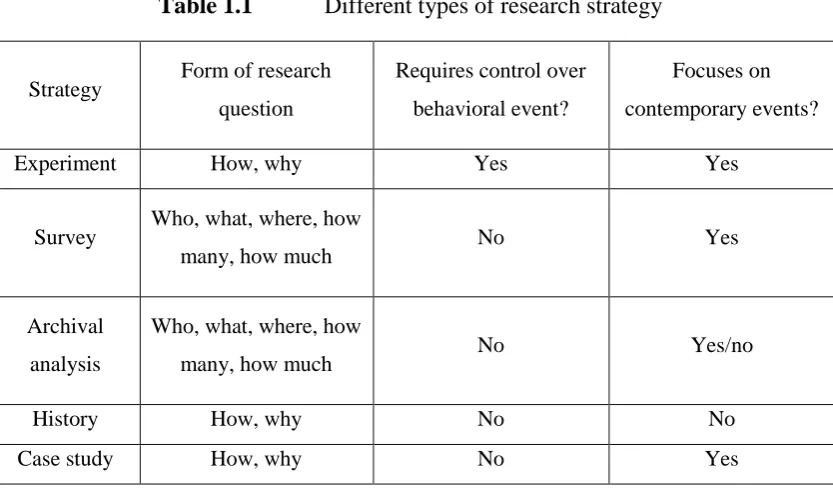
There are multiple paths of doing research, but selecting the proper path is very important because resources for a research is limited and there has to be decided what not to do to reach research objectives. Strategies for performing a research, according to (Yin, 2013) are in categories of experiments, case studies, surveys, archival analysis, and history. Each of the mentioned categories has its own limitations and functions.
For example to answer the research question of “how”, it is not suitable to choose the survey strategy or when total control over the subject is required the experiment seems the best method. Table 1.1briefly explains functions and limitations of each strategy.
Table 1.1 Different types of research strategy
Strategy Form of research question
Requires control over behavioral event?
Focuses on contemporary events?
Experiment How, why Yes Yes
Survey Who, what, where, how
many, how much No Yes
Archival analysis
Who, what, where, how
many, how much No Yes/no
History How, why No No
Case study How, why No Yes
1
question had a focus on the contemporary situation (see the detailed questions) of organization which eliminates the choice of case study.
The second question obviously had to be done in an experimental design because a “relationship” is under question and it had to be investigated under control so that the right effect be investigated.
1.7.2 Research Design
First Question
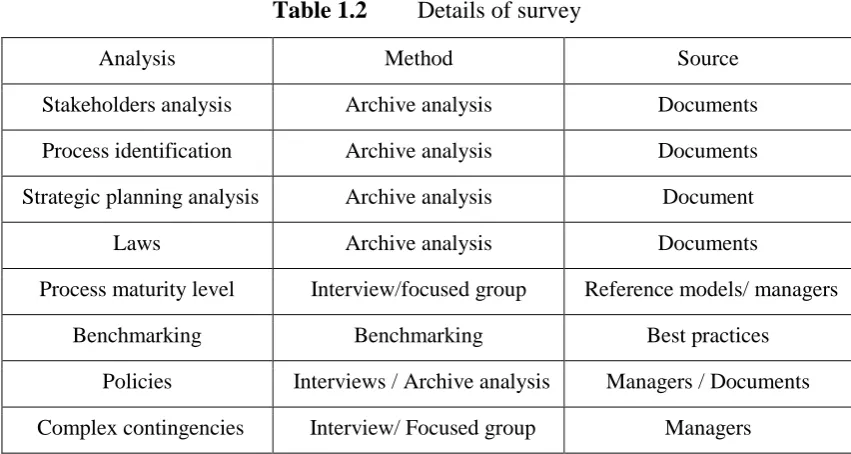
1
Table 1.2 Details of survey
Analysis Method Source
Stakeholders analysis Archive analysis Documents Process identification Archive analysis Documents Strategic planning analysis Archive analysis Document
Laws Archive analysis Documents
Process maturity level Interview/focused group Reference models/ managers
Benchmarking Benchmarking Best practices
Policies Interviews / Archive analysis Managers / Documents Complex contingencies Interview/ Focused group Managers
Second question
Second question was attempted to be answered in an experimental design. Parameters of the design are as follows:
Design Type: time-series design
Field of Study: BIPC and its three selected process (production, maintenance
and strategic planning)
Time Scope: 24 weeks from November 2010 to April 2011
Experiment (dummy) Variable: implementation of the proposed model
Analysis Variables: entropy of selected processes, experiment variable, total
internal entropy, and total external entropy
1
H1. Implementation of the proposed management model causes entropy level of production process to decrease.
H2. Implementation of the proposed management model causes entropy level of maintenance process to decrease.
H3. Implementation of the proposed management model causes entropy level of strategic planning process to decrease.
H4. Implementation of the proposed management model causes total (external) entropy level of the organization to decrease.
H5. Implementation of the proposed management model causes total (internal) entropy level of the organization to decrease.
Sampling Time: a week for production and maintenance / a month for
strategic planning
Analysis Methods: comparison of groups by ANOVA & Causality analysis
by Regression
Analysis software: IBM SPSS v22
1.8 Research Objectives
At design stage of this research two main objectives were predicted:
1
2. Designing a specific method mostly useful for the Iranian organizations so that they can localize international BPR models.
1.9 Significance and Contribution of the Study
As it was mentioned in the introduction part of this chapter, entropy is the tendency of a system toward disorder. So, if we can measure entropy in a managerial system, we will be able to monitor the tendency of a system to disorder status and plan for its decrease. Moreover, if we get to know the concept of entropy and its reasons in an organization, we will be able to design the systems of an organization in a way which tendency to disorder eliminate as much as possible. In other words, in the designing phase of an organization, there will be the possibility to decrease potential entropy with efficient design.
From the basic management theories it is known that management is engaged with planning, execution and control. In terms of resources, the following simple formulation can be applied in most organizations:
Input resources = Resources for day to day activities + Resources for developing activities + Resources for entropy elimination
It means all input resources for an organization (human resource, money, infrastructure and etc.) are allocated in three parts:
1. Day to day activities like production, accounting, purchase, customer relationship and etc. which are categorized as “execution”.
1
3. Elimination of disorder or entropy like controlling informal organizations, existent conflict between departments, lack of doing effective activities, customer`s dissatisfaction, lack of clarification in everyone`s responsibilities, labor`s dissatisfaction and etc. which are in sense “control” mechanisms and functions.
So, if we can decrease entropy in an organization, simply the resources which waste in order to control entropy will be available for development activities because day to day activities should be done in every situation.
As a whole, it can be said that taking the concept of entropy into consideration and apply this concept in real situation of organization management can have an enormous effect in resource management.
As it was mentioned before, entropy control can occur in two ways:
A. In designing phase of an organization, entropy can be decreased by clear and precise definition of activities and processes which cause future conflict in an organization.
B. By making entropy level quantitative so that it can be measured and refined in different departments of an organization by managers.
There is no significant research about controlling entropy in designing phase (first part), so far. Also, in entropy measurement, there is just a limited effort about the concept not in practice.
1
• Designing and defining the mechanism and model for entropy measurement in an organization based on its processes which has not been done before. Entropy measurement and refinement can help managers as a powerful information tool for integrated improvement in different departments.
• Attempting to calculate the entropy of processes and total system in order to help managers to lead their organization easily based on information that will be driven from this important concept.
• Proving the fact that proper process design instead of functional design results in decrease in potential entropy in an organization. So it is possible to develop an improved methodology for moving from functional system towards process system based on controlling the entropy.
Additionally, in this research, it has been attempted to design a total process map for BIPC which can be used by other petrochemical companies everywhere.
1.10 Research Limitations
The researcher in this study encounters some limitations. There are various kinds of research limitations such as limited access to information, data and also methodology limitations. As a whole, the researcher `s limitations are as follows:
• The majority of researches about the role and importance of entropy in organizations are qualitative and there are rarely models which measure entropy. The majority of performed researches in recent years, did not use and test the results in a real situation. In addition, if there is any, those results are not available free of charge.
1
selected organization. So, the researcher had to pilot the model in this research.
• Deploying the introduced framework in an international organization can’t guarantee the accuracy and requirements which is needed for measuring the entropy as well as monitoring and managing all kinds of organizations in all industries.
• Achieving the goals of this research was strictly related to the team working in the selected company as well as its top and middle managers cooperation.
• The studied company is located in the south-west of Iran, 1000 km away from its capital, with an inappropriate weather condition. This fact caused many difficulties for accommodation and travels.
1
1.11 Structure of Thesis
REFERENCES
Ackoff, R. L. (1999). Re-creating the Corporation: A Design of Organizations for the 21st Century. Oxford University Press.
Adesola, S., & Baines, T. (2005). Developing and evaluating a methodology for business process improvement. Business Process Management Journal, 11(1), 37–46. doi:10.1108/14637150510578719
Agarwal, R., & Bajaj, N. (2008). Managing outsourcing process: applying six sigma. Business Process Management Journal, 14(6), 829–837. doi:10.1108/14637150810916008
Argyris, C., & Schön, D. A. (1974). Theory in practice: increasing professional effectiveness. Jossey-Bass Publishers.
Awad, E. M. (1985). Systems Analysis and Design (2nd ed.). McGraw-Hill Professional.
Bailey, K. D. (1990). Social Entropy Theory. SUNY Press.
Barrett, J. L. (1994). PROCESS VISUALIZATION Getting the Vision Right Is Key. Information Systems Management, 11(2), 14–23.
doi:10.1080/10580539408964631
Becker, J., Pfeiffer, D., Falk, T., & Räckers, M. (2010). Semantic Business Process Management. In P. D. J. vom Brocke & P. D. M. Rosemann (Eds.), Handbook on Business Process Management 1 (pp. 187–211). Springer Berlin
Heidelberg. Retrieved from http://link.springer.com/chapter/10.1007/978-3642-00416-2_9
Berk, R. A. (2004). Regression Analysis: A Constructive Critique. SAGE. Bhatt, G. D., & Troutt, M. D. (2005). Examining the relationship between
integration and customer focus: an empirical study. Business Process Management Journal, 11(5), 532–558. doi:10.1108/14637150510619876
Bîrlea, S. (1973). Entropy in industrial cybernetic systems. Kybernetes, 2(2), 85–93. doi:10.1108/eb005326
Blauberg, I. V., Sadovskiĭ, V. N., & I U din, Ė. G. (1977). Systems Theory: Philosophical and Methodological Problems. Moscow: Progress Publishers. Boltzmann, L. (1866). The Second Law of Thermodynamics. Reprinted in
Ludwig Boltzmann: Theoretical Physics and Philosophical Problems, Selected Writings, ed. B. McGuinness, trans. P. Foulkes (1974).
Boulding, K. E. (1956). General Systems Theory—The Skeleton of Science. Management Science, 2(3), 197–208. doi:10.1287/mnsc.2.3.197
Bruss, L. R., & Roos, H. T. (1993). Operations, readiness, and culture: Don’t reengineer without considering them. INFORM-SILVER SPRING, 7(4), 57– 64. Buhl, P. D. H. U., Röglinger, D. M., Stöckl, D. S., & Braunwarth, D. K. S. (2011). Value Orientation in Process Management. Business & Information Systems Engineering, 3(3), 163–172. doi:10.1007/s12599-011-0157-5
Cameron, N. S., & Braiden, P. M. (2004). Using business process re-engineering for the development of production efficiency in companies making engineered to order products. International Journal of Production Economics, 89(3), 261– 273. doi:10.1016/S0925-5273(02)00448-6 Campbell, D. T., Stanley, J. C., & Gage, N. L. (1963). Experimental and
quasiexperimental designs for research (Vol. ix). Boston, MA, US: Houghton, Mifflin and Company.
Chang, J. F. (2005). Business Process Management Systems: Strategy and Implementation. CRC Press.
Cole, R. E. (1994, July 1). Reengineering the Corporation: A Review Essay. Retrieved October 28, 2014, from
https://secure.asq.org/perl/msg.pl?prvurl=/data/subscriptions/qmj_open/1 994/ july/qmjv1i4cole.pdf
Daft, R. L. (2010). Organization Theory and Design. Cengage Learning.
Dalmaris, P., Tsui, E., Hall, B., & Smith, B. (2007). A framework for the improvement of knowledge intensive business processes. Business Process Management
Journal, 13(2), 279–305. doi:10.1108/14637150710740509
Damij, N., Damij, T., Grad, J., & Jelenc, F. (2008). A methodology for business process improvement and IS development. Information and Software
Technology, 50(11), 1127–1141. doi:10.1016/j.infsof.2007.11.004
Davis, C. S. (2002). Statistical Methods for the Analysis of Repeated Measurements. Springer Science & Business Media.
Davis, S. M. (1984). Managing corporate culture. Cambridge, Mass.: Ballinger Pub. Co.
De Bruin, T. (2009). Business process management : theory on progression and maturity (Thesis). Queensland University of Technology. Retrieved from http://eprints.qut.edu.au/46726/
Dekkers, R., Kühnle, H., Amoo Durowoju, O., Kai Chan, H., & Wang, X. (2012). Entropy assessment of supply chain disruption. Journal of Manufacturing Technology Management, 23(8), 998–1014. doi:10.1108/17410381211276844
Doomun, R., & Vunka Jungum, N. (2008). Business process modelling, simulation and reengineering: call centres. Business Process Management Journal, 14(6), 838–848. doi:10.1108/14637150810916017 Durst, S. M., & Binder, M. (2006). Improving efficiency through internal
benchmarking. International Journal of Business Performance Management, 8(4), 290–306.
Flood, R. L. (2010). The Relationship of “Systems Thinking” to Action Research. Systemic Practice and Action Research, 23(4), 269–284. doi:10.1007/s11213010-9169-1
Hamel, G., & Prahalad, C. K. (1990). Corporate imagination and expeditionary marketing. Harvard Business Review, 69(4), 81–92.
Hammer, M. (1996). Beyond reengineering. Retrieved November 11, 2014, from http://cds.cern.ch/record/345114
Harmon, P. (2009). Process maturity models. Retrieved from http://www.bptrends.com/publicationfiles/spotlight_051909.pdf
Haynes, K. E., Phillips, F. Y., & Mohrfeld, J. W. (1980). The entropies: Some roots of ambiguity. Socio-Economic Planning Sciences, 14(3),
137–145.
doi:10.1016/0038-0121(80)90017-8
Helou, M. M., & Caddy, I. N. (2006). Definition problems and a general systems theory perspective in supply chain management. Problems and Perspectives in Management, 4(4), 77–83.
Jeston, J. (2008). High performance management-Process mastery reduces sting of change, complexity. Industrial Engineer, 40(5), 33–7.
Johannsen, F., Leist, S., & Zellner, G. (2010). Implementing Six Sigma for Improving Business Processes at an Automotive Bank. In P. D. J. vom Brocke & P. D. M.
Rosemann (Eds.), Handbook on Business Process Management 1 (pp. 361–
382). Springer Berlin Heidelberg. Retrieved from http://link.springer.com/chapter/10.1007/978-3-642-00416-2_17
Johnson, R. A., Kast, F. E., & Rosenzweig, J. E. (1973). The theory and management of systems. McGraw-Hill.
Kennedy, C. (1994). Re-engineering: The human costs and benefits. Long Range Planning, 27(5), 64–72. doi:10.1016/0024-6301(94)90228-3
Klein, M. M. (1993). IEs fill facilitator role in benchmarking operations to improve performance. Industrial Engineering, 25(9), 40–42.
Kogetsidis, H. (2011). Systems approaches for organisational analysis. International Journal of Organizational Analysis, 19(4), 276–287. doi:10.1108/19348831111173414
Kohlbacher, M., & Gruenwald, S. (2011). Process orientation: conceptualization and measurement. Business Process Management Journal, 17(2), 267– 283. doi:10.1108/14637151111122347
Lederer Antonucci, Y., & Goeke, R. J. (2011). Identification of appropriate responsibilities and positions for business process management success. Business Process Management Journal, 17(1), 127–146. doi:10.1108/14637151111105616
Lowenthal, J. N. (1994). Reengineering the organization: a step-by-step approach to corporate revitalization. Milwaukee, Wis.: ASQC Quality Press.
Martínez-Berumen, H. A., López-Torres, G. C., & Romo-Rojas, L. (2014).
Developing a Method to Evaluate Entropy in Organizational Systems. Procedia Computer Science, 28, 389–397. doi:10.1016/j.procs.2014.03.048 Mettler, T. (2011). Maturity assessment models: a design science research
approach. International Journal of Society Systems Science, 3(1), 81–98. doi:10.1504/IJSSS.2011.038934
Mingers, J., & White, L. (2010). A review of the recent contribution of systems thinking to operational research and management science. European Journal of Operational Research, 207(3), 1147–1161. doi:10.1016/j.ejor.2009.12.019
Mumford, E. (1994). New treatments or old remedies: is business process reengineering really socio-technical design? The Journal of Strategic
Information Systems, 3(4), 313–326. doi:10.1016/0963-8687(94)90036-1
Mumford, E., & Beekman, G. J. (1994). Tools for change and progress: a sociotechnical approach to business process re-engineering. Leiden: CSG.
Muthu, S., Whitman, L., & Cheraghi, S. H. (2006). Business Process Reengineering: A Consolidated Methodology. In Proceedings of the 4 th Annual International Conference on Industrial Engineering Theory, Applications, and Practice, 1999 U.S. Department of the Interior - Enterprise Architecture (pp. 8–13).
Neely, A., & Al Najjar, M. (2006). Management learning not management control: the true role of performance measurement. California Management Review, 48(3), 101–114.
402. doi:10.1108/14637151111136342
Norwich, K. H. (2005). Physical Entropy And The Senses. Acta Biotheoretica, 53(3), 167–180. doi:10.1007/s10441-005-2526-2
Nwabueze, U. (2012). Process improvement: the case of a drugs manufacturing company. Business Process Management Journal, 18(4), 576–584. doi:10.1108/14637151211253738
O’Neill, P., & Sohal, A. S. (1998). Business process reengineering: application and success an Australian study. International Journal of Operations &
Production Management, 18(9/10), 832–864. doi:10.1108/01443579810225487
Paim, R., Mansur Caulliraux, H., & Cardoso, R. (2008). Process management tasks: a conceptual and practical view. Business Process Management Journal, 14(5), 694–723. doi:10.1108/14637150810903066
Pöppelbuß, J., & Röglinger, M. (2011). WHAT MAKES A USEFUL MATURITY MODEL? A FRAMEWORK OF GENERAL DESIGN
PRINCIPLES FOR MATURITY MODELS AND ITS
DEMONSTRATION IN BUSINESS PROCESS MANAGEMENT. ECIS 2011 Proceedings. Retrieved from http://aisel.aisnet.org/ecis2011/28
Porter, M. E. (1985). Competitive advantage: Creating and sustaining superior performance. New York: Free Press.
Riguad-Tellez, N., & Escobar-Toledo, C. (2012). An Approach to Control Organizational Entropy in the context of R and D Organizations. Scholarly Journal of Engineering Research, 1(3), 45–50.
Rise, J. L., & Wiklund, T. (1992). Erricson Business Process Management. Stockholm: Erricson Qualit Institute.
Rosemann, M., & Brocke, J. vom. (2010). The Six Core Elements of Business Process Management. In P. D. J. vom Brocke & P. D. M. Rosemann (Eds.), Handbook on Business Process Management 1 (pp. 107–122). Springer Berlin
Schwaninger, M. (2007). Optimal structures for social systems. Kybernetes: The International Journal of Systems & Cybernetics, 36(3-4), 307–318.
doi:10.1108/03684920710746977
Seethamraju, R. (2012). Business process management: a missing link in business education. Business Process Management Journal, 18(3), 532– 547. doi:10.1108/14637151211232696
Seethamraju, R., & Marjanovic, O. (2009). Role of process knowledge in business process improvement methodology: a case study. Business Process
Management Journal, 15(6), 920–936. doi:10.1108/14637150911003784 Senge, P. (1990). The fifth discipline: The art and practice of the learning
organization. Doubleday.
Shadish, W. R., Cook, T. D., & Campbell, D. T. (2002). Experimental and Quasiexperimental Designs for Generalized Causal Inference. Houghton Mifflin.
Shannon, C. E. (1953). The lattice theory of information. Transactions of the IRE Professional Group on Information Theory, 1(1), 105–107. doi:10.1109/TIT.1953.1188572
Sharma, H. D., Gupta, S. D., & Gupta, A. D. (1994). Entropy, Quality and Wastivity: A Unified View of System Performance. Kybernetes, 23(8), 47– 54. doi:10.1108/03684929410071187
Sidorova, A., & Isik, O. (2010). Business process research: a cross disciplinary review. Business Process Management Journal, 16(4),
566–597. doi:10.1108/14637151011065928
Siha, S. M., & Saad, G. H. (2008). Business process improvement: empirical assessment and extensions. Business Process Management Journal, 14(6), 778–802. doi:10.1108/14637150810915973
Simonsson, M., Johnson, P., & Wijkström, H. (2007). Model-based IT Governance maturity assessments with cobit. x. Retrieved from http://urn.kb.se/resolve?urn=urn:nbn:se:kth:diva-80679
Siriram, R. (2011). CONVERGENCE OF TECHNOLOGIES. The South African Journal of Industrial Engineering, 22(1). doi:10.7166/22-1-30
Small, J., & Walker, D. (2011). Providing structural openness to connect with context. International Journal of Managing Projects in Business, 4(3), 389– 411.
doi:10.1108/17538371111144148
Smith, M., Scott, B., & Korn, J. (2011). From the systemic view to systems science. Kybernetes, 40(1/2), 23–46. doi:10.1108/03684921111117915
Stepanić, J., Sabol, G., & Stjepan Žebec, M. (2005). Describing social systems using social free energy and social entropy. Kybernetes, 34(6), 857–868. doi:10.1108/03684920510595535
Systems theory. (2015, January 6). In Wikipedia, the free encyclopedia. Retrieved from
http://en.wikipedia.org/w/index.php?title=Systems_theory&oldid=63076098 Taschdjian, E. (1974). The entropy of complex dynamic systems. Behavioral
Science, 19(2), 93–99. doi:10.1002/bs.3830190203
Taylor, J. A., & Williams, H. (1994). The “transformation game”: information systems and process innovation in organizations. New Technology, Work and Employment, 9(1), 54–65. doi:10.1111/j.1468-005X.1994.tb00050.x
Tejeida-Padilla, R., Peon-Escalante, I., & Badillo-Piña, I. (2007). Entropy and emergence in organizational systems under a turbulent environment. In Proceedings of the 51st Annual Meeting of the ISSS-2007, Tokyo, Japan
(Vol. 51, No. 2).
Teng, J. T. C., Grover, V., & Fiedler, K. D. (1994). Re-designing business processes using information technology. Long Range Planning, 27(1), 95–106.
doi:10.1016/0024-6301(94)90010-8
Trkman, P. (2010). The critical success factors of business process management. International Journal of Information Management, 30(2), 125–134. doi:10.1016/j.ijinfomgt.2009.07.003
Trochim, W., & Donnelly, J. P. (2006). The Research Methods Knowledge Base. Atomic Dog Publishing.
Warne, R. T. (2011). Beyond Multiple Regression Using Commonality Analysis to Better Understand R 2 Results. Gifted Child Quarterly, 55(4), 313– 318. doi:10.1177/0016986211422217
Watkins, J., Skinner, C., & Pearson, J. (1993). Business process reengineering: Hype, hazard or heaven. Business Change and Re-Engineering, 1(2), 41–46. Weinstein, M., Hayes, A., & Smith, F. (2009). ARMS the acquisition resource
management system. Contract Management, 49(12), 54–61.
Weiss, P. A., & Buechner. (1971). Hierarchically organized systems in theory and practice,. New York: Hafner Pub. Co.
Whitman, M. (2007). Information Security: Policy, Processes, and Practices. In Advances in Management Information Systems (pp. 123–151). Retrieved from http://mesharpe.metapress.com/content/62R0N485W3514287 Wiener, N. (1948). Cybernetics. Scientific American, 179(5), 14–18.
Wynn, M. t., Verbeek, H. m. w., van der Aalst, W. m. p., ter Hofstede, A. h. m., & Edmond, D. (2009). Business process verification – finally a reality! Business Process Management Journal, 15(1), 74–92.
doi:10.1108/14637150910931479
Yin, R. K. (2013). Case Study Research: Design and Methods. SAGE Publications. Yu, B., & Wright, D. T. (1997). Software tools supporting business process
analysis and modelling. Business Process Management Journal, 3(2), 133–150. doi:10.1108/14637159710173096
Zairi, M., & Sinclair, D. (1995). Business process re engineering and process management. Business Process Re-Engineering & Management Journal, 1(1), 8–30. doi:10.1108/14637159510798248
Zellner, G. (2011). A structured evaluation of business process improvement approaches. Business Process Management Journal, 17(2), 203–237. doi:10.1108/14637151111122329