18th International Conference on Structural Mechanics in Reactor Technology (SMiRT 18) Beijing, China, August 7-12, 2005 SMiRT18-D03-5
AGEING MANAGEMENT DATABASE DEVELOPMENT FOR
PWR NPP STEAM GENERATOR
Hongyun Liu, Liangjun Xu, Changhuai Xiong, Xianyuan Wang
Research Institute of Nuclear Power Operation
No.1011, Xiongchu Street, Wuhan, Hubei, China, 430074
Tel: 0086 27 87801701 Fax: 0086 27 87801267
E-mail: [email protected]
ABSTRACT
Steam generator (SG) is one of the key safe important equipments of NPP, which is covered by NPP aging management program. Steam Generator Aging Management Dabatase (SGAMDB) is developed to provide necessary information for SG aging management. RINPO is developing SGAMDB for demostic NPP. This system contains information and data about SG design, manufacture, operation and maintenance. The information include NPP fundamental data, SG design data, SG aging mechanism, SG operation data, SG ISI data, SG maintenance data and SG evaluation interface. The system runs at the intranet of Qinshan-1 NPP with B/S mode. It can provide information inquire and fundamental analysis for NPP SG aging team and SG aging resercheres. In addition, it provides necessary information and data for SG aging analysis and evaluation, such as all pressure test process and flaws of tubes, and collects the analysis results.
Keywords: NPP, Steam generator, Aging management, Database
1. INTRODUCTION
During the past ten years, nuclear power plant components ageing management(AM) was greatly concerned by nuclear industry and R&D organizations. During this process, collecting and keeping comprehensive and exact information about component design, fabrication, construction, operation, inspection and maintenance is highlighted as information platform of ageing management research and practice. Therefore, To built-up a database containing ageing management concerning information is considered to be the first and baseline step of AM. IAEA safety series 50-P-3[1] gives some requirements of data collection and record keeping for the management of nuclear power plant ageing. It proposes that the database should cover elementary data of design and construction, history data of operation and maintenance, cost data and transient data.
Steam generator (SG), safety important components of NPP, is generally selected as one of the key components concerned by AM. SG has two functions. One is to transfer the heat from primary side water to secondary side water to produce specified steam. Another is to act as the second nuclear safety barrier with thousands thin wall tubes which construct half pressure boundary of primary side. Ageing degradation of SG generally occurs at the tubes, which can affect primary boundary integrality and heat transfer capability. Most maintenance techniques for SG are used for tubes. For SG ageing management, to built-up a comprehensive information collection, keeping and exchange system, as mention thereinbefore, is necessary.
2. FUNCTIONS OF SGAMDB
SGAMDB is an elementary information platform for SG aging management. With SGAMDB, NPP staff and researchers can conveniently find their desired documents and data about SG design, manufacture, installation, operation, inspection, and maintenance, can find the related SGAM experience feedback, can make the preliminary trend analysis to the SG operation and inspection data. Functions of SGAMDB includes following five aspects.
1) Generally records process functions, including record input, deletion, revision, renewal and so on. The record input function has considered the connection with existing computer system, and has the capability of loading massive records.
2) Record storage, search and reappearance. SGAMDB provides enough space to keep different record formats used in NPP, such as text file of reports, CAD file of drawings, graphics file of visual inspect results, video file and so on. Additionally, SGAMDB provides several record search ways to find the desired information and reappearance them. User can search their wanted data by time, unit and SG number, NDT techniques, primary or secondary parameters. Of course, key words search is necessary function.
3) Records organization, elementary trend analysis, elementary statistical analysis and calculation. SGAMDB can show the thermalhydraulic data and water chemistry data of a time duration in a curve, which can show the trend clearly. SGAMDB also provides statistics calculation of records, such as extremum and average value.
4) SGAMDB provides interface for SG ageing condition analysis and evaluation. SG aging station analysis and evaluation is very important for SG aging management. SGAMDB has a special interface to output necessary records for SG aging condition analysis and evaluation, and to receive the evaluation result after the analysis process finished.
5) Generally database management and maintenance functions, such as visitor management function, data field renewal and so on.
It should be notices that the main function of SGAMDB is for collection and storage of SGAM related information. Although SG aging station analysis and evaluation gets input data from SGAMDB and restores its result in SGAMDB, the analysis and evaluation process should be performed self-dependently. Generally, analysis and evaluation has to use some specified and large scale calculation software. This process is so complex that it is impossible to have them included into SGAMDB.
3. RECORD COLLECTION AND KEEPING OF SGAMDB
All information related to SGAM during SG lifetime is stored in SGAMDB. The information can be classified into five data types. They are NPP information, SG foundation data, SG operation data, SG inspection data and SG maintenance data. In addition, SGAM knowledge inquiry and experience feedback are included in SGAMDB. In order to be advantageous for SG ageing condition analysis and evaluation, a special interface for aging condition evaluation, which can provide data for aging analysis and evaluation and receive the result, is designed. Fig. 1 shows the data construction of SGAMDB.
SGAMDB is used foe SGAM. Therefore, its data collection scope should agree with the need of SGAM. During the requirement analysis stage, SG aging degradation mechanism should be analyzed, and SGAM methods and techniques, especially ageing condition evaluation should be studied carefully to determine what data should be included into SGAMDB. However, at present, SGAM is under investigation and some degradation mechanism and evaluation techniques aren’t perfect. It is difficult to get a clearly data scope, The better choice for SGAMDB now is to collect SGAM information as more as possible to avoid any valuable data missed.
We have to consider the difference of data collection method during SGAMDB developing period and operation period (development finished). During developing period, data collection was completed mainly by the developing personnel, but during operation period , it is mainly by NPP staff to collect, input and maintain the database. Therefore, data collection method at this stage should adapt to NPP operation mode and work flow. Reasonable connection with NPP existing information system is managed and clear data collection procedure is established to have SGAMDB operate smoothly.
Records stored inside SGAMDB will increase with time. The computer system for SGAMDB must provide enough space to store the information accumulated during SG lifetime. This time may be 30 or 40 or 60 years depending on SG design lifetime. Considering the lifetime extension, the time may be extended. Generally, the fundamental data, such as NPP information and SG design information, are fixed. And the history data, such as SG operation data, inspection data, maintenance data and evaluation data, are dynamic and will accumulated with time. According to our estimation, for a unit with 2 SGs, there will be about 1Gbyte fundamental data volume and about 30Gbyte accumulated history data during its 30 years lifetime.
4. SGAMDB DEVELOPMENT AND OPERATION
The development of network technique provides a preferable environment for SGAMDB. The B/S structure is taken in this system to take full advantage of the computer system of NPP. SGAMDB is installed on the LAN server of NPP. User can visit SGAMDB and browse the data at his client computer with IE. No client software is installed. The visitors are managed by authorization and password. SGAMDB is developed under Visual Studio.net environment. The code is design to be memory-resident program to greatly decrease the next executing time.
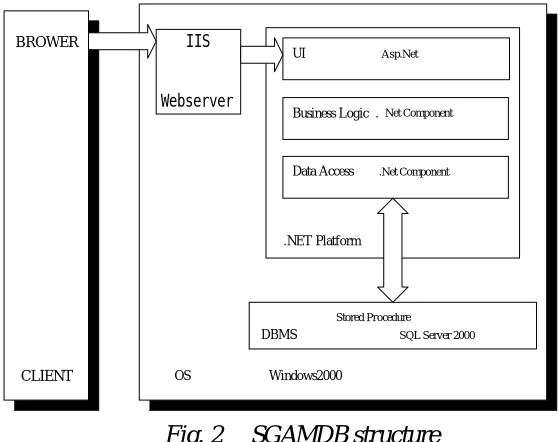
SGAMDB structure has four layers, which is shown as Fig. 2. They are database layer, data access layer, business logic layer and interface layer.
BROWER
CLIENT
IIS
Webserver
UI Asp.Net
Business Logic .Net Component
Data Access .Net Component
.NET Platform
Stored Procedure
DBMS SQL Server 2000
OS Windows2000
Fig. 2 SGAMDB structure
Database Layer: it is a data persistence layer of software system for storing all dataincluding the table definitions of and storing procedures defined to accelerate the access to database.
Data Access Layer: it maps table from relational model to program language’s object model, including data class and entity class. The former calls stored procedures to operate data (include Create, Retrieve, Update and Delete). The latter encapsulates data to access data by means of entity object.
Business Logic Layer: it processes data according to application logic and presents data to user interface, for instance, upload form, create report and create curve of parameters.
User Interface: it directly communicates with user through Web form. User browses Web form, submits form and event to business logic layer, and receives data from business logic layer.
the SGAM related procedure establishment. These procedures, which specify the operation, maintenance and application of SGAMDB at NPP, can ensure the data renewed, the system maintained and upgraded, and errors corrected timely.
Fig.3 interface for SG ageing degradation mechanism
Fig.5 interface for SG sludge distribution infomation
5. CONCLUSIONS
SGAMDB is the important information platform for SGAM research and practice. Participation and support of NPP plays key role during the development. NPP staff helps the developer to understand workflow of NPP and collect information. Moreover, they are operator and user of this system. SGAMDB is the first component AM database for domestic NPP. It will be improved and upgraded in the future with more operation experience.
REFERENCES
1. IAEA,1991,Safety Series No. 50-P-3,”Data Collection and Record Keeping for The Management of Nuclear Power Plant Ageing”.
SGAMDB Structure
SG fundmental data
SG design information
SG m a te r ia l information
SG
m a n u f a c tu r e information
SG install and test information SG ageing related component information
SG ISI data
SG ISI plan
SG weld inspection result
SG tube ET result
SG primary side cladding CCTV result SGAM experience SG maintenance data
SG m a in te n a n c e requirements
SG tube plugging
SG tune pulling out
SG sludge lancing
S G c h e m i c a l cleaning SG operation data Water cheministry Transient parameter Abroad SGAM experience NPP fundmental data
NPP summary Thermalhydraulic
parameters
SG sludge deposit distribution and status
SG secondary side foreign objects
SG upper structure inspection result SGAM evaluation interface Function evaluation Sludge condition evaluation Water chemistry evaluation Structure integrity evaluation Static parameter Design requirements
C o r r e c t i o n criteria
W a t e r treatment other SG inspection result SG FOR Other SG maintenance O p e r a t i o n
data Domestic SGAM experience SGAM evaluation and lifetime estimation Cooling system parameters Important component manufacturer SG ageing knowledge SG summary SG degradation mechanism IAEA reports SGAM information Information of different SGs
C o r r e c t i o n action
C o n d e n s e r leakge
Sludge condition