ISO 9000 CRITICAL QUALITY ELEMENTS FOR A
CONSTRUCTION
Mat Naim Abdullah, Ting Hie King Mohd Hanaffi Ayop Dr. Mohd Noor Sudin
INTRODUCTION
It is learnt from the experiences of the countries that had pioneered the ISO 9000 Quality Management System in the construction industry, one of the main factor that impedes the success of implementing the system at its infancy stage is the quality consultants’ lack of understanding of the industry [1]. Trying to apply the principles of ISO 9000 generic quality elements without understanding the processes and the parties involved in the construction industry will mount problems, far away to achieve a quality corresponding to the client’s requirements and to the budget and time allocated for a particular project. As a generic quality model the ISO 9000 is designed with flexibility in mind [2]. As such each industry or organisation can develop its model according to its particular needs. Indeed, the ideal ISO 9000 system for manufacturing industry would be totally different from that of construction industry.
ISO 9000 Critical Quality Elements for Construction Project Team 27
THE OBJECTIVE
This study aims to identify the critical ISO 9000 quality elements for the construction project team specifically the project manager, the supervisory consultants and the contractors in order to ensure an effective implementation of a QMS in a construction project.
THE METHODOLOGY AND SCOPE OF THE RESEARCH The case study [4] was conducted at the Kuala Lumpur International Airport (KLIA) project. To ensure the quality of this project, the government implemented the QMS with specific reference to the ISO 9000 standards with regard to construction industry. The study was focused to the construction stage and therefore was concentrated on the critical quality elements for the Project Management Consultant (PMC), the Supervisory Consultants and the Contractors.
Multiple sources of evidence particularly archival work on the quality records kept at the PMC’s office and interviews with the key personnel of the Department of Planning and Quality Assurance were extensively explored. Participant-Observation and survey through questionnaire techniques had not been used as the construction of the KLIA was at the final closing thus; most consultants and contractors were no longer based at the site office. The research activities had been divided into 6 tasks:
Task 1 - Literature review on the principle of ISO 9000 and general roles of PMC, the supervisory consultants and the contractors. Interviews the PMC’s personnel to understand the function of the parties involved in the project.
Task 3 - Developing Quality Requirements for each Quality Elements of ISO 9000 for PMC, Consultant and Contractor.
Task 4 - Categorizing and Recording All Reported Non-Conformances under relevant Quality Requirements and Elements of ISO 9000.
Task 5 - Identifying the Critical Quality Requirements for each Quality Elements for PMC, Consultant and Contractor respectively.
Task 6 - Identifying the Critical Quality Elements of ISO 9000 for PMC, Consultant and Contractor respectively
THE KLIA’S CONSTRUCTION PROJECT TEAM
The construction of KLIA comprised of 147 contracts where each contract amounts between RM 1million to RM 162million. More than 110 parties and 25 thousands employees from over 51 nationalities were involved in this project. Cross-culture interactions such as contradicting work culture and language barrier have posed many unavoidable problems at the same time.
ISO 9000 Critical Quality Elements for Construction Project Team 29
Figure 3.1 Organizational levels in KLIA Construction Project THE PROJECT MANAGEMENT CONSULTANT (PMC) KLIAB represented the government of Malaysia in making government-related decision. It was also responsible in the selection of consultants and contractors for this project. As PMC, KLIAB was obliged to ensure that the government’s requirements will be achieved that were to complete the project within the specified time, budget and specification. It acted as a leader to coordinate the work of all consultants and contractors so as to ensure a synchronized effort towards completing this project.
THE SUPERVISORY CONSULTANTS
The role of the supervisory consultants were to inspect the work performed by the contractors and advised the KLIAB regarding the level of conformance demonstrated by these contractors. With their expertise, they were required to provide technical advice and services so that defects as well as non-conformance to the quality requirements can be more effectively identified and eliminated during the course of construction. In cases where non-conformances were identified, supervisory consultants must report immediately to the project manager and inform the contractors. They had to provide technical advice and support; and work together with the contractors to develop corrective and preventive measures to overcome these non-conformances and defects.
KLIAB
Supervisory Consultants
Supervisory consultants were also responsible to check and verify all design specifications and work procedures fulfilled the quality requirements and complied with the regulations imposed by various authorities such as District Council and Fire Departments.
THE CONTRACTORS
The contractors were regarded as the executor of the construction works. They were the party directly responsible to convert the blueprinted quality requirements into reality. Thus, the quality of the product depended very much on the contractors. Under the QMS the contractors had to submit their quality plan, which includes the method statements and procedures of works to be carried out. This plan will be checked by the supervisory consultants to ensure that the procedures complied with the contract’s specification and approved by the PMC prior to construction. During the course of the construction, the contractors had to follow strictly to the procedures stated in the approved quality plan.
ISO 9000 QUALITY ELEMENTS
ISO 9000 Critical Quality Elements for Construction Project Team 31
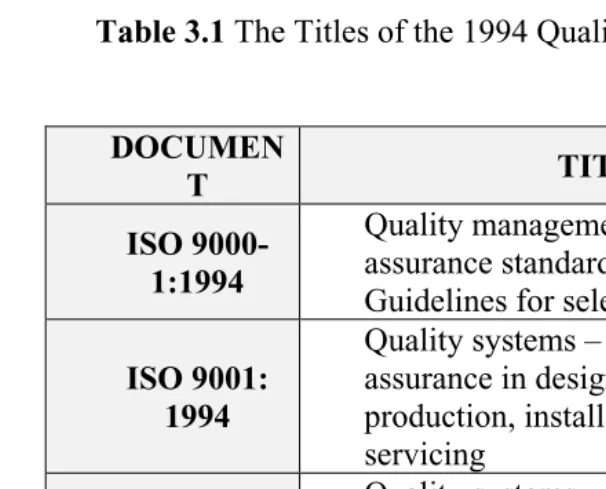
Table 3.1 The Titles of the 1994 Quality System Standards
DOCUMEN
T TITLE
ISO 9000-1:1994
Quality management and quality assurance standards – Part 1: Guidelines for selection and use
ISO 9001: 1994
Quality systems – Model for quality assurance in design, development, production, installation and servicing
ISO 9002: 1994
Quality systems – Model for quality assurance in production, installation and servicing
ISO 9003: 1994
Quality systems – Model for quality assurance in final inspection and test
ISO 9004-1: 1994
Quality management and quality system elements – Part 1:
Guidelines
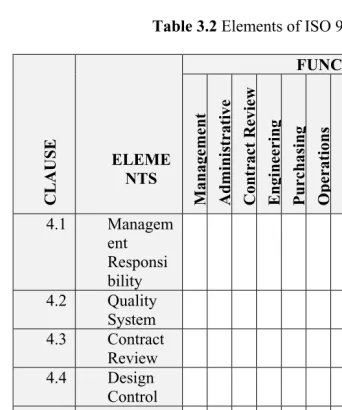
Table 3.2 Elements of ISO 9001
CLAUSE
ELEME NTS
FUNCTIONS
Mana
g
ement
Administra
tive
Contract Review En
g
ineerin
g
Purchasin
g
O
p
erations
Manufactu
rin
g
Q
ualit
y
Industrial Human Facilities Customer
4.1 Managem
ent Responsi bility 4.2 Quality
System 4.3 Contract
Review 4.4 Design
Control
4.5 Documen
t and Data Control 4.6 Purchasin
g 4.7 Control
of
ISO 9000 Critical Quality Elements for Construction Project Team 33
4.8 Product Identifica tion and Trace ability 4.9 Process
Control 4.1
0
Inspectio n and Testing 4.1
1
Control of
Inspectio n,
Measurin g and Test Equipme nt
4.1 2
Inspectio n and Test Status 4.1
3
Control of Non-conformi ng Product 4.1
4
4.1 5
Handling, Storage, Packagin g,
Preservati on and Delivery 4.1
6
Control of Quality Records 4.1
7
Internal Quality Audits 4.1
8
Training
4.1 9
Servicing
4.2 0
Statistical Techniqu es
Legend: (Major Role), (Support Role), (ReviewingRole)
QUALITY AUDIT RESULTS FOR KLIA’S CONSTRUCTION PROJECT TEAM
According to ISO 8402, quality audit is defined as; “A systematic and independent examination to determine whether quality activities and related results comply with the planned arrangements and whether these arrangements are implemented effectively and are suitable to achieve objectives” [3].
ISO 9000 Critical Quality Elements for Construction Project Team 35
demonstrate that the organization has achieved compliance to its documented quality system but also serves as a monitoring device to ensure continuous compliance and improvement.
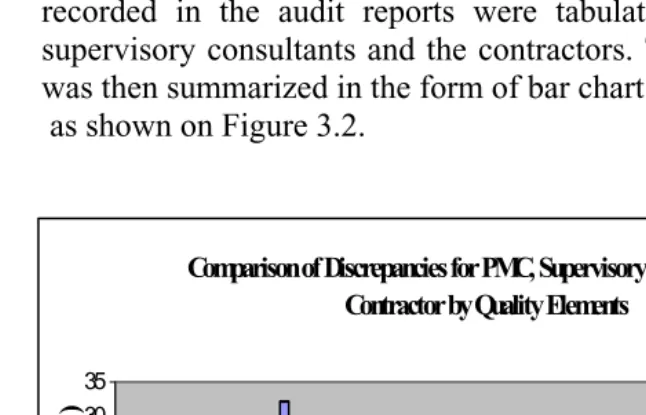
Quality audit was conducted frequently at KLIA construction project to ensure that the QMS was being implemented effectively. The results of the audit was analysed to identify discrepancies in the implementation of the system. All discrepancies such as no proper documentation and contravene the stated procedures that were recorded in the audit reports were tabulated accordingly – PMC, supervisory consultants and the contractors. The result for each party was then summarized in the form of bar chart
as shown on Figure 3.2.
Figure 3.2 Comparison of discrepancies for PMC, supervisory consultant and contractor by quality elements
Comparison of Discrepancies for PMC, Supervisory Consultant and Contractor by Quality Elements
0 5 10 15 20 25 30 35
4.1 4.2 4.3 4.4 4.5 4.6 4.7 4.8 4.9 4.10 4.11 4.12 4.13 4.14 4.15 4.16 4.17 4.18 4.19 4.20
Clauses in ISO 9000
Percenta
g
e
(%
)
ISO 9000 CRITICAL QUALITY ELEMENTS FOR KLIA’S CONSTRUCTION PROJECT TEAM
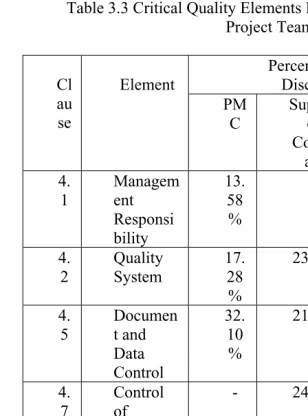
The data analysis presented above had enabled the identification of the critical quality elements for PMC, Supervisory Consultants and Contractors by using the Pareto concept (those 20% of elements that contribute 80% of the total discrepancies). The critical quality elements for each party are summarised as shown on Table 3.3.
According to the array of the most significant to the less significant, the critical quality elements of ISO 9000 for PMC are document and data control, control of quality records, quality system and management responsibility and for the supervisory consultants are control of customer supplied product, quality system, document and data control and control of quality records. Whereas, for the contractors the array is started with the element of quality system and then followed with inspection and testing, control of quality records and process control.
ISO 9000 Critical Quality Elements for Construction Project Team 37
Table 3.3 Critical Quality Elements For KLIA’s Construction Project Team
Cl au se
Element
Percentage (%) of Discrepancies PM C Supervis ory Consult ants Contra ctors 4. 1 Managem ent Responsi bility 13. 58 % - - 4. 2 Quality System 17. 28 % 23.59% 23.93 % 4. 5 Documen t and Data Control 32. 10 % 21.54% - 4. 7 Control of Customer Supplied Product
- 24.10% -
4. 9
Process Control
- - 15.34 % 4. 10 Inspectio n and Testing
CONCLUSION
Construction project involves various parties, which creates a ‘quality chain’ along the construction process. Identification of responsibility as such allows members of the parties to effectively focus all efforts towards the right direction of realising the client’s requirement. This also provides accountability, which is utmost critical in achieving continuous quality improvement
The study had identified four major critical ISO 9000 quality elements for each key party involves at the construction stage. Each party have one common critical element to be concentrated upon that is the quality system. The critical quality elements for the PMC are document and data control, control of quality records, quality system and management responsibility. The supervisory consultants have to give emphasis on the quality elements of control of customer-supplied product, control of quality records, quality system and document and data control. The contractors have to concentrate more on the quality elements of quality system, process control, inspection and testing and control of quality records. These findings hopefully will improve the capabilities of the construction project team in implementing the QMS effectively by giving greater attention to the identified critical quality elements. In addition they will also assist the quality consultants to design the correct and proper training schemes in quality programmes for the construction project team.
REFERENCES
Giles, R., ‘ISO 9000 Perspective For The Construction Industry In The UK’,Training for Quality, Vol. 5 No. 4, 1997, pp 178-181.
ISO 9000 Critical Quality Elements for Construction Project Team 39
MS ISO 8402: 1994, Quality Management and Quality Assurance - Vocabulary, Standard and Industrial Research Institute of Malaysia (SIRIM).
Yin, R.K., Case Study Research: Design and Methods, SAGE Publications, Inc., USA, 1984.
Freeman, Don L., The Quality Auditor’s Handbook, Prentice Hall, USA, 1997.
Besterfield, D.H., Quality Control, Prentice Hall, USA, 1998
Green, G.D., ISO 9000 Quality System Auditing, Gower Publishing, England, 1997.
Levy, S.M., Project Management in Construction, McGraw-Hill, USA, 1987.