Procedia - Social and Behavioral Sciences 114 ( 2014 ) 257 – 261
1877-0428 © 2013 The Authors. Published by Elsevier Ltd. Open access underCC BY-NC-ND license. Selection and peer-review under responsibility of Academic World Education and Research Center. doi: 10.1016/j.sbspro.2013.12.694
ScienceDirect
4th World Conference on Psychology, Counseling and Guidance WCPCG-2013
The Barriers of Enhancing Creativity Developed by Parents in
Developing Countries
Niloufar Tahghighi Ahmadi
a*, Sharif Mustaffa
b, Atefeh Ahmadi
ca,b,cFaculty of Education, University Technology Malaysia, Skudai, 81310 Johor, Malaysia
Abstract
Most parents believe that they can only promote their children’s creativity level by using enhancing creativity factors; whereas, the barriers of enhancing creativity can influence the process of improving creativity. The main aim of this study is to investigate the impact of barriers of enhancing creativity developed by parents upon children’s creativity level. This research was carried out based on the questionnaire survey; Raven intelligent test and Torrance creativity test for children amongst Malaysian parents as a developing country. The results show that some of the parents had poor performance in some items due to lack of awareness of barriers factors.
© 2013 The Authors. Published by Elsevier Ltd.
Selection and peer-review under responsibility of Prof. Dr. Tülay Bozkurt, Istanbul Kultur University, Turkey
Keywords: Children, Creativity, Barriers;
1.Introduction
Creativity is the ability to develop ideas using an original, novel or unconventional approach, or the ability to design something new or even to solve existing problems in new ways. Although creativity is a term understood by everyone, in their own way, which has made it very difficult for science to conduct measurements and to obtain a unified (Runcho & Albert, 2010).. Spanning a variety of disciplines, over 100 definitions of creativity already exist in the literature. (Hocevar & Bachelor, 1989; Park & Byrnes, 1984; Parkhurst, 1999). Yet, there is no single, all-encompassing definition that satisfies all.
Creativity can be regarded as a natural part of every person’s mental process. Creativeness may vary from one person to another, but a totally uncreative person does not exist (Downing, 1997). Accordingly, teachers and educators should acknowledge that enhancing creativity rests on the proposition that characteristics necessary for creativity can be helped to unfold in an appropriately stimulating learning environment. We are all born to be creative, imaginative, resourceful, artistic and innovative. Some studies investigating the relationship between creativity and intelligence demonstrate that creativity has a nonlinear impact on intelligence (i.e., the threshold theory), which means creativity can improve cognitive performance among individuals with an intelligence quotient (IQ) lower than 120, but the relationship between creativity and individuals with higher IQ is not significant
* Corresponding Author: Niloufar Tahghighi Ahmadi. Tel.: +60-17-741-3919
E-mail address: [email protected]
© 2013 The Authors. Published by Elsevier Ltd. Open access underCC BY-NC-ND license.
(Simonton, 1994). However, few studies supported the threshold theory (Kim, 2005; Sawyer, 2012) which suggests a minimum amount of traditional intelligence is needed for creativity (Runco, 2007). Moreover, as suggested by Sawyer (2012), lack of correlation between creativity and IQ higher than 120 could be linked to the small variation of IQ score above 120, and consequent responsibility for the null finding. In children, most creativity comes to light through their main activity – play. It is believed that children as young as four -four and a half years old, master a variety of learning skills through questioning, inquiring, searching, manipulating, experimenting, and playing (Torrance, 1969). During this period, they seem to display creative behavior. This creativeness among children re-merges gradually between grades one to three (Torrance, 1964). In general, the broad and complex multidimensional concepts of creativity can be satisfied by the Torrance Tests of Creative Thinking (TTCT: Torrance, 1974, 1990a, 1990b) and the Wallach–Kogan Creativity Tests (WKCT: Wallach & Kogan, 1965). What constitutes creativity is a hotly debated subject; however, most theorists agree that the creative process involves a number of components, most commonly:
i. Imagination
ii. Originality (the ability to come up with new and original ideas and products)
iii. Productivity (the ability to generate a variety of different ideas through divergent thinking) iv. Problem solving (application of knowledge and imagination to a given situation)
v. The ability to produce an outcome of value and worth
Barriers of creativity can prevent humans from unlocking the creative potential that they are capable of it. Barriers awareness should prepare individuals to recognize and then to avoid the barriers. Since parents are spending more time during the day with their children, they must assume the responsibility of educating their children in multidimensional. However, parents believe that training and nurturing creativity among children is a specialized job and should be handled by professionals. When parents fail to pay attention to enhancing their children’s creativity level, they are creating creativity barriers, which in turn can affect the process of improving creativity. Children’s creativity levels relation to promoting factors is demonstrated whereas; the barriers of enhancing creativity can affect the process of improving creativity.
With the recent rapid increase in information technologies; TV, CD, DVD and computer systems now play an important role in our lives (Asutay,2007). Researches show that children and young people nowadays spend more than 4-5 hours a day in front of media such as television, video, computer, internet, movie, radio, tape and video games (Taras, 1990; Bernard- Bonnin, 1991; Woodard and Gridina, 2000). While aids such as computer , TV and the internet provide children and teenagers a suitable and limitless learning environment (Specht, 2002), using the aids for the wrong purposes can cause harm. Hence, most researchers mention that barriers of enhancing activity factors are related to inappropriate use of new technology by children.
Shaughnessy (1998) reported that in the view of Torrance the greatest obstacles to creativity are; lack of opportunity to use ideas or what has been learned, lack of interest in the problem, the problem is impossible, lack of challenge to one’s best abilities, lack of chance to do things in one’s own way, and lack of purposefulness. Andra (2012) introduces some creativity barriers that are related to parental development. They are; unforgiveness, Insecurity, Jealousy, Lies, disbelief, Bitterness, Criticism and Rebellion.
This study was conducted to identify barriers developed by parents that prevent the enhancement of creativity factors. The main aim of this research is to investigate the impact of barriers that prevent the enhancement of creativity upon children’s creativity level. This research was carried out based on questionnaire survey, Raven intelligent test and Torrance creativity test (estimates of reliability ranged between .89 and .94). The respondents of the survey were children from a developing country, Malaysia.
2.Research Methodology
study. Systematic random sampling is a method of sampling in which individuals are selected from a list and all members of the population have an independent chance of being selected for the sample (Gay, et al., 2006).
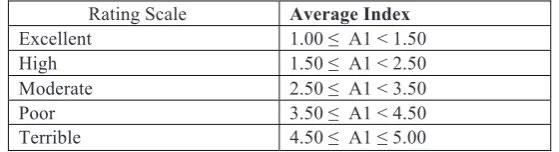
The survey respondents were chosen directly from postgraduate married students who have children studying in Universiti Teknologi Malaysia (UTM) campus. To test the reliability of the questionnaires a pilot study was conducted involving 32 people. The Cronbach's alpha coefficient for each group of questions related to barriers of creativity was individually measured. The Cronbach’s alpha coefficient score for this study for all questions on creativity barriers was 0.74 which is above the 0.7 reliable acceptable score. Based on Krejcie and Morgan sample size table (1970); 63 out of 75 Malaysian postgraduate students with children having the same IQ were selected for the study. All questions were structured to enable a logical quantitative analysis of the result. The data were analyzed by using Statistical Packages for Social Sciences (SPSS). Data collected from the respondents was analysed using two steps. Data was first presented in descriptive form where, responses to each item were presented and described in percentage and means index. All results, with an Average Index (AI) scores greater than 3.5, were accepted at the level of implementation barriers of enhancing creativity factors. The following formula was applied in Average Index methods. By referring to Majid and McCaffer (1997), the rating scales used for the questionnaires in this study are as follows:
Table 1. Classification of the Rating Scores in AI Method (Abd.Majid and McCaffer, 1997)
Rating Scale Average Index
Excellent 1.00 ≤ A1 < 1.50
High 1.50 ≤ A1 < 2.50
Moderate 2.50 ≤ A1 < 3.50
Poor 3.50 ≤ A1 < 4.50
Terrible 4.50 ≤ A1 ≤ 5.00
2.1 Research steps
Step1: The intelligence quotient of children (5-7 years old) was assessed by the Raven IQ test. Following Raven’s interpretation of IQ test, the IQ score for the 63 selected children was normal (100-110).
Step2: 63 questionnaires which included 9 questions about barriers of enhancing creativity factors were distributed amongst parents who have children with the same level of IQ.
Step3: Children’s creativity was assessed by the Torrance children’s creativity test.
Step4: Finally, the questionnaire result was compared with the findings from children’s creativity test.
3.Result and Discussion
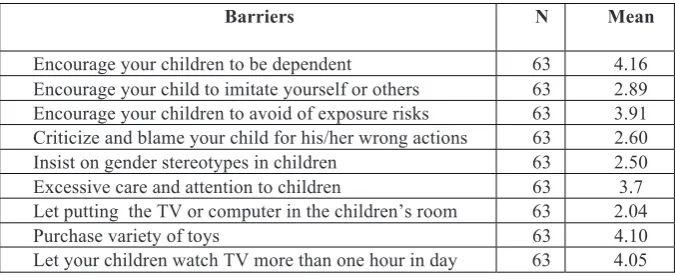
The results were processed by applying Statistical Package for Social Science (SPSS) version 19 to facilitate the understanding of data and information gained from the questionnaires. Nine barriers presented in Table 2 were developed by parents to prevent their children from being actively creative. Parents were initially asked to rate their degree of reliance on the barriers that prevent the enhancement of creativity factors which they impose upon their children. Questions were asked in such a way as to inhibit parents from taking a negative view of questions which deal with barriers that they are erecting.
Table 2. Barrier of enhancing creativity factor
Barriers N Mean
Encourage your children to be dependent 63 4.16
Encourage your child to imitate yourself or others 63 2.89 Encourage your children to avoid of exposure risks 63 3.91 Criticize and blame your child for his/her wrong actions 63 2.60
Insist on gender stereotypes in children 63 2.50
Excessive care and attention to children 63 3.7
Let putting the TV or computer in the children’s room 63 2.04
Purchase variety of toys 63 4.10
Let your children watch TV more than one hour in day 63 4.05
The above table shows, creativity barriers developed by parents such as purchasing a variety of toys, excessive care to children, encouraging them to be dependent and being dependent on their parents’ scores higher than moderate. On the other hand, the table shows that parents are less likely to let children have a computer or TV in their own room, allow them to watch TV more than one hour and encourage them to imitate their parents and insist on gender stereotypes. Dependency, avoidance of exposure risks and imitation make children rely to much on other decisions and thinking (Soliman, 2005). Blaming, excessive care and attention and insisting on gender stereotypes are obstacles of free imagination. Ecxessive computer and TV use encourage children to imitate what they are attracted to and is related to the hours of watching (Runco, 1999). Playing with different toys does not let children create new ways of playing and building.
Table 3. Comparing the barriers of enhancing creativity factors developed by parents and the level of children’s creativity
Group N
Barrier of enhancing factor for Mean less than 3.5
Barrier of enhancing factor for Mean more
than 3.5
Creativity level of children
Group1 21 √ High
Group2 42 √ Low
Table 3 shows that high performing parents, who avoid implementing barriers have children with high levels of creativity while, poor performing parents who implement barriers have children with low levels of creativity. While cognizant that environmental, genetic and familial factors affect children’s creativity level, the results show that parents do have their own views and role in determining their children’s creativity level. As shown, most parents are in group two, those who implement creativity barriers. They unknowingly prohibit children from being active in enhancing action and movement creativity level. Some restrictions and freedoms have negative effects on the ability of the mind to choose innovative behaviours and thoughts.
4. Conclusion
study, on understanding the relationship between the level of creativity of children and the parents’ treatment toward them yielded a low level of creativity among children whose parents develop barriers of creativity. It shows that the level of creativity among children with the same IQ correlates with familial and environmental factors. This study has proven that a nation should not focus only on preparing children mentally. Instead, it should also help children develop their creativity, which is a crucial component in a child’s life. This research has demonstrated that children whose parents erect creativity barriers have a lower level of creativity compared to children whose parents behave otherwise. It can be concluded that in order to increase children’s creativity, we should not only pay attention to elements that promote creativity, we must also take into consideration creativity enhancing barriers that reduce creativity enhancement among children. The results show that the barriers of enhancing creativity can have negative effects in the process of improving creativity.
Acknowledgements
The authors would like to thank the Ministry of Higher Education (MOHE) and Research Management Center (RMC), University Technology Malaysia (UTM) for financial support of this research under Research University Grant (RUG) Vot: 07 j93
References
Abd.Majid, M.Z. and McCaffer, R., 1997, Assessment of work performance of maintenance contractors in Saudi Arabia, Journal of Management in Engineering, ASCE, 13, 91.
Asutay,2007,Asutay, Hikmet. (2007). “İnternet Ile Yeni Medyalarda Çocuk ve Gençlik Yazını”, Trakya Üniversitesi Sosyal Bilimler Dergisi, Cilt 9, Sayı 2.
Downing 1997, Statistics the Easy Way, ISBN-13: 9780812093926.
Gay, G., et al. (2006). Perceptions of information and communication technology among undergraduate management students in Barbados.
International Journal of Education andDevelopment using Information and Communication Technology (IJEDICT), 2, 6-17
Hocevar, D., & Bachelor, P. (1989). A taxonomy and critique of measurements used in the study of creativity. In J. A. Glover, R. R. Ronning, & C. R. Reynolds (Eds.), Handbook of creativity (pp. 53–76). New York: Plenum.
Kim, K. H. (2005). Can only intelligent people be creative? The Journal of Secondary Gifted Education, XVI, 57–66. Runco, M. A., Steven, R.P., (1999). Encyclopedia of Creativity. Academic Press, 1, 657.
Runco, M. (2007). Creativity: Theories and Themes. Burlington, MA: Elsevier Academic Press.
Runcho, M. A., & Albert, R. S. (2010). Creativity research. In J. C. Kaufman & R. J. Sternberg (Eds.), The Cambridge handbook of creativity. NY: Cambridge University Press.
Sawyer, R. K. (2012). Explaining creativity: The science of human innovation. New York: Oxford University Press.
Shaughnessy, Michael F. (1998). An interview with E. Paul Torrance: About Creativity. Educational psychology Review, 10 (4), pp. 441- 452. Soliman, S.A.H. (2005). Systems and Creative Thinking. Pathways to Higher Education. Cairo University,5, 69-92.Simonton, D. K. (1994).
Greatness. New York: Guilford. Soliman, S.A.H. (2005). Systems and Creative Thinking. Pathways to Higher Education. Cairo University,5, 69-92.Simonton, D. K. (1994). Greatness. New York: Guilford.
Specht, J., Wood, E. ve Willoughby T. (2002). What Early Childhood Educators Need to Know About Computers in Order toEnhance the learning Environment. http://www.cjlt.ca/content/vol28.1/specht_etal.html.
Taras HL, Sallis JF, ve Nader PR (1990).Childrens Television-Viewing Habits And The FamilyEnvironment. AJDC 144: 357-359.
Torrance, E.P. (1964). The Minnesota studies of creative thinking: 1959-1962. In C.W. Taylor (Ed.), Widening horizons in creativity (pp. 125-144). New York: JohnWiley & Sons.
Torrance, E.P. (1969). What is honored: Comparative studies of creative achievement and motivation. Journal of Creative Behavior, 3(3), 149-154.
Torrance, E. P. (1990a). Torrance tests of creative thinking, norms-Technical manual (figural). Bensenville, IL: Scholastic Testing Service. Torrance, E. P. (1990b). Torrance tests of creative thinking, norms-Technical manual (verbal). Bensenville, IL: Scholastic Testing Service. Wallach, M. A., & Kogan, N. (1965). Modes of thinking in young children: A study of the creativity intelligence distinction. New York: Holt,
Rinehart &Winston.