Published by Canadian Center of Science and Education
An Analysis on the Relationship between Lecturers’ Competencies
and Students’ Satisfaction
Choi Sang Long1, Zaiton Ibrahim2 & Tan Owee Kowang1
1 Faculty of Management, Universiti Teknologi Malaysia, Johor Bahru, Malaysia
2 KFCH International College, Johor Bahru, Malaysia
Correspondence: Choi Sang Long, Faculty of Management, Universiti Teknologi Malaysia, 81310 Johor Bahru, Johor, Malaysia. E-mail: cslong_1@ yahoo.com
Received: October 11, 2013 Accepted: November 26, 2013 Online Published: December 16, 2013
doi:10.5539/ies.v7n1p37 URL: http://dx.doi.org/10.5539/ies.v7n1p37
Abstract
This study aims at determining the impact of lecturers’ competencies on students’ satisfaction in a private college in Malaysia. Attaining student satisfaction is one of the most critical objectives in all institutions of higher learning. Institution that fails to do so will definitely effect their reputation and students’ intake in future. Dissatisfied students may also affect their academic performance. This study employed quantitative method in examining the hypothesis. Survey method is used for data collection. Fourteen competencies are selected to be measured for this study and total of 260 students are chosen as sample in this case study. Competencies such as knowledge on subject, clarity of presentation, interaction with students, teaching creativity, clarifying learning outcome, class activity and lecture notes are significantly relates to student satisfaction positively. The findings also show that lecturer’s knowledge of subject contributes most to students’ satisfaction.
Keywords: lecturers’ competencies, students’ satisfaction, knowledge, private college, relationship
1. Introduction
Teaching and learning are two dimensions of the academic world and both depend on lecturers capabilities therefore, an effective lecturer has been conceptualised as one who produces desired outcomes in the course of his duty as a lecturer. Therefore, upon the observed deterioration in the academic accomplishments, attitude and values of students, one curiously wonders if the high failure rates and the poor quality of the students is not a reflection of the teaching quality or lack of lecturer’s competencies. In other words the incompetence of lecturers in classroom interaction with the students could be responsible for the observed poor performance of students in the classroom (Cohen, 1981; Theall & Franklin, 2001).
A competency comprises of one or more skills whose mastery would affect the attainment of the competency. A competency has its relation with all the three fields under which performance can be assessed. These fields are knowledge, skill and attitude. Because the competencies are observable, they are also measurable. It is possible to assess a competency from the performance of a lecturer. It is not necessary that all competencies of a lecturer have the same extent of knowledge, skill and attitude. There may be some competencies involving more of knowledge than skill and attitude, whereas, same competencies may be skill or performance oriented (Doyle, 2008).
Richards (2006) highlighted in his research that any definition of lecturer competence depends on teaching in a particular setting, the culture and values held in the community. It also depends on the innumerable lecturer and student characteristics and the classroom context. Through the above definitions we conclude that lecturer primary aim is to make students learn effectively and efficiently. In doing so, a lecturer has to do several activities such as plan classroom activity properly, provide effective instruction and evaluate the learning using appropriate methods and techniques. The effectiveness or ineffectiveness of teaching is closely linked to lecturer competencies. Competent lecturer would also create classroom conditions and climate, which are conducive for student learning.
performance and satisfaction. Furthermore, there is substantial research connecting student satisfaction to effective teaching methods (Theall & Franklin, 2001). A meta-analysis of 41 research studies provides the strongest evidence for the validity of student ratings since these studies examined the relationship between student ratings and student learning. Doyle (2008) mentioned that, “The use of students’ ratings for evaluating lecturer effectiveness is the single most researched issue in all of higher education”.
There is ample debate within the education community around the world on how teaching effectiveness may be defined and measured. Braskamp and Ory (1994) include teaching and learning in their definition, defining effective teaching as the “creation of situations in which appropriate learning occurs; shaping those situations is what successful lecturers have learned to do effectively”. There are many researchers who focused on whether or not students are legitimate judges of teaching effectiveness. Theall (2009) mentioned that the students can answer questions about the lecturers teaching quality, the value of readings and assignments, and the clarity of the instructor's explanations. Thus, students are certainly qualified to express their satisfaction or dissatisfaction through their experience. They have a right to share their opinions in any case and no one else can report the extent to which the experience was useful, productive, informative, satisfying, or worthwhile.
An expectation that cannot be fulfilled on the institutions is the key factors for students’ withdrawal (Alridge & Rowley, 2001). According to the study by Kanji, Malek, and Wallace (1999) do give some insights on the real situation of the Higher Education Institutions in Malaysia. Most institutions do give a great deal of importance to meeting students expectations which is similar to business organization, but they still lack customer awareness among the staff, and it has become a common drawback for many institutions. This brings us to an understanding that students will have more opportunity to support their continued enrolment into higher educational institutions and on how well the educational programs and services met students’ expectations.
2. Literature Review
According to Gordon (2001), lecturer efficacy is sometimes considered to be an indicator or prediction of teaching effectiveness and research shows that efficacious lecturers are capable of bringing about change in students behavior, motivation, and learning outcome.
A growing body of research shows that student achievement is more heavily influenced by lecturer quality than by student’s race, class, prior academic record, or school a student attends. The benefits associated with being taught by good lecturers are cumulative. Research indicates that the achievement gap widens each year between students with most effective lecturers and those with least effective lecturers.
This suggests that the most significant gains in student achievement will likely be realized when students receive instruction from lecturers with good teaching competencies.
Matzler and Woessmann (2010) study the relationship between lecturer competencies and students outcome. They discover that the teaching quality is directly related to the students’ achievement and it is very important for lecturers to develop strong teaching competencies in order to deliver quality teaching. One of the lecturer competencies they specifically mentioned in their study was lectures subject knowledge because without having subject knowledge, the lecturer is unable to comprehend the students with relevant knowledge and skills required for that particular subject. Therefore, the subject knowledge is essentially important for lecturers so that students could meet the desired learning outcome and are satisfied with their learning.
2.1 Relationship between Lecturer’s Competencies and Student’s Satisfaction
educational services offered by Pakistani universities.
In terms of specific variables of lecturer’s competencies, interaction often appears as a defining characteristic of quality learning experiences. Also, in the education literature, researchers' belief in the importance of student-lecturer interaction is so widespread that it is assumed to be a basic need for learning to occur (Picciano, 2002). The overall effectiveness and success of education depends upon the interaction which is an essential element to a student learning (Fresen, 2007; Northrup, 2001). Young and Norgard (2006) also confirmed the importance of these three types of interactions for student’s satisfaction; timely and quality interaction among students and between student and their lecturer, and finally between students and their course content. For this purpose, lecturers must ensure required level of interactions and discussions with their students (Shin et al., 2003). Therefore, lecturer must understand the increased diversity of learners, and then accordingly determine test formats, measurement practices, and assessment strategies (Banerjee & Brinckerhoff, 2002). Volery et al. (2000) also suggested that in order to boost student’s interactions, the lecturer may give a participation mark. Furthermore, lecturers should be able to understand the diverse nature of students, involve them in online discussions and encourage student to student interactions.
Lecturers must perform a variety of tasks in the process of teaching, e.g., provide a structure of the course contents, give feedback of accomplishments, stimulate students’ motivation to process and reflect on the content, and assist them to engage in learning activities (Brophy, 2001). Interaction between student and lecturer supports knowledge construction, motivation, and the establishment of a social relationship. The exchange of information regarding educational content as well as socio-emotional information is important for learning (Johnson, Hornik, & Salas, 2008; Paechter & Schweizer, 2006; Richardson & Swan, 2003).
Interaction with peer students also is considered important in improving student’s performance. This aspect consists of communication processes, where students exchange information of the course contents and socio-emotional information. Students benefit in the following ways: working in small groups to construct understanding, socio-emotional support, and learning within a cohesive and positive environment (Brophy, 2001; Jucks, Paechter, & Tatar, 2003). Mutual support and the feeling of group cohesion are related to students’ engagement in team work, motivation to participate in a learning environment, and course satisfaction (Concannon, Flynn, & Campbell, 2005).
Swan (2001) reported three factors such as interaction with lecturers and active discussion among course participants and clarity of course design, which significantly influenced students' satisfaction and perceived learning. Similarly, Shea, Pickett, and Pelz (2003) argued that following issues are highly correlated with students’ satisfaction level: lecture notes, lecturers’ direct interaction with students, and lecturers discourse facilitation. While Swan et al. (2000) argued that students preferred consistent course structure so that navigation does not change from one course to another, Yang and Cornelius (2004) found that students became frustrated when their courses were poorly designed, and when instructors did not participate in discussions or responded to questions within a very limited time (Zeng & Perris, 2004). This frustration may translate into a poor learning outcome and performance for students. This supports the need for experienced professional lecturers to increase the student’s satisfaction level (Shin et al., 2003).
Northrup (2002) indicated that students are expected to be more satisfied if the course materials are relevant and useful, and involve real life examples, facts, and cases. Along with this, course design must have rich communication potential, as the level of communication has a clear impact upon students' learning, satisfaction, and retention in online courses. Apart from this, learning outcomes may also contribute to student’s performance. This may refer to cognitive and emotional variables. On the side of cognitive variables, learning achievements are considered most important. They can be described as different facets of competences such as theoretical and methodical knowledge as well as skills required for problem solving, personal/social competences (e.g., in self-regulated or collaborative learning), and/or media competence (Paechter, Maier, & Macher, in press; Weinert, 2001). On the side of emotional variables, satisfaction with a course is an important outcome that influences the decision to continue or drop-out of a course (Chiu, Hsu, Sun, Lin, & Sun, 2005; Levy, 2007).
In short, a good lecturer refers how believable a receiver considers a source (Richmond, J. McCroskey, & L. McCroskey, 2005), and has three dimensions: competence, caring and character. Competence refers to how knowledgeable a source is perceived, caring refers to the extent to which a source expresses concern about another person’s well-being, and character refers to how trustworthy and honest he or she is.
Base on the above literature review, this study formulate one research hypothesis to be analyzed as below:
3. Research Method
3.1 Research Design
The researcher employed quantitative data analysis to analyse the survey questionnaires. Using statistical methods, the results of quantitative analysis can confirm or refute hypotheses about the impact of characteristics of variables that contribute to the student’s performance and satisfaction level.All data obtained from the questionnaires will be processed by using Statistical Package for Social Science Version 17.0 (SPSS Ver. 17.0). In this research, inferential approach is applied where the survey questionnaires are conducted for the Diploma students to explore impact or relationships between lecturer’s competencies to students’ satisfaction.
3.2 Research Sample and Data Collection
A private college has been selected in the state of Johor, the southern state in West Malaysia. The population of this study consisted of all the students. The name of the college is withheld for the purpose of confidentiality. Therefore, in this paper, the college will be named as ABC College. ABC College is a well-established institution of higher learning and it is a member of public listed company in Malaysia. The population size of ABC College (Johor Campus) is 777 students. The sampling method used in this research is Stratified Sampling method. It is the method most commonly used in many practical situations and the problem of bias can be reduced. According to Krejcie and Morgan (1970) sampling size table, for population size of 800 the sampling size needed is 260. The questionnaire has been designed to collect first-hand information from the respondents. ABC College students will be the respondents for the questionnaire to gather the first hand information.
4. Data Analysis and Discussion of Findings
4.1 Response Rates
According to Krejcie and Morgan (1970) sampling size table in Appendix A, for population size of 800, the sampling size needed is 260. Hence, based on the population of ABC College (Johor Bahru Campus) of 777 students, the sampling size should be at least 253 students. A total of 260 questionnaires were distributed to the students through stratified sampling method. A total of 2 questionnaires were rejected, resulted in 258 respondents as the final data set. This represented a response rate of 99.2 percent, as depicted in Table 4.2. High response rate may be due to distribution of survey forms during lecture time and collected back by their respective lecturers after end of their lecture.
4.2 Reliability Analysis
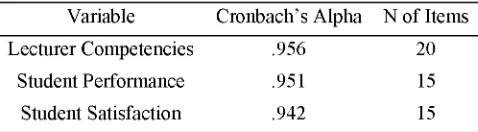
Table 1. Reliability of each variable
Variable Cronbach’s Alpha N of Items
Lecturer Competencies .956 20
Student Performance .951 15
Student Satisfaction .942 15
As depicted in Table 1, for each variable, namely lecturer competencies, student performance, and student satisfaction, all three record Cronbach’s Alpha of more than 0.7, at 0.956, 0.951, and 0.942 respectively. Therefore, the instrument has good internal consistency and deemed as reliable.
4.3 Research Hypothesis 1
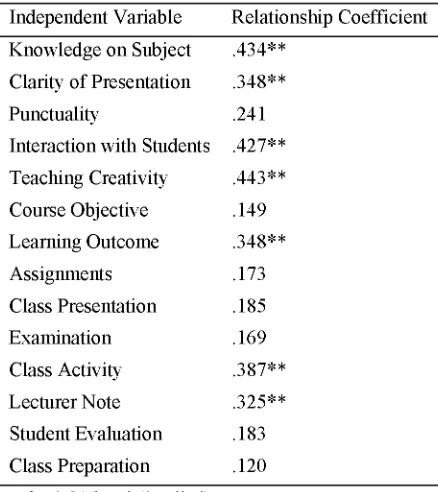
Pearson correlation Analysis. In order to identify the relationship between lecturer’s competencies and student’s satisfaction, all fourteen independent variables are combined together to test the possible relationship by using Pearson correlation analysis, one of the most commonly used bivariate relationship techniques. From Table 2, it can be deduced that clarity of presentation is positively correlated (r=.348, p<0.01) with student’s satisfaction, hence it is one of the significant factors in influencing student’s satisfaction. This has been supported by Good (1994), that in order for students to have better understanding, satisfaction, and achieve the learning outcomes, it is important for lecturer to deliver the lectures clearly and in effective manner.
leads to one being satisfied.
Beside than the two variables, knowledge on subject records a positive relationship (r=.434, p<0.01) with student’s satisfaction. Matzler and Woessmann (2010) discovered that the teaching quality is directly related to the student’s satisfaction. One of the lecturer competencies they specifically mentioned in their study was lecture’s subject knowledge because without having subject knowledge, the lecturer is unable to comprehend the students with relevant knowledge and skills required for that particular subject. Therefore, the subject knowledge is essentially important for lecturers so that students could meet the desired learning outcome and are satisfied with their learning.
Interaction with students also shows a positive relationship (r=.427, p<0.01) with student’s satisfaction, which is echoed by Gray (2010). He stated that it is very important for institutions to establish effective communication system with students to know and understand their expectations. Any interaction between students and institution staff, be it in the classroom between lecturer and student or be it outside the classroom with non-academic staff is a mean to understand the students satisfaction.
Two other variables that are positively correlated with student’s satisfaction are teaching creativity (r=.443, p<0.01) and class activity (r=.387, p<0.01). Chedzoy and Burden (2007) reckon that in situations where the lecturers are interpersonally oriented, creative, attentive, organize plenty of activities, empathic and fully cognizant of the students’ ability and they believe in the students, the students are extremely positive and satisfied towards learning.
Learning outcome is also one of the variables that is positively correlated (r=.348, p<0.01) with student’s satisfaction. Marton and Saljo (1997) carried out research on the learning outcome and their findings shows deeper approaches to learning are related to higher quality learning outcomes. The learning outcomes are also referred to as learning goals, the knowledge, skills, attitudes and habits of mind that students take with them from a learning experience. It is a specific measurable achievement, a unit of what we expect a student to learn from the material that is taught to them. Every subject taught in the programme has its prescribed learning outcomes and the entire programme has its collective learning outcomes which determine the effectiveness of teaching methodologies. Clear articulation of learning outcomes serves as the foundation to evaluating the effectiveness of the teaching and learning process, which determine student’s satisfaction.
Table 2. Relationships between lecturer’s competencies and student’s satisfaction
Independent Variable Relationship Coefficient
Knowledge on Subject .434**
Clarity of Presentation .348**
Punctuality .241
Interaction with Students .427**
Teaching Creativity .443**
Course Objective .149
Learning Outcome .348**
Assignments .173
Class Presentation .185
Examination .169
Class Activity .387**
Lecturer Note .325**
Student Evaluation .183
Class Preparation .120
** Relationship is significant at the 0.01 level (2-tailed)
model and the relative contribution of each of the predictor to the total variance explained. Findings using multiple regressions are as depicted in Table 3 and 4.
Table 3 indicates the relationship between lecturer’s competencies and student’s satisfaction in ABC College. From the table, the R-square value is 21.7%, hence this shows that 21.7% of the variation in student’s satisfaction can be accountedfor by lecturer’s competencies. This not only means that lecturer’s competencies are an important factor in determining student’s satisfaction, but specifically it tells that the lower the lecturer’s competencies the lower the student’s satisfaction, at the same direction, with 21.7% variance.
As for the FSTAT or F-value, it records a value of 7.746, and it is significant at p = .001. Since the F-value exceeds 4 and the significance value is lower than .05, thisprovides a clear evidence of existence of a linear relationship between lecturer’s competencies and student’s satisfaction.
Table 3. Relationship between lecturer’s competencies and student’s satisfaction (model summary)
R R2 Adjusted R2 Std. Error of the Estimate F Sig.
.499 .249 .217 .739 7.746 .001
Predictors: (Constant), Lecturer’s Competencies.
Dependent Variable: Student’s Satisfaction.
Moving on to Table 4, the impact and relationship of each variable of lecturer’s competencies on student’s satisfaction are as presented. The t test for the Beta coefficient is a test of relationship between the dependent variable and a specific independent variable, and in the case, between lecturer’s competencies and student’s satisfaction. The null hypothesis for this test is B=0, indicating that there is no relationship should the B-value is 0.
A beta coefficient is also used to define the direction of the relationship between the independent and dependent variable. If the sign of the coefficient is positive, the relationship between the variables is direct; scores on the two variables change in the same direction. If the sign of the coefficient is negative, the relationship is inverse, meaning that increases in one variable correspond to decreases in the other variable. Another way to interpret the Beta coefficient is that it represents the amount of change in the dependent variable for a 1unit change in the independent variable. From Table 4, it is known that all Beta values have positive signs. This indicates that the relationship between independent variables and dependent variable is direct and it moves in the same direction. It is also known that interaction with students has the highest Beta value, the closest to 1.000, at 0.874. This shows that lecturer’s interaction with students has the highest impact or influence on student’s satisfaction. Course objective on the other hand, has the lowest Beta value, at 0.038, which indicates the least impact it has on student’s satisfaction.
In determining the significance level of the independent variables shown in Table 4, the significance value has to be lower than 0.05 to be termed as significant. Based on the table, there are 4 variables of lecturer’s competencies that are significant to student’s satisfaction; namely lecturer’s clarity of presentation, interaction with students, learning outcome, and lecture note, with each having significance value of 0.000.
In supporting these findings specifically on interaction with students, according to Fresen (2007) and Northrup (2001), the success of education depends upon the interaction between lecturers or lecturers and students which is an essential element to a student learning and satisfaction. Young and Norgard (2006) also confirmed the importance of timely and quality interactions between student and their instructor for student’s satisfaction. Picciano (2002) went even further by saying that in the education line, researchers' belief in the importance of student-lecturer interaction is so widespread that it is assumed to be a basic need for learning to occur, which leads to one being satisfied.
the lecture notes and course materials are relevant and useful, and involve real life examples, facts, and cases.
On the aspect of learning outcome, learning achievements specifically on the side of cognitive aspect, are considered important in determining student’s satisfaction (Paechter, Maier, & Macher, in press; Weinert, 2001). They can be described as different facets of competences such as theoretical and methodical knowledge as well as skills required for problem solving. As for the emotional takeaway of learning outcome, it provides satisfaction to a student, and this satisfaction will influence the student’s decision to continue or drop-out of a course (Chiu, Hsu, Sun, Lin, & Sun, 2005; Levy, 2007).
Table 4. Impact of lecturer’s competencies on student’s satisfaction (coefficients)
Model Unstandardized
Coefficients
Standardized
Coefficients
B Std. Error Beta Sig.
Knowledge on Subject .810 .053 .851 .000
Clarity of Presentation .324 .194 .294 .000
Punctuality .659 .075 .562 .243
Interaction with Students .832 .061 .874 .000
Teaching Creativity .654 .053 .388 .036
Course Objective .025 .037 .038 .512
Learning Outcome .587 .152 .451 .000
Assignments .365 .230 .260 .316
Class Presentation .102 .072 .142 .125
Examination .361 .261 .389 .347
Class Activity .264 .024 .293 .472
Lecturer Note .127 .312 .157 .000
Student Evaluation .320 .236 .361 .138
Class Preparation .211 .096 .234 .226
Dependent Variable: Student’s Satisfaction.
5. Conclusion
5.1 Implication fo r Practice
Overall, out of these 2 analyses in the testing of 2 hypotheses, it is found that interaction with students is a common variable, showing a strong significant factor influencing for both student’s satisfaction and performance. Hence, strong emphasis should be given by the management to increase the level of interactions between lecturers and students. Volery et al. (2000) suggested that in order to boost students’ interactions, lecturers may give a participation mark. Furthermore, lecturers should be able to understand the diverse nature of students and involve them in online discussions to encourage more interactions. Brophy (2002) added that lecturers must also perform a variety of tasks in the process of teaching, e.g., provide a structure of the course contents, give feedback of accomplishments, stimulate students’ motivation to process and reflect on the content, and assist them to engage in learning activities. These are among the steps that could be implemented by the management of ABC College.
5.2 Recommendation fo r Future Research
This study definitely has strengthened past researchers; especially on how important lecturers’ competencies are in ensuring students perform and their satisfaction level is met. However, there are some areas where future researchers could capitalize on; such as by micro-managing the data and compare between rural and urban students. A comparison between gender or entry qualification could also be made pertaining to their impacts on students’ performance and satisfaction. These demographic data are presented in this study, but it is descriptive in nature, and not a comparative study.
Apart from this, future researches could also look at adding more variables to lecturer’s competencies, such as industrial training supervision. This is an area where most studies do not cover as more focus are geared towards classroom learning and not off-campus training. Researchers in the past may have excluded this as industrial training is not common back then; in fact to some extent even formal institutions are relatively not accessible at certain areas. This scenario has changed in the past decade where most higher learning institutions make it a compulsory for the students to go for practical training at least for 3 months. The structure might differ from one institution to another, but the idea is the same. Hence, this could be a wonderful opportunity for future researchers to do some studies on it, particularly in the domain of lecturers’ competencies and its link to students’ outcomes.
Besides, future researchers can also look at lecturer’s motivation instead of lecturer’s competencies, and its relationship with student’s performance and satisfaction. Motivation is a popular field of research, but in terms of lecturer’s motivation, it is still a premature subject. Majority of the studies are basically looking at the students point of view, with few focus are given to lecturers. A scale could be developed and tested for its reliability for this purpose.
Acknowledgements
Authors wish to acknowledge the Malaysian Ministry of Higher Education and Universiti Teknologi Malaysia under the Research Grant (Vot. 07J89) for supporting and sponsoring this publication.
References
Abbasi, M. N., Malik, A., Chaudhry, I. S., & Imdadullah, M. (2011). A Study on Student Satisfaction in Pakistani Universities: The Case of Bahauddin Zakariya University, Pakistan. Asian Social Science, 7(7), 209-219.
Aldridge, S., & Rowley, J. (2001). Conducting a withdrawal survey. Quality in Higher Education, 7, 55-63. Banerjee, M., & Brinckerhoff, L. C. (2002). Assessing student performance in distance education courses:
Implications for testing accommodations for students with learning disabilities. Assessment fo r Effective Intervention, 27(3), 25-35.
Braskamp, L. A., & Ory, J. C. (1994). Assessing faculty work: Enhancing individual and instructional performance. San Francisco, CA: JosseyBass.
Brophy, J. (2001). Generic Aspects of Effective Teaching. In M. C. Wang, & H. J. Walberg (Eds.), Tomorrow’s Teachers. McCutchan Publishing Company.
Centra, J. A. (1993). Reflective faculty evaluation. San Francisco, CA: Jossey-Bass.
Chedzoy, S. M., & Burden, R. L. (2007). Marking time or moving on: Students perceptions of school life in year 8 and their attribution of their success and failure in learning. Research in Education, 77, 31-45. http://dx.doi.org/10.7227/RIE.77.3
Chiu, C.-M., Hsu, M.-H., Sun, S.-Y., Lin, T.-C., & Sun, P.-C. (2005). Usability, quality, value ande-learning
continuance decisions. Computers & Education, 45(4), 399-416.
http://dx.doi.org/10.1016Zj.compedu.2004.06.001
Cohen, P. A. (1981). Student ratings of instruction and student achievement: A meta-analysis of Multisection validity studies. Review o f Educational Research, 51, 281-309.
Concannon, F., Flynn, A., & Campbell, M. (2005). What campus based students think about the quality and benefits of e-learning. British Journal o f Educational Technology, 36, 501-512.
Doyle, T. (2008). Evaluating Lecturers Effectiveness. Retrieved July 24, 2008, from ferris.edu/fctl/Teaching_and_Learning_Tips/.../EvalTeachEffec.htm
on E-Learning, 6(3), 351-362.
Good, T. L. (1994). Looking in Classrooms (6th ed.). New York: HarperCollins College Publishers.
Gordon, L. M. (2001). High lecturer efficacy as a marker of lecturer effectiveness in the domain of classroom management. San Diego, CA. Presented at the Annual Meeting o f the California Council on Lecturer Education (Fall 2001).
Gray, D. (2010). The Influence o f Student Engagement Levels on Satisfaction and Behavioural Intentions.
Macquarie University.
Johnson, R. D., Hornik, S. & Salas, E. (2008). An empirical examination of factors contributing to the creation of successful e-learning environments. International Journal o f Human-Computer Studies, 66, 356-369. http://dx.doi.org/10.1016/jijhcs.2007.11.003
Jucks, R., Paechter, M., & Tatar, D. (2003). Learning and collaboration in online discourses. International Journal o f Educational Policy, Research & Practice, 4, 117-146.
Kanji, G. K., Malek, A., & Wallace, W. (1999) A Comparative Study of Quality Practices In Higher Education Institutions In The US And Malaysia. Total Quality Management, 10(3), 357-371.
Krejcie, R. V., & Morgan, D. W. (1970). Determining sample size for research activities. Educational and Psychological Measurement, 30, 607-610.
Levy, Y. (2007). Comparing dropouts and persistence in e-learning courses. Computers & Education, 48(2), 185-204.
Longman, D., & Atkinson, R. (1999). College Learning and Study Skills. Wadsworth/Thomson Learning.
Marton, F., & Saljo, R. (1976). On qualitative differences in learning. I-Outcome and Process’ British Journal of Educational Psychology. Asian Social Science, 46(1), 4-11.
Marton, F., & Saljo, R. (1997). Approaches to learning. In F. Marton, D. Hounsell, & N. Entwistle, The Experience o f Learning. Edinburgh: Scottish Academic Press.
Matzler, J., & Woessmann, L. (2010). The Impact o f Lecturer Subject Knowledge on Student Achievement: Evidence from Within-Lecturer Within-Student Variation. The Institute for the Study of Labor.
Northrup, P. T. (2001). A Framework for Designing Interactivity into Web-based Instruction. Educational Technology, 41(2), 31-39.
Northrup, P. T. (2002). Online learners’ preferences for interaction. The Quarterly Review o f Distance Education,
3(2), 219-226.
Paechter, M., & Schweizer, K. (2006). Learning and motivation with virtual tutors. Does it matter if the tutoris visible on the net? In M. Pivec (Ed.), Affective and emotional aspects o f human-computer-interaction: Emphasis on game-based and innovative learning approaches. Amsterdam: IOS Press.
Paechter, M., Maier, B., & Macher, D. (in press). Evaluation von Lehremittels Einschatzungen des subjektive Kompetenzerwerbs. Psychologie in Erziehung und Unterricht, 222-229.
Picciano, A. G (2002). Beyond Student Perceptions: issues of interaction, presence and performance in an online course. Journal o f Asynchronous Learning Networks, 6(1), 21-40.
Richards, J. C. (2006). Communicative Language Teaching Today (1st ed.). Singapore: Cambridge University Press.
Richardson, J. C., & Swan, K. (2003). Examining social presence in online courses in relation to students' perceived learning and satisfaction. Journal o f Asynchronous Learning Networks, 7(1), 68-88.
Richmond, V. P., McCroskey, J. C., & McCroskey, L. L. (2005). Organizational Communication fo r Survival: Making Work, Work (3rd ed.). Boston, MA: Allyn & Bacon.
Shea, P. J., Pickett, A. M., & Pelz, W. E. (2003). A follow-up investigation of “teaching presence” in the SUNY learning network. Journal o f Asynchronous Learning Networks, 7(2), 61-80.
Shin, N., Jonassen, D., & McGee, S. (2003). Predictors of well-structured and ill-structured problem solving in an astronomy simulation. Journal o f Research in Science Teaching, 40, 6-33. http://dx.doi.org/10.1002/tea.10058
Swan, K., Shea, P., Fredericksen, E., Pickett, A., Pelz, W., & Maher, G. (2000). Building knowledge building communities: Consistency, contact and communication in the virtual classroom. Journal o f Educational Computing Research, 23(4), 389-413.
Theall, M. (2009). Students Ratings: Myths vs. Research Evidence. Brigham Young University. Focus on Faculty Newsletter, 10(3), 2.
Theall, M., & Franklin, J. (2001). Looking for bias in all the wrong places-A search for truth or a witch hunt in student ratings of instruction. New Directions fo r Institutional Research, 109(1), 45-48.
Volery, T., & Lord, D. (2000). Critical success factors in online education. International Journal o f Educational Management, 14(5), 216-223.
Yang, Y., & Cornelius, L. F. (2004). Students’ perceptions towards the quality of online education: A qualitative approach. Paper presented at the Association fo r Education Communications and Technology 27th Conference, USA.
Young, A., & Norgard, C. (2006). Assessing the quality of online courses form the students’ perspective.
Internet and Higher Educatio, 9(2), 107-115.
Zeng, W. Y., & Perris, K. (2004). Researching the efficacy of online learning: A collaborative effort amongst scholars in Asian open universities. Open Learning, 193, 247-264.
Copyrights
Copyright for this article is retained by the author(s), with first publication rights granted to the journal.