VOTE 75016
SELF-ACCESS LEARNING PROGRAMME:
ANALYSING STUDENTS’ LANGUAGE LEARNING NEEDS
AND EVALUATING LEARNING MATERIALS
PROGRAM PEMBELAJARAN KENDIRI:
MENGANALISA KEPERLUAN PEMBELAJARAN BAHASA
DI KALANGAN PELAJAR
DAN MENILAI BAHAN PEMBELAJARAN
MASDINAH ALAUYAH BINTI MD YUSOF
WAN FARA ADLINA BINTI WAN MANSOR
FAIZAH BINTI MOHD NOOR
NOOR ZAINAB BINTI ABDUL RAZAK
ii
ABSTRACT
iii
ABSTRAK
Alam pekerjaan pada masa kini memerlukan graduan yang bukan sahaja
berpengetahuan, malah berkemahiran tinggi dan versatile. Untuk membantu pelajar
mempunyai kemahiran yang diperlukan, Jabatan Bahasa Moden telah
menggabungkan program pembelajaran kendiri (SAL) dalam kursus-kursus
iv
TABLE OF CONTENTS
CHAPTER SUBJECT
PAGES
TITLE PAGE
ABSTRACT
ABSTRAK
TABLE OF CONTENTS
LIST OF TABLES
LIST OF FIGURES
i
ii
iii
iv
v
vii
CHAPTER 1
INTRODUCTION
1
1.1
Introduction
1.2
Background of the Study
1.3
Statement of the Problem
1.4
Purpose of the Study
1.5
Significance of the Study
1.6
Scope of the Study
1
2
3
3
4
4
CHAPTER 2
LITERATURE REVIEW
6
2.0 Introduction
2.1 Self-Access Learning (SAL)
2.1.1 Definition of Self-Access Learning
2.1.2 Rationale for Self-Access Learning
2.1.3 Self-Access Centre (SAC)
2.2 Roles of Materials in the SAL programme
2.2.1 Good Self-Access Learning Materials
2.3 Roles of Facilities in the SAL programme
2.4 Roles of Self-Access Learners
2.5 Learning Needs
2.6 Learner Contract
2.7 Chapter Summary
6
6
6
8
10
13
14
17
20
21
22
23
CHAPTER 3
METHOD
24
3.1
Subjects
3.2
Instruments
3.3
Procedures
3.4
Data Analysis
24
25
27
30
CHAPTER 4
FINDINGS AND DISCUSSION
31
4.1
Students’ View on the SAL Programmes
4.2
Students’ View on the SAL Materials
v
4.4.2 Writing Skills
4.4.3 Listening Skills
4.4.4 Speaking Skills
40
41
43
CHAPTER 5
CONCLUSIONS AND IMPLICATION OF THE
STUDY
44
5.1 Summary of Findings
5.1.1 Students’ View on the SAL Programmes
5.1.2 Students’ View on the SAL Materials
5.1.3 Students’ View on the SAL Laboratory
5.1.4 Students’ Language Learning Needs
5.2 Implications of the Study
5.3 Suggestions for Further Research
5.4 Conclusion
44
44
45
45
46
46
47
47
REFERENCES
49
vi
LIST OF TABLES
TABLE
NO.
TITLE PAGE
vii
LIST OF FIGURES
FIGURE
NO. TITLE PAGE
CHAPTER I
INTRODUCTION
1.1Introduction
One of the missions of Universiti Teknologi Malaysia (UTM) is to produce graduates
who can adapt to the demanding circumstances of the job market, work autonomously
and contribute towards the development of Malaysia. In achieving this, UTM has
therefore identified a range of attributes and generic skills which will enable graduates
to function effectively in a wide range of social and professional contexts. The
development of these attributes is embedded within the contexts of the students’
discipline or professional field. With the inclusion of generic skills training carried
out simultaneously with the process of teaching and learning as well as the
incorporation of information technology (IT), UTM has paved the way towards the
emergence of a new generation of knowledgeable, skilful and competitive experts
who are able to exploit the advanced technology available to them. Being a part of
UTM, the Department of Modern Languages, one of the departments of the Faculty of
Management and Human Resource Development, clearly shares this mission.
Consequently, steps are taken to ensure that this mission is a success when designing
1.2Background of the Study
The Department of Modern Languages offers a variety of English proficiency courses
to all students of UTM. Among the courses offered are UHB 1412, UHB 2332 and
UHB 2422 and many more. These courses are aimed to enhance students’ proficiency
level in English as well as to equip them with the knowledge and skills essential for
both academic and professional purposes.
In relation to the first course, UHB 1412 English for Academic Communication,
students are taught the fundamental skills that they should have, such as reading
skills, note-taking, bibliography, in-text citation, presentation skills and academic
writing. The training of these skills forms the core activities of the UHB 1412 course.
The core activities are in turn supported by a wide variety of exercises, assignments as
well as individual and group project work, which are termed as support (or pedagogic)
activities. All the pedagogic activities are put into contexts relevant to the students’
respective disciplines.
In relation to the pedagogic activities mentioned above, a different approach is
necessary to improve its efficacy. Further steps should be taken to foster self-directed,
autonomous learning in the students, which is a component in the generic skills
identified by the university and an ability that would prove to be pivotal to the student
in the future. Subsequently, as an extension and further reinforcement to the UHB
1412 course, self-access learning programmes have been introduced and embedded
into the course whereby students are able to carry out language learning activities
1.3Statement of Problem
The self-access learning programme is still quite new in UTM. At present, it is not
widely accepted and practiced amongst students and lecturers. Therefore, there is the
need to publicize the SAL programme and its benefits to both the student population and lecturers. Thus, this report aims to exhibit the response and feedback received
from participants of this study, which would both illustrate the students’ attitude and
reaction towards self-access learning programmes, as well as identifying areas that
need to be worked upon. It is hoped that the findings of the study could help to
publicize the SAL programme.
1.4Purpose of the Study
The study has the following purposes:
i. To investigate and gauge students’ attitude towards self-access
learning programme, materials and laboratories, as well as the ways in
which the SAL affects students’ learning.
ii. To identify areas where the programme’s design and execution that can
The research questions of the study are as follows:
i. What are the students’ general opinion on the self-access learning
programme?
ii. In what way has the programme benefited the students?
iii. What are the students’ expectations of the programme?
iv. What elements of the programme’s design and implementation need
reviewing?
1.5Significance of the Study
The findings of the study could provide information to lecturers, particularly language
lecturers as well as instructional multimedia designers on students’ opinion of
self-access learning programmes as a whole. This information serves as a basis for
inculcating IT in the learning process, learner autonomy among students, as well as
creating instructional software that would meet the needs and demands of the
students.
1.6Scope of the Study
This study focuses on first year students taking English for Academic Communication
(UHB 1412) course under the Department of Modern Languages who are required to
attend the self-access learning programmes. These programmes utilise materials
targeted at enhancing the 4 macro language skills, namely reading, listening, writing
CHAPTER II
LITERATURE REVIEW
2.0 Introduction
There is an extensive literature covering the topics on ‘Self-Access Learning’. This
chapter will basically review literatures related to the study, i.e. the concept of
Self-Access Learning (SAL), the roles of materials and facilities in the SAL programme, the role of Needs Analysis and Learning Contract in relation to SAL programme.
2.1 Self-Access Learning (SAL)
In this section, an overview of the SAL approach from different researchers’
perspectives will be presented. The discussion will include the definitions of SAL and the rationale for SAL and the Self-Access centre.
2.1.1 Definition of Self-Access Learning (SAL)
where learners could select, work independently, and later, obtain feedback on their
performances. Gardner & Miller (1999: 8-11), on the other hand, gave two definitions
of Self-Access. They argued that it was ‘an approach to learning language, not an approach to teaching language’, and ‘a system for organising resources and an integration of a number of elements which combine to provide a learning
environment’. In its handbook on ‘Self-Access’, the Malaysian Ministry of Education (MMoE, 2001) stated that Self-Access is a system which allows students to learn at
their own pace and time using organised learning materials and facilities. The term
‘Self-Access’ was referred to as a means to practise autonomy by Dickinson (1993, in
an interview concerning aspects of autonomous learning) while Jones (1995) stated
that Self-Access was dedicated to recognizing and fulfilling different individual
learner’s needs, who were expected to be actively responsible for their own language
study.
Though named differently, the definitions for Self-Access Learning (SAL) seemed similar to ‘Self-Access’. For example, Broady & Kenning (1996) referred it to the
approach which focused on the provision of various resources and contexts for
learning which learners could choose according to their needs. SAL is also referred to the place where learners could use materials which facilitate learning in their
self-constructed way by Dickinson (1987), Jones (1995) and Pamberton (1996). By
contrast, Faizah et.al. (1998) defined SAL as a remedy which could aid students who have not reached certain levels of proficiency.
From the above definitions, it can be concluded that ‘Self-Access’ and ‘Self-Access
learning’ refer to a type of learning materials, an approach to language learning, a
autonomy, and a way to recognise and fulfil learners’ needs. In other words, SAL is a learning approach where students could learn under their own direction, choose and
use suitable learning resources that facilitate their learning.
2.1.2 Rationale for Self-Access Learning (SAL)
The literature reveals many reasons why the SAL approach has been adopted for language learning. Klassen et.al. (1998), in their report on the effectiveness of the SAL approach, stated that the City University of Hong Kong had adopted the SAL because it offers a learning environment where students could be actively involved in
the learning process. In addition, the fact that SAL allows learners to make their own learning decisions regarding what to learn, which materials to work on, and when to
learn was another reason why many institutions had accepted the SAL approach (Dickinson, 1987 and Lai, 1999). The capability of the SAL in providing a practical solution to problems such as mixed ability language classes, learners’ different
psychological needs and personality, and others was also a reason (Sheerin, 1989 and
MMoE, 2001). Furthermore, the approach was adopted because it enables individual
learners with particular weaknesses to work either alone or with others with similar
needs (Sheerin, 1997 and Gardner & Miller, 1999), it benefits learners who are unable
to attend formal classes and learners of all ages and cultures (Sheerin, 1997), and it
enables learners to develop a sense of responsibility and different levels of
independence towards their learning and later helps them to be self-directed and
necessarily imply learners possess or exercise the capacity to control their own
learning.
Self-access learning educators have been known to adapt various strategies to instill
different levels of independence or self-directedness among learners. Self-access
learners may benefit from either a full-autonomy or partial-autonomy learning mode.
The gains for learners involved in such a learning mode are many. Self-access
learning motivates learners, leads them to employ higher order thinking skills, allows
them to experiment with different learning styles, gives the opportunity for learners to
use their own judgment about how best to learn, instills in them the ability to respond
to change, provides excitement and pleasure in learning. At the university, relative
independence from teachers is identified as one trait that makes learners successful
(Raaheim and Wankowski, 1981) as it instills personal confidence and feelings of
competence as a learner. The best part about self-access learning is that it mirrors
‘natural’ learning which learners experience in many facets of their life.
Nonetheless, this learning mode has its flaws too. For one, the educational system
introduced by the government or the learning institution might not be designed for
self-access learning. Second, Carl Rogers observes that only 1/3 or 1/4 of learners are
effective ‘independent’ learners while the rest do so because they have to. Third, too
little direction can lead to frustrations for the learner. Fourth, learners may not have
sufficient knowledge in the content of the subject for them to be able to proceed on
their own; which is why self-access learning is not suitable for certain subjects such as
Mathematics or Science. Fifth, learners may have very specific expectations and
assumptions about the role of a teacher; hence the ineffectiveness of the learner as an
Self-access learning thus poses a challenge for the educator. The greatest challenge is
in knowing the right amount of guidance to give learners without providing too much
direction. Self-access learners need direction in identifying areas of difficulty.
However, too much direction will not empower learners and make them proud owners
of their learning project.
2.1.3 Self-Access Centre (SAC)
In his report on ‘Learner’s Contribution To The SAC’, Aston (1993) stated that the SAC was created in recent years as a means to improve learning (pedagogic reason)
and to cut down teaching costs though not necessarily reduce staff loads (economic
reason). The many benefits of the SAL approach have also influenced the
establishment of the SAC in many modern educational institutions in South East Asia;
it is an alternative environment for their students to learn English (Gardner and Miller,
1997).
There are many descriptions in the literature of what a SAC is. The Temenggung
Ibrahim Teacher Training College in Malaysia, for example, described it as a centre
where learning could take place without the presence of a teacher or facilitator, and
where learning materials and facilities are provided and designed to teach and give
learners feedback on their progress. In two separate works, Sheerin (1989, 1997)
stated that the SAC is a means to cater for individual learners’ needs which requires
effort on teachers’ part to provide learning materials. Jones (1995), on the other hand,
attitudes and approaches whereby learners could take a more active role in
determining their own learning objectives and processes. Faizah et.al. (1998), in their report on the effectiveness of SAL materials, nevertheless, asserted that a SAC is a resource centre for autonomous learners, and a centre that offers learning materials
which complement a language course.
Concerning the purpose of SAC, Benson (2001: 114) argued that the ‘SAC should function as a quasi-independent unit with its own philosophy and routines for engaging learners in study outside the classroom’. In other words, the SAC should have principles and purposes which could encourage learners to learn outside formal
classes. Other purposes of the SAC include providing students the opportunity to
pursue their learning in their own preferred way at their own pace (Maley, 1989). In
other words, as Sheerin (1997) put it, the objective of the SAC is to provide
conditions that will prepare learners before they begin SAL, and which will support learners during their on-going Self-Access work. Jones (1995), on the other hand,
stated that the creation of the SAC was to allow learners to take as much personal
control of their learning as they wish, and to offer learners who have no aptitude or
desire for independence as much guidance as necessary. Dickinson (1987), too, stated
that the SAC makes provision for learners who were either fully autonomous,
semi-autonomous, or even non-autonomous. In short, it can be argued that the SAC
provides a conducive learning environment, offers learners opportunities to carry out
learning activities either on their own or in groups, accommodates relevant,
motivating and interesting learning materials, encourages the use of various learning
facilities, and caters for the needs of individual learners so as to enable them to
Moreover, a SAC may be seen as an advantage for the teachers. Waite (1994) and
Sturtridge (1992) argued that the SAC enables teachers to provide more relevant,
motivating but cost-effective materials at minimum teacher-time, and to address the
varying needs of students in large classes.
From the descriptions and purposes given above, SAC seemed to play several roles
related to a teaching-learning situation (Sturtridge, 1992). Sturtridge added that the
roles of SAC within the institution depend on how it is organised and equipped, the
materials it offers and the type of learning that is likely to take place. Roles which
could be assigned to the SAC (agreed by Sturtridge, 1992 and Faizah et.al., 1998) are as follows:
1. instruction centre – acting as a surrogate teacher or a supplement to taught
classes, where tests are included to ensure learners reach a particular level of
proficiency before progressing to a further unit.
2. practice centre – concerning practising an extension of what is covered in
class. It is closely related to the institution’s teaching programme
3. skill centre – focusing on only one language skill which meets an identified
need for improvement.
4. learning centre – allowing learners to extend their knowledge of the language
through practices, consolidations and tests of what has been learned in class.
It can be completely independent of taught classes, and is usually intended
for those who do not attend class with intrinsic motivation.
SAC and the measures taken to achieve them’. In other words, he stated that the purpose and management of SAC would determine whether students develop ‘learner
autonomy’.
2.2 Roles of Materials in the SAL Programme
For the Self-Access Language Learning (SALL) programme to be successful and for the students to develop the ability to learn independently, we cannot just rely on
changing the teachers’ and students’ roles. Martyn & Chan (1992), in a Self-Access
action research progress report, stated that the presence of suitable learning materials
is also important to ensure success. Even if the mere existence of Self-Access
facilities could not ensure independent learning, Sheerin (1997) argued that
well-organised and suitable Self-Access materials could facilitate and encourage
self-directed learning. Hence, she stressed that the SAC should provide materials that
could foster learner independence rather than teacher-directed materials or
instructions by remote control.
Boud (1981), too, stated that it is important for educational institutions to constantly
restructure learning materials and activities to prepare students for ‘learning after
school’ and to assist them in developing the skills needed in their future careers. In
inappropriately designed materials will feel that it is useless doing the activities and
that it is better to be passive learners. Due to this, Little (1991) stressed the
importance of considering both the students’ needs and teacher’s special expertise
when preparing the SAL materials. He stated that the preparation of the learning materials should take into consideration the teachers’ suggestions and the learners’
needs.
2.2.1 Good Self-Access Learning (SAL) Materials
What constitute good SAL materials? Many researchers seemed to agree that the most important criteria of good SAL materials would be a clearly written statement of the aims and objectives (Sheerin (1989), Carvalho (1993), Lum & Brown (1992),
Dickinson (1987), Boud (1981) and Meyer (1988)). In addition, Sheerin and Carvalho
agreed that the presentation of the SAL materials is vital because well-presented SAL materials can increase the students’ confidence in using them. They stated that as
human beings, students often like professionally done materials. They listed several
characteristics of well-presented SAL materials, i.e. attractive, inviting, professionally written and finished with appropriate and suitable size, layout, artwork and typeface.
Apart from the criteria mentioned earlier, the content, choice of procedures, tests and
feedback, record keeping advice, cross-referencing possibilities, and the practicalities
such as indexing, filing and recording usage of materials would also make SAL materials worthy. The Malaysian Ministry of Education (MMoE, 2001) stated that it
learning styles, abilities, and interests. Sheerin (1989), Carvalho (1993), Dickinson
(1987) and Meyer (1988), too, emphasized the need for materials to be worth
learning, i.e. they should consist of useful exercises, meaningful language input,
flexible and appropriate learning instructions, and useful advice. In short, researchers
agreed that SAL materials should have clear aims and objectives, worthwhile learning activities, useful feedback, appropriate assessment, flexible advice on record keeping,
and accessible for students to work either individually or in collaboration with others
without direct supervision from the teachers.
There were several suggestions given on how the SAL materials should be designed. The MMoE (2001), for example, stated that the SAL materials should give learners sufficient opportunities to be actively involved in their learning process while Sheerin
(1989) stated that the learning materials should be designed and organised in ways
where learners could select and work on tasks independently, and later, obtain
feedback on their performance through answer keys that are provided for the activities
or tasks given. Similarly, Faizah et.al. (1998) asserted that the learning materials should be more learner-friendly than the textbook and should guide students through
the learning process with all possible queries addressed. In addition, Barnett & Jordan
(1991), in their paper on how Self-Access facilities should be used, highlighted the
importance of linking the different learning materials to enable a more purposeful
learning and to allow long-term planning, consolidation and reinforcement.
Building stocks of SAL materials is also as important as preparing the materials. In reference to the published materials, Sheerin (1989), Gardner & Miller (1999),
materials in combination with in-house produced materials to meet the needs of a
particular group of students. To make the published materials more learner-friendly,
they suggested the followings to be done: (1) provide supporting worksheets which
could guide learners through the materials, (2) supply answer keys, and (3) separate
books into smaller and more manageable units.
Gardner & Miller (1999) stated that the quality of these in-house produced materials
can be enhanced through the use of authentic sources such as newspapers and
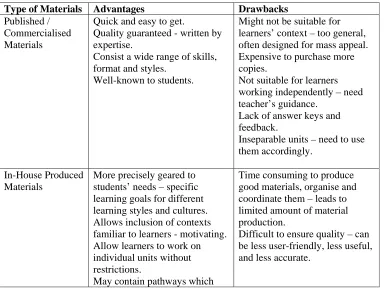
subject-specialised textbooks. Table 2.1 below further summarised the benefits and
drawbacks of the published/commercialised materials, in-house produced materials
and authentic materials.
Table 2.1: A summary of the different learning materials.
Type of Materials Advantages Drawbacks Published /
Commercialised Materials
Quick and easy to get.
Quality guaranteed - written by expertise.
Consist a wide range of skills, format and styles.
Well-known to students.
Might not be suitable for learners’ context – too general, often designed for mass appeal. Expensive to purchase more copies.
Not suitable for learners working independently – need teacher’s guidance.
Lack of answer keys and feedback.
Inseparable units – need to use them accordingly.
In-House Produced Materials
More precisely geared to students’ needs – specific learning goals for different learning styles and cultures. Allows inclusion of contexts familiar to learners - motivating. Allow learners to work on individual units without restrictions.
May contain pathways which
Time consuming to produce good materials, organise and coordinate them – leads to limited amount of material production.
allow cross-referencing. Can be up-dated from time on regular basis.
Cheaper to mass-produce.
Authentic Materials
Can be useful, motivating. Can promote acquisition. Can contribute to language immersion.
Professionally related materials can enable learners to channel their language energies relevant to their needs.
Complexity of language used may hinder learning and de-motivate learners.
May be low in production May be difficult to get – rare; time-consuming and frustrating.
Sources: Sheerin (1989, 1991), Lum & Brown (1992), Gardner & Miller (1999), Riley (1981), McGarry (1995).
However, in preparing and building up the materials, Lum & Brown (1992) warned
that teachers’ lack of management skills can lead to low-quality and poor production
of in-house produced materials. Little (1989), on the other hand, stressed that cost
should not be the measure in deciding the use of in-house produced materials. He
stated that it might be more expensive and worthless to spend huge amount of time
and money because preparing, editing, piloting, and administrating the in-house
produced materials require a lot of paperwork.
2.3 Roles of the Facilities in the SAL Programme
Hill (1994), Todd (1997), and Gardner & Miller (1999) seemed to agree that the
physical condition of the Self-Access Centre (SAC) could greatly influence how
autonomous learning is to be achieved and its overall success. In relation to this,
McCafferty (undated) stated that a system cannot be successful or run smoothly if it is
classified materials, sufficient and suitable workspace, effective and efficient storage
system, and tolerable disturbances (e.g. noise and movements) in the learning
environment can hinder the process of developing ‘learner autonomy’ among
students. Due to this, Jones (1995) reminded us that the intentions of a good SAC will
only be reflected if proper choice and arrangement of furniture and the disposition of
the materials are made. Maley (1989), who shared the same view, emphasized the
need to carefully consider the organizational systems of the SAC so that it can offer a
systematically designed framework of support for the students and can ensure
integration of work done in the centre and the classroom.
Regarding the location and the organization of space, Sheerin (1989) and the
Malaysian Ministry of Education (MMoE, 2001) agreed that these factors should be
carefully thought out. Firstly, with regard to the arrangement of the learning materials,
it was recommended that teachers or programme planners arrange the materials in
whatever way suitable and accessible to students even if only a limited space is
available. Sheerin then suggested breaking up larger learning areas into smaller ones;
clearly dividing them for different activities, e.g. creating private working areas,
reading corners, listening corners, viewing corners and others, using bookshelves or
screens as partitions. Secondly, regarding the design of the SAC, it should be
conducive, suitable, attractive, and appealing to students, and should cater for
individual students’ learning styles and small group interactions. Thirdly, concerning
the layout of the SAC, which includes how the furniture, learning materials and
equipment are arranged and placed, it was stressed that the layout should take into
account students’ movements, i.e. their movements into and out of the centre must be
accordingly, starting from the noisiest part at the entrance and then, gradually fading
down as the students advance into the different sections of the centre (Sheerin, 1987).
However, Barnett & Jordan (1991) argued that emphasis should not only be given to
the hardware and materials but also on how the SAC is managed. ‘Good
management’, according to Gardner and Miller (1999), is important regardless of the
size of the SAC. They argued that lack of management of the physical settings,
resources, students and the running of the centre could be a disaster for the SAC. The
importance of ‘good management’ was also emphasized by Sheerin (1989) and the
MMoE (2001). They stressed the need to properly manage the learning materials,
equipments, students, the distribution of noise, and the pathways provided for new
users of SAC. Sheerin then suggested building a storage compartment to stack the
learning materials as to prolong their shelf life. Besides placing the learning materials
according to different skills and levels of language proficiency, the MMoE
recommended sealing books with plastic, clearly labelling and mounting or
laminating printed materials such as worksheets onto cards, and arranging them in
separate colour-coded boxes. In terms of managing the equipment, the MMoE
emphasized the need to place and organize equipments such as cassette/video tapes
and players, computers and CALL software, board games and others systematically.
Regarding pathways, Sheerin (1989) asserted that there could be signs on the walls,
labels on the learning materials, and an information sheet or guideline listing the
content of the SAC, location of resources and appropriate learning procedures. In
relation to this, Kell & Newton (1997) listed several functions of pathways, i.e. as a
map (to guide students way around the centre), a sample (to inform students the
counsellor (to help students reduce anxiety dealing with unfamiliar materials), a
motivator (to motivate/force user to work more efficiently), a release (to provide user
with something different from syllabus) or a replacement teacher (to save on
resources). They later reminded that pathways should be kept simple as not to further
confuse the students with technical terms or complicated instructions.
2.4. Roles of Self-Access Learners
Self-access learners need to plan their own learning targets, choose their preferred
learning style, plan and organize their work, decide when best to work alone, work
collaboratively and when to seek advice. Self-access learners will become better
learners as they learn through their personal experience, identify and solve their own
learning problems, employ creativity in their learning process, and assess their own
progress with respect to their learning targets.
If learners were made to select and outline their own learning objectives, they would
be more directed and focused. This is because learners often do not know why they
are participating in learning activities (Brophy, 1998). Learners will derive more
satisfaction out of their participation in learning activities if they understand the
reasons and the objectives of the activities.
One important responsibility of the self-access learner, apart from identifying his
learning needs and learning objectives and goals, is to self-assess his learning
activities. Self-assessment is a prerequisite for a self-directed learner Todd ( ) lists
the many benefits of self-assessment for a self-access learner as follows: it raises a
learners’ awareness of the language, makes him aware of his effective ways of
learning and learning performance, increases learning motivation and goal orientation
in learning, enhances and formulates his beliefs about aspects of learning.
To become effective self-access learners, Marshall and Rowland (1993) recommend
that learners learn effective information retrieval methods such as the use of libraries,
discover their own learning purposes and learning style, learn ways to bridge the gap
from dependent learning which they are so used to while at school, to independent
learning which they need to empower themselves with while at the university. It is
also advocated that learners switch from utilizing so frequently the knowing and
remembering techniques of learning to higher learning techniques like analysing and
researching. Marshall and Rowland (1993) stress that it is important that independent
learners learn how to ask complex questions and how to pursue their own questions in
formal education.
As maturity and confidence increases in these independent learners, teachers who
have been providing them with direction and encouragement could gradually reduce
the amount of support that has been given.
2.5 Learning Needs
Learners are the best judges of their own learning needs and wants because only they
know what they can and cannot do with their learning process (Chan, 2001). Jones
learners. These learner needs include “feeling important and secure in the learning
environment, understanding learning goals, having time to integrate learning,
understanding the learning process, and receiving feedback”. It was observed that
learners’ motivation to learn increased when they felt that their needs were being met
in class.
2.6 Learner Contract
One specific tool which could clearly identify the learners’ needs and wants is the
Learner Contract. Besides identifying these areas for the learner, the Learner Contract
also helps facilitate the learners’ learning process. Upon filling in the Learner
Contract, learners may discuss the contract with their self-access learning counselor
who will help refine the learners’ ideas on what, how and when to learn. In the
Independent Learning Contract designed by Yates (2004), learners need to indicate
the topic that they wish to learn more about, resources which they need (places to
visit, people to interview, books, computer databases, etc.), how they will show what
they have learned, when their work will begin and end, and when they wish to present
their completed project to the class.
In Dickinson’s Learner Contract (1987), learners identify two or three learning goals,
tasks and learning materials that will be used to achieve these goals, and ways of
assessing the achievement of learning goals they have identified earlier on. In the
Learner Contract, the learner may select his own learning goals or the teacher may
2.7 Summary
In this chapter, the concept of Self-Access Learning, the importance of learning
materials and facilities in the SAL programme, and the responsibilities of Self-Access learners were reviewed. The first section reviews the Self-Access Learning concept,
definitions, and rationale. The review of literature on Self-Access centres, its history,
its purpose and functions, were also included. In sections two and three, a review of
literature on the roles of materials and facilities in the SAL programme was presented,
i.e. what constitute good SAL materials, centres, and facilities. In section four, the
roles of a self-access learner were discussed. Finally, the chapter ends with a
CHAPTER III
METHODOLOGY
3.1 Subjects
The subjects for this study were first year students taking English for Academic
Communication (UHB 1412) course offered by the Department of Modern
Languages. These subjects were required to undergo a self-access learning
programme embedded within the course. There were 22 classes totaling
approximately 1200 students who took part in the self-access learning programme
from July 2003 – December 2003. These participants were asked to fill up
questionnaires, needs analysis and learning contract for the self-access programme
that they went through.
The student population was chosen for a number of reasons. First, the first year
students have a need for innovative educational practice to meet the educational
requirements for their future study at the university. This self-access programme
could in a way enrich their proficiency level to ensure their survival in the following
year. Second, these students of various backgrounds could provide information on
different needs analyses that would help to upgrade the future English proficiency
courses. Third, communication skill is the main area of the English proficiency
course, thus the perception of the first year students could basically contribute to the
3.2 Instruments
The instruments used in this study were the self-access learning questionnaires, needs
analysis and learning contract. 1200 copies were distributed to the subjects. However,
235 copies of questionnaire, 253 copies of needs analysis and 663 copies of learning
contract were returned. The information gained from these instruments served as the
primary sources of data for this study.
This questionnaire consisted of 40 items that were adapted from a PhD questionnaire
entitled “Perceptions of Students and Lecturers Towards The Self-Access English
Language Learning (SAELL) Approach and Programme: A Case Study.” It consisted
of two sections, i) Personal and Educational Background and ii) Personal views (refer
to Appendix 1). The items on personal views were designed in a form of statements
of agreement (from Strongly Agree to Strongly Disagree). The purpose was basically
to obtain students’ perceptions towards the facilities provided, lecturers’ support
towards the programme, materials as well as the relevance of the self-access English
Language learning programme.
The needs analysis was designed to identify the subjects’ language needs (now;
future; now and future) as well as the students’ present proficiency level (very weak
to very good). The items were adapted from the General Needs Analysis Form used
by (HKUST) Self-Access Centre which was extracted from a chapter entitled
“Helping Learners Plan and Prepare for Self-Access Learning” by Winnie W.F (refer
to Appendix 2). This was depicted from a book entitled “Directions in Self-Access
The needs analysis required the subjects to complete 3 sections: a) Personal and
Educational Background, b) Various Language Learning Needs and c) Areas of
Language. These items provide information on several skills including reading,
writing, listening, speaking, grammar and pronunciation. The responses from reading
area indicated the subjects’ needs for note-taking. The writing area revealed the
subjects’ needs and competency in writing essays, thesis, memos, minutes, reports,
summary, resume and letters. The listening area showed the subjects’ ability to listen
to lectures, documentaries, interviews, business meetings, movies/TV, radio and
telephone conversations. The speaking area indicated the subjects’ needs and
competency in oral presentation, group discussions, interviews, business meetings,
social gatherings, and telephone conversation. The grammar and pronunciation areas
identified the subjects’ needs and competency in basic tenses (present, past and
future), sentence structure, vocabulary, spelling as well as word sounds and
intonation.
Another instrument used in this study was the learning contract. It was adapted from
the Learning Contract found in the book mentioned as above and a school planner
(refer to Appendix 3). The title of the student school planner is “The Bulmershe
School Student Planner 1998/9.” It included the information below:
a. Student’s target for self-access learning programme. This target is related to
the type of skills that the students intend to improve on i.e. reading, writing,
speaking, listening.
b. The actual skills and activities that the students went through for the
c. The self-checking progress. This is a detailed report of the skills, topic, time,
date and number of activities the students did that included the achievement of
the target.
d. The remarks or self-reflection of the students’ overall experience when
participating the self-access English language programme.
3.3 Procedures
Prior to the implementation of the self-access learning programme, all the instruments
i.e. the learning contract, the questionnaires, and the needs analysis were vetted by a
Self-Access Learning Committee. This was to ensure the validity and reliability of the
instruments.
The main study coincided with the English for Academic Communication course in
the first year curriculum. The students who took the course were given 10 marks for
self-access learning activity. The 10 marks should reflect ten different skills or
exercises that they have done. Specifically, 5 marks were given for the listening skills
and another 5 came from other skills according to the learning target set by the
subjects. Besides the 10 exercises required, the subjects were also encouraged to do
more for the sake of exposing themselves to the language skills. Materials of various
skills (listening, reading, writing and speaking) and forms were prepared for them to
access, i.e. digitized language learning software, printed handouts as well as a
self-access website. All materials can be self-accessed in the language lab from week 3 to
A guided tour was carried out by the lecturers for their students during one of their
regular classes. The potential subjects were given information about the purpose of
the self-access learning programme and what they could expect if they participated.
All students were given the learning contract and needs analysis relating to the
information on language needs and areas. Further, they were reminded that their
lecturers would be ready to assist if they needed help.
Upon arrival at the lab, subjects were informed that they could choose to explore the
contents or topic of the language learning software and tried out the exercises
according to the requirement of self-access learning programme. In this case, Clarity
Study Skills Software were selected as it covers mainly every skills required by the
subjects.
Eight different skills in Clarity Study Skills Software including the four basic skills
were explored by the subjects before deciding on which exercise to choose. The
subtopics of the skills appeared once the subject selected the skills they wanted to do.
Figure 3.1: Sample of Clarity’s Study Skill Success
The subjects then printed the interactive exercises that they have done as evidence of
their work.
The needs analysis forms were also given to the students to obtain significant
information about their language backgrounds and competencies. They were required
to complete part of the learning contract (i.e. the learning target) before doing the
self-access activity. This was to ensure that subjects planned their targets. The subjects
were also reminded that they were given about 11 weeks to do their self-access
learning activities. While going through the self-access learning programme, they
were requested to fill up another part of the learning contract (i.e. the activity chosen
to achieve the learning target). The submission of the learning contracts should be
done in week 13 upon completion of the self-access learning programme.
The questionnaires were distributed on week 13 by individual lecturers to their
submitted them to the lecturer. At this stage the head of self-access committee would
be responsible for collecting the instruments from the lecturers.
3.4 Data Analysis
In this research, the data collected were from the needs analysis, outcomes of
self-access learning activities, and responses to questionnaires that included comments.
The analysis of the data involved multiple methods and triangulation. The content of
the needs analysis was analyzed both quantitatively and qualitatively. The items of
learning contract were analyzed along with responses to scaled items in the
questionnaires, using the descriptive statistical procedures.
To help illustrate the sources from which content elements were sorted, categorized,
counted, and analyzed, excerpts from the answers were presented in subsequent
sections of this report. Similarly, selections of comments were presented to highlight a
CHAPTER IV
FINDINGS AND DISCUSSION
This chapter presents the analysis of data and findings. Specifically, it will report on
the findings of the survey in relation to the students’ views of the self-access learning
programmes, students’ views of the self-access learning materials, and students’
views on the self-access learning laboratory. This chapter will also provide the
analysis of the students’ language needs.
4.1 Students’ Views of the Self-Access Learning Programme
This section reports on the findings of UTM students’ views on the self-access
learning programme.
Table 4.1 below shows an analysis of the responses concerning the self-access
learning programmes. 79.6% of the students agreed that the objectives of the
access learning programme were clear. 80.8% of the students claimed that the
self-access learning programme allowed them to decide what they wanted to learn. 82.5%
of the students agreed that the self-access learning programme have helped them to
Table 4.1: Students’ views on the self-access learning programme
In terms of encouragement that students obtained from doing the self-access learning
activities, 72.3% of the students claimed that the self-access learning programme
encouraged them to be active learners. In addition, 64.2% of the students believed that
self-access learning programme encouraged them to attend English classes regularly.
71.9% of the students agreed that the self-access learning programme helped them to
be more responsible for their own learning. The majority (87.6%) of the students
thought that every student should make full use of the self-access learning
programme. Only 37.0% of the students in the study seemed to agree that the
self-access learning programme took the place of a lecturer.
In conclusion, the results from this section revealed that most of the students agreed
that the self-access learning programme was beneficial and motivating for them. They Agree
%
Freq Not sure %
Freq Disagr ee %
Freq
The objectives of the SAL programme are clear
79.6 187 14 33 6 14
The SAL programme takes the place of a lecturer
37 87 28.1 66 34.1 80
The SAL programme helps me to be more responsible of my own learning
71.9 169 20.9 49 6.85 16
The SAL programme encourages me to be an active learner
72.3 170 21.3 50 6 14
The SAL programme enables me to decide what I want to learn
80.8 190 11.5 27 5.55 13
The SAL programme helps me to work on my weak points of the English language
82.5 194 11.1 26 6 14
The SAL programme encourages me to attend English classes regularly
64.2 151 25.1 59 10.2 24
Every student should make full use of the SAL programme
believed that the programme have helped them to develop interest in learning English
language. This could be seen when the students claimed that the programme
encouraged them to attend English classes regularly. Besides that, the students also
believed that the self-access learning programme encouraged them to be active
learners. In addition, the students felt that all students should make full use of the
self-access learning programme. This shows that students realized how the self-self-access
learning programme could help them to learn the English language and they
understand that the programme could not replace their lecturers.
4.2 Students’ Views of the Self-Access Learning Materials
This section reports on the findings of UTM students’ views on the self-access
learning materials.
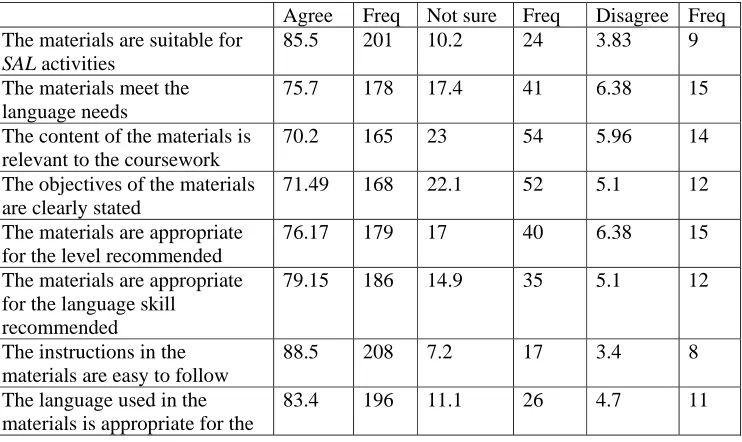
Table 4.2: Students’ views on the self-access learning materials.
Agree Freq Not sure Freq Disagree Freq
The materials are suitable for SAL activities
85.5 201 10.2 24 3.83 9
The materials meet the language needs
75.7 178 17.4 41 6.38 15
The content of the materials is relevant to the coursework
70.2 165 23 54 5.96 14
The objectives of the materials are clearly stated
71.49 168 22.1 52 5.1 12
The materials are appropriate for the level recommended
76.17 179 17 40 6.38 15
The materials are appropriate for the language skill
recommended
79.15 186 14.9 35 5.1 12
The instructions in the materials are easy to follow
88.5 208 7.2 17 3.4 8
The language used in the materials is appropriate for the
level recommended The explanations in the materials are clear
77.8 183 16.6 39 5.1 12
The materials help to improve the language proficiency
79.5 187 13.6 32 6.4 15
The materials help to improve the language skills
81.3 191 12.8 30 5.5 13
The design of the materials is attractive
56.2 132 26.8 63 17 40
The materials are clearly labelled
74.5 175 12.3 29 13.2 31
There are enough materials available for them to choose from
65.5 154 18.7 44 15.8 37
The different levels contain sufficient number of learning materials
60.4 142 28.1 66 11.1 26
As shown in Table 4.2, the majority (88.5%) of the students seemed to agree that the
instructions in the materials were easy to follow. 77.8% of the students agreed that the
explanations in the materials were clear, 71.5% of the students agreed that the
objectives of the materials were clearly stated, and 70.2% of the students claimed that
the contents of the materials were relevant to their coursework.
In terms of the appropriateness of the materials, 85.5% of the students surveyed
agreed that the materials for the self-access learning activities were suitable for them,
76.2% of the students claimed that the materials were appropriate for the levels
recommended, and 79.2% of the students thought the materials were suitable for the
language skills recommended. The students (65.5%) found that there were sufficient
materials for them to choose from, and 60.4% of the students agreed that the different
In relation to the language used in the materials, 75.7% of the students agreed that the
materials meet their language needs, and 83.4% of the students agreed that the
language used in the materials were appropriate for the level recommended.
In terms of the benefits gained from the materials, 77.8% of the students in this survey
believed that the self-access learning materials have helped them improve their
language proficiency and 81.3% of the students claimed that the materials have
helped them improve their language skills.
Although most of the students highly agreed with the quality, suitability, language and
benefits of the self-access materials, only 56.2% of the students thought that the
design of the materials were attractive. The students’ claims in relation to the
attractiveness of the materials were supported by the suggestion that they had made in
the open-ended section. The following are the suggestion made by the students about
the self-access learning materials:
It should be made more attractive and interesting.
Provide more interesting and attractive design for future materials.
In conclusion, the results from this section revealed that most of the students agreed
that the self-access learning materials were suitable for independent learning. They
believed that the materials were appropriate for the level and language skills
recommended. The students were satisfied with the quality of the materials such as
the objectives of the materials were clearly stated, instructions were easy to follow
appropriate to the students’ needs and the level recommended. Despite the suitability,
quality and sufficiency of the self-access learning materials, some of the students
thought that the materials should be interesting and attractive. Since the materials
were for independent learning, having attractive appearance might attract students’
attention. Therefore, it is reasonable for some of the students to suggest for more
attractive materials in the future.
4.3 Students’ Views on the Self-Access Learning Laboratory
This section reports the findings on the UTM students’ views of the self-access
learning laboratory.
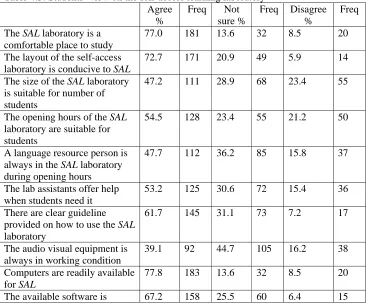
Table 4.3: Students’ view on the self-access learning laboratory
Agree %
Freq Not sure %
Freq Disagree %
Freq
The SAL laboratory is a comfortable place to study
77.0 181 13.6 32 8.5 20
The layout of the self-access laboratory is conducive to SAL
72.7 171 20.9 49 5.9 14
The size of the SAL laboratory is suitable for number of students
47.2 111 28.9 68 23.4 55
The opening hours of the SAL laboratory are suitable for students
54.5 128 23.4 55 21.2 50
A language resource person is always in the SAL laboratory during opening hours
47.7 112 36.2 85 15.8 37
The lab assistants offer help when students need it
53.2 125 30.6 72 15.4 36
There are clear guideline provided on how to use the SAL laboratory
61.7 145 31.1 73 7.2 17
The audio visual equipment is always in working condition
39.1 92 44.7 105 16.2 38
Computers are readily available for SAL
77.8 183 13.6 32 8.5 20
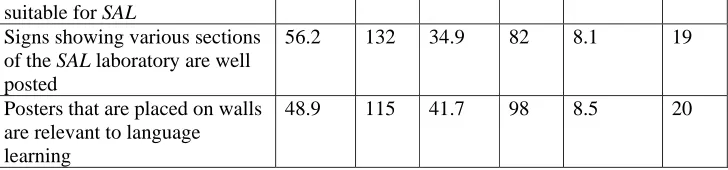
suitable for SAL
Signs showing various sections of the SAL laboratory are well posted
56.2 132 34.9 82 8.1 19
Posters that are placed on walls are relevant to language learning
48.9 115 41.7 98 8.5 20
Table 4.3 above shows an analysis of the responses concerning students’ views of the
self-access learning laboratory. The results indicated that 77.0% of the students
agreed that the self-access learning laboratory was a comfortable place to study and
72.7% claimed that the layout of the laboratory was conducive for self-access
learning. However, 23.4% of the students seemed to disagree on the size of the
self-access learning laboratory. The students thought that the laboratory was not suitable
for the number of students.
In terms of the management and services available at the self-access learning
laboratory, 54.5% of the students agreed that the opening hours of the self-access
learning laboratory were suitable for the students. However, only 47.7% of the
students agreed that a language resource person was always present in the self-access
learning laboratory during the opening hours. While 53.2% of the students claimed
that the lab assistants offered help when they need it.
In relation to the facilities available at the self-access learning laboratory, 61.7% of
the students agreed that the guidelines provided on how to use the self-access learning
laboratory were clear. The students rated highly the statements concerning the
availability of computers for the self-access learning laboratory, which is 77.8%.
However, the students were not really satisfied with audio-visual equipment that is
equipment were always in working condition. 67.2% of the students claimed that the
available software were suitable for the self-access learning laboratory.
Concerning the signage at the self-access laboratory, 56.2% agreed that the signs
showing various sections of the self-access laboratory were well posted. 48.9% of the
students indicated that the posters that were placed on walls were relevant to language
learning.
In the open-ended question, the students had provided a few suggestions to improve
the self-access laboratory. Some of the suggestions are:
Computer must be upgraded. Server should be faster.
Extend the lab opening hours until night. Provide more facilities and materials.
In conclusion, although the majority of the students were satisfied with the condition,
management, services, facilities, and signage of the self-access laboratory, these
students had suggested ways of upgrading the self-access laboratory. When
responding to the questionnaire, the students agreed that computers were readily
available for self-access learning, however, in the open-ended questions, these
students suggested that the computers need to be upgraded. The students also
suggested that the server should be faster. Although they agreed with the facilities of
the self-access laboratory, in the open-ended question these students suggested for
4.4 Students’ Language Learning Needs
The following sections examine how students rate their language learning needs
according to the four basic language skills: reading, writing, listening, and speaking.
4.4.1 Reading Skills
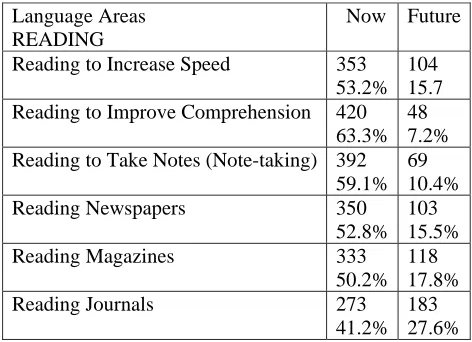
The findings in Table 4.4 below show that 63.3% of the students felt that to fulfil their
present need they have read to improve their comprehension. In contrast, only 7.2% of
the students thought that in future they might need to read to improve their
comprehension. 59.1% of the students claimed that now they had to read to take notes
(note-taking). The students thought that at present, it is also important for them to read
to increase speed, therefore, 53.2% of the students rated this item. 52.8% of the
students rated reading newspapers as their present need. Concerning reading
magazines and journals, 50.2% and 41.2% students respectively rated reading as their
present need.
Table 4.4: Language learning needs – reading skills
Language Areas READING
Now Future
Reading to Increase Speed 353 53.2%
104 15.7 Reading to Improve Comprehension 420
63.3% 48 7.2% Reading to Take Notes (Note-taking) 392
59.1% 69 10.4% Reading Newspapers 350
52.8% 103 15.5%
Reading Magazines 333
50.2% 118 17.8%
Reading Journals 273
In conclusion, the overall findings indicated that the students rated they need to read
more now than in the future. The order/sequence of the students’ needs to read now
are: i) to read to improve comprehension, followed by ii) to take notes (note-taking)
and iii) to increase speed. These three aspects seemed to be rated higher compared to
reading newspapers, magazines, and journals. It is obvious that most of the students in
this research need to acquire the reading skills mentioned now so as to prepare
themselves for their academic purposes. However, the students rated reading
newspapers, magazines, and journals as reading for pleasure.
4.4.2 Writing Skills
Table 4.5 below shows the analysis of the responses concerning students’ needs of
their writing skills. 67.3% of the students indicated that they needed the skills to write
essay/composition now. Writing summary was identified by 65.2% of the students as
the skills that they needed at present too. 39.8% of the students rated writing thesis as
the need for future. Although 37.1% of the students agreed that writing curriculum
vitae/resume was a need for the future, 33.8% of the students thought writing
curriculum vitae/resume was a present need. Writing essay/composition and writing
summary, 7.7% and 5.4% of the students respectively thought as less needed writing
Table 4.5: Language learning needs – writing skills
Language Areas WRITING
Now Future
Writing Essays/Compositions 446 67.3%
36 5.4%
Writing Thesis 231
34.8% 264 39.8%
Writing Memos 222
33.5% 251 37.9
Writing Minutes 222
33.5% 251 37.9%
Writing Reports 319
48.1% 156 23.5%
Writing Summary 432
65.2% 51 7.7% Writing Curriculum Vitae/resume 224
33.8% 246 37.1%
Writing Letters 313
47.2% 119 17.9%
In conclusion, the majority of the students showed that they need writing skills such
as writing memos and writing minutes for present and future need. The students also
seemed to rate writing thesis as their need in the future. This shows that the students
in this study understand that they have to write thesis in their final year; therefore,
they need this skill in the future. Writing essay/composition and writing summary
seemed to be of lesser need in the future. The students need these two skills now for
their academic purposes.
4.4.3 Listening Skills
As shown in Table 4.6 below, the majority (66.2%) of the students rated listening to
lectures as their need at present. This statement is only rated by 4.5% of the students
interview skills in the future. Listening to business meetings were rated by 54.0% of
the students as their future needs. In contrast, only 22.5% of the students rated the
same item as they need the skills now. Listening to radio, movies/TV, and telephone
conversations, which is 56.0%, 54.3%, and 50.7% respectively seemed to be the
students’ needs at present.
Table 4.6: Language learning needs – listening skills
Language Areas LISTENING
Now Future
Listening to Lectures – Note-taking 439 66.2%
30 4.5% Listening to Documentaries 278
41.9% 200 30.2% Listening to Interviews 234
35.3 247 37.3% Listening to Business Meetings 149
22.5 358 54.0% Listening to Movies / TV 360
54.3% 80 12.1% Listening to Radio 371
56.0% 80 12.1% Listening to Telephone Conversations 336
50.7% 110 16.6%
In conclusion, listening to interviews was closely rated as a need for now and future.
However, slightly more students thought that they needed the interview skills for their
future than those who need it now. Listening to radio, movies/TV, and telephone
conversations seemed to be the immediate need. These listening skills may be seen by
students as useful skills for personal purposes when they are students. Therefore, they
4.4.4 Speaking Skills
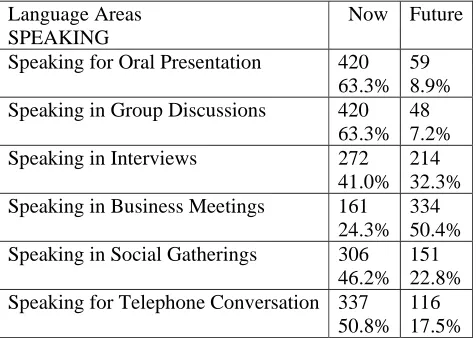
Table 4.7: Language learning needs – speaking skills
Language Areas SPEAKING
Now Future
Speaking for Oral Presentation 420 63.3%
59 8.9% Speaking in Group Discussions 420
63.3% 48 7.2% Speaking in Interviews 272
41.0% 214 32.3% Speaking in Business Meetings 161
24.3% 334 50.4% Speaking in Social Gatherings 306
46.2% 151 22.8% Speaking for Telephone Conversation 337
50.8% 116 17.5%
The findings in Table 4.7 above show that 63.3% of the students believed that
speaking for oral presentations were their present needs. Similarly, 63.3% of the
students rated speaking in group discussions were their present need. 50.4% of the
students rated speaking in business meetings to be their future needs. Speaking in
interviews was closely rated, that is 41.0% of the students needed the skills now while
32.3% of the students needed it in the future.
In conclusion, the majority of the students rated the speaking skills that they need to
learn or for academic purposes, such as speaking for oral presentations, group
discussions, and interviews as their present needs. However, speaking in business
meetings were considered as future needs. Telephone conversations were considered
to be present need. However, social gatherings were thought to be important for now
CHAPTER V
CONCLUSIONS AND IMPLICATIONS OF THE STUDY
In this chapter the findings of the study will be summarised, followed by a discussion
on the implications, suggestions for further research and the conclusion.
5.1 Summary of Findings
Based on the findings, several points which highlight crucial elements of SAL have surfaced and should be taken into consideration in future implementations of SAL. These points are:
• Students' Views on the Self-Access Learning Programmes
• Students’ Views on the Self-Access Learning Materials
• Students’ Views on the Self-Access Learning Laboratory
• Students’ Language Learning Needs
5.1.1 Students' Views on the Self-Access Learning Programmes
The students responded positively towards the self-access learning programmes in
these programmes. Apart from that, they showed readiness to assume the role of
active, autonomous learners when the need arises, and are in turn motivated to further
enhance themselves in the context of language proficiency and skills. Despite their
inclination towards autonomy, they still recognise the need and role of the lecturer as
their guide in the learning process. These are facts that should be reflected and
capitalised upon.
5.1.2 Students’ Views on the Self-Access Learning Materials
Overall, the students are satisfied with the materials used in the self-access learning
programmes, and agree that the materials are of good quality, appropriate and
sufficient. However, students have shown some concern with regards to the
attractiveness of the materials. This should be worked upon, since it could indirectly
affect the students’ drive for independent learning.
5.1.3 Students’ Views on the Self-Access Learning Laboratory
While the students are contented with layout, signage, posters, availability of
computers as well as the personnel at the laboratory, they have pointed out several
aspects which need change and/or improvement. These include the maintenance of the
audio-visual equipment, the laboratory’s size and opening hours, the Internet server’s
students suggests that they take aspects like flexibility as well as quality of the
learning experience seriously.
5.1.4 Students’ Language Learning Needs
In terms of their language learning needs, the students are mostly interested in
acquiring skills that they perceive as necessary in present time; namely reading,
writing, listening and speaking skills which are either academic-related skills or skills
that they can put to good use in their campus life. This implies that the students are
clear on the skills they need to know and have, in both present time and the near
future.
5.2 Implications of the Study
The first implication is the importance of obtaining students’ feedback with regards to
the design and implementation of the SAL programme. It is a naturally essential step in the evaluation phase, simply because the students are the ‘clients’ and ‘end-users’
of the programme in its entirety. From the feedback obtained, useful information that
reflect the overall quality of the programme can be gain