Jurnal Teknologi, 42(F) Jun. 2005: 67–74 © Universiti Teknologi Malaysia
1
Department of Polymer Engineering, Universiti Teknologi Malaysia, 81300, Skudai, Johor, Malaysia. 2
Faculty of Applied Sciences, Asian Institute of Medicine, Science & Technology (AIMST) 2, Persiaran Cempaka, Amanjaya, 08000, Sungai Petani, Kedah, Malaysia.
PROCESSABILITY STUDY OF ABS IMPACT MODIFIED PVC-U COMPOSITES -- EFFECT OF RICE HUSK ASH (RHA) FILLERS
AND COUPLING AGENTS
AZMAN HASSAN1 & K.SIVANESWARAN2
Abstract. A processability study was conducted to investigate the fusion behavior of RHA filled ABS (Acrylonitrile Butadiene Styrene) modified PVC-U (Unplasticisied Polyvinyl Chloride) using Brabender torque rheometer. The objective of this study is to investigate the effect of RHA loading and types of coupling agents on the fusion behavior of impact modified PVC-U. The study showed that in ABS impact modified PVC, RHA loading increased the fusion time. The torque decreased marginally with RHA loading. Treating the PVC compound with coupling agent increased the fusion time. The torque, however, reduced when the filled RHA PVC composites were treated with LICA 12.
Keywords: PVC-U, processability study, Brabender torque rheometer, fusion properties, rice husk ash
Abstrak. Kajian kebolehpemprosesan dilakukan untuk menyelidik sifat lakuran PVC tegar (PVC-U) terubahsuai hentaman terisi abu sekam padi (RHA) menggunakan reometer tork Brabender. Tujuan kajian adalah untuk mengetahui kesan penambahan RHA dan jenis agen penggandingan terhadap sifat lakuran terubahsuai hentaman PVC-U. Kajian menunjukkan bahawa dalam kes terubahsuai hentaman PVC-U, penambahan RHA meningkatkan masa pelakuran. Tork berkurang dengan penambahan RHA. Penyebatian adunan PVC bersama dengan agen penggandingan meningkatkan masa lakuran. Walau bagaimanapun, tork berkurang apabila komposit PVC-U tersisi RHA ditambah dengan LICA 12.
Kata kunci: PVC-U, kajian kebolehprosesan, reometer tork Brabender, sifat lakuran, abu sekam padi
1.0 INTRODUCTION
for the rapid growth of PVC is its processability by a variety of techniques such as extrusion, calendaring, and injection moulding.
However, unmodified PVC-U has the disadvantage of being prone to occasional brittleness and is notch sensitive. Impact modifier is therefore, one of the important additives used to enhance the impact properties of PVC [5]. The impact modifier, which is in rubbery phase, is capable in facilitating the yielding of the PVC matrix before failure when sudden load is applied. Several types of impact modifiers are currently available which include acrylate and chlorinated polyethylene (CPE) ABS [6].
Cost is one of the important factors considered when selecting materials for any application. Therefore, in thermoplastics, fillers are often used to reduce the cost of the products. However, the incorporation of filler in PVC may also modify the processability and mechanical properties of the products [7]. Calcium carbonate is the most popular type of filler for PVC because of its excellent combination of low cost, high brightness, and the ability to be used at high loadings. Besides mineral fillers, the use of natural fillers is gaining popularity [8,9]. These natural fillers have the advantages of low densities, low cost, non-abrasiveness, recyclability, biodegradability, and renewable nature [10]. As the field of plastics developed and expanded, a variety of naturally occurring materials were explored such as wood flour, oil palm empty fruit bunch (EFB), and rice husk (RH).
In Malaysia, RH is one of the biomass materials which is a by-product from the rice industry. RH contains cellulose 35%, hemi-cellulose 25%, lignin 20%, and ash 17% (silica 94%), by weight [11]. Applications of RH include as fuel in heat generation for drying rice, used in making cement, and as a fertilizer in agriculture. However, the industrial applications of this material are limited. The rest is burned or used for land-filling. Therefore, more efficient utilization of rice husk is urgently needed. One of the efforts is to produce value-added products such as composite materials from this important bio-sources. Utilization of RH offers some economical and environmental advantages too. There has been considerable effort and interest in the addition of RH and RHA to thermoplastics [11-15].
Fuad et al. [11] revealed the effect of white rice husk ash (WRHA) and black rice husk ash (BRHA) on PP matrix using a twin screw compounder. WRHA comprises of approximately 96% (w/w) silica while BRHA contains only about 56% (w/w). Both types of fillers exhibited their capability of enhancing the tensile modulus at the expense of tensile and impact properties.
and a number of methods have become available for the assessment of PVC fusion [18,19].
In this project, Brabender torque rheometer was used to study the processability of PVC compound by determining the fusion behaviour during processing. The Brabender torque rheometer is a torque measuring rheometer which can be interchangeably attached to a number of different measuring heads. Due to its flexibility in shear rates and reasonably good temperature control, the equipment is uniquely suited to investigate the fusion behavior of PVC. The Brabender torque rheometer is an invaluable tool for the polymer technologist, which is used to predict processability performance before committing large amounts of time and materials [20]. Aznizam et al. [21] investigated the effect of incorporating EFB into PVC-U on the fusion time and the end torque using Brabender torque rheometer. The results showed that the incorporation of EFB filler into PVC-U decreased the fusion time and the end torque.
This paper reports on the utilization of rice husk ash as a filler in ABS impact modified PVC-U composites. The main objective of the research reported in this paper is to determine the effect of RHA filler content on the processability, as determined from the fusion time and torque. The other objective of this research is to determine the effect of coupling agent types on the fusion properties. Coupling agent is a type of additive that improves the interfacial adhesion by intermolecular bridge between the filler surface and the polymer matrix [11].
2.0 MATERIALS AND METHOD
The PVC used in this study is a suspension resin with solution viscosity K-value 66, supplied by Industrial Resin Malaysia (IRM). The formulations are based upon a tin stabilised commercial window profile with a slight modification. The additives used are shown in Table 1. The ABS impact modifier (Blendex 338) was fixed at 8 parts per hundred resin (phr) for all samples.
For the first objective, i.e. the effect of RHA filler content, RHA was varied from 0, 10, 20, 30, and 40 phr. For the second objective, which is on the effect of coupling agent, three types of coupling agent were used.
weight of filler for Prosil 9234. The Prosil 9234 was diluted in ethanol to make up a 10% solution for better dispersion. The RHA filler was charged into a bench top tumbler mixer and the coupling agents were added slowly over a period of 15 minutes to ensure uniform distribution of the coupling agent. After completion of the PROSIL 9234 addition, the filler was continually mixed for another 30 minutes. The treated fillers were then dried at 100°C for about 2 hours.
Table 1 Additives used in PVC-U compound
Ingredient Parts per hundred Types Suppliers
(phr)
PVC 100.0 MH-66 (K-66) IRM Berhad
External lubricant 1.5 Stearic acid Ciba-Geigy
Internal lubricant 1.0 Calcium stearate Sun Ace Kakoh
Heat stabiliser 2.0 Tin Elf Atochem
Processing aids 2.0 Acrylic polymer Kaneka Malaysia
ABS impact modifier 8.0 ABS (Blendex 388) GE Specialty
Chemicals
Filler Varies (10, 20, 30, Rice husk ash Bernas Sdn. Bhd.
and 40)
Coupling agents (As explained in the Titanate (LICA 38 Kenrich Sdn. Bhd.
text) and LICA 12)
Silane (Prosil 9234)
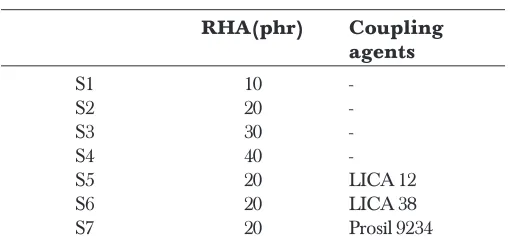
The blend formulations are shown in Table 2.
Table 2 Blend formulations
RHA(phr) Coupling
agents
S1 10
-S2 20
-S3 30
-S4 40
-S5 20 LICA 12
S6 20 LICA 38
S7 20 Prosil 9234
2.1 Fusion Study
possible for best reproducibility and comparability of test result [4]. This fusion behavior was studied by observing changes of torque and temperature with time.
3.0 RESULTS AND DISCUSSION
Based on the fusion characteristics of PVC-U compounds, two characteristics were studied; the fusion time and the torque at the equilibrium stage (end torque). The end torque was taken after 7 minutes when the torque had stabilized.
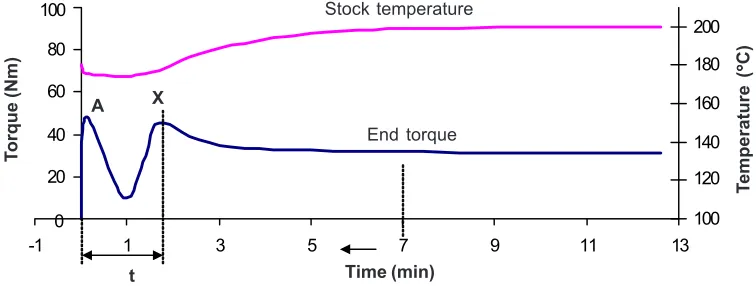
Figure 1 shows a typical fusion curve of the PVC-U compound obtained from the processability studies. The curve illustrates the changes of torque and temperature with time. The viscosity-related torque curve shows two different peaks. The first peak, A, in the torque curve was due to loading of sample, and the second peak, X, was due to compaction and onset of melting. When the PVC dry blend was loaded into the system, the initial peak was generated, then the torque began to decrease sharply because of the free material flow before it began to compact; the torque then began to increase and generated the second peak. At this peak, X, the material reached an effectively void-free stated and started to melt at the interface between the compacted material and the hot metal surface. The temperature and torque with respect to this point, X, is defined as fusion temperature and fusion torque, respectively. The time between the loading point A and the fusion point X is defined as fusion time, t.
Figure 1 Typical PVC-U compound fusion curve Time (min)
0 20 40 60 80 100
-1 1 3 5 7 9 11 13
100 120 140 160 180 200
T
orque (Nm)
Stock temperature
T
emperature (
°°°°°
C)
A X
t
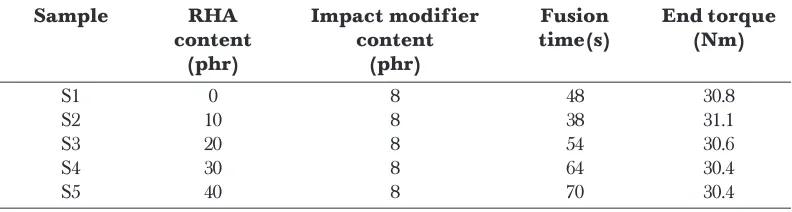
The effect of RHA content upon fusion time and end torque were studied on the ABS impact modified PVC-U samples. The RHA content ranged from 10, 20, 30, and 40 phr. The content of impact modifier was fixed at 8 phr as used throughout the study. Table 1 shows that the fusion time decreased upon the incorporation of 10 phr RHA. However, the fusion time increased with further RHA loading.
The increase in RHA loading (from 10 to 20 phr and higher) can hinder the processing aid from functioning effectively to promote fusion resulting in an increase
in fusion time. The other reason for the increase in fusion time is that the tendency of filler agglomeration increases with filler loading. This may increase the separation among PVC resin particles, resulting in the decrease of heat transfer throughout the PVC compound. Since shear is also a factor that controls the fusion of PVC, higher filler loading will decrease the shear between PVC particles, resulting in a slower fusion rate.
Aznizam et al. [21] in their study on the effect of EFB fillers on processability of unmodified PVC-U compound found that fusion time decreases with EFB fillers loading. This is because EFB contains residual oil that promotes fusion in the PVC compound.
The result in Table 2 also shows that the incorporation of RHA filler reduced the end torque of PVC-U compound slightly due to the separation of PVC particles. Reductions of the end torque means reducing in melt viscosity by which less force is required to continue mixing and homogenizing the fused stock.
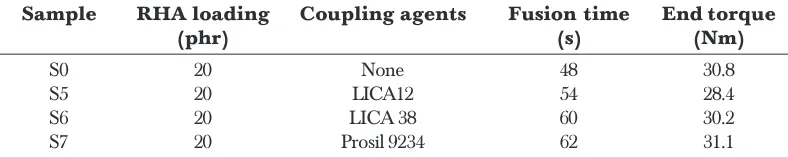
Table 3 shows that the coupling agent treated RHA filled impact modified PVC-U samples have longer fusion time than untreated sample. Shearing between the PVC primary particles is an important factor that promotes fusion. Therefore, the possible explanation for the longer fusion time of the coupling treated samples is that the coupling agent being in liquid form interferes with the shearing between primary particles of PVC. In a recent paper [22] on the processability study of calcium carbonate filled impact-modified PVC-U, treating the calcium carbonate fillers with LICA 38 was found to increase the fusion time. The results seems to be inconsistent with the finding from the present study.
A decrease in torque was observed with the addition of LICA 12, as shown in Table 4. The presence of a monomolecular layer of a surface coating resulted in soft agglomerates that were easier to break down by the low-level mechanical energy, resulting in the reduction of torque. The effects of LICA 12 and Prosil 9234 on end torque are, however, minimal.
Table 3 Effect of RHA content on fusion time and end torque of impact-modified PVC-U
Sample RHA Impact modifier Fusion End torque
content content time(s) (Nm)
(phr) (phr)
S1 0 8 48 30.8
S2 10 8 38 31.1
S3 20 8 54 30.6
S4 30 8 64 30.4
4.0 CONCLUSION
The processability study using Brabender torque rheometer showed that in ABS impact modified PVC, RHA loading increased the fusion time. The torque decreased marginally with RHA loading. Treating the PVC compound with coupling agent also increased the fusion time. However, the end torque reduced when the filled RHA was treated with LICA 12.
ACKNOWLEDGEMENTS
The authors would like to thank the Ministry of Science, Technology and Environment of Malaysia for sponsoring this work under IRPA project (Vot 72197). The authors would also like to thank Industrial Resin Malaysia for the material support.
REFERENCES
[1] Kaufman, M. 1969. The History of PVC. London: Elsevier.
[2] Penn, W. S. 1971. PVC Technology. 3rd edition. United Kingdom: Applied Science Publishers. [3] Mathews, G. 1996. PVC Production, Properties and Uses. 1st edition. London: Institute of Materials. [4] Titow, W. V. 1984. PVC Technology. New York: Elsevier Applied Science Publishers. 1233.
[5] Petrich, R. P., and J. T. Lutz. 1986. Polymeric Modifiers: Types, Properties, and Performance. Journal of Vinyl Technol. 5: 391-497.
[6] Lutz, J. T. 1993. Impact Modifiers for PVC. Journal of Vinyl Technology. 15 (2): 82.
[7] Tapper, M. 1985. The Use of Mineral Fillers in PVC: A Review of Principles. Pennsylvania: Pfizer Inc. Easton. 129-144.
[8] Ferrigno, T. H., and E. J. Wickson. 1993. Carbonate Fillers. In Wickson, E. J. Handbook of PVC Formulating. New York: John Wiley and Sons Inc. 395-429.
[9] Braddicks, R. P. Jr. 1977. Fillers. In Nass, L. I. Encyclopedia of PVC. New York: Marcel Dekker Inc. 713-748.
[10] Nabi Saheb, D., and J. P. Jog. 1999. Natural Fiber Polymer Composites: A Review. Advance in Polymer Technology. 18 (4): 351-363.
[11] Ahmad Fuad, M. Y., Z. Ismail, Z. A. M. Ishak, and A. K. Mohd Omar. 1995. Application of Rice Husk Ash as Fillers in Polypropylene: Effect of Titanate, Zirconate and Silane Coupling Agents. European Polymer Journal. 31(9): 885-893.
[12] Hattotuwa, G. B. P., H. Ismail and A. Baharin. 2002. Comparison of the Mechanical Properties of Rice Husk Powder Filled Polypropylene Composites with Talc Filled Polypropylene Composites. Polymer Testing. 21: 833-839.
Table 4 Effects of coupling agents on fusion time and end torque of RHA filled impact modified PVC-U
Sample RHA loading Coupling agents Fusion time End torque
(phr) (s) (Nm)
S0 20 None 48 30.8
S5 20 LICA12 54 28.4
S6 20 LICA 38 60 30.2
[13] Siriwardena, S., H. Ismail, U. S. Ishiaku, and M. C. S. Perera. 2002. Mechanical and Morphological Properties of White Rice Husk Ash Filled Polypropylene/Ethylene-Propylene-Diene Terpolymer Thermoplastic Elastomer Composites. Journal of Applied Polymer Science. 85: 438-453.
[14] Hassan, A., and S. K. Kannan. 2001. Effect of Titanate, Zirconate and Silane Coupling Agent in Rice Husk Ash-filled PVC-U Composites. Journal of the Institute of Materials Malaysia. 2(2): 31-42.
[15] Ismail, H., and L. Mega. 2001. The Effects of a Compatibilizer and Silane Coupling Agent on the Mechanical Properties of White Rice Husk Ash Filled Polypropylene/Natural Rubber Blend. Polym.-Plast. Technology Eng. 40(4): 463-478.
[16] Marshall, G. P., and M. W. Birch. 1982. Design for Toughness in Polymers. 3. Criteria for High Toughness in UPVC Pressure Pipes. Plast. Rubb Proc. & Applic. 2: 369-79.
[17] Benjamin, P. 1980. Fusion of PVC. Plastics Rubber Materials & Applications. 5:151.
[18] Gilbert, M., D. A. Hemsley, and A. Miadonye. 1983. Assessment of Fusion in PVC Compounds. Plast. Rubb. Proc. & Applic. 3: 343-51.
[19] Summers, J. W., and E. B. Rabinovitch. 1981. Use of Acetone in Determining Poly(vinyl chloride) Processing Morphology and Product Morphology. J. Macromol. Sci., Phys. B20: 193-201.
[20] Hawkins, T. 1982. Evaluation of PVC Compound on the Brabender Torque Rheometer. Journal of Vinyl Technology. 4 (3): 110-114.
[21] Abu Bakar, A., A. Hassan, and A. F. Mohd Yusuf. 2004. Mechanical Properties and Processability of Empty Fruit Bunch Filled Unplasticised Poly (Vinyl Chloride) Composites. 3rd USM-JIRCAS Joint International Symposium. Penang, Malaysia.