i
A HIGH SPEED 2D CONVOLUTION HARDWARE MODULE FOR IMAGE PROCESSING APPLICATIONS IN FPGA
BEENAL BABA
i
A HIGH SPEED 2D CONVOLUTION HARDWARE MODULE FOR IMAGE PROCESSING APPLICATIONS IN HARDWARE
BEENAL BABA
A project report submitted in partial fulfilment of the requirements for the award of the degree of
Master of Engineering (Electrical - Computer and Microelectronic System)
Faculty of Electrical Engineering Universiti Teknologi Malaysia
iii
iv
ACKNOWLEDGEMENT
Foremost, I would like to express my sincere gratitude to my advisor, Prof. Dr. Mohamed Khalil bin Hj Mohd Hani for the continuous support, patience, motivation, enthusiasm and immense knowledge. His guidance helped me in all the time of this project and writing of this thesis.
I would also like to extend my appreciation to Intel Microelectronics (M) Sdn. Bhd. for funding my studies. Special thanks to my manager as well as my colleagues who had provided me with help and support throughout the duration of my studies.
v
ABSTRACT
vi
ABSTRAK
vii
TABLE OF CONTENTS
CHAPTER TITLE PAGE
DECLARATION ii
DEDICATION iii
ACKNOWLEDGEMENT iv
ABSTRACT v
ABSTRAK vi
TABLE OF CONTENTS vii
LIST OF TABLES x
LIST OF FIGURES xi
LIST OF ABBREVIATIONS xiv
LIST OF APPENDICES xv
1 INTRODUCTION 1
1.1 Background 1
1.2 Motivation and Problem Statement 2
1.3 Objectives 3
1.4 Scope of Work 3
2 THEORY AND LITERATURE REVIEW 5
2.1 Convolution Operation 5
2.2 Gaussian Kernel 8
2.3 Literature Review 10
viii
3.1 Design Methodology 17
3.2 Design Tools 21
3.2.1 MATLAB 21
3.2.2 Verilog HDL 22
3.2.3 Quartus II 12.1sp1 23
3.2.4 Modelsim 10.1b 25
3.2.5 DE2 Development and Education Board 26
4 DESIGN IMPLEMENTATION 29
4.1 Design Specification 29
4.2 Software Design using Matlab 31
4.3 2D Convolution Designs 34
4.3.1 Barrel Shifter based 2D convolution 35 4.3.1.1 1D convolution with Barrel Shifter DU
35
4.3.1.2 Barrel Shifter based 2D convolution
41 4.3.1 Multiplier based 2D convolution 50
4.3.2.1 1D convolution with Multiplier DU
50 4.3.2.2 Multiplier based 2D
convolution
55
5 DESIGN VERIFICATION AND PERFORMANCE
ANALYSIS
64
5.1 1D Convolution Quartus II Simulation 64 5.2 2D Convolution Quartus II Simulation 67
5.4 Performance Analysis 74
7 CONCLUSION AND FUTURE WORK 76
7.1 Conclusion 76
ix
REFERENCES 79
x
LIST OF TABLES
TABLE NO. TITLE PAGE
4.1 RTL-CS Table for Control Unit of Barrel Shifter Based 1D Convolution Unit
40 4.2 RTL-CS Table for 2D Convolution Control Unit 47 4.3 RTL-CS Table for Control Unit with Multiplier in DU 54 4.4 RTL-CS Table for 2D Convolution Control Unit 60
xi
LIST OF FIGURES
FIGURE NO. TITLE PAGE
2.1 Moving Kernel from Point to Point on an Image 6 2.2 (left) 3x3 Kernel, (right) Kernel Coincides with Image,
(bottom) 2D Convolution Equation Based on the Image and Kernel Coordinates
7
2.3 2D Convolution 8
2.4 Bell Shaped Gaussian Function 9
2.5 Log Based Convolution Model 11
2.6 Kernel Architecture for 3x3 kernel 11
2.7 2D Convolution Architecture 12
2.8 2D Convolution Represented by 1D Convolution 13
2.9 Multiplier Based 1D Convoler 14
2.10 Barrel Shifter Based 1D Convoler 14
2.11 Barrel Shifter Based 2D Convoler 15
2.12 2D Convolution on GPU, CPU and FPGA 15
2.13 SRAM-based FPGA Design 16
3.1 2D Convolution Design Flow 18
3.2 RTL Design Design Flow 19
3.3 Verilog HDL Design Flow 23
3.4 Quartus II Design Flow 24
3.5 Quartus II Compilation Flow 25
3.6 Modelsim Simulation Flow 26
3.7 DE2 Board 27
3.8 SignalTapII Logic Analyzer Flow 28
xii
4.2 Gaussian Filter Matlab Code 32
4.3 (left) Original Image with Gaussian Noise (right) Gaussian Filtered Image
33
4.4 TInput Image Matrix from Matlab 33
4.5 Input Image in .mif File Format 33
4.6 Moore Model Control Unit(CU) 35
4.7 DFG for (left) [1 2 1] Kernel (right) [2 4 2] Kernel 37 4.8 Barrel Shifter based 1D Convolution ASM Chart 38 4.9 IO Block Diagram for Barrel Shifter Based 1D Convolution 39 4.10 Datapath Unit(DU) for Barrel Shifter Based 1D Convolution 39 4.11 Control Unit (CU) for Barrel Shifter Based 1D Convolution 41 4.12 Barrel Shifter Based 1D Convolution Top ModuleI 41 4.13 Barrel Shifter based 2D Convolution ASM Chart 43 4.14 Block Diagram for Barrel Shifter Based 2D Convolution 44 4.15 Functional Block Diagram of Sub-Module shift_121 45 4.16 Functional Block Diagram of Sub-Module shift_242 45 4.17 Datapath Unit(DU) for Barrel Shifter Based 2D Convolution 46 4.18 Control Unit (CU) for Barrel Shifter Based 2D Convolution 48 4.19 FPGA Friendly Block Diagram for Barrel Shifter Based 2D
Convolution
49
4.20 Quartus II Compilation for Barrel Shifter Based 2D Convolution
50
4.21 DFG for both [1 2 1] and [2 4 2] Kernel 51
4.22 Multiplier based 1D Convolution ASM Chart 52
4.23 IO Block Diagram for Multiplier Based 1D Convolution 53 4.24 Datapath Unit(DU) for Multiplier Based 1D Convolution 53 4.25 Control Unit (CU) for Barrel Shifter Based 1D Convolution 55
4.26 Multiplier Based 1D Convolution Top Module 55
4.27 Multiplier based 2D Convolution ASM Chart 57
4.28 Block Diagram for Multiplier Based 2D Convolution 58
4.29 Multiplier module for 1D Kernel 59
xiii 4.32 FPGA Friendly Block Diagram for Multiplier Based 2D
Convolution
62
4.33 Quartus II Compilation for Barrel Shifter Based 2D Convolution
63
5.1 Input Pixels with the Expected Output Pixels 65 5.2 Testbench for Barrel Shifter based 1D convolution module 66 5.3 Waveform for Barrel Shifter based 1D convolution module 66 5.4 Testbench for Multiplier based 1D convolution module 66 5.5 Waveform for Multiplier based 1D convolution module 66 5.6 Process to Validate 2D Convolution Module on Modelsim
tool
67
5.7 5x10 Random Input Pixels 68
5.8 Expected Output Pixels 68
5.9 Waveform for Barrel Shifter Based 2D Convolution Module 68 5.10 Waveform for Multiplier Based 2D Convolution Module 68
5.11 Dummy Memory Created for Testing 69
5.12 Expected Output Pixels 69
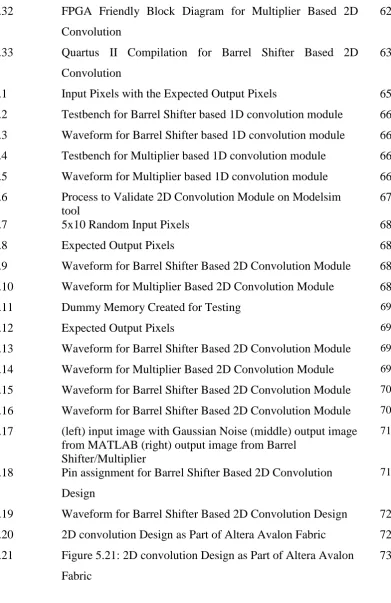
5.13 Waveform for Barrel Shifter Based 2D Convolution Module 69 5.14 Waveform for Multiplier Based 2D Convolution Module 69 5.15 Waveform for Barrel Shifter Based 2D Convolution Module 70 5.16 Waveform for Barrel Shifter Based 2D Convolution Module 70 5.17 (left) input image with Gaussian Noise (middle) output image
from MATLAB (right) output image from Barrel Shifter/Multiplier
71
5.18 Pin assignment for Barrel Shifter Based 2D Convolution Design
71
5.19 Waveform for Barrel Shifter Based 2D Convolution Design 72 5.20 2D convolution Design as Part of Altera Avalon Fabric 72 5.21 Figure 5.21: 2D convolution Design as Part of Altera Avalon
Fabric
xiv
LIST OF ABBREVIATIONS
ASIC - Application Specific Integrated Circuit ASM - Algorithmic State Machine
CAD - Computer Aided Design
CB - Computation Block
CLB - Configurable Logic Block CPU - Central Processing Unit
CU - Control Unit
DFG - Data Flow Graph
DIP - Digital Image Processing DSP - Digital Signal Processor
DU - Datapath Unit
FIFO - First In First Out
FIR - Finite Impulse Response
FPGA - Field Programmable Gate Array FSM - Finite State Machine
HDL - Hardware Description Language IC - Integrated Circuit
LAB - Logic Array Block
RAM - Random Access Memory
RTL - Register Transfer Level RTL-CS - RTL Control Sequence Verilog - Verilog HDL
xv
LIST OF APPENDICES
APPENDIX TITLE PAGE
A Barrel Shifter Based 2D Convolution Verilog Program 80
B Multiplier Based 2D Convolution Verilog Program 90
1
CHAPTER 1
INTRODUCTION
This project is about the hardware architecture design of a 2D convolution for spatial domain filter. The 2D convolution algorithm is implemented on the Field Programmable Gate Array (FPGA). This chapter gives an overview of the whole project, starts with a brief introduction to the background, followed by the problem statement, project objectives, scope of work and report outline.
1.1 Background
Visual information plays an essential role in almost all areas of our life. Hence, image processing becomes one of the highly researched subjects by many researchers around the world. Image processing can be divided into digital image processing and analog image processing. Digital image processing, has an obvious advantage as it allows a wider range of algorithms to be applied to the input data and can avoid problems like build-up of noise and signal distortion during processing. Over years, with the evolving technology of computers, digital image processing has become the most common form of image processing.
2 requirements. In such applications, for functions like image filtering, image restoration, object tracking, template matching and many others, the spatial domain two-dimensional (2D) convolution plays a pivotal role. Hence a lot of weight is given on 2D convolution studies and design improvements.
2D convolution algorithm can be realized on hardware using either one of the methods: Full custom hardware design (ASIC) or Semi-custom hardware devices which are programmable devices. ASIC definitely has an upper hand as it fully customized, hence able to deliver high performance. However, being costly, complex and less flexible for iterations as it comes with large costs of fabrication makes it a less popular choice for algorithm development. It is normally used in high volume commercial applications after the design is confirmed with it’s functionally and performance via Semi-custom hardware devices.
Semi-custom hardware devices further can be divided into two different categories, Digital Signal Processor (DSP) and Field Programmable Gate Array Logic (FPGA). Often, commercial DSPs are unable to support image convolution efficiently. For example, the TMS320C40 DSP microprocessor requires about 20 instructions per pixel when a 3x3 kernel is used [3]. Hence the need of parallelism and pipelining hardware is obvious.
FPGA as a programmable device which supports parallelism and pipelining hardware becomes an excellent choice. Adding on is the flexibility to change and modify the design at any point of time and reprogramming the device. Therefore FPGAs are ideal choice for hardware implementation of real-time image processing algorithms.
1.2 Motivation and Problem Statement
3 convolution efficiently, there is a need to have special purpose parallel hardware circuit for convolution that runs on high frequency and can be tested on FPGA. However in most designs, the multiplier operating frequency becomes the bottleneck. Besides that, in order to support real-time system, 2D convolution also requires an effective memory access algorithm so that all neighborhood pixels can be accessed within one clock cycle [1].
Various studies have been done on how to implement an algorithm on FPGA. However, there is always a lack of step by step documentation on how to do so specially for new students, besides the user manuals from the respective tools used. It is crucial to have such documents for educational purposes.
1.3 Objectives
The main objective of this project is to propose an enhanced version of hardware architecture design of 2D convolution for Gaussian filter in spatial domain. The 2D convolution algorithm is implemented on FPGA using Verilog HDL. This project designs a FPGA friendly 2D convolution design, while applying the concept of datapath pipelining. This project also implements parameterization to a certain level for design modularization. Efficient algorithms are implemented to access the entire neighborhood pixels defined by the convolution kernel within one clock cycle for real-time applications. In this project, two design options and architectures are explored for performance trade-off analysis.
1.4 Scope of Work
(672-4 pin package) FPGA that sits on the DE2 board. The design will be realized on FPGA with the help of Altera Quartus II version 12.1sps as a compiler and Modelsim version 10.1b as simulator. The design will be accomplished using Verilog HDL. A pipelined architecture is proposed to produce the output on every clock cycle.
The golden results will be obtained from MATLAB. This tool will be used to produce the software version results of the algorithm, and also to extract the input pixels of the image used. The design functionality will be verified by comparing the pixel output from the hardware simulation using Quartus II tool and the software version pixel output from MATLAB.
79
REFERENCES
[1] Ng Bee Yee, “FPGA Implementation of Image Processing 2D Convolution for Spatial Filter”, Universiti Teknologi Malaysia, June 2012.
[2] Anthony Edward Nelson, “Implementation of Image Processing Algorithms on FPGA Hardware”, Vanderbilt University, May 2000.
[3] Bernard Bosi, Guy Bois, Yvon Savaria, “Reconfigurable Pipelined 2-D Convolvers for Fast Digital Signal Processing’, IEEE Transaction on Very Large Scale Integration (VLSI) Systems, Vol. 7, No. 3, September 1999. [4] Ben Cope, “Implementation of 2D Convolution on FPGA, GPI and CPU,”
Department of Electrical & Electronic Engineering, Imperial College London.
[5] Ming Z. Zhang, Hau T. Ngo and Vijayan K. Asari, “Design of an Efficient Multiplier-less Architecture for Multi-Dimensional Convolution”, Old Dominion University, 2005.
[6] Ming Z. Zhang, Vijayan K. Asari, “An Efficient Multiplier-less Architecture for 2-D convolution with quadrant symmetric kernels”, INTEGRATION, the VLSI Journel 40 (2007) 490-502, July 2006.
[7] S. Perri, M. Lanuzza, P. Corsonello, G. Cocorullo, “SIMD 2-D Convolver for Fast FPGA-based Image and Video Processors”, Perri at al., Paper D2. [8] Francisco Fons, Mariano Fons, Enrique Canto, “Run-time self-configurable
2D Convolver for adaptive image processing,” Microelectronics Journal, August 2010.