A. Iglesias and N. Takayama (Eds.): ICMS 2006, LNCS 4151, pp. 320–330, 2006. © Springer-Verlag Berlin Heidelberg 2006
Technology Based Learning Environment: An
Implementation of a Mathematics Learning Framework
Zur’aini Dahlan1, Noraimi Shafie1, and Rozeha A. Rashid2
1 Science and Technology College, Universiti Teknologi Malaysia, City Campus,
Kuala Lumpur, Malaysia
2 Department of Telematics and Optics, Faculty of Electrical Engineering,
Universiti Teknologi Malaysia, Skudai, Johor Bharu, Malaysia
[email protected], [email protected], [email protected]
Abstract. In response to the current globalization in the educational arena, and to the new policy of change in the medium of instruction for teaching mathematics and science in English as implemented by the Malaysian Government in 2003, we introduce the e-learning Bilingual Model which has been designed and used at the university. The multimedia prototype of the model consists of text-based content for first-year mathematics subjects with exact forms available in both the English language and the native language. Content is identified to provide descriptions of core concepts dynamically using, audio, video and graphics, and also constructed to provide bilingual glossaries. The combination of Information Communication Technologies (ICT) such as Short Messaging Service (SMS), MOODLE e-learning, and Freeware Online-portals for Group-websites (FrOG) become the setting for an integrated framework for Technology Based Learning Environment, and work as instructional delivery tools in addition to the traditional method of teaching mathematics.
Keywords: bilingual model, multimedia prototype, and technology based learning environment.
1 Introduction
several language learning difficulties as indicated by several studies when two kinds of language conventions, that is the social language and the academic language, are now taking place in the classroom.
Researchers have found that students who are non-native English speakers attempt to read and write mathematics sentences the same way that they read and write standard narrative text. Usually they try to translate word-for word between a mathematical concept expressed in words and the concept expressed in symbols. However they do not realize that mathematical concept expressed in words often differs in its order from the way the concept is expressed in symbols. Dale and Cuevas (1992) offer as example the phrase eight divided by two which might be incorrectly translated to
2
8 rather than 2 8 ,
or the algebraic phrase, the number a is five less than the number b, which might be mistakenly restated as
a = 5 – b, when it should be a = b – 5.
Other difficulties that students may encounter are in the understanding of the specialized vocabulary and discourse features in the language of mathematics, and also in interpreting the meaning of logical connectors in mathematics discourse (Jarret, 1999).
Also, researchers believed that English as a second language (ESL) is best taught in natural situations, with the second language used in meaningful contexts rather than in repetitious drill of grammar and vocabulary. One variant of ESL, known as “sheltered subject-matter instruction”, adapts lessons according to students’ level of English proficiency. This approach is common in bilingual education programs, in which lessons are coordinated in students’ native language (Crawford, 1998).
In order to decide on the most appropriate approach to learning, some circumstances surrounding the learning was taken into account. For example, the bilingual, text-based mathematics prototype has an organization of instruction in which concepts are structured in increasing order of complexity. The learner can be introduced to the main concepts of a course and then move on to more of a self directed study that is meaningful to them and their particular context.
2 Designing the Bilingual Model
The construction of the prototype is based on several aspects including: the syllabus, the content experts’ opinion, the result of the Questionnaires and the Learning Style Inventory, as well as the learning theories and instructional design theories. Needs analysis was carried out in order to identify students’ learning characteristics, language preference, perceived helpfulness of e-learning, and preferred language of instruction as well. These will determine their preferences on the major features of the courseware (Dahlan, Mohd. Mahzir, 2004).
To ensure that the teaching and learning of mathematics in English will be implemented effectively, the learning system using multimedia tools and applications on the internet is developed to have features such as
• Presentation of mathematics problem and statement using simple and declarative sentence in English
• Having the Bahasa Melayu that is the native language version available for the same notes and example in English
• Video clips of selected lesson
• Narration for concept expressed in words and concept expressed in symbols
• Link of specialized vocabulary of mathematics in the notes with the corresponding social and mathematical meaning
The web-based learning system fully uses Macromedia Flash and Authorware as the foundation for the construction of online notes which is composed in the English version and the Bahasa Melayu version. For the glossary, PHP programming language and MySQL database are two components used in the search engine in order to display user’s search query. In addition, at the administrator’s site, PHP is also used to insert text and graphics in the glossary database; and similar components are used for constructing and managing quizzes. These multimedia tools together with the Apache web server are then linked in an existing university MOODLE e-learning system.
3 Multimedia Prototype
The multimedia web page for the subject is divided into three main pages. The first page contains the introduction and links to the second and third page. Website view of the first page is shown in Figure 1.
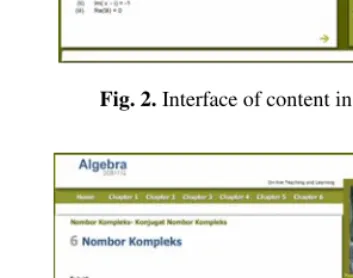
The second page contains subtopic of the access from the first page. Access of notes in both languages is available (as shown in Fig. 2 and Fig. 3); the contents are structured in order to comply to the learning of any individual being exposed to the topic for the first time. Video clips of selected lessons taught in English and also Bahasa Melayu are added for further understanding of any topics.
Fig. 1. Website view
Fig. 2. Interface of content in English
Fig. 3. Interface of content in Bahasa Melayu
Fig. 4. Audio sample for selected sentence
learners to realize that mathematical concept when expressed in words often differs in its order from the way when the concept is expressed in symbols.
The third page as shown in Fig.5 contains the search for words or mathematical terms which is hypertext from the notes oraccessed directly, from the database of the second page. The explanation of the mathematical term is given in both English and Bahasa Melayu. In obliging learners to understand the meaning of a word without any difficulty, short and simple descriptive phrase and presentation that is more acceptable to the general Malaysian scholar at the diploma level was prepared. The glossary section is most important in assimilating students with the use and the recognition of keywords. In reading sentence for mathematics subject in English, keyword recognition is one of the method that will help them to rapidly comprehend the context that is being discussed.
4 Implementation
The Mathematics Learning Framework includes the Short Messaging Service (SMS), MOODLE e-learning and Freeware Online-portals for Group-websites (FrOG), are examples of Information Communication Technologies (ICT) used as instructional delivery tools within the technology based instructional learning, in addition to the traditional method of teaching mathematics. The multimedia prototype, as a part of the e-learning package, is used as a supplementary learning tool after each lecture, in helping students to review mathematics easily and systematically. It is also enhanced with the combination of active and cooperative learning among learners.
Now that various forms of computer/mobile-mediated communication is available, learners have access to large amount of current information, which is constantly being added with a high rate of new information. The state of having excess of information and unable to make a decision or remain informed about a topic is often referred to information overload or “technostress” (Wikipedia, 2006). In order to avoid users from being controlled by ICT rather than being empowered by it, they need to be guided, coached, motivated, and trained to use the system effectively.
Hussin and Dahlan in 2005 selected the SMS/FrOG as additional instructional delivery tools since it deals directly with both learner and instructor as individuals and it penetrates or breaks all barriers between learner and instructor. It defies conventional definition of task execution and allows learning to occur in a multitude of on-job situations, thus the need to monitor learners and to get feedback from learners, or to give encouragement and motivation becomes simple and more efficient. It even challenges and redefines the roles or “learner” and “instructor”, by offering empowerment to anyone who masters the science (and art) of its application.
5 Finding and Discussions
All mature speakers of a language have knowledge about their language that is highly abstract, in other words they are able to distinguish between grammatical and ungrammatical sentences that differ only along this abstract dimension. This ability could not have been induced from simple exposure to the surface patterns of language but could have been acquired through a critical a prori knowledge about a language. For second language acquisition, the extension is that if learners successfully make similar distinctions, they must be able to follow their innate knowledge (Hakuta, McLaughlin, 1996).
From the linguistic perspectives, the rules of any grammar are highly abstract and do not reflect the surface properties of the language. Universal Grammar involves a set of principles with certain parameters which remain “open” until they are set by experience with the environment. Language acquisition is a process where the learner discovers how the principles operate in the target language and what parameter value apply. Furthermore, the grammar of a language is the set of values it assigns to various parameters (Hakuta, McLaughlin, 1996).
translation from the original statement in Bahasa Melayu. The reasoning behind this is when reading in English, the first year diploma students have the inclination towards translating word (in English) for word (into Bahasa Melayu), such that when they are reading mathematics reference text from an English publication the meaning of a sentence is lost in “their” translation.
Complex Number
Definition:
Number of the form a + b −1 or a + ib, with the imaginary number i = −1 and a,b ∈ℜ , is called a complex number.
Examples of complex numbers are:
3 - 2i, 1 + i,π + 3i, and also 2 + 0i = 2 or 0 + 5i = 5i .
Complex number of form a + ib is also known as complex number in rectangular form.
The set of complex number is C. This number consists of real and imaginary part. If z = a + ib that is
z
∈
C
, then the real part is Re(z) = Re(a + ib) = a, and the imaginary part is Im(z) = Im(a +ib) = b.The translation given below addressed the issue on how the parameters that have been set in the first language need to be reset or readjusted for the second language. Natural translation which refers to the cognitive skills involves, is applied here in order to enhance the contextual meaning and the link between the comprehension and meaning of the translation. The corresponding content in Bahasa Melayu statement is:
Nombor Kompleks
Takrif:
Nombor dalam bentuk a + b −1 atau a + ib, dengan nombor khayal i = −1 dan a,b ∈ℜ dipanggil nombor kompleks.
Contoh-contoh nombor kompleks ialah:
3 - 2i, 1 + i, π+ 3i , 2 + 0i = 2 , atau 0 + 5i = 5i .
Nombor kompleks dalam bentuk a + ib juga dikenali sebagai nombor kompleks dalam bentuk segiempat.
Set nombor kompleks ialah C. Nombor ini terdiri dari bahagian nyata dan bahagian khayal.
In this section, where the introduction to the imaginary number and the set of complex number is given, the learners have prior knowledge on the imaginary number. It was obtained when they were being taught the formula in finding roots of the quadratic equation. Once the learners have understood the construct of the imaginary number, they are able to apply the knowledge to other area that they have learned such as in the algebraic operations and exponential rule pertaining to the complex numbers without any difficulty.
Malakoff and Hakuta (1991) stated that bilingual has linguistic experience that is spread over two languages that are used in alternation. Experience is encoded in either one of the two languages and can be expressed in both languages. Similarly information representation can be switched between the languages. Most learning that is carried out in the first language readily transfers to English not only in content areas like mathematics, science and social studies, but also in skills, in speaking, reading and writing.
For type of content which involves concept or abstraction, such as in the definition of limit in calculus, the explanation on the concept in both languages is very extensive. The learner found it difficult to comprehend the meaning or understand the concept which is given in either the English or the native language at the first introduction. In this case, visual explanation is more appropriate and efficient in illustrating the idea.
When more complex challenges are given in mathematics, the Malaysian learners usually switch to the more dominant language that they have in order to understand or meet the challenges. Peal and Lambert in 1962 introduced the concept of “balanced” bilingual for those with equal proficiency in both languages in order to distinguish “pseudo-bilingual” from the truly bilingual. In this case, the majority of learners who are pseudo-bilingual/multilingual usually select the native language Bahasa Melayu as their domain. Further studies in determining the correlation between the preference or selection of language and the item difficulty of the mathematics content is being done and will be discussed later.
Mathematical notations need to have exactly one to one stringent translation in both languages with respect to their meaning and order. As an example, in the Binomial equation: r r n r n 0 r n n b a C ) b a ( − =
∑
= + (1)we have the symbol
∑
that denotes “summation” in English or “hasiltambah” inBahasa Melayu, and also the notations nC that is read as “n choose r” in English or r
“n pilih r” in Bahasa Melayu.
discourse feature in mathematics is encountered, then mistakes in the interpretation and comprehension may occur.
It was also observed that learners are able to comprehend mentally the visual interpretation of the more complex mathematical notations or the symbolic language of mathematics, but most of them do not have the same ability and quickness at demonstrating their oral presentation or communication in either languages (both Bahasa Melayu and English). In other words, they are able to show their work on mathematics, but they have difficulties in explaining the solution of their work to others. This disadvantage is more obvious when learners are required to construct mathematical conjectures, develop and evaluate some mathematical arguments, and also to select various types of representations of a certain mathematical problem. Action that has been taken to resolve this disadvantage is to practice the method of active and cooperative learning to cultivate the mathematics communication skill and to enhance their understanding on mathematics discourse during class.
6 Conclusion and Future Works
The introduction of the mathematics learning framework with the combination of MOODLE e-learning, SMS technology and free online group concept enable the instructors to monitor learners’ progress and performance better. It is hoped that this can react as a catalyst in the process of generating higher order thinking and cultivating multi-tasking skills among learners.
The existence of multilingual communities in Malaysia enrich the culture and lifestyle, nevertheless the selection of English as a medium of instruction in the education system conforms the people of every descendent in the country to a minority in the global world. Therefore, condition that is conducive to learning which promotes additive bilingualism, where the native language and the English language support both academically and emotionally by the community and society, is most important to ensure positive effect on cognitive development.
Mathematics is a universal symbolic language that stands alone in any medium of communication. Traditional studies in mathematics usually involve the course syllabus, which is content oriented, and exercise on the oral and written interpretation. The visual interpretation of mathematics, such as using images to stimulate thinking, need to be explored since instant messages can be conveyed in visual form. As the saying goes “a picture speaks a thousand words”.
Acknowledgments
1. Professor Dato’Dr Haji Kamel Ariffin Atan. Director at the Institute of Mathematical Research, Universiti Putra Malaysia. For his effervescence and delight towards all research in mathematics, and especially in giving me confidence on the importance of this research.
2. This research is supported by the Research Management Center, Universiti Teknologi Malaysia. VOT # 75046.
References
1. Crawford, J.W. (1998). Issues in U.S. Language Policy : Bilingual Eucation. Retrieved Dec 13, 2004 from http://ourworld.compuserve.com/homepages/ JWCRAWFORD/ biling.htm.
2. Cummins, J. (1999). Beyond Adversarial discourse: Searching for common ground in the education of bilingual students. In I.A. Heath & C. J. Serrano(Eds.), Annual editions: Teaching English as a second language (pp.204-224). Guildford, CT: Dushkin/McGraw-Hill. [Online] Available at http://www.iteachilearn.com/cummins
3. Dale, T.C., and Cuevas,G.J. (1992). Integrating mathematics and language learning. In P.A. Richard-Amato & M.A. Snow (Es.), The multicultural classroom: Readings for
content-area teachers White Plains, NY: Longman.
4. Dahlan, Z., Mohd Mahzir, A., (2004). The Construction of an E-Learning Bilingual Model for an Engineering Mathematics Subject at Universiti Teknologi Malaysia City Campus, Conference on Engineering Education., K.L., Malaysia, 14-15 Dec 2004.
5. Dahlan, Z., Hussin, F. H., (2005). Inculcating Generic Skills Among Students at University Teknologi Malaysia City Campus Through Technology Based Osmosis Learning, Proceedings of the 2005 Regional Conference on Engineering Education., Johor, Malaysia, 12-13 Dec 2005.
6. Ertmer, P. A., Newby, T. J. (1993). Behaviorism, cognitivism, constructivism: Comparing critical features from an instructional design perspective. Performance Improvement
Quarterly, 6 (4), 50-70.
7. Genetic epistemology (J.Piaget). [On-line]. Available: http://www.gwu.edu/~tip/ piaget. html
8. Hong, K.-S., Ridzuan, A. A., & Kuek, M.-K. (2003). Students' attitudes toward the use of the Internet for learning: A study at a university in Malaysia. Educational Technology & Society, 6(2), 45-49, Available at http://ifets.ieee.org/periodical/6-2/5.html (ISSN 1436-4522)
9. Hakuta, K., McLaughlin, B. (1996). Bilingualism and second language learning: Seven tensions that define the research. In Berliner & R. Calfree (eds.), Handbook of Educational Psychology (pp. 603-621). New York: Macmillan Publish Co.
10. Hakuta, K., Ferdman, B.M., Diaz, R.M. (1987). Bilingualism and cognitive development: three perspectives. In S. Rosenberg (ed.), Advances in Applied Psycholinguistics Volume II: Reading, Writing and Language Learning (pp 284-319). Cambridge: Cambridge University Press.
12. Hussin, F.H., Dahlan, Z.(2005). Alternative framework for on-job immersion action research: Case studies in Technology Based Osmosis Learning. Proceedings of the 2005 Regional Conference on Engineering Education, Johor, Malaysia, 12-13 Dec 2005. 13. Jarrett, D. (1999). Teaching mathematics and science to english-language learners.
Northwest Regional Educational Laboratory.[On-line] Available at http://nwrel.org/ msec/.
14. Malakoff, M., Hakuta, K. (1991). Translation skill and metalinguistic awareness in bilinguals. In E. Bialystok (Ed.), Language processing by bilingual children (pp.141-166). Oxford: Oxford University Press.
15. Mergel, B.(1998). Instructional Design and Learning Theory . [On-line] Available at http://www.usask.ca/education/coursework/820 papers /mergel/brenda.htm
16. Peal, E., Lambert, W. (1962) The relation of bilingualism to intelligence. Psychological
Mongraphs, 76(No.546).
17. Rogerson, A. (1986). The mathematics in society project: a new conception of mathematics. International Journal of Math Education, Science and Technology. Vol 17, No 5, pp 611-616.
18. Schwier, R. A. (1995). Issues in emerging interactive technologies. In G.J. Anglin (Ed.),
Instructional technology: Past, present and future. (2nd ed., pp. 119-127)., Englewood,
CO: Libraries Unlimited, Inc.