MODIFICATION OF BOX-JENKINS METHODOLOGY BY INJECTING
GENETIC ALGORITHM TECHNIQUE
1*
ZUHAIMY ISMAIL, 2 MOHD ZULARIFFIN MD MAAROF
1,2
Department of Mathematical Sciences, Faculty of Science Universiti Teknologi Malaysia, 81310 UTM Johor Bahru, Johor, Malaysia
1*
[email protected]
, [email protected]*Corresponding author
Abstract.
The Box-Jenkins(BJ) methodology has four stages in
modeling forecast time series data. The stages are model identification,
model estimation, model validation and model forecast. The difficulties in
modeling BJ is determining the right order in model identification and
identifying the right parameter in model estimation. This study, genetic
algorithm (GA) is proposed to solve the problem of model identification and
model estimation. International tourist arrival to Malaysia is used as a case
study to illustrate the effectiveness of this proposed model. The forecast
result generated from this proposed model outperform single BJ model.
Keywords
ARIMA; Box-Jenkins Methodology; Genetic Algorithm; Model
Identification; SARIMA
1.0
INTRODUCTION
Every definition of forecasting explained it as the process of predicting the
future events or observations through the organization the past information. It is
also described as a method to presage the future events. Forecasting can be
applied in areas as such forecasting electricity load demand, water demand, sales
of product demand, tourisms demand and also for authority policy making. For
instance, the hotels management may use forecasting as a tool to determine
operational requirements. Furthermore, it can prevent loses thus reducing the risk
of uninformed decisions and the cost of expenditure for future planning.
manipulation of data, and only the judgments of the forecaster were used.
Meanwhile, quantitative method is a technique that can be applied when there is
enough historical data. Quantitative method is widely used by researchers and
forecasters are it involved reproducible mathematical analysis of the historical
data in developing a model for forecasting. Furthermore, quantitative methods
can be categorized into two types namely, the time series method and causal
method. The Box-Jenkin (BJ) method is the most common quantitative time
series method as it is one of the most powerful and accurate forecasting
techniques for short term forecast of univariate time series.
Consequently, among all the applications of time series model in tourism
and forecasting studies, BJ [1] method is widely employed compared to other
methods of modeling. This is due to the capabilities of BJ methodology in
generating high accuracy forecast. According to Song and Li [2] reviewed on
methodology of forecasting technique applied in tourism forecasting, they found
that over two-thirds of the post-2000 studies conducted were using BJ technique.
Goh and Law [3] also reviewed the methodology used in tourism forecasting
since year 1995 until 2009. They also found that the BJ methods was the most
frequently applied at most 34 percent more than other models.
Thus, a detailed analysis of the BJ methods and their applications were
reviewed and are found in Chu [4], Kim and Moosa[5] , Goh and Law[6] , Lim
and McAleer[7], Cho[8] , Smeral and Wuger[9] , Gustavsson and
Nordstrom[10], Du Preez and Witt[11], Chu[12,14] ,Chang, Sriboonchitta, and
Wiboonpongse[13].
In two studies, the ARIMA model was proved to give a better result
compared to the other two time series models which is exponential smoothing
and adjusted ARIMA with economic indicator[14]. While Goh and Law [6]
proposed the used of SARIMA models and the results also showed that it
outperformed three others time series methods which is exponential smoothing,
naive model and moving average model. Unfortunately, Smeral and Wuger [15]
found that both SARIMA or ARIMA models could not even outperform the
naïve 1 (no change) model.
intervention function to capture the potential spill-over effects of the ‘‘parallel’’
demand series on a tourism demand data series. The multivariate SARIMA
model has significantly improved the forecasting performance of the simple
SARIMA as well as other univariate time-series models.
There are also many studies of BJ methodology found in tourism
forecasting such as the work by Chu[12], Chang, Sriboonchitta, and
Wiboonpongse[13] and Chu [16]. Chu[12] has applied three univariate
ARMA-based models to tourism demand for a number of Asian countries, and showed
that this
model
performed
very
well.
Chang,
Sriboonchitta,
and
Wiboonpongse[13] applied BJ methodology to inbound tourism in Thailand. A
test for the presence of both unit and seasonal unit roots are also included and
Chu [16] applied ARFIMA to inbound tourism to Singapore which showed the
proposed model is preferred than the traditional method.
Various kinds of BJ procedure have been applied in tourism forecasting.
Previous studies shows common method that have been used by researcher in
model identification phase of BJ procedure are correlogram method,
autocorrelation function(ACF) and partial autocorrelation function(PACF) plot.
As a result, the inconsistency performance of ARIMA model is unstable. One of
the problem using these methods in developing the identification BJ model is
computationally time consuming and expensive. In addition, at the identification
stage, it is necessarily inexact because no precise formulation of the problem is
available [17].
Thus this paper proposed a study on using a new formulation method
where Genetic algorithm (GA) is used to improve BJ methodology in model
identification at the identification stage. One of the advantages of GA
methodology is in determining the suitable order of parameter in BJ model (
p ,q,
P, Q
), where
p, q ,P, Q
are the degree of autoregressive model, moving average
model,
seasonal autoregressive model and seasonal moving average model
respectively.
1.1
PROBLEM STATEMENT
The first step when applying Box-Jenkins [1] model procedure is to
determine stationarity and seasonality of the time series data. The existence of
these characters can be determined through autocorrelation function(ACF) and
partial autocorrelation function(PACF) which is correlogram method. Stationary
pattern is determined by ACF while seasonality pattern is determined both y
ACF and PACF. When time series data has been stationeries and has no seasonal
pattern, the appropriate determining order of identification ARIMA model is
followed. Then estimating the parameter of identification ARIMA model,
diagnosing the residual of fitted model and finally develop forecast model.
However, in the ARIMA modeling process, the main goal is to determine the
orders
p
and
q
of ARMA model( where
p
is the degree of AR, and
q
is the degree
of MA). The autoregressive integrated moving average (ARIMA) model is
widely used for data with no seasonality but when the univariate time series data
contains seasonality, then SARIMA(
p
,
d
,
q
)(
P
,
D
,
Q
) is applied. If there is no
seasonal effect, SARIMA(
p
,
d
,
q
)(
P
,
D
,
Q
) will be reduced to pure ARIMA(
p
,
d
,
q
)
model, and when the time series data set is stationary, a pure ARIMA(
p
,
d
,
q
)
reduces to ARMA(
p
,
q
).
Although many researchers and practitioners have been focusing on the
estimation part of ARIMA model, the most crucial stage in building the model
[18] is the first part which identification phase as the false identification will
contribute to the increment of the cost of re-identification. So it has to be
properly found in order to estimate the correct parameters of the model. The
intervention of a human expert is also required in order to identify the best model
because it is also not fully automatic.
Additionally, a study on pattern recognition method also have been proposed
to identify the order of ARIMA model issue. The technique included
R
and
S
method[25], the Corner method[20], the ESACF method[26], the SCAN
method[27], and the MINIC method[28]. However, pattern recognition method
cannot identified SARIMA identification model. This is due to the four
dimensions. Furthermore, this technique only solved problem on local optimum
solution. As a result, when time series data has seasonal pattern, fitted model
produced are not accurate and less robust.
On the other hand, genetic algorithm (GA) is a well known technique for
solving optimization problems. The advantage of GA it can emulates natural
genetic operator such as reproduction, crossover, and mutation. Several studies
have been conducted to implement this technique on solving BJ traditional
procedure. Ong [29] focus on GA-based model identification to solve problem
on local optima in the family of BJ model. While Hammour [30] apply GA
technique to estimate orders and parameters of ARMA model. Since GA is more
likely to converge towards a global optimum solution. The motivation of this
study is to estimate the orders as well as parameters of SARIMA model for four
dimensions. As a consequent point, the orders and parameters of BJ family
(ARMA, ARIMA, SARIMA) can be directly obtained using GA-BJ
combination model.
.
1.2
DATA
The data used in this study are the secondary data provided by Malaysian
Tourism Promotion Board. The data is monthly time series data that covered the
period from 1990 to 2011.
2.0
M
ETHODOLOGYi.
Initialize the total of maximum parameter of the BJ model. The model
used in this study is ARIMA(
p
,
d,q
) and seasonal ARIMA(
p,d,q
)(
P,D,Q
)
s.
The maximum order, (
p, q, P, Q
) of BJ model is identified by analyzing
the total number of significant lag on ACF and PACF using MATLAB
programming. Then the true order of BJ model is identified through GA
method.
ii.
Represent the chromosomes in four genes within the range of maximum
order identified in step one using integer value where the total parameters
is equal to (
p+q+P+Q
) and the range of the order is such that :
max
0
p
p
,
0
q
q
max,
0
P
P
maxand
0
Q Q
max.
iii.
Generate the number of parameter randomly using GA based on the order
needed in step two in order to identify the best ordered based on fitness
value.
iv.
Determine the total size of population and generation of chromosome that
is desired to be used.
v.
Initialize the generation that have been form.
vi.
Calculate the value of fitness function of each chromosome.
vii.
Select the best chromosome based on the fitness value that is calculated
using roulette wheel method. The best chromosomes will form a new
population.
viii.
Then, do crossovers process by using single point crossover methods.
This process will produce quality chromosomes. Both of these methods
are also been applied in step six until a new population of high quality
chromosome is produced.
ix.
Do the mutation process. At this stage, a new population by mutation
process is form.
x.
Do elitism process on each population by using type 1 and type 2
elitisms. Then, a new fitness is recalculated until a new chromosome is
form.
xi.
This process is stop when reach the maximum generation.
xii.
Determine the best model based on the high value of fitness function.
xiii.
Determine the effectiveness and efficiency of combination genetic
xiv.
After best identifying ordered achieved in step 3, find tune the parameter
of the BJ model randomly using GA and fixed the identified ordered then
repeat step four until step thirteen using GA operator.
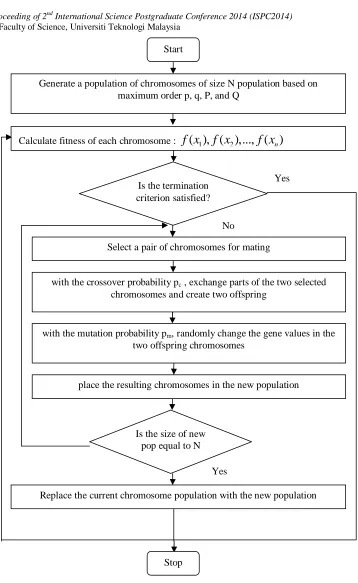
Figure 1 : Research flow of GA procedure Yes
Yes
No
Replace the current chromosome population with the new population Is the size of new
pop equal to N
place the resulting chromosomes in the new population with the mutation probability pm, randomly change the gene values in the
two offspring chromosomes
with the crossover probability pc , exchange parts of the two selected
chromosomes and create two offspring Select a pair of chromosomes for mating
Is the termination criterion satisfied?
Calculate fitness of each chromosome :
f x
( ), ( ),..., ( )
1f x
2f x
nGenerate a population of chromosomes of size N population based on maximum order p, q, P, and Q
Start
3.0
SIMULATIONS
AND
RESULTS
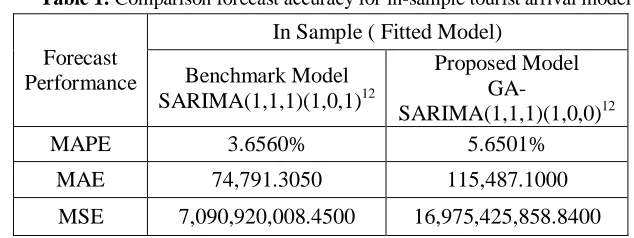
Table 1: Comparison forecast accuracy for in-sample tourist arrival model
Forecast Performance
In Sample ( Fitted Model)
Benchmark Model SARIMA(1,1,1)(1,0,1)12
Proposed Model
GA-SARIMA(1,1,1)(1,0,0)12
MAPE 3.6560% 5.6501%
MAE 74,791.3050 115,487.1000
MSE 7,090,920,008.4500 16,975,425,858.8400
The process of imitating a real phenomenon with a set of mathematical
formulas. Advanced computer programs are used to simulate the tourism
arrival pattern. In theory, any phenomena that can be reduced to mathematical
data and equations can be simulated on a computer. In practice, however,
simulation is extremely difficult because most natural phenomena are subject to
an almost infinite number of influences. For this tourist arrival data, Table 1
shows comparison study between the benchmark model for in-sample tourist
arrival and the proposed GA-BJ model. This study found that forecast accuracy
for benchmark model, SARIMA(1,1,1)(1,0,1)
12is 3.656% mean absolute
percentage error while the proposed GA- SARIMA(1,1,1)(1,0,0)
12model
produced 5.6501% mean absolute percentage error.
This shows that SARIMA(1,1,1)(1,0,1)
12is more accurate compared to
GA-SARIMA(1,1,1)(1,0,0)
12in modeling training data. This is due to the local
optima occurs in finding parameter values for GA-BJ model for training data.
Nevertheless, 2% different error is still acceptable to proceed for developing
forecast model.
Figure 2 In-sample benchmark model and proposed model for monthly International tourist arrival to Malaysia.
Table 2 : Comparison forecast accuracy for out-sample tourist arrival model
Forecast
Performance
Out Sample ( Forecast Model)
Benchmark Model
SARIMA(1,1,1)(1,0,1)12
Proposed Model
SARIMA(1,1,1)(1,0,0)12
MAPE 7.1920% 6.8580%
MAE 141,164.58 139,876.82
MSE 30,409,366,540.92 29,311,895,500.32
Table 2 shows forecast accuracy for 12 step ahead monthly international
tourist arrival to Malaysia year 2011. It shows that GA-SARIMA(1,1,1)(1,0,0)
12model successfully improved forecasting accuracy for modeling international
tourist arrival to Malaysia with 6.858% mean absolute percentage error
compared to benchmark model, SARIMA(1,1,1)(1,0,1)
12is 7.192% mean
absolute percentage error only. Thus, this proposed model can be used as an
alternative way to forecast monthly international tourist arrival.
benchmark model. As can be seen in proposed model, SARIMA(1,1,1)(1,0,0)
12has less parameters to be estimated compared to benchmark model,
SARIMA(1,1,1)(1,0,1)
12which has four parameters. Thus, it proves that GA can
effectively finds the approximate optimum solution in estimating the orders and
parameters of SARIMA model. This findings is in line with study by
Abo-Hammour [30] which GA technique produced more easy, robust and accurate
forecast model.
Figure 3 Out-sample benchmark and proposed model for monthly international tourist arrival to Malaysia.
General proposed forecast model used
for this study
is
SARIMA(1,1,1)(1,0,0)
12with 30 generations, 100 chromosomes and the
general formula is as follow :
1 1 11 1 1 1 11 1 12 1 1 1 1 12 1
t t t t t t t t t t
z
Z
Z
Z
Z
Z
Z
Z
a
a
1 11 11 12
1 12
0.3276
0.3323
0.1089
0.3276
0.3323
0.1089
0.3323
t t t t t t
t t t t
z
Z
Z
Z
Z
Z
Z
Z
a
a
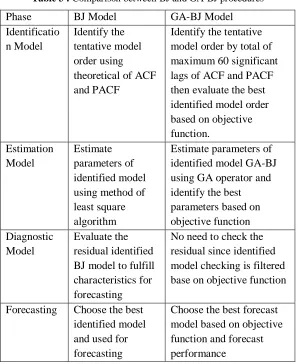
Table 3 : Comparison between BJ and GA-BJ procedures
Phase BJ Model GA-BJ Model Identificatio
n Model
Identify the tentative model order using theoretical of ACF and PACF
Identify the tentative model order by total of maximum 60 significant lags of ACF and PACF then evaluate the best identified model order based on objective function. Estimation Model Estimate parameters of identified model using method of least square algorithm
Estimate parameters of identified model GA-BJ using GA operator and identify the best parameters based on objective function Diagnostic
Model
Evaluate the residual identified BJ model to fulfill characteristics for forecasting
No need to check the residual since identified model checking is filtered base on objective function
Forecasting Choose the best identified model and used for forecasting
Choose the best forecast model based on objective function and forecast performance