Copyright 0 1996 by the Genetics Society of America
Mitochondrial DNA Sequence Variation
in
the Eastern House Mouse,
Mus musculus: Comparison With Other House Mice
and
Report
of
a 75-bp Tandem Repeat
Ellen M. Prager," Herbert
Tichyt and Richard
D.
Sage:*'
"Division of Biochemistry and Molecular Biology, University of California, Berkeley, California 94720-3202, tAbteilung Immungenetik, Max-Planck-Znstitut f u r Biologie, 0-72076 Tubingen, Germany and :Division of Biological Sciences,
University of Missouri, Columbia, Missouri 6521 1 Manuscript received May 30, 1995 Accepted for publication February 9, 1996
ABSTRACT
The control region and flanking tRNA were sequenced from 139 Mus musculus mitochondrial DNAs (mtDNAs) from mice collected at 44 localities extending from Germany to Japan. Among the 36 types of M. musculus mtDNA resolved, five have an added 75-bp direct repeat; the two copies within an individual differ by two to four base substitutions. Among 90 M . domesticus mtDNAs sequenced, 12
new types were found; 96 M. domesticus types have now been identified by sequencing this segment. Representative mtDNAs from M . castaneus, M . macedonicus, M . spicikgw and M . spretus were also se- quenced. A parsimony tree for the M. musculus mtDNAs is about half as deep as the tree for the M . domesticus mtDNAs, which is consistent with the idea that M . musculus is genetically less diverse and younger than M. domesticus. The patterns of variation as a function of position are similar but not identical in M . musculus and M . domesticus mtDNAs. M. castaneus and M . musculus mtDNAs are allied, at a tree depth about three times as great as the start of intra". musculus divergence. The coalescence of the M. musculus and M . castaneus mtDNAs is about half as deep as their coalescence with the M. domesticus mtDNA lineages. The mtDNAs of the aboriginal M . macedonicus and M. spicikgus are each other's closest relatives, at a tree depth greater than the deepest intracommensal node. The mtDNA results support the view that the aboriginal M. spetus is the sister group of the other five species.
M
EMBERS of the house mouse species group arethe best known vertebrate model organisms for a wide variety of fields, including molecular, chromo- somal and organismal evolution, molecular biology, physiology, immunology, genetics, development, popu-
lation biology, speciation, and ecology (see, e.g., BOUR-
SOT et al. 1993; SAGE et al. 1993; MORIWAKI et a/. 1994). The house mouse complex is now viewed as consisting
of three or four commensal species, M . domsticus, M .
musculus, M . castaneus, and M. bactrianus, plus three aboriginal species, M . spicilegus, M . macedonicus, and M .
spretus (BOURSOT et al. 1993; SAGE et al. 1993). The classical strains of laboratory mice carry a single type of
M . domsticus mtDNA and primarily M . domsticus nu-
clear genes, but some of their nuclear genes, as well as
the Y chromosome, are derived from other commensal
taxa, notably the populations of eastern Asia. Labora-
tory strains have been established from diverse wild-
caught representatives of most of the species in the
complex. Indeed, analysis of DNA from crosses and
backcrosses involving M . domesticus and M . spretus is a major tool in high-resolution mapping of the entire
mouse genome (COPEIAND et al. 1993).
Corrrsponding author: Ellen M. Prager, Division of Biochemistry and Molecular Biology, Barker Hall, Uiiversity of California, Berkeley, CA 94720-3202.
Present address: 131 Sierra Vista, Solvang, C A 93463.
Genetics 1 4 3 427-446 (May, 1996)
The native range of M. domesticus, which is often re-
ferred to as the western European house mouse, is west-
ern Europe, North Africa, and the Middle East and likely
extends into Iran (-HALL 1981; BOWRSOT et al.
1993). It is this taxon that humans during the last 500
years spread worldwide, notably to the Americas (TICHY et al. 1994), Australia, and throughout Africa. M . muscu- lus, known as the eastern European house mouse, has a native range encompassing eastern Europe and all of
northern Asia. M . castaneus is found primarily in south-
eastern Asia. Less genetic information is available for M .
bactrianus, which is described from the western Indian subcontinent, but it appears likely to be a distinct taxon (BOURSOT et al. 1993 and refs. therein). Many workers
(e.g., BOURSOT et al. 1993; BONHOMME et al. 1994; refs.
therein) regard these commensal taxa as subspecies; for
the reasons recently discussed by PRAGER et al. (1993)
and SAGE et al. (1993), we denote them as full species. The three aboriginal species each occupy relatively lim- ited ranges in Europe, North Africa, and western Asia,
essentially allopatric of one another but sympatric with
the resident commensal species.
Where M . domesticus and M. musculus meet in Europe,
there is a narrow hybrid zone. SAGE et al. (1993) and
428 E. M. Prager, H. Tichy and R. D. Sage
mark to eastern Bulgaria, and such studies of transect
animals are continuing
(e.g.,
ALJBERT et al. 1994; MACHO-LAN and ZIMA 1994; DALLAS et al. 1995; this report). It appears increasingly likely that there are hybrid zones
or areas of introgression wherever any two (or more)
of the commensal species meet. While M. domesticus has
been well studied throughout its range, only recently have genetic data been accumulating for a large part of
the range of M. musculus, i.e., central and much of east-
ern Asia ( e . 6 , FRISMAN et al. 1990; RUVINSKY et al. 1991; MEZHZHERIN and KOTENKOVA 1992; KOROBITSYNA et al.
1993; NAGAMINE et al. 1994; YONEKAWA et al. 1994). The
Indian subcontinent is now also receiving increasing at-
tention (BOURSOT et al. 1993, 1996; DIN et al. 1996).
Optimal use of house mice as model organisms and optimal interpretation of experimental observations re- quire knowledge of the genetic variation existing in nature and of the phylogenetic relationships of the sev- eral species. Despite great progress made during the
past two decades, a number of questions exist with re-
spect to the extent and organization of variation in wild
house mice. The present report addresses four such
questions from the viewpoint of mtDNA with an empha-
sis on M. musculus.
One area of inquiry concerns the relative genetic
diversity of M. musculus compared to M. domesticus.
There is some evidence from t haplotypes and nuclear
DNA restriction fragment length polymorphisms that M. musculus may be genetically more uniform (FIGUE-
ROA et al. 1987; KLEIN et al. 1987, 1988; RUVINSKY et al. 1991), while heterozygosity assessed by protein electro-
phoresis (summarized in SAGE et al. 1993) and microsat-
ellite heterozygosity on either side of the Danish hybrid
zone (DALIAS et al. 1995) implied little or no difference
in variability between the two species. An early high-
resolution mtDNA restriction analysis study involving
only a few M . musculus specimens (FERRIS et al. 1983)
suggested equal depths for the M. domesticus and M .
musculus mtDNA trees and similar intraspecific pairwise differences. A recent, comprehensive restriction study (BOURSOT et al. 1996), in contrast, implies that M . mus- culus is mitochondrially less diverse.
While it is now accepted that the commensal taxa
form a phylogenetic clade to the exclusion of the a b original taxa, questions remain about the relationship of the commensal taxa to one another. Leaving aside
the less-studied M. bactrianus, there is appreciable evi-
dence favoring a closer association of M . musculus and
M . castaneus to the exclusion of M. domesticus from a variety of studies, including electrophoresis of proteins encoded by autosomal genes and analyses of mtDNA,
the Y chromosome, and a pseudogene locus (e.g., SAGE
1981; MORIWAKI et al. 1984; TUCKER et al. 1989; BOURSOT
et al. 1993; HAMMER and SILVER 1993; SAGE et al. 1993;
NAGAMINE et al. 1994; YONEKAWA et al. 1994; refs.
therein). Yet the relationship is often represented as a
trichotomy ( . g . , HAMMER and WILSON 1987; DOD et al.
1989; BOURSOT et al. 1993; HAMMER and SILVER 1993).
With respect to the aboriginal species, there seems
to be a consensus that M. spicilegus and M. macedonicus
form a clade (BOURSOT et al. 1993; SAGE et al. 1993),
though divergence of the mitochondrial genomes of these two species does not appear to have been tempo- rally concordant with divergence of their nuclear ge-
nomes (FORT et al. 1985; BONHOMME 1986; SHE et al.
1990). The position of M. spretus, however, is a third
unresolved issue. On the basis of protein electrophore-
sis, SAGE (1981; cf. also SAGE et al. 1993) associated
M . spretus with M . spiciZegus and M. macedonicus in an aboriginal clade, an arrangement receiving some sup-
port from nuclear gene sequences (MORITA et al. 1992).
Other protein electrophoretic analyses (BONHOMME et
al. 1984), some mtDNA data (SHE et al. 1990), studies
of satellite DNA amplification (BONHOMME 1986; DOD
et al. 1989), and restriction analysis of nuclear rDNA
spacer regions (SUZUKI and KUIUHARA 1994) suggested
that M. spretus could be an outgroup to all the other
house mouse taxa, and this evolutionary framework has
sometimes been used (e.g., HAMMER and WILSON 1987;
HAMMER and SILVER 1993). A trichotomy (commensals, M. spicikgus
+
M. macedonicus, M . spretzcs) has often been the consensus or default arrangement depicted(e.g.,
BONHOMME 1986; DOD et al. 1989; SHE et al. 1990;AGULNIK et al. 1993; BOURSOT et al. 1993).
A fourth question concerns the time that house mice colonized Europe. The more widely accepted view is that colonization of the western European mainland was recent, roughly 5000 years ago and in concert with the spread of human activities, including agriculture
and seafaring (KLEIN et al. 1987; AUFFRAY et al. 1990;
BRITTON-DAVIDIAN 1990; SAGE et al. 1990; AUFFRAY and
BRITTON-DAVIDIAN 1992; refs. therein). Though there is agreement that house mice colonized northwestern
Europe only recently (55000 years ago; cf. PRAGER et
al. 1993), the fact that in benign climates M. domesticus
can and does live independently of humans (SAGE 1981;
SAGE et al. 1993; refs. therein) permits debate about
when these animals colonized the western Mediterra-
nean region. SAGE et al. (1990) used their results from
high-resolution restriction mapping of M. domesticus
mtDNAs (albeit calibrated with rates derived for crea- tures other than murine rodents) to suggest that mice
might have arrived in Europe much earlier, some
30,000-40,000 years ago in concert with the arrival and rapid expansion of populations of modern humans
(see, e.g., DI RIENZO and WILSON 1991). SAGE et al.
(1990) drew support from genetic and ecological data and pointed out that the absence of a fossil record for house mice could be explained by the rarity of fossiliza-
tion. AUFFRAY and BRITTON-DAVIDIAN (1992) have ad-
vanced cogent arguments based on evidence from pale- ontological and genetic investigations in urging rejection of the early colonization hypothesis.
To examine these issues, we chose sequencing of a
House Mouse mtDNA Sequences 429
tinct M. domesticus mtDNAs (PRAGER et al. 1993; NACH-
MAN et al. 1994). Our primary goal was to gather se-
quence data for M. musculus mtDNAs comparable to
those available for M. domesticus mtDNAs. Another goal
was to test the robustness of the phylogenetic and re-
lated inferences in PRAGER et al. (1993) by increasing
the M. domesticus dataset by >70% with respect to num-
ber of M. domesticus mtDNA types and number of localit-
ies. Among our 237 study animals are >150 M. domes-
ticus, M . musculus, and hybrids from a southern German-Austrian (Bavarian) transect; for these mice, we currently report only the essence of the mtDNA
variation ( cJ: legend to Table 1). This investigation pro-
vided also the opportunity to compare and contrast the patterns of mtDNA sequence variation as a function of
position in two closely related species of mice. Such
an analysis may suggest possible selective advantages or disadvantages of a particular mitochondrial genome, especially in hybrid or introgressed populations where the nuclear genome may be predominantly that of an- other species. Finally, this project led to the discovery of the tandem duplication of a 75-bp segment of the mtDNA control region at relatively high frequency in M. musculus.
MATERIALS AND METHODS
Mouse collection and DNA preparation: This sequencing
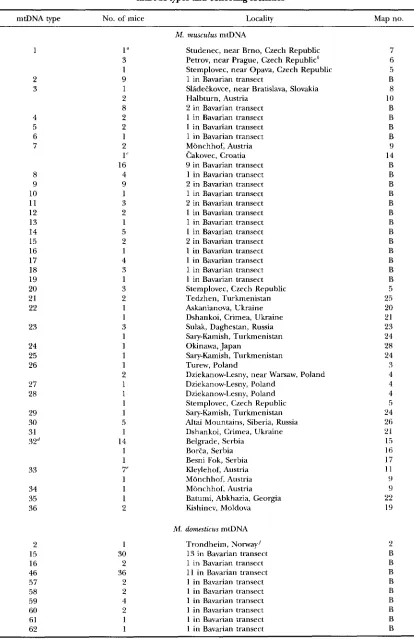
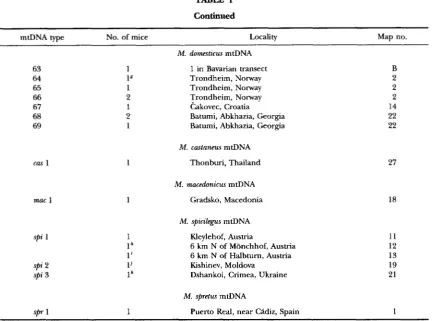
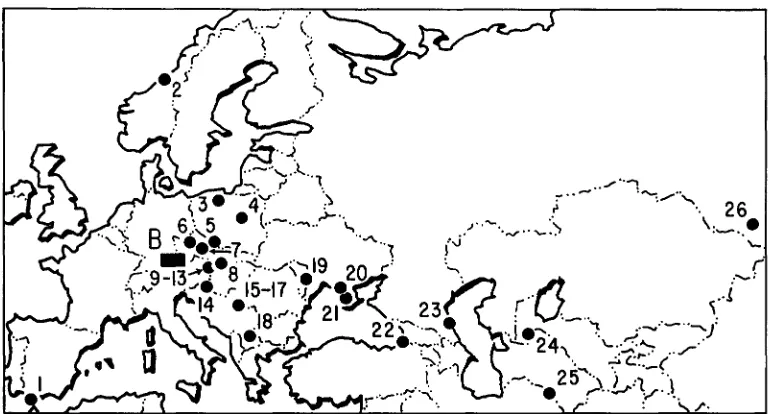
study involved 237 mice collected at 73 localities, 45 of them in or near Bavaria and the remainder extending across Eu- rope and Asia (Table 1, Figure 1). Commensal mice were trapped in or near buildings on farms and in villages, towns, and cities; aboriginal mice were collected in fields. A few laboratory descendants of separate lines of wild-caught fe- males were used, namely mice with M . musculus mtDNA from localities 7, 8, 15 (two of 14 individuals), and 28, as well as one or two individuals with M. castaneus, M. macedonicus, M. spicikgus (from localities 11 and 21), and M . spretus mtDNAs (Table 1). R. D. SAGE trapped the animals from the Bavarian transect in 1984, 1985, and 1992, from localities 9 and 11 in 1979, and from localities 10, 12, and 13 in 1992; he obtained those from localities 3 and 15-17 from other collectors in 1979 and 1982 (cf. FERRIS et al. 1983). U. GYLLENSTEN pro- vided purified mtDNA or genomic DNA from mice from local- ity 2. H. TICHY collected or obtained from other collectors the remaining 37 animals, from localities 4-6, 14, and 19- 26, during the 1980s. Voucher specimens are deposited at the Museum of Vertebrate Zoology of the University of Cali- fornia in Berkeley and in the Abteilung Immungenetik of the Max-Planck-Institut fur Biologie in Tubingen.
Total genomic DNA was prepared from liver or other tissues of 151 of the 237 mice according to standard procedures similar to that described before ( PRAGER et al. 1993). Highly purified mtDNA was available from 86 individuals from previ- ous and ongoing projects (FERRIS et al. 1983; SAGE et al. 1990; PRAGER et al. 1993; legend to Table 1): 73 mtDNAs from the Bavarian transect, three from Norway, M. musculus mtDNAs from localities 3, 7, 8, 15, and 28, and one mtDNA of each of the last four species listed in Table 1.
PCR amplification and sequencing of mtDNA: The region
of interest (Figure 2) was amplified in two portions, single- stranded DNA was generated, and templates were sequenced using primers and procedures described before (PRAGER et al. 1993) and slight modifications thereof. The general protocol
involved double-stranded amplifications with primers 1B (L15320) plus 4 (H15782) and 3 (L15735) plus 9B (H00072) and sequencing of single-stranded templates generated from one strand with primers lB, 5 (H16057), and 8 (H00066) and where necessary with primers 2 (L15492), 6 (H16125), and
7 (H16154). L, H, and the numbers refer, respectively, to the light and heavy strands and the positions of the 3’ base. From most of the purified mtDNAs from Bavarian transect mice, single-stranded sequencing templates for both portions were amplified directly from total mtDNAwith 37-39 amplification cycles. For six samples, representatives of M . musculus mtDNA types 1 and 24 plus types 1 from M. castaneus, M. macedonicus,
M. spicikps, and M . spetus, the opposite strand of the 5‘
portion of this 1-kb region was prepared and sequenced with primer 4 and, for M . musculus type 1, also with primer H15720 An average of 1005 bp was read per individual for M. muscu- lus mtDNAs ( n = 139), 1008 bp for M. domesticus mtDNAs [ n = 342, from PRAGER et al. (1993), DAI.IM et al. (1995), and this report], and 974 bp for mtDNAs from representatives of four other species ( n = 8; see Figure 2 and Table 1). One compression, characterized by PRAGER et al. (1993), occurred invariably. GenBank accession nos. are U47430-U47497 for the 68 types of M . domesticus sequences we determined [ 1
-
10 and 12-56 from PRAGER et al. (1993) and 57-69 from the present report], U47498-U47533 for the 36 types of M.
musculus sequences, and U47534U47539 for the six types of sequences from other taxa.
mtDNA sequences from the literature: For phylogenetic
analyses, M . domesticus mtDNA sequence types 1-56 (PRAGER
et al. 1993) and 27 additional distinct M . domesticus sequences from NACHMAN et al. (1994), types 70-96 in Table 2, were included along with M. domesticus types 57-69 reported here. The extreme 3’ ends of representatives of nine types among 1-56 were reanalyzed, so that nearly all the unsequenced variable sites in PRAGER et al. (1993) could be filled in as follows: at position 00052, A in types 4, 6, 10, 26, 31, 32, 52, and 56 and G in type 9; at position 00055, G in types 4 and 6, A in 26, T in 31, 32, and 52, and C in 56. In type 26 we found a variant base, C , at position 00056, rather than the T found in 64 of our 69 types (with types 7, 17, 41, and 50 unsequenced at this position). NACHMAN et al. (1994) do not report on variation in the far 3‘, Phe tRNA, portion of this region; we assumed particular bases at phylogenetically infor- mative sites in this portion as described in the next section. The M. sfwetus mtDNA sequence reported by NACHMAN and AQUADRO (1994) for positions 15352-16142 was denoted type 2; for analytical purposes it was taken as matching type 1 (Figure 2) in regions 5’ and 3‘ of the published sequence.
Calculations: Character-state parsimony trees for mtDNAs
were constructed with the SWOFFORD (1991) PAUP (Phyloge- netic Analysis Using Parsimony) program as described pre- viously (PRAGER et al. 1993). All character changes were weighted equally. The bootstrapping option was used for the analysis of 10 sequences representing six species. Because un- determined residues can lead to generation of more equally parsimonious trees and to impractically long computer runs, the likely base at missing variable sites was assumed, as de- tailed below. The same assumptions were included for compu- tation of pairwise differences. The probability of incorrect assignments at unsequenced sites is low, as the tree place- ments of the mtDNA types affected were nearly always well defined on the basis of their known sequences at other vari- able sites. The consequences of an incorrect assignment would most often be failure to detect an extra sequence change; occasionally increased resolution (i.e., an additional branching point) or minor differences in the arrangement of lineages at the tips of trees could be overlooked, but only rarely (for <lo% of the assumptions) is there a potential for rearrangements involving deeper lineages.
430 E. M. Prager, H. Tichy and R. D. Sage
TABLE 1
mtDNA types and collecting localities
rntDNA type No. of mice Locality Map no.
1 2 3 4 5 6 7 8 9 10 11 12 13 14 15 16 17 18 19 20 21 22 23 24 25 26 27 28 29 30 31 32* 33 34 35 36 2 15 16 46 57 58 59 60 61 62 1" 3 1 9 1 2 8 2 2 1 2 1' 16 4 9 1 3 2 1 5 2 1 4 3 1 3 2 1 1 3 1 1 1 1 2 1 1 1 1 5 1 14 1 1 7' 1 1 1 2 1 30 2 36 2 2 4 2 1 1
M. musculus mtDNA
Studenec, near Brno, Czech Republic Petrov, near Prague, Czech Republich Stemplovec, near Opava, Czech Republic 1 in Bavarian transect
Slkdefkovce, near Bratislava, Slovakia Halbturn, Austria
2 in Bavarian transect
1 in Bavarian transect 1 in Bavarian transect 1 in Bavarian transect Monchhof, Austria Cakovec, Croatia 9 in Bavarian transect 1 in Bavarian transect 2 in Bavarian transect 1 in Bavarian transect 2 in Bavarian transect 1 in Bavarian transect
1 in Bavarian transect
1 in Bavarian transect 2 in Bavatian transect 1 in Bavarian transect 1 in Bavarian transect 1 in Bavarian transect
1 in Bavarian transect Stemplovec, Czech Republic Tedzhen, Turkmenistan Askanianova, Ukraine Dshankoi, Crimea, Ukraine Sulak, Daghestan, Russia Sary-Kamish, Turkmenistan Okinawa, Japan
Sary-Kamish, Turkmenistan Turew, Poland
Dziekanow-Lesny, near Warsaw, Poland Dziekanow-Lesny, Poland
Dziekanow-Lesny, Poland Stemplovec, Czech Republic Sary-Kamish, Turkmenistan Altai Mountains, Siberia, Russia Dshankoi, Crimea, Ukraine Belgrade, Serbia
Bori-a, Serbia Besni Fok, Serbia Kleylehof, Austria Monchhof, Austria Monchhof, Austria Batumi, Abkhazia, Georgia Kishinev, Moldova
hf. domesticus mtDNA
Trondheim, Norway' 13 in Bavarian transect 1 in Bavarian transect 1 1 in Bavarian transect 1 in Bavarian transect
1 in Bavarian transect
1 in Bavarian transect 1 in Bavarian transect
1 in Bavarian transect
1 in Bavarian transect
House Mouse mtDNA Sequences
TABLE 1
Continued
43 1
mtDNA No. type
of mice Locality Map no.
63 64 65 66 67 68 69
cas 1
mac 1
spi 1
spi 2 spi 3
sfv 1
1
1
1 1* 1' 1' 1'
1
M. domesticw mtDNA
1 in Bavarian transect Trondheim, Norway Trondheim, Norway Trondheim, Norway Cakovec, Croatia
Batumi, Abkhazia, Georgia Batumi, Abkhazia, Georgia
M. castaneus mtDNA
Thonburi, Thailand
M. macedonicus mtDNA
Gradsko, Macedonia
M. spicilegus mtDNA
Kleylehof, Austria
6 km N of MBnchhof, Austria 6 km N of Halbturn, Austria Kishinev, Moldova
Dshankoi, Crimea, Ukraine
M . sfvetus mtDNA
Puerto Real, near CAdlz, Spain
B 2 2 2 14 22 22
27
18
11 12 13 19 21
1
Figure 1 shows the localities designated as map numbers 1-26 and B. The Bavarian transect (B) includes 45 localities encompassing the M . domesticus-M. musculus hybrid zone and adjacent areas, beginning in the west at Augsburg in southern Germany (Bavaria) and extending -180 km eastward to the vicinity of Hohnhart in north-central Austria; 30 of these localities have been listed before (SAGE et al. 1986; TUCKER et al. 1992). This table indicates the total numbers of transect mice and localities with a given type of mtDNA sequence. Details about specific localities and the mtDNAs found at each will be presented in a report devoted to characterization of several hundred Bavarian transect mice from a variety of molecular and supramolecular viewpoints (R. D. SAGE, E. M. PRAGER and R. KRAIT, unpublished results). Additional earlier publications (FERRIS et al. 1983; SAGE et al. 1990; RUVINSKY et al. 1991; PRAGER et al. 1993) and the authors are further sources of more details about collecting sites.
(I The sequence was determined for two individuals of a lab strain.
"This mouse is provisionally assigned to type 7, as the bases at variable positions 00016, 00052, and 00056 in Figure 3 were not determined; the available sequence rules out all but type 10 among the 35 other M . musculus mtDNA sequences recognized here.
Subtypes 32a-d are defined based on the relative amounts of T and C at position 15573 in the 3' copy of the 75-bp tandem repeat (see Figure 3). The mouse from locality 16 had type 32d and that from locality 17 had 32b. The number of Belgrade mice with types 32a-d, respectively, were three, three, six, and two; the sequences amplified from the two purified mtDNAs were of types 32a and 32c.
"Assignment of two of these mice, which have the 75bp insert, to type 33 is provisional as the 5' portion of the 1-kb segment was only partially sequenced. The assignment is based on the observation that the other five mice from this locality are all of type 33.
NACHMAN et al. (1994) obtained the same sequence for two mice trapped in Prague.
'The five mice listed as from locality 2 collectively came from three sites in Trondheim.
"Assignment of this mtDNA to type 64 is provisional because missing sequence at position 15363 (Figure
4) makes it indistinguishable from type 7. Type 7 has been reported in only one mouse (PRAGER et al. 1993), while type 64 (with G at position 15363) is known from four other mice from two localities in northern Scotland and the Orkney Islands (Table 2).
'
Nine hundred eighg-three basepairs of sequence were read; the undetermined portion is primarily at the far 3' end.' Nine hundred fifty basepairs of sequence were read; the undetermined portion is primarily within a highly
]Eight hundred ten basepairs of sequence were read; the undetermined portion is primarily within the
'Nine hundred forty-one basepairs of sequence were read; the undetermined portion is primarily at the conserved area 3' of position 15781.
re 'on from positions 15782-16039.
432 E. M. Prager, H. Tichy and R. D. Sage
FIGURE 1.-Map showing collecting localities for mice, as numbered in Table 1. B represents the Bavarian transect and encompasses 45 localities in southern Germany and north-central Austria, The far eastern Asian localities 27 and 28 in Table 1 are not shown.
All sequences and variable sites were entered into the com- puter for analyses of the 36 M. musculus plus one M. castaneus mtDNA sequences, except the C at position 15550 in the 3' copy of the 75bp repeat in M. musculus type 35. Variable positions within the tandem repeats in types 32-36 were en- coded only once, as at any given position a base substitution occurred in either the 5' or the 3' copy but not in both. Type 6 was assumed to have T at positions 00016 and 00056. Type 34 was taken as matching types 1, 2, 21, 32, 33, 35, and 36 in the unsequenced 3' portion of this segment (Figure 3). For
the 36 M. musculus mtDNAs, PAUP found 640 most parsimoni-
ous (ie., minimal-length) trees; for the 37 mtDNAs, PAUP found 704 such trees. To root the M. musculus
+
M. castaneus mtDNA tree, eight M. domesticus mtDNA sequences (types 1,6, 7, 10, 16, 25, 27, and 46) were used (with a total of 94
variable sites among the 45 sequences); PAUP found 2816 minimal-length trees. The frequencies of occurrence of inter- nal branches among M. musculus mtDNAs (cf. Figure 5) were identical for the sets of 37 or 45 sequences. For these interspe- cific analyses, M. musculus mtDNAs were assumed to be invari- ant at position 15333 (where types 4, 10, 13, 16, 18-21, 27,
28,30,34, and 35 were not sequenced) and at position 15363
(where type 35 was undetermined). For the interspecific analy- ses reported in Table 4 and Figure 8, M. musculus 29 was taken as identical to M . musculus 1 at variable position 00019, and
M . spicikgus 3 as identical to M. spicilegus 1 at position 15333. Among the 96 M. domesticus mtDNA sequences, 103 sites were variable and 55 of those were phylogenetically informa- tive. Variations only at informative sites were entered into the computer. Sixteen M . domesticus sequences (types 4, 16, 21,
31, 32, 34, 38, 39, 48, 57, 60, 63-65, 82, and 84) that were
phylogenetically equivalent to others were omitted. Assump- tions for undetermined sequences at informative sites were as follows: at position 16056, C in type 35; at position 00052, G in type 71 and A in 50, 70, and 72-96; at position 00055, G in type 70, A in 17 and 71-81, T in 50,82-90, and 96, and
C in 91-95. PAUP done on a Macintosh Quadra 650 did not
permit finding and storing all minimal-length trees among
80 M . domesticus mtDNA sequences (>6800 trees), and so
smaller subsets of 59-65 sequences (and some appreciably smaller) were analyzed. In this way it was possible to examine all most-parsimonious arrangements in various sections of the tree, by focusing in individual analyses on specific sections and eliminating extensive rearrangements elsewhere. To root
the M. domesticus tree, four M . musculus sequences (types 1 ,
20, 29, and 30) and the M. castaneus sequence were added,
under which circumstances M. domesticus types 21, 31, and 32 became phylogenetically distinct; because it was technically not possible to obtain all shortest trees for the complete data- set of 88 sequences and 80 informative sites, the set of all
1216 minimal-length trees for 67 sequences (with omission
of phylogenetically distinct M . domesticus types 9, 22, 29, 30,
33,35-37,40-43,54,62,66,67,71-73,80, and 83) was used.
To assess the stability of root placement on the M . domesticus mtDNA tree, the analysis was rerun for 66 sequences, omitting also M. domesticus type 96; 2112 minimal-length trees were generated in this case.
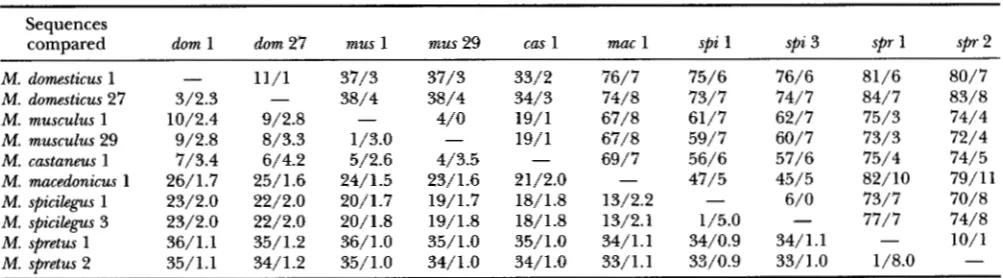
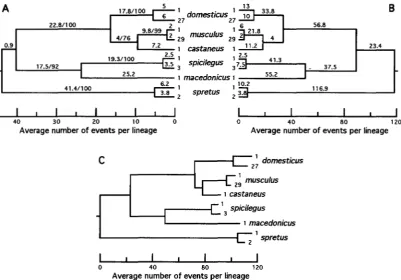
A. G. C I constructed a ~ neighbor-joining tree for 10 sequences (see Figure 8C) from a matrix of corrected pairwise differences in which transversions were weighted five times as heavily as transitions and length changes. Distance trees were also constructed from this corrected matrix and from matrices of observed differences with the UPGMA (un- weighted pair group method with arithmetic mean) tech- nique. For the larger datasets of all M. musculus and all M. domesticus mtDNAs, we did not calculate distance trees, nor did we weight transversions differentially, in light of the expe- rience of NACHMAN et al. (1994), who with a similar set of 42
M. domesticus sequences found only minor differences among trees produced with a variety of methods (character-state and distance) and a wide range of transversion weightings.
The Gtest with one degree of freedom (SOW and ROHLF
1981) was used to see if the numbers of mutations accumu-
lated along two lineages of parsimony trees were statistically significantly different. To evaluate the possibility of regional
(in situ) divergence of several mtDNAs, we computed the average number of differences (with length changes in- cluded) in the control region among all possible pairs of individuals from geographically restricted clades in mtDNA parsimony trees, as outlined previously (PRAGER et al. 1993). In calculating pairwise differences among M . musculus mtDNAs carrying two copies of a 75-bp repeat, we counted the apparently heteroplasmic polymorphism at one position in type 32 as half T and half C .
House Mouse mtDNA Sequences 433
TABLE 2
M . domesticus mtDNA types based on control
region sequences
mtDNA
type Locality Specimen number
2 England 13167
19 N Italy 1008-9
44 Mallorca Island, Spain 1272-3
6 Greece 1176
64 Scotland 13456, 13567
70 Greece 1177
71 Scotland 13345
72 Scotland 1328
73 Scotland 1329
74
s
Italy 1225, 124875 S Italy 1226
77 Catalunya, Spain 1287
79
c
Italy 108176 Greece 1199,1200
78
c
Italy 1067-880 Greece 1150-1
81 N Italy 1368
82 Catalunya, Spain 1311
83 Catalunya, Spain 1286
84 Scotland 1322-3
85
c
Italy 108386 N, C, S Italy 10367, 1128-9, 1214,
87 N, C Italy 1372-3, 12045
88 S Italy 1213
89
s
Italy 126290
s
Italy 126391 Greece 1173-4
92 Catalunya, Spain 1310
93 Switzerland 13667
1249
94
c
Italy 1103495 N Italy 1369
96 Greece 1192-3
Of the 42 types of M . domesticus mtDNA that NACHMAN et
al. (1994) distinguished among 56 mice by sequencing the
segments containing the ND3 gene plus the control region, the 32 types listed in this table could be resolved based on the sequence variation they reported for the control region
and the adjacent Pro tRNA gene. Scotland encompasses
northern Scotland and the Orkney Islands; N, C, and S indi-
cate northern, central, and southern, respectively. The actual sequences, tabulated according to specimen number, and de- tails about the collecting localities appear in NACHMAN et al. (1994). The first five mtDNA types listed correspond to types identified also by PRAGER et al. (1993; this report).
length. 7r is a function of number of pairwise differences be-
tween types, sequence length, and frequencies of each type of mtDNA. Because many of the individual sequences ( n =
139 and 399 for M. musculus and M. domesticus mtDNAs, re-
spectively) resulted, especially for M. domesticus mtDNAs, from intense sampling over a limited geographic area, we also com- puted 7r with equal frequencies assigned to each type of
mtDNA. Such sampling in Scandinavia (which was colonized
with mice having M . musculus nuclear genomes and M. domes- ticus mtDNAs via founder events during the past 5000 years) plus in the East Holstein source area yielded 110 mice with type 27 M. domesticus mtDNA (PRAGER et al. 1993; DALLAS et al. 1995) and nearly all the other 77 mice in the clade of 18
closely related sequences carrying an added 11-bp direct re-
peat (see Figure 6). Interspecific 7r values were computed
weighting each individual type within a species equally and, for M . castaneus us. M. musculus mtDNAs, also using observed frequencies.
T. W. QUINN used the Hitachi MacDNASIS Pro RNA Sec-
ondary Structure Prediction program, which implements the
ZUKER and STIEGLER (1981) method, to find and evaluate potential secondary structures within and adjacent to the 75-
bp repeat. The sequences from M. musculus types 1 and 32-
36 and M. domesticus type 1 were examined. The analyses were
done separately for four parts of the mitochondrial genome: the first 121 bp of the control region, 5‘ of the repeat motif;
each repeat of 75 bp (78 bp for the corresponding M. domes-
ticussequence); two tandem repeats together, ie., 150 bp, for M. musculus types 32-36; and the 121 bp 3‘ of the repeat motif. The “maximum bulge and interior loop” parameter was set at 2, 15, and 30; the last two settings gave identical results. Unless stated otherwise, free energies are reported as
ranges encompassing all sequences examined and all max- bulge settings used.
RESULTS
Mitochondrial DNA sequences: Figure
2
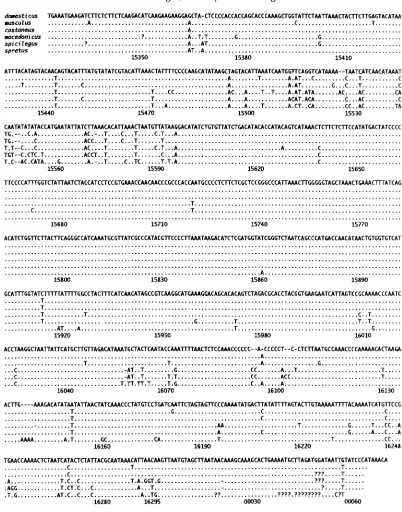
shows the complete sequences of the control region and flanking tRNA genes determined for one type of mtDNA from each of three commensal and three aboriginal house mouse species.M. musculus mtDNAs were found in 139 mice, 74 of
them from
22
localities in the Bavarian region and 65from 22 localities extending from central Europe to
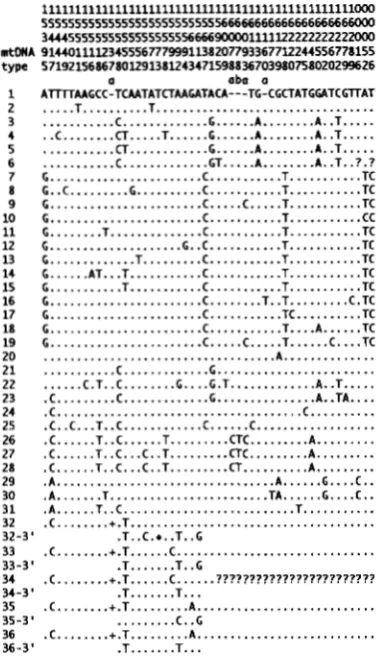
Japan (Table 1). Figure 3 shows the sequence variation
among the 36 distinct types of M. musculus mtDNA rec-
ognized. Of these, 16 types are confined to one or two
localities in the Bavarian transect, and 11 others are
confined to single localities elsewhere. Types 3 and
7
appear to be most widespread, the former found in 11
mice from four localities and the latter in 19 mice from
11 localities. Type 23 occurs at two rather distant locali-
ties separated by the Caspian Sea (23 and 24 in Figure
1). At five of the localities outside the Bavarian transect
(4, 5, 9,
21,
and 24 in Figure l ) , two or three different M. musculus mtDNAs were found. Though there is no- ticeable geographic structuring of mtDNA variability, especially at a microgeographic level (see Figure 5),degree of sequence difference does not consistently cor-
relate with geographic distance. For instance, types 24
from Japan and
21
from Turkmenistan each differ byonly two base substitutions from the Czech type 1. In
contrast, types 4 and 8 with 15 substitutions coexist in
the same Austrian locality, and there are eight to nine substitutions among the three types at locality 24.
At two localities away from the Bavarian hybrid zone
and environs, the present survey revealed both M. muscu-
lus and M. domesticus mtDNAs (Table 1). Locality 14 in
northeastern Croatia yielded M. musculus type
7
and M.domesticus type 67, while at locality
22
in Abkhazia M. musculus type 35 occurs together with M. dmnesticus types 68 and 69. Finding mtDNAs of both species at locality 14 is not surprising in light of current views about the434 E. M. Prager, H. Tichy and R D. Sage
dwesticus T G A A A T G A A G A T C T T C T C T T C T C A A G A C A T ~ ~ A G A A G G A G ~ A - C T C C C C A C C A C C A G C A C C ~ G ~ G G T A T T C T ~ T T A A A C T A C ~ C T T G A G T A C A T ~
musculus
...
A...
A . . . C . . . T . . .castaneus
...
A...
aacedonicus...
7...
A . . T . T . . . G . . . G . . . spicilegus ... ?...
A . . . A T . . . G . . . spretus...
AT..A.......
15350 15380 15410
A~ACATAGTACAACAGTACA~ATGTATATC~ACATTAAACTATTlTCCCCAAGCATATAAG~AGTACA~AAAT~TG~CAGGTCATAAAA--TMT~TCMCATAAAT
...
T...
A ....
T ... A.AT...C... ... C . . . T . . . C...
T....
T...
C . . ....
A....
A.AT ... G . . . C . .. T ... C... T
...
T . . . . C C . . . A C . . . A . . . . T . . T . . . . A . A T . A T A . . . A C . . . . A C . . . CA...
T ... C . . . T . . . A . . . . A . . . A C A T . A C A . . . C . . . A C . . . C...
T...
T . . . A . . . A . . . . A . . . . T . . . A . C T . . . C C . . A C . . . TA15440 15470 15500 15530
CAATATATATACCATGAATA'TTATCTTAMCACATTAAACTAATG'TTATAAGGACATATCTGT~ATCTGACATACACCATACAGTCAT~CT~~C'TTCCATATGACTATCCCC TG
.--..
C.A...
AC.-..
T....
C . . . T . . . C . T . . . A . . .TG.--
....
C...
ACC...T....C ... T . . . T . . .TGT--C.CTC.T. ACCT T . . . T . . . C A. C . . . T.T--C C AC....T.. T C . T . . . A . . . A . . . C . . .
T.C--AC .CATA .... G . . . A . - . . T . . . C . . T C . . . T . T . A . . . C . . .
... ...
...
......
...
..
.... ......
15560 15590 15620 15650
~ C C C C A ~ G G T C T A T T A A T C C C A T C C T C C G T G A A A C C A A C C C G C C C A C ~ T G C C C ~ ~ ~ C G C T C C G G G C C C A T T A A A C T T G G G G G T A G C T A A A C T G A A A C ~ A T C A G
...
. . .
...
T...
... C.
...
T....
. . .
15680 15710 15740 15770
ACATCTGGTTCTTACTTCAGGGCCAT(AAATGCGTTATCGCCCATACCTTCCCCGACATCTCGATGGTATCGG~CTAATCAGCCCATGACCAACATPCTGTGGTGTCAT
. . . ... . . . ...
...
A...
15800 15830 15860 15890
GCA~GGTATCmrrATTlTGGCCTACmCATCATCAACATAGCCGTCAAGGCAT~AGGACAGCACACAGTCTAGACGCACCTACGGT~GAATCA'TTAGTCCGCMMCCCPTC
...
T . . ....
T . . ....
T . . . ....
T . . ....
C . . T . . ......
T...
G...
T . . . ....
T . . T . . ....
AT....
A . . . ... T...
G . . .15920 15950 15980 16010
A C C T A A G G C T A A T T A T T C A T G m G T T A G A C A T A A A T G C T A C C C C C C C - - A - C C C C C T - - C - C T C T T A A T G C C A A A C C C C P A A A C A C T P ~
...
A....
...
T...
T.....
A...
G... ......
C . . AT..T....
G...
CC.....
A . . . T . . . ... T . . . . ....
C . . ... AT .. T....
T.T...
CC ... ACC ... T . . . ..... C ... T.'TT.'TT.T...T.G...
...
C . . A . . . A . . . ...16040 16070 16100 16130
ACTTG----AAAGACATATMTATTAACTATCAAACCCTATGTCCTGATCAATTCTAGTA~CCCAAAATATGACTTATATTlTAGTACTTGT~TTlTAC~ATCATGTTCCG
...
T...
G...C...C.......
T...
C....
c.......-...
T. . .
T . . . G . . . T . . . C C . . A...
T...
A . . . C . . ....
G...A...C... A...
A.T...
G C . . . C A . . . T . . . ... T...
CC ...16160 16190 16220 16248
TGAACCAAAACTCTAATCATACTCTArrACGCAAT~CA'TTAACAAGTTAATGTAGCTTAATAACAAAG~AGCACTGAAAATGCTTA~TGGATAA'TTGTATCCCAT~CA
... C ... T. ... T . . .
...
C . . ....
??? ... T . . . .A ... T.C .. C . . . T . . G . . . - . . . ? ? ? . . . T . . ..AGG ... T.CT.C ...
.T.G
...
AT.C..C...C.......
A . . T G . . ....
??...
????.????????.... C?T16280 16295 00030 00060
FIGURE 2.-Control region and tRNA gene sequences for mtDNAs of six species of house mice. The 1041-bp sequence of M . domesticus type 1 appears in the top row; the sequences of the type 1 mtDNAs of the other species are shown only where different, with identity to M. domesticus being indicated by
-
.
-, deletions relative to other sequences; ?, undetermined residues; blank areas, unsequenced regions. Numbering throughout this report is according to the M. domesticus type 1 sequence in BIBB et al.(1981), with absence of a bp at positions 15823 and 16240 and another correction as previously (PRAGER et al. 1993). The locations shown for length differences occurring in areas of direct repeats are arbitrary (see discussion in PRAGER et al. 1993). This segment includes the following parts of the mitochondrial genome: Thr tRNA (partial), 15321-15349; Pro tRNA, 15350-
15416; control region, 15417-16295; Phe tRNA, 1-68.
Europe (.g., VANLEREERGHE et al. 1986; SAGE et al. 1993).
The observation for locality 22 is consistent with growing
evidence of the presence of M. domesticus as well as M. musculus genes in the region between the Black and
Caspian Seas that includes the Caucasus and Transcauca-
sus ( . g . , FMSMAN et al. 1990; MILISHNIKOV et al. 1990;
MEZHZHERIN and KOTENKOVA 1992).
Painvise differences among all 36 M. musculus se-
quences in Figure 3 range from 1-15. The numbers of
painvise transversions and length changes range from
0-4 and 0-3, respectively. Two of the short length
changes, at positions 16078ab and 16093a, can be ex- plained by slipped mispairing in areas of direct repeats;
addition of a T at 161 60a cannot be explained this way,
as was true also for one 1-bp length change in a M .
House Mouse mtDNA Sequences 435
11111111111111111111111111111111111111111111111m
55555555555555555555555555~6666666666666666666W
&DNA 91440111123455567779991138207793367712244556778155
34445555555555555555556666900001111122222222222W
type 57192156867801291381243471598836703980758020299626
1 2 3 4 5 6 7 8 10 9 11 12 13 14 15 16 17 18 19 20 2 1 23 22 24 25 27 26 28 29 30 3 1 a AllTrAAGCC-TCAATATCTAAGATACA---TG-CGCTATGGATCGTTAT
...
T...
T . . ....
C...
G...
A . ....
A . . T . . . . ...
C ...CT... T . . . C ....
A . . ...
A..T...... G
...
A . . ...
A . . T . . ....
C...
GT...
A...
A . . T . . ? . ?G.
...
C...
T . . . . TCG
..
C . . . G . . . C . . . T . . . TCG..
...
C...
C . . . T . . . TCG
...
C ....
T . . . CCC
...
T . . ...
C . . . T . . . TCG.
...
G..
C . . . T . . . TC6..
...
T...
C . . . T . . .....
TCG ... AT...T...
...
C . . . .. T . . . TCG
...
T . . . C...
T . . ....
TCG
...
C . . . T . . T...
C.TCG
...
C . . . ....
T C . . ....
TCG..
...
C...
T . . . . A . . . TCG
...
C . . . C . . . T . . . C . . . . TC...
A...
...
c...
G....C C...G... A..TA....
C.T C G G.T A . . T . . .
.c
...
c.......
.C
..
C . . . T . . C . . . C . . . C . . .. C T . . C . . . C . . T . . . C T C . . . A
.C T . . C . . . T . . . C T C . . . A . . . . C
...
T..C...C..T. ...CT... A . . . . A...
A . . . G . . . . C . . . A...
T . . ....
TA....
G . . . . C . . . A...
T..C...
T . . ...
aba a
... ..
...
....
...
...
...
...
...
....
...
32 . C
...+.
T . . ....
32-3' .T..C.r..T..G
33 . C
...+.
T . . . C . . .33-3'
...
34 . C
...+.
T . . . . C . . . . . ..T T . . G
34-3'
...
35 . C
...+.
1. A . . . .T T . . .35-3'
...
C . . G36 . C
...+.
T . . . . ... A....
36-3' .T...
T . . ...
...
...
FIGURE 3.-Variable sites in the control region and flank-
ing tRNAs of 36 types of M . musculus mtDNA. Listed vertically across the top are 49 polymorphic sites numbered as in Figure 2; lowercase letters denote sites added relative to the baseline
( M . domesticus type 1) sequence in Figure 2. The sequence for M. musculus type 1 is shown at all 49 sites; the bases present
in the other types are shown only where different. -, dele-
tions relative to other sequences;
+
at 15537a indicates pres-ence of a tandem 75-bp repeat of the sequence from 15538-
15615;
*
calls attention to polymorphism at one site in type 32; ?, unsequenced sites. The two locations with length changesinvolving >1 bp (15537a and 16078ab) have been counted
as single sites. The variation in the 3' copy of the 75-bp repeat
is shown on separate lines designated 3'. Subtypes 32a-d are defined based on the approximate relative amounts of T and C at position 15573 in the 3' tandem repeat as follows: 32a, T only; 32b, 60-70% T; 32c, 50% of each base; 32d, 60-75%
C. Footnote d to Table 1 gives the numbers and collecting localities of individuals with each of the four subtypes.
In five types of M. musculus mtDNA (32-36 in Figure
3), a second, tandem copy of the
75-bp
control regionsegment from positions 15538-15615 was observed.
Tandem repeats of about this length and variation in their number have been recognized in the mitochon-
drial control region in diverse creatures (see, e.g., HOEL
ZEL et al. 1994; FUMACALLI et al. 1996). Duplication of
these 75 bp seems to be widespread in M. musculus
mtDNA, having been found in 28 animals from seven
localities stretching across some 2000 km from Austria
to Abkhazia. Within types, the tandem repeats differ by
a n average of 2.9 base substitutions, or 3.9%, with a
range of two to four substitutions. While the 5' copy
5555555555555555555555555566666666666660 11111111111111111111111111111111111111100
d m 3334455555555555555556799900000001222220
mtDNA 56609011223444447778931125015569904556855 type 73423416390135672362778258926733308028325
ab
1 GGClTAGGATCACATAACACCTACCAAATCC--TGGAlTAG 57
....
A.TAG....
G ..lT... T.G.C..
T . . . C . . A 58....
ACTA...
G..'IT.
T . . . T . G . C . . T . . . C . . A 59....
A.TA...
G ..lT... T.G.C.AT...
C . . A 60....
A.TA...
G ..lT... T.G.C..
T . . . C C.A 6 1 .... A.TA...
G ..lT... T.G....
T . . . C . . A 62 ...GI... T...
T . . l T . . . C . . C C . . . . C . . T 63 ...GI... T ...lT... C . . . C . . T 64 ????A....
CTG...iT..
T . . . A . C.GA 65....
A....
C T G . . . m . . T . . . A . C.GA 66 .... A....
CTG...lT..T...AA. C.GA68 A
...
A . . . "....
T.lT..T....CCAAAGC..C69 .AT.A
. . .
" TC lT.. T...
A G C . . C67
....
A....
CTG..--...lT..T...A. C.GA555555666 111111111
spi 445559011 mtDNA 791557605
t y p e 642040403
1 TACCrrACT
2 CGlTC? . A C 3 C G . . C C G A .
a
FIGURE 4.-Variable sites in M. domesticus and in M. spici-
kps mtDNA sequences presented in the format described in
Figure 3. M. domesticus type 64 here was not sequenced 5' of position 15407 and cannot be distinguished from type 7 but has been equated with type 64 (cf. Table 2) for the reasons given in footnote g to Table 1. At 64 sites beyond the 39 at the top of this figure, variation was found among 96 M. domesticus mtDNAs; among types 57-69, one of those sites (position 00018) was not sequenced for types 61, 64, and 69. See foot- notes j and k to Table 1 for information about unsequenced portions of M. spicilegzcs types 2 and 3.
differs among types by an average of only 1.2 substitu-
tions (range, 0-2), the 3' copy differs among types by
an average of 2.0 substitutions (range, 0-3.5). Thus,
the two copies of the 75-bp segment do not appear to have evolved in concert, though the time since occur- rence of the duplication may have been too short to
permit homogenization. The 3' copy seems to have ac-
cumulated more substitutions (see also legend to Figure
5). Finally, an instance of polymorphism consistent with
heteroplasmy was detected at position 15573 in the 3'
repeat in type 32, with some animals having only T and
others having 30-75% C along with T (see legend to
Figure 3 and Table 1 for details). Observation of this
kind of point-mutational polymorphism in one se-
quence derived from purified mtDNA makes it unlikely
that the apparent heteroplasmy is attributable to the
presence of a nuclear copy of this portion of the mito- chondrial genome.
The present survey yielded
17
distinct M. domesticusmtDNA sequences among 90 mice from 30 localities
(Table 1 ) , and Figure 4 shows the variation among the
13 types we sequenced beyond the 56 types described
in PRAGER et al. (1993). These
17
mtDNAs emanatefrom five major sections of the M. domesticus mtDNA
tree (see Figure 6). The four different mtDNAs from
436 E. M. Prager, H. Tichy and R. D. Sage
" Type Locality
0
2 1 Czech Republic 2 Bavaria
I
!.
3 slov. Aust. Bav22 Ukraine 23 Dagh, N Turk 21 S Turkmenistan 25 NTurkmenistan
I 31 Ukraine
I 10
' 11
12 13 14
q !
15ust, Craa, Bav
Bavaria
I
24 Japan
I 2 . 32 Serbia
35 Abkhazia 36 Moldova
0
~ 2 0 Czech Republic
2 29 N Turkmenistan
I
3 0 SiberiaM s castaneus
10 3 2 1 0
Average number of events per lineage
FIGURE 5.-Evolutionary tree constructed by parsimony analysis for 36 M. musculus mtDNAs and one M . castaneus mtDNA from sequences of the control region and neigh- boring
tRNAs.
Abbreviations for localities: Aust, Austria; Ba- varia and Bav, Bavarian transect; Croa, Croatia; Czech, Czech Republic; Dagh, Daghestan; N, northern; Slov, Slovakia; S, southern; Turk, Turkmenistan. The number of mutations in- ferred to have occurred along each lineage is indicated. The large solid triangle marks the lineage where the 75-bp direct repeat of the sequence from 15538-15615 has arisen; small open triangles mark the six lineages where additions or dele- tions of 1-2 bp are inferred. Length changes were includedin computing the depth of each node. The M. musculus por-
tion of the tree requires 70 mutations: 54 transitions, 10 trans- versions, and six length changes at, respectively, 39, nine, and four of the 49 polymorphic sites (consistency index = 0.79).
Inclusion of the M. castaneus mtDNA yields 59 polymorphic
sites and requires 87 events (66 transitions, 14 transversions,
and seven length changes; consistency index = 0.77). The
root was placed on the lineage indicated in all most-parsimo- nious trees constructed for these 37 mtDNAs plus eight M. domesticus mtDNAs; the 36 M. musculus mtDNAs formed a monophyletic clade in 100% of these minimal-length trees. Of the 18 internal branches depicted within the M . musculus portion of the tree, 11 occur in 100% of all minimal-length trees; the two deepest intra". musculus branches occur in 91% of these minimal-length trees. The unions of types 27
+
28,33
+
34, and 35+
36 were found 50% of the time, whiletwo other clades-of types 3-6
+
21-23+
25-28+
31 andwestern Europe. Eight of the M. domesticus mtDNAs in
Table 1 are known only from the Bavarian transect and
two others (types 15 and 16) are known also from other
southern German localities (PRAGER et al. 1993).
This 1-kb segment was wholly o r partially (810-983
bp) sequenced from M. spiciZegus mice from five localit-
ies (Table 1); the lower section of Figure 4 shows the
variation among the three kinds of mtDNA identified.
T h e painvise differences of 2 4 to
2 7
are similar to theintraspecific differences seen among M. domesticus and
M. musculus mtDNAs and the 210 differences between
the two M. spretus mtDNAs considered here.
Evolutionary trees for mtDNAs of commensal mice:
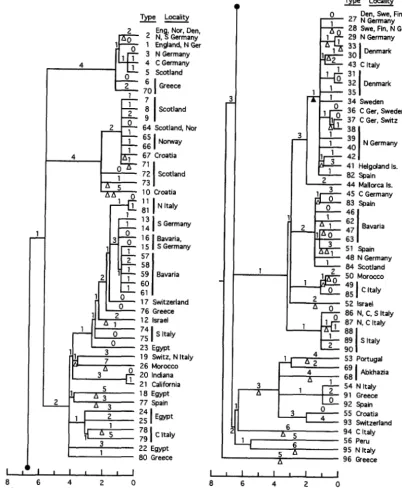
Figure 5 presents a rooted parsimony tree relating the
36 M. musculus mtDNAs to each other and to a M. castaneus mtDNA. T h e M. musculus portion of the tree accounts for the variation at 49 polymorphic sites with 70 mutations. T h e 5.4 ratio of transitions to transver-
sions matches the value reported for a tree of 56 M.
domesticus mtDNAs (PRAGER et al. 1993). In common
with that M. domesticus tree and the one in Figure 6
here, the M. musculus tree in Figure 5 exhibits notice- able variation in the numbers of events along different lineages emanating from the same node. The average
depth of the M. musculus tree is -3.5 events per lineage,
i e . , about half the depth of the M. domesticus trees. Of
interest, a parsimony tree constructed (E. M. PRAGER,
unpublished results) for only 19 M. musculus mtDNAs,
type 1 plus the 18 types detected across the Bavarian transect, is as deep as that shown in Figure 5 , which
inspires confidence that our 36 M. musculus mtDNAs
suffice for a realistic assessment of mtDNA tree depth for this species. The depth at which the representative M. castaneus mtDNA joins the tree suggests, in turn, that interspecific mtDNA lineage divergence occurred
roughly three times as long ago as the start of diver-
gence among the M. musculus mtDNA lineages exam-
ined here.
As noted earlier for M. domesticus mtDNAs (PRAGER
et al. 1993; NACHMAN et al. 1994; refs. therein), the tree
in Figure 5 implies some geographic structuring, partic-
ularly for the Bavarian transect clades of types 3-6 and 7-19. However, too few localities over the broad range of M . musculus have been sampled, particularly outside central Europe, to permit a comprehensive assessment
of geographic structuring of mtDNA lineages. Never-
theless, there appears to be a tendency for the deepest
lineages in each clade and in the tree as a whole to
come from central Asian rather than European localit- ies, which is consistent with the idea of the origin of
of types 24
+
32-36-appeared 73% of the time. This tree postulates four events, in the following order, along the lin- eage leading to the clade of types 32-36 (cf. Figure 3): a point mutation at position 15550, duplication of the 75-bpsegment, and two point mutations in the 3' copy. During