A Method for Gene Disruption That Allows Repeated Use of
URA3 Selection
in
the
Construction of Multiply Disrupted Yeast Strains
Eric Alani, Liang Cao and Nancy Kleckner
Department of Biochemistry and Molecular Biology, Harvard University, Cambridge, Massachusetts 021 3 8 Manuscript received December 23, 1986
Revised copy accepted April 27, 1987
ABSTRACT
In this paper, we describe a 3.8-kb molecular construct that we have used to disrupt yeast genes. The construct consists of a functional yeast URA3 gene flanked by 1. l-kb direct repeats of a bacterial sequence. It is straightforward to insert the 3.8-kb segment into a cloned target gene of interest and then introduce the resulting disruption into the yeast genome by integrative transformation. An appropriate DNA fragment containing the disruption plus flanking homology can be obtained by restriction enzyme digestion. After introducing such fragments into yeast by transformation, stable integrants can be isolated by selection for Ura+. The important feature of this construct that makes it especially useful is that recombination between the flanking direct repeats occurs at a high frequency (loe4) in vegetatively grown cultures. After excision, only one copy of the repeat sequence remains behind. Thus in the resulting strain, the Ura+ selection can be used again, either to disrupt a second gene in similar fashion or for another purpose.
N
yeast molecular biology, gene replacement is aI
common procedure in which a cloned DNA seg- ment introducedby
transformation is substituted by homologous recombination for a related region in the recipient genome (ORR-WEAVER,SZOSTAK
andROTH-
STEIN 1981). Often, the replacement event is moni- tored by including an appropriate selectable marker on the incoming molecule (SCHERER and DAVIS 1979). In many cases it is not easy to remove the marker and thus the same selection cannot be used for subsequent gene replacement events.
In
order to make repeated use of a convenient selectable marker, we have devel- oped a molecular construct in which the URA3 gene of Saccharomyces cerevisiae is flanked by direct repeats of a bacterial sequence. We anticipated that if such a construct were introduced into a cloned gene and integrated into the yeast genome, it would undergo frequent mitotic recombination between the direct repeats to eliminate the URA3 gene and leave behind a single copy of the repeat sequence at the site of the original integration (Figure 1). Mitotic recombination between nontandem direct repeats is known to occur at high frequency and this property has been used extensively to move genetic markers back and forth between yeast sequences cloned into plasmid mole- cules and the yeast genome (SCHERER and DAVIS 1979; WINSTON, CHUMLEY and FINK 1983). Because these excision events would lead to a Ura- phenotype, de- rivatives that have undergone such events could be directly selected with 5-fluoro-orotic acid (5-FOA) (BOEKE, LACROUTE and FINK 1984).We have constructed a 3.8-kb molecular construct that consists of the URA3 gene flanked by direct
Genetics 116: 541-545 (August, 1987)
repeats of Salmonella hisG DNA. We show here that when this construct
is
inserted into the TRPl locus of yeast, recombination between the direct repeats oc- curs at a frequency in vegetatively grown cul- tures. T h e resulting trpl mutation bearing a single copy of the direct repeat sequence does not revert toTrp+.
Similar results have been obtained with inser- tions of this construct in other yeast genes. We there- fore believe that this construct can be used easily and systematically to disrupt any cloned gene of interest. Furthermore, because it is easy to eliminate the Ura+ marker, the Ura+ selection can be used repeatedly, and the same 3.8-kb construct can be used to disrupt several different genes within a single strain. We show that a gene disruption carrying the 3.8-kb construct integrates efficiently into its normal chromosomal lo- cus even when introduced into a strain that already carries copies of the bacterial repeat sequence at one or two other loci, and that an SK-1 diploid strain carrying four copies of the repeat sequence sporulates efficiently and gives the normalhigh
frequency of asci containing four viable spores.MATERIALS AND METHODS
Strains: Escherichia coli K12 strain MM294 ( F , endA, hsdR, supE44, thiA) was used for all plasmid manipulations (GUARENTE et al. 1980). Yeast strain NKY 274 ( M A T a , ho::LYS2, u r a 3 , lys2) was derived from the homothallic pro- totrophic strain SK-1 (KANE and ROTH 1974; WILLIAMSON et al. 1983; W. RAYMOND, L. CAO and N. KLECKNER, un- published data).
1
FIGURE 1 .-Reduction of URA? gene flanked by direct repeats.
M A N , FINK and HICKS 1983). Minimal medium contained
0.7% yeast nitrogen base (Difco), 2% agar and 2% glucose, and 0.004% leucine, tryptophan, adenine and uracil were added according to strain requirements (SHERMAN, FINK and HICKS 1983). 5-Fluoro-orotic acid was purchased from SCM Specialty Chemicals, Gainesville, Florida. 5-FOA plates were prepared as described previously (BOEKE, LACROUTE and FINK 1984).
Yeast transformation: Lithium acetate transformations were performed by standard methods (ITO et al. 1983).
Nucleic acid techniques: All restriction enzymes, T 4 DNA ligase and T 4 DNA polymerase were purchased from New England Biolabs and used according to manufacturer’s specifications. Plasmid DNA was isolated by a cleared lysate protocol; DNA manipulations were described previously (MANIATIS, FRITSCH and SAMBROOK 1982). Yeast chromo- somal DNA isolations and Southern blottings using SP6 polymerase transcribed RNA probes were carried out as described by HOLM et al. (1 986), MANIATIS, FRITSCH and SAMBROOK (1982), SOUTHERN (1975), and MELTON et al.
(1984).
Plasmid constructions: All constructions were built from pNK294 (Salmonella hisOGD) (FOSTER et al. 198 1 ; N. KLECK-
NER unpublished data), YRP7 ( T R P l , A R S l ) (SHERMAN, FINK and HICKS 1983), and YEP24 (2p, URA?), (ROSE, GRISAFI and BOTSTEIN 1984; BOTSTEIN et al. 1979; New England Biolabs Catalog 1986). pNK294 bears the hisOGD
region of the Salmonella histidine operon (BARNES 1981) with a BamHI linker inserted at the PvuII site of the hisD
gene.
pNKY52 (hisG direct repeats separated by
URA3):
pNKY5 1 was built in four steps. (1) The backbone, pNKY3 was made by deleting the 2p DNA from YEP24 with EcoRI and by inserting a BglIl linker at the remaining EcoRI site (EcoR1 site is regenerated). (2) A 1.1 -kb BglII-BamHI frag-A.
SOURCE: pNK294 YEP24
into the BglII site of pNKY3 to form pNKY49. (3) The same 1.1-kb hisC fragment as in (2) was inserted at the
BamHI site of pNKY49 to form pNKY50. (4) T h e EcoRI site at the 5’ end of URA3 in pNKY50 was destroyed by f i l l -
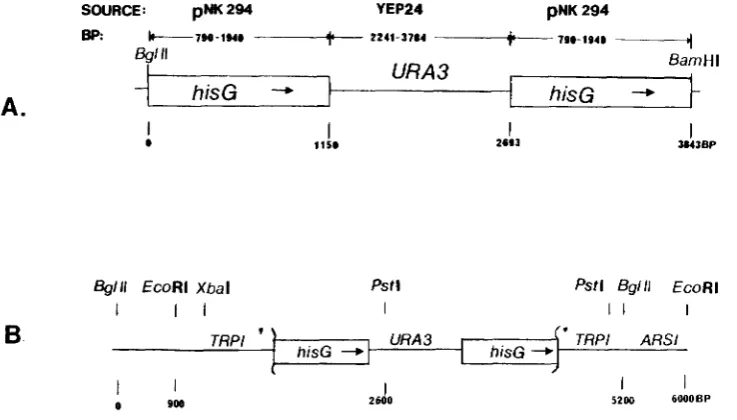
in and ligation reactions. The resulting plasmid, pNKY51, contains the 3.8 kb hisG-URA3-hisC fragment that can be gel isolated by a BglII and BamHI digest. The complete structure of pNKY51 is shown in Figure 2.
pNKy1009 (TRPI insertion vector): pNKY 1009 was built in two steps. (1) T h e BamHI site in Y RP7 was destroyed by fill-in and ligation reactions and a BamHI linker was inserted into the EcoRV site to form pNKY1006. (2) The 3.8-kb BamHI-BglII fragment of pNKY51, which contains the hisG-URA3-hisG construct, was inserted into the BamHI
site within the TRPI gene of pNKY1006 to form pNKY1009 (Figure 2).
RESULTS AND DISCUSSION
Construction and testing of pNKY51: We have made a molecular construct appropriate for the strat- egy described in the introduction: an E. coli plasmid vector containing the yeast
URA3
gene flanked by direct repeats of a sequence from the Salmonella histidine operon (pNKY5 1 ; Figure2).
Digestion of this plasmid with BamHI and BglI1 produces a 3.8-kb fragment that can be inserted into any cloned gene or construct of interest. This fragment contains very few sites for “six cutter” restriction enzymes. Thus, after insertion of the construct into the target gene, it is usually easy to excise a fragment containing the con- struct and flanking target gene homology that is suit- able for introduction into the yeast genome.T h e properties of this construct in yeast have been examined. The 3.8-kb BamHI-BgEII fragment of pNKY51 was inserted into the yeast
TRPl
genc at the EcoRV restriction site to yield pNKY 1009 (Figure 2). A 4.7-kb fragment of pNKY 1009 containing the con- struct plus flankingTRPl
homology was generated by digestion with enzymes EcoRI and BgZII and thenpNK 294
+ 7 W - l M O ~-- 2241-3784 718-1110 4
-6g/ II BamHl
hisGyl
hisG
-+I
3843BP
I 2 u 3
I
1158
I
EcoRl Xbal
1 I 1
Pstl
I
Pstl Bg/fJ EcoRl
I 1 I
I 0 900
1
I2500
FIGURE 2. A, Restriction map of 3.8-kb construct that consists of the
URA3 gene flanked by direct repeats of Salmonella hisG D N A . Construc- tion is described in the Materials and Methods. T h e following “six cutter” enzymes d o not cut within the 3.8-kb
BglII-BamHI fragment: EcoRI, BglII, BamHI, H p a I , PuuII, SalI, SphI, X b a I , Xhol, Sacl, SacII. B , Restriction map of the chromosomal TRPl locus bearing a hisG-URA3-hisG insertion. In order to obtain this integrant,
Yeast
URA3
Gene DisruptionsTABLE 1
Frcqucncy o f URAS pne loss within a transformant colony
5.2
No. of colonies
Strain Relevant renotwe Growth on minimal medium 0111s uracil 5 F O A Growth on O ~ ~ I C S
'?K?
I 6 X 10'
NKY290 ura3, trp1::hisC 6 X 10'
NKY537 ura3, trpl::hisC-URA3-hisC A 0 4 X 10' 68 2 x lo-'
A 0 7 x 10' 62 9 x 1 0 - 5
~ a 2 x 1 0 5 94 5 x 10-
I x 10-5
Bn2x IO' 22
Colonies from two trpl::hisC-URA3-hisC transformants of NKY274 were plated onto minimal glucose plates plus uracil and minimal glucose plates plus uracil and 5-FOA (BOEKE. LACROUTE and FINK 1984).
Bg
E
--
Ttp
+ - -
+ - -
Ura
- + + - + +
Bg
E
'
1
2
"
1
2
'
Ura
+
--
+-- +-- +--
, -
5.2
1.5
\
4.9
1.3
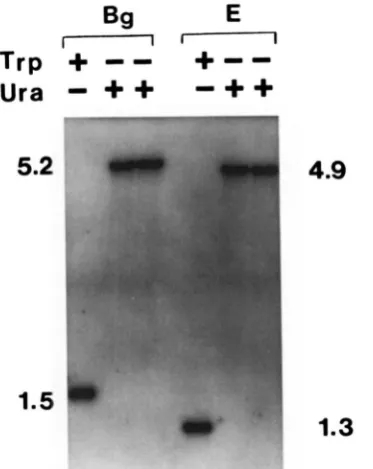
FIGURE S.-Southern blot of D N A extracted from NKY274
( M A T a . ura3, lys2, ho::LYS2) and two trpl::hisC-URA3-hisC trans-
formants thereof. Restriction enzyme digested chromosomal D N A was probed with TRPl sequences. Lambda DNA digested with Hind111 was used as a size marker (band sizes are in kb). E = EcoRI, Bg = Bglll.
transformed into the strain NKY274 by selection for growth in the absence of uracil. Four o u t o f four
Ura+
transformants were tryptophan auxotrophs.
Ura- derivatives o f two Ura+,
Trp-
transformants were initially obtained by patching o n t o 5-FOA plates, whichare
selective for uru3 strains (uracil plus5-
FOA) (BOEKE,
LACROUTE
a n d FINK 1984). Quantita- tive plating experiments subsequently showed that the frequency o f Ura- derivatives inisolated
single colo- nies of twoUra+
transformants was about 0.01% (Table 1). None of the Trp-,Ura-
derivatives gave rise toTrp+
revertants ata detectable
frequency(<lo-'
in cultures grown from single colonies). Integration of the construct into theTRPl
locus was confirmed by complementation analysis of o n e Ura- derivative, NKY290. We transformed NKY290(MATa,
trpl::hisC, uru3,
lys2, ho::LYSP)
with a 2 p2.6
1
1
4.9
1
2.4
FIGURE 4.--Southern blot of DNA extracted from wp1::huG-
URA3-hisC transformantsand 5-FOA' derivatives. 1 and 2 represent t w o independent Trp-, Ura' transformants and their 5-FOA' de- rivatives. Restriction enzyme digested chromosomal DNA was probed with hisC sequences. Lambda DNA digested with Hindlll
was used as a size marker (band sires are in kb). E = EcoRI. Bg =
Bglll.
vector bearing both the
URA3
a n dTRPI
genes orwith a
2p
vector bearing only theURA3
gene andselected
for growth in the absence of uracil. Only transformants containing theTRPl
plasmid could grow o n medium lacking tryptophan.T h e physical structures of two
Ura+,
Trp-
trans- formants a n d two 5-FOA resistant derivatives from each transformant were confirmedby
Southem blot analysis. Chromosomal DNA derived from these transformants a n d the parental strain NKY274 wasdigested
with EcoRIor
BglII.
Southem blotting ofNKY274 chromosomal DNA with a
TRPl probe re-
vealed 1.3 a n d 1.5 kb bands for the EcoRI a n d
BglII
digests, respectively (Figure
3).
Southern blots of Ura+,Trp-
transformantsprobed
with eitherTRPl
or
hisC
sequences revealed thepattern
of fragments expected for a simple gene replacement a tTRPl
with thetrpl::hisG-URA3-hisC
fragment:5.2-
a n d 4.9-kb bands were detectedfor
theBglII
a n d EcoRI digests, respectively (Figures3
a n d 4). T h e 5-FOA',Trp-
transformants displayed the bands expected from a deletion of the
URA3
a n d o n e of thehisC
sequences.Integration of leu2::hisG-URA3-hisG fragment into strains containing 0, 1 and 2 copies of hisG sequence
No. of Yo. of
No. of copies Ura+ Ura+, Leu- Percent Ura+,
Strain RdeVdnt genotype of hisG transformants transformants Leu-
NKY274 urajr, ho::LYSZ, lys2 0 92 66 72
NKY29O ura3, ho::LYS2, lys2, trp1::hisG 1 23 14 61
NKY536 ura?, ho::hisG, lys2, trp1::hisG 2 139 81 58
NKY289 u r d , ho::hisG, lys2 1 54 21 39
T h e above strains were transformed with a DNA fragment containing an insertion of the hisG-URAjr-hisG sequences a t the EcoRI site in
LELI2.
tained from the 5-FOA' derivatives yielded 2.6- and 2.4-kb bands, respectively, when probed with hisG
sequences.
Construction
of
multiply marked strains using the 3.8-kb construct: We have thus far used the pNKY5 1construct to make disruptions and/or deletions of the
T R P I , SPO13, HO, RADSO, URA3, and LEU2 yeast genes. Multiply marked strains can be made using these constructs in either of two ways: by transforming different construct disruptions into separate strains and generating the desired combinations by mating and sporulation, or by serial transformation of differ- ent construct disruptions into a single strain using repeating cycles of Uraf and Ura- selections. We have used the first approach to construct haploid and dip- loid SK-1 derivatives containingas many as four copies of the hisG repeat sequence (not shown). T h e presence of these four inserts has no detectable effect on either vegetative growth or sporulation; the strains grow at normal rates and give the normal high proportion (>go%) of asci containing four viable spores. We do not know whether meiotic recombination between these ectopic repeat sequences UINKS-ROBERTSON and PETES 1986; LICHTEN, BORTS and HABER 1987) oc- curs at some low level. We have also verified that it is feasible to transform strains bearing zero, one or two copies of the h i d sequence with a DNA fragment containing a hisG-lJRA3-hisG insert at the LEU2 gene. T h e presence of hisG copies in the transformed strain does not interfere with integration of a construct disruption into its normal locus, as the proportion of Leu- transformants is approximately 50% in all four strains (Table 2).
T h e hisG-URA3-hi& construct described here can easily be used to introduce gene disruption constructs into a wide variety of strain backgrounds. Selection for the desired integration event requires only the complementation of an appropriate Ura- mutant by the URA3 gene on the construct, and it is straightfor- ward to select such Ura- derivatives from any Ura+ strain using 5-FOA.
Additional direct repeat constructs: We have con- structed a vector analogous to pNKY51 in which the
U R A 3 gene is flanked by direct repeats of a different
1-kb sequence (derived from insertion sequence ISIO) (HALLING et al. 1982). This second vector may be useful in combination with the first for construction of strains carrying large numbers of construct inser- tions or for special cases where having two copies of the hisG sequence is not desirable. It should also be straightforward to make new gene disruption con- structs by substituting other selectable markers for the URA? gene in pNKY51. Most conveniently, the marker should be one for which both positive and negative genetic selections exist; the LYS2 gene an obvious example (CHATTOO et al. 1979). If other types of markers are used, excision/reduction events must be obtained by genetic screening rather than by direct selection.
We gratefully acknowledge WENDY RAYMOND for critical com- ments on the manuscript and A. FERRI for help in manuscript preparation. E. A. was supported by a National Institutes of Health predoctoral genetics training grant to the Department of Biochem- istry and Molecular Biology.
L I T E R A T U R E CITED
BARNES, W . M., 1981 Cloning and restriction map of the first part of the histidine operon of Salmonella typhimurium. J. Bac- teriol. 147: 124-1 34.
A positive selection for mutants lacking orotidine-5' phosphate decarboxylase ac- tivity in yeast: 5-fluoro-orotic acid resistance. Mol. Gen. Genet. 197: 345-346.
BOTSTEIN, D., S. FALCO, S. STEWART, M. BRENNAN, S. SCHERER, D. STINCHCOMB, K. STRUHL and R. DAVIS, 1979 Sterile host yeast (SHY) a eukaryotic system of biological containment for recombinant DNA experiments. Gene 8: 17-24.
CHATTOO, B. B., F. SHERMAN, D. A. AZUBALIS, T. A. FJELLSTEDT, D. MEHNERT and M. OGAR, 1979 Selection of lys2 mutants of the yeast Saccharomyces cerevisiae by the utilization of 01-
aminoadipate. Genetics 93: 5 1-65.
FOSTER, T. J., M. DAVIS, D. ROBERTS, K. TAKESHITA and N. KLECKNER, 198 1 Genetic organization of transposon TnlO. Cell 23: 201-213.
GUARENTE, L., G. LAURER, T. ROBERTS and M. PTASHNE, 1980 Improved methods for maximizing expression of a cloned gene: a bacterium that synthesizes rabbit p-globin. Cell
20: 543-553.
HALLING, S. M., R. W. SIMON, J. C . WAY, R. B. WALSH and N. KLECKNER, 1982 DNA sequence organization of IS10-Right of T n l O and comparison with WO-Left. Proc. Natl. Acad. Sci.
HOLM, C., W. MEEKS-WAGNER, W. FANGMAN and D. BOTSTEIN, BOEKE, J., F. LACROUTE and G. FINK, 1984
1986 A rapid, efficient method for isolating DNA from yeast. Gene 42: 169-173.
ITO, H., Y. FUKUDA, K. MURATA and A. KIMURA, 1983
Transformation of intact yeast cells treated with alkali cations. J. Bacteriol. 153: 163-168.
Chromosomal translo- cations generated by high-frequency meiotic recombination between repeated yeast genes. Genetics 114: 731-752.
KANE, S. M. and R. ROTH, 1974 Carbohydrate metabolism during ascospore development in yeast. J. Bacteriol. 118: 8-14.
LICHTEN, M., R. H. BORTS and J. E. HABER, 1987 Meiotic gene conversion and crossing over between dispersed homologous sequences occurs frequently in Saccharomyces cereuisiae. Ge- netics 115: 233-246.
MANIATIS, T., E. FRITSCH and J. SAMBROOK, 1982 Molecular Cloning: A Laboratory Manual. Cold Spring Harbor Laboratory Press, Cold Spring Harbor, N.Y.
MELTON, D., P. A. KRIEG, M. R. REBAGLIATI, T. MANIATIS, K.
ZINN and M. R. GREEN, 1984 Efficient in vitro synthesis of biologically active RNA and RNA hybridization probes from plasmids containing a bacteriophage SP6 promoter. Nucleic Acids Res. 12: 7035-7056.
Exferiments in Molecular Genetics. Cold Spring JINKS-ROBERTSON S. and T. PETES, 1986
MILLER, J., 1972
Harbor Laboratory Press, Cold Spring Harbor, N.Y. New England Biolabs Catalog, 1986-1987. Beverly, Mass. ORR-WEAVER, T., J. SZOSTAK and R. ROTHSTEIN, 1981 Yeast
transformation: a model for the study of recombination. Proc. Natl. Acad. Sci. USA 7 8 6364-6358.
Structure and func- tion of the yeast URA3 gene: expression in E. coli. Gene 2 9 113-124.
Replacement of chromosome segments with altered DNA sequences constructed in vitro.
Proc. Natl. Acad. Sci. USA 76: 4951-4955.
SHERMAN, F., G. FINK and J. HICKS, 1983 Methods in Yeast Genetics.
Cold Spring Harbor Laboratory Press, Cold Spring Harbor, N.Y.
Detection of specific sequences among DNA fragments separated by gel electrophoresis. J. Mol. Biol.
98: 503-517.
WILLIAMSON, D. H., L. H. JOHNSTON, D. J. FENNELL and G. SIMCHEN, 1983 The timing of the S phase and other nuclear events in yeast meiosis. Exp. Cell Res. 145: 209-217.
Eviction and trans- placement of mutant genes in yeast. Methods Enzymol. 101: 21 1-228.
Communicating editor: E. W. JONES
ROSE, M., P. GRISAFI and D. BOTSTEIN, 1984
SCHERER, S. and R. DAVIS, 1979
SOUTHERN, E. M., 1975