Polymorphism
of
Unique Noncoding DNA Sequences in Wild and
Laboratory Mice
Felipe Figueroa," Masanori Kasahara,? Herbert Tichy,* Esther Neufeld,* Uzi Ritte* and
Jan Klein*+
"Max-Planck-Institut f u r Biologie, Abteilung Immungenetik, 0 - 7 4 0 0 Tubingen, Federal Republic
of
Germany, TDepartment of Microbiology, University of Miami, Miami, Florida 33101, and *Department of Genetics, Hebrew University, Jerusalem 91 904, IsraelManuscript received April 1, 1987 Revised copy accepted May 30, 1987
ABSTRACT
Two DNA probes, D17Tul and D17Tu2, were isolated from a genomic DNA library containing only two mouse chromosomes, one of which is chromosome 17, carrying the major histocompatibility complex (H-Z), as well as the t complex genes. The D17Tul probe was mapped to the centromeric region of chromosome 17 and the D17Tu2 probe to the S region of the H-2 complex. Neither of the two probes appeared to detect any genes, but both contained unique, nonrepetitive sequences. Typing of DNA obtained from a large panel of mice revealed the presence of four D 17Tu 1 patterns in inbred mouse strains, one very common, one less common, and two present in one strain each. The two common patterns could not be detected in appreciable frequencies in the European wild mice tested (one of the two patterns was, however, found in Australian wild mice). Conversely, the patterns found frequently in European wild mice are absent in the laboratory mice. We therefore conclude that wild mice from the sampled regions of Europe could not have provided the ancestral stocks from which inbred strains were derived. Only one D17Tul pattern was found in all the populations of Mus musculus tested, while eight patterns were found in Mus domesticus, with virtually all the populations being polymorphic. We suggest that this difference reflects different modes in which the two species colonized Europe. The distribution of the D17Tu2 patterns in inbred strains correlates with the distribution of H-2 haplotypes.
HE eukaryotic genome contains two kinds of
T
DNA, one that codes for proteins or RNA which are necessary for cell function and another that does not seem to code for anything useful (HOOD, WILSONand WOOD 1975). T h e noncoding DNA occurs pri- marily in the form of repeated sequences distributed randomly over the genome. In addition, however, there are also noncoding sequences that are not re- peated (or if they are, then no more than the coding sequences) and that are also restricted in their distri- bution to either a single or only a few chromosomal regions (KAO 1985). Such noncoding, nonrepetitive
DNA may arise, for example, by randomization of extinguished genes, or it may represent unique struc- tural elements of the chromosome.
T h e noncoding, nonrepetitive DNA probably di- versifies without any constraints imposed on it by
selection and thus provides excellent probes for the study of populations, in particular as far as migration and origin of animal groups is concerned. It may also be useful for determining the evolution of closely related species; in species that are only distantly re- lated it may be so diversified that it can no longer be recognized by DNA-DNA hybridization. In the house mouse, for example, the probes could be used to elucidate how the present distribution of wild popu-
Genetics 117: 101-108 (September, 1987)
lations arose, how the many laboratory strains relate to these populations, and to determine the relation- ships among the numerous species and subspecies, which have been reported from different parts of the world (MARSHALL 198 1 ; SAGE 198 1).
We have isolated several probes that contain unique, probably noncoding sequences and that can be used to answer some of the questions concerning the origin of the house mouse (KASAHARA, FIGUEROA
and KLEIN 1987). T h e isolation of the probes is part of a study designed to map the proximal region of mouse chromosome 17. This region contains se- quences constituting the t complex, which influences segregation of chromosomes in male gametes, male fertility, embryonic development, and the recombi- nation frequencies (BENNETT 1975; SILVER 1985;
KLEIN 1986). T h e elements constituting the t complex are known to be distributed over at least 20 cM of
DNA.
In the present study, we have used these two clones to determine their polymorphism and the distribution of their individual variants in wild mouse populations, as well as in laboratory strains.
MATERIALS A N D METHODS
102 F. Figueroa et al.
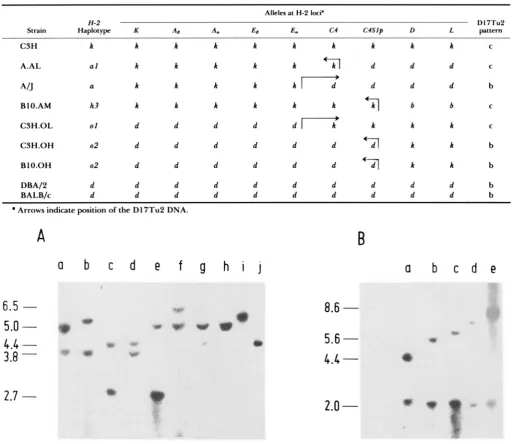
TABLE 1
Mapping of DlOTuZ into the D region of the H-2 complex
Alleles at H-2 IMP
H - 2 DI7Tu2
Strain Haplotype K A6 A. E# E. c4 c4s1p D L paccctn
C3H h h h h h h h h h h C
A.AL a1 h h h h d d d C
A1J a h h h h h [ d d d b
BIO.AM h3 h h h h h h q b b C
C3H.OL 01 d d d d d l h h h h C
C3H.OH 02 d d d d d d - d l h h b
BI O.OH 02 d d d d d d - h h b
DBA/2 d d d d d d d d d d b
BALB/c d d d d d d d d d d b
~~
Arrows indicate position o f the D 17Tu2 DNA.
A
a
b
c
d
e
f
g
h
i
j
6.5
-
5.0
-
4.4
-
3.8
-
2.7
-
B
a
b
c
d
e
-
8.6
-
5.6
-
4.4
-
2.0
-
FIGURE 1 .-Restriction patterns obtained after the digestion of genomic DNA with the Taql enzyme and hybridization with the DI 7Tu 1
(A) and D17Tu2 (B) probes. Patterns D17TuI-a through h. exept f. are found in M. d o m c s b ; pattern f i n M. musculus and patterns i
through I in other species. Patterns h and l are not included here as they were too weak.
T h e Jackson Laboratory, Bar Harbor, Maine. T h e sources of wild mice are listed in Figures 1 through 3. In addition, we also tested a set of strains carrying t haplotypes extracted from wild mice populations. These were described in pre- vious publications (KLEIN, SIPOS and FIGUEROA 1984; NI- BETIC. FIGUEROA and KLEIN 1984).
DNA probes: T w o probes were isolated from a cosmid genomic D N A library derived from the mouse-Chinese ham- ster cell line R44.1 (KASAHARA, FIGUEROA and KLEIN 1987). T h e D17TuI probe (derived from clone 3.4.1) is a 9.4-kb
EcoRI fragment which maps to the centromeric region of the mouse chromosome 17 (KASAHARA. FIGUEROA and KLEIN 1987). T h e D17Tu2 probe (derived from clone 9.4.3) is a 3.3-kb Hind111 fragment which maps within the H-2 complex (this publication). Both fragments were subcloned in pUC8. Extensive Northern blot analysis in which RNA
from different tissues (testis, brain, liver, kidney, teratocar- cinoma, spleen) was tested failed to provide any evidence for the presence of genes on the two fragments. Although these experiments do not exclude the presence of coding sequences on these probes, we shall assume-until proved otherwise-that the probes detect noncoding sequences. T h e fragments probably also contain repetitive elements, but when used in the presence of competing. unlabeled genomic DNA, they hybridize with unique DNA sequences.
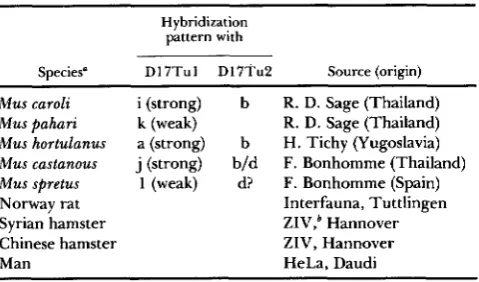
TABLE 2
Hybridization of D17Tul and D17Tu2 probes with DNA from different mammalian species
~~~ ~
Hybridization pattern with
Species" D17Tul D17Tu2 Source (origin) M u s c a d i
M u s pahari Mus hortulanus M u s castanous M u s sfwetus
Norway rat Syrian hamster Chinese hamster Man
~
i (strong) b R. D. Sage (Thailand) k (weak) R. D. Sage (Thailand) a (strong) b H. Tichy (Yugoslavia)
j (strong) b/d F. Bonhomme (Thailand) 1 (weak) d? F. Bonhomme (Spain)
Interfauna, Tuttlingen ZIV,b Hannover ZIV, Hannover HeLa, Daudi DNA from a single individual was tested for each species.
ZIV, Zentralinstitut fur Versuchstiere.
born, FRG). Probes were labeled by nick translation with "P (Amersham, Frankfurt, FRG), to a specific activity of 2
X lo' cpm. Hybridizations were performed in sealed bags for 24 hr, as previously described (FIGUEROA et al. 1985), in the presence of 100 p g salmon sperm DNA and 50 pg of sonicated mouse genomic DNA per milliliter of hybridizing solution. The filters were then washed twice at 60" in 0.1
X SSC. 0.1 % SDS.
RESULTS
Characterization of the probes: T h e D 1 7Tu 1 frag- ment maps to the centromeric region of chromosome 1 7 , probably outside the proximal inversion charac- terizing the t complex (KASAHARA, FIGUEROA and KLEIN 1987; ARTZT, SHIN and BENNETT 1982; HERRMANN et al. 1986). T h e D17Tu2 fragment was previously mapped to the mouse chromosome 17 be- cause it did not hybridize with DNA from a cell line having all mouse chromosomes except 17. Its more precise mapping is summarized in Table 1.
Digestion of mouse genomic DNA with the endo- nuclease TaqI produces two fragments which hybrid- ize with D17Tu2. T h e size of these fragments varies depending on the strain which donated the DNA. Thus far we have detected five patterns which we designate a through e (Figure 1). All inbred strains carrying the H-2k haplotype have pattern c, whereas all strains carrying the H-2d haplotype have pattern b (see below). Intra-H-2 recombinants derived from these two haplotypes have either the c o r b pattern, depending on which part of their H - 2 complex is derived from H-2k and which from H-2d (Table 1). T w o of the recombinants (H-2" and H-2"') map the fragment telomerically from the E, locus. Three other recombinants ( H - T ' , H-2h', H-2"*) map it centromer- ically from the D locus, thus locating the fragment into the S region of the H - 2 complex.
High polymorphism was also detected with the D 17Tu 1 probe. Eight patterns were detected by test- ing TaqI-digested DNA from Mus domesticus and Mus
musculus (laboratory or wild) and four additional pat- terns were discovered in other species of Mus (Figure 1). We designate these patterns by the letters a through 1. T h e hybridization of D17Tul with DNA from M. caroli, M . hortulanus and M . castaneus was as strong as that with DNA from M. domesticus and M . musculus, whereas hybridization with DNA from M. pahari and M . spretus was weaker. No hybridization was obtained with DNA from the rat (Rattus norvegi- cus), Syrian hamster (Mesocricetus auratus), Chinese hamster (Cricetulus griseus) or man. T h e D17Tu2 probe hybridized with DNA from M. caroli, M. hor- tulanus, M . castaneus and M . spretus, but not with DNA from any of the other species listed above (Table 2)-
Polymorphism of laboratory mice: T h e D 1 7Tu 1 probe detects four restriction fragment patterns among the inbred strains of the laboratory mouse (Table 3). T h e majority of the strains (22 of the 30
tested) have the same pattern (h); six strains have a different pattern (g); and one each have patterns a (PL/J) and c (CE/J). As we shall see shortly, this distribution of patterns is very different from that found in wild mice. T h e h pattern so common among the inbred strains has thus far been found only in wild mice from Australia; it is absent in all the European wild mouse populations that we have sampled. Simi- larly, the second most common pattern of the inbred strains ( g ) has thus far been found only in the small, isolated population of wild mice on the island of Helgoland in the North Sea. O n the other hand, the two very rare patterns of inbred strains ( a and c ) are very common among European wild mice.
T h e D17Tu2 probe also detects four patterns among the inbred strains, and these correlate with the H - 2 haplotypes these strains carry (Table 4). All strains with h-2 haplotypes a , b, d , q, s, and U have the
D 17Tu2-b pattern; all strains with H - 2 haplotypes j
and
p
have the D 17Tu2-a pattern; strains with the H - 2k and H-2" haplotypes have the D17Tu2-c pattern; and strains with the H-2' and H-2" haplotypes have the D17Tu2-d pattern. T h e D17Tu2-c pattern also occurs in H - 2 haplotypes w l , w13, w16, w22 and w27 which were extracted from wild mice and are related to H-2" (see DISCUSSION).104 F. Figueroa et al.
TABLE 3
Distribution of D17Tul a, c, g and h patterns among inbred mouse strains
TABLE 4
Distribution of D17Tu2 patterns among laboratory mice: Correlation with H-2 haplotypes"
H-2" H-Zb H-Zd H-2' H-2* H-2P H-2' H-2' H-2* H-2"
SM/J(c) NZW/J(d) B1 O.KPA42(c) BIO.STAlZ(c) BlO.BUAl(c) BlO.BUAl6(c) B 1 O.STA62(c) BlO.SM(c)
D17Tu2 pattern is given in parentheses after each strain.
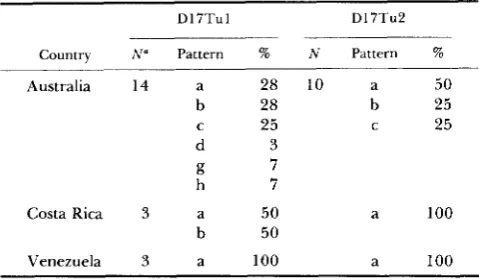
TABLE 5
Frequencies of patterns detected with the D17Tul and the D17Tu2 probes in wild mice from Australia and America
D 1 7 T u l D17Tu2
Countrv A'" Pattern '% N Pattern '%
Australia 14 a 28 10 a 50 b 28 b 25
C 25 C 25
d 3 h 7
Costa Rica 3 a 5 0 a 100 b 50
Venezuela 3 a 100 a 100 g 7
N = number of mice tested.
the only pattern o r at least the dominant pattern present in M . musculus. T h e D17Tul-f pattern is present only in M . musculus and not in any of the other species tested.
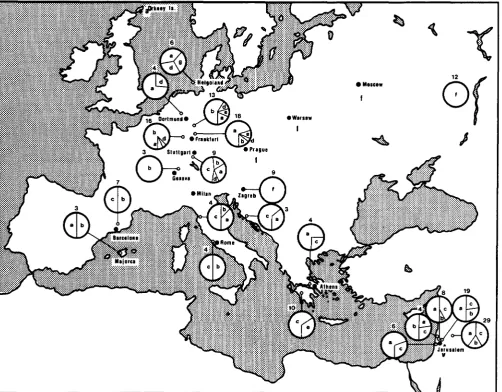
Another striking observation is that, as already men- tioned, the most common pattern of the laboratory mouse (D17Tul-h) has not been found at all in the European wild mice, and that the most common pat- tern of the wild mice (D17Tul-a) is absent in the tested sample of the inbred strains. T h e D17Tul-a pattern has been found in almost all the wild mouse populations that have been adequately sampled. The only population in which this pattern might be missing
is that from the Peloponnesus (1 0 mice tested). Inter- estingly enough, however, the pattern is present in wild mice on the mainland of Greece. Disregarding this one exception, the D17Tul-a pattern is distrib- uted worldwide, being found in M . domesticus of South America, Australia, and Europe. It is apparently also present in M . hortulanus from Yugoslavia. The fre- quency of the D17Tul-a pattern in some of the pop- ulations reaches over 75%.
The second most frequent pattern detected with the first probe is D17Tul-b, which, again, is absent only in those samples that were too small to be rep- resentative. This pattern, too, is absent in wild mice from the Greek Peloponnesus. All other patterns are less widely distributed and some seem to be restricted to certain geographic areas. T h e D17Tul-c pattern is found in the countries along the Mediterranean coast (but it can actually be traced all the way to southern Germany); it is apparently absent in northern Europe. T h e D17Tul-d pattern, on the other hand, is char- acteristic of wild mice from northern Europe and is absent in the Mediterranean region. T h e D17Tul-e has been found in only three localities: Egypt, Pelo- ponnesus, and around Frankfurt in central Europe. The D17Tul-g pattern is present only on the island of Helgoland and in Australia (and, of course, in laboratory mice), and the D17Tul-h pattern is found only in Australia (and in inbred mice).
FIGURE 2.-Frequencies of individual D17Tul patterns in wild mice from Europe. A full circle represents a frequency of loo%, small letters indicate patterns, and numbers indicate sample size. Small letters without circles indicate samples too small for the calculation of frequencies.
culus. Three of these patterns (a, b and c) are widely distributed, being present in samples from all four continents tested as well as in laboratory mice. T h e D 17Tu2-b pattern is also present in M. castaneus, M.
hortulanus and M . caroli; the D17Tu2-d pattern has also been found in M. castanevs and possibly in M. spretus.
Both the D17Tul and the D17Tu2 fragments oc- curred in homozygous as well as heterozygous states in the wild mice. T h e overall frequency of D17Tul heterozygotes was 4 1 % and that of the D17Tu2 het- erozygotes 60%. These estimates have been obtained by testing DNA digested with only one enzyme. T h e actual heterozygosity is probably higher.
Polymorphism of t haplotypes: T h e results ob- tained with the D17Tul probe were described in a
previous publication (KASAHARA, FIGUEROA and
KLEIN 1987). T h e results of the typing with the D 17Tu2 probe are summarized in Table 6, together with some H-2 and C4 typing results.obtained earlier
( N I ~ E T I ~ et aE. 1984; G O L U B I ~ et al. 1984; FIGUEROA
et al. 1985; LEVI-STRAUSS et al. 1985). All four TaqI patterns could be detected among the t haplotypes. T h e results are generally in agreement with the clas- sification of t haplotypes that we proposed earlier
(KLEIN et al. 1985). We established previously (DEM-
B I ~ , SINGER and KLEIN 1984) that the t haplotypes can be divided into two large groups, those not ex- pressing the E molecule controlled by the H-2 complex and those that do express it. We now find the D17Tu2-b and D17Tu2-d patterns to be associated with the E-nonexpressor haplotypes and the D17Tu2- c pattern to be associated with the E-expressor hap- lotypes. In addition, one of the E-expressors and two of the E-nonexpressor haplotypes have the D 17- Tu2-a pattern. T h e exceptions to this classification are on the one hand t", tTuWz0 , and tTUw3', which are E-nonexpressors but have the D 17Tu2-c pattern, and
tTuw6 and tTuwZg on the other, which are E-expressors
106 F. Figueroa et al.
FIGURE 3.-Frequencies of D17Tu2 patterns in European wild mice. A full circle represents a frequency of loo%, small letters indicate patterns, and numbers indicate sample size. Small letters without circles indicate samples too small for the calculation of frequencies.
tions (tTUw3* and tTUWz9) are clearly intra-H-2 recombi- nants on the basis of previous H-2 and C4 typing data
(NI~ETIC, FIGUEROA and KLEIN 1984; GOLUBIC et al. 1984; FIGUEROA et al. 1985). T h e remaining excep- tions must have some other explanation than intra-H- 2 recombination.
DISCUSSION
Origin of laboratory mice: T h e surprising finding that emerges in this study is that D17Tul patterns common among wild mice are not present in the laboratory mice, and vice versa. (The two exceptions are mice from Australia and mice from the small island of Helgoland, both extremely unlikely sources for stocks from which the inbred strains could have been derived.) This finding means that the populations we have tested thus far probably have not provided the ancestors of most of the inbred strains. Specifically, M . musculus and the populations of M . domesticus in central and southern Europe have apparently not
contributed in any major way to the gene pool of the laboratory mice.
From the distribution of the four D17Tu 1 patterns among the tested inbred strains it seems that the original Lathrop collection (KLEIN 1975) contained the <WO common patterns, D l 7 T u l - h and D17Tul- g, and that most of the other inbred strains ( i . e . , A K R , SWR, ST, BUB, WB, WC, SM, SEA, SJL, RF, RIII, NZB, and NZW) are also connected to this collection. Although the latter are listed in the current geneal- ogical trees of laboratory mice (KLEIN and KLEIN
1987) as being derived from sources other than the Lathrop collection, our data suggest that they, too, possess an admixture of genes from this original “melt- ing pot” of inbred strains. Of the strains tested, only
PL/J and CE/J seem to be derived from independent sources, both probably from wild mice trapped in the United States (New Jersey and Illinois, respectively)
(KLEIN and KLEIN 1987).
TABLE 6
Distribution of D17Tu2 patterns among strains with t haplotypes" Strain t6/+ Lub4 Lub9 GPC882 MOY336 EDY589 Lub 1 MSW25 1 ISL33 BRW942 t12/+ to/+ t w 2 / t w 2
BRU382 OBL984 ROD1455 LGN925 PLD826 ERPl465 Lub7/+ CR0437 t"'S/+
t w 5 / +
t
Haplotype
6 Lubl Lub9 T u w l l Tuw 15 T u w l 0 Lubl 12 Tuw20 Tuw32 Tuw29 0 w2 Tuw6 Tuw25 Tuw27 Tuw24 Tuw26 Tuw28 w73 Lub7 w5 Tuw8
D 17Tu2 pattern No. of c4 copiesb E , allele' C C C C C C C C C C b b b b b b b a a a d d d 3 3 3 3 3 3 3 3 2 2 3 2 2 2 2 2 2 2 2 3 2 2 2 w2 w2 w2 w2 W2 w2 w2 w28 w28 w28 w2 w29 w29 W2 w28.2 w28.2 w28.2 w28.2 w28.2 w2 w28. I w28.1 w29.1 ~~ ~~ ~
a The number of C4 copies and E alleles are shown for compar-
ison.
Data from GOLUBII: et al. (1984).
Data from DembiS, Singer and Klein (1984) and DEMBIC et al.
(1985). Alleles E", E'*', and have a deletion in the pro- motor region; alleles EZ9 E''.' have a defect in mRNA production. All these alleles are E-nonexpressors.
relate with the H - 2 haplotypes of the inbred strains without exception. However, they cluster some of the H - 2 haplotypes together and this does seem to reflect genealogical relationships among the haplotypes. T h e most striking example is the group carrying the D17Tu2-b pattern and including H - 2 haplotypes a , b, d , q , s , and U . T h e H-2", H - 2 d , and H-2" haplotypes
are related in that all three carry the H-2Dd allele, and the H-2', H - 2 , and H-2" haplotypes are related in that all three have the E-nonexpressor allele (KLEIN, FI-
GUEROA and DAVID 1983; KLEIN 1986). In addition,
the class I1 loci of H-2' and H-2d haplotypes are also closely related at the nucleotide sequence level (KLEIN and FIGUEROA 1986).
Another example is the group of strains which have the D17Tu2-c pattern. This group contains five H - 2 haplotypes extracted from wild mice captured rela- tively recently in Michigan (H-2 haplotypes w l , w 1 3 , w 1 6 , w 2 2 , and w 2 7 ; see ZALESKA-RUTCZYNSKA and
KLEIN 1977; DUNCAN and KLEIN 1980), in addition to the H-2" and H-2' haplotypes. As it turns out, the
SM/J mice carrying the H-2" haplotype are derived in part from wild mice trapped by McArthur in Michigan more than 50 years ago (MACARTHUR 1944). In ad-
dition, the H-2" and H-2'"' haplotypes carry a rare allele at the neuraminidase-1 locus (Neu-I"), which maps within the H - 2 complex (FIGUEROA et al. 1982). T h e H-2"' , H-2'-"16, and H-2"22 haplotypes are related to the H-2" haplotype in that they code for the antigens H-2.m153 and/or H-2.mll7, which are otherwise found in almost no other laboratory or wild mice, except some of those carrying certain t haplotypes.
Polymorphism of wild mice and mice with t hap- lotypes: T h e most interesting finding from the study of the wild mice is the monomorphism of M. musculus populations for the D17Tul fragment, contrasting with the extensive polymorphism of virtually all the
M. domesticus populations. T h e difference between these two species of M u s is by no means restricted to the D17Tu 1 probe. T h e two species differ also in that M . domesticus shows extensive chromosomal variation, as is revealed by the presence of Robertsonian fusions in numerous populations in Europe and North Africa (GROPP and WINKING 198 1 ; ADOLPH and KLEIN 198 1, 1983; TICHY and V U ~ A K 1987), while no Robertson- ian-type variation has been found in M. musculus. Another difference between the two species is that M. domesticus populations in Europe carry t haplotypes characterized by the presence of different lethal or semilethal genes on chromosome 17. At least 15 dif- ferent t haplotypes have been identified in this species, with different populations carrying different haplo-
types (BENNETT 1975; KLEIN, SIPOS and FIGUEROA
1984; F. FIGUEROA and J. KLEIN, unpublished data). In a striking contrast to this situation, the M . musculus populations all carry t haplotypes with the same lethal gene (tw7') (DUNN, BENNETT and COOKINGHAM 1973; KLEIN, SIPOS and FIGUEROA, 1984; DEMIN and KRYU-
KOV 1983; DEMIN, MAZIN and SAFRONOVA 1986; A.
RUVINSKY, personal communication; F. FIGUEROA and J. KLEIN, unpublished data). A few of these haplotypes may carry other lethal genes, in addition to tW7', but they all carry tW7', which is absent in M. domesticus.
We believe that these three examples represent an emerging pattern which indicates a greater homoge- neity of the M. musculus populations in comparison to the M. domesticus populations. This homogeneity probably did not arise through a "bottleneck" effect because other genes [ H - 2 and enzyme-encoding loci, for example, see KLEIN and FIGUEROA (1981), and unpublished data; BONHOMME et a l . (1984)l show no such restriction of their polymorphisms. It is more likely that the difference between the two species arose because of their different modes of dissemina- tion (KLEIN, TICHY and FIGUEROA 1987).
108 F. Figueroa et al.
of the USSR, Novosibirsk, USSR; G. SINGLETON, Division of Wild- life and Rangelands Research, CSIRO, Canberra, Australia; J. VIVES, Hospital Clinico y Provincial de Barcelona, Barcelona, Spain;
I. VUCAK, Department of Physiology, Faculty of Medicine, Univer- sity of Zagreb, Zagreb, Yugoslavia. We also thank J. NADEAU, T h e Jackson Laboratory, Bar Harbor, Maine, for DNA samples from laboratory mice, and BEATE POMMERL for excellent technical assist- ance.
LITERATURE CITED
ADOLPH, S. and J. KLEIN, 1981 Robertsonian variation in Mus musculus from Central Europe, Spain, and Scotland. J. Hered. Genetic variation of wild mouse populations in southern Germany. I. Cytogenetic study. Genet. Res. 41: 1 17-1 34.
Gene mapping within the T/t complex of the mouse. 11. Anomalous position of the H - 2 complex. Cell 28: 471-476.
72: 219-221.
ADOLPH, S. and J. KLEIN, 1983
ARTZT, K., H.-S. SHIN and D. BENNETT, 1982
BENNETT, D., 1975
BONHOMME, F., J. CATALAN, J. BRITTON-DAVIDIAN, V. M. CHAP-
M A N , K. MORIAWAKI, E. NEVO and L. THALER,
1984 Biochemical diversity and evolution in the genus Mus.
Biochem. Genet. 22: 275-303.
DEMBIC:, Z., M. AYANE, J. KLEIN, M. STEINMETZ, C. 0. BENOIST and D. J. MATHIS, 1985 Inbred and wild mice carry identical deletions in their E, MHC genes. EMBO J. 4 127-131.
D E M B I ~ , Z., P. A. SINGER and J. KLEIN, 1984 E": a history of a mutation. EMBO J. 3: 1647-1654.
DEMIN, Y. and V. I. KRYUKOV, 1983 Study of t-haplotypes of natural mouse populations (Mus musculus L.). 11. Analysis of complementation groups (in Russian). Genetika 19: 58-64.
Results of analysis of t-haplotypes isolated from a Moscow house mouse population (in Russian). Genetika 22: 507-510.
Histocompatibility-2 system in wild mice. IX. Serological analysisof 13 new BIO.W congenic lines. Immunogenetics 1 0 45-65.
DUNN, L. C., D. BENNETT and J. COOKINGHAM, 1973
Polymorphism for lethal alleles in European populations of Mus
musculus. J. Mammal. 5 4 822-830.
FIGUEROA, F., M. C O L U B I ~ , D. N I ~ E T I ~ and J. KLEIN, 1985
Evolution of mouse major histocompatiblity complex genes borne by t chromosomes. Proc. Natl. Acad. Sci. USA 84: 281 9- 2823.
FIGUEROA, F., D. KLEIN, S. TEWARSON and J. KLEIN, 1982
Evidence for placing the Neu-1 locus within the mouse H - 2
complex. J. Immunol. 1 2 9 2089-2093.
GOLUBI~, M., F. FIGUEROA, M. TosIand J. Klein, 1984 Restriction
fragment length polymorphism of C4 genes in mice with t
chromosomes. Immunogenetics 21: 247-256.
Robertsonian translocations: cytology, meiosis, segretation patterns and biological conse- quences of heterozygosity. In: Biology of the House Mouse, Edited by R. J. BERRY. Academic Press, London.
HERRMANN, B., M. BUCAN, P. E. MAINS, A.-M. FRISCHAUF, L. M. SILVER and H . LEHRACH. 1986 Genetic analysis of the prox- T h e T-locus of the mouse. Cell 6: 441-454.
DEMIN, Y., S. M. MAZIN and L. D. SAFRONOVA, 1986
DUNCAN, W. R. and J. KLEIN, 1980
GROPP, A. and H . WINKING, 198 1
imal portion of the mouse t-complex: evidence for a second inversion within t haplotypes. Cell 44: 468-476. '
HOOD, L. E., J. H. WILSON and W. B. WOOD, 1975 Molecular Biology of Eucaryotic Cells, Vol. 1 . W. A. Benjamin, Menlo Park, Calif.
Human genome structure. Int. Rev. Cytol. 9 6
Random cloning of genes from mouse chromosome 17. Proc. Natl. Acad. Sci.
Biology of the Mouse Histocompatibility-2 Complex. Principles of Immunogenetics Applied to a Single System. Springer- Verlag, New York.
KLEIN, J., 1986 Natural History of the Major Histocompatibility Com- plex. Wiley, New York.
KLEIN, J. and F. FIGUEROA, 1981 Polymorphism of the mouse H - 2 loci. Immunol. Rev. 60: 23-57.
KLEIN, J. and F. FIGUEROA, 1986 Evolution of the major histocom- patibility complex. CRC Crit. Rev. lmmunol. 6: 295-386.
KLEIN, J . and D. KLEIN, 1987 Mouse inbred and congenic strains. Methods Enzymol. In press.
KLEIN, J., F. FIGUEROA and C. S. DAVID, 1983 H-2 haplotypes, genes and antigens: second listing. 11. T h e H-2 complex. Im- munogenetics 17: 553-596.
KLEIN, J., P. SIPOS and F. FIGUEROA, 1984 Polymorphism of t-
complex genes in European wild mice. Genet. Res. 44: 39-46
KLEIN, J., H. TICHY and F. FIGUEROA, 1987 O n the origin of mice. An. Univ. Chile. In press.
KLEIN, J., D. NIZETIC, M. GOLUBI~, Z. DEMBIE and F. FIGUEROA,
1985 Evolution of H - 2 genes on t chromosomes. pp. 97-106.
In: Cell Biology of the Major Histocompatibility Complex, Edited by B. PERNIS and H. VOGEL. Academic Press, New York. LEVI-STRAWS, M., M. TOSI, M. STEINMETZ, J. KLEIN and T. MEO,
1985 Multiple duplications of complement C4 gene correlate with H-2-controlled testosterone-independent expression of its sex-limited isoform, C4-Slp. Proc. Natl. Acad. Sci. USA 82:
1746-1 750.
Genetics of body size and related char- acters. I. Selecting small and large races of the laboratory mouse. Am. Nat. 78: 142-157.
Taxonomy. pp. 17-26. In: The Mouse in Biomedical Research, Vol. I, Edited by H . L. FOSTER, J. D. SMALL and J. G. FOX. Academic Press, New York.
Evolutionary rela- tionships between the t and H - 2 haplotypes in the house mouse. Immunogenetics 1 9 31 1-320.
Wild mice. pp. 39-90. In: The Mouse in Biomed- ical Research, Vol. I, Edited by H. L. FOSTER, J. D. SMALL and
J. G. Fox. Academic Press, New York.
SILVER, L. M., 1985 Mouse t haplotypes. Annu. Rev. Genet. 19:
TICHY, H. and I . V U ~ A K , 1987 Chromosomal polymorphism in the house mouse (Mus domesticus) of Greece and Yugoslavia. Chromosoma 95: 31-36.
Histocompatibility-
2 system in wild mice. V. Serological analysis of sixteen B1O.W congenic lines. J. Immunol. 119: 1903-191 1.
Communicating editor: D. BENNETT KAO, F.-T., 1985
KASAHARA, M., F. FIGUEROA and J. KLEIN, 1987 51-88.
USA 84: 3325-3328.
KLEIN, J., 1975
MACARTHUR, J. W., 1944
MARSHALL, J. T . , 1981
N I ~ T I C , D., F. FICUEROA and J. KLEIN, 1984
SAGE, R. D., 1981
179-208.