Copyright2000 by the Genetics Society of America
Detecting Ancient Admixture in Humans Using Sequence Polymorphism Data
Jeffrey D. Wall
Department of Ecology and Evolution, University of Chicago, Chicago, Illinois 60637 Manuscript received April 18, 1999
Accepted for publication October 14, 1999
ABSTRACT
A debate of long-standing interest in human evolution centers around whether archaic human popula-tions (such as the Neanderthals) have contributed to the modern gene pool. A model of ancient population structure with recent mixing is introduced, and it is determined how much information (i.e., sequence data from how many unlinked nuclear loci) would be necessary to distinguish between different demographic scenarios. It is found thatⵑ50–100 loci are necessary if plausible parameter estimates are used. There are not enough data available at the present to support either the “single origin” or the “multiregional” model of modern human evolution. However, this information should be available in a few years.
T
HE question of modern human origins has fasci- mtDNA. The inferred sequence was found to be quite nated physical anthropologists for decades. Re- different from the homologous sequences of all extant cently, two main hypotheses have been proposed. One humans (Kringset al. 1997). This observation has beenview, often called the single origin model, claims that taken as evidence for the claim that modern humans modern humans evolved in a single location (probably and Neanderthals did not interbreed, and thus that in Africa) roughly 150,000 years ago and from there Neanderthals left no descendants among extant hu-expanded and replaced the existing hominid popula- mans (e.g., Kahn and Gibbons 1997; Lindahl 1997; tions around the world (e.g.,Howells1976;Stringer Wardand Stringer 1997). However, it is impossible and Andrews 1988). In contrast, the multiregional to make any strong inferences from single locus data model claims no single location for the origin of modern because of the randomness inherent in the underlying humans; instead, it posits that over the last 1–2 million evolutionary process. In fact, the mitochondrial data years humans have evolved gradually from their Homo are consistent with a high level of interbreeding between
erectus ancestors throughout the Old World (e.g.,Weiden- humans and Neanderthals (Nordborg 1998). Nord-reich1943;Wolpoffet al. 1984). Both theories claim borg calculates that even if Neanderthal mtDNA com-support from the fossil record (e.g.,Wolpoffet al. 1984; prised 25% of the ancestry of extant human mtDNA Stringer and Andrews 1988), and it is hard to sort roughly 68,000 years ago, there would still be a⬎50% out their conflicting claims. However, recent fossil stud- chance that by the present time all Neanderthal mtDNA ies tend to support the single origin hypothesis (e.g., would have been lost because of genetic drift. To have Lahr1994, 1996;Hublinet al. 1995; but seeDuarte any power, we must have data from multiple unlinked
et al. 1999), as do recent genetic studies (e.g.,Vigilant loci.
et al. 1991;Armour et al. 1996;Tishkoffet al. 1996). In this article, I explore how much power we have
Despite this trend, there are still vocal supporters of the to exclude the possibility that Neanderthals (or other multiregional model (e.g.,Wolpoff1996). archaic humans) left descendants among extant hu-One way of rephrasing the debate is to ask how much mans given sequence data from multiple unlinked neu-contribution regional “archaic” populations have had tral nuclear loci. I assume that no further loci from to current human morphological and genetic diversity. Neanderthals will be sequenced; given the difficulty en-Under the single origin model, this contribution is countered with ancient mtDNA, which is present in thought to be very small or nonexistent, whereas the hundreds of copies in each cell, it is highly unlikely that multiregional model predicts that it is quite large. Other any single copy nuclear DNA can be recovered from intermediate hypotheses predict a range of contribu- fossils as old as Neanderthals. Instead, I focus on the tions from relatively small (e.g.,Bra¨uer1984) to rela- effect of past demographic events on the patterns of tively large (e.g.,Smith1992). current observed variation in human populations. This One recent genetical breakthrough involved the re- can be done by examining the change in the shape covery and sequencing of a fragment of Neanderthal
of the genealogy caused by alternative demographic scenarios. Both changes in population size and the pres-ence of population subdivision produce characteristic
Address for correspondence: Department of Ecology and Evolution,
changes in the shape of genealogies when they are com-University of Chicago, 1101 E. 57th St., Chicago, IL 60637.
E-mail: [email protected] pared with genealogies generated from a constant size
practice, they must be inferred from observed sequence data. This inference is especially difficult when there is intragenic recombination. I deal with the problem of intragenic recombination by examining patterns that are directly observable in sequence data. The model assumes that there are data from many unlinked neutral loci. Unlinked loci essentially provide independent runs of the evolutionary process, because demographic his-tory is expected to equally affect the whole genome. Another advantage of considering multiple unlinked loci is that we can minimize the confounding effect of local selection.
I introduce ad hoc test statistics based on measures of inferred linkage disequilibrium or inferred genealogical tree shape, and I examine their powers to reject the null model (of panmixia) when the actual demography is as in Figure 1. More effective measures likely exist. However, my goal was to construct reasonable upper bounds for how much information (i.e., how many loci) would be necessary to distinguish between various de-mographic hypotheses. Full-likelihood methods were not considered. Algorithms that include intragenic re-combination have only been implemented for panmic-tic models (e.g.,Griffiths andMarjoram1996), and even these are not computationally feasible for the re-combination rates considered here (results not shown). An outline of the remainder of the article is as follows. First, the model and test statistics are introduced. Then, the test statistics are compared with each other, and the best one is chosen for further simulations. These simulations are parameterized to model
Neanderthal-Figure1.—A model of population subdivision. The popula- modern human admixture in Europeⵑ30,000–45,000
tion is panmictic from time 0 to time T0(going backward in
years ago (e.g.,Mercieret al. 1991;Hublinet al. 1995,
time). At time T0, lineages are separated into two isolated
1996) and more speculative admixture between modern subpopulations, in proportions c and 1⫺c. Then, at T1and
further back in time, the remaining lineages are randomly humans and H. erectus remnants in Southeast Asia ( Rob-mating. Throughout, a coalescent model with recombination ertset al. 1994;Swisheret al. 1996). Finally, shortcom-is employed (cf.Hudson1990). ings of the model are discussed, as are general issues
regarding demographic inference from current se-quence data.
panmictic model (e.g.,Takahata1988;Tajima1989a; SlatkinandHudson1991;MarjoramandDonnelly
MODEL AND TEST STATISTICS 1994). For example, Nordborg (2000) proposes a
model that could characterize Neanderthal admixture. To model archaic admixture, I use an infinite-sites Consider two populations that diverged at time T1 in coalescent model with recombination (cf. Hudson the past and remain completely isolated until time T0, 1983, 1990). I assume there is no selection and a con-at which point they merge into a single panmictic popu- stant rate of recombination per base pair per genera-lation in proportions c and 1⫺ c (see Figure 1). The tion. Consider a panmictic population with diploid
ef-genealogy in Figure 1 differs from a panmictic one in fective population size N. Going backward in time, that the amount of time when there are two ancestors suppose that at time T0 the remaining ancestors are is much larger than its expectation under panmixia. placed randomly into one of two subpopulations with Nordborg(2000) shows that under some extreme ad- probabilities c and 1⫺c. From time T0to time T1, these mixture scenarios, panmixia can be rejected because subpopulations are assumed to be completely isolated this time is too long. from each other and panmictic with diploid effective Nordborg notes that his results are not conservative population sizes of cN and N, respectively. [Replacing (i.e., the power to reject panmixia with actual data is cN by N or N by (1⫺ c)N did not change any of the
effective population size N. All further coalescences oc- Neanderthal ancestry will also have on average higher levels of polymorphism (due to longer genealogies) and cur in this panmictic population. The null model is c⫽
0, which yields constant-sized panmixia throughout time thus longer distances when measured by the number of intervening segregating sites.
(i.e., no contribution of archaic populations to the
mod-ern gene pool). T0 and T1 are scaled in units of 2N Nordborg(2000) uses the total time when there are exactly two ancestors as a test statistic. This is similar to generations. This model is similar to that proposed by
Nordborg (2000), except that it includes intragenic using the longest branch length in the unrooted tree as a test statistic, because the longest branch is often recombination. One possible problem with the model
is that the mixing event at time T0 is assumed to be the oldest one as well. (This correspondence is less meaningful when recombination causes different sites instantaneous, whereas possible interbreeding between
modern and archaic human populations might have to have different genealogies.) As mentioned before, tree topologies and branch lengths must be estimated been spread over thousands of years. However, the
in-stantaneous approximation is reasonable because few from the data. One measure with similar motivation is coalescent events are expected to occur during the time
of contact and because only small values of c are consid- lb⫽max {|A|
兩
A債{1, 2, . . . S } ered.The data simulated using the above scheme are in
and A is pairwise congruent}. the standard population genetic format of an ordered
list of segregating sites. Call a pair of segregating sites
lbis the maximum number of segregating sites that are
congruent if the subset of the data consisting of the two
all congruent to each other. If there were no recombina-sites contains only two different haplotypes.
Congru-tion, lbwould be an estimate of the number of mutations ence is a pairwise measure of linkage disequilibrium; it
on the longest branch. In practice, it is still useful even has been shown to be effective in detecting certain types
in the presence of intragenic recombination (see re-of population structure (Wall1999). If T1Ⰷ T0, then
sults). Another possible test statistic is the maximal at time T0 there will be many sites that are fixed for
number of nucleotide differences between two sampled alternative alleles in the two subpopulations. This will
individuals, denoted by kmax. This statistic has been used show up in data as a set of sites that is dispersed
through-in estimatthrough-ing the time to the most recent common an-out a locus and is pairwise congruent. (A set of sites is
cestor (TMRCA) of a sample (e.g., Templeton1993; Fu pairwise congruent if all possible pairs in the set are
andLi1997). The TMRCAis expected to be substantially congruent.) Over time these associations will decay, but
longer in scenarios such as depicted in Figure 1. they serve as the motivation for the following test
statis-One final test statistic considered isTajima’s (1989b) tics.
D (denoted here by dt), a commonly used measure of Label the segregating sites 1, 2, . . . , S in order, and
the skew in the observed frequency spectrum. When c suppose 1ⱕiⱕ jⱕ S. Define the indicator variable
is small, mutations on the oldest branch will tend to be at low frequency (assuming there is no outgroup),
Ic(i, j)⫽
冦
1 if i and j are congruent
0 otherwise. leading to a shift toward negative dt values. Because the multilocus likelihood calculations described below Consider the subset of the data consisting of the sites require discrete variables, each dt value was rounded
i, i⫹1, . . . , j. If this subset has evidence of recombina- down to the nearest tenth.
tion (by containing a pair of sites with| D⬘ | ⬍ 1; cf. Suppose an alternative model Alt ⫽(c, T
0, T1,, C ) HudsonandKaplan1985), then set Ir(i, j)⫽1. Other- is specified. (Here ⫽4Nis the population mutation wise, define Ir(i, j)⫽0. Now, let parameter and C⫽4Nr is the population recombination
parameter.) It is compared with a null model Null⫽
g⫽
兺
S⫺1
i⫽1
兺
S
j⫽i⫹1
Ic(i, j) (c ⫽ 0, T0, T1, , C). The’s for the two models are chosen so that the average pairwise divergences (; cf. Tajima1983) for the simulated data sets have roughly
gr⫽
兺
S⫺1
i⫽1
兺
S
j⫽i⫹1
Ic(i, j) Ir(i, j)
equal expectation. Furthermore, we assume that ⫽
C for each model. (This assumption is relaxed in the gd⫽ max {|i⫺j|
冨
Ic(i, j)⫽1}.discussion.) Recent high-resolution linkage maps (e.g., Bouffardet al. 1997;Nagarajaet al. 1997) and studies g is the number of pairs of sites that are congruent, gr
of human genetic variation (e.g.,Hardinget al. 1997;
is the number of pairs of sites that are both congruent
Zietkiewiczet al. 1997;Nickersonet al. 1998;Harris and have evidence of recombination between them, and
andHey1999) suggest that this is a reasonable
approxi-gd is the maximal distance (measured in segregating
mation. Note that the actual values of T0 and T1 are sites) between any two congruent sites. For gd, a distance
irrelevant for the null model. measure based on the number of intervening base pairs
statistics by simulation. A statistic will be effective when its distribution under the alternative model of archaic admixture is noticeably different from its distribution under the null model of equilibrium panmixia. For any value of k, set PrNull(g⫽k) as the probability that g⫽k
if the null model is simulated. (PrAltis defined similarly.) This probability can be estimated from the proportion of simulated trials where g ⫽ k. In general, 106 trials were considered sufficient for each combination of pa-rameter values. Now, suppose that data is available from
x independent loci, each simulated according to either
the null model or the alternative model. Define g(j )⫽ the value of g from the jth locus, and
G⫽
兿
x
J⫽1
冤
PrNull(g⫽g(j ))
PrAlt(g⫽g(j ))
冥
. statistics. Here CFigure 2.—Power vs. the number of loci for all six test⫽ ⫽ 10, n ⫽ 50, c ⫽ 0.1, T0 ⫽0.1, and T1⫽1.0. (䉬) Gr, (䊏) Lb, (䉱) G, (X) Gd, (*) Kmax, (䊉) Dt.
G is akin to a likelihood ratio and is used as a
one-tailed test statistic. An empirical distribution for G is determined from 105 simulations of the null model.
The most powerful test statistic (Gr) was chosen for Then, the power to reject the null model (at the 5%
more extensive simulations that sought to determine level) is determined from 105 simulations under the
how much information (i.e., how many loci) would be alternative model. G values that are too low are rejected.
required to distinguish between plausible human
demo-Gr, Gq, etc., are all defined analogously.
graphic scenarios. The results are described first for possible Neanderthal admixture in Europe and second RESULTS for possible H. erectus admixture in Southeast Asia.
Recent archaeological evidence suggests that modern Preliminary simulations were run to estimate the
opti-humans first entered Europe roughly 45,000 years ago, mal sample size, locus size, and test statistic. It was
as-and that remnant Neas-anderthal populations remained sumed that there is a constant per base pair cost for
until ⵑ25,000–30,000 years ago (e.g., Mercier et al.
sequencing; under the constraint of a fixed total cost,
1991;Hublinet al. 1995, 1996;Lahr1996;Duarteet
it was determined what combination of n,, number of
al. 1999). Making the same approximations of N⫽104 loci, and test statistic led to maximal power to reject
and a generation time of 20 years yields the estimate the null model. These simulations were meant to be
T0ⵑ0.07–0.11. It is more difficult to make a reasonable exploratory, not exhaustive. They suggest that the
opti-guess for T1. This is due to both the multiple interpreta-mal configuration has a relatively sinterpreta-mall sample size (nⵑ
tions of the fossil record and the fact that genetic isola-20) and a relatively large locus size ( ⵑ10), and that
tion might be only loosely correlated with morphologi-power is maximized using Gr (results not shown). All
cal divergence. Foley and Lahr (1997) suggest that further simulations fixed ⫽10 and n⫽50. This
corre-the divergence may be relatively recent (i.e., roughly sponds to roughly 8–10 kb of sequence. The larger than
250,000 years ago), while others have postulated that it optimal sample size was taken to conform more closely
is far older (e.g.,Carbonellet al. 1995;Hublin1998). to the large sample sizes considered in most recent
I simulated T1 values from 0.6 to 2.0 (increment 0.2), studies of human genetic variation (e.g.,Hardinget al.
which cover the whole range of possibilities. Also, T0 1997;Zietkiewiczet al. 1997;Nickersonet al. 1998).
values from 0.06 to 0.2 (increment 0.02) were consid-As an illustration, Figure 2 shows the power (in
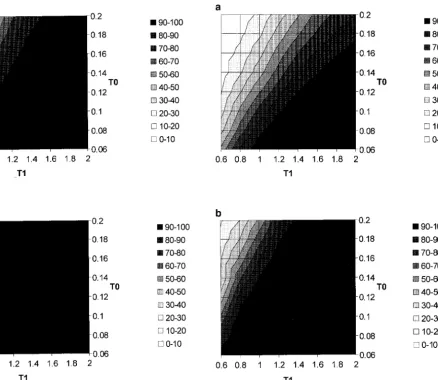
percent-ered. Results are shown in Figures 3 and 4. Figure 3 has age) vs. the number of loci for all six test statistics. The
c⫽ 0.1 while Figure 4 has c⫽ 0.02. For both, the first other parameters are c ⫽ 0.1, T0 ⫽0.1, and T1⫽ 1.0.
graph shows the power to reject the null model when If we make the standard assumptions of N⫽104and a
there are 60 loci, and the second shows the power when generation time of 20 years, then T0is 40,000 years ago
250 loci are considered. Not surprisingly, more extreme and T1is 400,000 years ago. Gr, Lb, and G are all
reason-subdivision (i.e., smaller T0 values or larger T1 values) ably powerful with ⵑ40 or more loci, while the others
leads to greater power. For the genealogy of a given site remain weak even when a large number of loci are
to look like Figure 1, at least one lineage must be present considered. Gris slightly more powerful than G because
in both subpopulations. For the parameters considered it weights those congruent pairs that are “far” (as
mea-here (i.e., c Ⰶ1 and many expected ancestors at time sured by evidence of recombination) over those that
T0), representation in the nonarchaic subpopulation is are “near.” The former are much more unusual under
Figure 4.—Power as a function of T0 and T1. The other
Figure 3.—Power as a function of T0 and T1. The other
parameters are C⫽ ⫽10, n⫽50, and c⫽0.02. (a) Power parameters are C⫽ ⫽10, n⫽50, and c⫽0.1. (a) Power
with 60 independent loci; (b) power with 250 loci. with 60 independent loci; (b) power with 250 loci.
the null model might require on the order of hundreds 1 if and only if it contains archaic ancestry. Higher values
of loci. of c lead to a greater proportion of sites having archaic
With the recent claim that H. erectus survived on Java ancestry and hence greater power. These same
qualita-until just 25,000 years ago (Swisheret al. 1996), there
tive results were noted byNordborg(2000). The
proba-has arisen the intriguing possibility that H. erectus and bility that a given site has archaic ancestry depends on
modern humans might have been contemporaneous in both c and the number of ancestors present at time T0.
Southeast Asia. Modern humans first colonized Austra-As T0 increases, there are fewer expected ancestors at
liaⵑ60,000 years ago (Roberts et al. 1994), and due
time T0 and thus a smaller probability of a particular
to geographical constraints they must have at least tem-site having archaic ancestry and less power to reject the
porarily occupied Southeast Asia. This time of possible null model. Alternatively, as T1increases, those sites with
contact corresponds to T0values of 0.06–0.15 or more. archaic ancestry will have a longer oldest branch; this
H. erectus first colonized East Asia almost 2 mya (e.g.,
will lead to more segregating sites in strong linkage
Swisheret al. 1994;Huanget al. 1995), and the marked
disequilibrium with each other and greater power to
morphological conservatism in the Southeast Asian H. reject the null model. Figure 3a shows that 60 loci are
erectus fossil record is suggestive of a high degree of
sufficient to distinguish between high levels of
Neander-genetic isolation. The 1.6–1.8 mya dates ofSwisheret
thal admixture and panmixia in most situations, whereas
al. (1994) suggest an upper bound for T1ofⵑ4.0–4.5. Figure 4a suggests that the power to detect lower
(possi-bly more realistic) levels of admixture depends much Figure 5 shows the results of power simulations where
T0 varies from 0.06 to 0.20 (increment 0.02) and T1 more on specific parameter assumptions. In particular,
as few as a dozen loci might be sufficient for extreme demographic scenarios, it seems that 60 or more loci would be necessary if parameter values are close to our best guesses for them. Furthermore, some demographic scenarios will be impossible to distinguish from equilib-rium panmixia even if the entire genome is sequenced in every living human. If the contact between archaic and modern populations happened too far in the past (i.e., if T0is too large) and/or the archaic contribution was too small (i.e., if c is too small), then genetic drift in the intervening years could easily obscure whatever pattern there once was. One conclusion is that genetic sequence data can never exclusively support a single origin model with complete replacement, because very low levels of hybridization with the local archaic popula-tions (thus very few sites with archaic ancestry) can never be ruled out. Another is that there is not enough human sequence information available at the present for us to make any real demographic inferences. As of July 1999, there are only four published nuclear data sets of reason-able size (i.e., n ⬎10 and ⬎5) for which haplotype information is available (Lpl, Nickerson et al. 1998; Pdha1,HarrisandHey1999; Xq13.3,Kaessmannet al.
1999; ACE,Riederet al. 1999; I exclude MHC loci, which
are known to be under strong diversifying selection). Sufficient data will probably be collected in the next 5–10 years, and until then it is probably most appro-priate to take an agnostic attitude toward the debate on whether archaic populations have contributed to the modern human gene pool.
Even though very low values of c (e.g., c ⬍ 0.001)
Figure 5.—Power as a function of T0and T1. The other might be impossible to distinguish from c ⫽ 0 by the
parameters are C⫽ ⫽10, n⫽50, and c⫽0.005. (a) Power
methods described here, they could still produce pat-with 60 independent loci; (b) power pat-with 250 loci.
terns in the data that would be highly suggestive of population structure. Lower c values imply a higher proportion of sites that conform to an equilibrium pan-modern gene pool is likely to be minor, a low value of
c (c⫽0.005) was assumed. Figure 5a shows power with mictic model because they have no archaic ancestors. However, conditional on a given site containing archaic 60 loci, while Figure 5b shows power with 250 loci.
If H. erectus were isolated for most of its existence in ancestry, the expected length of sequence sharing this ancestry is quite large. For example, when T0⫽0.1 and Southeast Asia (e.g., T1ⵑ3 or more), then there would
be reasonable power with 60 loci and very high power n⫽50, the expected length is roughly the distance over which Cⵑ30 (i.e.,ⵑ20–30 kb; results not shown). Also, with 250 loci even when T0 is large; those loci with
archaic ancestry would appear extremely unusual, and the expected frequency of archaic variants (conditional on their existence) is roughly one over the expected this would more than counteract the low value of c.
However, if there had been intermittent gene flow then number of ancestors at time T0(ⵑ7% when T0⫽0.1), so is not vanishingly small (results not shown). If T1 is lower values of T1 would be appropriate; if so, there
would be reduced power, because the vast majority of large (e.g., T1 ⬎ 3 in the case of Southeast Asian H.
erectus ancestry), then areas of the genome with archaic
sites with no archaic ancestry would swamp out the
pat-tern from other sites. ancestry would contain an unusually large number of reasonably rare segregating sites in high linkage disequi-librium with each other. These sites would not be tightly DISCUSSION
bunched, but would be dispersed over several kilobases of sequence.
Figures 3–5 show that the number of loci needed to
have reasonable power to reject the null model is quite I have focused on the power to reject c⫽0 when the actual situation is c⬎ 0. It would be just as easy to use sensitive to assumptions about when and how long the
archaic human populations). Suppose M(c)⫽(c, T0, T1, Panmixia: The human population is not panmictic. Genetic studies have consistently found differences be-, C) is a class of models where all but the first parameter
are fixed, and gr(j) is the value of grfrom the jthlocus. tween regional populations (e.g.,Vigilantet al. 1991; Cavalli-Sforzaet al. 1994;Hardinget al. 1997;Harris Then one could estimate c by taking the value of c that
maximizes
兿
lj⫽1PrM(c) (gr⫽gr(j )). This method of using and Hey 1999). In general, any form of geographic subdivision tends to produce an excess of linkage dis-maximum likelihood on summary statistics has been
equilibrium between alleles and could lead to spurious used in other situations (e.g., Fu and Li 1997; Weiss
rejection of the null model (i.e., the null assumption andvon Haeseler1998). It will be informative to
exam-of panmixia in the modern human population is not ine the likelihood curve for c when more real data are
conservative with respect to underlying population available.
structure). This problem might be avoided if a suitable The model considered in this article is somewhat
sim-model of geographic subdivision could be used as the plistic; it assumes that modern humans (and most of
null model. For example, an island model could be their direct ancestors) form a constant-sized panmictic
considered with migration rates determined from ob-population, that the archaic population is formed and
served Fstvalues between populations. Under an island dissolved instantaneously, and that the archaic
popula-model, the archaic contribution to the modern gene tion is completely isolated for the duration of its
exis-pool would likely be geographically localized. The actual tence. Some of these assumptions are known to be false.
population structure in humans is probably quite com-Below I discuss some possible shortcomings of the
plex, and it remains to be shown whether simple models model assumptions and how more realistic models
(e.g., island models) are appropriate substitutes. would change the general conclusions reached here.
Uncertainty inC:This uncertainty can take two forms. Complete isolation of the archaic population: It has
First, the ratio C/ may be greater than one. As this been suggested that multiple dispersal events might be a
ratio increases, there will be less linkage disequilibrium common pattern in human evolution (LahrandFoley
and less correlation in the genealogies of nearby segre-1994;Lahr1996). Also, the multiregional model posits
gating sites and thus less useful information for making low levels of gene flow between all hominid populations
demographic inferences. However, as long as C is known (e.g., Wolpoffet al. 1984). One way of incorporating
(so we can condition on how much linkage disequilib-this into the model is to include a (presumably low)
rium is expected), there is no loss of power. For exam-migration rate between the two subpopulations.
Be-ple, if Figure 3a is rerun with C⫽ 20 (instead of C⫽ cause migration has a homogenizing effect, increasing
10) everywhere, the power to reject the null model is the migration rate leads to a less extreme subdivision
essentially unchanged (results not shown). model and less power to reject the null model. Scenarios
A more serious concern is that regional variation in that include a reasonable amount of migration are
diffi-recombination rates might cause C to be different for cult to distinguish from the null model because they
each locus. If so, the test statistics described here could are in actuality very similar to panmictic models.
be used only if C could be measured accurately for each Constant population size:The recent population
ex-locus. This would require linkage maps withⵑ10-fold plosion highlights the fact that human population sizes
finer resolution thanBouffardet al. (1997) and Naga-have changed over time. Some researchers Naga-have
postu-rajaet al. (1997), because current methods of
estimat-lated that human population sizes were small in the
ing C from extant sequence data (e.g., Hudson 1987; distant past and then started to grow rapidly during the
Griffiths and Marjoram 1996; Hey and Wakeley upper Paleolithic (e.g.,Rogers1995;Stineret al. 1999).
1997) are all biased and have large variances (results This has been modeled by constant size followed by
not shown). One possible solution would be to choose exponential growth (e.g., Marjoram and Donnelly
the most conservative recombination rate for each locus 1994). One aspect of exponentially growing populations
[i.e., for locus j the one that maximizes PrNull(gr⫽gr(j))/ is that coalescent events tend to be bunched around
PrAlt(gr⫽gr(j))]. Another option would be to construct the time of the onset of growth. If the onset of growth
a test statistic whose definition does not depend on an precedes T0, then a sample will tend to have more
ances-assumed recombination rate. The loss in power by either tors present at time T0 than it would in the
constant-method is substantial. An example of the latter type of sized case, which leads to a greater proportion of sites
test statistic is with archaic ancestry and greater power to reject the
null model. If, on the other hand, T0is further back in
fr(k)⫽the number of loci for which grⱕ k.
time than the exponential growth phase, then power
Here k is an arbitrary constant. Note, however, that depends on the scaled value of T0, which in turn
de-determining the rejection power of this statistic still pends on assumptions about N. The power in this
situa-requires simulations over many possible values of C. If tion is very close to the power for the comparable
con-c⫽0.1, T0⫽ 0.1, T1⫽1.0, and k⫽7, then the power stant-sized population case. Thus, the assumption of a
to reject the null model with fr(k) and 60 loci isⵑ30%. constant population size is conservative with respect to
ancestor of a sample of DNA sequences. Mol. Biol. Evol. 14: Nature of recombination: The model used here
in-195–199.
cludes crossing over but not gene conversion. The incor- Griffiths, R. C., andP. Marjoram, 1996 Ancestral inference from samples of DNA sequences with recombination. J. Comp. Biol. poration of gene conversion might lead to higher values
3:479–502. of gr; if a conversion tract is surrounded on both sides
Harding, R. M., S. M. Fullerton, R. C. Griffiths, J. Bond, M. J. Cox
by regions with the same genealogy, then it is more likely et al., 1997 Archaic African and Asian lineages in the genetic ancestry of modern humans. Am. J. Hum. Genet. 60: 772–789. that one observes two congruent sites with evidence of
Harris, E. E.,andJ. Hey,1999 X chromosome evidence for ancient recombination between them. To avoid this problem,
human histories. Proc. Natl. Acad. Sci. USA 96: 3320–3324. either (1) the null model could be modified to include Hey, J.,andJ. Wakeley,1997 A coalescent estimator of the
popula-tion recombinapopula-tion rate. Genetics 145: 833–846. intragenic recombination or (2) test statistics of similar
Howells, W. W.,1976 Explaining modern man: evolutionists versus power (e.g., lb or g; see Figure 2) could be used that migrationists. J. Hum. Evol. 5: 477–495.
are likely to be less sensitive to assumptions regarding Huang, W., R. Ciochon, Y. Gu, R. Larick, Q. Fanget al., 1995 Early Homo and associated artefacts from Asia. Nature 378: 275–278. recombination.
Hublin, J. J.,1998 Climatic changes, paleogeography, and the evolu-Even though there are not yet enough genetic
se-tion of the neandertals, pp. 295–310 in Neandertals and Modern quence data to answer conclusively questions sur- Humans in Western Asia, edited byT. Akazawa, K. AokiandO.
Bar-Yosef. Plenum Press, New York. rounding modern human origins, it is important to start
Hublin, J. J., C. Barroso Ruiz, P. Medina Lara, M. Fontugneand thinking about how multilocus data can be used to infer J. L. Reyss,1995 The Mousterian site of Zafarraya (Andalucia, demographic history. Unlike selection, which tends to Spain): dating and implications on the palaeolithic peopling processes of Western Europe. C. R. Acad. Sci. Paris 321: 931–937. be localized, demography is expected to affect the whole
Hublin, J. J., F. Spoor, M. Braun, F. ZonneveldandS. Condemi,
genome. As methods become more sophisticated, we 1996 A late Neanderthal associated with upper Paleolithic arte-will have the power to consider more complicated (and facts. Nature 381: 224–226.
Hudson, R. R.,1983 Properties of a neutral allele model with intra-hopefully more realistic) models of demographic
his-genic recombination. Theor. Popul. Biol. 23: 183–201. tory. The model of ancient structure with recent mixing Hudson, R. R.,1987 Estimating the recombination parameter of a presented here might be a reasonable approximation finite population model without selection. Genet. Res. 50: 245–
250. of human demographic history. If so, estimating c will
Hudson, R. R.,1990 Gene genealogies and the coalescent process, give us some idea of what proportion of our genome pp. 1–44 in Oxford Surveys in Evolutionary Biology, Vol. 7, edited came from Neanderthals or other archaic human popu- byP. H. HarveyandL. Partridge.Oxford University Press,
New York. lations. The results obtained here suggest that at least
Hudson, R. R.,andN. L. Kaplan,1985 Statistical properties of the in some cases, tens of thousands of years of random number of recombination events in the history of a sample of mating are not sufficient to obliterate the patterns of DNA sequences. Genetics 111: 147–164.
Kaessmann, H., F. Heißig, A. von Haeseler andS. Pa¨a¨bo, 1999 population structure from the distant past.
DNA sequence variation in a non-coding region of low recombi-I thank R. Hudson and M. Nordborg for helpful discussions and nation on the human X chromosome. Nat. Genet. 22: 78–81.
Kahn, P.,andA. Gibbons, 1997 DNA from an extinct human. Sci-R. Hudson, M. S. McPeek, M. Przeworski, and two anonymous
review-ence 277: 176–178. ers for comments on an earlier version of this manuscript. This work
Krings, M., A. Stone, R. W. Schmitz, H. Krainitzki, M. Stonekinget
was motivated by discussions at the North Atlantic Treaty Organization
al., 1997 Neanderthal DNA sequences and the origin of modern Advanced Study Institute on Human Evolution at the Newton Institute
humans. Cell 90: 19–30.
in Cambridge. Lahr, M. M., 1994 The multiregional model of modern human
origins: a reassessment of its morphological basis. J. Hum. Evol. 26:23–56.
Lahr, M. M.,1996 The Evolution of Modern Human Diversity.
Cam-bridge University Press, CamCam-bridge, United Kingdom. LITERATURE CITED
Lahr, M. M.,andR. Foley,1994 Multiple dispersals and modern
Armour, J. A. L., T. Anttinen, C. A. May, E. E. Vega, A. Sajantila human origins. Evol. Anthropol. 3: 48–60.
et al., 1996 Minisatellite diversity supports a recent African ori- Lindahl, T.,1997 Facts and artifacts of ancient DNA. Cell 90: 1–3. gin for modern humans. Nat. Genet. 13: 154–160. Marjoram, P., and P. Donnelly, 1994 Pairwise comparisons of
Bouffard, G. G., J. R. Idol, V. V. Braden, L. M. Iyer, A. F. Cunning- mitochondrial DNA sequences in subdivided populations and hamet al., 1997 A physical map of human chromosome 7: an implications for early human evolution. Genetics 136: 673–683. integrated YAC contig map with average STS spacing of 79 kb. Mercier, N., H. Valladas, J. L. Joron, J. L. Reyss, F. Levequeet Genome Res. 7: 673–692. al., 1991 Thermoluminescence dating of the late Neanderthal
Bra¨uer, G.,1984 The ‘Afro-European sapiens hypothesis’ and homi- remains from Saint-Cesaire. Nature 351: 737–739.
nid evolution in East Asia during the late Middle and Upper Nagaraja, R., S. MacMillan, J. Kere, C. Jones, S. Griffinet al., Pleistocene. Cour. Forschungsinst. Senckenb. 69: 145–165. 1997 X chromosome map at 75-kb STS resolution, revealing
Carbonell, E., J. M. Bermudez De Castro, J. L. Arsuaga, J. C. Diez, extremes of recombination and GC content. Genome Res. 7:
A. Rosaset al., 1995 Lower Pleistocene hominids and artifacts 210–222.
from Atapuerca-TD6 (Spain). Science 269: 826–830. Nickerson, D. A., S. L. Taylor, K. M. Weiss, A. G. Clark, R. G. Cavalli-Sforza, L. L., P. MenozziandA. Piazza,1994 The History Hutchinsonet al., 1998 DNA sequence diversity in a 9.7-kb
and Geography of Human Genes. Princeton University Press, region of the human lipoprotein lipase gene. Nat. Genet. 19:
Princeton, NJ. 233–240.
Duarte, C., J. Mauricio, P. B. Pettitt, P. Souto, E. Trinkauset Nordborg, M.,1998 On the probability of Neanderthal ancestry.
al., 1999 The early Upper Paleolithic human skeleton from the Am. J. Hum. Genet. 63: 1237–1240.
Abrigo do Lagar Velho (Portugal) and modern human emer- Nordborg, M.,2000 On detecting ancient admixture, in Proceedings gence in Iberia. Proc. Natl. Acad. Sci. USA 96: 7604–7609. of the NATO ASI Workshop, “Genes, Fossils, and Behaviour: An
Inte-Foley, R.,and M. M. Lahr,1997 Mode 3 technologies and the grated Approach to Human Evolution” (NATO Science Series: Life
evolution of modern humans. Camb. Arch. J. 7: 3–36. Sciences, Vol. 310). IOS Press, Amsterdam.
Rieder, M. J., S. L. Taylor, A. G. ClarkandD. A. Nickerson,1999
Sequence variation in the human angiotensin converting enzyme. Takahata, N.,1988 The coalescent in two partially isolated diffu-Nat. Genet. 22: 59–62. sion populations. Genet. Res. 52: 213–222.
Roberts, R. G., R. Jones, N. A. Spooner, M. J. Head, A. S. Murray, Templeton, A. R., 1993 The “Eve” hypothesis: a genetic critique
et al., 1994 The human colonisation of Australia: optical dates and reanalysis. Am. Anthropol. 95: 51–72.
of 53,000 and 60,000 years bracket human arrival at Deaf Adder Tishkoff, S. A., E. Dietzsch, W. Speed, A. J. Pakstis, J. R. Kiddet
Gorge, Northern Territory. Q. Sci. Rev. 13: 575–583. al., 1996 Global patterns of linkage disequilibrium at the CD4
Rogers, A. R.,1995 Genetic evidence for a Pleistocene population locus and modern human origins. Science 271: 1380–1387. explosion. Evolution 49: 608–615. Vigilant, L., M. Stoneking, H. Harpending, K. HawkesandA. C.
Slatkin, M.,andR. R. Hudson, 1991 Pairwise comparisons of mito- Wilson,1991 African populations and the evolution of human chondrial DNA sequences in stable and exponentially growing mitochondrial DNA. Science 253: 1503–1507.
populations. Genetics 129: 555–562. Wall, J.,1999 Recombination and the power of statistical tests of
Smith, F. H.,1992 The role of continuity in modern human origins, neutrality. Genet. Res. 74: 65–79.
pp. 145–156 in Continuity or Replacement? Controversies in Homo Ward, R.,andC. Stringer, 1997 A molecular handle on the
Nean-sapiens Evolution, edited by G.Bra¨uerandF. H. Smith. A. A. derthals. Nature 388: 225–226. Balkema, Rotterdam, The Netherlands.
Weidenreich, F.,1943 The skull of Sinanthropus pekinensis: a
compar-Stiner, M. C., N. D. Munro, T. A. Surovell, E. TchernovandO. ative study of a primitive hominid skull. Palaeontol. Sin. Ser. D Bar-Yosef, 1999 Paleolithic population growth pulses
evi-10:1–485. denced by small animal exploitation. Science 283: 190–194.
Weiss, G., and A. von Haeseler, 1998 Inference of population
Stringer, C. B.,andP. Andrews,1988 Genetic and fossil evidence
history using a likelihood approach. Genetics 149: 1539–1546. for the origin of modern humans. Science 239: 1263–1268.
Wolpoff, M. H., 1996 Interpretations of multiregional evolution.
Swisher, C. C., G. H. Curtis, T. Jacob, A. G. Getty, A. Suprijoet
Science 274: 704–706.
al., 1994 Age of the earliest known hominids in Java, Indonesia.
Wolpoff, M. H., X. Wu andA. G. Thorne, 1984 Modern Homo Science 263: 1118–1121.
sapiens origins; a general theory of hominid evolution involving
Swisher, C. C., W. J. Rink, S. C. Anton, H. P. Schwarcz, G. H.
the fossil evidence from East Asia, pp. 411–483 in The Origins of
Curtiset al., 1996 Latest Homo erectus of Java: potential
con-Modern Humans: A World Survey of the Fossil Evidence, edited byF.
temporaneity with Homo sapiens in Southeast Asia. Science 274:
SmithandF. Spencer.Liss, New York. 1870–1874.
Zietkiewicz, E., V. Yotova, M. Jarnik, M. Korab-Laskowska, K. K. Tajima, F.,1983 Evolutionary relationships of DNA sequences in
Kiddet al., 1997 Nuclear DNA diversity in worldwide distributed finite populations. Genetics 105: 437–460.
human populations. Gene 205: 161–171.
Tajima, F.,1989a The effect of change in population size on DNA polymorphism. Genetics 123: 597–601.
Communicating editor:S. Tavare´ Tajima, F., 1989b Statistical method for testing the neutral mutation