Copyright2000 by the Genetics Society of America
egl-4
Acts Through a Transforming Growth Factor-

/SMAD Pathway in
Caenorhabditis elegans
to Regulate Multiple Neuronal Circuits
in Response to Sensory Cues
Susan A. Daniels,*
,1Michael Ailion,
†,1James H. Thomas
†,‡and Piali Sengupta*
*Department of Biology and Volen Center for Complex Systems, Brandeis University, Waltham, Massachusetts 02454 and †Molecular and Cellular Biology Program of the University of Washington and Fred Hutchinson Cancer Research Center
and‡Department of Genetics, University of Washington, Seattle, Washington 98195
Manuscript received April 6, 2000 Accepted for publication May 15, 2000
ABSTRACT
Sensory cues regulate several aspects of behavior and development inCaenorhabditis elegans, including entry into and exit from an alternative developmental stage called the dauer larva. Three parallel pathways, including a TGF--like pathway, regulate dauer formation. The mechanisms by which the activities of these pathways are regulated by sensory signals are largely unknown. The geneegl-4was initially identified based on its egg-laying defects. We show here that egl-4 has many pleiotropies, including defects in chemosensory behavior, body size, synaptic transmission, and dauer formation. Our results are consistent with a role foregl-4in relaying sensory cues to multiple behavioral and developmental circuits inC. elegans. By epistasis analysis, we also placeegl-4in the TGF--like branch and show that a SMAD gene functions downstream ofegl-4in multipleegl-4-regulated pathways, including chemosensation.
O
RGANISMS make complex behavioral and devel- are specialized for survival and dispersal in harsh envi-opmental decisions on the basis of sensory cues in ronmental conditions and can recover and resume re-their environment. The nematodeCaenorhabditis elegans productive growth when conditions improve.responds to multiple types of sensory signals, including The decision to enter into or recover from the dauer chemical, mechanical, and thermal stimuli (for recent stage is made through the assessment of multiple paral-reviews, see Driscoll and Kaplan 1997; Troemel lel sensory and developmental inputs. A high concentra-1999). Responses to these stimuli are mediated by well- tion of a constitutively produced pheromone signals defined circuits consisting of ciliated sensory neurons, increased population density and is the primary chemo-interneurons, and motor neurons (Whiteet al.1986). sensory signal regulating dauer formation (Goldenand Functions of individual sensory neurons have been de- Riddle1982, 1984b, 1985). In addition, high tempera-fined by laser killing experiments, and it has been shown ture and low levels of food indicate adverse conditions that distinct subsets of sensory neurons are required for and also promote dauer formation (Goldenand
Rid-the response to each type of stimulus (Chalfie et al. dle1984a,b). Thus, regulation of dauer entry and exit 1985;BargmannandHorvitz1991a;Bargmannet al. requires integration of information from multiple sen-1993;KaplanandHorvitz1993;MoriandOhshima sory pathways and provides an excellent model system
1995). in which to investigate several aspects of neuronal
func-Several aspects ofC. elegansbehavior and development tion.
are regulated by environmental signals. Chemical cues Three signaling pathways that act in parallel to regu-direct movement toward sources of food and away from late dauer formation have been defined (Figure 1; Vow-toxic compounds. Behaviors such as locomotion, pha- elsand Thomas1992;Thomaset al.1993; Gottlieb ryngeal pumping, defecation, foraging, and egg laying and Ruvkun 1994; Riddle and Albert 1997). Most are also modulated by sensory cues (Horvitzet al.1982; major players in each of these pathways have been
iden-AveryandHorvitz1990;Thomas1990;LiuandThomas tified by studying mutants that either enter the dauer
1994). In addition, environmental stimuli regulate de- state inappropriately under noninducing conditions velopmental decisions such as entry into and exit from [dauer-formation constitutive (Daf-c)], or fail to enter an alternative third larval stage called the dauer larva the dauer state under inducing conditions [dauer-for-(for review, seeRiddleandAlbert1997). Dauer larvae mation defective (Daf-d)]. The group I Daf-c genes are thought to act by activating the ASJ chemosensory neu-rons among others to promote dauer formation under
Corresponding author:Piali Sengupta, Department of Biology and
inducing conditions (VowelsandThomas1992;Thomas
Volen Center for Complex Systems, Brandeis University, 415 South
et al. 1993; Schackwitz et al. 1996). The group II St., Waltham, MA 02454. E-mail: [email protected]
1These authors contributed equally to this work. Daf-c genes constitute a transforming growth factor-
Figure 1.—Parallel pathways mediate dauer formation. Genes described in this work are in-cluded in each pathway. GC, gua-nylyl cyclase; Hsp90, heat shock protein 90; TGF-R, TGF- recep-tor; NHR, nuclear hormone re-ceptor; insulin R, insulin rere-ceptor; PI3 kinase, phosphoinositide-3-OH kinase. See text for additional details.
(TGF-)-like signaling pathway and function to repress pal sensory neurons and genes regulating dauer forma-tion have been identified, it is unclear how multiple dauer formation under noninducing conditions via the
ASI, ADF, and ASG neurons (BargmannandHorvitz sensory and developmental inputs are translated into modulation of each of these pathways. Since each 1991b; Schackwitz et al. 1996; Riddle and Albert
1997; Patterson and Padgett 2000). Under nonin- branch of the dauer pathway is regulated by parallel sensory inputs, there is likely to be functional redun-ducing conditions, the DAF-7 TGF- homolog is
pro-duced by the ASI neurons (Renet al.1996;Schackwitz dancy among genes that play roles in such regulatory events. One might also expect that these genes would et al.1996). The DAF-7 signal is transduced via the DAF-4
TGF-type II and the DAF-1 TGF-type I receptors, as function in several aspects of neuronal function and thus would show pleiotropic mutant phenotypes. well as the DAF-8 and DAF-14 SMAD proteins (Georgi
et al.1990;Estevezet al.1993;RiddleandAlbert1997; The genesunc-31,unc-64, andunc-3were initially iden-tified on the basis of the impaired movement of mutants
InoueandThomas2000). This pathway antagonizes the
action of the DAF-3 SMAD protein and thedaf-5 gene (Brenner1974).unc-31andunc-64mutants show pleio-tropic phenotypes consistent with their general effects product (as yet uncloned) to repress dauer
develop-ment (Patterson et al. 1997). In a third pathway, an on neuronal function. unc-31 and unc-64 encode a CAPS-related protein and a syntaxin homolog, respec-insulin-like ligand(s) represses dauer formation via the
DAF-2 insulin receptor and the AGE-1 phosphatidyli- tively; these proteins are required for calcium-regulated secretion (Livingstone1991;Averyet al.1993;
Ngu-nositol-3-OH kinase (Morris et al.1996;Kimuraet al.
1997). This pathway is antagonized by the DAF-18 PTEN yen et al. 1995; Ann et al. 1997; Ogawa et al. 1998;
Saifeeet al.1998). Mutations in these genes also affect phosphatase and the DAF-16 forkhead domain protein
(Larsen et al. 1995; Lin et al. 1997; Ogg et al. 1997; the dauer pathway. While animals singly mutant in one of these genes form very few dauers under noninducing
Ogg and Ruvkun 1998; Gil et al. 1999; Rouault et
al.1999). It is equally likely that these pathways act to conditions, double mutant combinations with other genes result in a strong synthetic Daf-c phenotype (Syn-promote reproductive growth as opposed to repressing
dauer arrest. As shown in Figure 1, these pathways are Daf; Ailion et al. 1999). The Daf-c phenotype of unc-31andunc-64mutants is strongly suppressed by muta-thought to converge at the DAF-12 nuclear hormone
receptor (RiddleandAlbert1997;Antebiet al.1998). tions indaf-16, suggesting that these genes may regulate insulin release in response to sensory and/or metabolic The signals from these parallel pathways are integrated
via unknown mechanisms and transduced to result in signals (Ailion et al. 1999). Similarly, unc-3 mutants also show a number of pleiotropies, including a Syn-coordinated developmental changes in multiple tissue
types throughout the animal. Daf phenotype (I. Katsura,personal communication;
this work).unc-3encodes an Olf-1/EBF1-like transcrip-To reflect environmental changes accurately, it is
cru-cial that the activities of the three major dauer regula- tion factor that regulates expression of genes such as daf-7, as well as cholinergic genes in motor neurons (M.
tory pathways are appropriately regulated in response
to sensory and developmental signals. The sensory cues AilionandJ. H. Thomas,unpublished results;P. Ren
andD. Riddle, personal communication;T. Starich
pheromone, temperature, and food have been shown
to regulate expression of the DAF-7 TGF-ligand (Ren andJ. Shaw,personal communication;K. Lickteigand
princi-were outcrossed a total of four times prior to further character-1998).unc-3functions in the TGF--mediated pathway
ization. Population assays toward volatile and water-soluble for dauer formation, and the Daf-c phenotype ofunc-3
chemicals were performed as described previously (
Barg-mutants is fully suppressed bydaf-3anddaf-5mutations mannandHorvitz1991a;Bargmannet al.1993).
(M. AilionandJ. H. Thomas, unpublished results). Noncomplementation between odr-9 andegl-4:odr-9(ky27) andodr-9(ky185) failed to complement for the defect in re-Studying genes with weak Daf-c phenotypes can
there-sponse toward diacetyl. odr-9(ky27) was mapped to the left fore provide information about the mechanisms
in-arm of LGIV using standard mapping crosses.odr-9(ky27)/ egl-volved in the modulation of dauer regulatory signals,
4(n478)andodr-9(ky185)/egl-4(n478) trans-heterozygotes failed in addition to providing insight into specific aspects of to complement for the phenotypes of chemotaxis defects, neuronal function. Here we describe characterization egg-laying defects, altered body size, darkened intestines, and hyperforaging behavior. All alleles ofegl-4were recessive for of the geneegl-4. egl-4was initially identified in screens
all phenotypes tested. for mutants defective in egg-laying behavior (Trentet
Egg-laying assays:To count and stage eggs, N2 and egl-4 al.1983). We show that mutations inegl-4result in
sev-adult hermaphrodites were mounted on agarose pads and eral pleiotropies that include chemosensory defects, al- viewed under Nomarski optics at⫻400 magnification. Animals tered body length, and defects in synaptic transmission. were grown at 20⬚, and first day adults were analyzed. To determine ifegl-4is responsive to food cues, single N2, egl-We also find thategl-4plays a role in relaying sensory
4(n478), andflp-1(yn2)adult hermaphrodites were placed on cues to the egg-laying circuit. Moreover, we show that
standard worm growth plates with either no food or a day-old similar tounc-31,unc-64, andunc-3 mutants, egl-4
mu-lawn of bacteria. Animals were allowed to lay eggs for 2–3 hr tants are Syn-Daf and exhibit defects in dauer formation. at room temperature. Animals were then picked off the plate Finally, we show that egl-4 mutations deregulate the and the number of eggs laid was counted.
Dauer assays:Age-synchronized animals were allowed to lay TGF-branch of the dauer pathway, and that most
de-eggs at room temperature for 3–6 hr. Parent animals were fects ofegl-4mutants, including chemosensory defects,
then removed and plates were incubated at the given assay are variably suppressed by mutations indaf-3anddaf-5.
temperatures. Dauer and nondauer animals were counted To our knowledge, this is the first report that implicates afterⵑ100 hr at 15⬚, 65 hr at 20⬚, 48 hr at 25⬚, and 44 hr at a SMAD protein in chemosensory signaling. 27⬚. This permitted the scoring of transient dauers that recover rapidly. Small differences in temperature⬎25⬚can make sig-nificant differences in the number of dauers formed, so each set of assays included all the relevant strains. All relevant com-MATERIALS AND METHODS
parisons are between strains assayed in parallel. Plates with
Strains:Wild-type worms used wereC. elegansvariety Bristol, partially purified dauer pheromone were prepared as de-strain N2. Worms were grown using standard methods (Bren- scribed (Vowelsand Thomas 1994). Additional details on
ner1974). the protocol followed for dauer assays are provided elsewhere
Strains carrying the following mutations were used in this (AilionandThomas2000).
work. Strains were obtained from theCaenorhabditisGenetics Serotonin assays:Serotonin was made as a 10 mg/ml stock Center unless noted otherwise. Mutations are listed by linkage solution in water and added to a final concentration of 1, 2,
group: or 5 mg/ml to worm growth agar immediately before pouring.
Plates were seeded with concentrated bacteria immediately LGI: daf-16(m27), daf-16(mgDf50), dpy-5(e61), egl-32(n155), before use. Dauer formation was assayed after 43 hr following unc-13(e450), unc-29(e1072), unc-75(e950). synchronous egglays. After counting, plates were returned to LGII: daf-5(e1385), dpy-10(e128), kyIs37[odr-10-GFP::lin-15], 27⬚ and incubated for an additional 4 days, after which the tph-1(mg280), tra-2(q276), unc-4(e120), unc-52(e444). number of nondauers was counted to score for dauer recovery. LGIII:daf-2(e1370), daf-7(e1372), tax-4(ks11), unc-64(e246).
Aldicarb and levamisole assays:The effects of aldicarb and LGIV: daf-14(m77), egl-4(n477), egl-4(n479), egl-4(n612),
levamisole were scored in acute paralysis assays as follows. For egl-4(n579), egl-4(n478), flp-1(yn2), osm-3(p802), unc-31(e928).
both assays, plates were seeded with bacteria the day before LGV:daf-11(sa195),osm-6(p811).
the assay. A total of 20 young adult animals were picked to LGX: daf-3(e1376), daf-12(m20), dpy-3(e127),
kyIs53[odr-10-each of two duplicate plates. Aldicarb was made as a 100 mm
GFP(tagged)::lin-15], 1(e719), 3(e151), 6(e78),
unc-stock solution in 70% ethanol and added to a final concentra-58(e665).
tion of 0.5 or 1.0 mmto worm growth agar immediately before pouring. Animals were scored for movement and pharyngeal flp-1(yn2)was obtained from C. Li;tph-1(mg280)was obtained
pumping when prodded with a platinum wire after 6, 8, and from J. Y. Sze and G. Ruvkun;kyIs37andkyIs53were generated
10 hr. To most clearly show the differences between resistant in the laboratory of C. I. Bargmann. The strain carrying
mEx47-and nonresistant strains, we plotted the percentage paralysis [daf-7-GFP::rol-6] was obtained from D. Riddle. unc-64(e246)
on 0.5 mmaldicarb at 10 hr, where paralyzed is defined as was outcrossed once to remove an unlinked
temperature-sensi-failure to move when prodded. Strains defined as resistant tive sterile mutation; theegl-4 alleles n477, n479, and n612
were clearly different from wild type at all time points and were outcrossed an additional two times before analysis. The
concentrations. Levamisole was made as a 100 mmstock solu-following strains carrying multiple mutations were obtained
tion in water and added to agar to a final concentration of from the Caenorhabditis Genetics Center: lin-1(e1275)
unc-100m. Acute paralysis was scored every 30 min for 2 hr. 33(e204)IV,dpy-9(e12) ced-2(e1752) lin-1(e1275)IV. The
follow-Paralysis was defined as the absence of any moving or pumping ing two strains were obtained from H. R. Horvitz:egl-32(n155)
when animals were prodded with a platinum wire. I; daf-3(e1376)X andegl-32(n155)I; daf-5(e1385)II.
Construction of double and triple mutant strains:Double
Behavioral screens and assays:odr-9(ky27)andodr-9(ky185)
mutants between egl-4 and various daf-c or daf-d mutations were isolated in behavioral screens for mutants unable to
were constructed and confirmed by the methods described chemotax towards diacetyl, essentially as described previously
Briefly,egl-4double mutants with daf-cmutations were built alleles, and therefore likely represent strong loss-of-function mutations (Thomaset al.1993;GottliebandRuvkun1994; by first constructingegl-4/⫹; daf-c/⫹heterozygotes.egl-4was
homozygosed by picking Egl animals. Subsequently, thedaf-c Ogget al.1997;Pattersonet al.1997).
Statistical analysis: In all analyses involving comparisons mutation was homozygosed by picking dauers and
recover-ing them.egl-4double mutants withdaf-dmutations were built among multiple groups, statistical significance was determined using the Bonferroni-Dunn multiple comparisons procedure, by constructing egl-4/⫹; daf-d/mheterozygotes wheremis a
visible marker.egl-4was homozygosed by picking Egl animals, with the significance level set at 5%. Analyses were performed using the Statview 4.5 application (Abacus Concepts, Berkeley, and the daf-d mutation was homozygosed by picking
ani-mals that failed to segregate the markerm.Markers used were CA). as follows: daf-16—dpy-5(e61) unc-75(e950) or unc-13(e450);
daf-3—unc-1(e719) dpy-3(e27); daf-5—unc-52(e444); daf-12—
unc-58(e665) orunc-6(e78).The unexpected strong suppres- RESULTS sion of the 27⬚Daf-c phenotype ofegl-4(n479)in several double
mutants made us examine whether the 27⬚ Daf-c mutation odr-9andegl-4are allelic:We identified two alleles of was actually present in the double mutants and hence whether
the gene odr-9 (ky27andky185) in behavioral screens the 27⬚ Daf-c mutation was identical to the egl-4 mutation.
for mutants unable to respond to the volatile attractive First, we confirmed that the 27⬚Daf-c mutation inn479
mu-chemical diacetyl (see materials and methods). We tants mapped to the same region asegl-4.Second, we
decons-tructed theegl-4(n479); daf-3anddaf-16; egl-4(n479)strains to placed odr-9 in the same genetic interval as the pre-reisolate theegl-4mutation. In both cases, allegl-4homozygotes viously identified geneegl-4using standard three-factor generated were strongly Daf-c at 27⬚, indicating that the
sup-mapping crosses (data not shown). Five alleles ofegl-4 pressed strains do contain the daf-c mutation and that it is
(n477,n478,n479,n579, andn612) have been identified tightly linked toegl-4.
in genetic screens for mutants with defects in egg-laying Anegl-4 osm-3double mutant was constructed by first
gener-atingosm-3/egl-4 unc-33heterozygotes. Egl non-Unc Osm re- behavior (Trentet al.1983). We found thatodr-9and combinant progeny were selected and homozygosed. The egl-4are allelic.n478/ky27andn478/ky185 trans -hetero-egl-4; osm-6double mutant was built by successively homozygos- zygotes fail to complement for all phenotypes tested ingegl-4 andosm-6 by the Egl and Osm or Dyf phenotypes,
(seematerials and methods). This gene is henceforth respectively.tph-1doubles were built by picking Egl (egl-4) or
referred to asegl-4.Here we present detailed character-Unc (unc-31,unc-64, orunc-3) animals segregating from
tph-1/m; egl-4orunc/⫹heterozygotes, wheremwasdpy-10(e128) ization of seven alleles ofegl-4.
unc-4(e120), except in the case of the unc-3 double, where egl-4 mutants are egg-laying defective: Since several m was tra-2(q276). Animals that failed to segregate m were alleles of egl-4 had been previously identified on the presumed to carrytph-1, which was also scored by a
low-pene-basis of their egg-laying defects, we further examined trance withered tail (Wit) phenotype. Triple mutants of
egl-the egg-laying behavior of all egl-4mutants. Egg-laying 4; unc-3withdaf-5ordaf-16were built by picking dauers from
egl-4/⫹; unc-3/⫹; daf-5/unc-52ordaf-16/⫹heterozygotes to behavior has been described as biphasic, with periods homozygose bothegl-4andunc-3simultaneously. After dauers of active egg laying interspersed with inactive periods recovered, daf-5 was homozygosed by picking animals that (Waggoner et al. 1998). Induction of entry into the failed to segregate Unc animals, whiledaf-16was homozygosed
active phase is regulated by sensory cues and is mediated by picking partial dauers. Theegl-32; egl-4double mutant was
by the neurotransmitters serotonin and FMRFamide-constructed by crossingunc-13/⫹; egl-4/⫹ males withegl-32
related neuropeptides (Horvitzet al. 1982; Trent et hermaphrodites. Non-Egl cross-progeny were picked
individu-ally, and those segregating Unc animals were kept. Egl animals al. 1983; Weinshenker et al. 1995; Waggoner et al. from these plates were again picked singly, and those segregat- 2000). Within the active phase, the rate of egg laying is ing Unc animals were selected as animals having the genotype regulated by an additional neurotransmitter, acetylcho-egl-32/unc-13; egl-4/egl-4. egl-32was homozygosed by picking
line (ACh;Trentet al.1983;Weinshenkeret al.1995; animals that failed to segregate Unc progeny. Presence of the
Waggoneret al.1998). It has been reported previously appropriate single mutations was confirmed by
complementa-tion testing for visible or behavioral phenotypes. Addicomplementa-tional that egl-4 mutants exhibit normal rates of egg laying details on strain constructions are available upon request. within the active phase, but have longer latent periods The rationale behind the selection of alleles for some dou- between active phases (Waggoneret al.1998). Consis-ble mutant constructions is as follows. Thetph-1(mg280),
unc-tent with this,egl-4mutants experience “transient bloat-3(e151), unc-31(e928), daf-11(sa195), daf-14(m77), and
daf-ing,” where animals become filled with eggs but eventu-16(mgDf50) alleles are likely null alleles (Averyet al. 1993;
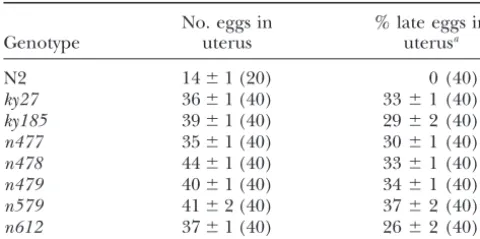
Ogget al.1997;Prasadet al.1998;Birnbyet al.2000;Inoue ally lay most of their eggs. In Table 1 we examined this
andThomas2000;Szeet al.2000).daf-7(e1372)mutants have egg-laying phenotype in two ways. First, we counted the
been shown previously to exhibit a Daf-c phenotype equivalent number of eggs retained in the uterus of adult hermaph-in strength to that of animals carryhermaph-ing a predicteddaf-7null
rodites and found that egl-4 mutants retain approxi-allele (Renet al.1996). daf-2(e1370)results in severe loss of
mately three times as many eggs as wild-type adults of daf-2function; no cleardaf-2null mutations have been
identi-fied (Kimuraet al.1997). It has been shown previously that comparable stage. We also examined the developmental the Daf-c phenotype ofdaf-7(e1372)anddaf-2(e1370)mutants stages of eggs retained in the uterus of egl-4 mutants. is strongly enhanced in double mutant combinations with Typically, early events in embryogenesis occurin utero; mutations in parallel branches of the dauer pathway, but not
eggs are laid during gastrulation (atⵑ120–180 min post-with mutations in the same branch (Thomaset al.1993).
daf-fertilization). We find thatⵑ30% of the eggs retained 3(e1376)anddaf-16(m27)alleles have been shown to suppress
TABLE 1
Number and stage of eggs in N2 andegl-4animals
No. eggs in % late eggs in
Genotype uterus uterusa
N2 14⫾1 (20) 0 (40)
ky27 36⫾1 (40) 33⫾1 (40)
ky185 39⫾1 (40) 29⫾2 (40)
n477 35⫾1 (40) 30⫾1 (40)
n478 44⫾1 (40) 33⫾1 (40)
n479 40⫾1 (40) 34⫾1 (40)
n579 41⫾2 (40) 37⫾2 (40)
Figure2.—Egg laying byegl-4mutants is insensitive to food
n612 37⫾1 (40) 26⫾2 (40)
cues. Mean number of eggs laid per hour with or without food present is shown. The numbers of independent animals Number in parentheses is number of animals counted.
tested for each condition are indicated under the appropriate
aLate stage eggs are defined as eggs that are at or beyond
bars. Egg laying in wild-type animals is decreased in the ab-the comma stage in development (ⵑ400 min postfertilization
sence of food (P⬍0.001). Egg laying inegl-4andflp-1mutants or later).
is not significantly altered in the absence of food (Pⱖ0.05). Pvalues were determined using the Mann-Whitney rank sum test.
development (ⵑ400 min postfertilization or later). Eggs at this late developmental stage are rarely if ever
ob-served in the uterus of well-fed wild-type hermaphro- are sensed by the bilaterally symmetrical ciliated neuron dites. Thus, egl-4 mutants lay eggs at a later develop- types AWA and AWC (Bargmann et al. 1993). AWA mental stage, likely as a consequence of delayed active neurons mediate responses to the chemicals diacetyl egg-laying periods. All alleles appear to cause significant (2,3-butanedione) and pyrazine, while AWC neurons defects with no clear allelic series. are required for the attractive response to the volatile Since entry into the active phase of egg laying is regu- chemicals benzaldehyde, isoamyl alcohol, butanone, lated partly by serotonin, the defects ofegl-4 mutants and 2,3-pentanedione. Both neuron types are required could result from pre- or postsynaptic defects in the for the response to the chemical trimethylthiazole. Sig-serotonergic pathway. The egg-laying phenotype ofegl-4 naling molecules such as olfactory receptors, G proteins, mutants is variably responsive to both serotonin and and ion channels that function in each of these neuron imipramine (a serotonin reuptake inhibitor;S. A. Dan- types have been identified previously (Coburn and iels and P. Sengupta, data not shown; Trent et al. Bargmann1996;Komatsuet al.1996;Senguptaet al. 1983), suggesting that egl-4 could function both pre- 1996;Colbertet al.1997;Zwaalet al.1997;Roayaie and postsynaptically.egl-4 could also act to potentiate et al.1998;Jansenet al.1999;Troemelet al.1999). the effect of serotonin on initiating the active phase of We first examined the responses of allegl-4mutants egg laying (Waggoneret al.2000). Such a function has to odorants sensed by the AWA neurons. As shown in been ascribed to the FMRFamide-related neuropeptides Figure 3, allegl-4alleles tested exhibit very strong defects encoded by theflp-1gene.flp-1plays a role in relaying in the response to diacetyl and weaker but significant sensory cues to the egg-laying circuit such that the rate defects in the response to pyrazine. Sinceegl-4mutants of egg laying inflp-1mutants is insensitive to food signals retain residual responses to pyrazine, egl-4alleles likely (Waggoneret al.2000). To determine ifegl-4functions affect a subset of functions rather than overall develop-similarly, we compared the rate of egg laying inn478 ment of the AWA neurons. Diacetyl is recognized by the mutants in the presence or absence of a bacterial food seven-transmembrane domain olfactory receptor ODR-source. We find that egg laying byegl-4mutants is insensi- 10, which is expressed specifically in the AWA neurons tive to regulation by food cues (Figure 2). While egg and is localized to their sensory cilia (Senguptaet al. laying by wild-type animals is significantly suppressed 1996). To determine if the strong diacetyl defect ofegl-4 in the absence of food, the rate of egg laying in egl-4 results from defects inodr-10expression or localization, mutants is unaffected. Thus,egl-4may function to relay we examined expression and subcellular localization sensory cues to modulate the egg-laying circuit. of a green fluorescent protein (GFP)-tagged ODR-10 egl-4 mutants exhibit multiple defects in chemosen- fusion protein in n478 animals. Both expression and
sory behaviors:Theky27andky185alleles were isolated localization of ODR-10 were unaltered inn478mutants
Figure 3.—Responses of egl-4 mutants to odorants sensed by the AWA neu-rons. Responses ofegl-4 mu-tants to a point source of (A) 1 nl of diacetyl; (B) 1l of 10 mg/ml pyrazine; (C) 1 l of 1:1000 dilution of trimethylthiazole; and (D) 100, 10, and 1 nl of diacetyl. Each data point represents the mean of at least six inde-pendent assays usingⵑ200 animals in each assay. Error bars equal the SEM. Single asterisks mark responses that are different from wild type atPⱕ0.01; double as-terisks mark responses that are different at Pⱕ0.001. C.I., chemotaxis index.
are sensed redundantly by the AWA and AWC neurons with defects in the structure of the sensory cilia often fail to fill with dye (Perkins et al.1986;Starichet al. (P. Sengupta and C. I. Bargmann, unpublished
re-sults). However,egl-4mutants fail to respond to all con- 1995). However,egl-4mutants dye-fill normally, and no obvious defects in the morphology of the neurons were centrations of diacetyl tested (Figure 3D), consistent
with defects in both the AWA and AWC chemosensory visible (data not shown).
We also examined additional sensory behaviors. neurons.
We next tested the responses ofegl-4mutants to addi- These included repulsion from volatile repellents, re-sponses to mechanical cues such as nose touch and tional odorants sensed by the AWC neurons. While all
alleles have normal responses to the odorant benzalde- osmotic shock, and responses to gentle body touch. Sensory neurons mediating each of these behaviors have hyde, they have weaker defects in the responses to
buta-none and isoamyl alcohol, and strong defects in the been identified (Chalfie et al.1985; Bargmannet al. 1990;KaplanandHorvitz1993;Troemelet al.1995, response to 2,3-pentanedione, an odorant structurally
related to diacetyl (Figure 4). Overall, n478 has the 1997).egl-4mutants were found to be wild type in their responses to these stimuli (data not shown), indicating strongest defects andn477has the weakest defects. All
egl-4mutants exceptn478exhibit wild-type response to that mutations inegl-4affect the functions of a restricted subset of neurons.
trimethylthiazole (Figure 3C).
Attractive water-soluble chemicals: C. elegans is also at- egl-4 mutants are hypersensitive to dauer-inducing
conditions:Dauer formation is dependent on the
per-tracted to water-soluble chemicals such as NaCl and
lysine (Ward1973; Dusenbery1974;Bargmannand ception of chemosensory cues such as dauer pheromone and food. These cues are sensed by ciliated neurons
Horvitz1991a). This behavior is mediated largely by
the ASE ciliated neuron type, with minor contributions (Bargmann and Horvitz 1991b; Schackwitz et al. 1996). Mutants with chemosensory defects often have from additional neurons (ASG, ASI, ADF, and ASK;
BargmannandHorvitz1991a). In addition to wide- defects in the regulation of dauer formation (Lewis
and Hodgkin 1977; Albert et al.1981; Riddle et al. spread defects in responses to volatile attractive
chemi-cals, we found that allegl-4mutants have strong defects 1981; Thomas 1993; Vowels and Thomas 1994;
Coburnet al. 1998). In addition to the chemosensory in their responses to NaCl and lysine (Figure 5). The
morphology of a subset of ciliated neurons (ASI, ASK, defects described above,egl-4mutants also show defects in the dauer formation process. egl-4(n478) has been ADL, AWB, ASH, and ASJ) can be visualized by filling
animals with the lipophilic dye DiO (Perkinset al.1986; shown previously to be hypersensitive to dauer phero-mone (Golden and Riddle 1984b). We verified this
Figure4.—Responses of egl-4 mutants to odorants sensed by the AWC neu-rons. Responses ofegl-4 mu-tants to a point source of (A) 1l of 1:200 benzalde-hyde, (B) 1l of 1:1000 di-lution of butanone, (C) 1l of 1:100 dilution of isoamyl alcohol, and (D) 1 l of 1:1000 dilution of 2,3-pen-tanedione. Each data point represents the mean of at least six independent assays usingⵑ200 animals in each assay. Error bars equal the SEM. Single asterisks mark responses that are different from wild type atPⱕ0.01; double asterisks mark re-sponses that are different at Pⱕ0.001.
and extended it by demonstrating that all alleles ofegl-4 this allelic order differs from that found for the response exhibit hypersensitivity to dauer pheromone (Figure to volatile odorants.
6A). While wild-type animals make⬍1% dauers upon Mutations in other Daf-c genes also result in hypersen-addition of 1l of dauer pheromone, at this concentra- sitivity to dauer pheromone (Golden and Riddle
tion nearly 100% ofegl-4(n479)animals form dauers. By 1984b; Thomaset al. 1993). However, unlike most of this assay, the strengths of alleles are as follows:n479⬎ these mutants, which are strongly Daf-c at 25⬚, all egl-4 ky27,n579,n477⬎n612⬎ n478,ky185.We note that alleles exceptn479form few or no dauers under nonin-ducing conditions at this temperature.n479exhibits a weak Daf-c phenotype at 25⬚(Figure 6A). Dauer forma-tion is modulated by temperature, and it has been shown previously that several mutants with weak Daf-c pheno-types at 25⬚are strongly Daf-c at the elevated tempera-ture of 27⬚(Ailionet al.1999). Such mutants include unc-31,unc-64, andunc-3(Ailionet al.1999). We exam-ined the Daf-c phenotypes of egl-4 mutants at 27⬚. As shown in Figure 6B, allegl-4alleles exhibit a Daf-c phe-notype to varying degrees at 27⬚.n479is the strongest allele, forming close to 100% dauers at 27⬚, whileky185 is the weakest allele, forming⬍25% dauers. The allelic series with respect to dauer formation at 27⬚is roughly similar to that determined by pheromone hypersensi-tivity.
Figure 5.—Responses of egl-4 mutants to water-soluble egl-4is Syn-Daf withunc-3:Many weak Daf-c mutants
chemicals. Shown are responses ofegl-4mutants to 0.2mNaCl have a Syn-Daf phenotype in double mutant combina-and to 0.5mlysine. Each data point represents the mean of
tions withunc-31,unc-64, and unc-3 mutants (I.
Kats-five independent assays using ⵑ100 animals in each assay.
ura,personal communication;Ailionet al.1999). We Error bars equal the SEM. All responses differ from wild type
Figure6.—Dauer formation phenotypes ofegl-4mutants. (A) The number of dauers formed at different concentrations of added pheromone is shown as a percentage of the total number of animals on the plate. Approximately 100–200 animals were counted at each concentration of pheromone. (B) Shown are the number of dauers formed after 2 days at 27⬚. Seematerials
and methodsfor additional details. Approximately 100 animals of each genotype were counted. Numbers shown are from a
single experiment. Experiments repeated on independent days show similar relative differences.
egl-4 unc-31 and unc-64; egl-4 double mutants do not or unc-3 mutants. However, serotonin does appear to enhance dauer recovery of these mutants. Exogenous show Syn-Daf phenotypes (M. AilionandJ. H. Thomas,
data not shown;I. Katsura,personal communication). serotonin leads to a dose-dependent increase in dauer recovery of egl-4, unc-64, and unc-3 mutants, and to a However, we find that theegl-4(n478); unc-3(e151)
dou-ble mutant is strongly Syn-Daf, forming nearly 100% lesser extent of unc-31mutants (Figure 7B). This sug-gests that the effect of serotonin on dauer recovery is dauers at all temperatures (see Table 5).unc-3has been
shown to regulate the expression of the DAF-7 TGF- not specific toegl-4.
To determine if serotonin acts in parallel toegl-4, we ligand (M. AilionandJ. H. Thomas,unpublished
re-sults;P. RenandD. Riddle,personal communication). analyzed double mutants with tph-1 (Table 2). Dauer formation is enhanced in atph-1; daf-7double mutant, We examined the expression of adaf-7::GFP fusion gene
inegl-4(n478)mutants, and found that unlikeunc-3mu- suggesting thattph-1acts in parallel to the group II Daf-c pathway (Sze et al. 2000). Similarly, we find that the tants, mutations inegl-4do not affect expression of the
DAF-7 TGF-ligand (data not shown). Daf-c phenotype of atph-1; egl-4double mutant is also strongly enhanced at all temperatures tested, indicating
Serotonin acts in parallel to egl-4 to regulate dauer
formation:egl-4mutants exhibit a subset of the pheno- thattph-1acts in parallel toegl-4(Table 2).tph-1mutants
also enhance dauer formation of unc-31, unc-64, and types associated with those of mutants with defects in
serotonin signaling. For example,tph-1tryptophan hy- unc-3 mutants, suggesting that tph-1 acts in parallel to these genes as well. We find that thetph-1; unc-31and droxylase mutants that fail to synthesize serotonin have
egg-laying defects and a weak Daf-c phenotype similar tph-1; unc-64double mutants are no longer temperature sensitive for dauer formation, while thetph-1; egl-4 dou-to that ofegl-4mutants (Szeet al.2000). Serotonin has
also been implicated in regulating foraging behavior ble mutant is weakly temperature sensitive.
egl-4 mutants exhibit synaptic transmission defects: and male mating (Loer andKenyon 1993; Duerr et
al.1999). We examined egl-4mutants and found that unc-64andunc-31encode proteins that mediate synaptic transmission and other types of Ca2⫹-regulated secretion
they also have foraging and male mating defects (data
not shown). This raised the possibility thategl-4mutants (Livingstone1991;Averyet al.1993;Annet al.1997;
Ogawaet al.1998;Saifeeet al.1998). Likeegl-4, both have defects in serotonin signaling. The defects of
tph-1mutants can be rescued by the addition of exogenous mutants have multiple behavioral pleiotropies and are Syn-Daf.unc-64andunc-31are resistant to aldicarb, an serotonin (Szeet al.2000). Although serotonin does not
completely rescue the egg-laying defect ofegl-4mutants inhibitor of acetylcholinesterase, indicating that these genes play a role in cholinergic transmission (Nguyen
(see above), we tested whether exogenous serotonin
could rescue the 27⬚Daf-c phenotype of theegl-4(n479) et al. 1995; Milleret al. 1996;Saifee et al. 1998). To test whetheregl-4also plays a role in synaptic transmis-mutant. As shown in Figure 7A, serotonin does not
in the postsynaptic response to ACh. To determine whether egl-4 functions presynaptically or postsynapti-cally, we assayed sensitivity to the nicotinic ACh receptor agonist levamisole (Lewiset al.1980a,b). A postsynaptic mutantunc-29(e1072)is completely resistant to levami-sole (Fleming et al. 1997), whereas the unc-31(e928) mutant, which is involved in presynaptic release mecha-nisms, is sensitive. All three alleles of egl-4 tested are sensitive to levamisole, as are unc-3(e151)mutants, sug-gesting thategl-4functions presynaptically in regulating synaptic transmission (Figure 8B).egl-4mutants also ap-pear to be hypersensitive to levamisole, similar tounc-31 mutants. However, unlikeunc-31mutants,egl-4mutants exhibit adaptation at later time points, such that para-lyzed animals resume pumping and slight movements of the nose.
egl-4mutants have increased body length:Body length in C. elegansis regulated via a DPP/BMP-mediated sig-naling pathway (Savageet al.1996;Padgettet al.1998;
PattersonandPadgett2000). This pathway is similar to the TGF--mediated branch of the dauer pathway, but uses a different ligand and an independent set of receptors and SMAD signaling genes with the exception of the DAF-4 TGF- type II receptor, which is shared by both pathways. daf-4 mutants are Daf-c and have reduced body length (Estevezet al.1993). In contrast, we noted thategl-4alleles cause increased body length (Figure 9).egl-4mutants areⵑ20–30% longer than wild-type animals. n579mutants show the strongest defect, being on average 31% longer than wild type, while the n477andn612mutants show the weakest phenotypes, being ⵑ17% longer. In comparison, lon-2(e678) mu-tants, which have been implicated in the pathway regu-lating body length, are ⵑ34% longer than wild-type animals.
egl-4 functions in the group II branch of the dauer
signaling pathway:Three parallel pathways that regulate
dauer formation have been identified (see Introduc-tion). In addition to the Daf-c phenotype,egl-4mutants share additional phenotypes in common with both
Figure7.—egl-4mutants and serotonin. (A) Shown is the group I and group II Daf-c genes. Group I Daf-c mutants
percentage of dauers formed at 27⬚in the presence of 5 mg/ exhibit chemosensory defects to volatile and water-solu-ml serotonin in the plate. A total of 100–200 animals of each
ble chemicals, while group II Daf-c genes have defects genotype were counted in two independent assays. (B) The
in egg laying, have dark intestines (Din), and exhibit a number of dauers on plates containing serotonin were
counted after 4 days at 27⬚to assay recovery. Wild-type animals “clumpy” behavior, in which animals tend to congregate recover in 1 day at 27⬚in the presence or absence of serotonin. in clumps (Trent et al.1983; Thomas 1993; Vowels andThomas1994;RiddleandAlbert1997).egl-4 mu-tants, in addition to having chemosensory and egg-lay-mutants to aldicarb. In Figure 8A, we show that the ing defects, are also Din, but exhibit little if any clumpy n479andn612mutants ofegl-4are strongly resistant to behavior. To determine the pathway in whichegl-4 func-aldicarb while theky27mutant is less resistant. We also tions, we made double mutants betweenegl-4and muta-find that unc-3(e151) mutants are strongly resistant to tions in each of these pathways. We examined suppres-aldicarb. In addition to the quantitative measurement sion or enhancement of different phenotypes of egl-4 of aldicarb resistance,egl-4mutants are qualitatively less in these double mutants.
TABLE 2
tph-1interactions with Syn-Daf genes
Dauer formation (%)
Genotype 15⬚ 20⬚ 25⬚
tph-1(mg280) 1 (289) 3 (245) 5 (171)
egl-4(n479) 0 (268) 0 (425) 0 (225)
unc-3(e151) 0 (433) 0 (402) 0 (412)
unc-31(e928) 0 (487) 0 (306) 0 (345)
unc-64(e246) 1 (198) 0 (154) 0 (182)
tph-1(mg280); egl-4(n479) 47 (270) 75 (223) 76 (99)
tph-1(mg280); unc-3(e151) 0 (244) 4 (216) 49 (134)
tph-1(mg280); unc-31(e928) 65 (324) 67 (241) 64 (151)
tph-1(mg280); unc-64(e246) 74 (281) 61 (244) 71 (214)
Number in parentheses is number of animals counted.
branches are not (Thomaset al.1993). We first tested dauer formation in unc-31 and unc-64 mutants is also suppressed by mutations indaf-12anddaf-16, the Daf-c whether the dauer formation defects of egl-4 mutants
are suppressed bydaf-3anddaf-5.We found that muta- phenotype of these mutants is not suppressed bydaf-3 anddaf-5(Ailion et al.1999). In contrast, as shown in tions in either daf-3 or daf-5 completely suppress egl-4
dauer formation induced by pheromone (Table 3), sug- Table 4, dauer formation in egl-4 mutants at 27⬚ is strongly suppressed bydaf-3anddaf-5mutations, further gesting that egl-4functions in the group II pathway of
dauer formation. We also assayed suppression of the confirming placement ofegl-4in the group II pathway. Interestingly,egl-4anddaf-3appear to mutually suppress Daf-c phenotype of the strong n479allele at 27⬚. The
Daf-c phenotype ofn479is suppressed by mutations in each other, since while thedaf-3(e1376)mutant and egl-4(n479)each form dauers at 27⬚, theegl-4;daf-3double the Daf-d genes daf-3, daf-5, daf-16, and daf-12 (Table
4).daf-12mutations suppress the dauer phenotypes of mutant makes fewer dauers than either single mutant alone. Mutations in the Daf-d gene osm-6, which also Daf-c mutants in all three branches, since these
branches are thought to converge atdaf-12(Riddleand lead to a Daf-c phenotype at 27⬚(M. AilionandJ. H.
Thomas, unpublished results; Apfeld and Kenyon
Albert1997;Antebiet al.1998).daf-16mutations have
been shown to suppress the 27⬚ Daf-c phenotypes of 1999), do not suppressegl-4, demonstrating that such mutual suppression is specific todaf-3.
mutants in different branches of the pathway (Ailion
et al.1999;ApfeldandKenyon1999). However, while We also determined whether the Syn-Daf phenotype
Figure 8.—Pharmacological analysis of synaptic transmission. (A) egl-4 mutants are resistant to aldicarb. The number of
TABLE 4
Suppression ofegl-4dauer formation at 27ⴗ
% dauer formation
Genotype 26.8⬚ 27⬚
N2 4 (187) 11 (163)
daf-3(e1376) 30 (216) 96 (219)
daf-5(e1385) 2 (191) 6 (206)
daf-16(m27)a 1 (172) 1 (166)
daf-12(m20) 0 (94) 0 (61)
egl-4(n479) 97 (263) 100 (272)
egl-4(n479); daf-3(e1376) 0 (151) 22 (174)
Figure9.—egl-4mutants have increased body length. The daf-5(e1385); egl-4(n479) 0 (260) 4 (239)
mean body length (in millimeters) is shown for animals of
daf-16(m27); egl-4(n479)a 1 (284) 2 (249)
the indicated genotypes. At least 30 adult animals of each
egl-4(n479); daf-12(m20) 0 (193) 0 (169) genotype were measured under 100⫻ magnification using
Nomarski optics and an eyepiece micrometer. Animals were
Genotype % dauer formation at 26.7⬚ measured 24 hr after the final molt. The mean body length
of eachegl-4 mutant is different from that of wild type at N2 4 (238)
P⬍0.001. osm-6(p811) 96 (192)
egl-4(n479) 99 (289)
egl-4(n479); osm-6(p811) 99 (272) of theegl-4; unc-3double mutant is suppressed by
muta-Number in parentheses is the number of animals counted. tions in daf-5 and daf-16. We find that mutations in aPartial dauers as described (VowelsandThomas1992).
daf-5 completely suppress the egl-4(n478); unc-3(e151) synthetic dauer phenotype at either 15⬚ or 25⬚, while daf-16mutations fail to suppress at 25⬚and only weakly
Daf-c phenotype at 15⬚. At this temperature,egl-4clearly suppress at 15⬚(Table 5). These results further support
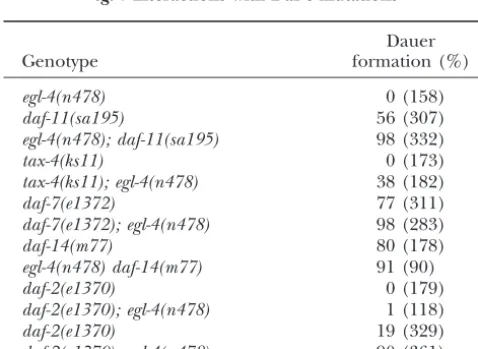
enhances the Daf-c phenotypes ofdaf-11(sa195)and tax-placement ofegl-4in the group II branch.
4(ks11) (group I genes; Table 6). Although egl-4 does Since dauer formation is regulated by parallel
path-not enhance the Daf-c phepath-notype of daf-2(e1370) (a ways, there is strong enhancement of the Daf-c
pheno-member of the third branch) at 15⬚, there is significant type in double mutants between genes in different
path-enhancement at 20⬚. These results suggest thategl-4acts ways, but not between those acting in the same pathway
in parallel to the group I branch and thedaf-2branch. (see Figure 1). For instance, while the Daf-c phenotypes
We find that dauer formation is also slightly increased ofdaf-8anddaf-11mutants are incompletely penetrant
inegl-4(n478); daf-7(e1372)andegl-4(n478); daf-14(m77) at low temperatures, adaf-8; daf-11double mutant forms
double mutants (Table 6). This is difficult to interpret 100% dauers (Thomas et al. 1993). In contrast, the
since daf-7 anddaf-14 are strongly Daf-c on their own phenotype of adaf-8; daf-14double mutant is still
incom-at 15⬚. However, in both cases it appears thategl-4does pletely penetrant since both of these genes function in
enhance the phenotype, suggesting that egl-4 may act the TGF- pathway (Thomas et al. 1993). To further
at least partially in parallel to the TGF- pathway, as confirm thategl-4functions in the group II pathway, we
well as the other two pathways. Since we do not know the built double mutants ofegl-4 with Daf-c mutations in
molecular nature of theegl-4(n478)allele, it is formally different pathways and looked for enhancement of the
possible that the enhancement observed in the double mutants is due to the nonnull nature of this allele.
Chemosensory behaviors:Group I Daf-c mutants exhibit
TABLE 3
numerous chemosensory defects (VowelsandThomas
daf-3anddaf-5suppressegl-4dauer 1994; Coburn and Bargmann 1996). Group I genes
formation on pheromone such asdaf-11encode components of a cGMP-mediated
signaling pathway that function both in dauer formation % dauer formation at 25.4⬚
as well as other chemosensory processes (Birnbyet al. Genotype ⫺pheromone ⫹pheromonea 2000). To date, no genes in the TGF-or the insulin
pathway have been implicated in other chemosensory
N2 0 (180) 90 (189)
pathways (Trent et al.1983; Ren et al.1996;
Schack-daf-3(e1376) 0 (162) 0 (158)
witzet al.1996;Szeet al.2000;Tissenbaumet al.2000).
daf-5(e1385) 0 (155) 1 (143)
egl-4(n478) 1 (123) 100 (81) We further examined whether the chemosensory de-egl-4(n478); daf-3(e1376) 0 (137) 0 (124) fects of egl-4(n478) are suppressed by daf-3 and daf-5 egl-4(n478); daf-5(e1385) 0 (99) 1 (77) mutations. We find that daf-3(e1376) completely sup-presses all olfactory defects ofegl-4(n478) (Figure 10). Number in parentheses is the number of animals counted.
spe-TABLE 5
egl-4andunc-3synthetic dauer formation
% dauer formation
Genotype 15⬚ 25.4⬚
egl-4(n478)a 0 (⬎200) 0 (⬎200)
unc-3(e151)a 0 (⬎200) 0 (⬎200)
egl-4(n478); unc-3(e151) 96 (238) 100 (256)
daf-5(e1385); egl-4(n478); unc-3(e151) 0 (363) 0 (386)
daf-16(m27); egl-4(n478); unc-3(e151)b 79 (220) 99 (146)
Number in parentheses is the number of animals counted.
aNot performed in parallel. Multiple independent experiments yielded identical results. bPartial dauers.
cific. Whiledaf-5(e1385)suppresses defects in behaviors sory defects of egl-4(n478) (Figure 10). However, like egl-4(n478);daf-5(e1385)double mutants, theegl-4(n478); mediated by the AWC olfactory neurons, it fails to
sup-press the diacetyl olfactory defect ofegl-4, mediated by daf-16(mgDf50) double mutant shows an enhancement of the defect in the response to pyrazine. The osm-3 the AWA neurons. Interestingly, while neitherdaf-3nor
daf-5mutants exhibit any olfactory defects of their own, mutation also largely fails to suppress the chemosensory defects ofegl-4mutants, showing only weak partial sup-daf-5(e1385)appears to enhance the relatively weak
py-razine response defect of n478.It is possible that this pression for the response to butanone. Finally, we also examined the responses ofegl-4(n478);daf-12(m20) dou-enhancement is specific for thee1385allele ofdaf-5.
To determine if mutations in other branches can also ble mutants. Although daf-12 mutations suppress the Daf-c phenotypes of mutants in all three branches of suppress the chemosensory behavioral phenotypes, we
examined the sensory behaviors of double mutants be- the dauer pathway, it has been shown previously that daf-12fails to suppress other pleiotropies (Thomas1993; tweenegl-4and the Daf-d mutationsdaf-16(mgDf50)and
osm-3(p802). Interestingly, we find that daf-16(mgDf50) Riddle and Albert 1997; Antebi et al. 1998), sug-gesting thatdaf-12is the point of convergence only for exhibits chemosensory behavioral defects on its own
(Figure 10). daf-16 mutants show severely reduced re- the dauer pathway. Consistent with this, we find that daf-12fails to suppress any of the behavioral defects of sponses to the odorants butanone and isoamyl alcohol,
egl-4mutants. Surprisingly, we also find thatdaf-12(m20) and exhibit significantly reduced responses to pyrazine
single mutants show strong defects in the response to and trimethylthiazole. This is not specific to thedaf-16
butanone (Figure 10). These results provide additional (mgDf50)allele, sincedaf-16(m27)mutants show similar
evidence to indicate thategl-4functions in the group II defects (data not shown). Unlikedaf-3anddaf-5,daf-16
pathway, upstream ofdaf-3 anddaf-5. mutations fail to significantly suppress any
chemosen-Egg-laying behavior:It has been shown previously that in addition to suppressing the Daf-c phenotype, daf-3 TABLE 6
anddaf-5mutants suppress other pleiotropies of group
egl-4interactions with Daf-c mutations II Daf-c genes. These include the egg-laying defect, the Din phenotype, and the clumpy behavior (Trent et Dauer al.1983;VowelsandThomas1994). We reexamined Genotype formation (%) whether the egg-laying defect of egl-4 mutants is
sup-pressed by daf-3 and daf-5 mutations, and also
deter-egl-4(n478) 0 (158)
daf-11(sa195) 56 (307) mined whether this defect can be suppressed by
muta-egl-4(n478); daf-11(sa195) 98 (332) tions in other branches of the pathway. As shown in
tax-4(ks11) 0 (173) Figure 11A, we find that both daf-3(e1376) and
daf-tax-4(ks11); egl-4(n478) 38 (182) 5(e1385)partially suppress the egg-laying defect of
egl-daf-7(e1372) 77 (311)
4(n478)mutants. In contrast, osm-3, daf-16, and daf-12 daf-7(e1372); egl-4(n478) 98 (283)
double mutants clearly show less suppression.
Qualita-daf-14(m77) 80 (178)
tive examination also indicates that the Din phenotype
egl-4(n478) daf-14(m77) 91 (90)
ofegl-4is suppressed bydaf-3 anddaf-5, but not by
daf-daf-2(e1370) 0 (179)
daf-2(e1370); egl-4(n478) 1 (118) 16,daf-12, orosm-3(data not shown).
daf-2(e1370) 19 (329) Body length: Mutations in the DAF-4 TGF- receptor
daf-2(e1370); egl-4(n478) 90 (361) cause small body length, yet this defect is not suppressed by daf-3 and daf-5 mutations (Vowels and Thomas
All counts were performed on strains grown at 15⬚with the
Figure 10.—Chemosensory phenotypes ofegl-4mutants are suppressed bydaf-3and daf-5 mutations. Chemotaxis indices be-tween 0 and 1.0 have been divided into 11 equal-sized bins and assigned a circle of size indicated at the bottom. Open circles repre-sent a negative chemotaxis index; filled cir-cles represent a positive chemotaxis index. Each data point represents the mean of at least three independent assays ofⵑ200 ani-mals each. Concentrations of odorants used are as indicated in Figures 3 and 4. The alleles indicated for each single mutant are present in the double mutant strains. Re-sponses significantly different from that of wild type atP⬍0.01 are indicated by an asterisk next to the circle.
downstream of DAF-4 to mediate body size regulation tants show dramatically increased body length (Thomas
et al. 1993), and we find that daf-12 mutants are on (Savage et al.1996; Padgett et al. 1998). Sincedaf-3
and daf-5 suppress all phenotypes of egl-4 tested, we average ⵑ21% longer than wild-type animals. The ef-fects of mutations inegl-4anddaf-12are partially additive wished to determine if the increased body length
pheno-type could also be suppressed bydaf-3 anddaf-5 muta- for body length since theegl-4; daf-12double mutant is significantly longer than either single mutant (P ⬍ tions. We found thatdaf-3(e1376) fully suppresses the
increased body length of egl-4(n478) (P ⬎ 0.03 com- 0.001; Figure 11B). Taken together, these results are strongly consistent with the placement of egl-4 in the pared to wild type), whereas this phenotype is only
par-tially suppressed bydaf-5(e1385)(Figure 11B). We find group II pathway, either together with the TGF-Daf-c genes or partially in parallel.
thatdaf-16(mgDf50)andosm-3(p802)also show weak
sup-pression. As reported previously,daf-12(m20)single mu- egl-32 may function in the same pathway as egl-4: A
Figure 11.—daf-3 and
Figure12.—egl-32mutants show chemo-sensory defects that are suppressed by daf-3anddaf-5.The representation of the data is as described for Figure 10. Each data point represents the mean of at least three independent assays ofⵑ200 animals each. Responses significantly different from that of wild type atP⬍0.01 are indicated by an asterisk next to the circle.
single egl-32 allele (n155) was isolated in the same We also find thatdaf-3anddaf-5suppress the olfactory defects ofegl-32mutants with thedaf-5(e1385)mutation screens that resulted in the isolation of egl-4 alleles
suppressing more strongly than thedaf-3(e1376) muta-(Trentet al. 1983).egl-4andegl-32appear to function
tion (Figure 12). Although these data should be inter-at least partly in similar pinter-athways since it has been shown
preted with caution since only one mutant allele of egl-that (1) both egl-4 andegl-32show similar variable
re-32is available, the phenotypic analyses suggest thategl-4 sponses to exogenous serotonin and imipramine
andegl-32may function partly similarly to regulate dauer (Trentet al.1983), (2) the egg-laying defects of both
formation, and chemosensory and egg-laying behaviors. egl-32andegl-4mutants are suppressed bydaf-3anddaf-5
mutations (Trentet al.1983), and (3)egl-4andegl-32 are Syn-Daf withunc-3mutations (I. Katsura,personal
DISCUSSION communication). However, unlikeegl-4,egl-32is not
hy-persensitive to dauer pheromone and we find thategl-32 egl-4mutants show a number of behavioral and devel-is not Daf-c at 27⬚(M. AilionandJ. H. Thomas,unpub- opmental abnormalities, including defective chemosen-lished results;GoldenandRiddle1984b). In addition, sation and dauer formation, defective egg laying, altered egl-32(n155) does not enhance the Daf-c phenotype of body size, and defective synaptic transmission. Most phe-egl-4(n478)(data not shown). notypes ofegl-4mutants are suppressed by mutations in Sinceegl-4mutants exhibit strong chemosensory de- thedaf-5anddaf-3(encoding a SMAD protein) genes, fects, we examined the chemosensory behaviors ofegl- suggesting that egl-4 functions through the group II 32(n155) mutants. We find that egl-32 mutants show branch of the dauer formation pathway to regulate mul-strong chemosensory defects in the responses mediated tiple functions. We propose thategl-4acts to relay sen-by the AWC neurons, with weak defects in the responses sory cues to modulate different neuronal signaling path-to odorants sensed by the AWA neurons (Figure 12). ways.
here indicate that the focus ofegl-4action is primarily to the acetylcholinesterase inhibitor aldicarb. This is a characteristic of genes that function at cholinergic neuronal. We provide several lines of evidence in
sup-port of this hypothesis. synapses (Milleret al.1996). Mutations in presynaptic
genes such asunc-17, which encodes the vesicular ACh All behavioral and developmental pathways affected
by egl-4 mutations are regulated by neuronal inputs. transporter, andcha-1, which encodes the choline acetyl-transferase, are also aldicarb resistant due to reduced Environmental cues are sensed by sensory neurons.
Sig-nals are then relayed to interneurons where integration or absent ACh at the neuromuscular junction (Alfonso
et al.1993, 1994).unc-29mutants are also aldicarb resis-of these signals occurs (for example, seeMoriand
Ohs-hima1995). Interneurons then relay this information tant sinceunc-29encodes the␣subunit of the nicotinic ACh receptor, which functions postsynaptically in target to target tissues. The relatively specific chemosensory
defects of egl-4 mutants point to a deficit in sensory muscles (Fleminget al.1997). However, we show that unlikeunc-29mutants,egl-4mutants are levamisole sen-signaling, or perhaps integration, rather than a general
defect in target tissues. This is also consistent with the sitive, similar tounc-17andcha-1.This strongly indicates that the focus ofegl-4function is neuronal. The relatively effects ofegl-4mutations on dauer formation. The target
of the DAF-7 TGF-ligand in dauer formation is thought restricted phenotypes ofegl-4mutants suggest thategl-4 is required for function rather than development of the to be neuronal (InoueandThomas2000). The
coordi-nated developmental changes that occur throughout nervous system.
egl-4and neurotransmitters:Our results indicate that the animal in response to dauer cues indicate that
inte-gration of dauer-forming signals occurs in neurons, and egl-4 functions presynaptically, at least in cholinergic neurons. Both ACh and serotonin have been implicated a coordinated and integrated signal is then sent to
addi-tional tissue types. Mosaic analysis has shown that the in regulating dauer formation and recovery (Szeet al. 2000;Tissenbaumet al.2000). This raises the possibility DAF-4 TGF- type II receptor functions
nonautono-mously in the nervous system for dauer formation thategl-4plays a role in the release or synthesis of neuro-transmitters such as ACh or serotonin. In general, mu-(InoueandThomas2000). Work presented here
sug-gests thategl-4functions with or partially in parallel to tants with strong defects in ACh synthesis or release at the neuromuscular junction show movement abnormal-the group II Daf-c genes (see below), suggesting that
egl-4may also function in neurons. ities and are uncoordinated. These include unc-17, cha-1, unc-31, unc-3, and unc-64. unc-3encodes a tran-Egg-laying behavior is also regulated by neuronal
in-puts. Serotonin is released primarily by the HSN neu- scription factor that is required for the expression of unc-17andcha-1in cholinergic motor neurons (K.
Lick-rons and allows egg-laying muscles to enter into an active
state (Horvitzet al.1982; Trentet al.1983; Desaiet teig and D. Miller, personal communication). unc-31and unc-64may be required for exocytosis of ACh. al. 1988; Weinshenker et al. 1995; Waggoner et al.
1998). Within the active state, ACh released by both the However, egl-4 mutants show no gross movement de-fects. It is possible that egl-4 affects ACh synthesis or HSN and VC motor neurons promotes egg laying by
excitation of egg-laying muscles (Waggoneret al.1998). release but to a lesser degree such that inegl-4mutants the level of ACh released is sufficient to excite muscles, The action of serotonin is potentiated byflp-1-encoded
neuropeptides, which may act to relay sensory cues to but insufficient to mediate the paralyzing effects of aldi-carb. ACh regulates the frequency of egg laying in the the egg-laying machinery (Waggoneret al.2000).
Anal-ysis of the egg-laying pattern ofegl-4mutants indicates active phase, and cha-1 mutations result in a decrease in the frequency of egg laying within the active phase thategl-4is deficient in the induction of the active
egg-laying phase, similar to serotonergic mutants as well as (Waggoneret al.1998). The frequency of egg laying in the active phase is unaffected inegl-4mutants, consistent flp-1mutants (Waggoneret al.1998, 2000). Similar to
flp-1mutants, egl-4mutants are also unable to regulate with a minor effect ofegl-4mutations on ACh release. egl-4mutants share a subset of defects found in mu-their rate of egg laying in response to food cues.
flp-1 is expressed in interneurons that integrate sensory tants defective in serotonin signaling. These include defects in egg laying, foraging, male mating, and effects information (Schinkmann and Li 1992). The defects
of egl-4 are consistent with a role for egl-4 in sensory on dauer formation. However, our results suggest that egl-4is not directly involved in the serotonergic pathway. neurons and/or interneurons to integrate or relay
sen-sory signals. First, added serotonin fails to fully rescue the egg-laying
defects or dauer formation defects ofegl-4mutants. Res-Body size may also be regulated by signals from
neu-rons. The DBL-1 DPP/BMP-like signal that regulates cue by serotonin would be expected if egl-4 functions presynaptically in serotonin signaling. Second, we find body size is expressed in neurons (Suzukiet al.1999).
This signal is then transduced to other tissue types such that the Daf-c phenotype of egl-4; tph-1 mutants is strongly enhanced, suggesting that tph-1 functions in as the hypodermis to regulate body size. egl-4 could
function in neurons to modulate body size regulatory parallel to egl-4 and not in the same pathway. Third, serotonin has been shown to inhibit ACh release at the signals.