TABLE OF CONTENTS
FOREWORD 1. INTRODUCTION
A. Technical Specifications 2. CONSTRUCTION
3. OPERATION OF THE WEAPON A. Loading Magazines
B. Stock Assembly
C. Loading and Cocking the Weapon D. Charging the Weapon
E. Inserting the Magazine
F. Placing the Weapon on “Safe” G. Removal of Magazine
H. Fire Selector Lever Operation I. Firing the Submachine Gun J. Malfunctions
4. STRIPPING AND REASSEMBLING A. B. .c. D. E. F. 0. H. I.
Field Stripping
1) Removing Upper Receiver 2) Removing the Bolt 3) Removing the Stock Trigger Mechanism Extractor
Recoil Spring
Receiver Pin Catch . . Magazine Catch
Safety Catch Stock Latch Magazine 5. REASSEMBLY
6. CLEANING AND MAINTENANCE 7. ILLUSTRATIONS
8. PARTS LIST
FOREWORD
This manual is published for the information and guidance of personnel whose duties involve the use, maintenance and repair of the Ml0 SMG and the Ml1 SMG. Disassembly, assembly, clean- ing and minor repairs may be undertaken in the field.
In all cases where the nature of the repair or adjustment is beyond the scope of facilities of the unit, the Manufacturer should be in- formed in order that trained personnel with suitable tools and equipment may be provided.
1. INTRODUCTION
The Ingram Model 10 and Model 11 represent a significant break through in compact submachine gun design. The Ml0 is available in 9MM Para and .45 ACP calibers, the Ml1 in .380 ACP caliber.
Both Models are light in weight, durable steel construction and easy to fire, either semi-automatic or full automatic.
The compact size of the Ml0 makes it especially suitable for tank crews, gun and mortar crews, etc., and its selective fire capability makes it an excellent weapon for police use.
The addition of a noise suppressor further enhances the per- formance, reducing the noise and eliminating muzzle flash.
A. TECHNICAL SPECIFICATIONS
Model 10 Model 10 Model 11 .45 AC? 9MM Cam. JR0 AC?
GUN DIMENSIONS WlliiOUl
SUPPRESSOR I
Length without stock Length stock telescoped Length stock cxtendod
Barrel Length Maximum width
Inches MM Inchmr MM Inches
10.50 267 10.50 267 8.75 11.60 295 11.60 295 9.81 21.57 548 21.57 548 18.11
5.75 146 5.75 146 5.06 1.96 50 1.96 50 1.36
MM 222 249 460 129 35
GUN DIMENSIONS WITH SUPPRESSOR ATTACHED
Length without stock Length stock telescoped Length stock extended Maximum width
20.35 517 20.35 517 16.25 413 21.45 545 21.45 545 17.31 440 31.42 798 31.42 798 25.61 650
2.13 54 2.13 54 1.75 44
SUPPRESSOR DIMENSIONS
Length 11.44 291 11.44 291 8.81
Diameter 2.13 54 2.13 54 1.75
224 44
WEIGHT AND CAPACITY
Gun without mogozinc Suppressor
Loodcd 16 round magazine LoAded 30 round magazine Loaded 32 round mogozine
lbs.
6.25 1.20
2.15 -
Kg. lbs. Kg. Lbr.
2.81 6.25 2.81 3.50 0.54 1.20 034 1.00
- 0.62
0.97 - - -
- 1.37 0.61 1.12
Kg.
1.57 0.45 0.27
0.54 TYPE OF FIRE ... Semi-automatic or full automatic
CYCLIC RATE OF FIRE, M10/45 ACP.. ... Minimum 950 rounds per minute MlO/PMM Paro.. ... Minimum 950 rounds Per minute Ml 1 380 ACP ... Minimum 1200 rounds per minute FRONT SIGHT ... Protected post REAR SIGHT, Ml0 ... fixed opertur. for 100 maters Ml1 ... Fixed opwtura for 50 meters SAFETIES.. ... Manually operated safeties for locking bolt in open
2. CONSTRUCTION
The weapon consists of the foliowing major components: Barrel, Receiver, Bolt, Frame, Firing
Mechanism, Magazine, and Extendable Stock
A sling swivel is attached to the barrel and receiver assembly. The front end of the barrel is threaded to accept a suppressor. The receiver is fitted with a fixed front sight and houses the bolt, recoil spring, buffer and ejector rod. The frame carries the re- ceiver group, trigger mechanism, magazine housing, stock guide, and safety assembly.
The trigger mechanisms consist of sear, sear spring, selector lever, retainer, trip, trigger, trigger pin, trigger spring, and dis- connector.
The stock is designed to telescope into the frame when not in use thereby reducing the overall size of the weapon.
The bolt assembly on the Model 10 and Model 11 is fitted with a cocking handle. Both models have fixed firing pins. The ex tractor on the Model 10 operates on the leaf spring principle while the Model 11 utilizes a compression spring.
3. OPERATION OF THE WFAPON
A. loading Magazines
9 MM Para- rounds s wacity
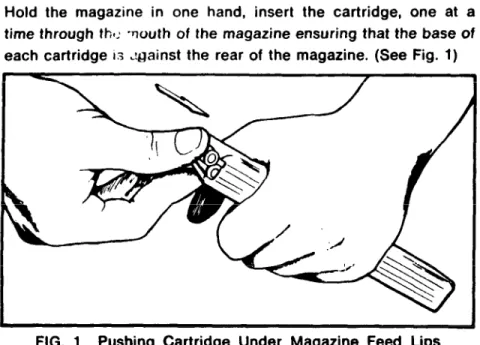
Hold the magazine in one hand, insert the cartridge, one at a time through thl; -wuth of the magazine ensuring that the base of each cartridge 13 zuainst the rear of the magazine. (See Fig. 1)
loading Magazines
.45 ACP-W Rds. Capacity s
380 ACP-32 Rds. Capacity
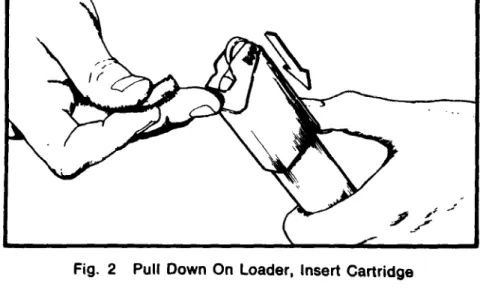
Place the magazine loader on top of the magazine, then place the
base of the magazine on a firm surface. Push down on the loader
to depress the magazine follower. Insert a cartridge, base first, into the magazine. Lift the loader, and push the cartridge all the
way into the magazine. Push down on the loader, depressing the
cartridge and magazine follower. Repeat the operation (Fig. 2)
until the magazine is full.
Fig. 2 Pull Down On Loader, Insert Cartridge
6. Stock Assembly
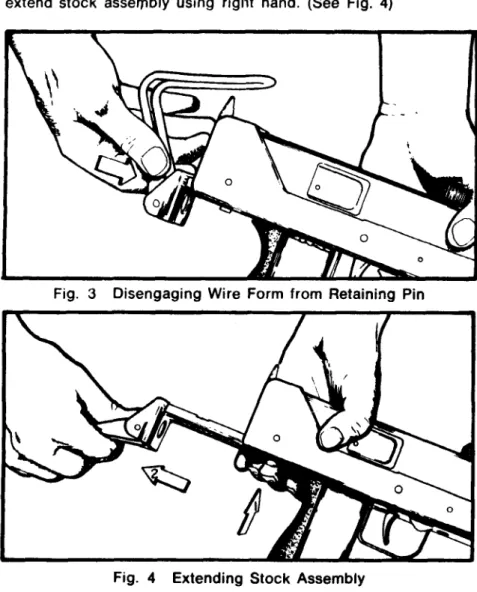
Hold weapon in left hand, with right hand press inwards on right side of wire form butt near the pivot to allow wire form stock to rotate clockwise to normal firing position. (See Fig. 3)
Still holding weapon in left hand depress stock latch button and extend stock assembly using right hand. (See Fig. 4)
Fig. 3 Disengaging Wire Form from Retaining Pin
Fig. 4 Extending Stock Assembly
C. loading and Cocking the Weapon
Move frame safety lever to ‘fire’ position. Holding the gun by the pistol grip in the right hand and keeping the index finger out- side the trigger guard pull back on the cocking handle to the rear with the left hand until the bolt is held to the rear by the sear. (See Fig. 5) Move safety lever to ‘safe’ position.
Insert loaded magazine in its housing until the magazine catch engages magazine. (See Fig. 6) Select ‘semi’ or ‘auto’ fire as re- quired, move frame safety to ‘fire’ position.
The gun is now ready to fire.
D. Charging the Weapon
E. Inserting the Magazine
FIG. 6
F. Placing the Weapon on “Safe”
The safety is located on the right of the underside of the frame, it moves front to back, front is the ‘fire’ position and back is the ‘safe’ position. (See Fig. 7)
G. Removal of Magazine
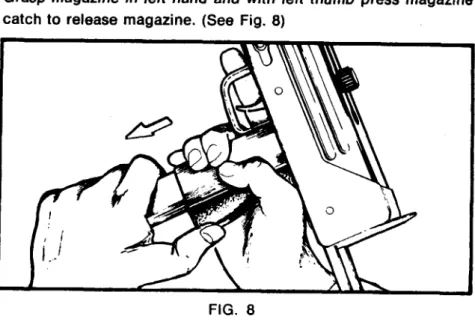
Grasp magazine in left hand and with left thumb press magazine
catch to release magazine. (See Fig. 8)
FIG. 8
H. Fire Selector lever Operation
Located on the left side of the frame the selector is rotated 10
select ‘semi’ automatic or ‘full’ automatic fire. (See Fig. 9)
FIG. 9
I. Firing the Submachine Gun
As the bolt is moved back to the cocked position, the recoil spring is compressed and the sear engages the sear notch of the bolt. When the trigger is pressed, the sear releases the bolt, which is driven forward by the recoil spring. During this forward move- ment, the bolt strips a cartridge from the magazine into the chamber. The bolt continues forward and fires the cartridge. When the cartridge is fired, the chamber pressure forces the bullet out of the muzzle of the barrel. At the same time, this pressure overcomes the forward movement of the bolt and starts it to the rear. By the time the bolt and empty case have moved to the rear far enough to open the rear of the chamber, the bullet has left the barrel, and the chamber pressure has diminished. (In the submachine gun, the chamber pressure is relatively low and the bolt is relatively heavy; this eliminates the need for positive lock- ing and unlocking.) During the rearward movement of the bolt, the empty cartridge case is extracted and ejected, the recoil spring is compressed and the top round in the magazine moves up against the lips of the magazine. The rearward movement of the bolt is stopped by contact with the buffer plate.
J. Malfunctions
Malfunctions are usually the result of worn parts or improper care of the gun. A knowledge of how the gun functions enables the user to classify and correct the malfunction. Listed below are the types of malfunctions which might occur.
2. Failure to Chamber. The top cartridge from the magazine is not seated in the chamber.
3. Failure to Fire. The cartridge is chambered but does not fire.
4. Failure to Extract. If the cartridge fires, the chamber pressure will normally push the empty cartridge case out of the chamber. If the cartridge case is not completely removed from the chamber and the bolt is retracted, then there is a failure to extract. This malfunction seldom occurs.
5. Failure to Eject. The empty cartridge case is not ejected from the weapon.
6. Failure to Cock. If the bolt is retracted and is not held by the sear, or if, during firing, the bolt does not move to the rear far enough to clear the top cartridge in the magazine, the gun fails to cock.
Common Malfunctions. The two most common malfunctions are:
1. Failure to feed-usually caused by a defective magazine.
2. Failure to fire-usually caused by defective ammunition.
Causes of Malfunctions. The following chart lists common causes
of various malfunctions and corrective action.
Foilwe to fe*d. Dirty or dented moga~in~. Roplaco magazine.
Weak or broken magazine spring. Replace magazine.
Worn magazine notch. Replace magoxine.
Corroded ammunition. Replace ammunition.
Worn or broken magazine catch. Replace mogorinc catch.
Foilura to chombcr. Dirty chamber
Obstruction in chamber.
Weak recoil springs.
Clean chombcr.
Remove obstruction.
Replace recoil spring.
Failure to fire. D*fectiw ammunition.
Def*ctiw firing pin.
Weak recoil springs.
Replace ammunition.
Replace bolt.
Replace recoil springs.
Foilur. to l xhoct.
Failure to l jwt. Broken cicctor. Replace oiactor. Broken or misting extractor. Replace extractor
F&lure to cock. Worn scar.
Worn sear notch.
Bent guide rods.
Low powered ammunition
Replace scar.
Replace bolt.
Straighten. Replace ammunition
Prevention of Malfunctions. Periodic inspection and proper care
and cleaning will reduce the possibility of the submachine gun
4. STRIPPING AND REASSEMBLING
The Model 10 and Model 11 have been designed so that no special
tools are necessary in order to’strip or reassemble the weapon.
Stripping
Before starting to strip the weapon remove the magazine and
check the barrel chamber by looking through the EJECTION
PORT to make sure there are no live rounds in the weapon.
A. Field Stripping
consists of1) Removing Upper Receiver (Cock Weapon)
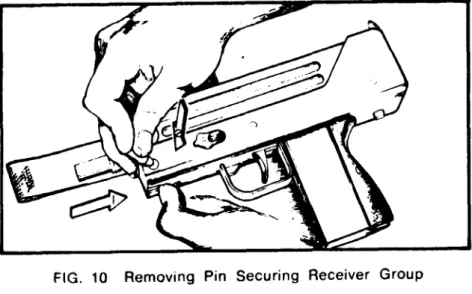
Push receiver pin catch back and remove receiver pin. (See Fig.
10). On alternate configuration where there is no receiver pin
catch, a sharp push on the receiver pin is all that is required for
removal.
Push upper receiver from frame. (See Fig. 11)
FIG. 10 Removing Pin Securing Receiver Group
‘IG. il Removing Barrel and Receiver Group
2) Removing the Bolt
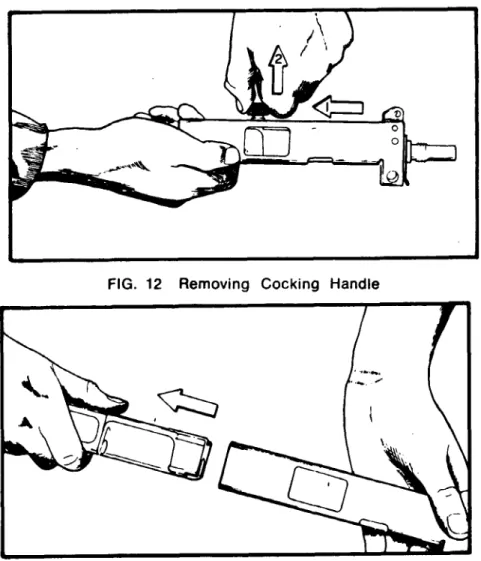
Slide cocking handle to rear of-guide slot, rotate handle a few degrees and pull from bolt. (See Fig. 12) The bolt and recoil spring assembly can now be removed from the rear of the re- ceiver. (See Fig. 13)
FIG. 12 Removing Cocking Handle
3) Removing the Stock
To remove stock, depress stock latch button and keeping pressure on button pull stock completely out. (see Figs. 3 and 4)
The procedure mentioned above is generally sufficient for normal maintenance and cleaning. If necessary to clean trigger mechanism, removal is as follows:
B. Trigger Mechanism
Lift retainer and remove selector lever, this aldo allows removal of sear, sear spring and tripping lever. Push trigger pin out of the left side for removal of trigger or torsion spring. Note: for re- assembly, free arm of torsion spring is located on rear side of disconnector. Disconnector may be replaced by using a pin punch to remove spring pin.
C. Extractor
Use pin punch to remove extractor spring pin.
D. Recoil Spring
Compress spring and move guide rod clear of bolt and use pin punch to remove spring pin from guide rod.
E. Receiver Pin Catch
Use pin punch to remove spring pin.
F. Magazine Catch
G. Safety Catch
Use pin punch to remove catch spring pin.
H.
Stock LatchPress down lightly at center of pin and slide to either side to re- move retaining pin. Invert frame and latch will drop out.
I. Magazine
M1./9MM Poro, Ml 1 380 ACP
Depress stud in floor plate and slide plate from magazine case. Keeping finger over the bottom of the magazine to prevent the magazine spring from flying out. Remove the magazine spring and the magazine follower.
M10/45 ACP
Lift the tab in the floor plate by inserting a screw-driver in the hole. Remove base plate, placing the finger over the bottom of the magazine to prevent the magazine spring from flying out.
Remove the magazine spring and the magazine follower.
NOTE: To achieve the proper functioning when reassembling the Ml1 and M10/45 magazine ensure that the slope of the top coil of the spring corresponds with the slope on the follower.
5. REASSEMBLY
Items are reassembled in the reverse order to the stripping pro- cedure.
6. CLEANING AND
It is essential for reliable operation and performance. that the
weapon receive careful maintenance. It should be cleaned at
the end of each day’s firing.
The Gun need only be “field stripped” for this maintenance.
Barrel and Receiver Group Cleaning
A.
B.
C.
D.
E.
Bolt
A.
6.
Use cleaning rod, patch and solvent. Stubborn residue can
be removed with a bristle bore brush.
Swab bore with patch saturated in solvent.
Use solvent saturated patch and swab inside of receiver to
remove residue.
Use clean dry patch to dry barrel and inside of receiver
group.
Dampen patch with light oil and swab barrel and receiver.
Assembly Cleaning
Remove powder residue with solvent and patch.
Wipe all surfaces of bolt to remove carbon. The bolt face
should be completely free of carbon and other residue.
C. Wipe dry and apply a light coat of oil.
Frame Assembly Group Cleaning
A. Remove residue build-up on exposed surfaces with solvent-
B. Clean around the lockwork. The weapon is designed to
tolerate some dirt in the frame group but excessive dirt will impair operation. Detail cleaning is required after pro-
longed operation or improper’ functioning of weapon.
C. Wipe dry and use oily patch to coat exposed metal areas
with light film of oil.
Magazine Cleaning
A. Inspect magazine for damaged areas. Damaged magazines
should be discarded.
B. Clean lip area and top of the follower.
C. Wipe with oily patch.
Suppressor Cleaning
The suppressor requires no other maintenance apart from
ensuring that the bore is kept clear of obstructions. Inspection
must be made with the suppressor removed from the weapon.
The front end cap of the suppressor is replaceable. It should be
replaced atter each 500 rounds of firing or sooner if the noise
level has increased significantly.
a
e
.$i
T
8. MO/45 SUBMACHINE GUN
Item Title Port No.
1. Receiver 150309
2. Bolt Handle 150012
3. Hanger 150395
4. Barrel 150063
5. Strap Assembly 150394
6. Spring Pin, Barrel 150032-4
7. Spring Pin, Receiver Pin Catch 150032-6
8. Compression Spring, Receiver Pin Catch 150025-11
9. Pin Catch 150039
10. Spring Pin, Recoil Spring Rod 150032-5 11. Compression Spring, Bolt Handle Detent 150611
12. Bolt Handle Detent 150037
13. Bolt 150073
14. Spring Pin, Extractor 150032-6
15. Extractor 150021
16. Buffer 150047
17. ’ Plate 150024
16. Ejector 150023
19. Guide Rod 150022
20. Compression Spring, Recoil 150616 21. Spring Pin, Bolt Handle Detent i50032-2
22. Receiver Pin 150038
23. Button 150169
24. Spring Pin, Safety 150032-g
25. Frame Assembly 150081
26. Magazine Catch 150465
27. Compression Spring, Magazine Catch 150598
28. Grip 150068
ILLUSfRAlED PARTS LIST
29. Grip Screw
30. Magazine Catch Pin 31. Stock Rail
32. Stock Hinge Pin ’ 33. Retaining Ring
34. Compression Spring, Stock Hinge 35. Wire Form Butt
36. Trigger Pin 37. Sear Pin
38. Safety Detent Plunger
39. Compression ‘Spring, Safety Detent 40. Safety Slide
41. Compression Spring, Sear 42. Sear
43. Trip
44. Disconnector
45. Spring Pin, Disconnector 46. Torsion Spring, Trigger 47. Trigger
46. Latch
49. Stock Latch Pin 50. Retainer
51. Plunger, Stock Latch
52. Compression Spring, Stock Latch
ACCESSORIES: (Not Included)
Magazine 150111
Magazine Pouch 150072
Magazine Loader 150245
Cleaning Rod 150209
Sling 150459
Suppressor 150216
8. M10/9MM SUBMACHINE GUN
Itom Title Pati No.
1. Receiver 150309
2. Bolt Handle 150012
3. Hanger 150395
4. Barrel 150005
5. Strap Assembly 150394
6. Spring Pin, Barrel 150032-4
7. Spring Pin, Receiver Pin Catch 150032-6 6. Compression Spring, Receiver Pin Catch 150025-l 1
9. Pin Catch 150039
10. Spring Pin, Recoil Spring Rod 150032-5 11. Compression Spring, Bolt Handle Detent 150611
12. Bolt Handle Detent 150037
13. Bolt 150004
14. Spring Pin, Extractor 150032-6
15. Extractor 150294
16. Buffer 150047
17. Plate 150024
18. Ejector 150023
19. Guide Rod 150022
20. Compression Spring, Recoil 150580
21. Spring Pin, Bolt Handle Detent 150032-5
22. Receiver Pin 150038
23. Button 150169
24. Spring Pin, Safety 150032-g
25. Frame Assembly 150010
26. Magazine Catch 150077
27. Compression Spring, Magazine Catch 150598
28. Grip 150068
29. Grip Screw 159043 30. Magazine Catch Pin 166041
31. Stock Rail 150088
32. Stock Hinge Pin 150462
33. Retaining Ring 150460
34. Compression Spring, Stock Hinge 150612
35. Wire Form Butt 150155
36. Trigger Pin 150016
37. Sear Pin 150252
36. Safety Detent Plunger 150293
39. Compression Spring, Safety Detent 150597
40. Safety Slide 150166
41. Compression Spring, Sear 150594
42. Sear 150070
43. Trip 150268
44. Disconnector 150249
45. Spring Pin, Disconnector 150032-5
46. Torsion Spring, Trigger 150539
47. Trigger 150448
46. Latch 150091
49. Stock Latch Pin 150094
50. Retainer 150269
51. Plunger, Stock Latch 150110
52. Compression Spring, Stock Latch 150598
ACCESSORIES: (Not Included)
Magazine, Walther Conversion
Magazine Pouch
Magazine Loader
Cleaning Rod
Sling
Suppressor
150115
150072
Not Req’d.
150209 150459
150217
8. Ml 1 ,380 SUBMACHINE GUN
ILLlJSTRAtED. PARTS LIST
Item Title
1. 2. 3. 4. 5. 6. 7. 6. 9. 10. 11. 12. 13. 14. 15. 16. 17. 18. 19. 20. 21. 22. 23. 24. 25. 26. 27. 28. Receiver Bolt Handle Hanger Barrel
Strap Assembly Spring Pin, Barrel
Spring Pin, Receiver Pin Catch
Compression Spring, Receiver Pin Catch Pin Catch
Spring Pin, Recoil Spring Rod
Compression Spring, Bolt Handle Detent Bolt Handle Detent
Bolt Extractor
Compression Spring, Extractor Buffer
Plate Ejector Guide Rod
Compression Spring, Recoil Spring Pin, Extractor
Spring Pin, Bolt Handle Detent Receiver Pin
Button
Spring Pin Safety Frame Assembly Magazine Catch
Compression Spring-Magazine Catch
27
Part No.
29. Grip
30. Grip Screw
31. Magazine Catch Pin 32. Stock Rail
33. Stock Hinge Pin 34. Retaining Ring 35. Wire Form Butt 36. Trigger Pin 37. Sear Pin
38. Safety Detent Plunger
39. Compression Spring, Safety Detent 40. Safety Slide
41. Compression Spring, Sear 42. Sear
43. Trip
44. Disconnector
45. Spring Pin, Disconnector 46. Torsion Spring, Trigger 47. Trigger
46. Latch
49. Stock Latch Pin 50. Retainer
51. Plunger, Stock Latch
52. Compression Spring, Stock Latch
ACCESSORIES: (Not Included)
Magazine
Magazine
Magazine Pouch Magazine Loader Cleaning Rod Sling Suppressor 150139 150043 150041 150162 156463 150466 150534 150179 150248 150293 150597 150189 150599 156134 150264 150249 150032-S 150615 150135 150145 156180 150270 15011 o-2 150598 150113-l (32 rd.) 150113-2 (16 rd.) opt.
150072 150197 150209 Not Req’d.
150218
ITEM TITLE M IO/45 Ml0/9MM MII
IA RECEIVER 150634-l 150634-l 150633-I 22A RECEIVER PIN 150628-I l50628-I -
23A RECEIVER PIN - -- 150628-2
22 A ( MIO-OMM , MO-45 1 23A (MII)
SUPPRESSOR SHOWING REPLACEABLE END CAP
Suppressor M-lo/MM 150217
End Cap 150225-l
Suppressor M-10/45 ACP 150216
End Cap 150225-2
Suppressor M-l l/.360 ACP 150218
150461-BODY
. .FOLLOWER
150237-BODY
1
150116 -
.
f
FOLLOWER
8
I
<3
150240 -
0
FLOOR
PLATE
RETAINER
150131-BODY
‘(-I ) 32 RD
t-2 1 16 RD
\ i
f I
I
. I