Effect of Aggregate Grading and Cementitious
By-product on Performance of Pervious Concrete
Husain N Hamdulay, Roshni J John, D.R.Suroshe
PG Student, Dept. of Civil Engineering, Saraswati College of Engineering, Kharghar, India. Head, Dept. of Civil Engineering, Saraswati College of Engineering, Kharghar, India.
Principal, Revera Institute of Technology, Kharghar, India
ABSTRACT: In India the rainwater on the streets and parking’s on asphalt and conventional concrete pavement
generally lead to water logging and the also run-off water from various sources go in streams or nallahs. Pervious concrete should be chosen for its obvious environmental benefits. As environment is concerned, carbon dioxide emission from Portland cement production is significant. Therefore, by partially replacing the cement with industrial by-product, such as fly ash and slag which have been used successfully as supplementary cementitious materials. The change in properties of pervious concrete due to size of aggregates used is being assessed in this project. The concrete is assessed for its Compressive Strength, Split Tensile Strength, Permeability and flexural strength. The results are interpreted based on graphs obtained.
KEYWORDS: Pervious concrete, Flyash, GGBS, falling head permeability.
I. INTRODUCTION
Pervious concrete is considered a sustainable building alternative for concrete and/or asphalt pavement parking lots because it provides pollution mitigation and storm water management. Pervious concrete acts as a filtration device for storm water and turns the entire parking area, pathway, or other paved surface into a retention treatment basin.Storm water can flow through the pavement to the subgrade underneath, taking with it pollutants that would typically end up in municipal storm water systems. Naturally occurring soil microbes then store and break down the pollutants, preventing aquifer pollution.
Advantages of Pervious Concrete
The benefits of pervious concrete are not limited to its infiltration capacities.
A number of studies have shown its potential to remove pollutants from water,
Decreasing flooding possibilities, especially in urban areas and reducing puddles on the road
Reduce noise, improve skid resistance, and
Help mitigate the heat island effect
It returns rain water to the ground, recharging ground water and aquifers
The runoff from paved areas is reduced, which reduces the need for separate storm water retention
Supporting vegetation growth
II. RESEARCH SIGNIFICANCE
III. MATERIAL USED
- Cement
Ordinary Portland cement of 53-grade will be used in this study conforming to IS: 8112-1989 having Specific gravity 3.15.
- Aggregates
The coarse aggregate passing through 20 mm and retained on 10 mm sieve was used in research. Aggregates of size 10 mm and 20 mm used in the project will be local angular aggregates available with distributer.
- Ground Granulated Blast Furnace Slag (GGBS)
The GGBS used in research was obtained from JSWSteel Plant. The specific gravity of about GGBS is 2.88. - Fly ash (FA)
Fly ash required for the project was obtained from local fly ash brick manufacturer having its source from Nasik Thermal Power Plant having a specific gravity of 2.15.
- Admixtures
Water Reducing Admixtures is being used for preparing the pervious concrete mix. BASF admixtures Master Polyheed 8650 was used for the purpose.
- Water
Water quality used in pervious concrete should be the same as that used in conventional concrete: potable water, recycled water from the concrete industry, or tap water. Due to the sensitivity of pervious concrete, water quality control is very important.
IV. MIX PROPORTION
Trial concrete mixes shall be prepared keeping water to cementitious material ratio (W/Cm) constant for all the six
concrete mixes. The design mix proportions are as follows:
Table 1 Mix Proportions for Pervious Concrete Mixes
Mix Composition Mix Abbv
Quantity (Kg/m3) Cement Fly
Ash
GGBS Water CA10 CA20 Admixture
C:FA/GGBS = 100:0 PM 1 300 0 0 100 1780 0 1 C:FA/GGBS = 100:0 PM 2 300 0 0 100 712 1068 1 C:FA = 85:15 PM 3 255 45 0 100 1780 0 1 C:FA = 65:35 PM 4 195 105 0 100 1780 0 1 C:GGBS = 75:25 PM 5 225 0 75 100 640 960 1 C:GGBS = 50:50 PM 6 150 0 150 100 640 960 1
C: Cement; FA: Fly Ash; GGBS: Ground Granulated Blast Furnace Slag
V. EXPERIMENTAL PROGRAMME:
As part of project 6 samples of pervious concrete were prepared. Practical preparation of concrete mixes for various concrete/ aggregate mix proportions, use of admixtures was done
Proportion 1- Use of only 10 mm aggregates (PM 1)
Proportion 6- Higher strength mix (From above) + GGBS (50 %) (PM 6)
The basis of mix design was based on trial and error method as no exact design method is available for mix design of pervious concrete.
VI. TESTING METHODS AND PROCEDURES
All the six concrete mixes were tested for
A. Compressive strength at 3, 7 & 28 days following the guidelines of IS 516, B. Flexure test for beams at 28 days,
C. Split tensile test for cylindrical molds at 28 day D. Water Permeability test at 28 days
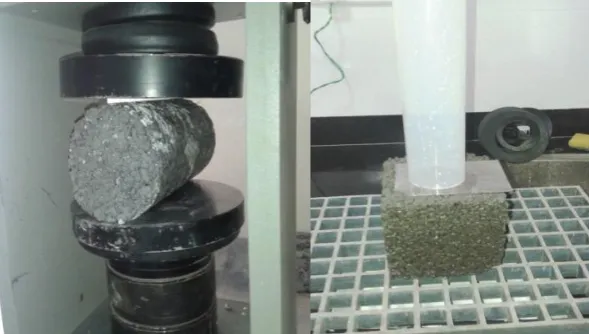
Fig 2 (a) Compressive strength and flexure strength testing of Pervious sample
VII. EXPERIMENTAL RESULTS AND DISCUSSION
Compression Test and Density
Table1 Results for Compressive Strength and Density of Pervious Mixes
Fig 1 -3, 7 & 28 days Compressive Strength for different Mixes
The mean value of the 28 days compressive strength of pervious concrete with 100% cement had 17.16 MPa for 10mm aggregate and 13.62 MPa for mix of 10 and 20mm aggregate. As expected, pervious concrete resulted in 26% low compressive strength due to its higher porosity At the same age, pervious concrete with 15% fly ash had the strength of 9.67 MPa, while the strength of pervious concrete with 35 % fly ash had strength of 8.46 MPa, which is only 55.4% and 48% respectively of the 100% OPC. When cement replaced with GGBS with 25% and 50% variation gave 28 days strength of 15.49 MPa and 13.55MPa respectively which is 10.78% and 26.64% less than 100% OPC respectively. All concrete mixes showed improvement in strength with the increase in the age. The strength of pervious concrete with Flyash showed low strength development from 14 to 28 days.
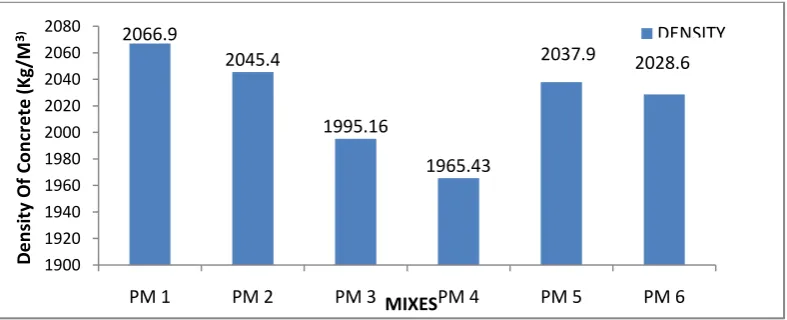
Fig 3 Density of various pervious mixes
10.28 8.75 6.12 5.06 8.55 7.25 11.52 11.74 6.93 6.47 11.38 10.58 17.16 13.62 9.67 8.46 15.49 13.55 0 2 4 6 8 10 12 14 16 18 20
PM 1 (100 % OPC)
PM 2 (100 % OPC)
PM 3 (15% FA) PM 4 (35% FA) PM 5 (25% GGBS)
PM 6 (50% GGBS) COM PRE SS IVE S TRE N GTH (M Pa) MIXES 3 Days 7 Days 28 Days 2066.9 2045.4 1995.16 1965.43 2037.9 2028.6 1900 1920 1940 1960 1980 2000 2020 2040 2060 2080
PM 1 PM 2 PM 3 PM 4 PM 5 PM 6
The mean density for conventional concrete varies between 2400 and 2500 kg/m3, while pervious concrete has a density between 1965 and 2067 kg/m3. Therefore, the pervious concrete showed nearly 21-27% lower density than conventional concrete.
Split Tensile Strength
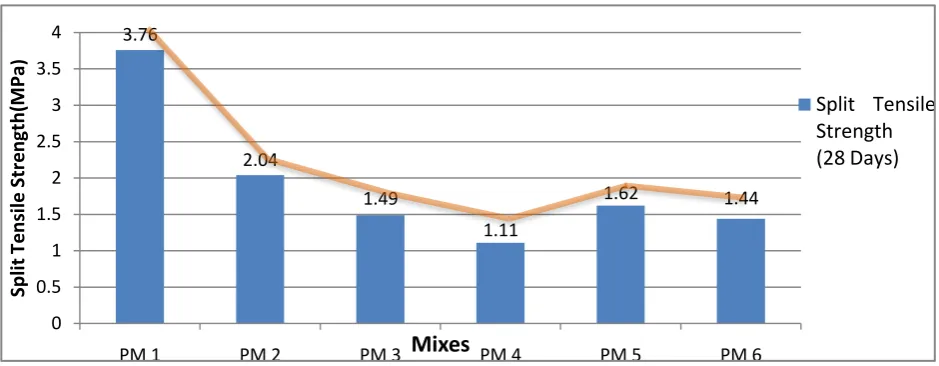
Fig 4 28 Days Split Tensile Strength for Different mixes
The split tensile strength for 100% OPC with 10 mm aggregates showed strength of 3.76MPa. For mix PM 2 the strength reduced by 45.7% after using a combination of 10mm and 20mm aggregates. When tested for samples containing flyash and compared to 100 % OPC with PM 1 mix the strength was only 39.6% and 29.5% for PM 3 and PM 4. The mix containing GGBS showed greater strength than FA but 43% and 38.3% strength of PM 1 mix.
Flexure Test
Fig 5 28 Days Flexural Strength for Different mixes
Permeability
The calculations for finding the permeability coefficient by falling head test are as below
3.76
2.04
1.49
1.11
1.62 1.44
0 0.5 1 1.5 2 2.5 3 3.5 4
PM 1 PM 2 PM 3 PM 4 PM 5 PM 6
Spli
t
Te
ns
ile
S
tre
ngt
h(
MP
a
)
Mixes
Split Tensile
Strength
(28 Days)
4.82
3.11
1.83
1.38 1.54 1.12
0 1 2 3 4 5 6
PM 1 PM 2 PM 3 PM 4 PM 5 PM 6
Fl
ex
ur
al
S
tre
ngt
h(
MP
a
)
Mixes
𝑟𝑒𝑓𝑓 = 𝑟1+ 𝑟2
2 =
3.4 + 7.5
2 = 5.45 𝑐𝑚
𝐴𝑒𝑓𝑓 = 𝜋𝑟𝑒𝑓𝑓2 = / 𝜋 × 5.452= 93.313 𝑐𝑚2
𝑘𝑝=
𝑉 𝐴𝑒𝑓𝑓 × (𝑡2− 𝑡1)
Fig 6 Permeability for Different Mixes
Permeability of pervious concrete mixes showed a major variation for PM 2 mixes. The graph showed that permeability increased with the increase in aggregate size. The addition of supplementary materials showed a marginal difference of 1% - 2%
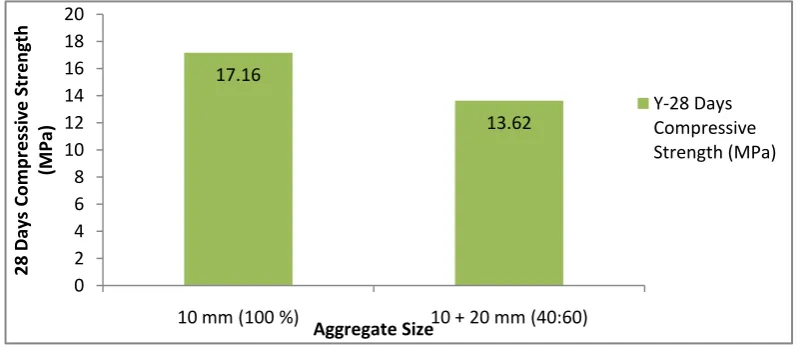
Fig 7 Relation between Aggregate Size and Compressive Strength
Fig 7 is graph which shows about the effect of variation of aggregate size to the compressive strength of concrete. It can be seen that for smaller size aggregate the strength obtained is 26% greater than that for a combination of 10 mm and 20 mm aggregate
.
0.386
0.605
0.382 0.383 0.397
0.451
0 0.1 0.2 0.3 0.4 0.5 0.6 0.7
PM 1 PM 2 PM 3 PM 4 PM 5 PM 6
Per
m
ea
bil
it
y
(cm
/sec
)
Mixes
Permeability
(cm/sec)
17.16
13.62
0 2 4 6 8 10 12 14 16 18 20
10 mm (100 %) 10 + 20 mm (40:60)
28
D
ay
s
Co
m
p
re
ssi
ve
Str
e
n
gth
(M
P
a)
Aggregate Size
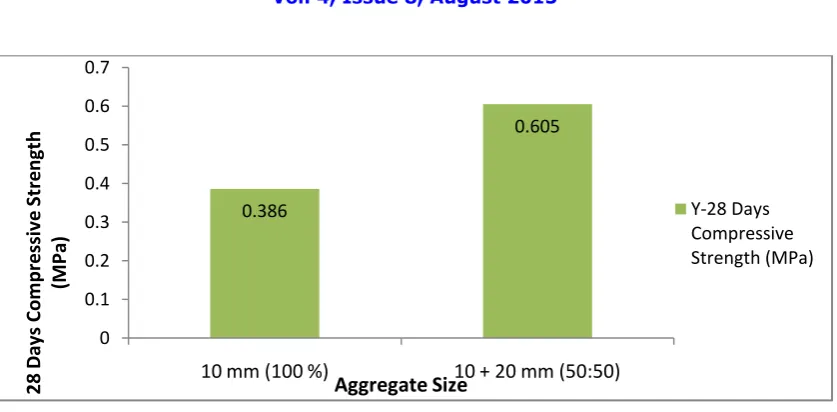
Fig 8 Relation between Aggregate Size and Permeability
For Fig 8 it can be seen that the aggregate size and permeability are related to each other. The lesser the aggregate size lesser is the permeability and vice-versa. The results are reversal for what it is seen for aggregate size and compressive strength.
VIII. CONCLUSIONS
Grading of aggregate is equally important to get desired strength and on the other hand permeability. Greater the aggregate size the greater is the permeability but lower is the strength and vice-versa.
A proper gradation of aggregate and mix design is important to get an optimum mix.
Flyash reduced the strength properties of the concrete, the major reason may be the grade and quality of Flyash.
GGBS as supplementary material gave a good results regarding the strength properties although lower than 100% OPC.
Permeability was not much varied due to variation in paste density. Permeability is moreover related to method of compaction and size of aggregates used.
Pervious concrete can be applied for various engineering applications in India such for Green Building culture, Jogging tracks, low traffic density roads, pavement sidewalks.
Pervious concrete blocks can also be used in various places which are as good as concrete pavement.
ACKNOWLEDGEMENT
I would like to acknowledge and thank Mr. Sandeep Keskar and Mr. Sandeep Kadam of Ultratech Cement Ltd for their guidance and support throughout my project. Their assistance and guidance with laboratory testing helped me ensure the adequacy of all procedures conducted throughout my research. I would like to thank Mr. Sunil Reddy, BASF India The Chemical Company for providing the admixture required for the project. I would also like to thank JSW Cement Ltd for providing GGBS required for project and Mr. Dhananjay Sawant for providing Fly ash.
REFERENCES
[1] Shetty M. S. "Concrete Technology" S. Chand & Co.Ltd, 1997.
[2] A.K. Jain, Dr. J.S. Chouhan, S.S. Goliya Effect Of Shape And Size Of Aggregate On Permeability Of Pervious Concrete JERS/Vol. II/ Issue IV/October-December, 2011/48-51
0.386
0.605
0 0.1 0.2 0.3 0.4 0.5 0.6 0.7
10 mm (100 %) 10 + 20 mm (50:50)
2
8
D
ay
s C
o
m
pr
essiv
e
St
re
ngt
h
(MPa
)
Aggregate Size
[3] An Cheng, Hui-Mi Hsu, Sao-Jeng Chao, and Kae-Long Lin “Experimental Study on Properties of Pervious Concrete Made with Recycled Aggregate” International Journal of Pavement Research and Technology Vol.4 No.2 Mar. 2011 Copyright @ Chinese Society of Pavement Engineering
[4] C. Lian, Y. Zhuge “Investigation of the effect of aggregate on the performance of permeable concrete” Challenges, Opportunities and Solutions in Structural Engineering and Construction – Ghafoori (ed.)© 2010 Taylor & Francis Group, London, ISBN 978-0-415-56809-8
[5] Darshan S. Shah , Prof. Jayeshkumar Pitroda, Prof. J. J. Bhavsar “Pervious Concrete: New Era For Rural Road Pavement” International Journal of Engineering Trends and Technology (IJETT) – Volume 4 Issue 8- August 2013ISSN: 2231-5381
[6] Rasiah Sriravindrarajah, Neo Derek Huai Wang, and Lai Jian Wen Ervin “Mix Design for Pervious Recycled Aggregate Concrete” International Journal of Concrete Structures and Materials Vol.6, No.4, pp.239–246, December 2012 DOI 10.1007/40069-012-0024-x ISSN 1976-0485 / ISSN 2234-1315
[7] Silvija Mrakovčić, Nina Čeh, Vedrana Jugovac Effect of aggregate grading on pervious concrete propertiesGRAĐEVINAR 66 (2014) 2, 107-113, DOI: 10.14256/JCE.977.2013
[8] Sonali K. Gadpalliwar, R. S. Deotale, Abhijeet R. Narde, “To Study the Partial Replacement of Cement by GGBS & RHA and Natural Sand by Quarry Sand In Concrete” IOSR Journal of Mechanical and Civil Engineering (IOSR-JMCE) e-ISSN: 2278-1684,p-ISSN: 2320-334X, Volume 11, Issue 2 Ver. II (Mar- Apr. 2014), PP 69-77 www.iosrjournals.org
[9] S L Patil, Dr M V Baride, Dr M Husain, B V Mahajan “Fly Ash Concrete for Road Pavement: A Techno Economic Analysis International Journal of Advanced Engineering Technology E-ISSN 0976-3945 IJAET/Vol. I/ Issue III/Oct.-Dec.,2010/93-100
[10] IS 456 -2000 “Code of Practice for Plain and Reinforced Concrete”, Bureau of Indian Standards, New Delhi. [11] IS 516 -1959 “Methods of Tests for strength of concrete”, Bureau of Indian Standards, New Delhi.
[12] IS 10262 -2009 “IS Method of Mix Design”, Bureau of Indian Standards, New Delhi. [13] IS 383: 1970 “Specification for coarse and fine aggregates from natural source for concrete”
[14] IS 3812-1 (2003): Specification for Pulverized Fuel Ash, Part 1: For Use as Pozzolana in Cement, Cement Mortar and Concrete [15] IS 12089 (1987): Specification for granulated slag for the manufacture of Portland slag cement
BIOGRPHY
Husain N Hamdulay holds B.E degree from Saraswati College of Engineering, Kharghar, Navi Mumbai and pursuing his Masters in Civil (Structural Engineering) from University of Mumbai. His research interest includes concrete technology, built environment and structural design.
Mr. D.R.Suroshe holds M.E (Structural Engineering) Degree form Mumbai University and Bachelor’s degree from Sardar Patel College of Engineering, Mumbai. He is Principal of Revera Institute of Technology, Kharghar having a teaching experience of 10 years. His major interests are Structural Dynamics and Concrete Technology.