1 Assistan Pittsburgh 2 Professo ([email protected] ABSTRA A plants to compatibl spectrum examine t the entire level of co
INTROD S response s time histo obtain pro spectrum-time-histo suffer from A However, and the c 2011). Sp resulting r T compatibi response s STATEM S spectrum. spectrum
R
nt Professor, D h, PA (mpozz or, Dept. of Ci berkeley.edu)
ACT
A response-spe circumvent le PSD. How
and the corr three methods range of freq ompatibility.
DUCTION
eismic design spectra. It is a ories and perf obabilistic est -compatible p ory analysis. m the arbitrar A number of m
, recently som orresponding pecifically, w response spec This paper inv ility for all f spectrum that
MENT OF TH
everal metho The basic i to the varianc
RESPONSE
FOR
Matte
Dept. of Civil [email protected]) ivil and Envir )
ectrum-comp costly time wever, investi responding P s for generati quencies. We
n requiremen a standard pra form time-co timates of the power spectra Aside from riness of the s methods have me investigato g PSD may b when the pow ctrum does no vestigates the frequency ran t must be satis
HE PROBLE
ds are availab identity used ce of the mod
E SPECT
HIGH-FR
eo Pozzi1, an
and Environm
ronmental En
patible power history analy igators have PSD may be ing a PSD cor also discuss
nts for nuclea actice in the n nsuming resp e response. A al density (P
the computat selected time
been propose ors have note e lacking in wer spectral d ot match the t e above prob nges. The pa sfied in order
EM
ble in the liter to generate dal response:
RUM CO
REQUENC
d Armen De
mental Engin
ngineering, Un
spectral dens ysis. Several
recently note lacking in th rresponding t
conditions on
ar power plan nuclear indust
ponse history An alternative PSD) and per tional saving histories and ed for generat ed that the co the high freq density is con target respons
lem and offe aper also exa r to generate a
rature to gene the compatib | ,
OMPATIBL
CY RANG
r Kiureghian neering, Carneniversity of C
sity (PSD) is u methods are ed that comp he high frequ to a response
n the respons
nts are usuall try to generat y analysis to e to this appr rform random gs, the random
the difficult t ting the respo ompatibility b quencies (high nverted back se spectrum in ers three appr amines the re a compatible
erate PSDs co ble PSD is a
|
LE PSD
GE
n2
egie Mellon U
California, Be
used in design e available f patibility betw
uency range. spectrum tha se spectrum s
ly specified i e suites of sp satisfy code roach is to ge m vibration a m vibration a task of select onse-spectrum
between the her than 10H
into a respo n the high fre roaches that equirements o
PSD.
ompatible wit a relation lin
University,
rkeley, CA
n of nuclear p for identifyin
ween the res . In this pape at is compatib shape to assur
in terms of d ectrum-comp requirements enerate a resp analysis inste approach doe ing a sample m-compatible response spe Hz) range (Os
onse spectrum quency range
provide cons on the shape
th a given res nking the res
power ng the ponse er we ble for re this design patible or to ponse-ead of es not size. PSD. ctrum stadan m, the e. sistent e of a
ponse ponse
In the above equation, is the pseudo-acceleration response spectrum, is the corresponding peak factor, which is typically a slowly varying function of frequency, is the variance of the pseudo-acceleration response of an oscillator with angular frequency , is the one-sided compatible PSD, and , is the Frequency Response Function (FRF) for pseudo acceleration response of the oscillator forced at frequency and is given by
, (2)
in which denotes the damping ratio of the oscillator and i √ 1 is the imaginary unit. Eq. 1 is based on the assumption of stationary input and output processes. The first identity in Eq. 1 derives from the definition of the peak factor as the ratio between the maximum and the standard deviation of a stationary process, while the second one is the fundamental relation between the mean-square stationary response and the input PSD (Lutes and Sarkani, 2004).
We face an inverse problem: Given the response spectrum , we aim at identifying the corresponding PSD , using Eq.1. We require that the function be real and non-negative, since it represents the PSD of a real process. We note that there is no guarantee that Eq.1 admits solutions for an arbitrary response spectrum shape. If it does not admit a solution, then it means that the proposed response spectrum is not compatible with the fundamental rules of random vibration theory that are behind Eq.1.
For a given variance function , Eq.1 has the form of an inhomogeneous Fredholm integral equation of the first kind, where | , | is the kernel function. By changing variables, taking the logarithm of the frequency, Eq.1 can be re-shaped as a convolution integral, which can be solved by means of the direct and inverse Fourier transform (Polyanin and Manzhirov, 1998). However, when the function admits no exact solutions for a non-negative function , it is convenient to apply approximate methods. The following section provides a review of these methods.
INCREMENTAL APPROACH BY VANMARKE
An approximate solution for the compatible PSD can be derived by the approach proposed by Vanmarke (1977), which is based on an approximation of the kernel function in Eq.1. We start by adding and subtracting, in Eq.1, the value of the PSD at the modal frequency :
| , | (3)
The above integral is now evaluated in two parts:
| , |
| , | ≅ (4a,b)
(5)
where 4 /4 . Re-arranging the terms and replacing the variance by the identity in Eq.1, we end up with the following approximation:
(6)
Eq.6 is an incremental formula to compute . As a first approximation, the peak factor may be set to a constant value, say 3. We start at 0, imposing the initial conditions 0 0 and
0 0 to assure finite ground velocity. We then proceed to compute for increasing frequencies by numerical integration.
TAIL BEHAVIOR
It is well known that the pseudo-acceleration response spectrum must approach the peak ground acceleration, , at high frequencies. It follows that the response variance function must approach the variance of the ground acceleration, as → ∞. Using this relation in Eq.5, we can write
∞
(7)
Let be an anchor frequency in the high-frequency tail. Since the PSD must be integrable to achieve a finite peak ground acceleration, we adopt the power tail form
≅ , (8)
where 0. By substituting Eq.8 in Eq.7, we obtain the following tail approximation:
≅ , (9)
Rearranging terms and taking the logarithm, we obtain
log ≅ log , (10)
with log 1/ log 1 log . For a specified response spectrum ,
setting 3, we can calibrate parameters and by examining two points in the tail of the spectrum. This helps us determine the tail behavior of the PSD function.
COMPATIBILITY CONDITIONS
range below and, therefore, its response cannot be arbitrarily small. This requirement imposes a condition on the shape of the response spectrum. To check if a given response spectrum is admissible, we apply Eq.6. If, for any frequency, the function is negative, we consider the response spectrum as inadmissible. This requirement of course relies on the assumptions supporting Eq.6, which are stationary response and small damping ratio .
Equation 10 imposes an additional constraint on the tail of the response spectrum. Namely, for a large , the value obtained for the parameter must be positive. If not, the tail of the response spectrum is not decaying sufficiently fast.
A given response spectrum may be inadmissible for a number of practical reasons. For example, in design codes, the response spectrum is usually prescribed in parametric form, with the parameters depending on site and soil conditions. The spectrum shape is usually constructed by processing a set of ground motion records and fitting a simple analytical function to their envelope. There is no attempt to verify that the conditions described in this section are fulfilled. For this reason, we believe response spectra specified in certain codes may be inadmissible.
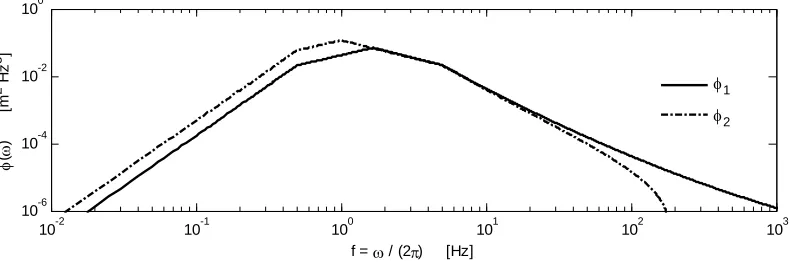
Figure 1. Identified PSDs for two target response spectra: a compatible spectrum (continuous line) and incompatible spectrum (dashed-dotted line).
EXACT SOLUTION FOR SPECIFIC VARIANCE FUNCTIONS
Equation 6 yields closed-form solutions for certain variance functions. Let for . The corresponding solution of the PSD is:
1 0
1 0
1
1 (11)
This solution is applicable to positive, negative or zero values of , the latter case representing a constant variance. The above solution allows constructing exact solutions of Eq.6 for any piecewise variance function, where each piece is defined in the manner described above. In particular, design response spectra in modern building codes are usually defined by piecewise linear combinations of such functions. Assuming a constant peak factor, the corresponding variance function can be expressed in the manner described above.
Figure 1 shows the computed PSDs for two target response spectra. We assume a constant peak factor, 3. Both spectra have PGA 4ms , a pseudo-acceleration spectrum value linearly increasing with the natural period up to 10ms at 0.2s, constant up to , proportional to up to 2s, and proportional to above that. PSD function in Figure 1 is computed assuming 0.6s, while PSD function assumes 1s. In the former case we can find a compatible PSD; in the latter case the identified PSD becomes negative at frequency 194Hz. This indicates that the response spectrum
10-2 10-1 100 101 102 103
10-6 10-4 10-2 100
f = / (2) [Hz]
(
)
[m
2 Hz 3]
with 1s is inadmissible. This happens because the drop in the response spectrum value down to the PGA is too fast for the long constant-acceleration phase of the spectrum.
DER KIUREGHIAN AND NEUENHOFER’ APPROACH
An alternative method to identity the response-spectrum-compatible PSD was proposed by Der Kiureghian and Neuenhofer (1992). This is an iterative scheme to solve Eq.1, which does not require the approximation employed in Eq.4. The initial approximation is based on response to white noise, according to which in Eq.1 is replaced by its value at the resonance frequency, , yielding
≅ | , | (12)
The corresponding first approximation of the PSD is
(13)
We now can solve the direct problem, i.e., obtain the variance function for the given PSD. To do this, we discretize the frequency axis and numerically perform the integration for each . After iterations, we have
| , | (14)
The updated PSD can now be written as
(15)
The iterations converge when the computed variance function from Eq.14 matches the target variance function .
In principle, this iterative approach may start with a first approximation different from that in Eq.13. However, the white-noise approximation guarantees that the starting trial function is non-negative. Note that all subsequent functions in the sequence are also non-negative, as is evident in Eq.15. Thus, using this method, we never face the inconsistent result of a negative PSD. In the case of using an inadmissible response spectrum, the method converges to a PSD that is not consistent with the target variance for high frequencies. More specifically, if the PSD is used to generate a corresponding response spectrum, the result does not match the target response spectrum in the high frequency range.
NUMERICAL SCHEME BASED ON QUADRATIC PROGRAMMING
Equation 1 can also be solved numerically. We discretize the variance function into vector , the PSD into vector , and the kernel function into matrix so that, in the discretized space, Eq.1 reads . Depending on the discretization employed, the matrix may or may not be invertible. In any case, we can characterize the space of the admissible variance functions as the part of the image of matrix referring to vectors with only non-negative components.
When matrix is not invertible, we find an optimal vector by minimizing a cost function defined as
where, for every vector and positive-definite matrix , the weighted Euclidean norm is defined as
‖ ‖ √ . A reasonable choice for the weight matrix is a diagonal matrix storing weights proportional to the target variance: , . With this choice, we accept a constant relative error. The second term in the right-hand-side of Eq.16 is introduced as a normalization constant for preventing over-fitting (Hastie et al., 2009): I is the identity matrix and a penalty term. We seek an optimal solution, ∗, satisfying
∗ argmin
s. t. ∀ : 0 (17)
Eq.17 defines a quadratic cost function and all constrains in Eq.17 are linear. Thus, the problem can be efficiently solved by the available techniques of quadratic programming (Dostal, 2009).
NON COSTANT PEAK FACTOR
In the above formulations we assumed a constant peak factor. An early expression for the peak factor derived by Davenport (1964) is
2 log . (18)
where is the duration of the excitation (taken as the duration of the strong-motion phase of the ground
motion, say 10-20s) and / / is the mean zero-crossing rate, wherein
| , | is the 2nd spectral moment. To avoid unreasonable values of the peak factor for small frequencies, ω 1.56 is assumed for 1.6. (Otherwise, Eq.19 predicts a peak factor increasing with decreasing frequency.)
Equation 18 can be applied directly, obtaining function for any assigned . However, if we substitute Eq.18 in Eq.1, we end up with a highly non-linear integral equation. In general, we can solve the problem iteratively: Assume an initial peak factor function and obtain the a
corresponding variance function / . Any of the methods described in this paper can be applied to this variance function, obtaining a first approximation of the PSD, . From this, we obtain an improved peak factor function by Eq.18. This process is repeated until convergence is achieved. The approach by Der Kiureghian and Neuenhofer is already based on an iterative scheme, so we can directly combine the updating of the peak factor function in the computation of the corresponding variance, obtaining, instead of Eq.15:
(19)
COMPARISON OF METHODS
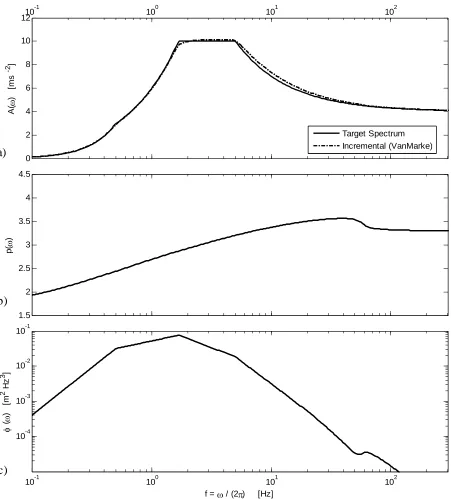
decay of the peak factor. Numerically, we face the following issue: If we iterate computations of the peak factor function and of the PSD, the sequence does not converge to a stable solution, but oscillates with period 2. The results in graphs (b) and (c) are obtained after 100 iterations. In summary, we are not able to find a compatible pair of functions ( , ) so that Eqs.1 and 18 are both accurately satisfied. However, employing the approximate peak factor function depicted in graph (b), the PSD shown in graph (c) is compatible with the target response spectrum.
Figure 2. Target (continuous line) and reconstructed (dash-dotted line) response spectra (a), peak factor
function (b), identified PSD (c) for the incremental method of Vanmarke.
10-1 100 101 102
0 2 4 6 8 10 12
A(
)
[m
s
-2]
Target Spectrum Incremental (VanMarke)
1.5 2 2.5 3 3.5 4 4.5
p(
)
10-1 100 101 102
10-4 10-3 10-2 10-1
(
)
[m
2 Hz 3 ]
f = / (2) [Hz]
a)
b)
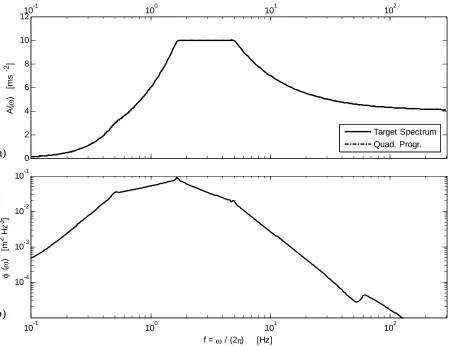
Figure 3 shows the results of the numerical scheme based on quadratic programming. The agreement between the target and reconstructed spectra shown in graph (a) is much closer, so that the two lines cannot be distinguished. This method is more flexible and does not require the simplifying assumptions of the incremental method – hence the reasons for the close match. The identified PSD, shown in graph (b), exhibits peaks at frequencies where the target response spectrum is not differentiable. These small peaks allow the reconstructed spectrum to closely follow the target one around these points. We experience the same lack of convergence in the peak-factor function as with the incremental method. The optimization was performed by using MATLAB routines. This method is computationally much more demanding than the previous method, and faces the same issue about lack of convergence of the peak factor function.
Figure 3. Target (continuous line) and reconstructed (dash-dotted line) response spectra (a), identified
PSD (b) for the method based on quadratic programming.
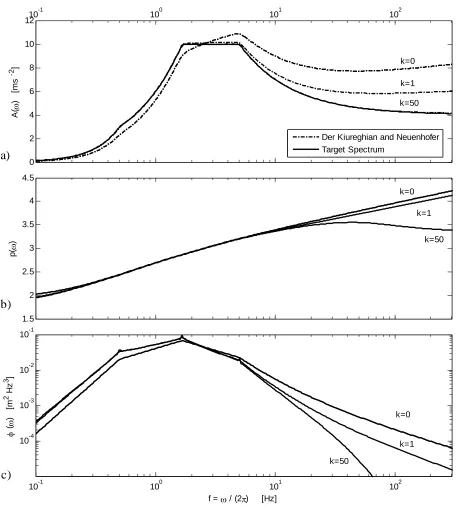
Figure 4 shows the results obtained by the iterative method of Der Kiureghian and Neuenhofer. In graph (a) we show results for iteration numbers 0, 1 and 50. While the agreement is poor at the initial stage, the sequence converges to the target spectrum. In graph (b), we report the correspondent sequence of peak-factor functions and in graph (c) the identified PSDs. Computationally, the method is not as demanding as that based on quadratic programming, but it is more demanding than the incremental method, since it requires solving the forward problem by numerical integration. In this case, we do not experience lack of converge of the sequence of peak-factor functions. The correspondent PSD does not exhibit the local maximum at high frequencies, and the peak-factor function decays more smoothly than those presented in Figures 1(b) and 2(b).
10-1 100 101 102
0 2 4 6 8 10 12
A(
)
[m
s
-2]
Target Spectrum Quad. Progr.
10-1 100 101 102
10-4 10-3 10-2 10-1
(
) [
m
2 Hz 3]
f = / (2) [Hz]
a)
Figure 4. Target (continuous line) and reconstructed (dash-dotted line) response spectra (a), peak factor
function (b), identified PSD (c) for the iterative method of Der Kiureghian and Neuenhofer.
SUMMARY AND CONCLUSIONS
Three methods for generating a power spectral density (PSD) compatible with a target response spectrum are described. It is shown that the target response spectrum should satisfy certain requirements to allow generation of spectrum-compatible PSD. A response spectrum not satisfying these conditions violates fundamental rules of random vibrations theory (under the assumption of stationary input and
10-1 100 101 102
0 2 4 6 8 10 12
A(
)
[m
s
-2]
k=0
k=1
k=50
Der Kiureghian and Neuenhofer Target Spectrum
1.5 2 2.5 3 3.5 4 4.5
p(
)
k=0
k=1
k=50
10-1 100 101 102
10-4 10-3 10-2 10-1
(
)
[m
2 Hz 3]
f = / (2) [Hz]
k=0
k=1
k=50
a)
b)
output). This finding provides a basis for examining the admissibility of response spectrum shapes prescribed in building codes.
Of the three methods examined, the incremental procedure by Vanmarke is computationally inexpensive and works well for low damping ratio. The iterative procedure proposed by Der Kiureghian and Neuenhofer works well with admissible target response spectra. Quadratic programming provides a brute-force optimization scheme for solving the inverse problem. It allows for flexibility, selecting an optimal trade-off between smoothness of PSD and accuracy of the reconstructed response spectrum; however, tuning of the weight matrix and parameter requires some experience. All three methods produced compatible PSDs for an admissible response spectrum for the entire range of frequencies.
REFERENCES
Der Kiureghian, A., and A. Neuenhofer (1992). Response spectrum method for multiple-support seismic excitation. Earthq. Engrg. Struct. Dyn., 21(8), 713-740.
Dostal, Z. (2009). Optimal Quadratic Programming Algorithms. Springer.
Hastie, T., Tibshirani, R. and Friedman, J. (2009), The Elements of Statistical Learning, Springer.
Lutes, L.D., and Sarkani, S. (2004). Random Vibrations: Analysis of Structural and Mechanical Systems, Elsevier Butterworth-Heinemann, Burlington, Mass.
Ostadan, F (2011). Personal communications with the second author.
Polyanin, A.D., and A.V. Manzhirov (1998), Handbook of Integral Equations, CRC Press.
Vanmarcke, E.H., (1977) ,‘‘Structural response to earthquakes’’ in Seismic risk and engineering
COPYRIGHT TRANSFER AGREEMENT
The below text in italic is for your information and agreement prior to submittal of the paper.
The author(s) warrants that the submitted manuscript is the original work of the author(s) and has never been published in its present form.
The Lead Author, with the consent of all other authors, by submitting the manuscript for publication in SMiRT-22 transactions, hereby transfers copyright interest in the submitted manuscript to IASMiRT subject to the following.
• The Lead Author and all coauthors retain the right to revise, adapt, prepare derivative/
expanded works, present orally, or distribute the work.
• In all instances where the work is prepared as a "work made for hire" for an employer, the
employer(s) of the author(s) retain(s) the right to revise, adapt, prepare derivative/expanded works, publish, reprint, reproduce, and distribute the work provided that such use is for the promotion of its business enterprise and does not imply the endorsement of IASMiRT.
• It is recognized that an author who is a U.S. Government employee and who has participated
in the submitted work does not own copyright in it.