Copyright 0 1992 by the Genetics Society of America
Seventeen Complementation Groups of Mutations Decreasing Meiotic
Recombination in Schirosaccharomyces pombe
Linda C. DeVeaux, Nicole A. Hoagland and Gerald R. Smith
Fred Hutchinson Cancer Research Center, Seattle, Washington 98104 Manuscript received August 5, 199 1
Accepted for publication September 30, 1991
ABSTRACT
We have analyzed 43 recessive mutations reducing meiotic intragenic recombination in Schizosac- charomyces pombe. These mutations were isolated by a screen for reduced plasmid-by-chromosome recombination at the ade6 locus. Sixteen of the mutations define 10 new complementation groups, bringing to 17 the number of genes identified to be involved in meiotic recombination. The mutations were grouped into three discrete classes depending on the severity of the recombination deficiency in crosses involving the ade64426 recombination hotspot. Class I mutations caused at least a 1000- fold reduction in M26-stimulated intragenic recombination at the ade6 locus. Class I1 mutations reduced M26-stimulated recombination approximately 100-fold. Class I11 mutations caused a 3-10- fold reduction in either MP6-stimulated or non-hotspot recombination. We obtained multiple alleles of class I and class I1 mutations, suggesting that we may be nearing saturation for mutations of this type. As a first step toward mapping, we used mitotic segregation to assign fourteen of the rec genes to chromosomes. Mutations in the six rec genes tested also caused a decrease in intragenic recombi- nation at the ura4 locus; five of these mutations also reduced intergenic recombination between the pro2 and arg3 genes. These results indicate that these multiple rec gene products are required for high level meiotic recombination throughout the S. pombe genome.
B
O T H biochemical and genetic approaches have been used to investigate the mechanism of ge- netic recombination in eukaryotes. Biochemical anal- yses involving the purification of activities predicted to be necessary for recombination are limited in that usually only those activities that are assayed will be found. Eventually, a mutant lacking this activity must be obtained to determine whether or not the activity is indeed involved in recombination in the cell. A genetic approach has the advantage of producing the mutants with fewer constraints imposed by the imag- ination of the investigator. An experimental design that combines the two approaches is the ultimate goal. With this end in mind, we have undertaken a contin- uation of the work initiated by PONTICELLI and SMITH ( 1 989) to identify genes involved in meiotic recombi- nation in Schirosaccharomyces pombe through the isola- tion and analysis of recombination-deficient mutants. Prior to the work of PONTICELLI and SMITH (1 989) only a few S. pombe mutations affecting meiotic recom- bination had been isolated. A dominant mutation in a gene, recl, reduces mitotic recombination at the ade6locus but does not alter the meiotic recombination rate (GOLDMAN and GUTZ 1974). Three recessive mutations (rec2, rec3 and rec5) isolated on the basis of reduced ectopic recombination between the unlinked tRNA suppressor genes, sup3, sup9 and supl2, have no effect on general meiotic recombination, suggest- ing their involvement in illegitimate pairing (THU-
Genetics 1 3 0 251-262 (February, 1992)
RIAUX 1985). Mutations in 10 swi genes involved in mating-type switching were analyzed, but mutations in only one, swi5, show a deficiency in meiotic recom- bination (GUTZ and SCHMIDT 1985; SCHMIDT, KAP- ITZA and GUTZ 1987).
PONTICELLI and SMITH (1989) developed a screen that identified multiple mutants deficient in meiotic recombination. They isolated mutants with a de- creased frequency of recombination between two al- leles of the ade6 gene, one carried on a multicopy plasmid and the other in the normal chromosomal location. Since recombination is necessary for the proper segregation of chromosomes at meiosis I, mu- tants deficient in recombination have reduced spore viability due to frequent aneuploidy; however, the three chromosomes of S. pombe assorting randomly will produce a true haploid approximately 10% of the time, allowing sufficient viability for measurement of recombinant frequencies. Colonies of mutagenized cells were therefore screened for a decrease in the number of Ade+ prototrophs produced in a meiotic homothallic self-cross, which allowed the isolation of recessive mutations. They isolated thirteen mutations, one of which was dominant. Of the recessive muta- tions, nine defined six complementation groups (rec6-
252 L. C. DeVeaux, N. A. Hc TABLE 1
S. pombe strains
Strain Genotype Source or reference"
GP6 h' ade6-M375 (1)
GP13 h- ade6-52 (2)
GP18 h-leul-32 V. ZAKIAN
GP24 h+ ade6-M26 (1)
GP27 h+ ade6-M210 sup9 (1)
GP43 h- ade6-M375 leul-32 GP6 X GP18
GP66 hgO ade6-M26 ura4-294 (pade6-469) (2) GP213 hgo swi5-134 lys2 ade6-M210 J. KOHLI
GP349 h- arg3-I24 ura4-294 (2)
GP350 h+ pro2-1 ura4-595 (2)
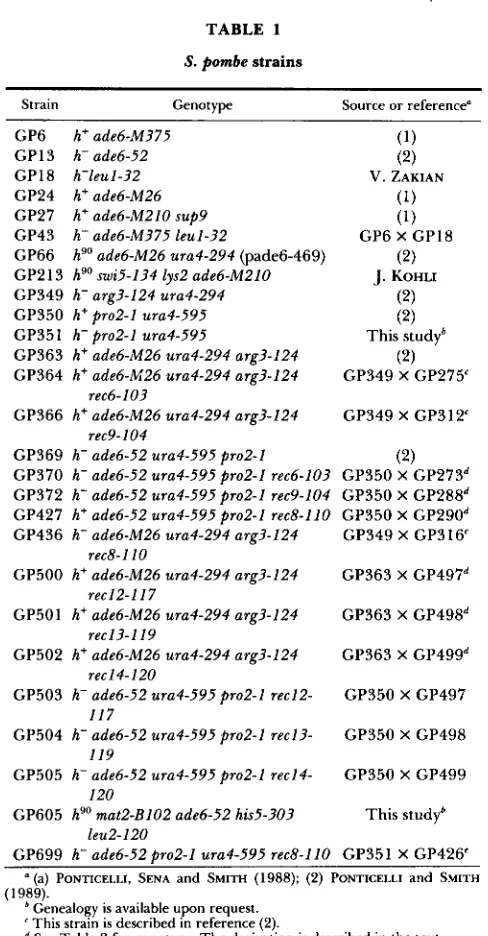
GP35 1 h- pro2-1 ura4-595 This studyb GP363 h+ ade6-MZ6 ura4-294 arg3-124 (2) GP364 h+ade6-M26 ura4-294 arg3-124 GP349 X GP275'
GP366 h+ ade6-MZ6 ura4-294 arg3-I24 GP349 X GP312'
GP369 h- ade6-52 ura4-595 pro2-1 (2) GP370 h- ade6-52 ura4-595 pro2-1 rec6-I03 GP350 X GP273d GP372 h- ade6-52 ura4-595 $1-02-1 rec9-104 GP350 X GP288d GP427 h' ade6-52 ura4-595 pro2-1 rec8-110 GP350 X GP290d GP436 h- ade6-M26 ura4-294 arg3-124 GP349 X GP316'
GP500 h+ ade6-M26 ura4-294 arg3-124 GP363 X GP497d
GP501 h+ ade6-M26 ura4-294 arg3-124 GP363 X GP49ad
GP502 h+ ade6-M26 ura4-294 arg3-124 GP363 X GP49gd
GP503 h- ade6-52 ura4-595 pro2-1 recl2- GP350 X GP497
GP504 h- ade6-52 ura4-595 pro2-1 recl3- GP350 X GP498
GP505 h- ade6-52 ura4-595 pro2-1 recl4- GP350 X GP499
GP605 hQo mat2-Bl02 ade6-52 his5-303 This studyb
GP699 h- ade6-52pro2-1 ura4-595 rec8-110 GP351 X GP426'
rec6-103
rec9-104
rec8-110
recl2-I 17
rec13-119
rec14-120
117
I19
I20
leu2-120
(19!9).
(a) PONTICELLI, SENA and SMITH (1988); (2) PONTICELLI and SMITH Genealogy is available upon request.
See Table 2 for genotype. The derivation is described in the text. GP426, isolated from the same cross as GP427, has the same genotype.
' This strain is described in reference (2).
threefold. Since only one or two alleles of each gene was isolated, t h e pool of rec genes in S. pombe was far from saturated by this mutagenesis. We have contin- ued this work by isolating and analyzing more mutants using the same screen. Twenty-seven new mutants, in addition to the three mutants not further analyzed by PONTICELLI a n d SMITH (1989), fall into 16 comple- mentation groups, 10 of which have not been de- scribed previously. Several alleles of the strongest rec mutations were isolated, which suggests that we are now approaching saturation for these genes.
MATERIALS AND METHODS
Strains: S . pombe strains are described in Table 1 and other tables where appropriate, following the genetic no- menclature of KOHLI (1987).
Plasmids and transformation: Plasmid DNA was intro-
,agland and G. R. Smith
duced into S. pombe strains using the LiOAc method of ITO
et al. (1983). Plasmid pade6-469 contains the ade6-469 allele and the Saccharomyces cerevisiae URA3 gene (SZANKASI et al. 1988). The URA3 gene, when present in high copy, comple- ments the uracil requirement of an S. pombe ura4 mutation.
S. pornbe culture media: Rich medium was yeast extract agar (YEA) or yeast extract liquid (YEL) (GUTZ et al. 1974). Synthetic sporulation agar (SPA) and malt extract agar (MEA) were prepared according to GUTZ et al. (1974). Minimal media used were MMA (GUTZ et al. 1974) and NBA (PONTICELLI and SMITH 1989). Liquid minimal me- dium (NBL) was NBA without agar. SPA, MEA, MMA and NBA were supplemented with required amino acids, purines and pyrimidines at 100 pg/ml.
Isolation of rec mutants: We used the screen of PONTI-
CELLI and SMITH (1989) to isolate additional mutants defi- cient in meiotic plasmid-by-chromosome recombination. Briefly, homothallic strain GP66, which carries the chro- mosomal ade64426 and ura4-294 mutations and the plasmid pade6-469, was mutagenized with nitrosoguanidine and plated on minimal MMA medium with adenine but without uracil, to maintain selection for the plasmid. After 5 days of incubation, many cells had mated and sporulated. Individual colonies were transferred to microtiter wells, treated with glusulase and ethanol, and spotted onto MMA
+
uracil or onto YEA. Typically, unmutagenized GP66 gave approxi- mately 50 white (Ade+) papillae on YEA, whereas rec can- didates gave few or no papillae on YEA, and few or no Ade+ colonies on MMA+
uracil.Each candidate was grown nonselectively in rich medium to obtain Ura- segregants which had lost pade6-469. T o eliminate the possibility that the recombination deficiency was due to a plasmid mutation, pade6-469 was reintroduced into several candidates and the plasmid-by-chromosome re- combinant frequency redetermined. Since this test did not eliminate any candidates in the first experiment, it was not used in later experiments unless rec derivatives were diffkult to isolate after meiotic crosses. T o test for additional muta- tions in the ade6 gene, some of the Ura- segregants were crossed with a strain (GP27) carrying the sup9 mutation, which suppresses the adenine requirement of the ade6-M26 mutation (GUTZ 197 1). T o test for dominance or recessive- ness of the rec mutations in chromosome-by-chromosome recombination, each candidate was also crossed with a rec+ strain (GPI 3).
Meiotic crosses: For crosses of two heterothallic strains, equal volumes of saturated cultures in YEL were mixed in a 1.5-ml microfuge tube, the cells were washed with saline, and the entire sample, in approximately 10 p1 of saline, was spotted on supplemented SPA medium. When one strain was homothallic, that strain was used at one-fifth the volume of the heterothallic strain to increase the frequency of interstrain matings. After incubation for 3-5 days at room temperature, the matings were harvested into 0.5 ml of 0.5% glusulase in water and incubated overnight at room temperature. The spore suspensions were then treated with 30% ethanol for 30 min and washed once with water prior to plating.
S. pombe rec Genes 253
patched strains. The mating plate was incubated at room temperature for 3-5 days. When the test crosses were per- formed to determine mating type, the mating plate was exposed to iodine vapors, which stain sporulating colonies
(GUTZ et al. 1974). For determination of the rec phenotype, the mating plate was replicated onto an NBA plate without adenine. The NBA plate was incubated for two days and replicated onto an identical NBA plate, which was incubated for 2 days more and scored for growth of Ade+ recombi- nants. We found this sequential replication to be critical for accurate scoring of the rec phenotype.
Determination of meiotic recombinant frequencies: On media, such as YEA, that contain limiting amounts of ade- nine, S. pombe strains carrying the ade6-M26 or ade6-M375 allele are dark red, whereas ade6-52-carrying strains are pink (GUTZ et al. 1974). Ade+ colonies are white under these conditions. T o measure plasmid-by-chromosome recombi- nation, the homothallic ade6-M26 rec strains carrying pade6-
469 were allowed to self-mate. The spore suspension was diluted and plated on YEA to determine total viable spores and, in some cases, Ade+ (white) recombinants. In some experiments, Ade+ recombinants were also selected on NBA plates.
For quantitation of chromosome-by-chromosome recom- bination, two strains were grown in YEL and crossed as described above. The spore suspension was diluted and plated on YEA to determine total viable spores and on NBA to select for prototrophic recombinants.
In order to determine whether the Ade+ colonies in rec
mutant crosses were true recombinants or simply revertants of the ade6 mutations, we measured the meiotic revertant frequencies of the three chromosomal ade6 alleles used. For each allele, crosses were performed between an h+ ade6 and an h- ade6 strain, and the spore suspensions plated as de- scribed above for determination of recombinant frequen- cies. Each allele was tested eight times, and the strains for each trial were grown in separate cultures from individual single colonies. The revertant frequencies were as follows (in Ade+/106 viable spores): ade6-52, 0.11, C0.76, C0.3, (0.23, CO.19, <0.25, C0.13, C0.2; ade6-M26, 2.1, 0.18, <0.47, c3.5, C0.22, C0.45, <0.37, c0.27; and ade6-M375, (0.14, 0.67, C0.22, <0.48, C0.29, c0.27, C0.33, <0.29. In those cases where no Ade+ revertants were seen, the upper limits of the revertant frequencies were calculated based on an assumption of three Ade+ revertants in the sample plated.
Complementation of rec mutations: Complementation of rec mutations was determined first qualitatively, in a "spot" test, and then quantitatively as described above for measurement of ade6 chromosome-by-chromosome recom- binant frequency. In the "spot" test, strains to be tested were grown in YEL, mixed in a microfuge tube and spotted o n SPA sporulation medium. Instead of harvesting the mating, the SPA plate was replicated onto an NBA
+
uracil plate which was incubated for two days, and then replicated onto an identical NBA+
uracil plate, which was incubated for 2 days more. Comparison of the Ade+ recombinants present in each experimental mating to control matings allowed qualitative assignment of wild-type or mutant levels of recombination. This qualitative test decreased signifi- cantly the number of quantitative crosses necessary to ac- curately assign complementation groups.Mitotic mapping by formation of stable diploids and induction of haploidization: Strains with the genotype h90
mat2-B102 mate with either heterothallic type (h+ or h-) but fail to sporulate when crossed with an h- strain (EGEL 1984). We employed this phenotype to create stable diploids, mod- ifying the procedure of KOHLI et al. (1977). An auxotrophic
h90 mat2-Bl02 strain was crossed on SPA with an h- strain carrying different auxotrophies. After 20 hr at room tem- perature, the mating mixture was scraped with a toothpick and streaked onto NBA to select for protrophic diploids. After three days at 32", large colonies were individually inoculated into 1 ml of supplemented NBL containing 0.4- 0.8% m-fluorophenylalanine to induce haploidization
(KOHLI et al. 1977). After 2 days at 32", the cultures were diluted and plated on YEA. The YEA plates were incubated for 2 days and replicated onto NBA
+
adenine. Each parent contained, in addition to other markers, an auxotrophy on chromosome Z (either leu2 or pro2). Thus, haploids were identified as auxotrophs. By this criterion, 50-95% of the colonies were haploids. Haploids were picked from the YEA plate onto another YEA plate in a grid, which in turn was used for replication onto minimal plates to score the auxo- trophies or onto MEA plates to score for rec, as described above.Sensitivity to DNA damaging agents: T o test for sensi- tivity to MMS (methyl methane sulfonate), strains were streaked on YEA medium containing MMS (50-100 PI/ liter) and 0.1 % (wt/vol) caffeine. Sensitivity to UV (ultravi- olet light) was determined qualitatively by spotting 10 PI of a saturated culture in YEL onto a YEA plate, exposing it to up to 3200 ergs/mm2 UV, and incubating the plate at 32" for 3 days. Sensitivity was scored as either reduced colony size or failure to grow.
RESULTS
Isolation of additional rec mutants: We used the
screen described above to isolate mutants defective in meiotic adeb plasmid-by-chromosome recombination, which were then examined for chromosome-by-chro- mosome recombination deficiencies. This screen takes advantage of the recombination "hotspot" activity of t h e ade6-M26 allele (GUTZ 197 l ) , which stimulates recombination at the ade6 locus 10- 1 !%fold, thus pro- viding a higher initial recombinant frequency from which to screen for recombination-deficient mutants. Because the starting strain was homothallic and was allowed to self-mate, recessive mutations were re- covered.
Five independent cultures of strain GP66, grown from single colonies, were mutagenized. Approxi-
mately 18,000 colonies were screened, and eighty-two candidates were chosen that appeared in the initial screen to have a recombination deficiency. For six of these, Ura- segregants could not be isolated, and they were discarded. Of the remaining 76, 36 strains car- ried dominant mutations; 8 of these were tested for additional ade6 mutations by crossing with a sup9
strain, which suppresses the adenine requirement of the ade6-M26 mutation present in the parental strain. Five of the eight were no longer suppressible, sug- gesting that the majority of the dominant mutations were additional mutations in the adeb gene. Strains carrying dominant mutations were not characterized further in this study. T h e remaining forty strains carried recessive mutations, and their Ura- segregants were used for further analysis. In addition, three
254 L. C . DeVeaux, N. A. Hoagland and G .
R.
SmithPONTICELLI and SMITH (1989) were further charac-
terized in this study, for a total of forty-three recessive mutations.
Identification of 10 new complementation groups
and additional alleles of defined groups: Seven re-
cessive mutants from the first two mutageneses were tested for complementation with rec6-recll by cross- ing each h90 ade6-M26 ura4-294 rec candidate with h-
ade6-52 strains carrying rec6-recll and quantitating the recombinant frequency (data not shown). Two mutants carried new alleles of rec8 and reclO and are discussed below. Five mutants defined new comple- mentation groups: recl2, recl3, recl4, recl5 and recl6.
T h e h- ade6-52 rec derivatives of the recl2-recl6
strains were obtained for further analysis.
Ura- segregants of the remaining thirty-six new mutants (including rec-106, rec-112 and rec-113) were crossed with the h- ade6-52 derivatives of the rec6-
recl6 strains and analyzed by the spot complementa-
tion test. Eighteen mutants appeared to complement
rec6-recl6 in these homothallic-by-heterothallic spot tests and were mated with GP 13 to isolate h- ade6-52
rec derivatives. For only 5 of the 18 mutants were h-
ade6-52 rec derivatives obtained; the remaining 13
mutants were not analyzed further. T h e appropriate derivatives of these five mutants were crossed against each other: each represented a different complemen- tation group, thus defining recl7, recl8, recl9, rec20
and rec21. For recl2-rec21, the h- ade6-52 rec strains were crossed with an h+ ade6-M26 strain (GP24), and the h+ ade6-M26 rec derivatives were isolated. These
h- ade6-52 rec and h+ ade6-M26 rec derivatives of each new mutant (recl2-rec21) were used to verify comple- mentation with the existing rec mutants (rec6-recll)
and with each other in heterothallic-by-heterothallic
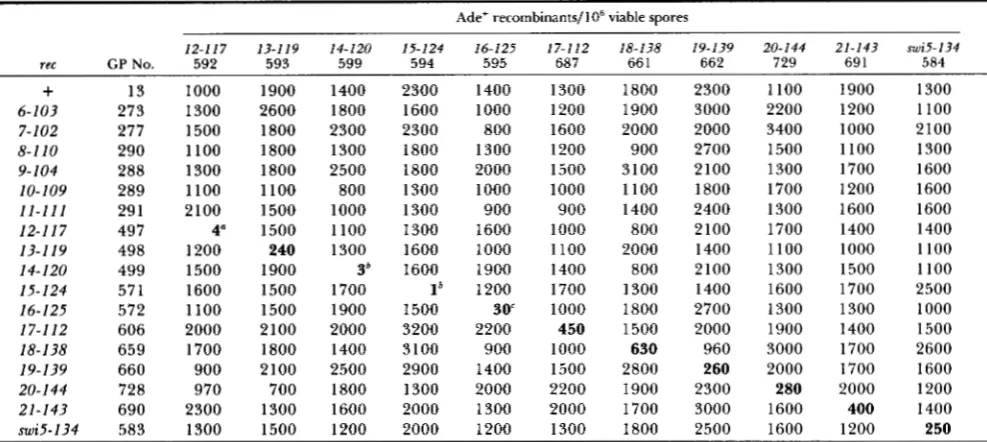
crosses (Table 2). All of the new mutations comple- mented the recombination deficiency of the swi5-134
strain, which reduces adeb chromosome-by-chromo- some recombination approximately 1 O-fold (Table 2;
SCHMIDT, KAPITZA and GUTZ 1987). These results
brought to 17 (including m i 5 ) the number of comple- mentation groups affecting meiotic ade6 interchro- mosomal recombination.
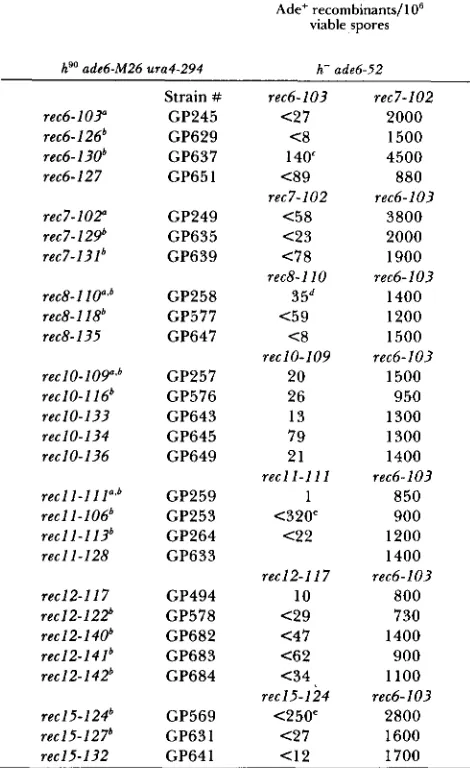
We isolated additional alleles of several of the known complementation groups. Twenty of the orig- inal 43 recessive mutants failed to complement one of the rec6-rec21 mutations. Table 3 shows the results of crosses in which the homothallic Ura- segregants containing the new rec alleles were mated with the heterothallic derivatives of two known rec mutants: one which failed to complement, to verify the group assignment, and one which complemented, to verify recessiveness. In all but one case, the new alleles showed a recombinant frequency comparable to the original allele. rec6-130 showed a repeatedly higher recombinant frequency than the original allele (rec6-
103) and the other new rec6 alleles (rec6-126 and rec6- 137). rec6-130 apparently has a "leaky" phenotype. It should be noted that rec6-126 and rec6-130 came from the same mutagenized culture. However, we believe that these alleles are not clonally related since they show distinctly different recombination phenotypes.
rec15-124 and rec15-127 were also isolated from the same mutagenized culture, but we believe that these two alleles are independent, since the original recl5- 124 isolate also carried a mutation which caused low spore yields. Two of the mutations (rec-106 and rec- 113) described by PONTICELLI and SMITH ( 1 989) are alleles of recll; their third unassigned mutation (rec- 112) defined the recl7 complementation group. One allele from each new complementation group was chosen for further characterization in this study. The number of alleles for each of the complementation groups is discussed below.
Characterization of rec deficiencies: In crosses
homozygous for a given rec mutation (Table 2) the reduction in chromosome-by-chromosome recombi- nation varied from approximately threefold (recl7
and recl8) to approximately 1000-fold (recl2, recl4
and recl5). Based on our reversion analysis (see MA- TERIALS AND METHODS) we believe that the few Ade+ colonies seen in the crosses of the most recombination- deficient mutants represent recombinants and not revertants of either ade6 allele. Recombinant frequen- cies not significantly different from those of rec+
strains were obtained in crosses where complementa- tion occurred, verifying that these mutations were fully recessive.
Effect of new mutations on M26 recombination
stimulation: Since the mutant screen took advantage
of the hotspot activity of the ade6-M26 allele, it was important to compare the effect of each rec mutation on hotspot and non-hotspot recombination. T h e ade6- M375 mutation is located three nucleotides from adeb- M26 and is also a single base-pair change of G:C
-
T:A (SZANKASI et al. 1988; PONTICELLI, SENA and
SMITH 1988). ade6-M375, however, does not show the
stimulation of recombination of ade6-M26 (GUTZ
1971), and thus serves as an excellent control for the
M26 hotspot activity. T h e h+ ade6-M375 rec derivative of each new rec mutation was isolated by crossing the
h- ade6-52 rec strains with GP6 (h+ ade6-M375). The effect of each rec mutation on M26 stimulation of meiotic ade6 interchromosomal recombination was examined by comparing the recombinant frequency in ade6-M26 X ade6-52 crosses with those in ade6- M375 X ade6-52 crosses. For each rec mutation the recombinant frequency was decreased in both the
M26 and the M375 crosses (Table 4). In cases where there was a detectable but low level of recombination
S. pombe rec Genes 255
TABLE 2
Complementation analysis of new recessive rec mutations
Ade+ recombinants/106 viable spores 12-11? 13-119 14-120 15-124 16-125 17-112 18-138 19-139 20-144 21-143 swi5-134
rec GP No. 592 593 599 594 595 687 66 1 662 729 69 1 584
+
13 1000 1900 1400 2300 1400 1300 1800 2300 1100 1900 13006-103 273 1300 2600 1800 1600 1000 1200 1900 3000 2200 1200 1100
7-102 277 1500 1800 2300 2300 800 1600 2000 2000 3400 1000 2100
8-110 290 1100 1800 1300 1800 1300 1200 900 2700 1500 1100 1300
9- 104 288 1300 1800 2500 1800 2000 1500 3100 2100 1300 1700 1600
10-109 289 1100 1100 800 1300 1000 1000 1100 1800 1700 1200 1600
11-111 291 2100 1500 1000 1300 900 900 1400 2400 1300 1600 1600
12-1 I 7 497 4" 1500 1100 1300 1600 1000 800 2100 1700 1400 1400
13-119 498 1200 240 1300 1600 1000 1100 2000 1400 1100 1000 1100
14-120 499 1500 1900 3' 1600 1900 1400 800 2100 1300 1500 1100
15-124 571 1600 1500 1700 1' 1200 1700 1300 1400 1600 1700 2500
16-125 572 1100 1500 1900 1500 3 0 1000 1800 2700 1300 1300 1000
17-1 12 606 2000 2100 2000 3200 2200 450 1500 2000 1900 1400 1500
18-138 659 1700 1800 1400 3100 900 1000 630 960 3000 1700 2600
19-139 660 900 2100 2500 2900 1400 1500 2800 260 2000 1700 1600
20-144 728 970 700 1800 1300 2000 2200 1900 2300 280 2000 1200
21-143 690 2300 1300 1600 2000 1300 2000 1700 3000 1600 400 1400
mi5-134 583 1300 1500 1200 2000 1200 1300 1800 2500 1600 1200 250
Strains along the top row were of the genotype h+ ade6-M26 rec; strains on the left column were of the genotype h- ade6-52 rec. For rec6-recll, these strains are described by PONTICELLI and SMITH (1989). For rec12-21, the derivations of the h- ade6-52 rec and h ade6-M26 rec strains are described in the text. The m i 5 strains were similarly constructed from GP213 (Table 1). >200 Ade+ recombinants were scored for each recombinant frequency determination, except where noted. 1 1 5 0 colonies (and generally 1200, but with 5 exceptions of >115 colonies) were counted to determine total viable spores.
Only 2 Ade+ recombinants were obtained.
'
Only 1 Ade+ recombinant was obtained.' Only 3 Ade+ recombinants were obtained in this experiment (see Table 4).
Effect of recd, rec8, rec9, recl2, r e d 3 and r e d 4
on recombination at other intervals: PONTICELLI and
SMITH (1 989) reported that mutations in rec7, reclO
and recl
I
reduce intragenic recombination at the ura4locus, as well as intergenic recombination between
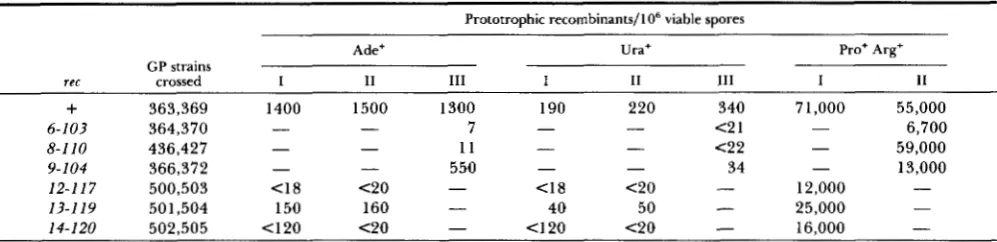
p r o 2 and arg?. We determined the effect of their rec6, rec8 and rec9 mutations, as well as the new rec muta- tions, recl2, recl? and recl4, on recombination at loci other than ade6 by constructing strains that would allow determination of both u r a 4 and ade6 intragenic and pro2-arg3 intergenic recombination in the same cross. T h e data presented in Table 5 show that most
rec mutations tested decreased both Ura+ and Arg' Pro+ recombinant frequencies, although the relative reductions differed from locus to locus, as was de- scribed for rec7, reclO and r e c l l (PONTICELLI and
SMITH 1989) T h e exception was rec8, which showed
strongly decreased intragenic recombination at both
ade6 and u r d , but nearly wild-type levels of inter- genic recombination at pro2-arg? (see DISCUSSION).
Mitotic phenotypes of the rec mutants: Some mu-
tations affecting meiotic recombination in other or- ganisms have been isolated by their effect on mitotic growth, typically sensitivity to DNA-damaging agents
(GAME et al. 1980). In contrast, only two of the S.
pombe rec mutants previously reported (rec9 and mi5) demonstrate any mitotic phenotype (PONTICELLI and
SMITH 1989; SCHMIDT, KAPITZA and GUTZ 1987;
SCHMIDT et al. 1989). Several rad mutants of S. pombe
that show a mitotic sensitivity to UV are not deficient in meiotic intragenic recombination (GROSSEN-
BACHER-GRUNDER and THURIAUX 1981). We tested
the effect of UV and MMS
+
caffeine on mitotically growing strains carrying mutations in rec12-rec22.Strains carrying either a recl7 or a recl9 mutation showed sensitivity to MMS when combined with caf- feine, whereas strains carrying the remaining rec mu- tations did not (data not shown). In addition, cells of
recl7 strains grown mitotically tended to clump in liquid medium. Strains carrying either a recl7 or a
recl8 mutation had greater doubling times than rec+
strains, whereas recl9 strains were not affected. All three mutations, like rec9 and swi5, only moderately reduced the ade6 recombinant frequency (3-1 0-fold). Since each of these complementation groups is rep- resented by only one allele (with the exception of swi5,
no alleles of which were isolated by this screen) and extensive analysis of meiotic segregants for coinherit- ance of the mitotic and rec phenotypes has not been done, the two phenotypes may be due to separate mutations.
Linkage group assignments: As a first step in map-
256 L. C. DeVeaux, N. A. Hoagland and G. R. Smith TABLE 3
Assignment of new rec alleles to complementation groups
Ade' recombinants/106 viable spores
h9" ade6-M26 ura4-294 h- ade6-52
Strain # GP245 GP629 GP637 GP65 1
GP249 GP635 GP639
GP258 GP577 GP647
GP257 GP576 GP643 GP645 GP649
GP259 GP253 GP264 GP633
GP494 GP578 GP682 GP683 GP684
GP569 GP631 GP64 1
rec6-103
<27 <8 140" <89
rec7-102
<58 €23 <78
rec8-1 IO 3 5d <5 9
<8
rec10-109
20 26 13 79 21
r e c l l - I 1 I 1 <320' <22
recl2-117
10 <29 e 4 7 C62
rec15-124
<250' €27 <12 <34 ~
rec7-102
2000 1500 4500 880
rec6-103
3800 2000 1900
rec6-103
1400 1200 1500
rec6-103
1500 950 1300 1300 1400
rec6-103
850 900 1200 1400
rec6-103
800 730 1400 900 1100
rec6-103
2800 1600 1700 Crosses were h- adc6-52 ret X hqo ade6-M26 ura4-294 rec. The h- ade6-52 rec strains were those in Table 2. The hw ade6-M26 ura4-294 rec strains are the Ura- segregants of the mutagenized derivatives of strain GP66 (see of the recombinant frequency was calculated by assuming three Ade+ colonies MATERIALS AND METHODS). For entries with no Ade' colonies the upper limit in the sample plated.
(19!9). rec-106 is hereby designated recll-106, and rec-113, recll-113.
'These alleles and strains were described by PONTICELLI and SMITH
the same mutagenized culture and thus may not be independent isolates (see Within each complementation group, alleles noted were isolated from text).
' Repetition of the cross gave a recombinant frequency of 113 Ade+/106 viable spores.
Heterothallic-by-heterothallic crosses with this allele gave lower recom- binant frequencies (Table 7; PONTICELLI and SMITH 1989).
' Due to consistently low spore yields, the recombinant frequency could not be more accurately determined. Heterothallic derivatives of the recl5- 124 strain gave a higher spore yield, allowing a more sensitive frequencv determination (see Tables 2 and 4).
For ease of testing the rec genotype of haploid segregants in test crosses (see MATERIALS AND METH- ODS), both parental strains contained the ade6-52 mu- tation. T h e mat2-Bl02 strain used (GP605) also car- ried mutations in genes on chromosome
Z
(leu2) and chromosomeZZ
(his5). For each rec gene we con- structed an h- strain that would form a nonsporulating diploid with the mat2-Bl02 strain. These strains con-tained, in addition to a mutation in the rec gene being mapped, mutations in genes on chromosome
Z
( p r o 2 )and chromosome
ZIZ
( u r a 4 ) . We scored haploid segre- gants from at least four independent diploids for eachrec gene.
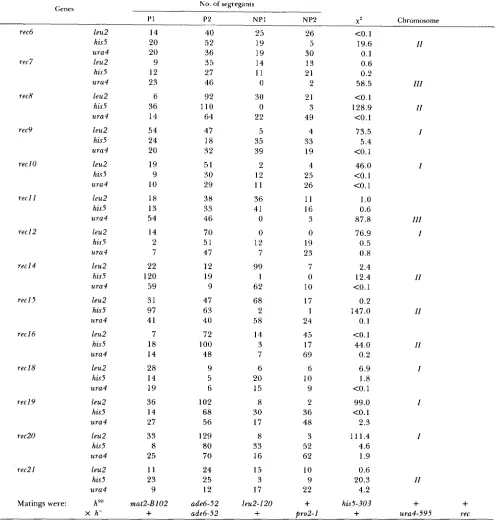
Diploids were formed, and auxotrophic segregants were isolated during mitotic growth and analyzed. T h e segregants were scored for rec and the various auxotrophies by replica-plating. T o minimize mitotic recombination the diploid strains were not grown extensively before haploidization. Thus, we expected each rec mutation to show linkage to one of the auxotrophies. T h e results of this analysis are pre- sented in Table 6. For each pair of markers, the segregants were classified into four types-P 1, P2, NP 1 and NP2 described in the legend to Table 6-and contingency Chi square analysis was performed on the resulting numbers of segregants. We have presented only the data for the segregation of each rec mutation with the three auxotrophies; the auxotrophies (except for leu2 and pro2, both on chromosome I ) showed the expected independent segregation from each other (data not shown). For the chromosome
Z
segregation, we have presented only the leu2 segregation. Since the leu2 and pro2 mutations in the diploids came from different parents, we have included in our analysis only those segregants which showed the parental con- figurations of these mutations (Leu+ Pro- or Leu- Pro+). We used the presence of a nonparental phe- notype of these two markers (Leu+ Pro+ or Leu- Pro-) in the segregants to indicate either a mitotic recom- bination event or diploidy/aneuploidy. Most of those nonparental segregants were of the Leu+ Pro+ type, and when examined under a microscope appeared to be diploid (data not shown). T h e low frequency (less than 1%) of Leu- Pro- segregants suggested that mitotic recombination did not occur at a significant rate.In Table 6, the number of segregants of each type with respect to rec and the given auxotrophy is shown. For each rec, segregation with one auxotrophy had a Chi square value significantly higher than the other two, indicating that segregation was not random. In this way, we assigned each rec gene, with the exception of recl3 and r e c l 7 , to a chromosome as indicated in the last column of Table 6. T h e rec phenotypes of the
recl3 and recl7 haploids were not clear enough in the cross-stamp test to allow an accurate scoring.
Meiotic linkage of some rec genes to other known
genes: Heterothallic derivatives of the h9* rec15-124
mutant were rarely obtained from meiotic crosses with an h- rec+ strain. We found that the recl5 mutation was meiotically linked to the matl locus. In twenty spores isolated from heterothallic crosses (h+ adeb- M26 rec15-124 X h- ade6-M26 or h- ade6-52 recl5-
S. pombe rec Genes 257
TABLE 4
Comparison of M26 and M 3 7 5 recombinant frequencies in rec mutant strains
Ade+ recombinants/106 viable spores Ade+ recombinants/lO' viable spores
M375 X 52 M 2 6 x 52
GP strains Mutation
GP strains
crossed Expt 1 Expt 2 crossed Expt 1 Expt 2
rec+ 6 , 13 320 (369) 330 (424) 24, 13 2000 (357) 2900 ( 1 68)
rec12-117 5 79,497 2 (2) 2 (2) 59 2, 49 7 2 (1) 2 (2)
recl3-I19 5 96,498 27 (62) 35 (9) 593, 498 260 (265) 330 (627)
rec14-120 5 81,499 <7 ( 0 ) <56 (0) 59 9, 49 9 2 (2) <24 (0)
rec15-124 5 97,571 1 ( 1 ) 6 (1) 594, 571 1 ( 1 ) 4 (1)
rec16-125 598, 572 <3 (0) <38 ( 0 ) 59 5, 57 2 23 (21) 33 (4)
rec17-112 7 31,606 43 (16) 92 (46) 6 87 ,6 06 420 ( 1 60) 770 (477)
rec18-138 7 32,659 94 (10) <56 ( 0 ) 66 1 , 659 300 (95) 650 (339)
rec19-139 6 85,660 16 (18) 45 (77) 6 6 2 , 6 6 0 550 (377) 410 (201)
rec20-144 7 30,728 45 ( 1 15) 66 ( 1 40) 729, 728 440 (387) 430 (243)
rec21-I43 6 92,690 33 (89) 130 (253) 69 1,690 210 (338) 570 (550)
swi5-134 586,583 89 (9) 584, 583 390 (70)
determine viable spores. The ade6-M375 strains were constructed by crossing GP6 (h+ ade6-M375) and the h- ade6-52 rec strains in Table 2, with the exception Crosses were h+ ade6-M26 or M375 rec X h- ade6-52 rec. Numbers in parentheses indicate Ade' colonies counted. At least 200 colonies were counted to
of GP597. Due to the meiotic linkage of recl5 and mat, GP597 was constructed from the cross of GP43 (h- ade6-M375 leu2) and GP594 (h+ ade6-M26 recJ5- 124). The ade6-M26 and ade6-52 strains were those in Table 2.
TABLE 5
Effect of certain rec mutations on d e 6 and ura4 intragenic and pro2-arg3 intergenic meiotic recombination
rec
~~
GP strains crossed
+
6- IO3 8-110 9-104 12-117 13-1 19 14-120
~~~~
363,369 364,370 436,427 366,372 500,503 501,504 502,505
~ ~
Prototrophic recombinants/106 viable spores
Ade* Ura+ Pro+ Arg+
I I1 111 I 11 111 I 11
1400 1500 1300 190 220 340 7 1,000 55,000
c 2 1 - 6,700
c 2 2 - 59,000
-
-
550 - - 34 - 13,000<18 e 2 0 - <18 <20
-
12,000150 160 40 50
-
25,000 -<120 <20 - <1 20 e 2 0
-
16,000 -- - 7 - -
1 1
- - - -
- -
5 2 ura4-595 pro2-1 rec. - = not determined.
I , 11 and 111 are separate experiments. The strains crossed are described in Table 1 and have the genotypes h+ ade6-M26 u r d - 2 9 4 arg3-124 rec and h- ade6-
recI5 were observed. This result confirmed our as- signment of the recl5 gene to chromosome
ZZ.
T h erec6 gene is meiotically linked to the pat1 gene (P.
SZANKASI, personal communication), and r e c l l to
ade6 (P. SZANKASI, A. S. PONTICELLI and G. R. SMITH,
unpublished observations); both linkages are approx- imately 1-2 cM and confirm our assignment of these genes to chromosome
ZZ
andZZZ,
respectively.DISCUSSION
Prior to this study, the number of genes known to be involved in meiotic recombination in
S.
pombe was low. Mutations in seven genes, rec6-reclI
(PONTICELLIand SMITH 1989) and mi5 (SCHMIDT, KAPTIZA and
GUTZ 1987), reduce intragenic recombination at the
ade6 locus from 3- to 1000-fold. Because only one or
two mutations in each of these genes had been ob- tained, we reasoned that the pool of rec genes ame- nable to this screen must be larger than this and undertook a more extensive search for rec mutants, using the screen of PONTICELLI and SMITH (1 989).
Isolation of mutants: We have assigned thirty re-
cessive mutations that decrease meiotic intragenic re- combination to 17 complementation groups. Strains carrying these mutations vary greatly in degree of
deficiency, although within a complementation group, multiple alleles usually behaved similarly. Mutations in five of the six genes identified by PONTICELLI and
SMITH (1 989) reduce recombination by at least 100-
fold, and our search identified four additional com- plementation groups that were as severely affected. We also isolated 20 additional alleles of the groups with reductions of 100-fold or greater but found no additional alleles of the less deficient groups. A sum- mary of our results on the 10 new complementation groups and swi5, as well as the results of PONTICELLI
and SMITH (1 989) on rec6-recl I , is presented in Table
7.
T h e distribution of alleles for the strongest recgenes suggests that saturation is being approached and that only a few more genes of this type are likely to be identified by this screen.
L. C. DeVeaux, N. A. Hoagland and G. R. Smith TABLE 6
Assignment of rec genes to chromosomes by mitotic segregation
N o . of segregants Genes
P1 P2 NP1
rec6
rer 7
recK
rec9
rec I0
r e e l 1
rec I 2
rec I 4
recl5
reel6
rec 18
recl9 rec20 rec21 leu2 his5 ura4 leu2 his5 ura4 leu2 his5 ura4 leu2 his5 ura4 leu2 his5 ura4 leu2 his5 ura4 leu2 his5 ura4 leu2 his5 ura4 leu2 his5 ura4 leu2 his5 ura4 leu2 his5 ura4 leu2 his5 ura4 leu2 his5 ura4 leu2 his5 ura4
Matings were: h"J x h-
14 20 20 9 12 23 6 36 14 54 24 20 19 9 10 18 13 54 14 2 7 22 120 59 31 97 41 7 18 14 28 14 19 36 14 27 33 8 25 11 23 9 mat2-Bl02
+
40 52 36 35 27 46 92 110 64 47 18 32 51 30 29 38 33 46 70 51 47 12 19 9 47 6 3 40 72 100 48 9 5 6 102 68 56 129 80 70 24 25 12 25 19 19 14 11 0 30 0 22 5 35 39 2 1 2 1 1 36 41 0 0 12 7 99 1 62 68 2 58 14 3 7 6 20 15 8 30 17 8 33 16 15 3 17ade6-52 leu2-120
NP2 X P Chromosome 26 5 30 13 21 2 21 3 49 4 33 19 4 25 26 11 16 3 0 19 23 7 0 10 17 1 24 45 17 69 6 10 9 2 36 48 3 52 62 10 9 22
+
<o.
1 19.6 0.1 0.6 0.2 58.5 <0. 1 128.9 <O. 1 73.5 5.4 <O. 1 46.0 <O. 1<o.
1 1.o
0.6 87.8 76.9 0.5 0.8 2.4 12.4<o.
1 0.2 147.0 0.1 <O. 1 44.0 0.2 6.9 1.8<o.
1 99.0 <O. 1 2.3 111.4 4.6 1.9 0.6 20.3 4.2 his5-303+
11I I I
11
1
1
I l l
1 11 11 11 1 1 1 II
+
+
ade6-52
+
pro2-1 ura4-595 recexcept for the rec8 strain, GP699, which is described in Table 1 . Haploid mitotic segregants were obtained and analyzed as described in MATERIALS AND METHODS. The h"" parent was GP605, and the h- parents were derived from crosses between the h- ade6-52 rec strains in Table 2 and GP350 (h+ pro2-1 ura4-595),
1'1 (parental) segregants had the genotype of the h"' parent, GP605, with respect to rec and each auxotrophy. P2 segregants had the genotype of the h- parent.
NPI (nonparental) and N P 2 segregants had the non-parental genotypes, N P l being rec+ and N P 2 being rec. Contingency x' values were calculated according to S'I'RICKRERGER (1968). The leu2 and pro2 genes are located on chromosome 1, his5 is on chromosome 11, and ura4 is on chromosome I l l (KOHLI 1987). Only auxotrophs containing either a leucine or proline auxotrophy, but not both, were included in this study. Other auxotrophs were diploid or aneuploid as revealed by microscopic examination of the cells.
S. pornbe rec Genes TABLE 7
Summary of rec mutant characterization
259
Meiotic recombination frequency at ade6
Plasmid X chromosome
Chromosome X chromosome Ade+/l Os Ade+/l O6
No. viable spores viable spores DNA
of damage Meiotic
Gene alleles M26 X 469 M 2 6 X 52 M375 X 52 sensitivity Chromosome linkage
rec+ 25 2500 330
rec6 4 <0.5 4 3 11 patl"
rec7 4 <0.5 2 2 111
rec8 4 0.4 4 5 11
reel2 5 0.5 2 2 I
reel4 1 <0.8 2 <7 11
reel5 3 0.1 3 3 11
reel 0 5 0.8 30 5 I
reel I 5 0.6 12 4 111
reel6 1 0.6 28 <3 I I
rec9 1 5 1000 77 MMS, UV I
recl3 1 7.5 300 31
reel 7 1 6.0' 600 68 MMS
rec 18 1 10 480 94 I
rec I9 1 4.4 480 30 MMS I
rec20 1 <0.8 440 55 I
rec21 1 CO. 1 390 82 11
m i 5 3 390 89
uv
11Class 1
Class I1
Class I11
mat1
ade6'
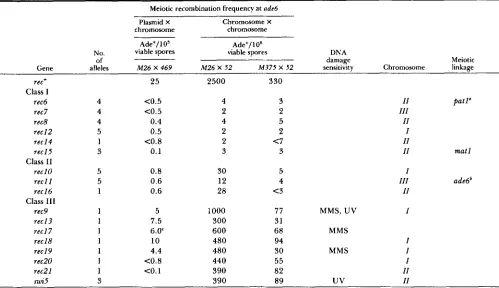
recJ2-rec2J the meiotic adc6 interchromosomal recombinant frequencies are the averages of the two experiments of Table 4. The chromosome assignments are Recombinant frequencies and DNA damage sensitivities for recb-reclJ have been reported previously (PONTICELLI and SMITH 1989). For re<+, swiZ and summarized from Table 6 (except for swi5). Information on the swi5 alleles was reported by GUTZ and SCHMIDT (1985) and KOHLI (1987). Other data were determined as described in MATERIALS AND METHODS. The number of alleles for each rec gene includes those reported previously (PONTICELLI and SMITH 1989).
P. SZANKASI, personal communication.
' ' PONTICELLI and SMITH (1989); tec-J 12 has been designated rec17-112. P. SZANKASI, A. S . PONTICELLI and G . R. SMITH (unpublished data).
strain was required to mate and sporulate, and the spores to germinate and grow well. Because mi5 mu- tations also affect mating-type switching (GUTZ and
SCHMIDT 1985), such mutations may not have passed
the requirement for self-mating imposed by the screen, and indeed none were isolated. Because of these requirements, there may be unidentified rec genes that have additional roles in other processes. Finally, only those mutations which affect plasmid-by- chromosome recombination would have been de- tected. Thus, mutations that affect only chromosome- by-chromosome interactions, such as pairing, would have been overlooked.
Dominant mutations were not analyzed further but represented approximately half of the initial candi- dates. PONTICELLI and SMITH (1 989) reported a dom- inant mutation, rec-101, which was not linked to ade6. From our analysis, it was clear that whereas some dominant mutations were additional mutations in the ade6 gene, others were not and may be of future interest.
Classes of mutants: PONTICELLI and SMITH (1 989)
placed rec6-recll into two classes based on their effect
260 L. C. DeVeaux, N. A. Hoagland and G. R. Smith We have defined three classes of rec mutants with
respect to their effects on the rec-dependent pathway. Class I mutants may be completely deficient for the rec-dependent pathway, but like all rec mutants they retain the basal pathway. Class I1 mutations strongly reduce the rec-dependent pathway but do not abolish it; recombination by this pathway is detectable only in the presence of the M26 hotspot. The use of the M26 hotspot in the screening of these mutants provided a means of distinguishing class I1 mutants from class I
mutants. Class I11 mutants are approximately 3-10- fold reduced for the rec-dependent pathway; in each mutant hotspot and non-hotspot recombination are equivalently reduced. T h e mutant phenotypes suggest that each class I, and possibly class 11, gene may be essential for recombination through the rec-depend- e n t pathway, whereas class I11 genes are not. We further infer that both hotspot and non-hotspot re- combination proceed by the rec-dependent pathway. We have assigned recl2, recl4 and recl5 to class I; mutations in these genes, as well as those in rec6, rec7 and rec8, all reduce ade6 hotspot recombinant fre- quencies approximately 1 000-fold. We have placed recl6 in class I1 with reclO and recll. We have reclas- sified rec9 to class 111, along with our remaining new mutations (recl3, recl7, recl8, recl9, rec20 and rec2l) and mi5 (Table
7).
We found the rec genes in each class to be distributed among the three chromosomes of S. pombe (Table 6). T h e meiotic mapping data for two class I genes, rec6 and recl5, show that, although mutations in the two genes have similar phenotypes and the genes are both located on chromosomeZI,
they are meiotically unlinked.
Since our screen used the M26 hotspot, we might have expected to recover a mutation specific for hot- spot recombination. All of the mutations tested af- fected both hotspot and non-hotspot recombination, although in some cases to different extents (Table 4). A hotspot-specific mutant might reduce hotspot re- combinant frequencies to those of non-hotspot recom- binant frequencies but not alter the latter. As dis- cussed above, mutations that decreased recombina- tion only 10-fold might not be as easily detected in this screen as those that more drastically reduced it, and thus the screen may be biased against recovery of such hotspot-specific mutants. Although we isolated seven class 111 mutants, only one allele of each gene was obtained, which supports our suggestion that the screen was not as effective at identifying such mutants. Alternatively, a hotspot-specific protein might also play an integral role in meiosis, such that a mutation in the gene encoding such a protein would be meiot- ically lethal, or the mutation might affect mitotic growth and have been overlooked. A third possibility is that such a protein might be involved in general recombination, so that a mutation would affect both
hotspot and non-hotspot recombination. A bacterial analog is the RecBCD enzyme, which recognizes the recombination-stimulating sequence Chi, but muta- tions in recB or recC reduce recombination in the absence as well as the presence of Chi (SMITH 1988). Thus, one of the rec genes we have identified may encode a hotspot-specific protein.
Effect of rec mutations on other recombination
events: We sought mutants deficient in chromosome-
by-chromosome recombination and used plasmid-by- chromosome recombination in the initial screen. For the most part, there is a good correlation between the degree of reduction of plasmid-by-chromosome re- combination and that of chromosome-by-chromosome recombination (Table
7).
This correlation indicates that the pathway for plasmid-by-chromosome recom- bination shares many components with the chromo- some-by-chromosome pathway. T o isolate the heter- othallic derivatives of each mutant, we scored chro- mosome-by-chromosome recombination. Thus, a mutant deficient only in plasmid-by-chromosome re- combination would not have been analyzed further. We did isolate 13 recessive mutants for which heter- othallic derivatives were not obtained. These mutants may be deficient only in plasmid-by-chromosome re- combination. Alternatively, their rec mutations may be tightly linked to either mat1 or ade6, making iso- lation of the desired derivatives difficult. Of these 13 mutants, 6 had plasmid-by-chromosome recombinant frequencies comparable to that of class I and class I1 mutants (data not shown); it may be fruitful to analyze these mutants further.We examined the effect of several of the rec muta- tions on meiotic recombination at intervals other than the ade6 locus (Table 5 ) . rec6, rec8 and rec9, described
by PONTICELLI and SMITH (1989), as well as recl2,
recl3 and recl4, were also tested for their effect on intragenic recombination at the ura4 locus and for intergenic recombination in the pro2-arg3 interval.
PONTICELLI and SMITH (1989) reported that for the
three rec genes tested the degree of reduction at the ura4 locus is not as great as that at ade6 when the ade6-M26 hotspot is involved. However, if ura4 re- combination is compared to non-hotspot recombina- tion at ade6, the degree of reduction is more nearly equal. In the case of the class I mutation (rec7} tested
by PONTICELLI and SMITH (1 989), both ura4 and ade6
non-hotspot recombination are reduced about 70- fold. For the class I mutations tested in this study (rec6, rec8, recl2 and recl4) no Ura+ recombinants were obtained; however, ura4 recombination was re- duced at least 10-fold. T h e two class I1 mutations (reclO and recll) tested by PONTICELLI and SMITH
S. pombe ret Genes 26 1
hotspot recombination is compared instead of hotspot. For the class 111 mutations analyzed here (rec9 and recl3), the reduction of recombination at the ura4
locus was comparable to the reduction at ade6. While the effect of these mutations on pro2-arg3 intergenic recombination was not as dramatic, there was still an effect by all the mutations, with the exception of rec8.
rec8 reduced ade6 intragenic recombination over 100- fold but had no significant effect on pro2-arg3 inter- genic recombination. For the other mutations the degree of reduction was similar to the degree of reduction of intragenic recombination; this finding supports the idea that these genes are involved in meiotic recombination throughout the genome.
We have considered four interpretations of the differential reductions in recombinant frequencies. First, some rec gene products may be required for intragenic recombination (presumably gene conver- sion) but not for intergenic recombination (presum- ably crossing over). T h e re& gene product, for ex- ample, may be required for gene conversion but not crossing over. CARPENTER (1987) and HASTINCS
(1988) have discussed evidence that conversion and crossing over occur by distinct mechanisms.
Second, some rec gene products may be required for correction of base mismatches that arise when hybrid DNA is formed at the site of a mutational difference between the parental strains; mismatches at one test interval may be sensitive to the action of a particular rec gene product and those at another not. T h e PMSl gene product of S. cerevisiae is required for correction of G/G mismatches but not of C/C
mismatches (BISHOP, ANDERSEN and KOLODNER
1989).
Third, a particular rec mutation may alter the length of hybrid DNA formed during recombination. For example, if ade6+ recombinants are formed primarily when hybrid DNA covers only one adeb allele, then longer hybrid DNA tracts would decrease the ade6+ recombinant frequency. If these tracts were shorter than the pro2-arg3 interval, then the proZarg3 recom- binant frequency would be scarcely affected. In this view, hybrid DNA might be longer in rec8 mutants.
Finally, some rec gene products might be more stringently required for recombination at one locus than at another. For example, the rec8 gene product may be required at ade6 and ura4 but not at pro2 or arg3. CATCHESIDE (1 977) has reviewed the properties of Neurospora crassa rec gene products, which repress recombination at some loci but not at others. T h e possible differential locus specificity of the S. @ombe rec gene products predicts, for example, that recom- bination of all adeb alleles, but not that of pro2 or arg3 alleles, would be reduced by the rec8 mutation.
Mitotic phenotypes: Several findings suggest that
mitotic and meiotic recombination and DNA repair
may utilize different pathways and enzymes. Of the mutants isolated by this screen, only rec9, recl7 and recl9 showed sensitivity to DNA-damaging agents. In the case of recl7 and recl9, that effect was slight. rec9- 104 does not significantly alter mitotic recombinant frequencies (N. HOLLINGSWORTH and K. L. LARSON,
personal communications). Conversely, the S. pombe recl gene affects mitotic, but not meiotic, recombi- nation (GOLDMAN and GUTZ 1974). Additional muta- tions altering mitotic but not meiotic recombination have recently been reported (GYSLER-JUNKER, BODI
and KOHLI 1991). Similarly, some S. cerevisiae rad
mutants are altered in mitotic but not meiotic recom- bination (KUNZ and HAYNES 198 1 ; ESPOSITO et al.
1984), and newly identified early meiotic rec muta- tions have no effect on mitotic recombination (MA- LONE et al. 1991). These observations support the hypothesis, discussed earlier, of a rec-dependent meiotic pathway and a rec-independent mitotic path- way.
In conclusion, the screen developed by PONTICELLI
and SMITH (1 989) has been used to isolate mutations
in 16 complementation groups affecting meiotic re- combination in
s.
pombe, bringing to 17 the number of genes thus far identified to be involved in meiotic recombination. Since the mutations most severely af- fecting recombination fall into a few groups with multiple alleles, we believe that we are nearing satu- ration for these types of mutations. Cloning the genes by complementation of the strong recombination-de- ficient phenotype should enable the construction of null mutations in these genes, and the determination of their nucleotide sequences will allow a physical analysis essential for understanding the role that each gene plays in meiotic recombination.We thank JURG KOHLI and GINGER ZAKIAN for strains of S.
pombe, FRED PONTICELLI for some of the mutagenized S. pombe
cells, KAREN LARSON for helpful genetic advice, PHILIPPE SZANKASI, ANDREW TAYLOR, SUSAN HOLBECK and SUE AMUNDSEN for com- ments on the manuscript, KAREN LARSON and NANCY HOLLING-
SWORTH for unpublished data, and KAREN BRIGHTON for sharing her word processing expertise. This work was supported by research grants GM31693 and GM32194 from the National Institutes of Health to G.R.S.
LITERATURE CITED
BISHOP, D. K.,J. ANDERsENand R. D. KOLODNER, 1989 Specificity of mismatch repair following transformation of Saccharomyces
cerevisiae with heteroduplex plasmid DNA. Proc. Natl. Acad. Sci. USA 8 6 3713-3717.
CARPENTER, A. T. C., 1987 Gene conversion, recombination nod- ules, and the initiation of meiotic synapsis. BioEssays 6:
232-236.
CATCHESIDE, D. G., 1977 The Genetics OfRecombination. University Park Press, Baltimore.
EGEL, R., 1984 T w o tightly linked silent cassettes in the mating- type region of Schizosaccharomyces pombe. Curr. Genet. 8: