1
A low-cost approach using diatomaceous earth biosorbent as alternative SPME
coating for the determination of PAHs in water samples by GC-MS
Naysla Paulo Reinert1, Camila M. S. Vieira1, Cristian Berto da Silveira2, Dilma Budziak3,
Eduardo Carasek1,*
1Departamento de Química, Universidade Federal de Santa Catarina, Florianópolis
88040-900, SC, Brazil.
2Universidade do Estado de Santa Catarina, Departamento de Solos e Recursos Naturais,
Lages, Santa Catarina, Brazil, 88509-900.
3Departamento de Agronomia, Universidade Federal de Santa Catarina, Curitibanos
89520-000, SC, Brazil.
*Corresponding Author (E. Carasek). E-mail address: [email protected]
Keywords: solid-phase microextraction; biosorbent, diatomaceous earth, polycyclic aromatic hydrocarbons; water samples.
2
Abstract
In this study, the use of recycled diatomaceous earth as the extraction phase in a the solid phase microextraction (SPME) technique for the determination of polycyclic aromatic hydrocarbons (PAHs) in river water samples, with separation/detection performed by gas chromatography-mass spectrometry (GC-MS), is proposed. The optimized extraction conditions are extraction time 70 min at 80 ºC with no addition of salt. The limits of quantification were close to 0.5 μg L-1 with RSD values lower than
25% (n = 3). The linear working range was 0.5 μg L-1 to 25 μg L-1 for all analytes. The
method was applied to samples collected from the Itajaí River (Santa Catarina, Brazil) and the RSD values for repeatability and reproducibility were lower than 15% and 17%, respectively. The efficiency of the recycled diatomaceous earth fiber was compared with that of commercial fibers and good results were obtained, confirming that this is a promising option for use as the extraction phase in SPME.
3
1 Introduction
Water is an extremely valuable natural resource as it is responsible for maintaining biological, geological and chemical cycles [1,2]. Environmental problems caused by anthropogenic activities are continually increasing and gaining attention worldwide [1]. With population growth and increased industrial activities, ever greater amounts of petroleum-based fossil fuels are being consumed [3]. These fuels contain a class of compounds known as polycyclic aromatic hydrocarbons (PAHs).
PAHs are a group of organic compounds composed of multiple aromatic rings [4]. The formation of these molecules is associated with the incomplete combustion of natural organic materials, for instance, due to volcanoes or the incomplete burning of wood in forest fires, and from anthropogenic sources including industrial processes (e.g., refineries), vehicular emissions [5], cane burning [6], and others [7]. According to the International Agency for Research on Cancer (IARC) and the US EPA (the United States Environmental Protection Agency) PAHs are recognized as persistent environmental pollutants with carcinogenic and mutagenic capacity in humans [7,8]. Based on these issues, measures have been taken by governments around the world to monitor the concentrations of compounds that may be harmful to human health, with different standards and regulations being established often aimed at ensuring the quality of drinking water [7].
The determination of these pollutants generally requires a sample preparation procedure to remove matrix interferents, concentrate the analyte and make the extract compatible with the analytical instrumentation. One of the most commonly used sample preparation techniques is solid-phase microextraction (SPME) [9,10].
4 and solid-liquid extraction [9,10]. This technique is based on the distribution of the analytes between the sample matrix and the extraction phase (fiber), combining sampling, isolation and enrichment in a single step [11,12]. SPME fibers consist of a fused silica or metallic support coated with a polymeric material, for instance, polymethylsiloxane (PDMS), polyacrylate (PA), or other commercially available sorbent [13-16].
In the search for new sorbent materials for SPME, biosorbents have gained prominence in miniaturized techniques because they provide greener, less expensive, renewable and biodegradable extractive phases. Many of these biosorbents can be found in the environment and are formed by macromolecules containing various functional groups that are available to interact with different types of contaminants. Our research group has previously used natural sorbents for the determination of organic contaminants using SPME [17,18]. Diatomaceous earth is of particular interest as a new biosorbent since it is discarded in large scale as a waste from breweries, where it is used for the clarification and filtration of organic materials and beers [19].
Diatomaceous earth is obtained from sedimentary rocks, originating from fossilized algae belonging to the class Bacillariophyta (diatoms). It is an amorphous mineral, comprised mainly of silica dioxide, of light weight and low molar mass, and its coloration can vary from white to gray. Structurally, diatoms have a hollow cylindrical form of low density and high surface area [20].
5
2 Materials and methods
2.1 Reagents and Materials
Analytical standards of PAHs in a mixture containing acenaphthylene, fluorene, phenanthrene, anthracene, pyrene, benzo(a)anthracene, chrysene, benzo(b)fluoranthene, benzo(k)fluoranthene, benzo(a)pyrene (Bellefonte, PA, USA) were used to prepare stock solutions of 1 mg L-1 in acetonitrile obtained from J.T. Baker (Mallinckrodt, NJ, USA).
The salting-out effect was studied using sodium chloride obtained from Synth (SP, Brazil). The ultrapure water used in the experiments was purified in an ultrapure Mega purity system (Billerica, USA). A granulometric sieve (200 mesh), nitinol wires (2 cm length and 0.128 mm diameter), epoxy glue (Brascola, SP, Brazil), and a heating block (Dist, SC, Brazil) were used for the preparation of the fiber. A thermostatic bath (Lab Companion RW 0525G, Seoul, Korea), magnetic stirrers (Dist, SC, Brazil) and 40 mL vials (Supelco, PA, USA) were used for the SPME extractions. Commercial fibers (DVB/Car/PDMS, 50/30 µm; PDMS 100 µm and PDMS/DVB, 65 µm; Supelco, PA, USA) were used to compare the analyte extraction efficiencies.
2.2 Instrumental and chromatographic conditions
6 the columns were the same used for the GC-MS and GC-FID. The injection was performed in splitless mode, the injector temperature was set at 260 °C and the desorption time was 15 min. The initial oven temperature was 80 °C (1 min) and this was subsequently increased at 6 °C min-1 to 300 °C (10 min). For the GC-MS, the transfer line
and the ion source temperatures were set at 280 and 250 °C, respectively. Helium was used as the carrier gas at a flow rate of 1.0 mL min-1. The mass spectrometer was operated
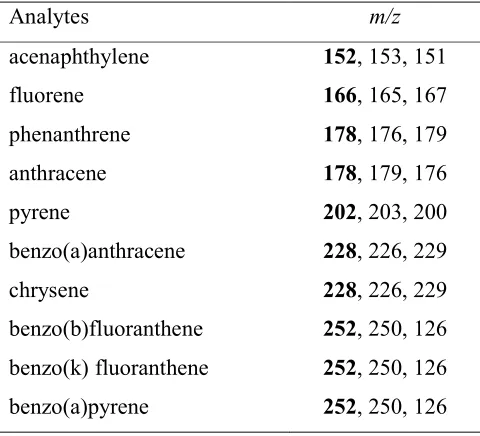
in electron impact ionization (EI) mode at 70 eV. The PAHs were determined in selected ion monitoring (SIM) mode and the mass/charge (m/z) ratios employed are shown in Table 1. The m/z values in bold were used for the quantitative determination of the analytes.
Table 1. The m/z values used for the determination of PAHs by GC-MS (values in bold were used for the quantification of the analytes).
Analytes m/z
acenaphthylene 152, 153, 151
fluorene 166, 165, 167
phenanthrene 178, 176, 179
anthracene 178, 179, 176
pyrene 202, 203, 200
benzo(a)anthracene 228, 226, 229
chrysene 228, 226, 229
benzo(b)fluoranthene 252, 250, 126 benzo(k) fluoranthene 252, 250, 126
benzo(a)pyrene 252, 250, 126
2.4 Preparation of diatomaceous earth fibers
7 Due to its high porosity, the material presents a high degree of saturation with organic matter from the treatment of beer. Thus, a heat treatment is required [20], not only to eliminate the residues originating from the beer filtration but to ensure that all of the organic matter adhered to the material is removed. The diatomaceous earth, after the thermal treatment, was sieved to obtain homogeneous particle size (< 200 mesh). The diatomaceous earth was then immobilized, using epoxy glue, on a nitinol wire with 2 cm length and 0.128 mm thickness. In the next step, the nitinol covered with biosorbent was inserted into the heating block at 180 ºC for 90 min. The fiber was then conditioned at 240 ºC for 90 min in a GC injection port. The fiber lifetime was verified during the study by comparing the responses of the chromatographic areas of the analytes to the optimum extraction condition at a concentration of 5 μg L-1. Fibers were used while the extraction
efficiency did not present a reduction greater than 10%.
2.5 Optimization of SPME procedure
A multivariate approach was adopted to optimize the extraction conditions for the proposed analytical method using the diatomaceous earth fiber. A central composite design, totalizing 11 experiments, including a triplicate at the central point was carried out. In the optimization strategy the extraction temperature ranged from 30 to 80 °C and the extraction time from 30 to 117 min. The sodium chloride concentration (0-20% m/v) was also evaluated, but in the univariate form. The SPME was performed in direct-immersion mode (DI-SPME). In this case, 25 mL of water sample spiked with each PAH studied, at a concentration of 100 μg L-1, was transferred to a 40 mL vial and kept under
8 response surface, the geometric mean of the areas of the chromatographic peaks obtained in each extraction using Statistica 8.0 software (Statsoft, USA) was used.
2.6 Comparison of the extraction efficiencies using diatomaceous earth and commercial
fibers
After the optimization of the analytical procedure, the diatomaceous earth was compared to commercial fibers (PDMS and PDMS/DVB) in terms of their efficiency in the extraction of the PAHs studied. An aliquot (25 mL) of the ultrapure water spiked with the analytes at a concentration of 5 µg L-1 was transferred to a 40 mL vial and subjected
to extraction using one of the fibers at 80 °C for 70 min. The chromatographic analysis was performed by GC-MS.
2.7 Analytical figures of merit and application of the method developed
The calibration curves for river water spiked directly with five concentrations of each analyte (0.5-25.0 μg L-1) were obtained by plotting the peak area versus the
concentration of analytes, in triplicate. The linear coefficient of determination (R2) was
calculated based on the calibration curves. The limits of quantification (LOQs) corresponded to the lowest concentration on the analytical curve that could be quantitatively measured with acceptable precision and accuracy (< 20). The limits of detection (LODs) were obtained dividing the LOQ by 3.3. The precision and accuracy of the method were evaluated by performing extractions using real water samples spiked with the analytes at 0.5 μg L-1. Precision was calculated as the relative standard deviation
9
3 Results and Discussion
3.1 Characterization of the diatomaceous fiber
The diatomaceous earth samples used for the production of SPME fibers belong to the class Bacillariophyceae Centricae and their color may vary from white to gray. The material consists mainly of silica, SiO2 (87-91%), alumina and ferric oxide [21].
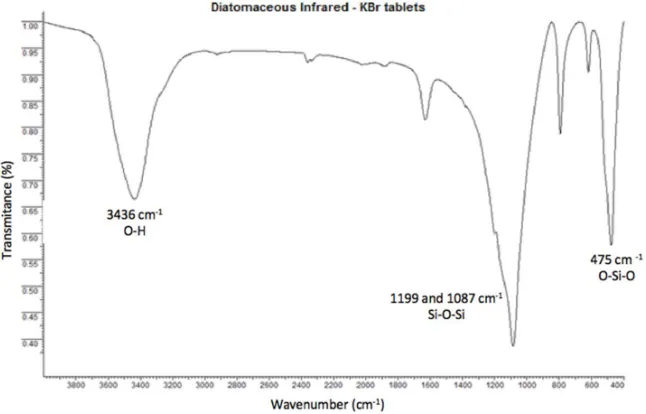
Scanning electron microscopy (SEM) was performed to characterize the surface morphology of the proposed sorbent coating. The images obtained at magnifications of 2000 and 4000x for the surface evaluation are shown in Fig 1 (A and B, respectively). An image of a cross-section of the proposed fiber was obtained at a magnification of 100x (Fig 1 C). According to the SEM results, the morphology of the material shows a high porosity which facilitated the physical processes involving the sorption of the analytes. FTIR spectroscopy was carried out to identify the functional groups in the material. Figure 2 shows the FTIR spectrum obtained from the biosorbent previously conditioned at 240 ºC. A broad peak at ~ 3400 cm-1 corresponds to the O-H bonds of
silanol groups. Two intense peaks between ~ 1200 and 1080 cm-1 were assigned to the
asymmetric stretching of the Si-O-Si siloxane groups and one at ~ 790 cm-1 is related to
the Si-O-Si vibrations attributed to mesoporous silicas. At ~ 475 cm-1, a peak related to
O-Si-O vibration was present. Lastly, the peak at ~ 1600 cm-1 refers to the angular
deformation of the adsorbed water molecules.
10
Figure 1. SEM micrographs obtained with the biosorbent fiber at magnifications of (A) 2000x and (B) 4000x and a cross-section of the proposed fiber (C) at a magnification of 100x.
11
3.2 Optimization of DI-SPME extraction procedure
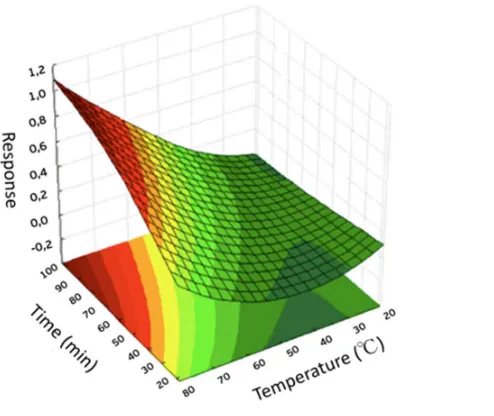
The SPME parameters that can influence the extraction of the PAHs were optimized using the diatomaceous earth fiber. The geometric means of the chromatographic peak areas corresponding to the analytes were used as the response for the experimental planning. The data obtained from the chromatograms were evaluated using the software Statistica 8.0. The response surfaces obtained for the biosorbent fiber are shown in Figure 3.
Figure 3. Response surface obtained for the optimization of DI-SPME procedure using biosorbent fiber (diatomaceous earth).
12
3.3 Comparison between the extraction efficiencies of the biosorbent and commercial
coatings.
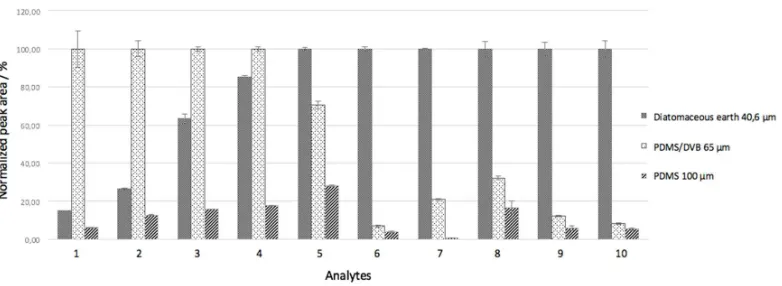
The extraction efficiencies were compared using the proposed fiber and commercial fibers (PDMS/DVB and PDMS). The conditions for the extractions were based on those mentioned in the literature (extractions of 70 min at 80 ºC) [22-24]. A bar graph of the normalized peak area, taking into account the film thickness of each fiber, is shown in Figure 4.
Figure 4. Comparison of extraction efficiencies of the biosorbent fiber, PDMS/DVB and PDMS coatings for determination of PAHs. Analytes: (1) acenaphtlylene; (2) fluorene; (3) phananthrene; (4) anthracene; (5) pyrene; (6) benzo(a)anthracene; (7) chrysene; (8) benzo(b)fluoranthene; (9) benzo(k)fluoranthene; (10) benzo(a)purene.
13 In addition, reproducibility studies using two diatomaceous earth fibers were performed and the results showed no significant variation (data not shown). The repeatability obtained with the fibers was evaluated comparing the results of the first extraction with those obtained after 15 extractions using the same fiber (data not shown). It was verified that there was no significant loss of extraction efficiency, confirming that the fiber produced with the biosorbent material can be used at least 15 times.
These results verify the high potential for the use of the diatomaceous earth fiber as a sorbent phase for SPME. Moreover, diatomaceous earth is biodegradable, natural and renewable. In addition, its chemical composition provides numerous possibilities of chemical interaction with a wide range of compounds. Diatomaceous earth is a highly porous material, which facilitates the extraction of the analytes through a physical process. In addition, it contains compounds such as cellulose and lignin, with a number of aromatic moieties and, therefore, π-π interactions allow the efficient extraction of PAHs.
3.4 Validation parameters
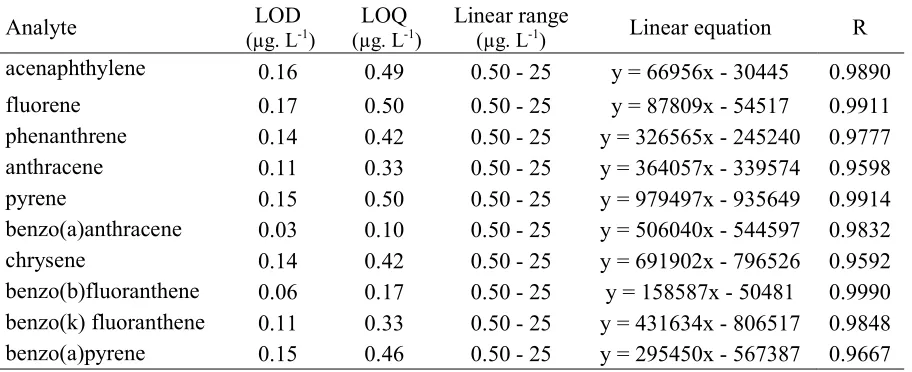
The analytical figures of merit obtained in this study can be seen in Table 2. The linear coefficient of determination (R2) values were > 0.95, which indicates a good linear
fit. The LOD and LOQ values were satisfactory based on those obtained in other studies. Precision was evaluated in terms of intra-day repeatability (n = 3) and inter-day reproducibility (n = 9) using samples spiked at the lower level. The results obtained are shown in Table 3. It can be observed that the intra-day and inter-day precision for diatomaceous earth fiber presented values of RSD < 15% and < 17%, respectively.
14 Analyte (µg. LLOD -1) (µg. LLOQ -1) Linear range (µg. L-1) Linear equation R
acenaphthylene 0.16 0.49 0.50 - 25 y = 66956x - 30445 0.9890
fluorene 0.17 0.50 0.50 - 25 y = 87809x - 54517 0.9911
phenanthrene 0.14 0.42 0.50 - 25 y = 326565x - 245240 0.9777 anthracene 0.11 0.33 0.50 - 25 y = 364057x - 339574 0.9598
pyrene 0.15 0.50 0.50 - 25 y = 979497x - 935649 0.9914
benzo(a)anthracene 0.03 0.10 0.50 - 25 y = 506040x - 544597 0.9832
chrysene 0.14 0.42 0.50 - 25 y = 691902x - 796526 0.9592
benzo(b)fluoranthene 0.06 0.17 0.50 - 25 y = 158587x - 50481 0.9990 benzo(k) fluoranthene 0.11 0.33 0.50 - 25 y = 431634x - 806517 0.9848 benzo(a)pyrene 0.15 0.46 0.50 - 25 y = 295450x - 567387 0.9667
The selectivity of the proposed method was confirmed through the chromatographic analysis of the extract obtained from the river water sample without the addition of the analytes. No peaks appeared at the retention times of the target analytes, except for pyrene, chrysene and benzo(a)pyrene, but these peaks were not quantifiable. Figure 5 shows the chromatograms obtained for samples of spiked river water (10 μg L -1) and non-spiked river water.
15 fluorene; (3) phananthrene; (4) anthracene; (5) pyrene; (6) benzo(a)anthracene; (7) chrysene; (8) benzo(b)fluoranthene; (9) benzo(k)fluoranthene; (10) benzo(a)pyrene.
4 Conclusions
In this study, the use of a natural sorbent as a SPME fiber provided promising results in comparison to widely used commercial fibers. The preparation of the biosorbent fiber is simple and the material can be reused several times. The separation and detection of the analytes by GC-MS is effective and it is possible to determine a working range in accordance with current Brazilian legislation. The proposed method achieved good results for linearity, LOD, LOQ, recovery and precision, particularly using the biosorbents. The method is of low cost, because the natural sorbent can be reused in numerous extractions and is widely applicable because the material its easily obtainable.
16
Funding: Conselho Nacional de Desenvolvimento Científico e Tecnológico (CNPq), process number 303892/2014-5. Coordenação de Aperfeiçoamento de Pessoal de Nível Superior - Brasil (CAPES) - Finance Code 001”
Acknowledgements
The authors are grateful to the Brazilian governmental agency “Conselho Nacional de Desenvolvimento Científico e Tecnológico (CNPq) and Coordenação de Aperfeiçoamento de Pessoal de Nível Superior” for the financial support which made this research possible.
Conflict of interest: The authors declare no conflict of interest.
References
1. Benson, R.; Conerly, O. D.; Sander, W.; Batt, A. L.; Boone, J. S.; Furlong, E. T.; Glassmeyer, S. T.; Kolpin, D. W.; Mash, H. E.; Shenck, K. M., Simmons, J. E. Human health screening and public health significance of contaminants of emerging concern detected in public water supplies. Sci. Total Environ.2017, 579, 1643-1648.
2. Pal, A.; He, Y.; Jakel, M.; Reinhard, M.; Gin, K. Y. Emerging contaminants of public health significance as water quality indicator compounds in the urban water cycle.
Environ. Int. 2014, 71, 46-62.
3. Heleno, F. F.; Lima, A. C. Evaluation of analytical methods for BTEX analysis in water using extraction by headspace (HS) and solid phase microextraction (SPME), Quim. N.
17 4. Hong, W. F.; Jia, H.; Li, Y. F. Polycyclic aromatic hydrocarbons (PAHs) and alkylated PAHs in the coastal seawater, surface sediment and oyster from Dalian, Northeast China.
Ecotox. Environ. Safe.2016, 128, 11-20.
5. Slezakva, K.; Castro, D.; Delerue-Matos, C. Impact of vehicular traffic emissions on particulate-bound PAHs: Levels and associated health risks. Atmospheric Res.2013, 127, 141-147.
6. Cristale, J.; Silva, F. S.; Zocolo, G. J.; Marchi, M. R. R. Influence of sugarcane burning on indoor/outdoor PAH air pollution in Brazil. Environ. Pollut. 2012, 169, 210-216.
7. Dat, N. D.; Chang. M. B. Review on characteristics of PAHs in atmosphere, anthropogenic sources and control technologies. Sci. Total Environ. 2017,31, 682-693.
8. Siritham, C.; Thammakhet-Buranacha, C. A preconcentrator-separator two-in-one online system for polycyclic aromatic hydrocarbons analysis. Talanta. 2017, 15, 573-582.
9.[4] Li, Z.; Ma, R.; Bai, S.; Wang, C.; Wang, Z. A solid phase microextraction fiber coated with graphene-poly9ethylene glycol) composite for the extraction of volatile aromatic compounds from water samples. Talanta.2014, 119, 498-504.
18 11. Lord, H.; Pawliszyn, J. Evolution of solid-phase microextraction technology. J
Chromatogr A. 2000, 885, 153-93.
12. Dias, A. N.; Simão, V.; Merib, J.; Carasek, E. Cork as a new (green) coating for solid-phase microextraction: Determination of polycyclic aromatic hydrocarbons in water samples by gas chromatography-mass spectrometry.Anal. Chim. Acta. 2013, 772, 33-39.
13. Carasek, E.; Merib, J. Membrane-based microextraction techniques in analytical chemistry: A review.Anal. Chim. Acta. 2015, 23, 8-25.
14. Pawliszyn, J. Handbook of Solid Phase Microextraction, Beijing: Chem. Ind. Press,
2009.
15. Tsao, Y. U.; Wang, Y. C.; Wu, S. F.; Ding, W. H. Microwave-assisted headspace solid-phase microextraction for the rapid determination of organophosphate esters in aqueous samples by gas chromatography-mass spectrometry. Talanta, 2011, 84, 406-410.
16. Ahmadi, M.; Elmongy, H.; Madrakian, T.; Abdel-Rehim, M. Nanomaterials as sorbents for sample preparation in bioanalysis: A review. Anal Chim Acta. 2017, 15 ,1-21.
19 18. Suterio, N. G.; do Carmo, S. N.; Budziak, D.; Merib, J.; Carasek, E. Use of a Natural Sorbent as Alternative Solid-Phase Microextraction Coating for the Determination of Polycyclic Aromatic Hydrocarbons in Water Samples by Gas Chromatography-Mass Spectrometry. J. Braz. Chem. Soc., 2018, 00, 1-9.
19. Silveira, C. B.; Goulart, M. R.; Methodologies for the reuse of the diatomaceous earth residue, from filtration and clarification of beer. Quim. Nova, 2011, 34, 625-629.
20. Souza, G. P.; Filgueira, M. Characterization of natural diatomaceous composite material. Ceramica, 2003, 49, 40-43.
21. Kirk-Othmer Encyclopedia of Chemical Technology, in: Wiley (Ed.) Kirk-Othmer
Encyclopedia of Chemical Technology, New York, 1993, 108.
22. Menezes, H. C.; Paulo, B. P.; Paiva, M. J. N.; Barcelos, S. M. R.; Macedo, D. F. D.; Cardeal, Z. L. Determination of polycyclic aromatic hydrocarbons in artisanal cachaça by DI-CF-SPME–GC/MS. Microchem. J. 2015, 118, 272-277.
23. Aguinaga, N.; Campillo, N.; Vinas, P.; Hernández-Córdoba, M. Determination of 16 polycyclic aromatic hydrocarbons in milk and related products using solid-phase microextraction coupled to gas chromatography–mass spectrometry. Anal. Chim. Acta.