Abstract
Acknowledgements
This thesis has eaten selfishly into the lives of those I hold dear, and I shall always remember that they have neither deserted me nor resented my preoccupation and absences, both literal and metaphorical. They are many to name, and I doubt they would wish the publicity, but they are all between the lines of what I shall ever write.
My colleagues at the Institute of Education have had to bear with an increasingly harassed and impatient bundle of nervous exhaustion, at a time when their own energies are stretched to breaking point in the current policy and resources climate. Diana Leonard, Janet Maw and Charles Posner have each, in their own inimitable ways, been enormously supportive. There are also those colleagues beyond the Institute for whom I have considerable respect, and who have each, in different ways, given me confidence to continue this work: Wilfried Breyvogel, Helga Kruger, David Jenkins, Dieter Renz and Valerie Walkerdine. I would like to record my thanks to the GAOC team, too, for the energies they invested in the project : Shane Blackman, Tuula Gordon, Janet Holland and Jean McNeiL Finally, Steve Huston's skilled work on the typescript and tables has relieved me of many hours in front of the screen, for which I am very thankfuL The Post-Sixteen Education Centre was, as ever, generous with its excellent computer resources. Michael Klenke's graphics studio provided the last waltz.
Paul Atkinson has written* of Basil Bernstein as dogged by a Doppelgtinger: the demon of a mythology which embraces his work and his person. As mentor and critic, Basil Bernstein is frequently demonic and his input anything but mythologi-cal, as those of us who have had the good fortune of his supervision know to our benefit. His intellectual and personal generosity are not, however, honoured as they should be. He takes a serious delight in other people's interesting ideas, to which he brings a formidable critical acumen and an admirable commitment to a job of work I owe him an eternal debt of gratitude, and not only for his supervision of an awkward customer. A figure of Basil Bernstein's stature has no need of my underwriting of his qualities, but I had need of his underwriting of mine. I hope he will think that the investment was worth it.
Contents
Prolegomena Introduction
1 Restructuring the weft: a selective review
1.1 The division of labour by sex: sociohistorical perspectives
1.2 Gender, skills and vocation
1.3 Girls and transitions: choices and circumstances
2 The modalities of gender relations: a general model 2.1 Perspectives and life-plans
2.2 The nature of the model
2.3 Cultural semantics, gender locations and dynamics 2.3.1 The field of femininity and its
occupational translations
2.3.2 Gender locations: an initial classification 2.3.2.1 Gender locations: a brief discussion 2.3.3 The dynamics of the 'gendered career' 2.4 Concluding remarks
3 The sample: social and educational context 3.1 Research design and sampling 3.2 The schools: brief portraits
3.2.1 Wilhelma 3.2.2 Dame's Trust 3.2.3 Sternrise 3.3 The girls' parents
3.3.1 Parents' jobs 3.3.2 Discussion
3.4 Siblings: occupations and school-work transitions 3.4.1 Education and training beyond 16
4 The modalities of gender relations: an empirical 129 exploration
4.1 The analysis of the interview data 130
4.2 Gender locations: case studies 137
4.2.1 Non-transforming positions 138
4.2.2 Potentially transforming positions 142
4.2.3 Transitional locations 150
4.2.4 Non-transforming resolutions 155
4.2.5 Intersections between gender, ethnicity 157
and class
4.3 Gender locations: pattern types 161
4.3.1 Social origins and locations 162
4.3.2 Resources and role models 164
4.3.3 Understandings of the social world 166
4.3.3.1 The division of labour by sex 168
4.3.3.2 Awareness and consciousness of 171
gender divisions
4.3.4 Educational-occupational realisations 174
4.4 Gender divisions and emancipatory change 177
5 Perspectives, aspirations and expectations: 185
occupational worlds and gendered futures
5.1 The sample and the data 185
5.2 Occupational worlds 187
5.2.1 The joblists as data 188
5.2.2 Perceptions of occupational structure 190
5.3 Gendered futures 199
5.3.1 Job aspirations and expectations: the 199
survey data
5.3.2 Job aspirations and expectations over 206
time: the interview data
6 Gender and the management of transitions
6.1 Unfolding transitions: patterns and trajectories 6.2 Vulnerable transitions: case studies
6.2.1 Discussion
6.3 Endangered transitions: case studies 6.3.1 Discussion
6.4 Promising transitions: case studies 6.4.1 Discussion
6.5 Well-managed transitions: case studies 6.5.1 Discussion
6.6 Unfolding transitions: concluding commentary
Conclusions
Appendices
I Perspectives on occupational choice: a brief note II The interview sample: aliases and case numbers
m
The interview schedule and the interviewing contextIV The survey instruments
V The working universe of occupations
VI A map of girls' aspirations
VII Episode cards: an exemplar set
Prolegomena
Anatomieren magst du die Sprache, doch nur ihr Kadaver; Geist und Leben entschlUpft fliichtig dem groben Skalpell. (You may well be able to dissect the language, but only its corpse;
Life and soul fleet before the crude scalpeL) Goethe, Xenien, 1796
Are the terms occupation, career and vocation effective synonyms for each other, their practiced interchangeability in everyday usage meaningless? In seeking to comprehend the realities and meanings of young adolescent girls' biographies, I found myself continually irritated by a common elision of terms applied within the complex of education-employment transitions. It was this nagging irritation which ultimately shaped the form of this thesis, turning it into an exploration of the contextualisationof girls' occupational choices within patterns of social and cultural reproduction. The view taken here is that understanding occupational choice processes and gender is material to an understanding of the processes of social and cultural reproduction, both in a purely theoretical sense and as an exemplar of the ways people must actively come to terms with structural and ideological constraints and possibilities.
Introduction
Neither the facts of women's disadvantaged labour market position, nor the general
view that gender inequalities are linked with a dual oppression of women both in the family and in employment, are in dispute. Beyond such very general statements, however, there lies considerable disagreement about the precise nature and signif-icance of these linkages for processes of social and cui tural reproduction and change. Unidimensional explanations are clearly insufficient, but most writers concur that occupational segregation by sex represents a key link in the reproduction of gender inequalities. Consequently, since the mid-seventies research and policy energy has been invested into trying to sever that link by attempting to manipulate educational and occupational choices and destinations. Not surprisingly, much agitated debate has ensued about what such attempts imply, particularly since evidence of 'success' has to date been quantitatively meagre. We might have expected research attention to turn to more detailed study of gendered patterns of occupational choice in order to reach a better understanding of reproduction processes at a context-specific level. This has not noticeably taken place.
occupational aspirations and expectations are but interim and relatively unproblem-atic indicators of those processes actually occurring (or not, as the case may be). It
is as if the matter of occupational choice evades our grasp, and this must, in some way, reflect the enormously significant dividing line which is drawn between education and work: occupational choice sits on the interface, straddles the chasm. Fundamentally, the study of occupational choice is a marginal endeavour- institut-ionally, culturally, and within sociological analysis.
explicitly feminist analyses of women's work, this more recent literature (which is selectively reviewed in Chapter 1) offers a broader empirical and more sophisticated analytical base from which to regenerate theoretical perspectives on occupational choice.
All studies dealing with girls and adolescent transitions attest with varying degrees of frustration that the occupations to which girls overtly aspire are narrow and stereotypical in range. The more insightful writers distinguish between childhood and adolescence, showing how the realities of gender divisions and the labour market impact increasingly negatively on girls' expectations. Girls gradually narrow down both their aspirations and their expectations into gender-appropriate categor-ies, on the basis of realistic observations and actual experiences. Explanations which effectively blame the victims are prima facie unsatisfactory, but it remains the case that a very few occupations persistently dominate the expressions of the consequen-ces of these channelling processes. This suggests, inter alia, that such occupations are symbolically heavily redolent. What do these occupations symbolise? What role might they play in the social reproduction of gender relations as repositories of cultural meaning sets?
both to the experiences of adult women in their communities and to the information or advice they are offered.
There are a number of perfectly objective labour market and employer-related reasons why girls are crowded into a narrow range of occupational spaces. The strength of these magnets in girls' voiced aspirations (i.e. what they generally state they 'want to be') nevertheless requires some independent sociological explanation at a more sophisticated level than simple reference to sex-role socialisation and normative behaviour. Explanations of occupational choice have satisfied them-selves too readily with outcomes rather than processes; they have paid too little attention to the multi-dimensionality of the social distribution of chances. What are the alternatives actually available to girls living and growing up in particular social and cultural circumstances? How do they come to terms with the fact that available resolutions to the dilemmas of gendered transitions are objectively limited and largely accommodative? Where potentially transforming resolutions are available and provisionally adopted, how do such girls 'maintain the line' of resistance? It is this set of problems that I am here concerned to pursue.
immedi-ately expands alarmingly. Thirdly, this thesis did not begin as a blank slate, but rather represents a stage in the development of my thinking across a number of years and a range of research activity. Both of these factors led naturally to a selection from a wide range of possibilities in relation to an existing line of inquiry. Chapter 1 has, therefore, four sections, which consecutively build a basis for the plausibility of the theoretical approach taken in this thesis. The first section takes up the discussion by reflecting upon what socio-historical studies of the social division of labour can tell us about the interplay between gender, class, production and reproduction in western European social structure and tradition. The second section focuses upon a core issue arising from that initial discussion- the relationships between gender, skills and the concept of vocation. In the third section, attention turns to recent studies of the culture of femininity in adolescence and their implications for gendered occupational choice processes. Finally, the last section reviews those few contemporary studies which have specifically or indirectly addressed themselves to the question of gendered youth transitions in a holistic manner.
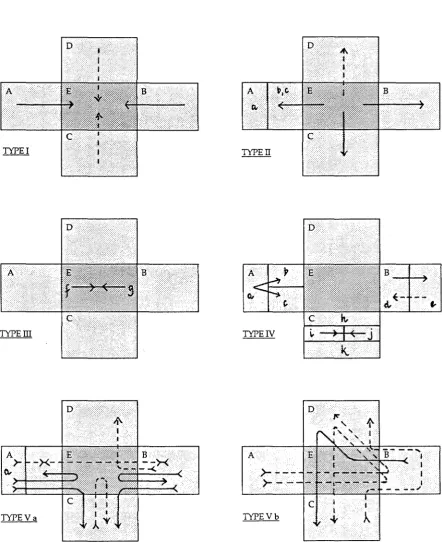
processes of occupational choice for boys, though its axes and dynamics would certainly be dissimilar from those which apply for girls. This thesis is centrally concerned with the exploration of a model, an approach towards studying gendered youth transitions which developed in an interactive process between theory form-ation and empirical analysis. It began with a deep irritation at the way in which available models of occupational'choice' (or, occupational'placernent') and studies of adolescent girls in transition simply did not 'speak' to each other. In this sense, the thesis aims not to 'prove' a set of tenets, but rather to establish a way of speaking about occupational choice that makes sociological sense.
Chapters 3 to 6 inclusive present the empirical analysis and findings. Data drawn from the Girls and Occupational Choice (GAOC) projectm, a cross-sectional and longitudinal study of predominantly working-class and female pupils in Greater London and aged 11-16 between 1983-86, are used to investigate occupational choice processes within the frarnewor k of gendered transitions. Two sources of rna terial are included : questionnaire survey data in quantitative form, and in-depth semi-structured interview data in qualitative form. The quantitative data provide an aggregate description of the ways in which girls perceive and understand the occupational structure and the labour market, both in general terms and as access-ible to them and their communities. The relative emphasis lies, however, in the use of the qualitative data. These serve the purpose of mapping and tracing locations and trajectories adopted and pursued by respondents in their construction of a transition biography across the secondary schooling years.
contexts are then described by an analysis of parental employment and occupations, and of the experiences of elder siblings in their transitions to employment and adult life. Chapter 4 uses the interview material to explore and illustrate the typology of gender locations (as presented in Chapter 2). It opens with a description of the principles and method of analysis developed for this dataset. As realised through specialised locations which are contingent upon recognisable features of girls' social worlds and their interpretations of these, the modalities of gender relations are empirically mapped and then illustrated with case-studies. The analysis is drawn together firstly, by considering the intersections between gender, ethnicity and class as experienced by the girls in this study and, secondly, by identifying production/ reproduction relations as the key axis in understanding gender divisions. Chapter 5 widens and changes the empirical base by looking at girls' aspirations and expect-ations in the light of their perspectives of occupational structure, (primarily) using survey data separately collected in the schools and forms from which the interview sample was drawn. Chapter 6 returns to the interview data, this time that arising from a three-stage sequence of interviews conducted between 1984 and 1986 for a sub-sample of girls in two age-groups. Its purpose is to identify and trace different kinds of gendered trajectories as these unfold either in the three years leading up to school subject specialisation or in the two years that follow, the last phase of compulsory schooling.
struct-ured contradictions that operate at the very interface of two major arenas of social and cultural reproduction: education and work. This interface simply has to act as a nervecentre, a site which combines both the strength and the vulnerability of the structures and processes of that reproduction. At the same time, placing gender at the centre of attention forces us to consider how interactive principles of social division work together through youth transitions to (largely) ensure reproduction rather than transformation.
potentially transforming power of breaking occupational segregation by sex is contained, in tandem, by the ideological power of the culture of sacrificial femininity and by the material structures of capitalist patriarchy. In the struggles that young women face at the intersection of education and work, most remain trapped in their vocation. They become 'women'- and in so doing, ensure the social reproduction of gender relations.
Footnotes
1 The GACX:: project was funded between 1983 and 1988 by the SSRC/ESRC (personal research grants
F00232036, FD0232203) with additional support from the ECX::, from the ILEA Equal Opportunities Unit, and
from the University of London Institute of Education Research Fund. The writer was the grant holder and
principal investigator; those working with the project included, for varying periods and in a range of capacities,
Francis Bernstein, Shane Blackman, Tuula Gordon, Mary Hickman, Janet Holland, Celia Jenkins, Jean McNeil,
and numbers of teachers in the project schools (who perforce must remain anonymous to preserve the
1
Restructuring the weft: a selective reviewOccupational choice theories were framed for men. The pivotal notion is that individuals have free rein to foiiowtheir inclinations. The theories do not recognise the major limitations placed on women by their early socialisation and by sex-structuring of the labour force, with the result that women perceive only a narrow range of alternatives. (An grist and Almquist, 1975, pp.144-5)
This succinct verdict was accurate in the mid-seventies, and it remains so at the close of the eighties. In the interim, theory and research in to occupa tiona! choice processes have stagnated. A comprehensive review of the 'conventional' literature is thus an unprofitable way into the questions addressed in this thesis.(l) This chapter's discussion aims to begin afresh, by selective review of a wider literature. However, in neither the sociology of youth transitions nor of gender divisions - the most relevant related fields- has the topic of occupational choice been addressed direct! y, in its own right. There is little virtue in conducting a comprehensive review here either; the literature has rather served the purpose of charting orientation points, gathering clues, and extracting puzzle pieces for the development and grounding of an argument. This chapter rehearses that process by offering a thematically ordered account of the contributing literature, from which particular threads are selected and carried through. We begin, firstly, with socio-historical studies of the division of labour by sex and then, secondly, continue with a consideration of the relationships between gender, skill and vocation. The final section looks at girls' occupational choices and their framing circumstances by drawing out relevant information from recent British qualitative studies of adolescent girls in general and of (gendered) youth transitions in particular.
lives of all women. It equally argues that, within this framework, women are specifically situated. Their social positionings, and the cultural traditions associated with these, place them differently in relation to gendered discourses and practices. This is the basis for the model of gender locations which is the subject of Chapter 2. In
their turn, these locations frame the spaces \\-'ithin which girls struggle between accommodation, resistance and potential transformation in the process of transition to 'womanhood'. Occupational choice processes are, then, one expression (amongst others) of the reproduction of gender relations. In this respect, we can see why the relevant broader literature has not necessarily seen the topic as independently important (see Appendix I). However, as argued in the Introduction, occupational choice- howsoever embedded in wider structures and processes- is not 'simply' an expression. It both actively realises and legitimates the production and reproduc t-ion of gender relatt-ions, whose occupatt-ional expresst-ions are specified for different social, cultural and educational contexts.
1.1 The di'vision of labour by sex: so do-historical perspectives
Bradley (1989) undoubtedly offers the fullest and most balanced review available to date of historical and sociological work on this topic. She was particularly interested in evaluating the debate over whether women's social position, especially in production, had deteriorated or (ultimately) improved as a consequence of indus-trialisation. She concludes that the immense complexity of the change processes in-volved make it difficult to reach firm generalised conclusions (ibid., p. 34). In reviewing similar literature for this study, my interest was to trace cultural continuit-ies rather than to determine the effects of industrialisation on production
I
reprodrather than the optimistic accounts of Pinchbeck (1930/1981) and Shorter (1976). (2)
In other words, historically and relatively - but not uniformly, universally, or absolutely - some ground has been lost in terms of women's positioning and distribution in production. At the same time, the changing contexts of production/ reproduction relations in which such shifts have taken place are of such complexity and specificity that we cannot extract any one element without the risk of distorting its meaning and real implications for women's lives.
The discussion here highlights particular strands of socio-historical argument and evidence relevant to my purpose. The intention here is to take up threads, not to muster the entire fabric. Yet interestingly, Bradley's (op. cit., Ch.2) exhaustive survey reaches conclusions which fit the pattern: firstly, both capitalisation and the break-up of family production are closely linked with shifts in the division of labour by sex and in 'occupational gender'. Secondly, the flexibility of the pre-industrial division of labour by sex offered a minority of women the opportunity to challenge patriarchal relations, a space which was subsequently lost. Thirdly, understandings of 'women's work' (and, of course, 'men's work') are heavily informed and regul-ated by culturally symbolic meaning systems which reach back over a long period of European history.
their deceased husband or father had belonged. Their inheritance entitled them to practice their trade as 'femmes soles', on the same terms as men.
Allowances made for such 'special cases' could never have opened the way for a real challenge to patriarchal relations by creating the conditions for women's economic independence from and competition with men. Pahl (1984) concludes that individ-uals of both sexes were in practice obliged to be members of households. Pre-industrial patterns of work were not feasible unless carried out within the house-hold: the economic unit of production, reproduction, distribution and consumption. Individuals would simply find it very difficult to survive alone. Whilst households probably varied considerably in composition, the basic glue was provided by a marriage relationship whose essential nature was that of a social and economic contract.
and property requires control both of production and of reproduction. Women's labour power, but also their fertility (and hence sexuality), must be placed at the disposal of their male kin. The integration of women into mixed-sex households achieves both.
On the other hand, Power (op.cit.) proposes that practically speaking women operated on reasonably equal terms with their menfolk. As the mistress of the household, women in affluent circumstances enjoyed considerable status and power as 'chief executives' of what were large-scale economic enterprises, especially where husbands were absent for long periods on political and military errands. However, only one woman per household could enjoy such a role; the rest were formally subordinate, just as they would have been to a male chief of staff. The mistress of the household was always second-in-command, at best representing her own boss. The majority of women, of course, were in a quite different position. Their 'rough and ready' equality derived from their centrality both as productive workers and as domestic managers for the economic survival and reproductive maintenance of a small subsistence unit.
confined to affluent households, for which casual help was hired as needed. General housework (as we understand it) was a task allotted to servants and young girls of the household. Pahl's purpose here is to indicate the greater flexibility of the pre-industrial division of labour by sex. But in so doing, the fact that the hired cleaners were largely women and that the housework was largely delegated to subordinate females slips under the surface. In sum, then, we cannot relegate patriarchal relations to the status of a marginal irritation in the lives of pre-industrial women on the basis of the 'relatively privileged' position of some women and more weakly gendered task boundaries in household or market economies.
In contrast, Roberts' (1984) account of the lives of working-class women growing up in the north-west industrial borders of England between 1890 and 1940 never loses sight of the realities of patriarchal relations, although her purpose was to highlight positively the "power and achievements" of these ordinary women rather than explicitly to focus on patriarchy:
The oral evidence does not ... suggest universal oppression of women within working-class
marriages; indeed, in the great majority of marriages in the sample, the woman exerted
significant power, not so much from legal rights as from moral force. Although the source of
her power was moral, it could and did give her considerable economic control over the
family .. .it was simply assumed that all earning children gave their wages to their mother for
her to dispose of as she thought best. Similarly, 'good' husbands were expected to hand over
their wages without any deductions having been made. (Roberts, 1984, p.llO)
Roberts nevertheless contextualises these findings within the framework of patriar-chal relations. In the social world in which her respondents grew up, children quickly learned they were part of a working social and economic unit of which they, too, had to be active members. The first kind of work children came to know and do was, of course, domestic labour. In families with no daughters, sons were obliged to participate fully. Otherwise, it was girls who did more than their brothers, and it was girls to whom the tasks of childcare, cooking and sewing were allocated. The household supplied a learning-by-doing pedagogic context: both sexes knew how the division of labour between the sexes was practised and were early able to reproduce the patterns by differential skills acquisition. Girls could see that even though their mothers typically worked for wages in some way and for much of the time, the responsibility for household-family maintenance lay exclusively with women.
In effect, girls were apprenticed to their mothers and had acquired a considerable array of skills by the time they came on to the labour market between the ages of twelve and fourteen. By the end of the nineteenth century the labour market had become rigidly sex-segregated and exclusionist (see here Alexander, 1983, for a case study of London; Bradley (op.cit.) for a range of occupational case-studies). It is hardly surprising that Roberts' respondents sought to turn the domestic-based skills they already possessed to good use. These could bring a return not only in the form of waged work, but also as unpaid domestic labour in the household economy. Only a small minority of these women secured an apprenticeship or similar in the market (primarily in tailoring/ dressmaking or secretarial/ clerical). The vast majority went into domestic service, shopwork or the textile mills. (5) Allowing for regional
self-evident.
If we now step back into pre-industrial England once more, Clark's study of seven-teenth century working women
... stresses the complementarity of men's and women's activities, ... where there was no rigid
separation between home and work, and where a woman's place in the wider economy
flowed inevitably from the skills she acquired in the domestic sphere ... Many activities were
interchangeable between the sexes, but ... there was a separation of public and domestic
spheres which reflected and reproduced deeper ... divisions of influence and authority
between women and men ... The two spheres were separate and interdependent but the
relationship between them was unequal; women's areas of influence and responsibility were
subordinate to and controlled by men's ... Working Life of Women is an account of the
consequences of men's control over women's productive and reproductive lives. (Chaytor
and Lewis, 1982, pp.33-35)
This summary encapsulates the puzzle of pre-industrial gender relations, in which the 'facts' of the matter are probably as clear as they ever will be- but which raises question marks about the relationships between material conditions, ideologies, and subjectivities. How was it that women's contribution could be recognised as of central, direct importance to the survival and prosperity of a household-based econ-omy, yet still be ranked as subordinate- not only legally, but also in common-sense understandings of the world? In other words, independence and subordination existed in a curious juxtaposition to each other. (6) I can only propose there to have
been not only a practical but also an ideological separation within patriarchal relations between what was legally and publicly the case (women's subordination) and what was actually and privately the case (sexual complementarity within a firmly circum-scribed equality).
strictly subordinate capacities offers an example: the reproduction and legitimation of hegemony falls into the classic province of the Church. Although a literally 'unthinkable' supposition, had women enjoyed full access to the highly-politicised and intellectualised medieval cloisters, they may have begun to understand what they 'actually did' differently from how women's activities were 'supposed' to be understood. Women's struggle for access to education- in this sense, a secular religion - has been interestingly described as follows:
... an elaborate system of symbolic boundaries was being broken down ... women were
step-ping from a different and non-competitive world, and thus were polluting the values of both
the world they left- the 'home'- and the world they entered. The reluctance to allow them
to compete ... demonstrated the importance of the symbolic separation between men's and
women's worlds. (Marks, 1976, p.188)
The comment that education is a dangerous commodity because it may encourage people to startthinkingmoreforthemselves is trivial but apposite, even if we equally know that contemporary schooling inclines to reproduce rather than to weaken patriarchal relations. However: where the reproduction of femininity cannot be achieved by material restriction and exclusion, symbolic boundaries can be restaked to ensure that girls do not readily miss their vocation.
women in propertied/titled families makes a certain sort of material sense. It makes no sense whatsoever in the case of the labouring and peasant classes unless we give some credence to a specifically ideological hegemony. Secondly, the evident contra-dictions (we see) between actualities and meaning systems may not have had much relevance for people's lives, and certainly the ways in which relevancies were structured and experienced are specific to particular groups. I want to argue that class cultures are positioned differently within 'hegemonic space', that they are located more distantly from some hegemonic elements than they are from others. (7)
differentially enmeshed. Occupational choices might then be seen as expressions of cultural meaning from differentially constrained ranges of possibilities. In the next section, I want to explore dimensions of constraint and possibility in this respect.
1.2 Gender, skills and vocation
All discussions of women's labour force position and distribution take the question of skill as a problematic issue. Setting aside for the moment what the concept of skill means, or has been held to mean, we might consider the linkage of skill with mastery, one of the most interesting generic masculine terms in the English language. The 1977 edition of Chambers etymological dictionary defines mastery as "the power or authority of a master; upper hand; control; masterly skill or knowledge." The noun master is defined in tum as "one who commands or controls; a lord or owner; a leader or ruler; a teacher; one eminently skilled in anything; one who has complete knowledge; a workman who has set up on his own account, or is qualified to do so; formerly prefixed to a name or designation as Mr. is now- now only of a boy in this use." (8) In modern Germany, the equivalent term Meister (9) remains an occupat-ional qualification with legal force, which requires a further period of education/ training beyond completion of the apprenticeship. Without this accreditation, skilled crafts workers may not set up their own business, and they may not take on apprentices; this access and qualifications system derives, of course, from the medieval guilds.
industrial capitalism introduced new twists into patriarchal relations. The long term progressive exclusion of women from large sections of the occupational structure means that the division of labour by sex in production also has a well established history in working class experience. The patterns were set much earlier and more firmly than was the case for what became middle class occupations. The classical professions of the law, medicine, the Church and the university scholar are rather different altogether. Their recent history, well documented elsewhere, represents not only exclusion of 'ladies' from 'mental' knowledge and its practical applications, but also the entry of impoverished gentlemen into the labour force.
Today, horizontal and vertical sex segregation in the labour force is actually sharpest for manual and routine non-manual occupational sectors, those in which people from working class backgrounds are most likely to find themselves.cto) In general, it is these sectors for which the strongest common-sense ideological justifications of that sex segregation are mounted, and in turn, these have provided a basis for the mooted 'traditionalism' of working class culture compared with the supposed
'progressivism' of the educated middle classes.
Occupationalsegregationbysexintheworkingclassemployrnentsectorsiscertainly rooted in pre-industrial patriarchal relations, but it was taken up by labour force segmentation under capitalist industrialisation. As a consequence
Women workers in the [printing and bookbinding] trades had a common, but difficult choice to make. In accepting work as compositors at lower rates (they were seldom offered 'the rate for the job') or as machine operators in jobs which displaced men, they were opting for food and rent instead of destitution. Yet, it was argued, they were taking that same food and rent out of the hands of men and thus acting against the interest of their own class. (Hunt, 1983, p.520)
In other words, such women cannot act in their own interests as women without being 'class traitors', which suggests one reason why working class girls are still, today, very reluctant indeed to cross the occupational gender boundary. (11) My impression
is that young women who go into traditionally male dominated skilled and artisan trades more frequently come from middle class backgrounds than can be demo-graphically expected, although I have no firm evidence for this. H this is so, then perhaps what they represent is resistance to aspects of middle class values (rather than patriarchal values), and in a way which does not seriously threaten class interests. They may be crossing the occupational gender boundary, but from a class location in which the division of labour by sex in production is not so firmly fixed in historical
and ideological terms. However, this does not mean that working class cultures are necessarily more 'traditional' in terms of sex roles, but rather that middle class women are positioned differently in relation to the relevant hegemonic elements. I shall return to this point below.
distinct points in a network of practices rather than as objective competencies attached to individuals. Phillips and Taylor (1986) argue that skills should be analysed as ideological constructs, in which patriarchal ideology finds its express-ion. How else might we begin to understand the skill ratings of, for example, the US federal dictionary of occupational ti ties? O'Donnell's (1984, Ch.l) discussion reports that the lowest possible skill rating is allocated to the occupation 'foster mother', which falls into the general category of 'domestic servants'; even a 'horse pusher' (who 'feeds, waters and otherwise tends horses en route by train') rates more highly.
These mediating mechanisms equally structure gendered occupational choice pro-cesses; they partially regulate the intersection of gender and occupation. In stark terms: firstly, women cannot choose skilled occupations because they cannot pos-sess skills in the sense of mastery. Secondly, occupations practiced by women cannot be skilled because they are practiced by women. Thirdly, women may practice occupations in two categories: either 'unskilled' pure labour (as in factory or domestic work) or jobs demanding selfless dedication, where the skills involved are 'natural' and even mystical. Thus
The dominant construct of skill is the outcome of an historical compromise between two
leading reproduction codes- the code of the aristocracy, with its paradigm of the amateur and
the gentleman, and the code of the bourgeoisie predicated upon the position of the
profes-sional and the self-made man. Under the former, skill is constructed as a natural aptitude, an
inheritance of cultural capital, a birthright and a legacy of effortless mastery. The latter
code ... defines skill in terms of personal initiative and drive, measured through an incremental
grid of status and career. The rise of the career code can be traced in the history of its
rneaning .. .However, the code of inheritance is farfrom having been eclipsed .. .In combination,
the two codes thus relay a contradictory message : skill is both an inherent property and a
socially-achieved practice, both the cause and the effect of mastery ... There is another major
construct of skill, which increasingly mediates between the terms of this contradiction ... From
thetimeofthe Puritan revolution, the code of vocation has offered an image of skill as a special
gift or calling, acquired through a purely interior process .. .Skill here becomes a sign of grace.
Cohen's analysis speaks directly to the linkages between gentleman/inheritance and man/mastery in a way which implicitly throws light on how women are excluded (which Cohen does not explore) : women are not in possession of natural aptitudes for knowledge and skill as defined by male hegemony, and they can neither inherit nor learn. This excludes them from the terms of both of Cohen's codes, and hence both dimensions of skill. As for the vocation - Puritanism did not invent the concept, but rather transformed it, ultimately into the protestant work ethic. Women certainly did have access to the 'vocation code', both originally and in its transformed character, and in both religious and secular forms. The image of skill as a special gift or calling, acquired in (mysterious) interior ways, is equated here with a sign of grace. This indeed is woman's only chance. The natural and mystical qualities of womanhood are the very source of a potential rise to grace, exemplified in purity, innocence and dedication. (12) This positioning offers a ready translation
into specific occupations for which women could be held to be naturally talented. The moral legitimation for their incumbency could not have come from a more powerful source: the Divine.
Hartmann (1976) has argued that occupational segregation by sex is very much a consequence of a contradiction between patriarchy and capitalism in which the latter threatened the former, because women could have been drawn into the labour market on the same terms as men. In practice, accommodations were made between the two systems (for general accounts, see Beechey,1986; Garnsey et al.,1985). Similarly, it might be argued that it is women's access to vocation which is the weak link in male hegemony, so that is precisely here that the need for containment has been critical.
relevant for jobs staffed by women of middle class origin. For the majority of working class women, vocation has little occupational significance- but consider-able general power through the reproduction of femininity in the service of family life. (13) An account of young women metal and building trade apprentices
com-ments that
They tend to draw a clear line between what is now- the pride and pleasure they draw from
their work- and what has to be in a few years' time, to conform to the social image of a good
wife and mother built upon renunciation. (Wagner, cited in Cockburn, 1985, p. 210, my
emphasis)
Vocation certainly does spill over into all women's work lives outside the family, for women are not 'supposed' to be interested in extrinsic rewards. Indeed, their concern for intrinsic rewards has typically been held to 'explain' the 'non-rationality' of their occupational choices and career decisions (see Chisholm,1987).
Gender-specific connections between 'career' and 'vocation' also deserve further exploration. Most writing in industrial/occupational sociology takes Wilensky's (1960) definition of career as a starting point: a sequence of events and stages linked in a hierarchy of onward upward progression and requiring planning, self-invest-ment, etc. This pattern is that of the successful middle class white male for whom classical models of occupational choice were constructed (see Appendix I). Flett's (1971) study of girl schoolleavers indicated that they made little distinction between having a working life and having a career, i.e., they did not seem to perceive a difference at all. She was led to speculate further on what 'career' might imply beyond the standard sociological definition:
What distinguishes career-orientation .. .is the compound of 'using' the system as well as
'giving' oneself to the system .. .It is the combination of the exploitative and the vocational
working life of selfless dedication on the other. It is in the 'career' category that women have
been least often represented and [their presence least justified ideologically J. (Flett, 1971, p.3)
She argues that although women have been found in 'pure labour' occupational categories, their modal position has been in jobs which involve leading lives of selfless dedication- whether occupationally or domestically. Attempts to improve the pay and conditions of traditional female professions (i.e. vocations) have always met with opposition focused around the image of the selflessly dedicated woman. Flett suggests that the in ternalisa tion of this orientation tends to inhibit how women think about paid work altogether.
In other words, women's work should benefit others rather than themselves; women cannot legitimise their occupational choices, for example, by being openly amb-itious. We are forcefully reminded, once more, that the key to vocation is sacrificial femininity, and that occupational choice processes are part of the reproduction of gender relations on those terms. Cap low (1954) points out that women who remain single in order to pursue a 'career' in the classic male sense of the term are liable to be characterised as having failed as women. Even if such 'career women' cohabit (heterosexually) they retain the sociological status of spinster. What might be taken as an outdated truism acquires a more interesting complexion when set against a juxtaposition of women's careers and women's vocation. It is only when the career is defined as a vocation that the 'career woman' becomes acceptable, because it is only
since the dual role handicaps women hopelessly in competition with men. Only women "of extraordinary talent'' are likely to overcome the obstacles. How very true. (14)
This section's discussion has moved the argument forward in three ways. Firstly, occupational choice models available in the 'conventional' literature are all predic-ated to some degree upon the classic notion of a career, even where the emphasis lies in the structured impossibility of access to occupations/jobs with career potential. Secondly, given the linkages between career, vocation and skill, part of what structures girls' occupational choices must be a preference for avoiding pure labour where possible, leaving selfless dedication as the more desirable option. Thirdly, the pressures to which women are subject are differently constituted according to class position. Tentatively and crudely, we might suggest that middle class women are more 'distanced' from ideological elements which define and legitimate the sexual division of labour, in particular as expressed through the social construction of skill. They may be 'nearer' elements defining and legitimating power and authority relations as mediated through an occupational articulation of vocation. Working class women may perhaps be in a rather opposite position: 'nearer' to the sexual division of labour, 'further' from power and authority relations.
1.3 Girls and transitions: choices and circumstances
Much recent writing on gender and transitions has been influenced by the youth cultural studies perspective developed across the seventies (see Chisholm (1990) for a critical review). The idea of a 'culture of femininity' - which interacts with and mediates structured gender inequalities- emerged from this tradition in youth reseach and remains influential in the field (see inter alia CCCS,1978; McRob-bie,1982; McRobbie and Nava,1984). In the earlier studies of youth cultures and subcultures (both within contemporary cultural studies and in those reaching back to the Chicago school) gir Is were either absent altogether or appeared in stereotyped, stylised guises. The 'culture of femininity' concept was an attempt to redress that marginality by asserting the independence of girls' (sub )cultures from those of boys and by providing a more realistic picture of female adolescent experience.
over gender (for example: Brown, op.cit.; Coffield et al.,1986; Jenkins,1983), or they attempt to bring gender into an articulation with class (for example: Aggleton, 1987; Jones,1986; Wallace, 1987). It ought not to follow that class analysis and mixed-sex samples lead to androcentric accounts, but in practice the contemporary youth transitions literature has not wholly freed itself from the legacies of the past.
Jenkins (1983, p.134) openly acknowledges an 'uncomfortable awareness' that his late seventies ethnography of 'lads, citizens and ordinary kids' was 'primarily concerned with the nature of class life-styles' and therefore 'necessarily superficial' and 'inadequate' on the question of gender. I do not concur with his logic, but Jenkins' overriding interest in his protestant working class Belfast 'lads' and dis-missive neglect of his 'citizens' is a direct illustration of the influence of mainstream youth cultural studies (and especially Willis' Learning to Labour). Most of what he has to say about the Belfast girls he studied (rather at a distance, cf. Jenkins, op.cit., pp.19-21) is restricted to discussion of local mores and patterns of courtship and marriage within a 'separate spheres' male-dominated cultural tradition. This meant that for young women, marriage was the only legitimated route to independence and adulthood. (15) The implications for their labour market destinations are
self-evident, regardless of local labour market conditions. In any event, the girls were much more likely to end up in unskilled work than were the boys, but Jenkins has nothing to say about the gender-specific processes that lead to these outcomes.
similar milieu, here grounded in the collective experience of the mining commun-ities. The separate and interdependent but fundamentally unequal relationship between women and men that was (arguably) carried over from pre-industrial life continued to frame the experiences and expectations of young people, but the material basis of their class culture had disappeared. The material basis for their gendered culture had not dissolved, however: girls found themselves even more disadvantaged than boys as they sought to gain a foothold in training and employ-ment. Local labour market conditions exacerbated the divisions between women's and men's work, and the young women were driven into pursuing marriage and childbearing as alternative routes to adulthood (in contrast to the lack of alternatives for Jenkins' Belfast girls).
destinations of his sample; this is not his interest. He was, nevertheless, prompted to wonder whether occupational preferences express something more fundamental than simply a way of making a living: whether obtaining certain
types
of employ-ment is central to the achieveemploy-ment of the culturally specified adult roles to which pupils aspire (Brown, op.cit., p.55). He did not pursue this idea, however.Turning now to the writing which has focused more closely upon gender divisions per se and upon girls independently of
boys,
we might begin by recalling that the early 'culture of femininity' studies were concerned to show that the social reprod-uction of gender relations does not proceed in a straighforward, mechanistic manner. Girls are also active agents in the processes involved, and they do exercise various forms of resistance and accommodation. Occupational choice itself, how-ever, was not of much moment. The transition between education and occupation (or unemployment) was recontextualised within a more holistic approach to under-standing the conditions and meanings of girls' lives as they move from childhood into adulthood.match the actual distribution of women workers, either, in that few girls chose factory work, catering and similar lower level service jobs. Sharpe interpreted these findings with reference to the cultural symbolism of femininity combined with an extension of women's traditional family roles into the marketplace. So, for example, secretarial and office work is clean and respectable; and it looks as if it holds the prospect of meeting eligible men (Griffin (1982) explored this, too). Many women's jobs are imbued with- even defined by- the feminine tasks of caring for and servicing other people. Their very nature can, in Sharpe's words (ibid., pp166-7), suffocate individuality and leave little space for self-expression - self-sacrifice is a virtue reserved for women only.
Beecham (1980), in a study of the relationship between the culture of femininity and educational-occupational transitions for girls attending a London girls' comprehensive (16) which had been formed by the fusion of a grammar school and
a secondary modern school, found that
The world of the skilled man worker was not their world and for the few girls who wanted
to enter a career, occupational choice was related to the notion of 'being feminine' ... The jobs
which the ex-grammar girls wished to do all involved some form of extended or higher
education and could be labelled careers. The jobs that the ex-secondary modern girls wished
to do were fairly predictable and traditional forms of female labour which were mainly those
of clerical and caring aspects .. .It is the culture of femininity that restricted their work
expectations and poses motherhood as the main 'career'. (Beecham, 1980, pp.l7-18)
but who are not 'career aspirers' in Beecham's terms? Are these the girls most likely to choose (in Flett's (op.cit.) terms) 'pure labour' jobs, or rather, slide into such, insofar as they find paid work at all? The 'pure labour' category of employment has never held positive attraction for many young people, given its monotony and conditions of work. However, as Roberts' (op.cit.) respondents said, pure labour in the form of employment in the Lancashire textile mills was both plentiful and paid relatively well. Thus we are unlikely ever to have found many girls who aspired to (i.e. desired) such occupations, though a great many will have expected to find such employment. So, in Griffin's (1985) well-known study, Birmingham working class schoolgirls said (at 15+) they wanted clerical or caring jobs, but ultimately (at 17) found themselves in low-level factory work.
Wallace's (1986,1987) Isle ofSheppey schoolleavers (of both sexes) maintained their (gendered) occupational choices even though the local labour market was patently no longer able to fulfil their hopes. In this sense, the reproduction of gendered patterns of choice had become functionally redundant (ibid., 1986, p.99), but there were no signs that these were breaking down. We might say that expectations had literally disappeared from young people's horizons, leaving aspirations uncon-tested because there was little labour market reality with which to engage. From the late seventies, young people were aware that their chances of realising their choices, whatever these might be, had declined significantly. Yet there may still be good symbolic reasons for retaining one's aspirations - for example, as expressions of femininity /masculinity per se. Even when there is no labour market in which to realise those expressions, occupational choices remain part of the (re)production of gender relations.
at 16+, when her five-year study began. (18) She did, however, describe her
school-leavers' job preferences as reflections of gender and class identities (ibid.,1987, pp.41-58). Occupations were evaluated for their personal appropriateness against the hvo axes of feminine/masculine and rough/respectable. Those girls who saw themselves as neat and respectable, who were liked by their teachers but were not particularly academically inclined (though thought qualifications important), esp-ecially said they wanted to go in to clerical work and to a void factory work at all costs.
In fact almost all girls saw factory work as undesirable (though a notable proportion eventually found themselves doing it). Shopwork occupied a middle position in the hierarchy - an acceptable alternative to clerical work, and a preferable option to factory work. Those occupations which required rather more training and qual-ifications basically comprised nursing and nursery nursing ('almost vocations', as Wallace comments) and hairdressing.
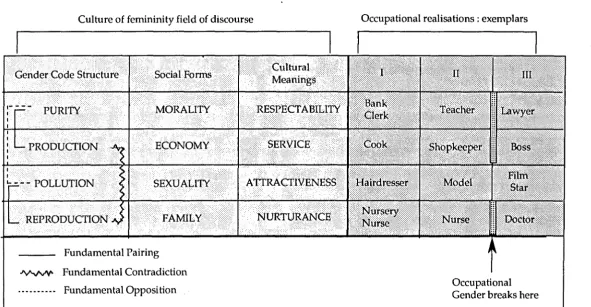
The 'clerical and caring' jobs so prominent in girls' aspirations
service
others in anassisting
capacity; the former emphasiserespectability,
the latterselfless dedication.
They are, then, occupational expressions of core aspects of the culture of femininity, but in practice such jobs may not be as easy to secure for all girls as many may think.
(19) If the vocation of sacrificial femininity is not realisable occupationally, though,
assisting. Which girls are in a position to do so, and how do they come to understand 'femininity' in relation to themselves?
Aggleton's (1987) ethnography of young people from 'new middle class' back-grounds studying for their A-levels at an FE college in southern England wanted to uncover the reasons why their tutors identified them as potential underachievers. These were students who, in his words, came from homes high in cultural capital where at least one parent was employed in the field of symbolic control; their college tutors saw them as having relatively high academic potential but likely to do badly at A-level because of their active social lives and their attitudes towards study. He concluded that the orientations of the students could not be understood as product-ive resistance to the social reproduction of class and gender relations, but rather as at best weakly emancipatory in these respects. The invisible pedagogy of their home environments encouraged the acquisition of personal and evaluative competences, especially of verbal communication skills, used to challenge externally imposed expectations and demands - from the firm foundation of confidence in their own judgements and taste. (20) These students' curriculum and career choices, however,
reflected their attempts to reproduce their parents' cultural and social locations. Parents themselves had intervened at all critical points in their children's educat-ional trajectories to ensure a liberal but formally educationally successful schooling context. The students' A-level choices incorporated a disavowal of the vocational and of the scientific-mathematical: in other words, they accepted the discourse/practice hierarchy of school knowledge, but not its field hierarchy. The interesting point here is that for both sexes these choices were bound up with the gendered identities they saw as culturally acceptable, i.e. with the stylised images realised and affirmed in their milieu :
associated with manual labour [ = male students on male-typed academic or vocational courses} and the essential impotence they saw as characteristic of those whose involvement in mental labour was both committed and industrious [=male college teachers?!} (Aggleton, 1987, p.73)
The female students distinguished themselves both from those who had left school at 16+ and from those who had stayed on at school to do their A-levels. The very fact of leaving school at 16+ was interpreted as evidence that such girls were only interested in pursuing domestic trajectories, which was a wholly unacceptable orientation and image for the college girls. But those who had opted for the sixth-form were also viewed as consixth-formists: they not only acceded to the school's but also to gendered expectations of behaviour and identity. Such girls were described as aspiring towards traditional female employment such as nursing or office work; they were despised in much the same way as were their college peers who were pursuing secretarial or similar vocational courses. The college girls did not, of course, grasp the gendered quality of their own aspirations ,locked as these were into media, aesthetic and symbolic fields; the gender-typing of fields of discourse/ practice was masked by alternative political-cultural evaluative criteria. It would seem that they were able to define themselves unproblematically as 'gender trend-setters', so to speak, by automatically disqualifying girls who were industrious, openly ambitious, interested in scientific/technical subjects, and so on. My own data (see Chapters 2 and 4) suggest that it is high-achieving girls from working class backgrounds who are more inclined to fall into this latter group. There are, then, some clear indications here that class (fraction) differentiated cultures of femininity are actively implicated in the meanings attached to given occupational aspirations by differently located groups of girls.
denied by assumptions about what typical girls are like. These assumptions, related to ideologies of femininity, nevertheless influence girls' experiences at school and at work. Griffin's purpose was thus to deconstruct stereotypes of adolescent femininity. In consequence, she does not seek to draw out the finer patterns of adolescent femininities which are associated with sets of social, educational and cultural circumstances- although some of her findings suggest such patterns, especially the differences she noted between her Afro-Caribbean and indigenous respondents. In general, office work- a 'good' job- represented an idealised form of femininity for both girls and their mothers, whereas factory work was something for the trouble-makers and layabouts. But for some (especially black) girls, factory work as an aspiration (not as reality) was an expression of resistance. Such girls interpreted office work both as 'snobby' and as demanding a feminine submissiveness and flirtatiousness they were unwilling to act out (ibid., pp.l00-4). The nine 'black sisters' Mac an Ghaill (1988) included in his ethnography of eighties urban black youth had also developed a solidary culture of resistance in response to their schooling experiences, but of a different kind. These were high achieving working class girls studying for A-levels at sixth-form college, who were determined to succeed educationally no matter what obstacles were placed in their way. For these girls, the rejection of education to which they saw young black men as (understand-ably) prone was not a productive solution. Rather, they saw academic qualifications as the escape route from black working class female work, and had no intention of accepting repeated advice from teachers to go into child care, office work or banking.
independent adulthood, bringing with it a measure of economic protection against their own weak position in the labour market. (21) Lees' (1986, Ch.3) study of the social
construction of sexuality confirms girls' very mixed feelings about marriage. The fifth-form London comprehensive schoolgirls (from a variety of class and ethnic backgrounds) she interviewed in the early eighties almost universally expected to marry. It remains, Lees argued, the only way girls can protect themselves from the 'slags and drags' dichotomy that constructs and constrains female sexuality. Never-theless, girls are at least implicitly aware of the contradictions between the ideal and the reality of marriage. Many spoke of husbands in negative terms- frequently violent, overdrinking, behaving like 'pashas'. The girls wanted to marry because there is no realistic alternative -they have "neither the financial independence nor the cultural support to make other choices" (ibid., p.95).
Finally, resistance to the reproduction of gender relations as expressed through (rather than simply 'against') the culture of femininity has been a favourite theme in the cultural studies literature. In the first instance, resistance strategies reveal the complex and contradictory quality of social and cultural reproduction. But sec-ondly, it is possible to see that forms of resistance are frequently contradictory in themselves, tending to lead towards accommodations rather than transformations. Samuel (1983) writes that whilst the working class Australian girls she studied may resist and rebel as a group, they were also caught up in the culture of femininity. They admitted that in personal terms they see little alternative to a 'traditional' female adult life; their public rejection of elements of the culture of femininity con-stituted more of a surface, partial resistance.
This [resistance) does not mean ... that they are feminists in the sense that they have elaborate
acts on them in contradictory ways so that their reactions to this oppression are also
contradictory and ultimately self-destructive. They do not correctly identify the forces which
imprison them ... The only avenue to more control over their lives, education in its broadest
sense, is closed. (Samuel,1983, p.369)
The reference to working class female resistance as centred on authority in general rather than on male dominance in particular is interesting. The girls are, in effect, demonstrating class solidarity by resisting oppression as exercised through the power and authority of state agencies. They are not resisting patriarchal hegemony, and they are not resisting the established division of labour by sex. Class solidarity overrides gender solidarity; it is in this sense that they do not identify the forces which imprison them. The interpretation of resistance in Samuel's study parallels the historical dilemma of working class women in the labour market as discussed earlier (in section 1.2). This interpretation also clarifies further the concept of distance/proximity to ideologised elements of women's subordination, which has been introduced at several points in this chapter. Theideaofdistancedoesnotimply that a particular element has less effect than another, but rather that its effect is differently articulated (vis a vis others) for girls and women from given social and cultural contexts. So, for example, girls may have to secure a job as part of the transition to adulthood
but of more significance is their future role as wives and mothers and as helpers in the process
of production. Women carry out the menial and servile and nurturant tasks for those doing
the 'really important jobs', i.e. the male breadwinners. The main criterion then for judging
women is their femininity, and this is more the case for working class women than for their
middle class counterparts. who may achieve status through professional or other well-paid
occupations. (Samuel, ibid., p.370, my emphasis)
circumstance. The main criterion for judging all women is indeed their femininity. But just as there is no such thing as a 'typical woman', so can there be no such thing as a unitary culture of femininity operating indiscriminately. From this perspective, the occupational choices girls make can be seen as symbolic expressions of differen-tiated cultures of femininity, which are in turn associated with the social circum-stances and cui tural milieux in which they grow up. The next chapter therefore turns to the task of developing a model of the modalities of gender relations which can expose some of these patterns.
Footnotes
1 Appendix I provides a concise critical summary of the field.
2 It is impossible to ignore Shorter's work, given its influence in the field. Bradley quite rightly (critically)
summarises his view to be that 'the market liberated women from the cage of the patriarchal home' (ibid., p.34).
He now appears to be openly arguing in socio-biological terms for the historical inevitability of male dominance;
processes of social and economic modernisation can ameliorate but not eradicate women's subordination
(Shorter,l988).
3 Snell (1985) claims this pattern continued through to the eighteenth century; Macfarlane (1978) suggests that
the particularly marked individualism of English society has traditionally offered more 'space' in crossing the
boundaries set by social ascription in comparison with other European cultures (although this begs the question
of whether the spaces were simply differently located).
4 On the other hand, wives' employment status per se made no difference to the balance of power between
married couples. The historical and contemporary evidence on the relationship between wives' employment
status and marital power relations is mixed; what is certain is men's persistently low domestic labour
participation rate, repeatedly found across Europe in regular surveys (e.g. EOC,l989, McRae,l989).
5 Relative to the increasingly available alternatives, the status and pay of domestic service was poor and therefore
declining in popularity by the turn of the century. The choice was thus between shopwork, of higher status but
with poor pay and conditions, and factory work, which was disliked but plentiful and with better pay. At the
close of the eighties, the choices facing working class girls in the North of England are little changed. Those who
are 'fortunate' gain access to routine non-manual work; factoryworkis no longer exactly plentiful, but it remains
an option; shop work is relatively plentiful but still poorly-paid and frequently casualised; even domestic service
has returned to recruit maids-of-ali-work for affluent families in the South-East.
6 One which continues, from my personal observation, to present itself in similar form amongst contemporary
farming families in middle Europe.
7 This idea of distance/proximity raises a crucial theoretical point. Patriarchy may be a virtual historical