DOI: 10.1534/genetics.111.127217
Prion-Forming Ability of Ure2 of Yeasts Is Not Evolutionarily Conserved
Herman K. Edskes,* Abbi Engel,* Lindsay M. McCann,* Andreas Brachmann,*
,1Huei-Fung Tsai
†and Reed B. Wickner*
,2*Laboratory of Biochemistry and Genetics, National Institute of Diabetes, Digestive, and Kidney Diseases†Clinical Mycology Section, Laboratory of Clinical Infectious Diseases, National Institute of Allergy and Infectious Diseases,
National Institutes of Health, Bethesda, Maryland 20892
Manuscript received January 25, 2011 Accepted for publication February 27, 2011
ABSTRACT
[URE3] is a prion (infectious protein) of theSaccharomyces cerevisiae Ure2p, a regulator of nitrogen catabolism. We show that wild S. paradoxuscan be infected with a [URE3]prion, supporting the use of
S. cerevisiaeas a prion test bed. Wefind that the Ure2p ofCandida albicansandC. glabrata also regulate nitrogen catabolism. Conservation of amino acid sequence within the prion domain of Ure2phas been proposed as evidence that the[URE3]prion helps its host. We show that theC. albicansUre2p, which does not conserve this sequence, can nonetheless form a[URE3]prion inS. cerevisiae, but theC. glabrataUre2p, which does have the conserved sequence, cannot form[URE3]as judged by its performance inS. cerevisiae. These results suggest that the sequence is not conserved to preserve prion forming ability.
T
HE Saccharomyces cerevisiae Ure2 protein is central in nitrogen catabolite repression—the ability to repress the uptake and utilization systems for poor nitrogen sources when a good nitrogen source is present (Cooper 2002). The C-terminal domain ofUre2p (amino acids 94–354) is sufficient for its reg-ulatory function when overproduced (Masison and Wickner 1995), although the first 93 amino acids are important to stabilize the protein against degradation (Shewmaker et al.2007). However, these proximal 93 amino acids allowUre2pto form a prion, an infectious inactive form of the protein (Masison and Wickner 1995; Wickner 1994). The first 65 amino acids have been shown sufficient to propagate the prion form of Ure2p (Masison et al. 1997), and form infectious amyloid with a parallel in-register b-sheet structure (Brachmannet al.2005; Baxaet al.2007; reviewed in Wickneret al. 2008).
The C-terminal domains of the Ure2proteins of as-comycete yeasts, starting at amino acid 100 ofS. cerevi-siae, show strong conservation (Edskes and Wickner
2002; Baudin-Baillieu et al. 2003; Harrison et al. 2007). For instance the C-terminal domains of the Ure2 proteins of the human pathogenic yeasts Candida albicans andC. glabratashare, respectively, 80 and 92% sequence identity with the S. cerevisiae protein, and each can functionally substitute for S. cerevisiae Ure2p
(Edskesand Wickner2002).
In contrast to the conservation in the C-terminal do-mains the N-terminal dodo-mains of these three proteins are poorly conserved, although they all contain a sub-stantial amount of asparagine residues (Edskes and Wickner2002; Baudin-Baillieuet al.2003; Harrison
et al. 2007). In addition, theS. cerevisiaeandC. glabrata
proteins share a 30-amino-acid domain found in some but not all Ure2proteins (residues 10–39 of theS. cer-evisiae Ure2p) (Edskes and Wickner 2002). This do-main, in isolation, has a strong propensity to form amyloid (Baxa et al. 2005; Chan et al. 2005), but that amyloid is not infectious (Brachmannet al.2005).
Ure2p is thought to transmit information about the nitrogen state of the environment through an interac-tion with the transcripinterac-tion factor Gln3p (reviewed in Cooper2002; Magasanikand Kaiser2002). Curiously, in contrast to Ure2 proteins of different ascomycete yeasts, theGln3proteins show limited sequence conser-vation. Identity is limited to 52 centrally located amino acids comprising a zincfinger domain. This zinc finger domain is characteristic of fungal transcription factors involved in nitrogen catabolite repression. In addition, the threeGln3proteins share a 7- or 8-residue C-terminal sequence. Overall identity between S.
cerevi-siae and C. glabrata Gln3 proteins is 34%, between
Supporting information is available online athttp://www.genetics.org/ cgi/content/full/genetics.111.127217/DC1.
Microarray data have been uploaded to the NCBI GEO microarray repository with accession no. GSE26620, with subseries nos. GSE26612 for the AgilentC. glabrataarray, GSE26613 forC. albicans, and GSE26611 forS. cerevisiae.
1Present address: Biozentrum der LMU Munchen, Bereich Genetik,
Grosshaderner Str. 2-4, 82152 Martinsried, Germany.
2Corresponding author:Bldg. 8, Room 225, National Institutes of Health,
8 Center Dr., MSC 0830, Bethesda, MD 20892-0830. E-mail: [email protected]
S. cerevisiae and C. albicans Gln3 proteins is 24%, and between C. glabrata andC. albicans Gln3 proteins is also 24%. While the Gln3p ofC. albicansis known to regulate nitrogen catabolism (Liaoet al.2008), it is not clear that thealbicansUre2p does so, or does so through Gln3p.
C. albicans and C. glabrata are predominantly found as commensals of warm-blooded animals. Both species can proliferate in healthy people and, when the im-mune system is weakened, can cause mucosal and bloodstream infections (Kaur et al. 2005; Bialkova and Subik 2006; Noble and Johnson 2007; Brisse
et al. 2009; Lewis 2009).C. albicans causes 45–60% of invasive candidiasis while C. glabrata contributes 20–22% of the cases. Bloodstream infections of either organism have a death rate of 40–50% (Lewis 2009). These organisms are distantly related, with C. glabrata
closer to S. cerevisiae. C. glabrata is a haploid yeast, whereasC. albicans, likeS. cerevisiae, is found in the wild as a diploid. Although an incomplete sexual cycle has been described forC. albicans, no mating has been ob-served in C. glabrata (Nielsen and Heitman 2007). Nonetheless, loci with sequence similarity to theS.
cer-evisiae MATa and MATa are found in C. glabrata
populations.
Prions (infectious proteins) of yeast and fungi in-clude [URE3], [PSI1], [PIN1], [SWI1], [MCA], [OCT1], [MOT1], and [ISP1] ofS. cerevisiaeand [Het-s] of Podospora anserina, which are amyloids of Ure2p,
Sup35p, Rnq1p, Swi1p, Mca1p, Cyc8p, Mot3p, Sfp1p, and HETs, respectively (Wickner 1994; Coustou
et al.1997; Derkatchet al.2001; Duet al. 2008; Alberti
et al. 2009; Nemecek et al. 2009; Patel et al. 2009; Rogoza et al. 2010).Sup35p is a subunit of the trans-lation termination factor; Rnq1p has no known func-tion;Swi1p, Cyc8p,Mot3p, and Sfp1 are transcription factors; andMca1pis a metacaspase (putative protease). HETs, in its prion form, is involved in heterokaryon incompatibility inP. anserina. In yeast and fungi, prions are both infectious proteins (the definition of a prion), spreading horizontally by cytoplasmic mixing (cytoduc-tion), and heritable as genes, passing vertically to mi-totic offspring.
The first suggestion that prions might be beneficial was the discovery of a prion underlying a heterokaryon incompatibility phenomenon in P. anserina(Coustou
et al.1997; comment by Wickner1997), but this prion also induces a meiotic drive system, calling that inter-pretation into question (Dalstra et al. 2003). It was then proposed that [PSI1] had a beneficial effect on yeast, enabling it to resist stress (Eaglestone et al. 1999) and thereby promoting evolvability (True and Lindquist 2000). It has likewise been suggested that
[URE3]is beneficial (Shorter and Lindquist2005), and the conservation, in some yeasts, of a 30-residue region in the Ure2p prion domain (see above) was cited as evidence for the usefulness of prion formation
(Harrisonet al. 2007). Since the Ure2p ofC. glabrata has this conserved region, but it is missing from that of
C. albicans, we undertook a study of their prion forming abilities in part as a test of these hypotheses.
MATERIALS AND METHODS
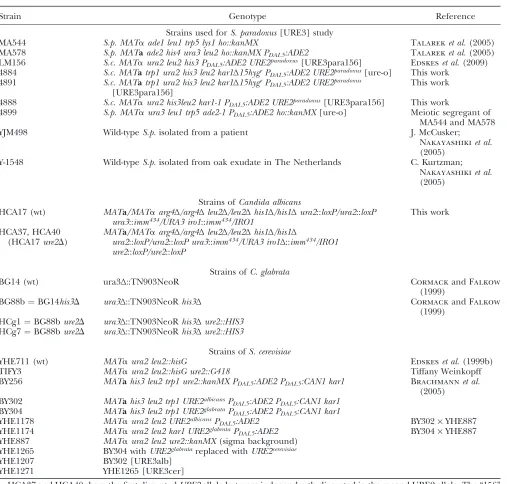
Strains and media: Media are as described by Sherman (1991), except YES medium, which contains 5 g/liter yeast extract, 30 g/liter dextrose, and 30 mg/liter tryptophan. Strains are listed in Table 1. AllC. albicansstrains were derived from SN148 (Nobleand Johnson2005). Disruption of genes and marker exchange were performed according to Dennison et al.(2005). Transformation ofC. albicanswas performed using the Li acetate method at 44 (Ramonand Fonzi2009). The URA2gene was disrupted with LAL and LHL (Dennisonet al. 2005). Subsequently, IRO1and URA3were restored through transformation with a PCR product originating 418 bp up-stream ofIRO1and terminating 408 bp downstream ofURA3. As template, genomic DNA from the Darlington strain of
C. albicanswas used (Kakeyaet al.2000). AfterURA3 was re-stored,CRE-mediated recombination was initiated [to remove the arginine (LAL) and histidine (LHL) markers] using a LEU2-marked CRE gene controlled by the MET3 pro-moter and directed to theARG4locus. This produced strain HCA17. Sequences containing 59 ARG4and the MET3 pro-moter as well as ARG4 39 sequences were amplified from pCAD (Dennison et al. 2005). LEU2 was amplified from SN100 genomic DNA (Nobleand Johnson2005). The whole CRE cassette was cloned into the EcoRV site of pBC KS1 (Stratagene) resulting in pH948. TheURE2gene was then dis-rupted with LAL and LHL and the markers again removed through CRE-mediated recombination giving strains HCA37 and HCA40, which both grew slightly slower than the paren-tal strain HCA17.
URE2was disrupted inC. glabratastrain BG88b (Cormack and Falkow1999) using a PCR product obtained from geno-mic DNA ofC. glabratastrain 37A (Miyazakiet al.1998) that contained the HIS3 gene (bordered by loxP sites), starting 443 bp upstream of the start codon and terminating at the
HIS3stop codon.C. glabrata strains BG14 and BG88b are both derived from clinical isolate BG2 (Fidelet al.1996).C. glab-ratawas transformed by the Li acetate method (Geitz and Woods2002). Both HCg1 and HCg7 grew slightly slower than the parental strain BG14.
URE2 of YHE711 was replaced with kanMX4 by transfor-mation with a PCR- amplifiedure2::kanMX4 from the corre-sponding S. cerevisiae Genome Deletion Project strain. S. cerevisiae was transformed by the Li acetate method (Geitz and Woods2002). TIFY3 grew slightly slower than parental strain YHE711.
We integrated URE2albicans and URE2glabrata into the URE2 locus of strain BY256 replacing thekanMX gene present there (ure2::kanMX). The ORF ofURE2albicansorURE2glabrataflanked by 179 bp 59-UTR and 463 bp 39-UTR from theS. cerevisiae URE2was transformed into strain BY256. Transformants con-tainingURE2albicans(BY302) orURE2glabrata (BY304) at theS. cerevisiae URE2 locus were selected using their resistance to canavanine, sensitivity to G418, and inability to grow on medium lacking adenine. There are no CTG codons in
URE2albicans.
presence of ammonia as nitrogen source (e.g., Difco yeast nitrogen base without amino acids). Alternatively, theDAL5
promoter may be fused to ADE2 and adenine prototrophy, and a change from red to white colony color on adenine-limiting media indicatesUre2pinactivity.
Cytoduction: Cytoplasm is transferred from one strain to another using thekar1mutation defective in nuclear fusion (Condeand Fink1976). The donor of cytoplasm isr1and the recipient, of opposite mating type, is maderoby growth
on ethidium bromide. Cells are mixed in water and incubated on rich medium for7 hr. The mixture is then streaked for single colonies on plates selecting against the donor strain. Donor or recipient must have akar1mutation to largely
pre-vent nuclear fusion. Mating occurs and the unfused nuclei separate at the next cell division. Clones with the nuclear markers of the recipient (but not diploid) and r1 are cyto-ductants and are scored for the prion phenotype.
Microarray protocols: Total RNA was isolated from log phase cultures ofS. cerevisiae(strains YHE711 and TIFY3),C. albicans(strains HCA17, HCA37, and HCA40) andC. glabrata
(strains BG88b, HCg1, and HCg7) grown in YPAD at 30using Trizol (Invitrogen) and purified using the RNeasy MiniElute cleanup kit (Qiagen).S. cerevisiaemicroarrays were purchased from Agilent. ForC. glabrata, Agilent custom microarrays were used as described (Tsai et al. 2010) C. albicans microarrys (Brown et al. 2006) were purchased from the Genome
TABLE 1
Strains ofS. cerevisiaeandS. paradoxus
Strain Genotype Reference
Strains used forS. paradoxus[URE3] study
MA544 S.p. MATaade1 leu1 trp5 lys1 ho::kanMX Talareket al.(2005) MA578 S.p. MATaade2 his4 ura3 leu2 ho::kanMX PDAL5:ADE2 Talareket al.(2005) LM156 S.c. MATaura2 leu2 his3 PDAL5:ADE2 URE2paradoxus[URE3para156] Edskeset al.(2009)
4884 S.c. MATatrp1 ura2 his3 leu2 kar1Δ15hygrP
DAL5:ADE2 URE2paradoxus[ure-o] This work
4891 S.c. MATatrp1 ura2 his3 leu2 kar1Δ15hygrP
DAL5:ADE2 URE2paradoxus [URE3para156]
This work
4888 S.c. MATaura2 his3leu2 kar1-1 PDAL5:ADE2 URE2paradoxus[URE3para156] This work
4899 S.p. MATaura3 leu1 trp5 ade2-1 PDAL5:ADE2 ho::kanMX[ure-o] Meiotic segregant of
MA544 and MA578 YJM498 Wild-typeS.p.isolated from a patient J. McCusker;
Nakayashikiet al. (2005)
Y-1548 Wild-typeS.p.isolated from oak exudate in The Netherlands C. Kurtzman; Nakayashikiet al. (2005)
Strains ofCandida albicans
HCA17 (wt) MATa/MATaarg4Δ/arg4Δleu2Δ/leu2Δhis1Δ/his1Δura2::loxP/ura2::loxP ura3::imm434/URA3 iro1::imm434/IRO1
This work
HCA37, HCA40 (HCA17ure2D)
MATa/MATaarg4Δ/arg4Δleu2Δ/leu2Δhis1Δ/his1Δ
ura2::loxP/ura2::loxP ura3::imm434/URA3 iro1Δ::imm434/IRO1 ure2::loxP/ure2::loxP
Strains ofC. glabrata
BG14 (wt) ura3Δ::TN903NeoR Cormackand Falkow
(1999)
BG88b¼BG14his3D ura3Δ::TN903NeoRhis3Δ Cormackand Falkow (1999)
HCg1¼BG88bure2D ura3Δ::TN903NeoRhis3Δure2::HIS3
HCg7¼BG88bure2D ura3Δ::TN903NeoRhis3Δure2::HIS3
Strains ofS. cerevisiae
YHE711 (wt) MATaura2 leu2::hisG Edskeset al.(1999b)
TIFY3 MATaura2 leu2::hisG ure2::G418 Tiffany Weinkopff
BY256 MATahis3 leu2 trp1 ure2::kanMX PDAL5:ADE2 PDAL5:CAN1 kar1 Brachmannet al. (2005)
BY302 MATahis3 leu2 trp1 URE2albicansP
DAL5:ADE2 PDAL5:CAN1 kar1 BY304 MATahis3 leu2 trp1 URE2glabrataP
DAL5:ADE2 PDAL5:CAN1 kar1 YHE1178 MATaura2 leu2 URE2albicansP
DAL5:ADE2 BY302·YHE887
YHE1174 MATaura2 leu2 kar1 URE2glabrataP
DAL5:ADE2 BY304·YHE887
YHE887 MATaura2 leu2 ure2::kanMX(sigma background) YHE1265 BY304 withURE2glabratareplaced withURE2cerevisiae YHE1207 BY302 [URE3alb]
YHE1271 YHE1265 [URE3cer]
Sequencing Center at Washington University, St. Louis, MO. Microarray hybridization was performed by the Genomic Technologies Section, Research Technologies Branch, Na-tional Institute of Allergy and Infectious Diseases, NaNa-tional Institutes of Health (NIH), Bethesda, MD (Tim Myers) as de-scribed by Tsaiet al.(2010). Statistical calculations were per-formed on the processed signal data by using the mAdb analysis system provided by the BIMAS group at the Center for Information Technology, NIH. Data werefiltered with the parameters that included genes present in three or more arrays per group and each array with 80% or more genes present. Genes not present in bothURE2deletion strains ofC. albicans
andC. glabratawere discarded. Signals of genes scoring consis-tently,100 pixels on all arrays were discarded as background. Genes for which reciprocal labeling showed an inconsistent trend were discarded as well as genes positive in three or more arrays per group but not positive in the majority of arrays.
RESULTS
Nomenclature:As previously described (Edskeset al. 2009), we indicate a[URE3]prion originating in cells expressing the C. albicans Ure2p and propagating in cells expressing the S. cerevisiae Ure2p by the symbol [URE3alb]cer(if there were such a strain). In this work, [URE3alb]albwill usually be abbreviated to [URE3alb]. When we refer to [URE3] of theS. paradoxusUre2p in
S. paradoxuscells, we will be explicit.
Wild S. paradoxus strains can propagate [URE3]: Because of the difficulties of Candida genetics, we chose to examine the prion-forming abilities ofC. albi-cansandC. glabrataUre2p in S. cerevisiae, an approach often used by others as well (Chernoff et al. 2000; Kushnirovet al.2000; Santosoet al.2000; Nakayashiki
et al.2001). However, while the Ure2p of S. paradoxus
forms a prion in S. cerevisiae (Edskes and Wickner 2002; Edskes et al. 2009), it was found to not form [URE3] inS. paradoxusitself (Talareket al.2005), cast-ing doubt on this approach.
As reported by Talareket al.(2005), we found that we could not select [URE3para]para in S. paradoxus strain MA578, even on overproduction of Ure2ppara. We tested whether the [URE3para]para, generated in
S. cerevisiaecarrying theparadoxus URE2gene in place of that ofcerevisiae, could be transmitted toS. paradoxus
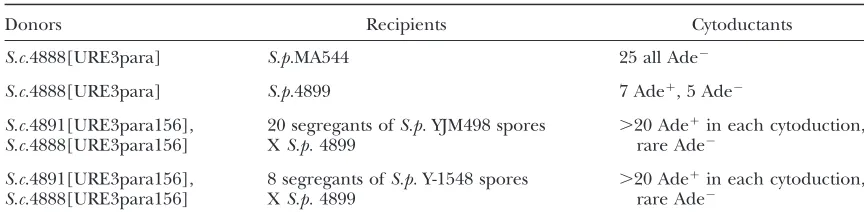
by cytoduction (cytoplasmic mixing) to strain MA578, and found that none of several [URE3para] variants were transmitted (Table 2 and data not shown). How-ever, using genetic crosses, we constructed several other S. paradoxus strains with the PDAL5:ADE2
con-struct used for scoring [URE3] as Ade1, and found that, for example, S. paradoxus strain 4899 could be made [URE3para] by cytoduction from S. cerevisiae
[URE3para] donors (Table 2). Each of these Ade1 cytoductants was cured by growth on 3 mmguanidine, an inhibitor of the disaggregating chaperoneHsp104, whose activity is necessary for propagating the S. cere-visiae[URE3]. Further, these cytoductants could trans-mit their Ade1 trait back toS. cerevisiaestrain 4884 by
cytoduction. Thus,S. paradoxusstrain 4899 can propagate [URE3para].
To determine whether wild S. paradoxus can propa-gate [URE3para], we carried out meiotic crosses be-tween S.p.4899 and germinating meiotic spores from the wildS.p. strains YJM498 and Y-1548. From the for-mer cross we chose 20 and from the latter 8 suitably marked (ade2-1 PDAL5:ADE2 ho::kanMX) segregants, and used each as a cytoduction recipient from a S.c.
[URE3para] donor. We found that each of the 28 seg-regants from the two crosses could stably maintain [URE3para], indicating that there is at least no single gene defect in either wild strain preventing [URE3para] propagation (Table 2). These results indicate that wild
S. paradoxuscan be[URE3]and suggest that the use of
S. cerevisiae as a test bed for potential prion proteins appears to be valid.
C. albicansandC. glabrataUre2p regulate N-catabolism genes:GLN3is known to have an important role in nitro-gen regulation inC. albicans(Dabasand Morschhauser 2007; Dabasand Morschhauser2008; Liaoet al.2008). As the Ure2 proteins fromC. glabrataandC. albicansfully restore nitrogen regulation in aS. cerevisiaeure2D strain (Edskesand Wickner2002), it seems likely that nitrogen regulation in these two Candida species is also directed by Ure2p. However, the limited sequence identity found among the Gln3proteins fromS. cerevisiae, C. albicans, and C. glabrata (supporting information, Figure S1) brings into question whether the response of these organ-isms toUre2pinactivation parallel each other. To record the transcriptional response of these three organisms toUre2pinactivation, we disruptedURE2inS. cerevisiae, C. albicans, andC. glabrata.
We find that among the 182 genes of S. cerevisiae
whose transcription is repressed twofold or more by
Ure2pin rich medium, 73 are involved in nitrogen uti-lization and amino acid metabolism (File S1). Of these 182 genes, 47 were reported byGodardet al. (2007) to be nitrogen catabolite repression (NCR) target genes. None of the 22 genes that we found twofold or more upregulated by Ure2pwere NCR targets. These results are similar to previous work in S. cerevisiae (Cox et al. 1999; Shamjiet al. 2000; Rossand Wickner2004).
Of the 46C. albicansgenes derepressed by ure2D, 16 are homologous to Godardet al.'s (2007) NCR target genes. Of the 209 genes upregulated inure2D C. glab-rata, 19 are NCR targets, but 5 genes listed byGodard
et al. (2007) as NCR targets are downregulated in C. glabrata(File S1).
find changes in the same direction inS. cerevisiae, C. albi-cans, andC. glabrata:CAR1(arginase),DIP5(dicarboxylic amino acid permease), DUR1 (urea amidolyase), GAP1
(general amino acid permease), GLN1(glutamine syn-thase),UGA1(g-aminobutyrate transaminase),FCY2 (pu-rine-cytosine permease), and YPS1 (aspartyl protease) (File S1,Figure S2).
C. albicans Ure2p can form a prion in S. cerevisiae: Overproduction of a prion protein increases the fre-quency ofde novoformation of the prion form (Wickner 1994), thus providing both a means of obtaining cells with the prion and evidence that it is indeed a prion. Neither C. albicans nor C. glabrata Ure2p overproduc-tion induces the appearance of S. cerevisiae [URE3]
(Edskesand Wickner2002). Further, whenC. albicans orC. glabrataUre2p expression was directed from a plas-mid in aS. cerevisiaestrain carrying a chromosomalure2
deletion neither protein could propagate [URE3] de-rived from S. cerervisiae Ure2p introduced by cytoduc-tion. These results indicate that there is at least a substantial species barrier between S. cerevisiae Ure2p
and the two Candida Ure2ps.
Using pH563 (pPGAL1URE2albicans) in BY302 (URE2albicans),
we transiently overproduced Ure2palbicans by growing cells in galactose-containing medium.[URE3]-containing cells were detected using a PDAL5:ADE2 fusion. DAL5, encoding allantoate permease, is repressed by Ure2p
when a rich nitrogen source, such as ammonia, is pres-ent.Dal5pcan also transport USA, the product of Ura2p (aspartate transcarbamylase). Thus, deficiency ofUre2p
(as when[URE3]is present) derepressesDAL5 transcrip-tion, allowing aura2mutant to grow on USA in place of uracil. Alternatively, placing the ADE2 gene under the control of theDAL5 promoter results in normal cells being Ade2 and [URE3] cells being Ade1. After growth on galactose, cells were plated on2Ade plates with glucose as the carbon source to shut off the over-production ofUre2p. The frequency of Ade1cells was increased >100-fold by overproduction of Ure2palbicans, indicating that [URE3alb] had formed (Table 3).
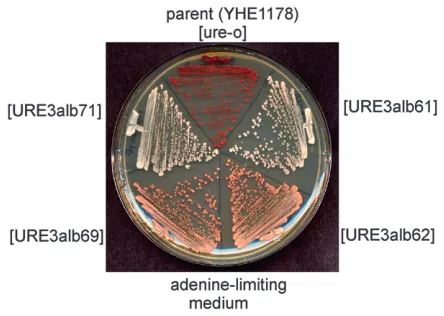
Many of the Ade1clones induced by Ure2albicans over-expression were stable on growth under nonselective con-ditions (YPAD), but were then cured by growth on YPAD containing 3 mm guanidine HCl (Figure 1), a known feature ofS. cerevisiae[URE3](Moriyamaet al.2000).
Prions are, in most cases, readily transmitted by cytoduction. Seven stably Ade1guanidine-curable puta-tive [URE3alb] clones were used as cytoduction donors to a rhoo [ure-o] recipient. In four cases, all (20) or nearly all (19 or 20) of the cytoductants had become USA1, confirming that these isolates were [URE3alb].
Two variants of [URE3alb]: A single protein can adopt different amyloid structures and thus show distinct heritable and infectious biological properties (reviewed by Collingeand Clarke2007). Cytoductants of [URE3-alb] isolates YHE1161 and YHE1171 into the common recipient strain YHE1178 were slow growing and only weakly Ade1 (red on adenine-limiting media), while cytoductants of isolates YHE1162 and YHE1169 into the same recipient were fast-growing and strongly Ade1 (Fig-ure 2). Thus, this prion, as other yeast prions, can display variants.
C. glabrataUre2p cannot form a [URE3] prion:While transient overexpression of Ure2palbicansinduced the for-mation of [URE3alb], the same was not true of overex-pression of Ure2pglabrata in cells expressing only Ure2pglabrata (Table 3), although Ure2pglabrata was in-deed strongly overexpressed (Figure S2). The frequency of Ade1clones did not increase, and none of the stably Ade1clones were cured by growth on guanidine, so they were not prions. Six Ade1 clones were used as cytoduc-tion donors with strain YHE1174 [MATa ura2 leu2 kar1
URE2glabrataPDAL5:ADE2] as recipient. Not a single case of
transfer of the ADE1phenotype from donor cells to re-cipient cells was observed (total of 79 cytoductants with 8–17 cytoductants per BY304 ADE1 isolate).
It has been shown that the prion forming domain of
S. cerevisiae Ure2p is far more efficient in inducing
[URE3] when transiently overexpressed than the full-length protein (Masisonand Wickner1995). We thus
TABLE 2
S. paradoxuscan propagate [URE3paradoxus]
Donors Recipients Cytoductants
S.c.4888[URE3para] S.p.MA544 25 all Ade2
S.c.4888[URE3para] S.p.4899 7 Ade1, 5 Ade2
S.c.4891[URE3para156], 20 segregants ofS.p.YJM498 spores .20 Ade1in each cytoduction, rare Ade2
S.c.4888[URE3para156] XS.p.4899
S.c.4891[URE3para156], 8 segregants ofS.p.Y-1548 spores .20 Ade1in each cytoduction, rare Ade2
S.c.4888[URE3para156] XS.p.4899
S.c., Saccharomyces cerevisiae;S.p., Saccharomyces paradoxus. An interspecies cytoduction of [URE3para] fromS.c. URE2paradoxus[URE3para] strains toS.p. strains was carried out as forS. cerevisiae. TheP
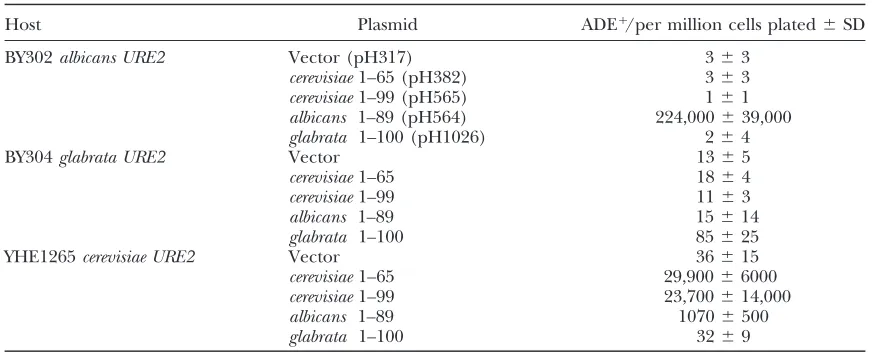
transiently overexpressed the N-terminal domains from the S. cerevisiae, C. albicans, and C. glabrata Ure2 pro-teins and measured their ability to induce [URE3]
(Table 4). While the cerevisiae and albicans N-terminal domains' overproduction dramatically increased Ade1 colony formation, only a small increase was seen for
glabrata.Guanidine curing experiments confirmed that all of thealbicansAde1colonies contained prions (12 of 12 tested cured by guanidine). Tests of 40 of theglabrata
Ade1clones showed that none were guanidine curable, although some were completely converted to Ade2 on growth in rich medium.
In a further attempt to induce [URE3gla] formation, we introduced cytoplasm with [URE3cerevisiae] or [URE3alb] by cytoplasmic mixing. Neither prion was successfully transferred to cells expressing Ure2pglabrata, although each was efficiently transmitted to a recip-ient expressing aUre2pidentical to the donor (Table 5). [URE3alb] was not transmitted to cells expressing
Ure2pfrom several Saccharomyces species.
We considered the possibility that in the process of constructing BY304 some other change had been in-advertently introduced that made the cells unable to propagate a prion. We therefore, replaced URE2glabrata
with URE2cerevisiae forming YHE1265. Overexpression of
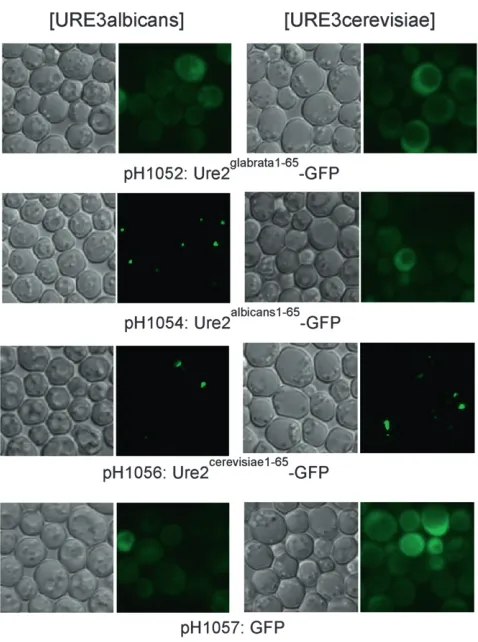
Ure2cerevisiae1-65 or 1-99 each stimulated prion formation (Table 4), indicating that no such mutation was present. Aggregate formation in vivo: Ure2-GFP fusion pro-teins that include the prion domain can be incor-porated into the prion filaments in vivo and allow visualization of the prion aggregates (Edskes et al. 1999a) (Figure 3). The fusion protein expression also may cure the prion (Edskeset al.1999a). We found that when Ure2albicans1-65-GFP (Figure 3) was expressed from theS. cerevisiaeURE2promoter in a [URE3alb] cell, and cells were grown selecting for the prion, dot-like aggre-gates were observed in a large fraction of cells. Unex-pectedly, Ure2cerevisiae1-65-GFP or Ure2cerevisiae1-99-GFP (also expressed from the S. cerevisiae URE2 promoter) also showed the dot appearance in [URE3alb] strains (Figure 3). No foci were observed in isogenic [ure-o] cells.
TABLE 3
Prion induction by transient overexpression of full-length Ure2palbicansor Ure2pglabrata
Host Plasmid ADE1per 106cells plated
BY302albicans URE2 pH317 (vector) 1168
pH563 (albicans) 16806490
BY304glabrata URE2 pH317 (vector) 20615
pH659 (glabrata) 16616
BY302 (or BY304) with a chromosomal copy of URE2albicans (or URE2glabrata) with the S. cerevisiae URE2 promoter was transformed with a copy of the same URE2 controlled by the GAL1 promoter or the vector control. Transformants were grown in leucine dropout media containing 2% galactose and 1% rafinose as carbon source. Cells were washed, diluted, and plated onto adenine dropout plates containing glucose as the carbon source. Colonies were counted after 5 days at 30. pH317 2m,LEU2PGAL1(Edskesand Wickner2002); pH563 pH317 with URE2albicans (Edskes and Wickner 2002); pH659 pH317 with URE2albicans (Edskes and Wickner2002).
Figure1.—Curing of [URE3alb] by growth on 3 mM gua-nidine. The parent strain BY302 and seven Ade1 derivatives were streaked for single colonies on YPAD with 3 mM guani-dine HCl. Four single colonies from each were streaked on adenine-limiting medium (YES). Red clones are Ade2. The white clones on the left and right are the Ade1derivatives of BY302 not exposed to guanidine.
Overexpression of many proteins, including prion proteins, often produce an aggregated appearance of protein-GFP fusions even without prion formation. Overexpressing Ure2cerevisiae1-99 from a GAL1 promoter produces aggregates that are revealed byUre2cerevisiae1-65 -GFP expressed at a low level from the URE2promoter. However, Ure2glabrata1-100-GFP or Ure2glabrata1-65-GFP did not detect any aggregates, when Ure2glabrata1-100was overexpressed from a GAL1 promoter, indicating that Ure2glabratahad little tendency to aggregate.
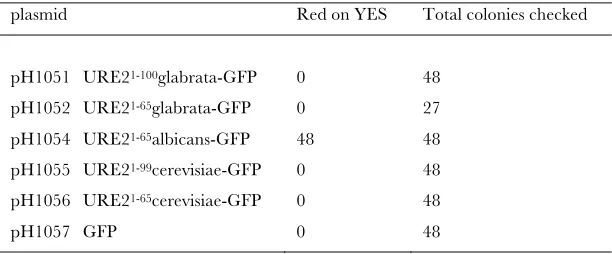
URE2-GFP curing: We found that expression of
URE2albicans1-65 from theURE2 promoter cured
[URE3-alb] (in strain YHE1207), but not [URE3cer] (in strain YHE1271) (Table S1).
DISCUSSION
S. cerevisiae and S. paradoxus are separated by 5–20 million years of evolution (Kellis et al. 2003). Wefind that theS. paradoxusUre2pcan form a prion inS. para-doxus itself, thus resolving an apparent disparity with results inS. cerevisiae.While it may be reassuring thatS. cerevisiaeturns out to be a good test bed for prion forma-tion in this case, there are numerous chromosomal genes affecting prion generation and propagation, so that this assumption may not always prove to be valid in the many studies which have used this approach. TheUre2pofS. castelliiis unable to form a prion inS. cerevisiae (Edskes et al. 2009), but it has not yet been tested in S. castellii itself. Engineering other organisms to detect prions is a daunting task. We found that the Ure2p ofC. albicansandC. glabratahave nitrogen regu-lation functions, like that ofS. cerevisiae.However, when we constructed ura2D/ura2D ure2D/ure2D homozygous knockout mutants ofC. albicans, we found that they did
not utilize ureidosuccinate in place of uridine, so we could not use this approach to test for [URE3] in C. albicans.C. albicans has aDAL5homolog, butC. glabrata
does not, so we did not attempt this approach.
A protein domain that can substitute for the Sup35
prion domain in prion formation may not be able to do so in its native context. Since prion formation by prion domains of Ure2p or Sup35p are hundreds or thou-sands of times more likely to form prions than the full-length proteins expressed at similar levels (Masison and Wickner1995; Kochneva-Pervukhovaet al.1998), it is possible that some domains that can be prions in isolation or a foreign environment may be completely stabilized in their native context.
The Ure2p ofC. albicansforms a [URE3alb] prion with properties similar to those of the[URE3]ofS. cerevisiae.
We observed elevation of prion generation frequency by overproducing the full-length Ure2albicans and even greater induction by overexpressing just the prion do-main. The prion is cured by guanidine, transmitted by cytoduction, and shows at least two prion variants.
In contrast, the Ure2p ofC. glabratadoes not detect-ably form a prion under the conditions tested. Even with overproduction of Ure2glabrataor its prion domain, we could not detect [URE3gla] formation. Attempts to observe aggregated Ure2glabrata using fusions with GFP were likewise unsuccessful. Because of the substantial dependence of prion propagation on chaperones and other cellular components, it remains possible that Ure2glabratacan form a prion inC. glabrataitself.
It has been suggested that the conservation of se-quence in the prion domains ofUre2pandSup35pare indications that the prion must have some func-tion beneficial to the cell that has been selected, thus resulting in the conserved prion domain sequence
TABLE 4
[URE3] induction assays using N-terminal domains
Host Plasmid ADE1/per million cells plated6SD
BY302albicans URE2 Vector (pH317) 363
cerevisiae1–65 (pH382) 363
cerevisiae1–99 (pH565) 161
albicans 1–89 (pH564) 224,000639,000
glabrata 1–100 (pH1026) 264
BY304glabrata URE2 Vector 1365
cerevisiae1–65 1864
cerevisiae1–99 1163
albicans 1–89 15614
glabrata 1–100 85625
YHE1265cerevisiae URE2 Vector 36615
cerevisiae1–65 29,90066000
cerevisiae1–99 23,700614,000
albicans 1–89 10706500
glabrata 1–100 3269
(Shorterand Lindquist2005; Harrison et al.2007). However, we find that the C. glabrata Ure2p, which has the conserved prion domain sequence (residues 10–39 in S. cerevisiae), cannot form a prion. Similarly,
the Kluyveromyces lactis Ure2p, which also has the con-served prion domain sequence, cannot form a [URE3] prion as tested inK. lactisitself (Safadiet al. 2011). In contrast, the Ure2p ofC. albicans, which lacks the con-served sequence, forms a prion much like that of S. cerevisiae. Thus the sequence conservation is not a sign of conservation of forming ability. In fact, prion-forming ability is not even conserved within Saccharo-myces. TheUre2pofS. castelliicannot form[URE3]in
S. cerevisiae (Edskes et al. 2009), and one-fourth of S.
cerevisiaestrains tested in one study had a large deletion in the prion domain ofSup35p, making them unable to propagate [PSI1] (Resendeet al.2003).
Beyond these facts, it should be noted that this argu-ment that prions must be adaptive assumes that the conservation of sequence in the prion domain would be necessary for, or at least favor, prion formation. In fact, the amino acid sequences of theUre2porSup35pprion domains may be randomly shuffled and each of the five shuffled domains of each domain can form prions (Ross
et al.2004, 2005). Thus, the conservation of sequence is not an argument for conservation of prion forming ability. Why are there conserved sequences in the prion domains? The Sup35p prion domain is important for the normal process of mRNA turnover in yeast and humans (Hoshino et al. 1999; Hosoda et al. 2003; Funakoshiet al.2007), while theUre2pprion domain is important for the stability against degradation of the full-length protein (Shewmakeret al.2007). It is likely that these important functions are the basis for the con-servation of sequence of these prion domains.
Does prion function benefit the yeast cells or are prions diseases? Since [PSI1] and[URE3]can be quite stable, if they were beneficial, they would spread rapidly in wild populations and, like mitochondrial DNA, be found in most wild strains. In fact, the prion state of
Ure2porSup35pis rare in nature, as none of the many wild strains examined carry the[URE3]or [PSI1] prions
TABLE 5
Species barriers among [URE3] prions
Cytoductants
Donor [URE3]/URE2 Recipient/URE2 Total USA1
LM69S. cerevisiae YHE1202C.glabrata 26 0
LM69S. cerevisiae YHE1177C. albicans 26 0
LM69S. cerevisiae LM60S. cerevisiae 19 19
YHE1211C. albicans LM11S. bayanus 8 0
YHE1211C. albicans LM14S. kudriavzevii 10 0
YHE1211C. albicans LM16S. mikatae 7 0
YHE1211C. albicans LM18S. paradoxus 8 0
YHE1211C. albicans LM27S. castellii 7 0
YHE1211C. albicans LM41S. cariocanus 13 0
YHE1211C. albicans LM45S. cerevisiae 16 0
YHE1211C. albicans YHE1203S. glabrata 45 0
YHE1211C. albicans YHE1181C. albicans 85 85
All strains are S. cerevisiae with URE2 from the indicated species. Donor strains have the corresponding [URE3cer] or [URE3alb].
(Nakayashikiet al.2005). The [PIN1] prion is found at a frequency comparable to that of the mildly detrimen-tal RNA viruses and 2-mm DNA plasmid (Nakayashiki
et al.2005). Since deletion of RNQ1has no phenotype (Sondheimer and Lindquist 2000), it is possible that there is not enough of a detriment of carrying [PIN1] to eliminate it from the population.
Another test of whether or not cells are happy to be [PSI1] or [URE3] is the response of their stress reac-tion system, the heat shock proteins. Transcripreac-tion of
HSP104andSSA1are stimulated by a variety of stresses, including heat, high ethanol, high salt, high osmolarity, heavy metals, dessication, or starvation (among other conditions). Masison and coworkers have found that
Hsp104andSsa1protein levels are consistently elevated by the presence of the [PSI1] or[URE3]prions ( Jung
et al.2000; Schwimmerand Masison2002), suggesting that these prions are recognized by the cell as stress conditions. The occasional broken limb trait is widely conserved among vertebrates, but one would not argue that the limb structures are conserved for this purpose. On the basis of the very sparse evidence so far avai-lable,[URE3]and [PSI1] prion-forming ability appears to be sporadically distributed among species, as its occurence in the wild is, at most, sporadic. Further work will be necessary to explore the properties of prions in other organisms.
We thank Brendan Cormack forC. glabratastrains and plasmids, Alexander D. Johnson forC.albicansstrains, Alistair J. P. Brown for theC. albicanscre-loxP plasmid system, and Janyce A. Sugui for help with microscopy. We are grateful to Michel Aigle for markedS. para-doxusstrains and to Clete Kurtzman for wildS. paradoxusisolates. This work was supported by the Intramural Program of the National In-stitute of Diabetes, Digestive, and Kidney Diseases of the National Institutes of Health.
LITERATURE CITED
Alberti, S., R.Halfmann, O.King, A.Kapilaand S.Lindquist,
2009 A systematic survey identifies prions and illuminates se-quence features of prionogenic proteins. Cell137:146–158.
Baudin-Baillieu, A., E.Fernandez-Bellot, F.Reine, E.Coissac
and C.Cullin, 2003 Conservation of the prion properties of
Ure2p through evolution. Mol. Biol. Cell14:3449–3458.
Baxa, U., N.Cheng, D. C.Winkler, T. K.Chiu, D. R.Davieset al.,
2005 Filaments of the Ure2p prion protein have a cross-beta core structure. J. Struct. Biol.150:170–179.
Baxa, U., R. B.Wickner, A. C.Steven, D.Anderson, L.Marekov
et al., 2007 Characterization ofb-sheet structure in Ure2p1–89 yeast prionfibrils by solid state nuclear magnetic resonance. Bio-chemistry46:13149–13162.
Bialkova, A., and J.Subik, 2006 Biology of the pathogenic yeast
Candida glabrata.Folia Microbiol.51:3–20.
Brachmann, A., U.Baxaand R. B.Wickner, 2005 Prion generation
in vitro: amyloid of Ure2p is infectious. EMBO J.24:3082–3092.
Brisse, S., C.Pannier, A.Angoulvant, T.De Meeus, L.Diancourt
et al., 2009 Uneven distribution of mating types among geno-types ofCandida glabrataisolates from clinical samples. Eukaryot. Cell8:287–295.
Brown, V., J. A.Sextonand M.Johnston, 2006 A glucose sensor
inCandida albicans.Eukaryot. Cell5:1726–1737.
Chan, J. C. C., N. A.Oyler, W.-M.Yauand R.Tycko, 2005 Parallel
b-sheets and polar zippers in amyloidfibrils formed by residues 10–39 of the yeast prion protein Ure2p. Biochemistry44:10669–
10680.
Chernoff, Y. O., A. P.Galkin, E.Lewitin, T. A.Chernova, G. P. Newnamet al., 2000 Evolutionary conservation of prion-forming
abilities of the yeast Sup35 protein. Mol. Microbiol.35:865–876.
Collinge, J., and A. R. Clarke, 2007 A general model of prion
strains and their pathogenicity. Science318:930–936.
Conde, J., and G. R.Fink, 1976 A mutant ofSaccharomyces cerevisiae
de-fective for nuclear fusion. Proc. Natl. Acad. Sci. USA73:3651–3655.
Cooper, T. G., 2002 Transmitting the signal of excess nitrogen in
Saccharomyces cerevisiaefrom the Tor proteins to th GATA factors: connecting the dots. FEMS Microbiol. Rev.26:223–238.
Cormack, B. P., and S. Falkow, 1999 Efficient homologous and
illegitimate recombination in the opportunistic yeast pathogen
Candida glabrata.Genetics151:979–987.
Coustou, V., C.Deleu, S.Saupeand J.Begueret, 1997 The
pro-tein product of thehet-sheterokaryon incompatibility gene of the fungusPodospora anserinabehaves as a prion analog. Proc. Natl. Acad. Sci. USA94:9773–9778.
Cox, K. H., A. B.Pinchakand T. G.Cooper, 1999 Genome-wide
transcriptional analysis in S. cerevisiaeby mini-array membrane hybridization. Yeast15:703–713.
Dabas, N., and J. Morschhauser, 2007 Control of ammonium
permease expression andfilamentous growth by the GATA tran-scription factorsGLN3 andGAT1inCandida albicans.Eukaryot. Cell6:875–888.
Dabas, N., and J.Morschhauser, 2008 A transcription factor
reg-ulatory cascade controls secreted aspartic protease expression in
Candida albicans.Mol. Microbiol.69:586–602.
Dalstra, H. J. P., K.Swart, A. J. M.Debets, S. J.Saupeand R. F. Hoekstra, 2003 Sexual transmission of the [Het-s] prion leads
to meiotic drive inPodospora anserina.Proc. Natl. Acad. Sci. USA
100:6616–6621.
Dennison, P. M., M. Ramsdale, C. L.Manson and A. J.Brown,
2005 Gene disruption in Candida albicans using a synthetic, codon-optimisedCre-loxPsystem. Fungal Genet. Biol.42:737–748.
Derkatch, I. L., M. E. Bradley, J. Y.Hong and S. W. Liebman,
2001 Prions affect the appearance of other prions: the story of [PIN]. Cell106:171–182.
Du, Z., K.-W.Park, H.Yu, Q.Fanand L.Li, 2008 Newly identified
prion linked to the chromatin-remodeling factor Swi1 in Saccha-romyces cerevisiae.Nat. Genet.40:460–465.
Eaglestone, S. S., B. S. Coxand M. F. Tuite, 1999 Translation
termination efficiency can be regulated inSaccharomyces cerevisiae
by environmental stress through a prion-mediated mechanism. EMBO J.18:1974–1981.
Edskes, H. K., V. T.Grayand R. B.Wickner, 1999a The [URE3] prion
is an aggregated form of Ure2p that can be cured by overexpression of Ure2p fragments. Proc. Natl. Acad. Sci. USA96:1498–1503.
Edskes, H. K., J. A.Hanoverand R. B.Wickner, 1999b Mks1p is
a regulator of nitrogen catabolism upstream of Ure2p in Saccha-romyces cerevisiae.Genetics153:585–594.
Edskes, H. K., and R. B.Wickner, 2002 Conservation of a portion of the
S. cerevisiaeUre2p prion domain that interacts with the full - length protein. Proc. Natl. Acad. Sci. USA99(Suppl. 4): 16384–16391.
Edskes, H. K., L. M. McCann, A. M. Hebertand R. B.Wickner,
2009 Prion variants and species barriers amongSaccharomyces
Ure2 proteins. Genetics181:1159–1167.
Fidel, P. L., J. L.Cutright, L.Taitand J. D.Sobel, 1996 A murine
model ofCandida glabratavaginitis. J. Infect. Dis.173:425–431.
Funakoshi, Y., Y. Doi, N.Hosoda, N. Uchida, M. Osawa et al.,
2007 Mechanism of mRNA deadenylation: evidence for a molec-ular interplay between translation termination factor eRF3 and mRNA deadenylases. Genes Dev.21:3135–3148.
Geitz, R. D., and R. A.Woods, 2002 Transformation of yeast by the
Liac/SS carrier DNA/PEG method. Methods Enzymol.350:87–96.
Godard, P., A.Urrestarazu, S.Vissers, K.Kontos, G.Bontempi
et al., 2007 Effect of 21 different nitrogen sources on global gene expression in the yeast Saccharomyces cerevisiae. Mol. Cell. Biol.27:3065–3086.
Harrison, L. B., Z. Yu, J. E. Stajich, F. S. Dietrichand P. M. Harrison, 2007 Evolution of budding yeast prion-determinant
Hoshino, S., M.Imai, T.Kobayashi, N.Uchida and T.Katada,
1999 The eukaryotic polypeptide chain releasing factor (eRF3/GSPT) carrying the translation termination signal to the 39-poly(A) tail of mRNA. J. Biol. Chem.274:16677–16680.
Hosoda, N., T.Kobayashii, N.Uchida, Y.Funakoshi, Y.Kikuchi
et al., 2003 Translation termination factor eRF3 mediates mRNA decay through the regulation of deadenylation. J. Biol. Chem.278:38287–38291.
Jung, G., G.Jones, R. D.Wegrzynand D. C.Masison, 2000 A role
for cytosolic Hsp70 in yeast [PSI1] prion propagation and [PSI1] as a cellular stress. Genetics156:559–570.
Kakeya, H., Y.Miyazaki, H.Miyazaki, K.Nyswaner, B.Grimberget al.,
2000 Genetic analysis of azole resistance in the Darlington strain of
Candida albicans.Antimicrob. Agents Chemother.44:2985–2990.
Kaur, R., R. Domergue, M. L. Zupancic and B. P. Cormack,
2005 A yeast by any other name:Candida glabrataand its inter-action with the host. Curr. Opin. Microbiol.8:378–384.
Kellis, M., N.Patterson, M.Endrizzi, B.Birrenand E. S.Lander,
2003 Sequencing and comparison of yeast species to identify genes and regulatory elements. Nature423:241–254.
Kochneva-Pervukhova, N. V., A. I.Poznyakovski, V. N.Smirnov
and M. D.Ter-Avanesyan, 1998 C-terminal truncation of the
Sup35 protein increases the frequency of de novo generation of a prion-based [PSI1] determinant inSaccharmyces cerevisiae.Curr. Genet.34:146–151.
Kushnirov, V. V., N. V.Kochneva-Pervukhova, M. B.Cechenova, N.
S.Frolovaand M. D.Ter-Avanesyan, 2000 Prion properties of
the Sup35 protein of yeastPichia methanolica.EMBO J.19:324–331.
Lewis, R. E., 2009 Overview of the changing epidemiology of
can-didemia. Curr. Med. Res. Opin.25:1732–1740.
Liao, W. L., A. M.Ramonand W. A.Fonzi, 2008 GLN3encodes
a global regulator of nitrogen metabolism and virulence of C. albicans.Fungal Genet. Biol.45:514–526.
Magasanik, B., and C. A.Kaiser, 2002 Nitrogen regulation in
Sac-charomyces cerevisiae. Gene290:1–18.
Masison, D. C., and R. B.Wickner, 1995 Prion-inducing domain of
yeast Ure2p and protease resistance of Ure2p in prion-containing cells. Science270:93–95.
Masison, D. C., M.-L.Maddeleinand R. B.Wickner, 1997 The prion
model for [URE3] of yeast: spontaneous generation and require-ments for propagation. Proc. Natl. Acad. Sci. USA94:12503–12508.
Miyazaki, H., Y.Miyazaki, A.Gerber, T.Parkinson, C.Hitchcock
et al., 1998 Fluconazole resistance associated with drug efflux and increased transcription of a drug transporter gene, PHD1, in Can-dida glabrata.Antimicrob. Agents Chemother.42:1695–1701.
Moriyama, H., H. K. Edskes and R. B.Wickner, 2000 [URE3]
prion propagation in Saccharomyces cerevisiae: requirement for chaperone Hsp104 and curing by overexpressed chaperone Ydj1p. Mol. Cell. Biol.20:8916–8922.
Nakayashiki, T., K. Ebihara, H. Bannai and Y. Nakamura,
2001 Yeast [PSI1]“prions”that are crosstransmissible and sus-ceptible beyond a species barrier through a quasi-prion state. Mol. Cell7:1121–1130.
Nakayashiki, T., C. P.Kurtzman, H. K.Edskesand R. B.Wickner,
2005 Yeast prions [URE3] and [PSI1] are diseases. Proc. Natl. Acad. Sci. USA102:10575–10580.
Nemecek, J., T.Nakayashikiand R. B.Wickner, 2009 A prion of
yeast metacaspase homolog (Mca1p) detected by a genetic screen. Proc. Natl. Acad. Sci. USA106:1892–1896.
Nielsen, K., and J. Heitman, 2007 Sex and virulence of human
pathogenic fungi. Adv. Genet.57:143–173.
Noble, S. M., and A. D.Johnson, 2005 Strains and strategies for
large-scale gene deletion studies of the diploid human fungal pathogenCandida albicans.Eukaryot. Cell4:298–309.
Noble, S. M., and A. D.Johnson, 2007 Genetics ofCandida albicans,
a diploid human fungal pathogen. Annu. Rev. Genet.41:193–211.
Patel, B. K., J.Gavin-Smythand S. W.Liebman, 2009 The yeast
global transcriptional co-repressor protein Cyc8 can propagate as a prion. Nat. Cell Biol.11:344–349.
Rai, R., F.Genbauffe, H. Z.Lea and T. G.Cooper, 1987
Trans-criptional regulation of theDAL5gene inSaccharomyces cerevisiae.
J. Bacteriol.169:3521–3524.
Ramon, A. M., and W. A. Fonzi, 2009 Genetic transformation of
Candida albicans.Methods Mol. Biol.499:169–174.
Resende, C. G., T. F.Outeiro, L.Sands, S.Lindquistand M. F. Tuite, 2003 Prion protein gene polymorphisms inSaccharomyces
cerevisiae.Mol. Microbiol.49:1005–1017.
Rogoza, T., A. Goginashvili, S. Rodionova, M. Ivanov, O. Viktorovskaya et al., 2010 Non-mendelian determinant
[ISP1] in yeast is a nuclear-residing prion form of the global tran-scriptional regulator Sfp1. Proc. Natl. Acad. Sci. USA107:10573–
10577.
Ross, E. D., and R. B.Wickner, 2004 Prions of yeast fail to elicit
a transcriptional response. Yeast21:963–972.
Ross, E. D., U.Baxaand R. B.Wickner, 2004 Scrambled prion
domains form prions and amyloid. Mol. Cell. Biol.24:7206– 7213.
Ross, E. D., H. K.Edskes, M. J.Terryand R. B.Wickner, 2005
Pri-mary sequence independence for prion formation. Proc. Natl. Acad. Sci. USA102:12825–12830.
Safadi, R. A., N.Talarek, N.Jacques and M.Aigle, 2011 Yeast
prions: Could they be exaptations? TheURE2/[URE3] system in
Kluyveromyces lactis.FEMS Yeast Res.11:151–153.
Santoso, A., P. Chien, L. Z. Osherovich and J. S. Weissman,
2000 Molecular basis of a yeast prion species barrier. Cell100:
277–288.
Schwimmer, C., and D. C.Masison, 2002 Antagonistic interactions
between yeast [PSI1] and [URE3] prions and curing of [URE3] by Hsp70 protein chaperone Ssa1p but not by Ssa2p. Mol. Cell. Biol.22:3590–3598.
Shamji, A. F., F. G.Kuruvillaand S. L.Schreiber, 2000 Partitioning
the transcriptional program induced by rapamycin among the effectors of the TOR proteins. Curr. Biol.10:1574–1581.
Sherman, F., 1991 Getting started with yeast, pp. 3–21 inGuide to Yeast Genetics and Molecular Biology, edited by C. GUTHRIEand G. R. FINK. Academic Press, San Diego.
Shewmaker, F., L.Mull, T.Nakayashiki, D. C.Masisonand R. B. Wickner, 2007 Ure2p function is enhanced by its prion
do-main inSaccharomyces cerevisiae.Genetics176:1557–1565.
Shorter, J., and S.Lindquist, 2005 Prions as adaptive conduits of
memory and inheritance. Nat. Rev. Genet.6:435–450.
Sondheimer, N., and S.Lindquist, 2000 Rnq1: an epigenetic
mod-ifier of protein function in yeast. Mol. Cell5:163–172.
Talarek, N., L. Maillet, C. Cullin and M. Aigle, 2005 The
[URE3] prion is not conserved among Saccharomyces species. Genetics171:23–54.
True, H. L., and S. L. Lindquist, 2000 A yeast prion provides
a mechanism for genetic variation and phenotypic diversity. Nature407:477–483.
Tsai, H.-F., L. R.Sammons, X. Zhang, S. D.Suffis, Q. Suet al.,
2010 Microarray and molecular analyses of the azole resistance mechanism inCandida glabrata oropharyngeal isolates. Antimi-crob. Agents Chemother.54:3308–3317.
Wickner, R. B., 1994 [URE3] as an alteredURE2protein: evidence
for a prion analog inS. cerevisiae.Science264:566–569.
Wickner, R. B., 1997 A new prion controls fungal cell fusion
in-compatibility. Proc. Natl. Acad. Sci. USA94:10012–10014.
Wickner, R. B., F.Shewmaker, D.Kryndushkinand H. K.Edskes,
2008 Protein inheritance (prions) based on parallel in-register b-sheet amyloid structures. Bioessays30:955–964.
GENETICS
Supporting Information
http://www.genetics.org/cgi/content/full/genetics.111.127217/DC1
Prion-Forming Ability of Ure2 of Yeasts Is Not Evolutionarily Conserved
Herman K. Edskes, Abbi Engel, Lindsay M. McCann, Andreas Brachmann,
Huei-Fung Tsai and Reed B. Wickner
H. E. Edskes et al.
2 SI
FILE S1
Genes affected by deletion of URE2 in S. cerevisiae, C. albicans and C. glabrata.
H. E. Edskes et al. 3 SI
Gln3 proteins ClustalW
cerevisiae MQDDPENSKLYDLLNSHLDVHGRSNEEPRQTGDSRSQSSGNTGENEEDIAFASGLNGGTF 60 glabrata MEGFQDDLDGMGVLNSFLKDG--SGES--KSGAEKSSTTKPQAEN--VVPFVN----DNY 50 albicans ---MTTSNSQSKQ--- 10 :: .::
cerevisiae DSMLEALPDDL--YFTDFVSPFTAAATTS---VTTKTVKDTTPATN---HMD 104 glabrata DSMLEALPDELNLDFTSLLSPFPAPGQGNDDDITVNVNPYIGQSNNDFYKIDEVPEEDLQ 110 albicans ---FETVPSIVDLLYSAKKLLNLQPRIDN---LHLR 40 :*::*. : :: . . .:
cerevisiae DDIAMFDSLATTQPIDIAAS---NQQNGEIAQLWDFNVDQFNMTPSNSSG 151 glabrata QGSEIINSTTQLQPITINNSKQQNYNQINVDSSNQQNGEIAQFWDFNVDTLNITPSNSSG 170 albicans RSNSRTQLVMQSQALSMNNR---NTASNGKDDNQSFSISPVNNQALGATH 87 . : *.: : * .. : .*.:. .* . .::
cerevisiae SATISAPNSFTSDIPQYNHGSLGNSVSKSSLFPYNSSTSNSNINQP-SINNNSNTNAQSH 210 glabrata SATISAPNSYNSEIPLGVTTGFNNNNN-NHLFAHGVLGGGSSIGNSNIINNTSLTYSNQQ 229 albicans DKVLDLLSPLSIDDLKNNTITTTTTTTTSYHQNKSNQRLNGNVNTN-PTHNTGNNSDTRS 146 . .:. .. . : .. . . . ...:. :*.. .
cerevisiae HSFNIYKLQNNNSSSSAMNITNNN--NSNNSNIQHPFLKKSDSIG--- 253 glabrata NSFPGSSLHSKPTTATTVTYTNTPPIKENQSIIANSSLKASQFTGKRPISVVGSNNSYSE 289 albicans TLFKPRSPHSENTSPKNILSSSSS--SATTTVVAVPKVNN--- 184 * . :.: ::.. : :.. . . : : . ::
cerevisiae ----LSSSNTTNSVRKNSLIKPMSSTSLANFKRAASVSSSISNMEPSGQNKKPLIQCFNC 309 glabrata NPYILSAANTSNSVRKNSLPRQLSSTSLNNYR--KSVSSSERPPDPD---AVHCDNC 341 albicans ----LNHNTTTNNDGGNSEFK-SSNSSLPSKK---VTKCYNC 218 *. .*:*. ** : *.:** . : :* **
cerevisiae KTFKTPLWRRSPEGNTLCNACGLFQKLHGTMRPLSLKSDVIKKRISKKRAKQTDPNIAQN 369 glabrata KTYKTPLWRRSPEGKVLCNACGLFQKLHGTMRPLSLKTDVIRKRNSKKRTKIQMN--PQQ 399 albicans NTTATPLWRRDAEGNTLCNACGLFLKLHGTCRPLSLKSDVIKKRNSRKTSTSSKVGTSTN 278 :* ******..**:.******** ***** ******:***:** *:* :. . :
cerevisiae TPSAPATASTSVTTTNAKPIRSRKKSLQQNSLSRVIP--EEIIRDNIGNTNNILNVNRGG 427 glabrata TQSQQRQHIQYQTQQNSMQKLLSNHSSPTDTFSSGKS--RRKLSSTRLNQD--MTTIRYS 455 albicans QFINTSVRGNDVRMKQTPIAIAATSSSTSLSGSGGVSGANSLPSSQRFKNVLILPKPPSG 338 :: . * : * . . . : : .
cerevisiae YNFNSVPSPVLMNSQSYNSSNANFNGASNANLNSNNLMRHNSNTVTPNFRRSSRRSSTSS 487 glabrata REGGSLTKQGFTTTPTYNSRSPNYS---NSAAASNTRKSKSRRSSTSS 500 albicans TNLTGSARTKSIPIPANNAPSPDGP---FSPSLKRKKSEVDVGPRTPTSL 385 : . . : *: ..: * . . . *:.**
cerevisiae NTSSSSKSSSRSVVPILPKPSPNSANSQQFNMNMNLMN---TTNNVS---AGN 534 glabrata VNSNSSRSSSRSNVPILPKISGHSS-SGNSPMNIQSTTPGGGPQTSNSVGNFLAMGAYSN 559 albicans SASASASFSMRNRVPSSSSLTGTSFTNSIKRNNSFSNRKSSLTSLMQRKNTLGTTPTTTN 445 * *: * *. ** .. : * . * : . *
cerevisiae SVASSPRIISSANFNSNSPLQQNLLSNSFQRQGMNIPRRKMSRNASYSSSFMAASLQQLH 594 glabrata SLTSSPRNAS--IYGTNAPSRN--LSSSASKYGVSMPGRKLSRNASYSSSFINTNPQQTQ 615 albicans SLTSSNINILNQRFPQPTYFEN-FGNNNSGPQSPAISRHNSTTTLMNSNQVILENVNTPG 504 *::** : : .: ... . :. :: : . *...: . :
cerevisiae EQQQVDVNSNTNTNSNRQNWNSSNSVSTNSRSSNFVSQKPNFDIF---NTPVD 644 glabrata DIG--NFNDDQSIQGNGTGVNSQNIRRIN---SNYDSPQPNFDLFRL----DSNKDSPEN 666 albicans SYNSTNSFPSYVPHETPNSIPETPLNVNDLLPSSFNRRSSQMSTRQERVLEEYRASKPPA 564 . : . : . . . : *.: ..::. ..*
cerevisiae SPSVSRPSSRKS---HTSLLSQQLQNSE---SNSFIS--NHKFNNR---L 683 glabrata IPDVLRSDSRLSQKSQVSHTSLLSQQIQNQQRMRGEKSISQENLQFKQTPTMQGQTERNI 726 albicans MPHKGIDDEMMILDALNDFPGLEAIDMGNPNGMSTDNYNNEYNDLFRKFTSLENDPFVDQ 624 * .. ...* : :: * : :. . * *.:
H. E. Edskes et al. 4 SI
albicans TANSNQNNNFGFQQIPTGNNFYKVGNNGNIG--- 655 .: :.. .: . . .
cerevisiae ---TKGSSKESSAIADELDWLKFGI 730 glabrata KTVILGQEQNFANPEANGNEAKKSALEQDLDWLKFGI 823 albicans ---SANKNNSSNVSNNSGDYKDLDWLKFDI 682 ... :.*. .:******.*
H. E. Edskes et al. 5 SI
FIGURE S2.—Venn diagram of genes regulated by URE2 in S. cerevisiae, C. albicans and C. glabrata. "up" means up-regulated in
H. E. Edskes et al.
6 SI
FIGURE S3.—C. glabrata Ure2p is overproduced on galactose induction. Minus indicates no induction (glucose media), plus
indicates induction (2% galactose/1% raffinose media), M = markers (kDa) (SeeBlue Plus2, Invitrogen), FPS337 = lysates of strain FPS 337 with chromosomal URE2cerevisiae-3HA (Table 1). CaUre2-HA = BY302 carrying pH1017 (2LEU2
H. E. Edskes et al. 7 SI
TABLE S1
Curing of [URE3alb] by Ure2 albicans 1-65-GFP expression
plasmid Red on YES Total colonies checked pH1051 URE21-100glabrata-GFP 0 48
pH1052 URE21-65glabrata-GFP 0 27
pH1054 URE21-65albicans-GFP 48 48
pH1055 URE21-99cerevisiae-GFP 0 48
pH1056 URE21-65cerevisiae-GFP 0 48
pH1057 GFP 0 48
Strain YHE1207 (BY302 [URE3alb]) was transformed with the indicated plasmids, each with the URE2cerevisiae promoter driving expression of the protein shown. Colony