High Performance of Concrete by Partial
Replacement of Cement by Marble Powder and
Partial Replacement of Sand by Granite Powder
Azhar Maswood
1, Rakesh K M
2, Girish C P
3, Eranna Badigera
4, Shivakumar R H
5U.G. Student, Department of Civil Engineering, STJIT Engineering College, Ranebennur, Karnataka, India 1,2,3,4
Asst. Professor, Department of Civil Engineering, STJIT Engineering College, Ranebennur, Karnataka, India5
ABSTRACT: Concrete is a composite material which is comprises of blue metal and sand which are bonded together
with a fluid cement which hardens over time. Concrete has been used since ancient times to build massive structures. Various researches have been carried out for a long time looking for replacement materials for the constituents of concrete to improve various properties such as strength, permeability, etc. Researchers have also taken a path to reduce the cost of concrete production by use of various locally available replacement materials. The concrete industry is on the lookout for replacement materials constantly due to various ill effects in the current materials. In this experimental investigation cement is partially replaced by marble powder and sand by tile powder. These materials have been used as replacement in 10, 20 & 30% initially. There are very less research papers that indicate the effects of using these materials as individual replacement materials in concrete. There is no evidence of these materials being used together as replacement materials in concrete which led to the ideology of experimenting the usage of combination of replacement materials in concrete. The experimental investigation was carried out using M25 grade concrete. The replacement materials were used as to replace the conventional elements of concrete in the percentages 10, 20& 30.The combinations of these percentages have been carried out to keenly note the results and strength variations.
KEYWORDS: Marble powder, Granite powder, Concrete, Sand, Blue metal.
I. INTRODUCTION
Concrete is a composite material composed of coarse and fine aggregate bonded together with a fluid cement which hardens over time. Most concretes used are lime-based concretes such as Portland cement concrete or concretes made with other hydraulic cements. In this project marble powder is partially replace by cement and partially replacement of sand by granite powder in concrete. This project describes the feasibility of using these materials in concrete production its contents on physical and mechanical properties of fresh and hardened concrete have been investigated on slumped air content of fresh concrete and absorption and compressive strength of hardened concrete.The tests results show that this industrial bi products is capable of improving the hardened concrete performance upto replace 10 % to 30% of these materials in concrete production.
II. MATERIAL
Cement
The most commonly used cement is Ordinary Portland Cement. Out of total cement production OPC accounts for 80-90%. In our study OPC of 53 grade is used, many tests were conducted on cement. Some of them are Consistency test, Setting time test, Specific gravity, etc.
Fine Aggregate
Locally available, debris free riverbed sand is used as fine aggregate. The sandparticle should also be packed to give minimum void ratio. Higher void content leads to requirement of more water while mixing. In this study sand confirming to zone III as per Indian Standards has been used.
Coarse Aggregate
The crushed aggregate used are of sizes 20mm and12.5mm and are tested as per Indian Standards and the results are within permissible limits.
III. BASIC TESTS & RESULTS
Specific Gravity and Water Absorption of Fine Aggregate (Sand)
The specific gravity test for fine aggregate was done based on Method 3(2.4) of IS 2386-1963 part 3. The apparatus used for conducting this experiment was a Pychnometer. This method is known as Oven Dry Method. The specific gravity of fine aggregate was found to be 2.48 & the water absorption as 3.67
Sieve Analysis
A sieve analysis (or gradation test) is a practice or procedure used to assess the particle size distribution (also called gradation) of a granular material. The size
distribution is often of critical importance to the way the material performs in use. A sieve analysis can be performed on any type of non-organic or organic granular materials
including sands, crushed rock, clays, granite, feldspars, coal and soil, a wide range of manufactured powders, grain and seeds, down to a minimum size depending on the exact method. Being such a simple technique of particle sizing, it is probably the most common.
Initial Setting Time of Cement
The initial setting time of cement was found using Vi-cat apparatus. The initial setting time of the cement used was found out to be 1 hour & 10mins.
Final Setting Time of Cement
The final setting time of cement was found using Vi-cat apparatus. The initial setting time of the cement used was found out to be 2 hour & 35mins.
Slump Cone Test
MIX DESIGN (IS 10262:2009)
Stipulations for Proportioning Grade designation: M25
Type of Cement: OPC 53 grade confirming to IS 8112: 2013
Maximum Nominal Size of Aggregate: 20mm.
Minimum Cement Content: 280kg confirming to IS 456: 2000
Maximum water cement Ratio: 0.4
Workability: 100mm (Slump).
Exposure Condition: Moderate.
Degree of Supervision: Good.
Type of Aggregate: Crushed Angular Aggregate Maximum Cement Content: 492.5kg.
MIX PROPORTIONING
The quantity of concrete for various mix proportions for creating specimens for testing was calculated based on the mix design using IS 10262:2009.The specimens that were cast are cubes, cylinders and beams. The quantity of replacement materials were calculated for using in the concrete based on the weight of conventional materials used for preparation of concrete. The replacement materials are replaced in the percentages 10, 20 & 30 percentages. These materials have been used as replacement individually and also combination of all three respective elements for these three materials has been used.
Manufacturing Process
3.1 Experimental Test
Different types of mixes were prepared by changing the percentage of replacement of cement and fine aggregates with cement and granite powder. Moulds are prepared along with conventional mix. 10%, 20%, 30% of both cement and fine aggregates are replaced by using marble powder and granite powder individually. And also replacement of both cement and fine aggregates is done at a time by changing the percentages of 10%, 20%, 30%.
SAMPLE PREPARATION & TESTING
Before using concrete for any construction work theconcrete has to be tested by making specimens of specificsizes. The strength of the specimens gives the strength ofconcrete.
Test Specimens:
The test specimens were cubes, cylinders and prisms. Foreach ratio 9 cubes were cast and a cylinder and prism werecast. For 7th day 3 cubes were tested and their average valuewere taken. The same procedure was followed for 14th dayand 28th day results. Cylinder and prism were tested directlyfor 28 days.The cubes were of dimension 150mm x 150mm x150mm.The prism has a nominal dimension of 500mm x100mm x 100mm & the cylinder has a nominal dimensionof 150mm diameter and 300mm in height.
Preparation of Moulds
Mixing
Thorough mixing of the materials is essential for the production of uniform concrete. The mixing should ensure that the mass becomes homogeneous, uniform in colour and consistency. There are two methods adopted for mixing concrete: (i) Hand mixing (ii) Machine mixing.
Placing
The prepared fresh concrete was placed in the moulds in layers of 3 with placing of each layer followed by manual compaction using a tamping rod by tamping it for 25 times to remove the entrapment of air. The process of compaction can be done using machines such as needle vibrators,vibrating tables, etc.
Fig 1: Curing of specimens.
Curing
After the placing of concrete, curing of concrete has to be done (Fig 1). Curing is the process in which the concrete is protected from loss of moisture and kept within a reasonable temperature range. This process results in concrete with increased strength and decreased permeability. Curing is also a key player in mitigating cracks, which can severely affect durability. After 24 hours the specimens were removed from the mould and were placed in a curing tank.
Testing Procedure
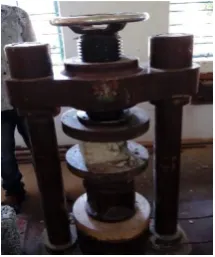
The cast specimens were tested on their respective schedules of testing. Cubes were tested for compression in Compression Testing Machine. Cylinders were tested for Split tension and beams were tested for Flexure.Out of many test applied to the concrete, this is the utmost important which gives an idea about all the characteristics of concrete. By this single test one judge that whether Concreting has been done properly or not.
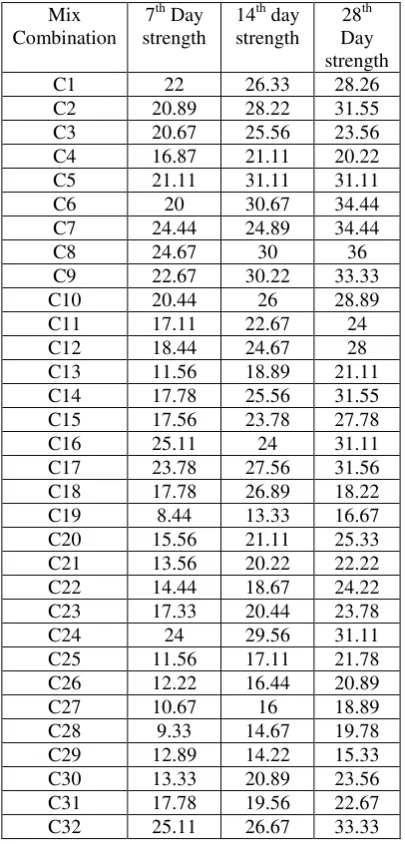
Table 1:Compression Test Results (Strength in N/mm2)
Mix Combination
7th Day strength
14th day strength
28th Day strength
C1 22 26.33 28.26
C2 20.89 28.22 31.55
C3 20.67 25.56 23.56
C4 16.87 21.11 20.22
C5 21.11 31.11 31.11
C6 20 30.67 34.44
C7 24.44 24.89 34.44
C8 24.67 30 36
C9 22.67 30.22 33.33
C10 20.44 26 28.89
C11 17.11 22.67 24
C12 18.44 24.67 28
C13 11.56 18.89 21.11
C14 17.78 25.56 31.55
C15 17.56 23.78 27.78
C16 25.11 24 31.11
C17 23.78 27.56 31.56
C18 17.78 26.89 18.22
C19 8.44 13.33 16.67
C20 15.56 21.11 25.33
C21 13.56 20.22 22.22
C22 14.44 18.67 24.22
C23 17.33 20.44 23.78
C24 24 29.56 31.11
C25 11.56 17.11 21.78
C26 12.22 16.44 20.89
C27 10.67 16 18.89
C28 9.33 14.67 19.78
C29 12.89 14.22 15.33
C30 13.33 20.89 23.56
C31 17.78 19.56 22.67
Fig 3: Split tensile test
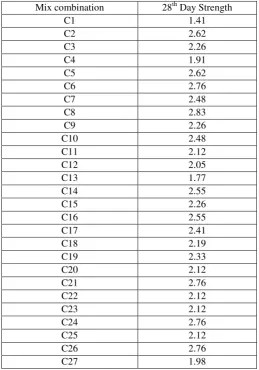
Table 2: Split Tensile Test results (N/mm2)
Mix combination 28th Day Strength
C1 1.41
C2 2.62
C3 2.26
C4 1.91
C5 2.62
C6 2.76
C7 2.48
C8 2.83
C9 2.26
C10 2.48
C11 2.12
C12 2.05
C13 1.77
C14 2.55
C15 2.26
C16 2.55
C17 2.41
C18 2.19
C19 2.33
C20 2.12
C21 2.76
C22 2.12
C23 2.12
C24 2.76
C25 2.12
C28 2.12
C29 1.69
C30 1.84
C31 1.91
C32 2.76
IV. CONCLUSION
By using these replacement materials in concrete it gives the good strength to the concrete It is economic and reduce the cost of construction material
Granite powder and marble powder are replaced upto 10 to 20% in concrete production its shows good strength in concrete.
REFERENCES
1) Indian standard code investigation for Aggregate for concrete, Specific gravity, Density, voids, Absorption and Bulking (Eleventh Revision)IS : 2386(part III)-1963, Bureau of Indian Standards.
2) Indian standards code of practice for Aggregate for Concrete, Particle Size and Shape(Eleventh Revision) IS: 2386(part I)-1963, Bureau of Indian standard.
3) Replacement of Cement for Establishing Sustainable Concrete, International Journal of Engineering Trends and Technology, June2013. 4) Indian Standard Code of Practice for Concrete Mix Proportioning Guidelines (First Revision) IS: 10262-2009, Bureau of Indian Standards,
July 2009, New-Delhi
5) Hemanth Kumar. Effect of Waste Ceramic Tiles in Partial Replacement of Coarse and Fine Aggregate of Concrete, International Advanced Research Journal in Science, Engineering and Technology, July 2014.
6) M.S.Shetty. Concrete Technology, S.Chand Publishers, New Delhi, 2005.
7) Veena G Pathan and Md. Gulfam Pathan. Feasibility and Need of use of Waste Marble Powder in Concrete Production, International Journal of Engineering Research and Applications April 2014.
8) Pooja J Chavhan. To Study the Behaviour of Marble Powder as Supplementary Cementicious Material in Concrete, April 2014
9) Nitisha Sharma. Review on Use of Waste Marble Powder as Partial Replacement in ConcreteMix, International Journal of Civil Engineering April 2015.
10) S Sarankokila. Experimental Investigation of Egg ShellPowder as Partial Replacement with Cement inConcrete, International Journal of Engineering Trendsand Technology, August 2014.
11) Amitkumar D Raval. Ceramic Waste: EffectiveReplacement of Cement for Establishing SustainableConcrete, International Journal of Engineering Trendsand Technology, June2013.