A Comparison of Atmospheric and Chemical
Properties of Inner Planets
A.Nag
1, A.Dan
2Assistant Professor, Modern Institute of Engineering and Technology, Hooghly, West Bengal, India1
Lecturer, B.P.C Institute of Technology, Krishnagar, West Bengal, India 2
ABSTRACT: A comparison among Venus, Earth and Mars, the so called inner planets, is elaborately examined in this
paper emphasizing on their origination, chemistry of atmospheres formed during accretion of the Earth and other terrestrial planets, habitability condition, features associated with wind, weather and cloud, conditions for greenhouse warming, related radiation pattern and Vertical acoustic profiles.
KEYWORDS: Venus, Earth, Mars, radiation pattern, greenhouse warming, acoustic profile.
I. INTRODUCTION
Earth, Venus, and Mars have secondary atmospheres, originated by the outgassing of volatiles from minerals during and after planetary accretion [1-4]. The outgassed volatiles formed atmospheres and oceans on Earth, and atmospheres of Mars, and Venus. The outgassing of ordinary chondritic material have implications for metamorphism on meteorite parent bodies [5]. In this paper we summarize the chemistry of the atmospheres formed on the Earth and other inner planets during their accretion. Indeed the atmospheres formed during Earth’s accretion were probably H2-rich and that steam atmospheres [6] formed only in special conditions. The heating during formation of the Earth should release volatiles such as H2O from the accreted material and lead to formation of an H2O-bearing atmosphere and oceans (after cooling) [7]. The volatiles released were composed primarily of H2O and CO2. The conversion of at least some of the kinetic energy of accreted planetesimals into heat led to impact outgassing of volatiles during the accretion of the Earth and other terrestrial planets. In this paper the chemistry of the atmospheres produced by impact outgassing during accretion of the Earth and other terrestrial planets have been overviewed assuming that volatiles are outgassed during accretion and that the extent of outgassing and the speciation of volatiles are given by chemical equilibrium calculations as it is a good assumption for modeling chemistry of impact generated atmospheres.
II. INNER PLANETS
A. EARTH.
and mantle-outgassed components in the atmosphere. Atmospheric removal by giant impacts may also lead to separation of the water budget from the other volatiles. If water were present as a condensed ocean, it would be removed in much smaller proportions compared to the atmospheric gases, and thus giant impacts preferentially remove CO2 and noble gases compared to water, which may explain the higher than chondritic H/C ratio of the bulk silicate Earth [13-18]. Earth’s atmosphere after the formation of the Moon could have been dominated by water with significant depletion of other volatiles. Subsequently, planetesimals were delivered to Earth during late accretion with sufficient impact velocities to substantially vaporize the planetesimal. Thus, Earth’s early atmosphere was generated by outgassing late-accreting chondritic planetesimals [19-21].
B. VENUS
Compared to Earth, Venus’s atmosphere has about 20 times higher abundance of Ne and a 20Ne/22Ne ratio closer to the solar value [22]. Thus, Venus must have lost a smaller fraction of the volatiles that were accreted during the main stages of planet formation. The abundance of noble gases on Venus reflects the absence of a late giant impact with substantial atmospheric erosion. Typical accretionary giant impacts onto a slowly spinning proto-Venus will generate magma oceans but remove little of the atmosphere [18-19]. So, Venus’s atmosphere should include both a nebular component and a chondritic component derived from late-accreting planetesimals.
C. MARS
The atmosphere of Mars is significantly fractionated in the lighter noble gases due to long term atmospheric escape. The strongest constraints on the origin of the martian atmosphere are the Kr isotopes measured in SNCs: the Kr isotopic ratios are identical to solar [23-28]. If Mars accreted in a couple million years, its entire growth occurred in the presence of the solar nebula. However, late planetesimals were accreted to all the terrestrial planets. These planetesimals are expected to have also delivered volatiles with a chondritic signature. Upon impact-induced vaporization, the vaporized projectile achieved escape velocity from Mars. Toward the end of terrestrial planet formation, the mean velocity of late-accreting planetesimals is expected to be high due to the dynamical stirring by the fully grown planets. Simulations of high-velocity impacts find that most of the vaporized projectile mass should be accreted to Earth and Venus but lost from Mars [20, 21] and so, the volatile components of late-impacting planetesimals may not be accreted to Mars.
III. HABITABILITY OF THE INNER PLANETS
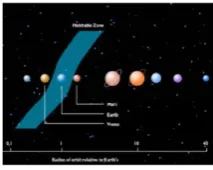
The factors controlling Habitability are
a) Distance from the Sun or main star b) Atmospheric Greenhouse effect c) Gravity
d) Composition (presence of water) e) Luminosity of the Sun or ones Main Star
Figure 1 shows the habitable zones. Fig. 1 Habitable one
IV. GREENHOUSE EFFECT
do with the greenhouse effect. Greenhouse Effect warms Venus, Earth, & Mars. On Venus, it is very strong, on Earth, it is moderate and on Mars it is weak.
The dashed lines show how the surface temperatures of Venus, Mars and Earth may have increased, due to greenhouse effect, as water vapor and other gases accumulated in the atmosphere. On Mars and Earth the increase was terminated when water vapor pressure in the atmosphere reached to the saturation vapor pressure, shown as the solid line, and freezing occurs. On Venus, temperature is higher as it is closer to the Sun and saturation was not achieved. All gases released to the atmosphere from volcanoes on Venus remain in the atmosphere, where they produce a “runway greenhouse effect” that has increased through time.
Evolution of the atmospheres of inner planets is shown in Figure 2 and the greenhouse warming of the inner planets is shown in Figure 3. In Figure Emission spectra of the inner planets is shown in Figure 4.
V. STRUCTURE OF TERRESTRIAL PLANET ATMOSPHERES
Mars, Venus, Earth all have warm tropospheres (and greenhouse gases) have warm thermospheres which absorb Solar X rays. Only Earth has a warm stratosphere an UV-absorbing gas (O3) All three planets have warmer surface temps due to greenhouse effect. Table I shows the atmospheric and chemical properties of the inner planets.
TABLE I
ATMOSPHERIC AND CHEMICAL PROPERTIES OF THE INNER PLANETS
Parameters Venus Earth Mars
Wind, Weather pattern Slow wind, no violent storms,
acid rain
Winds, hurricanes Winds, dust storms
Clouds, Hazes Sulfuric acid clouds H2O clouds, pollutions H2O and CO2 clouds, dust
Radius 6049 6371 3390
Reflectivity 72% 36% 25%
N2 3.4 78 2.7
O2 0.007 21 0.13
CO2 96 0.037 95
H2O 0.019 1~2.8 0.03
Surface Pressure 90 atm 1 0.006
No Greenhouse Average Surface Temperature −43 oC −17 oC −55 oC
Actual Average Surface Temperature 470 oC 15 oC −50 oC
Greenhouse Warming 513 oC 32 oC 5 oC
Solar Distance 0.72 AU 1.00 1.52
Stability of Water Unstable Stable (Ocean) Frozen
Atmospheric Mass(gm) 5.3 X 10²³ 5.3 X 10²¹ 2.4 X 10¹⁹
No of Moons 0 1 2
*
no greenhouse temperature is calculated by assuming no change to the atmosphere other than lack of greenhouse warming
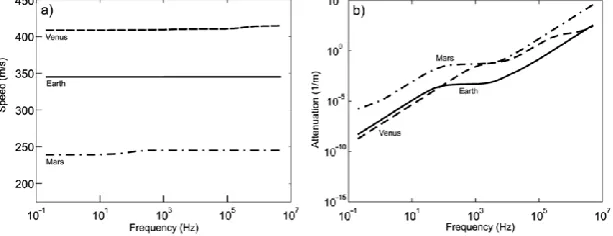
Diverse origins of terrestrial planet atmospheres are inferred from differences in the noble gas abundances and isotope ratios observed on Venus, Earth, and Mars. The model predictions for the frequency-dependent sound speed and acoustic attenuation in the surface atmospheres of Venus, Mars, and Earth are shown in Figure 5. Inflection points in both sound speed and attenuation indicate the presence of molecular relaxation processes.
Fig. 5 Frequency dependence of the (a) sound speed and (b) attenuation coefficient at the surfaces of the inner planets
The CO2-dominated martian environment has the highest absorption coefficient of the four planets at all frequencies except in the 1–10 kHz window where it is comparable to that of Venus’ atmosphere. On Venus, due to the elevated temperature, relaxational effects extend well into the MHz range, as indicated by the presence of the two attenuation inflection points. The environment of Venus is acoustically the “fastest,” Even though Mars and Venus have similar atmospheric compositions, the large difference in their temperatures plays a major role in the sound speeds.
VI.VERTICAL ACOUSTIC PROFILES
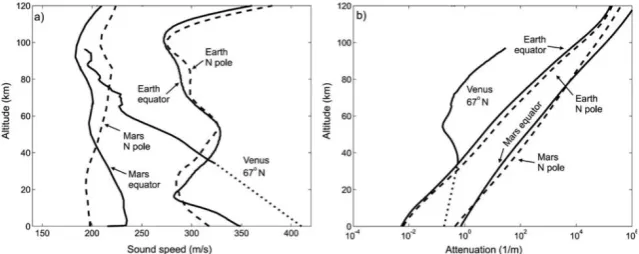
defined as SPL = 20 log10 |p(r)/pref|, where p(r) is the pressure amplitude at distance r, including attenuation, and pref = 20 μPa. Over the 1-m sensing path, SPL drops imperceptibly for Earth (from 65.686 to 65.634 dB), while on Venus the SPL drop is also fairly small (from 101.983 to 100.406 dB). The highly absorptive environment of Mars induces a much larger change (from 26.512 to 22.995 dB). The development of active acoustic sensors designed to extract information as the probe descends into the atmosphere requires a good prediction of sound propagation characteristics as a function of altitude. Figure 6 shows the vertical atmospheric profiles for sound speed (a) and acoustic attenuation (b) at 15 kHz. The profiles were calculated based on altitude dependent pressure, temperature, and density values extracted from general circulation models for Mars [29], and Earth [30].
Fig. 6. Vertical acoustic profiles at f = 15 kHz. (a) Sound speed profiles. The large sound speed swings, brought about largely by the temperature variability, mirror the atmospheric structure. (b) Attenuation profiles.
VII. CONCLUSION
Noble gas measurements on Earth [4-6] and the high-spin Moon-formation scenario [3] shed new light on the origin of Earth’s early atmosphere. Most of the mantle was degassed and most of the outgassed volatiles were lost during the final sequence of giant impacts onto Earth. Earth’s early atmosphere was dominated by late-accreting planetesimals. Venus did not suffer substantial atmospheric loss by a late giant impact and retains a higher abundance of nebular noble gases compared to Earth. The fastaccreting Mars has a solar noble gas signature inherited from the nebula, and its low mass led to gravitational escape of the volatile components of late planetesimals due to vaporization upon impact. Earth’s early atmosphere was generated by outgassing late-accreting chondritic planetesimals. . Acoustic attenuation in the surface atmospheres of Venus, Mars, and Earth shows inflection points in both sound speed and attenuation indicating the presence of molecular relaxation processes. All three inner planets have warmer surface temps due to greenhouse effect but only Earth has a warm stratosphere an UV-absorbing gas (O3). On Mars and Earth the increase of warming was terminated when water vapor pressure in the atmosphere reached to the saturation vapor pressure. On Venus, temperature is higher as it is closer to the Sun and saturation was not achieved. All gases released to the atmosphere from volcanoes on Venus remain in the atmosphere, where they produce a “runway greenhouse effect” that has increased through time against the habitability condition
REFERENCES
[1]Brown 1949; [2]Arrhenius et al. 1974; [3] Lange and Ahrens 1982a,b; [4]Abe and Matsui 1985 [5] Schaefer and Fegley 2007 [6] Abe and Matsui 1985) [7] Arrhenius et al (1974)
[8] Pepin, R.O. and D. Porcelli (2002) Rev. Min. Geochem. 47, 191.
[9] Halliday, A.N. (2013)GCA, in press.
[10] Ćuk, M. and S.T. Stewart (2012) Science338, 1047.
[11] Mukhopadhyay, S., et al. (in review) Nature.
[12] Mukhopadhyay, S. (2012) Nature 486, 101.
[13] Tucker, J.M. and S. Mukhopadhyay (2013) LPSC 44 (and EPSL, in review).
[14] Genda, H. and Y. Abe (2003) Icarus 164, 149.
[16] Canup, R.M. and E. Asphaug (2001) Nature 412, 708.
[17]Ahrens, T.J. (1993) AREPS 21, 525.
[18] Lock, S.J. and S.T.Stewart (2013) LPSC 44.
[19] Agnor, C.B., et al. (1999) Icarus 142, 219.
[20] Elkins-Tanton, L.T. (2008) EPSL 271, 181.
[21] Hirschmann, M.M. and R. Dasgupta (2009) Chem. Geol. 262, 4.
[22] Wieler, R. (2002) Rev. Min. Geochem. 47,
[23] Dauphas, N. and A. Pourmand (2011) Nature 473, 489.
[24] Walsh, K.J., et al. (2011) Nature 475, 206. [25] Raymond, S.N., et al. (2009) Icarus 203, 644.
[26] Stewart, S.T. and Z.M. Leinhardt (2012) ApJ 751, 32.
[27] de Niem, D., et al. (2012) Icarus 221, 495.
[28] Shuvalov, V. (2009) MAPS 44, 1095.
[29] http://www-mars.lmd.jussieu.fr