I
nternational
J
ournal of
I
nnovative
R
esearch in
S
cience,
E
ngineering and
T
echnology
Volume 3, Special Issue 3, March 2014
2014
I
nternational
C
onference on
I
nnovations in
E
ngineering and
T
echnology (ICIET’14)
On 21st & 22nd March Organized by
K.L.N. College of Engineering, Madurai, Tamil Nadu, India
Copyright to IJIRSET www.ijirset.com 292
M.R. Thansekhar and N. Balaji (Eds.): ICIET’14
Discern Of Gestures and Tracking of Human
Using Kalman Filter
S. Kanagamalliga
1, Dr. S. Vasuki
2, R.Sundaramoorthy
3, J.Allen Deva Priyam
4, M.Karthick
51
Assistant Professor, Department of Electronics and Communication Engineering, Velammal College of Engineering and Technology, Madurai ,India
2
Professor Head , Department of Electronics and Communication Engineering, Velammal College of Engineering and Technology, Madurai, India
3
U.G Student, Department of Electronics and Communication Engineering, Velammal College of Engineering and Technology, Madurai, India
4
U.G Student, Department of Electronics and Communication Engineering, Velammal College of Engineering and Technology, Madurai, India
5
U.G Student, Department of Electronics and Communication Engineering, Velammal College of Engineering and Technology, Madurai, India
ABSTRACT--This paper provides the interrelated topics of action recognition and detection of Humans. The foreground clutter is used to segment the human action from the video using the statistical method of Adaptive Background Mixture Model. The descriptor can be computed from drawing the boundary box for the humans in the video and the counting of actions is also displayed. The values for features are calculated from the descriptor. The descriptor allows for the comparison of the underlying dynamics of two space-time video segments irrespective of spatial appearance, such as differences induced by clothing, and with robustness to clutter. The calculated feature values are taken for extraction of human actions. An associated similarity measure is introduced that admits efficient exhaustive search for an action template, derived from a single exemplar video, across candidate video sequences also under occlusive conditions the human is detected using the adaptive filter.
KEYWORDS—Action detection, Action Representation, Foreground, Descriptor,Adaptive Background Mixture Model, Color Features, Kalman Filter
I. INTRODUCTION A. Motivation:
This paper addresses the interrelated topics of detectingand localizing space-time patterns in a video. Specifically, patterns ofcurrent concern are those induced by human actions. Here, “action” refers to a simple dynamic pattern executed by an actor over a short duration of time (e.g., walking and hand waving). In contrast, activities can be considered as compositions of actions, sequentially, in parallel, or both. Potential applications of the presented research include video indexing and browsing, surveillance, visually guided interfaces, and tracking initialization.. Action detection seeks to detect and spatiotemporally localize an action, represented by a small video clip (i.e., thequery), within a larger video that may contain a large corpus of unknown actions. In the present work, action spotting is achieved by a single query video that defines the action template, rather than a training set of (positive and negative).
Copyright to IJIRSET www.ijirset.com 293
M.R. Thansekhar and N. Balaji (Eds.): ICIET’14
1) Background clutter arises when actions are depicted in front of complicated, possibly dynamic, backdrops and 2) foreground clutter arises when actions are depicted with distractions superimposed, as with dynamic lighting, pseudo transparency (e.g., walking behind a chain-link fence), temporal aliasing, and weather effects (e.g., rain and snow). It is proposed that the choice of representation is key to meeting these challenges: Arepresentation that is invariant to purely spatial patternallows actions to be recognized independent of actorappearance; a representation that supports fine delineations of space-time structure makes it possible to tease action information from clutter. Also, for real-world applications such as video retrieval from the web, computational efficiency is a further requirement.
B. Related work:
A wealth of work h a s c o n s i d e r e d the a n a l ys i s of human actions from v i s u a l data, e.g., [1],[2].One m a n n e r o f organizing this literature is interms of the underlying representation of actions. A brief corresponding survey of representative approaches follows: Tracking-based methods begin by tracking body parts,joints, or both and classify actions based on features extracted from the motion trajectories, e.g.,[3],[4],[5], [6]. General impedimentsto f u l l y a u t o m a t e d operation include tracker initialization and robustness .Consequently, much o f this work ha s been realized with some degree of human intervention.
Other me t ho d s have classified actions detection and tracking based on features extracted from c o l o r h i s t o g r a m s body shape sasrepresented by contours or silhouettes, with the motivation thatsuch representation sarero bust to spatial appearance details This class of approach relies on figure-ground segmentation across space-time,with the drawback tha trobust segmentation remain selusive in uncontrolled settings .Further,silhouette do not provide information on the human body limbs when they are infront of the body(i.e.,inside thesilhouette) and thus yield ambiguous information.
II. ACTION DETECTION DATASETS
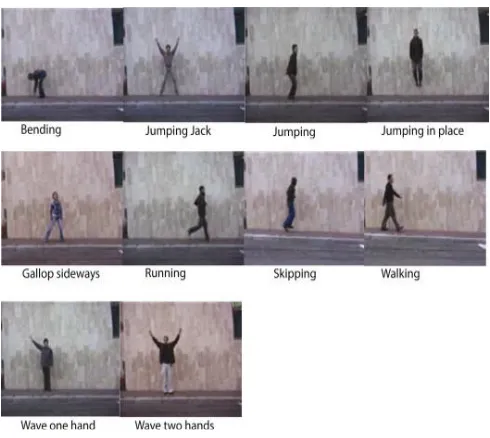
The Weizmann dataset consists of 10 action categories with 9 people, resulting in 90 videos. In the Weizmann dataset, a static and simple background is used throughout the videos. Simple human actions of `running', `walking', `jumping-jack', `jumping forward on two legs', `jumping in place on two legs', `galloping sideways', `waving one hand', `waving two hand', and bending' are performed by the actors. The resolutions of the videos are 180*144, 25fps. Both dataset are composed of relatively simple action-level activities, and only one participant appears in the scene. What we must note is that these datasets are
designed to verify the `classification' ability of the systems on simple actions. Each video of the datasets contains executions of only one simple action, performed by a single actor. That is, an entire motion-related feature extracted from each video corresponds to a single action, and the goal is to identify the label of the video while knowing that the video belongs to one of a limited number of known action classes. Further, all actions in both datasets except for the `bend' action of the Weizmann dataset are periodic actions (e.g. walking), makingthe videos suitable for action-level classification systems. The Action detection datasets are used in various research and scholarly articles for video processing the below dataset is a widely used dataset in the video processing research since it is widely accepted by all the research areas.
Fig 1.Weizmann datasets
Copyright to IJIRSET www.ijirset.com 294
M.R. Thansekhar and N. Balaji (Eds.): ICIET’14
III. STATISTICAL METHOD FOR FOREGROUND
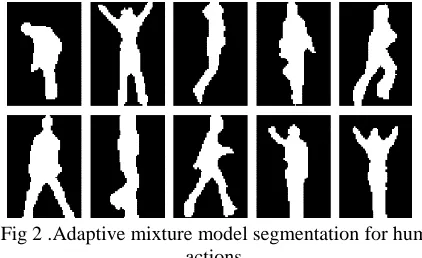
Adaptive background mixture model is used for extraction, namely, segmenting a human body or objects from a background, is usually the first and enabling step for many high-level vision analysis tasks, such as video surveillance, people tracking and activity recognition [5].Once a background model is established humans in the video frames can be detected as the difference between the current video frame and the background model. In this work, as a part of our on-going research effort to develop automated video-based activity monitoring analysis for eldercare, we propose an accurate and robust background extraction and human tracking algorithm which is capable of operating in real-world, unconstrained environments with complex and dynamic backgrounds. In our eldercare research project, we use video cameras to collect information about elderly residents' daily extract important activity information to perform automated functional assessment and detect abnormal events, such as a person falling onto the floor.
Fig 2 .Adaptive mixture model segmentation for human actions
IV. BOUNDINGBOX REPRESENTATIONS
Incorporating the person bounding box into the classifier: Previous work on object classification [7] demonstrated that background is often correlated with objects in the image (e.g. cars often appear on streets) and can provide useful signal for the classifier. The goal here is to investigate different ways of incorporating the background information into the classifier for actions in still images. We consider the following three approaches:
A. “Person": Images are centered on the person performing the action, cropped to contain1:5_ the size of the bounding box and re-sized such that the larger dimension is 300pixels. This setup is similar to that of Gupta et al. , i.e. the person occupies the majority of the image and the background is largely suppressed.
B1. “Person-Background’: The original images are resized so that the maximum dimension of the 1:5_ rescaled person bounding box is 300 pixels, but no cropping is performed. The 1:5_ rescaled person bounding box is then used in both training and test to localize the person in the image and provides a coarse segmentation of the image into foreground (inside the rescaled person bounding box) and background (the rest of the image). The foreground and background regions are treated separately. The final kernel value between two images X and Y represented using foreground histograms xf and yf , and background histograms xb and yb, respectively, is given as the sum of the two kernels, K(x;y) = Kf (xf ;yf )+Kb(xb;yb).
B2. “Person-Image”: This setup is similar to B1, however, instead of the background region, 2-level spatial pyramid representation of the entire image is used. Note that approaches A, B1 and B2 use the manually provided person bounding boxes at both the training and test time to localize the person performing the action. This simulates the case of a perfectly working person detector.
V. COLOR FEATURES
Human vision system is more sensitive to color information than grey levels so color is the first candidate used for feature extraction. Color histogram is one common method used to represent color contents. The algorithm follows a similar procession: selection of a color space, representing of color features, and matching algorithms. It is the most common one used for images on computer because the computer display is using the combination of the primary colors (R,G,B) to display any perceived color. Each pixel in the screen is composed of 3 points which is stimulated by R,G,B electron gun separately. However RGB space is not perceptually uniform so the color distance in RGB color space does not correspond to color dissimilarity in perception. Therefore we prefer to transform image data in RGB color space to other perceptual uniform space before feature extraction
VI. TRACKING USING KALMAN FILTER
Copyright to IJIRSET www.ijirset.com 295
M.R. Thansekhar and N. Balaji (Eds.): ICIET’14
VII. IMPLEMENTATION AND SIMULATION RESULTS
Let us consider the input as video sequence from Weizmann datasets which is related to single human activity (like avi or mpeg format).From that, we evaluate the performance for silhouette extraction, bounding box representations by simulations conducted in MATLAB
A. Input video
Let us consider the input as Weizmann datasets which it perform human activity like bend, jump, walk, run etc...where, we had taken two activities as bend and jump. Bend activity consist of 84 frames. Similarly walk activity consists of 67 frames.
Fig 3. Consider a single human activity for single video. (a) Human activity like walk.
B. Background segmentation
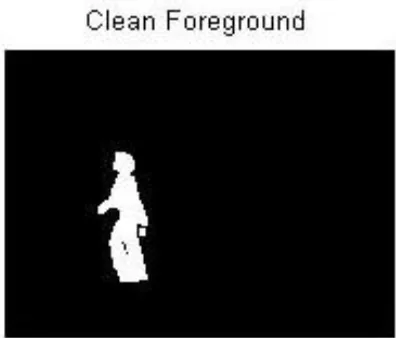
For single human activity recognition silhouette segmentation is accurate and robust. It is one of the background modelling. It can be used under Gaussian mixture model. Let
𝐼(𝑥, 𝑦)
be a new image entered into a system, a reconstructed image.𝐼
′𝑥, 𝑦 𝑡
is obtainedusing M eigenvectors information. A moving object,𝐷
𝑖(𝑥, 𝑦)
is adifference between
𝐼(𝑥, 𝑦)
and𝐼
′𝑥, 𝑦 𝑡
as the following equation:𝐷
𝑖𝑥, 𝑦 = 𝐼 𝑥, 𝑦 − 𝐼
′𝑥, 𝑦 𝑡
Fig. 4Background segmentation for walk activity
C. Bounding box representation
We represent an activity video as a composition of its scene background and the foreground videos of the sub events composing the activity. Sub-events are atomic-level actions (e.g. stretching an arm, withdrawing an arm, and moving forward), for example, pushing activity is composed of multiple sub events which it includes one person stretching an arm, other person pushed away.
Fig 5 Bounding Box representation
Formally, we represent an activity video in V by its three components V = (b,G,S), Where b is the background image, G describes the spatial location of the activity’s centre, where G=(c ,d ,o).S is the sub set of events,
𝑠 =
𝑠
1, 𝑠
2… . . 𝑠
𝑖 where𝑠
𝑖is the sub event. Each 𝑠𝑖containsCopyright to IJIRSET www.ijirset.com 296
M.R. Thansekhar and N. Balaji (Eds.): ICIET’14
Then,𝑎𝑖 indicates the actor id performing the sub-event,
𝑟𝑖 is the normalized bounding box specifying the
sub-event’s spatial location, which is described relatively with respect to
𝑟
𝑖= 𝑟
𝑖 𝑙𝑒𝑓𝑡, 𝑟
𝑖𝑟𝑖𝑔 𝑡, 𝑟
𝑖𝑒𝑖𝑔 𝑡, 𝑟
𝑖𝑤𝑖𝑑𝑡 Where𝑟
𝑖Multiplied by d specifies the relative occurring region of thesub-event 𝑠𝑖in the video. Where, is a normalized time
interval specifying the centre of the interval and its duration.Let the starting time of the sub event be 𝑠𝑡𝑎𝑟𝑡𝑖
and the ending time of it be 𝑒𝑛𝑑𝑖.Then
𝑡
𝑖𝑙𝑜𝑐 =𝑠𝑡𝑎𝑟𝑡𝑖+ 𝑒𝑛𝑑𝑖2.𝑜
𝑡
𝑖𝑑𝑢𝑟
=
𝑒𝑛𝑑𝑖 –𝑠𝑡𝑎𝑟𝑡𝑖 𝑜Furthermore, foreground videos of the sub-events, are maintained independently
D. Color Features
The idea of an intensity histogram can be generalized to continuous data, say the signals represented by real functions or images represented by functions with two-dimensional domain.
Let𝑓 ∈ 𝐿1 𝑅𝑛 (see Lebesgue space)
then the cumulative histogram operator H can be defined by:
𝐻 𝑓 𝑦 = 𝜇 𝑥: 𝑓 𝑥 ≤ 𝑦
µ is the Lebesgue measure of sets. H(f)In turn is a real function. The (non-cumulative) histogram is defined as its derivative.
𝑓 = 𝐻 𝑓′
Fig. 6 Color Features in RGB Histogram
By comparing histograms signatures of two images and matching the color content of one image with the other, the color histogram is particularly well suited for the problem of recognizing an object of unknown position and rotation within a scene
E. Action Detection and Tracking of Human using Kalman Filter
In order to use the Kalman filter to estimate the internal state of a process given only a sequence of noisyobservations, one must model the process in accordance with the framework of the Kalman filter
Fig. 8 Detection and Tracking of Human
This means specifying the following matrices: Fk, the
state-transition model; Hk, the observation model; Qk, the
covariance of the process noise; Rk, the covariance of the
observation noise; and sometimes Bk, the control-input
model, for each time-step, k, as described below.
The Kalman filter model assumes the true state at time k is evolved from the state at (k−1) according to
Copyright to IJIRSET www.ijirset.com 297
M.R. Thansekhar and N. Balaji (Eds.): ICIET’14
Where
𝐹
𝐾is the state transition model which is applied tothe previous state 𝑋𝐾−1
𝐵𝐾 is the control-input model which is applied to
the control vector 𝑈𝐾
𝑊𝐾 is the process noise which is assumed to be
drawn from a zero mean multivariate normal distribution with covariance𝑄𝐾
𝑊
𝐾~𝑁 0, 𝑄
𝐾At time K an observation (or measurement) 𝑍𝐾 of the true
state 𝑋𝐾 is made according to
𝑍
𝐾= 𝐻
𝐾𝑋
𝐾+ 𝑉
𝐾Where𝐻𝐾 is the observation model which maps the true
state space into the observed space and 𝑌𝐾 is the
observation noise which is assumed to be zero mean Gaussian white noise with covariance𝑅𝐾
𝑉
𝐾~𝑁 0, 𝑅
𝐾The initial state, and the noise vectors at each step
{
𝑋
0,
𝑊
1, ….
𝑊
𝐾𝑉
1… … 𝑉
𝑘}
are all assumed to bemutually independent.
VIII.CONCLUSION
We have presented a new approach to detect the action and track the human using a single exemplar video. Adaptive background mixture model is used to segment the human from the background. Bounding box is drawn to calculate the values for feature extraction. RGB histogram values are taken to enhance the video and also to calculate the features. Finally, Kalman filter is used to detect the actions of human in the video and also to track the human.
REFERENCES
[1] P.Turaga, R .Chellappa, V . Subrahmanian, and O. Udrea, “Machine RecognitionofHumanActivities: A Survey,” IEEE Trans. Circuits andSystemsforVideoTechnology, vol.18, no.11, pp.1473-1488,Nov.2008
[2] R.Poppe,“A Survey on Vision-BasedHuman Action Recognition,”ImageandVision Computing,vol.28,no.6,pp.976-990,2010.
[3] Y. Yacooband M.Black,“ParameterizedModelingand
Recognition of Activities,”Computer Vision and Image
Understanding, vol.73,no.2,pp. 232-247,1999.
[4] D.Ramananand D.Forsyth, “AutomaticAnnotationofEveryday Movements” proc.Neural Information Processing Systems 2003
[5] C.Fanti, L. ZelnikManor, and P. Perona,“HybridModels for HumanMotionRecognition,”Proc.IEEEConf.ComputerVisionand Pattern Recognition,pp. 1166-1173,2005.
[6]S.Ali,A.Basharat,and M.Shah,“ChaoticInvariantsforHuman
Actions Recognition” Proc 11th IEEE Int’l Conf. computer
vision 2007