ISSN(Online): 2320-9801 ISSN (Print): 2320-9798
I
nternational
J
ournal of
I
nnovative
R
esearch in
C
omputer
and
C
ommunication
E
ngineering
(An ISO 3297: 2007 Certified Organization)
Vol. 3, Issue 4, April 2015
Fault Prediction and Relay Node Placement in
Wireless Sensor Network
Smita S. Kharade, Simran R. Khiani
M.E. Student, Dept of Computer, G.H. Raisoni College of Engg and Mgt, Savitribai Phule Pune University, India.
Assistant Professor, Dept. of I.T. G. H. Raisoni College of Engg and Mgt, Savitribai Phule Pune University, India.
ABSTRACT: In Wireless Sensor Network (WSN), collected data will be faulty due to internal and external influences, such as environmental conditions, communication link failure, battery drain, etc. These are reduces the reliability of the WSN network. Faults may affect on quality of services (QoS), in WSN networks faults may produce incorrect data provided by sensor nodes or the network may make a misjudgment on nodes or the network and placing relay nodes to tolerate these faults, to improve Qos and reliability of the network.
In this work, we propose the prediction model Support Vector Machine (SVM) to predict faulty nodes in wireless sensor network and add minimum number of relay nodes as compared to existing system to recover the network proactively from the faults and to continue working successfully.
KEYWORDS: Wireless Sensor Network (WSN), Support Vector machine (SVM), Fault Prediction, Fault Recovery, Relay Node Placement.
I. INTRODUCTION
A Wireless Sensor Network (WSN) is a collection of many various types of wireless sensor nodes for the purpose of data communication. These sensor nodes pass their information through the network cooperatively to the sink node. The sensor nodes sense various conditions such as temperature, humidity, pressure, etc. The different wireless sensor networks have been developed for different applications like military, healthcare, civil, bridge monitoring, home automation, traffic monitoring, etc.[4][6]
ISSN(Online): 2320-9801 ISSN (Print): 2320-9798
I
nternational
J
ournal of
I
nnovative
R
esearch in
C
omputer
and
C
ommunication
E
ngineering
(An ISO 3297: 2007 Certified Organization)
Vol. 3, Issue 4, April 2015
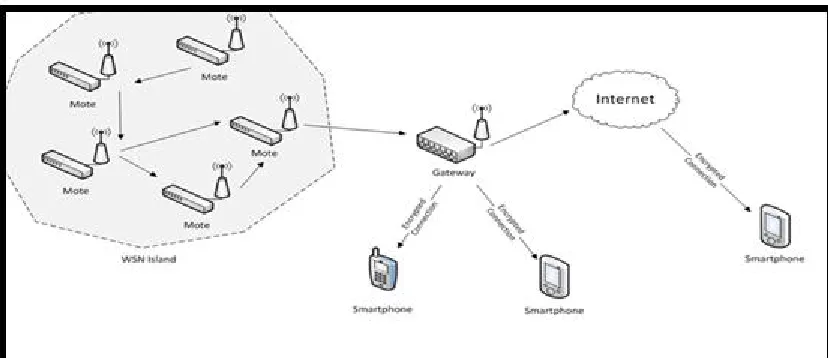
Figure 1 shows the architecture of wireless sensor networks. It contains various sensor nodes, the nodes are transmits their data to the main location cooperatively.
The sensors in WSN are inexpensive, low power devices and which have limited resources. In most wireless sensor network, battery is the only source of energy. The faults in WSN are occurs due to various reasons like hardware failure, communication link failure, malfunctioning, environmental hazards, battery exhaustion, etc. May lead to produce incorrect data and reduce reliability and quality of services (QoS) and make misjudgement on events. [5][7][15].
The WSN networks recover from faults proactively is the solution of this problem. When predict the faulty nodes before they actually faulty and repaired this faulty nodes at that time, save the time and continue working of wireless sensor network without disturbing for this purpose proposed the new prediction model to predict faulty nodes in WSN proactively, which results more reliability, availability, and QoS, etc. and placing minimum number relay nodes to recover the faulty nodes in WSN. [18]
II. RELATED WORK
In paper [1] author discuss about the prediction of the patients disease by using naïve Bayesian classification. The naïve bayes contained in the data sample by observing them individually, independent of each other. It based on bayes rule of conditional probability. It uses all attributes contained in data and analyses them individually as though they are equality important and independent of each other
In paper [2] author discuss about the J48 classifier used for the purpose of quality prediction in software. A decision tree is a predictive machine training model that decides the target values (dependent variables) of a new sample based on various attributes of the available data. The J48 decision tree classifier follows the simple algorithm in order to classify the new items it first needs to create a decision tree based on the attribute values of the available training data.
In paper [3] author presents a forecasting model i.e. ARIMA (p,d,q) using the data of real WSN applications. They propose an algorithm to find suitable ARIMA model and forecast, which corrects the anomalous data at sink for each sensor node with ARIMA, forecast values at any point of time. The methods uses ARIMA model to construct a prediction model for sampled data. In this method the model is being run on both sensor nodes and at the base station. If the difference between values sampled at sensor node model is smaller than a predefined tolerance, the value is not transmitted over network to the base station.
In paper [18] author discuss about how to place the relay nodes in WSN. There are two ways to place relay nodes in WSN.
- Stenerization of Edges:- Suppose u and v be two target nodes, we want to place minimum number of relay nodes in between u and v then follow two steps.
One way steinerization: In one way steinerization the directed edge uv is considered and create a one way path from u to v and place a minimum number of relay nodes from u to v when necessary.
Two way steinerization: In two way steinerization the undirected edge uv is considered and create a two way path from u to v and place a minimum number of relay nodes from u to v when necessary.
- Segmentation of neighborhood: Segment or divide the neighboring area of a particular node into small region such that the nodes within the same region. Suppose u be the one node then split the neighbor of u with the pair of positive values (r1,r2). First we create a circle with radius r1 at node u and also create a square just large to recover the circle. The n segment this square from left to right and top to bottom into small cells with length is diagonally equal to r2.
In paper [6] author deploys the additional relay nodes by using iterative algorithms to achieve desired connectivity. steiner MPC algorithm is to deploy minimum number of relay nodes in which the algorithm create a path between two nodes like u and v and placing the relay nodes when necessary.
In paper [19] the author deploying relay nodes for fault tolerant in the heterogeneous wireless sensor networks, which having different transmission radius. There are two categories for deploying relay nodes.
- Partial Fault Tolerant Relay Node Placement (PFRP): In PFRP placing the minimum number of relay nodes between every pair of sensor node.
ISSN(Online): 2320-9801 ISSN (Print): 2320-9798
I
nternational
J
ournal of
I
nnovative
R
esearch in
C
omputer
and
C
ommunication
E
ngineering
(An ISO 3297: 2007 Certified Organization)
Vol. 3, Issue 4, April 2015
III.PROPOSED ALGORITHM
A. Description of the Proposed Algorithm:
Aim of the proposed algorithm is to predict the faulty nodes before they actually faulty and to place minimum number of relay nodes as compared to existing system to recover the network from faults.
Support Vector Machine (SVM) Algorithm for fault prediction:
Step 1: Let PTis = path that connect node i to sink s, then obtain the value for every node ni in path PTis.
Like,
= delay bound between node ni & ni-1
= jitter between node ni & ni-1
=signal to noise ratio between node ni & ni-1
Thrput i,i-1 = throughput between node ni & ni-1
Step 2: Build a data set of failed nodes for variables mentioned in step 1 for these nodes for time Step 3: Use SVM function for extracting features from the dataset in step 2.
(3)
Subject to the condition
(4)
For j = 1,2,…,n
Step 4: Collect the four parameters for all nodes after time and using extracted features in Step2 and using SVM function in Step3 to predict whether node will fail or not.
Algorithm for Relay Node Placement Relay Node Placement Techniques: 1. One way Steinerization
Where, - Directed edge from ‘u’ and ‘v’ - Euclidian distance from ‘u’ and ‘v’
2. Two way Steinerization
ISSN(Online): 2320-9801 ISSN (Print): 2320-9798
I
nternational
J
ournal of
I
nnovative
R
esearch in
C
omputer
and
C
ommunication
E
ngineering
(An ISO 3297: 2007 Certified Organization)
Vol. 3, Issue 4, April 2015
- Euclidian distance.
Algorithm for One way Partial Fault-tolerant Relay Node Placement (PFRP)
ISSN(Online): 2320-9801 ISSN (Print): 2320-9798
I
nternational
J
ournal of
I
nnovative
R
esearch in
C
omputer
and
C
ommunication
E
ngineering
(An ISO 3297: 2007 Certified Organization)
Vol. 3, Issue 4, April 2015
Algorithm for Two Way Partial Fault-tolerant Relay Node Placement (PFRP)
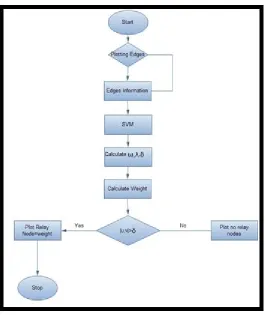
Figure 3 Flow chart of Algorithm of Two Way Partial Fault-tolerant Relay Node Placement
IV.SIMULATION RESULTS
There will be two parts for getting results. 1. For Fault Prediction:
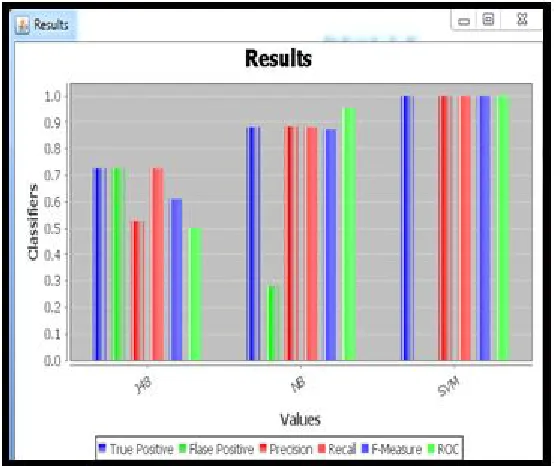
The Support Vector Machine (SVM) is compared to J48 and naïve bayes classifier. In this six parameters are considered true positive, false positive, precision, recall, F-measure and ROC. The performance of the SVM is better than j48 and naïve bayes. These six parameters are calculated by following formulas.
- True positive:-Faulty nodes correctly predict as faulty
- False positive:-Non faulty nodes are incorrectly identified as faulty - True negative:-Non faulty nodes correctly identified as non faulty - False negative:-Faulty nodes incorrectly identified as non faulty - Precision= No. of true positives/No. of true positive + false positive - Recall=No. of true positives/No. of true positives + No. of false negatives - F-Measure=2.Prcision.Recall/Precision + Recall
- ROC (Receiving Operating Characteristics):- It is a curve plotting true positive rate against the false positive rate at various threshold settings.
ISSN(Online): 2320-9801 ISSN (Print): 2320-9798
I
nternational
J
ournal of
I
nnovative
R
esearch in
C
omputer
and
C
ommunication
E
ngineering
(An ISO 3297: 2007 Certified Organization)
Vol. 3, Issue 4, April 2015
Figure 4 Comparison of SVM, J48 and naïve bayes classifiers
2. For Relay Node Placement:
The number of relay nodes which are placed in proposed system is less than 3 to existing system. Therefore the performance of the proposed system is better than existing system, because the minimum number of relay nodes required send the packet from sensor to sink as compared to existing system, so the time required to sending packet and cost of relay nodes reduces.
The formulas of calculating relay nodes in proposed system, which are as follows: - One Way Stenerization:-
- Two Way Stenerization:-
ISSN(Online): 2320-9801 ISSN (Print): 2320-9798
I
nternational
J
ournal of
I
nnovative
R
esearch in
C
omputer
and
C
ommunication
E
ngineering
(An ISO 3297: 2007 Certified Organization)
Vol. 3, Issue 4, April 2015
Figure 5 Comparison of Existing System and Proposed System for Relay Node Placement
V. CONCLUSION AND FUTURE WORK
Faults occurring in WSNs are common due to various reasons such as battery exhaustion, malfunctioning, etc. This may jeopardize the reliability of WSN network. Existing solutions use reactive approaches for relay node placement in WSN to tolerate the faults. In proposed system a proactive technique is used to predict nodes that are likely to become faulty in WSN and then they will be tolerate proactively to placing minimum number of relay nodes to continue network communication.
In future the distributed wireless sensor network is developed for the purpose of fault prediction and fault tolerant. The distributed wireless sensor network contain the more than one sink node, so the load of on one sink node is decrease and time is reduces for complete the all process.
REFERENCES
1. Manjusha K. K, K.Sankaranarayanan, Seena P, “Prediction of different dermatological conditions using Naive Bayesian Classification”. International Journal of Advanced Research in Computer Science and Software Engineering.vol. 4, Issue 1, Jan2014.
2. Laveena Sehgal, Neeraj Mohan, Dr. Parvinder S. Sandhu, “Quality Prediction Based Software Using Decision Tree Approach”. International Conference on Computer Engineering and Multimedia Technologies(ICCEMT 2012),September 8-9,2012, Bankok (Thialand).
3. Abhishek Kr. Singh, Bollibisai Giridhar, Partha Sarathi Mandal, “Fixing Data Anomalies with Prediction Based Algorithm in Wireless Sensor Network”,arxiv:1111:3334v/[Cs.Dc] 14 Nov 2011.
4. Benahmed khelifa, H. Haffaf, Merabti Madjid, and David Llewellyn Jones, “Monitoring Connectivity in Wireless Sensor Networks”. Proceedings of the 14th IEEE Symposium on Control and information Technology (ISCC), pages 507-512 print ISBN-978-1-4244-4672-8 (2009).
5. Biljana Riseska Stojkoska, Kliment Mahoski, “Comarisions of Different Data Prediction Methods for Wireless Sensor Networks”. The 10th Conference for Informatics and Information Technology (IIT) (2013).
ISSN(Online): 2320-9801 ISSN (Print): 2320-9798
I
nternational
J
ournal of
I
nnovative
R
esearch in
C
omputer
and
C
ommunication
E
ngineering
(An ISO 3297: 2007 Certified Organization)
Vol. 3, Issue 4, April 2015
7. Ehsan Warriach, Tuan Anh Nguyen, Kenji Tei, “Fault Detection in Wireless Sensor Network: A Hybrid Approach”. Proceeding of the 11th International Conference on Information Processing in Sensors Networks,IPSN12, April 16-20,2012, Bijing(China)
8. Errol L. Lloyd and Guoliang Xue, “RelayNode Placement in Wireless Sensor Network”. IEEE Transactions on Computer. (2007). 9. Er. Saurabh, Dr. Rinkle Rani Aggarwal, “A Review of Fault Detection Technique for Wireless Sensor Networks”. IJCSI International
Journal of Computer Science. Vol.10, Issue4, No-1, July 2013.
10. Femi A. Anderohunmu, Giacomo Paci, David Brunelli, Jeremiah D. Deng, Luca Benin I, Martin Purvis, “An Application – Specific Forecasting Algorithm for Extending WSN Lifetime”. IEEE International Conference on Distributed Computing in Sensor Systems, DOI 10.11 09/DCOSS.2013.51 (2013).
11. G. Vennira Selvi, R. Manoharan, “Cluster Based Fault Identification and Detection Algorithm for WSN – A Survey”. International Journal of Computer Trends and Technology. (IJCTT), Vol 4, Issue 10 Oct2013.
12. Guiyi Wei, Yun Ling, Binfeng Guo, Bin xiao, Athanasios V. Vasilakos, “Prediction Based Data Aggregation in Wireless Sensor Networks: Combining Grey model and Kalman Filter”. Journal Computer Communications,793-802,34(2011).
13. Hai Liu, Amiya Nayak, and Ivan Stojmenovic, “Fault Tolerant Algorithms / Protocols in Wireless Sensor Networks”,DOI 10.1007/978-1-84882-218-4-10,Springer Verlag, London Limited (2009).
14. Lilia Paradis and Qi Han, “A Survey of Fault Management in Wireless Sensor Networks”. Journal of Network and Systems Management.DOI:10:1007/10922-007-9062-0,Springer Science + Business Media LLC (2007).
15. Luciana Moreira Sa de Souza, Harald Vogt, Michale Beigl, “A Survey on Fault Tolerance in Wireless Sensor Networks”. (2013) 16. Muhammad Asim and Hala Mokhatar and Madjid Merabit, “A self managing fault management mechanism for wireless sensor
networks”. International Journal of Wireless and Mobile Networks, Vol2, NO-4, November (2010).
17. Ning Li and Jennifer C. Hou, “A fault Tolerant Topology Control Algorithm for Wireless Sensor Networks”. Proceedings of the 10th
annual International Conference on Mobile Computing and Networking. (2004).
18. Xiaofeng Han, Xiang cao, Errol L. Llod, Chien Chung Shen, “Fault Tolerant Relay Node Placement in Heterogeneous Wireless Sensor Networks”. IEEE Transactions on Mobile Computing. (2010).
19. P. Rachelin sujae, T. Saravanan and S. Sarvana “Sensor Capacity Based Relay Node Placement in Heterogeneous Wireless Sensor Networks” Middle East Journal of Scientific Research, 20(12),2542-2544(2014).
20. Smita Kharade, Simran Khiiani “Fault Prediction in Wireless Sensor Network – A Survey” Internatonal Journal of Science and Research (IJSR), Volume 3, Issue 10, (2014).
BIOGRAPHY