ISBA, a Technical Information System for the Construction, Operation, Service,
Backfitting and Aging Management of Nuclear Power Plants
Horst Schillberg 1) , Holger Drozella 2)
1) Framatome-ANP (Advanced Nuclear Power) GmbH, Erlangen, FRG 2) INIT GmbH, Bochum, FRG
ABSTRACT
ISBA (i.e. an acronym based on the German, meaning “Civil engineering and plant layout information system”) is a tool that was initially developed for the application in the civil engineering field at the planning of nuclear power plants. Today it has reached a state where it can provide information for the entire civil engineering and plant layout field, not only at the design stage, but also throughout the entire lifetime of the plant. That covers the construction phase, where the basic information is created, the operation and service as well as backfitting and aging management.
The system is built on an object-oriented database. Information retrieval is gained via several viewers by means of a 3-D model or intelligent 2-D plan. The latest viewers available today are Internet browsers, which enable users worldwide to practice concurrent engineering by utilizing one central data pool.
INTRODUCTION
Civil engineering work and plant layout for nuclear power plants demands a big amount of information that is produced by numerous engineers involved. It is a must to hold redundant data as small as possible in order to avoid e.g. the erroneous use of not up to date planning versions in the design process. In addition the communication of separate software systems through interfaces implies also the well-known risk of information loss. For that reason the information system ISBA was developed as one central information pool. At the beginning it was the aim to provide in one system information related only to civil engineering. Today all information of interest may be managed concerning not only the planning and construction phase but also operation, service and backfitting aspects as well as aging phenomena of the plant. This information can belong to disciplines as e.g. structural design, routings and component arrangement with its corresponding execution and licensing documents as well as tracking of planning versions and planning chronology during the design and erection phase in a digital archive. Information concerning facility management and the documentation of aging phenomena became a vital component of the information system.
The heart of the system is the global product data model in an object oriented database system combining the information of all areas mentioned above. The building model is one essential element in ISBA. It is the user interface to reach the desired information. At the outset AutoCad was used as a “viewer”, where the element of interest was picked with the mouse and the desired information was shown via a dialog box. Later on the viewers were supplemented by 3D Studio Viz of Autodesk, where the 3-D model could be viewed in virtual reality quality.
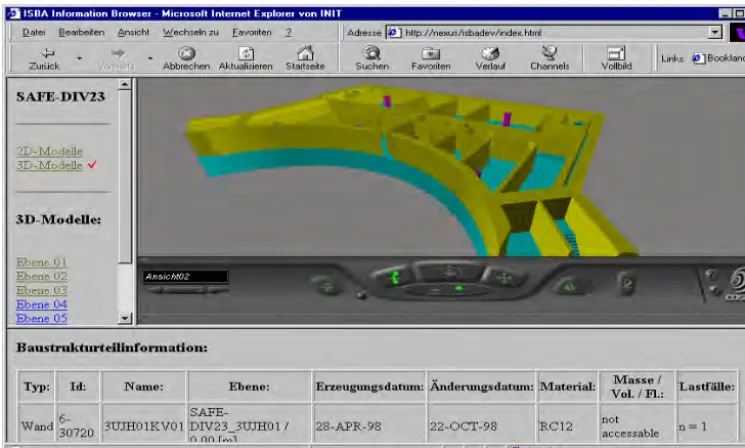
One big progress in the development of ISBA was the step into the world of Internet applications. Today only an Internet browser is needed to communicate and work with the system. With the additional program “Cosmo Player” this communication may be proceeded with the 3D model.
So, in principle, engineering processes with customers and companies that are involved in a specific project may be communicated and handled worldwide via Internet using only a network browser.
THE INITIAL PROJECT
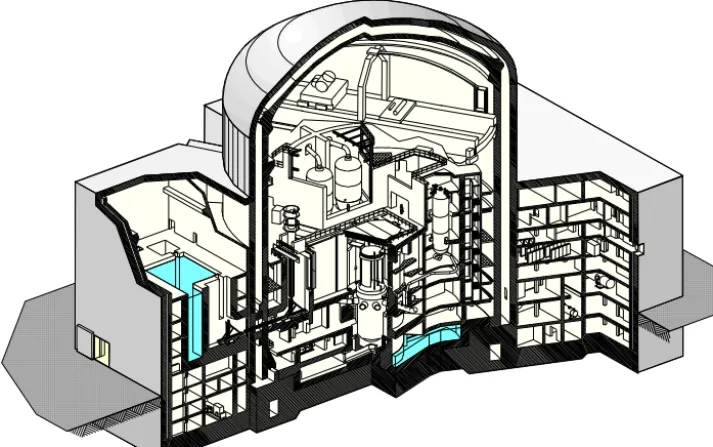
ISBA was initially developed for the European Pressurized Water Reactor the so called EPR which is a common design work of NPI (Nuclear Power International), Siemens and Framatome in co-operation with EDF and the major German Utilities for a new generation of nuclear power plants (see fig. 1). It shall be built in France in the next years.
SMiRT 16, Washington DC, August 2001 Paper # 1382
Fig. 1 View at the EPR
So in the basic stage it contained the following information:
- Geometric modelling of all structural components
- Graphical representation of all loads and their combinations
- Static system idealization
- Construction materials used
- Determination of construction costs
- Construction sequences for supporting scheduling as well as optimization of construction process and
- Object oriented storage of all planning documents and information.
FIELD OF APPLICATION
Primarily ISBA is an information and facility management system. The other important feature is the planning and construction tool, which is used to create the building model. This model can be built during the planning phase for new plants as well as for existing plants on the basis of ‘old’ documents.
The possibilities for the use of ISBA in a project are various and not limited to civil engineering aspects. Therefore its application was extended to the entire field of civil engineering and plant layout.
Planning And Construction Phase
ISBA is utilized to plan the civil structures (see fig. 2). In this phase it is used as CAD system which creates the 3D model of the building. In our historically grown practice this model normally is transferred to another CAD system where it represents a referenced building and where all equipment is planned.
This is the part of the construction tool in ISBA, but by creating the 3D building model already an essential part of the information system is generated. The 3D building model is part of the global product data model in the object oriented database system.
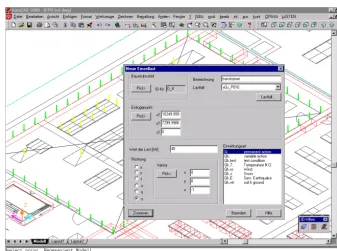
Fig. 2 View at one part of the EPR building model Fig. 3 Screen shot of a dialog with the 2D drawing
This is the graphical part of the system. System data are complemented when they are available. On this basis drawings e.g. layout and load drawings are generated. These drawings do not contain only graphical information but also other data from ISBA. That can be loads (see. Fig. 4), material quantities and operational data of systems, attributes of components and so on. As long as these drawings are still on screen, they are absolutely intelligent and have direct access to the database (see fig. 3).
Fig. 4 Definition of loads
Fig. 5 Reactor building with embedded parts Fig. 6 Listing of embedded parts
Fig. 7 Planning and recording of switchgear cubicles
Plant Operation And Service
Fig. 8 Pipelines, air ducts and cable trays with database reference
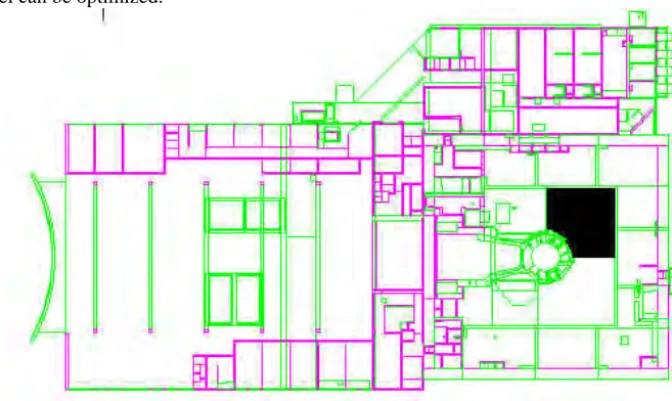
Also the management of areas is easily to be organized with ISBA (see fig. 9). For outages the placement of inspection tools of the various outage teams can be optimized. E.g.: in case of a research reactor the test equipment for tests that are performed in parallel can be optimized.
Fig. 9 Area management for organization and optimization of outages
Aging Management
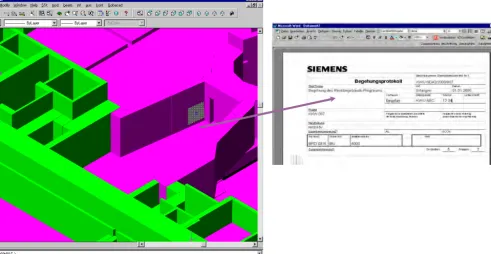
Fig. 10 Documents linked with the corresponding building object
Information systems like ISBA provide an excellent possibility to create a digital archive. All documents are virtually linked to the objects they belong to (see fig. 10). When some information is needed only the object or part of the building of interest has to be clicked with the cursor and either the information is taken directly from the screen or retrieved as paper document. This archive also records all modifications of the plant with the corresponding states and documents.
Internet Communication
Nowadays Internet communication gains more and more importance. A local server solution enables teams to work concurrently at one project. This approach is normally limited to one location. When more institutions or parties are involved in one project, then it is advantageous to use the Inter-, Intra- or Extranet.
For this purpose a module was developed that enables the access to the central data pool with help of only an Internet browser (see fig. 11). The client can communicate with the system according to predefined rights. Either he can only read or read and write. It is also absolutely necessary to structure the system in such a way that the rights for the access to specific information can be limited or denied.
Fig. 11 Internet access with Internet Explorer
Viewing the 3D model in the browser requires the shareware program Cosmoplayer (see fig. 12).
Fig. 12 Internet access with the Cosmoplayer
Today in principle the communication and handling of engineering processes of all partners involved in a project is worldwide possible via Internet using only an Internet browser. In this regard one significant aspect becomes very high importance. This is the security of data transfer and the access to company confidential Intranets. Although there are already solutions available, it has still to be done a lot in order to improve the handling of the security systems, but this is not a topic of this contribution.
PRODUCT DATA MODEL
In the following chapters some information about the theoretical background is given.
Object-Oriented Product Data Modeling
Integrated information processing requires constant availability and exchangeability of all planning data. This affects not only the disciplines of statics, design and construction but also licensing and design modification processes, tracking of planning versions and planning chronology, especially for planning of large structures. A prerequisite for this is the imple-mentation of a global product data model combining the information in the areas listed above and extending to the corresponding requisite degree of detail. The heterogeneous nature of the information requires a correspondingly flexible modeling technology, which is available in object-oriented modeling.
Modeling of Structural Components
Classification of the structural components is based on the corresponding function in relation to supporting behavior of the structure (walls, ceilings, beams, columns) and accounts for the desired information access based on common structural elements (buildings, levels, rooms, etc.).
SUMMARY AND OUTLOOK
ISBA is a technical information system based on object-oriented technologies. It controls synchronous application of CAD and the database system based on an object-oriented product data model.
Initially ISBA was developed to provide an information system that supports civil engineers to process the vast amount of load data, which has to be considered in nuclear plant design. Today it can provide information for the whole nuclear power plant and is an ideal tool for facility management purposes. It is a tool for the coordination of the individual design participants and it can depict the entire plant in virtual reality thus making the entire information of ISBA accessible.
The planning world is growing together with rapidly developing possibilities for communication and visualization (ISDN, Internet and multimedia). Cooperation between all planners involved in a project is becoming increasingly closer, and is no longer restricted to the confines of regional borders. ISBA with its interfaces to all these possibilities is prepared to meet this challenge.
REFERENCES
1. Weber, B. & H. Drozella Objektorientierung bei der automatischen Nachweisführung nach DIN 18800 (11.90). Bauingenieur 68 (1993) 411-417
2. Richter, H Symbiose von AVA und CAD - das digitale Bauwerksmodell. AEC Report (1-95) 58 - 61 3. Objectivity Objectivity/DB Reference Manual Rel. 3.81. Objectivity Inc. Menlo Park CA (1996)
4. Schillberg, H. & H. Drozella Objektorientierte Produktmodellierung für die Tragwerksplanung im Kraftwerksbau. Darmstädter Massivbau-Seminar ‘Multimedia im Bauwesen’ Band 16. Freunde des Institutes für Massivbau der TH Darmstadt e.V.(1996)
5. Schillberg, H. & H. Drozella Technische Informationssysteme für die bautechnische Bearbeitung von Kraftwerksanlagen Bauingenieur 72 (1997) 479-487